
Consulting Hospitality Jobs: Your 2026 Career Guide
22 May 2026
You're probably reading this while juggling a rota gap, a supplier chase, two staff issues, and a service that already feels underpowered before the first ticket lands. This forms the practical context for consulting hospitality jobs in the UK. It isn't boardroom theatre. It's what happens when an operator needs a practical fix for labour pressure, unstable service, and margin squeeze.
In hospitality, “consulting” often gets misunderstood. People picture slide decks, vague recommendations, and someone leaving just before Friday dinner. In practice, the useful end of hospitality consulting is far more hands-on. It's rota redesign, labour planning, menu simplification, stock control discipline, kitchen reset work, and helping a team function again when normal management bandwidth has run out.
That matters even more in a market where staffing pressure hasn't eased in any meaningful way. If you run a pub in Devon, a boutique hotel in Berkshire, a restaurant in Bristol, or a seasonal site in Dorset, you already know the pattern. Short notice sickness knocks out prep. Agency cover turns up inconsistent. A weak pass ruins the whole floor. One chef leaving can knock confidence out of the kitchen for weeks.
For operators, the key question isn't whether “consulting hospitality jobs” exist as a career path. They do. The better question is what kind of support solves the problem in front of you. Sometimes that means a consultant. Sometimes it means an experienced relief chef who can steady service tonight, not next month.
Why Hospitality Consulting Is No Longer a Luxury
A lot of managers still treat outside help as something you bring in when the brand is large enough, the budget is comfortable enough, or the problem has become impossible to hide. That's outdated thinking.
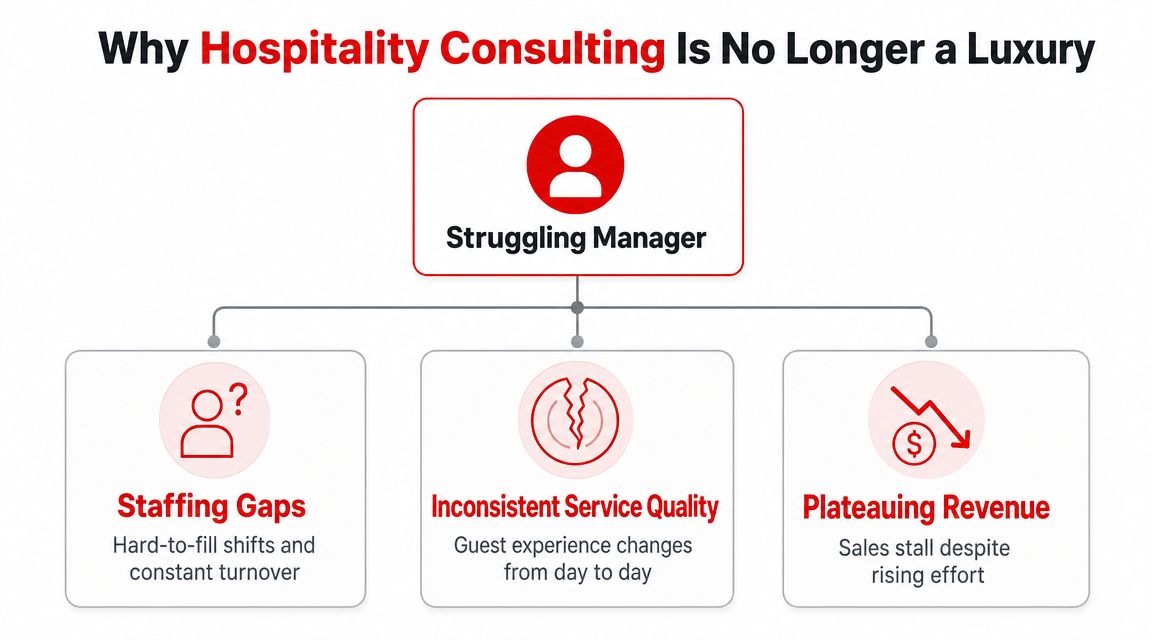
Hospitality has always had pressure points, but the current version is more stubborn. Labour gaps don't stay isolated. They spread into slower prep, reduced menus, missed cleaning standards, poor handovers, tired supervisors, and online reviews that reflect all of it. When a team is permanently short, managers stop leading and start firefighting.
The scale of the issue is clear. The Office for National Statistics reported that UK vacancies in accommodation and food service activities peaked at 171,000 in mid-2022 and remained high at 126,000 by early 2024, as cited in Oysterlink's summary of UK hospitality labour data. That isn't a short blip. It's a structural operating problem.
What that means on site
When vacancies stay high, businesses can't rely on “we'll recruit our way out of it”. They need to redesign how the operation runs with the team available.
That's where hospitality consulting becomes commercially sensible. A capable consultant helps a venue answer blunt questions:
- Which shifts are overbuilt and which ones are dangerously thin?
- Which menu items slow the kitchen down without earning their keep?
- Where are managers wasting hours plugging avoidable gaps?
- What can be simplified now without damaging guest spend?
Practical rule: If the same staffing problem keeps returning, you don't have a one-off issue. You have an operating model issue.
External help isn't failure
There's still a bit of ego around this. Some owners think bringing in support means they've lost control. Usually it means the opposite. It means they've realised muddling through is expensive.
A good consultant doesn't replace leadership. They give leadership room to operate properly again. In some cases that support is strategic. In others, it's operational and immediate, especially in kitchens where one missing senior chef can derail the entire week.
What a Hospitality Consultant Actually Does
A useful hospitality consultant doesn't arrive to impress you with jargon. They arrive to find friction, cost, and instability. Then they strip it out.
In practical terms, that usually starts with observation. They watch service, review labour deployment, check ordering patterns, inspect the menu mix, look at prep structure, and test whether the rota reflects actual trade rather than habit. They'll also look at how decisions get made. Many sites don't have a staffing problem alone. They have a communication problem dressed up as a staffing problem.
The job is closer to operations than people think
The ONS Business Insights and Conditions Survey has repeatedly shown accommodation and food services among the sectors most likely to report labour shortages. That means a consultant's core job is now workforce analytics, rota optimisation, and retention modelling to create stability, not just generic recruitment advice, as discussed by Glion's overview of hospitality consultant skills.
That sounds technical, but on site it's very simple. A consultant asks whether the rota matches demand, whether breaks are sensible, whether peak windows are properly buffered, and whether the kitchen is carrying complexity it can't staff consistently.
What they usually look at first
A hands-on consultant will often start with a short priority list:
- Labour deployment: Who is on shift, when, and why?
- Service flow: Where does the handoff break between kitchen, pass, and floor?
- Menu pressure: Which dishes create bottlenecks during live service?
- Retention risks: Which team members are close to leaving, and why?
- Management drag: Which tasks are swallowing leadership time without improving results?
Here's a common example. A pub kitchen in Wales might not need another full menu redesign. It may need a calmer prep structure, a trimmed spec on a few slow dishes, and a rota that stops putting the strongest chef on the wrong shift. Likewise, a hotel in Bristol might not need more recruitment ads first. It may need demand-led scheduling and firmer role clarity across breakfast, lunch, and event trade.
The best consultants don't start by asking what the business wants to become. They start by asking why service keeps slipping on the same shifts.
What doesn't work
Some consulting fails because it stays too abstract. Reports with no implementation plan rarely help a stretched GM. Generic recruitment advice is also weak when the problem is retention, shift design, or unrealistic menu ambition.
What works is site-specific operational change. That includes tighter handovers, realistic pars, better shift starts, simpler ordering routines, and service models built around the team you can field.
If you're considering consulting hospitality jobs as a career, that's the reality of the work. You need to solve mess, not describe it elegantly.
Key Consulting Roles and Who Hires Them
Not every hospitality consultant does the same job, and not every venue needs the same kind of help. Owners waste time when they hire a strategist for an execution problem, or when they expect a relief operator to solve a long-term commercial issue.
The main types of consulting hospitality jobs
| Role | Typical brief | Usually hired by |
|---|---|---|
| Operations consultant | Fix service flow, labour use, SOPs, and site discipline | Independent restaurants, pubs, boutique hotels |
| Kitchen or chef consultant | Reset menu, kitchen systems, staffing structure, GP discipline | Food-led pubs, hotel restaurants, struggling independents |
| Revenue or commercial consultant | Improve forecasting, pricing discipline, occupancy or cover strategy | Hotels, groups, event-led businesses |
| Opening consultant | Build systems, recruit teams, launch the site cleanly | New hotels, refurb launches, multi-site operators |
| Interim operator | Step into leadership during disruption | Groups, private members' clubs, high-pressure seasonal sites |
A pub in Devon with poor consistency and a burnt-out head chef may need a kitchen consultant or interim chef operator. A Windsor hotel preparing for a relaunch may need opening support across rooms, food and beverage, and staffing. A group trading across Wales may bring in commercial support to tighten forecasting and standardise labour control.
Who should hire a consultant, and who shouldn't
Bring in a consultant when the issue is structural. That includes repeated service breakdowns, poor labour discipline, weak management layers, drifting standards, or a concept that no longer fits the staffing reality.
Don't bring in a consultant if the problem is immediate cover. If your head chef has walked, your sous is off sick, and you've got a full book for the weekend, you don't need a report. You need someone who can run the kitchen safely and competently now.
That's why operators should also understand the role of specialist staffing support. For acute kitchen disruption, a relief chef often acts like on-demand operational consulting. They step in, steady service, organise prep, protect standards, and give the site breathing room. That's a different solution from a traditional project-based consultant, and often the right one.
If you're weighing agency routes and what different staffing models do, this guide to employment agencies for chefs is a useful starting point.
From Head Chef to Hospitality Consultant
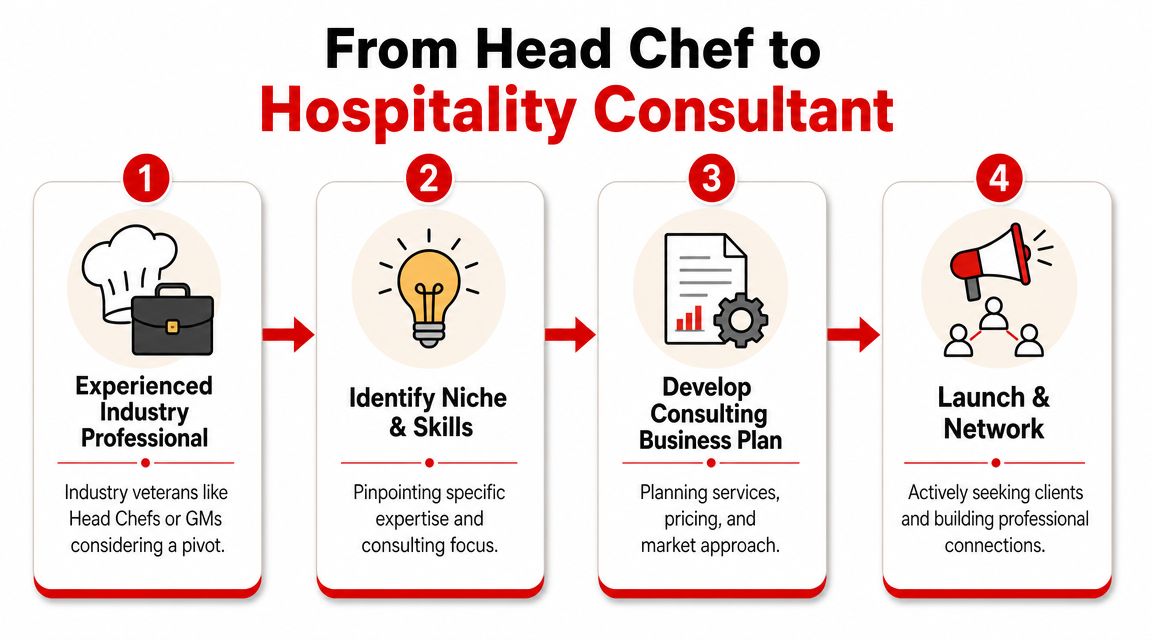
A lot of the strongest consultants come from senior operational roles. Head chefs, executive chefs, GMs, and ops managers already know where core problems sit because they've lived them under pressure.
That said, operational experience on its own doesn't automatically become a consulting offer. Plenty of good operators struggle when they move into consulting because they describe their history instead of packaging a clear business solution.
Start with proof, not personality
If you're moving from head chef to consultant, build a portfolio of outcomes. That means writing down what changed under your leadership.
Useful evidence includes things like:
- Kitchen stabilisation: You took over a weak brigade and got service under control.
- Menu reset work: You simplified a food offer without lowering standards.
- Team retention: You stopped the constant churn by improving structure and training.
- Operational discipline: You fixed prep, ordering, wastage control, or pass management.
Keep it factual. Don't inflate. Operators hire people who sound credible, not theatrical.
A strong consultant profile often reads better when it's niche. “Hospitality consultant” is broad. “Pub kitchen turnaround specialist in the South West” is clearer. “Menu and labour reset for boutique hotels” is clearer. “Private chef operations for villas and yachts” is clearer again.
Choose a niche clients can understand
The market responds better when your offer is easy to place. Consider niches such as:
- Seasonal coastal operations in places like Devon or Dorset
- Food-led pubs that need a simpler, more profitable kitchen model
- Boutique hotel F&B support where breakfast, events, and dinner all compete for labour
- Luxury private placements such as yacht chefs or villa chefs
- Troubled brigade turnaround work after a senior chef exit
Field note: The best niche is usually the problem you've solved repeatedly, not the one that sounds most glamorous.
Learn how to sell without sounding like a salesperson
Consulting work usually comes from reputation, referrals, and clarity. Operators don't want a polished pitch. They want confidence that you understand their exact pain.
Your networking should reflect that. Stay close to former GMs, owners, suppliers, and chefs. Be known for a specific fix. When people ask what you do, answer in operating language. Say what you stabilise, improve, or open.
For chefs considering this route, the day-to-day leadership base still matters. These responsibilities of a head chef are exactly the kind of practical foundations clients expect a consultant to understand.
Build an offer that can actually be delivered
A common mistake is offering everything. Audits, openings, mentoring, menus, recruitment, training, procurement, culture change, concept work. That's too loose.
A tighter offer wins more trust. For example:
- Site review and diagnosis
- Short implementation plan
- On-site support for rollout
- Follow-up review with management
That keeps expectations realistic and gives the client something tangible.
The Business Case for Hiring a Consultant
Friday lunch has gone off the rails. Two chefs are missing, prep is behind, the rota never matched the booking pattern in the first place, and the duty manager is firefighting instead of running the floor. In that situation, outside support stops being a nice idea and becomes a commercial decision.
Most hospitality businesses do not have spare cash for outside help. Fair enough. But operators still pay for bad systems every week through wasted labour, weaker service, poor reviews, and management time dragged into problems that should have been fixed months ago.
Where the value usually sits
A good consultant should improve one of three things fast. Labour control, service consistency, or management discipline. If none of those move, the fee is hard to justify.
For an owner or GM, the value usually shows up in practical areas such as:
- Overstaffed quiet periods that drain payroll without improving service
- Understaffed peaks that create delays, complaints, and lost repeat trade
- Menus with too much drag in prep and service
- Poor forecasting habits that leave teams exposed on busy dates
- Weak management routines that create inconsistency between shifts
These are not abstract strategy issues. They are day-to-day operating faults that hit margin and stability. A consultant worth paying will trace the problem back to the routine causing it, then fix the routine, not just write a report about it.
The cost of doing nothing is usually hidden
Many operators focus on the consultant fee because it lands as a clear line on the P&L. The ongoing losses are less visible, which is why they get tolerated for too long.
Those costs often look like this:
| Operational issue | Likely commercial effect |
|---|---|
| Short kitchen cover | Reduced menu, slower service, lost spend |
| Rota built on habit | Wasted labour or exposed peaks |
| Repeated agency mismatch | Retraining, poor standards, manager distraction |
| Weak team structure | Burnout, resignations, unstable service |
| Inconsistent execution | Poor reviews and reduced return visits |
A fixed project cost is often cheaper than paying for the same disruption every week.
When immediate operational support gives better value
Some problems need diagnosis and change. Others need a capable pair of hands on-site before the next service starts. That distinction matters.
If the issue is kitchen continuity, a relief chef can function like on-demand operational consulting. They do more than fill a gap. They protect service, steady the brigade, spot weak prep flow, and give management breathing room to make a proper decision. For operators weighing emergency cover against a broader hire, this guide to chef jobs and hospitality recruitment agencies helps clarify what kind of support fits the problem.
That is the trade-off. Bring in a consultant when the business needs systems, structure, and accountability. Bring in specialist short-term kitchen support when revenue is at risk tonight and the operation needs stabilising first.
How to Find the Right Hospitality Support

Most operators don't struggle to find people who call themselves consultants. They struggle to find the right kind of help for the problem they have.
That starts with being honest about the situation. If the issue is a new opening, a concept drift, or weak site systems, look for a consultant with relevant operational history. If the issue is tonight's service, tomorrow's prep, or a bank holiday rota collapse, look for immediate cover from a specialist chef staffing source.
A simple decision test
Use this quick filter before you hire anyone:
- Strategic problem: New site planning, repeated service design issues, weak leadership systems, menu-commercial mismatch. You likely need a consultant.
- Operational emergency: Sickness, walkout, holiday gaps, failed agency booking, sudden volume spike. You likely need a relief chef.
- Longer-term team build: Replacing a head chef, sous chef, or core kitchen team member. You likely need permanent recruitment support.
That distinction saves time and money. A consultant won't solve a short-notice kitchen gap. A temporary chef won't redesign your full operating model.
How to vet properly
Plenty of businesses hire on charisma. That's risky. Vet on relevance.
Look for:
- Direct sector fit: Pub experience for pubs, hotel experience for hotels, private household experience for villas or yachts.
- Operational credibility: Have they run service, teams, and budgets?
- Implementation ability: Can they execute on site, not just advise?
- Commercial awareness: Do they understand labour pressure, menu practicality, and guest impact together?
- Clear scope: Do they define what they'll do, over what period, and what success looks like?
If you're searching for chef-specific support channels, these job search agencies for hospitality and chef roles can help clarify the route.
A quick video can also help frame what to look for in hospitality job support and recruitment:
Where operators usually look first
The best support often comes through a mix of routes rather than one.
Professional referrals
Ask other operators who they used when things went wrong, not just when things were easy.Specialist hospitality recruiters
Useful when the need is chef-led, time-sensitive, or role-specific.Direct outreach to proven operators
Many credible consultants don't market aggressively. They work through network and reputation.LinkedIn with caution
Good for background checks. Less useful if you rely on profile polish instead of actual fit.
Hire for the problem in front of you, not the label on the person's business card.
Frequently Asked Questions About Hospitality Consulting
What are consulting hospitality jobs in practice
They're roles focused on improving how a hospitality business runs. That can include labour planning, rota optimisation, menu development, kitchen systems, service flow, opening support, and commercial analysis. In the UK, the most useful consultants tend to be former operators who understand real-world site pressure.
What's the difference between a consultant and a strong General Manager
A strong GM owns the business day to day. A consultant comes in to diagnose, fix, or guide a specific issue. The GM lives with the result. The consultant should accelerate change, transfer discipline, and then step back.
The strongest sites usually need both at different moments. A consultant without management buy-in won't get much done. A GM with no external support can get trapped inside the same recurring problems.
Are consulting hospitality jobs only for large hotel groups
No. Independent pubs, boutique hotels, restaurants, event venues, and private hospitality businesses all use consulting support. In fact, independents often benefit quickly because one operational fix can remove a major pressure point.
That's especially true in places with heavy seasonal demand, patchy recruitment, or a small local talent pool.
Can a head chef become a consultant
Yes, if they can translate operational experience into a clear offer. Clients want proof that you can solve specific problems. They don't just want a long CV.
The strongest transitions usually come from chefs who have led teams, reset poor kitchens, trained juniors properly, and made commercially sound decisions under pressure.
When should I hire a relief chef instead of a consultant
Hire a relief chef when the problem is immediate kitchen delivery. That includes short notice sickness, holiday cover, a chef walking out, a failed agency shift, or a sudden increase in bookings.
Hire a consultant when the issue is structural and keeps repeating. That includes weak labour planning, an overcomplicated menu, poor management discipline, or unstable service systems.
Do consultants only produce reports
Poor ones often do. Useful ones work on site, challenge bad habits, and help put changes into practice. In hospitality, implementation matters more than theory. If nobody can follow the recommendation during a busy Saturday service, it isn't much use.
What should I ask before hiring one
Keep it straightforward:
- What exact problems do you solve most often
- What types of venues have you worked in
- How much of your work is on site
- How do you define scope
- What will management need to do for this to work
- What does the first phase look like
Those questions usually tell you very quickly whether you're speaking to a practitioner or a presenter.
If your kitchen is short, unstable, or one sick call away from service problems, don't wait for the issue to become expensive. Relief Chefs UK has supported hospitality businesses nationwide since 2013 with relief chefs, temporary chefs, permanent chef recruitment, yacht chefs, villa chefs, and wider hospitality staffing support. If you need practical cover that protects service, standards, and revenue, get in touch and speak to someone who understands how hospitality works.
Call the team.
Office 01392 715474 · info@reliefchefs.co.uk