
A kitchen goes quiet in the worst possible way. The Friday dinner push is building in a busy Bristol gastropub, tickets are already stacking, and the head chef who was meant to cover the pass has just walked out. The front of house team keeps smiling. The diners don't know yet. The owner knows, and so does every manager who's ever had to ring around for emergency cover while the first wave of orders is already late.
That same problem lands differently in Windsor on a wedding weekend, where one missing chef can derail a packed function room, or on a yacht in the Solent mid-charter, where the galley has to keep moving because guests are already onboard. In each case, the business doesn't need theory. It needs a contract recruitment agency that can put a qualified chef in place fast, with the paperwork in order and the service still intact.
For hospitality operators, this isn't about filling a gap on a spreadsheet. It's about keeping covers, protecting reviews, and avoiding the ugly, expensive moment when a service has to be cut short because the kitchen can't hold. The firms that understand that difference act like working kitchen partners. The ones that don't act like CV shops, and the gap shows up at the worst possible time.
When a Missing Chef Becomes a Crisis
At 5pm on a Saturday, a missing chef is never just one missing person. It's a delayed prep list, a weak section on the pass, and a senior team member pulled away from their own job to ring candidates who may or may not answer. In a Bristol gastropub, that can mean losing a full dinner service. In a boutique hotel in Windsor, it can mean apologising to a wedding party that's already paid. On a yacht, it can mean the galley is suddenly under pressure with guests expecting high-quality service.
The financial pain is immediate, but the reputational damage lasts longer. One bad night gets talked about by guests, staff, suppliers, and online reviewers. A venue can recover from an awkward service. It's harder to recover from being known as the place that couldn't keep the kitchen open.
What operators actually feel first
The first signs are usually practical, not dramatic. A rota hole appears, prep slips, the sous chef starts firefighting, and the venue manager begins weighing up whether to reduce covers. That's when a reliable staffing partner matters most, because the cost of inaction is not the agency fee, it's the lost trade and the strain it puts on the team already working.
UK hospitality has enough pressure without guessing who can come in, who's legal to work, and who can hold a section. The sector vacancy picture stays tight, with the accommodation and food service activities industry reporting 7.2 vacancies per 100 employee jobs in the three months to June 2024, compared with 4.8 across the whole UK economy, according to ONS vacancy data cited in industry commentary. That gap explains why short-notice sickness and seasonal spikes can break a kitchen faster than owners expect.
Practical rule: if a venue can't name its emergency cover route in under a minute, it doesn't have one.
What a Contract Recruitment Agency Actually Does
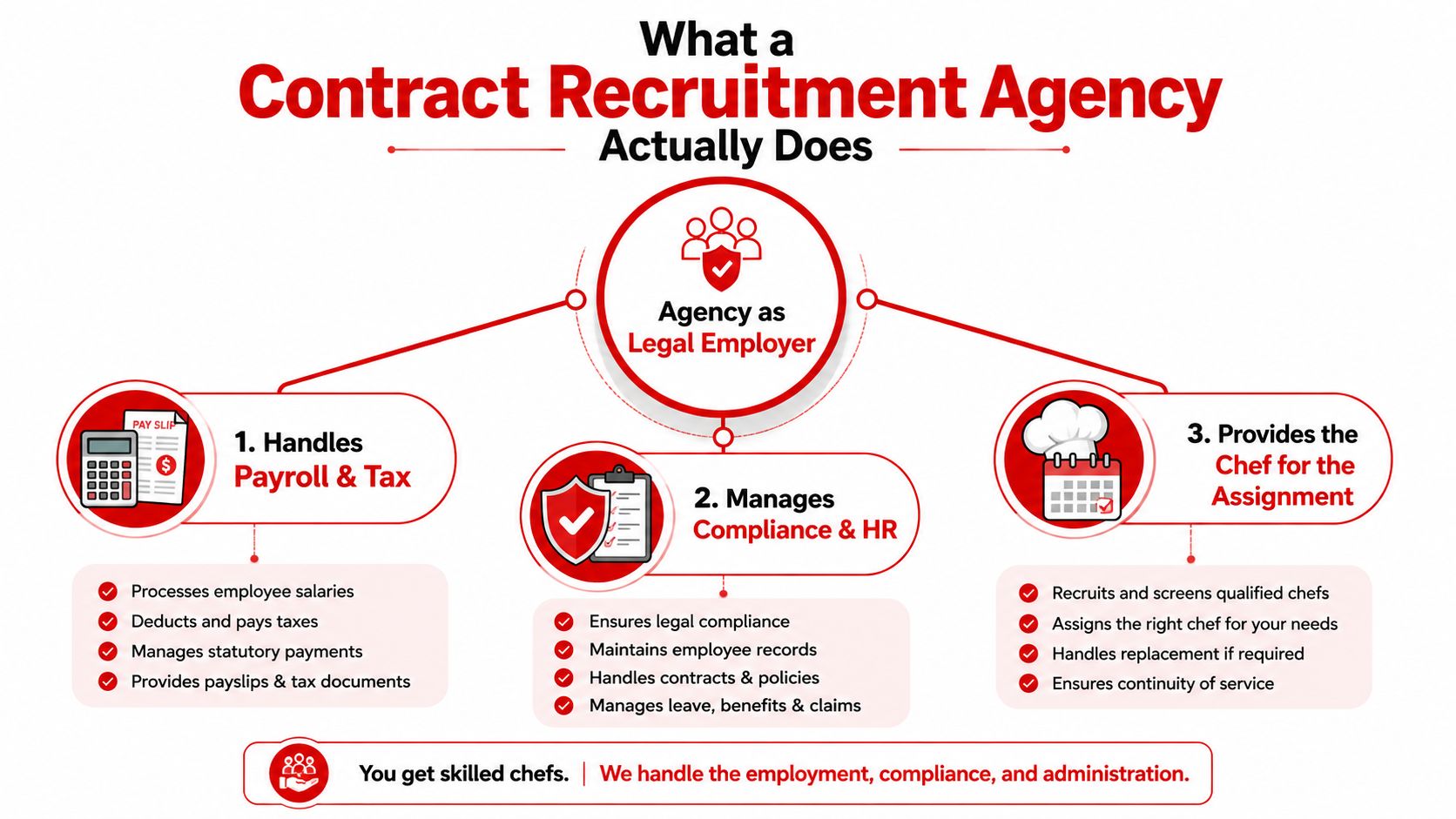
A contract recruitment agency is not just a finder of people. In the UK, it normally becomes the legal employer of record for the chef during the assignment, which means it handles payroll, holiday pay, tax and employer obligations while the venue gets the working cover it needs. For operators, that structure matters because the bill rate includes pay, employment costs, and margin, so compliance and gross-margin discipline are part of supplier selection, not an afterthought. The model is set out clearly in contract staffing guidance.
Contract, temporary and permanent in plain English
Contract and temporary staffing are close cousins in practice. Both are built for cover, flexibility, and a quick start. Permanent recruitment is different, because the chef becomes your employee and the agency charges a placement fee rather than running payroll for the assignment.
A simple kitchen comparison works better than a legal lecture. Hiring contract cover is like bringing in a trusted temp plumber for a burst pipe. Hiring permanently is like bringing in your own maintenance engineer. One solves the immediate problem, the other adds long-term capacity.
For hospitality buyers, the legal split matters too. Agency working in the UK separates the worker's contract with the employment agency from the assignment with the venue, and ACAS says the hiring organisation directs the worker's day-to-day work during the assignment. That clears up who controls rotas, tasks, and supervision on the floor and in the kitchen, especially when relief chefs arrive at short notice. Read the practical summary on ACAS agency worker rules.
Where Relief Chefs UK fits
A chef-run partner behaves differently from a recruiter-led desk. Relief Chefs UK, established in 2013, operates as a nationwide hospitality staffing partner with chef-led judgement on what a venue needs at 5pm, not just what the job description says on paper. That distinction matters when you're booking relief chefs, temporary chefs, permanent chef recruitment, yacht chefs, villa chefs, or wider hospitality staffing support.
Contract vs Temporary vs Permanent Chef Staffing
A Saturday night goes sideways fast when the sous chef phones in sick and the pass is already under pressure. At that point, the decision is not academic. Hospitality buyers usually judge the staffing model on speed, cost, flexibility, legal liability, candidate quality, and whether the kitchen can keep service moving without drama.
Contract and temporary staffing usually win for short-notice cover because they are built for responsiveness. Permanent staffing wins when the need is structural and the role sits at the centre of the venue's long-term culture. The right answer depends on the job, but the trade-off is always the same. You pay more for speed and flexibility, or you accept a slower process for a hire that stays inside the business.
| Criterion | Contract | Temporary | Permanent |
|---|---|---|---|
| Speed to cover | Fast, designed for urgent shifts | Fast, often shift-by-shift | Slower, built around a full hiring process |
| Cost predictability | Strong, because the bill rate is clear | Strong for short bursts | Better for long-term salary planning |
| Flexibility | High, ideal for fluctuating demand | High, ideal for rota gaps | Lower, because the role is fixed |
| Legal liability | Mostly managed through the agency structure | Mostly managed through the agency structure | Sits with the employer |
| Candidate quality and fit | Strong when the agency screens properly | Varies by agency and pool depth | Stronger for long-term team fit |
| Best use case | Short-notice sickness, seasonal peaks, event cover | Ad hoc cover and immediate gaps. For more on how agencies differ, see our guide to temp staff agencies | Core leadership, stability, succession |
The table looks simple because kitchen staffing really is a trade-off exercise. Contract cover is usually the right default for short-term kitchen support, especially when the venue needs someone quickly and cannot afford to reopen recruitment every week. Permanent hiring makes more sense for core roles where the chef is shaping menus, training teams, and setting standards over time.
That split also explains why specialist agencies exist. The UK market uses flexible hiring heavily, with 2021 estimates showing £42.9 billion in total UK recruitment-sector sales, including £36.4 billion from temporary placements and £6.5 billion from permanent placements, plus 22.4 million temp and contract placements and 547,692 permanent placements in the same year, according to the SRA recruitment statistics summary.
A chef who is worth sending into a live service at short notice needs more than a CV. They need to show up on time, understand the section, read the room quickly, and fit the pace of the kitchen without creating extra work for the brigade. That is why the best contract or temporary supply is screened for practical cooking ability, reliability, and fit for the venue, not just years on paper.
Operational takeaway: if the role exists mainly to keep service moving, the flexible model usually fits better than a permanent search.
Real Costs and Pricing Models
The biggest mistake hospitality buyers make is comparing a chef's hourly pay to the agency bill and stopping there. That ignores the employment costs the agency carries, the cover risk it absorbs, and the difference between ordinary weekdays and the pressure shifts that hit weekends, bank holidays, and Christmas. A realistic conversation starts with the bill rate, not the headline pay.
What the bill rate is really doing
In a contract or temporary arrangement, the venue receives one hourly or daily bill rate. That rate usually has to cover the chef's pay, employer costs, holiday accrual, pension auto-enrolment where applicable, insurance, and the agency's margin. The exact figure varies by role, region, urgency and date, which is why a £18 hourly pay rate can land much higher once everything is added up.
The point is not to chase the lowest figure. The point is to understand what you're buying. If a venue underprices cover, the agency either can't supply consistently or it cuts corners on quality and compliance. Neither outcome is useful on a Friday night.
Three pricing models you'll see
Some agencies work on a simple bill-rate model. Others show a transparent margin. A growing number offer monthly plans for venues that need regular cover, especially multi-site operators that want predictable supply rather than ad hoc panic booking.
Cost reality: one closed service can cost more than a month of cover, because lost covers hit revenue, service quality, and the team's patience at the same time.
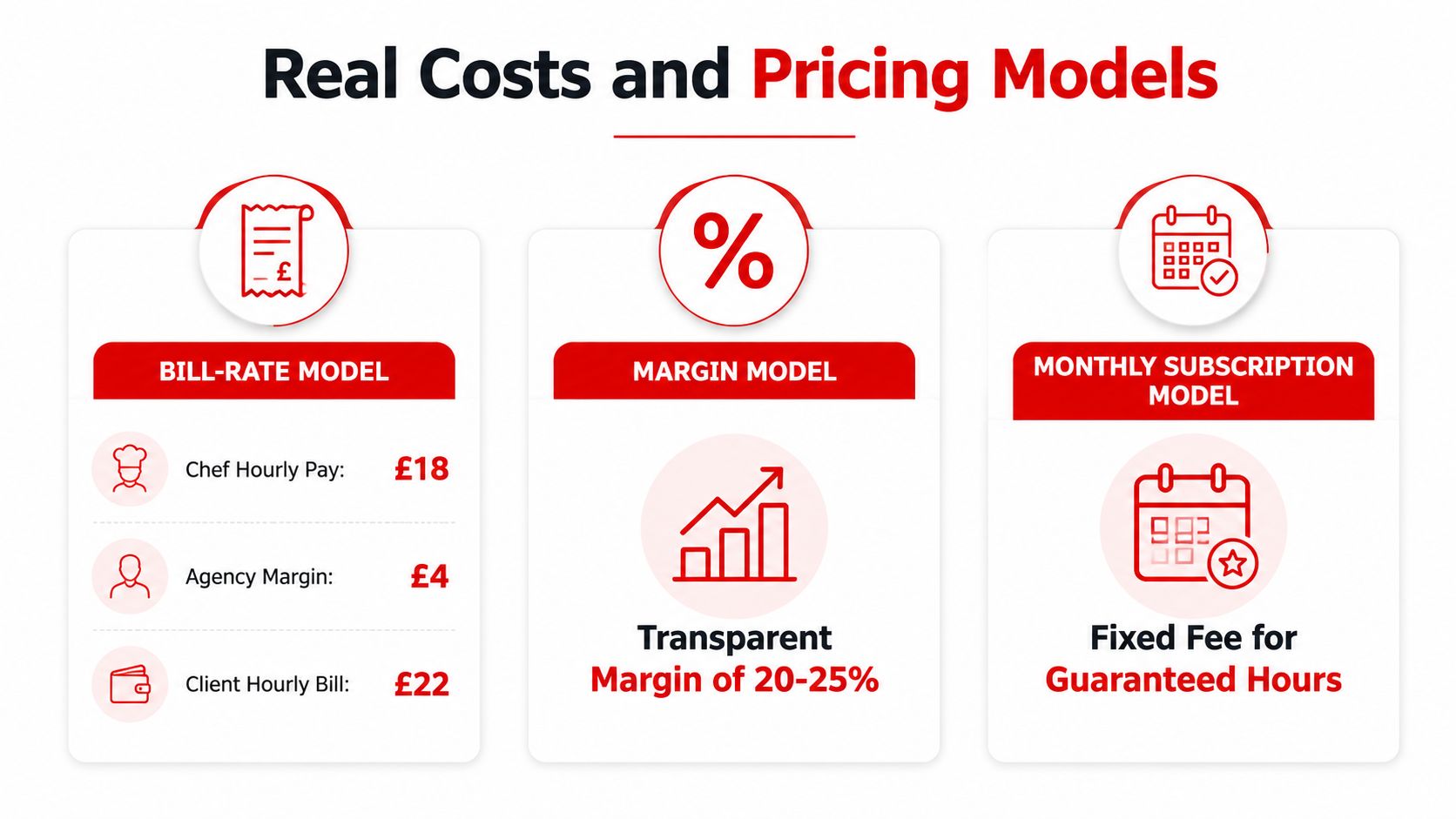
For venues comparing agency options, Relief Chefs UK also publishes a transparent pricing model that suits operators who want to see how cover is packaged rather than guessing what sits behind the invoice. The practical decision is whether your need is occasional, weekly, or steady enough to justify a rolling plan.
When monthly plans make sense
Smaller pubs and cafés usually want straightforward, occasional cover. Multi-site hotel groups, wedding venues and seasonal operators need something more controlled, especially when the same shortages keep returning. In those cases, a monthly agreement can beat repeated one-off bookings because the business knows what response it's buying and the agency knows what supply it has to maintain.
Benefits and Risks for Hospitality Operators
Contract cover gives kitchens breathing room. It keeps service open when a head chef is off sick, a sous chef resigns, or a seasonal spike lands harder than expected. It also reduces the burden on internal teams because the agency handles the employment side and the venue can focus on the pass.
What works in practice
The strongest benefits are operational, not theoretical. You get continuity of service, vetted right-to-work chefs, replacement cover if a placement fails, and a cleaner way to manage urgent gaps without adding long-term payroll liability. That matters in a Devon restaurant losing its head chef in July, a Reading hotel group needing multiple chefs during a corporate event week, or a yacht management company covering a stew-to-chef gap mid-season.
The hospitality labour market also stays uneven by location. Agencies that can source outside London, Manchester and Birmingham are more useful than those that only talk about big-city talent pools. A venue in Dorset or Wales needs proof of supply, not broad promises.
Where the risk sits
The weak agencies expose buyers to inconsistent quality, poor validation, and weak on-call pools. Some can fill one role quickly but struggle to repeat that performance across a week of pressure. Others talk about flexibility but can't prove they have enough chefs on standby when the market is tight.
There's also a compliance question buyers shouldn't ignore. The UK's off-payroll rules have applied in the private sector since 2021, and they shape how contractor status is assessed. HMRC's position is that worker status depends on the engagement, not just the label on the invoice, so venues need status determinations and clear compliance processes. That's especially important when a chef arrives through a limited company rather than PAYE.
- Check right-to-work evidence: Ask for it before the first shift, not after a problem surfaces.
- Ask for references from similar venues: A hotel kitchen and a pub kitchen don't run the same way.
- Insist on replacement terms: If a chef fails, the agency should state what happens next.
- Request an SLA: Time-to-submit, validation standards, and response windows should be written down.
- Clarify worker status: Know whether the engagement sits under PAYE or another structure before the booking is confirmed.
Choosing the Right Contract Recruitment Agency
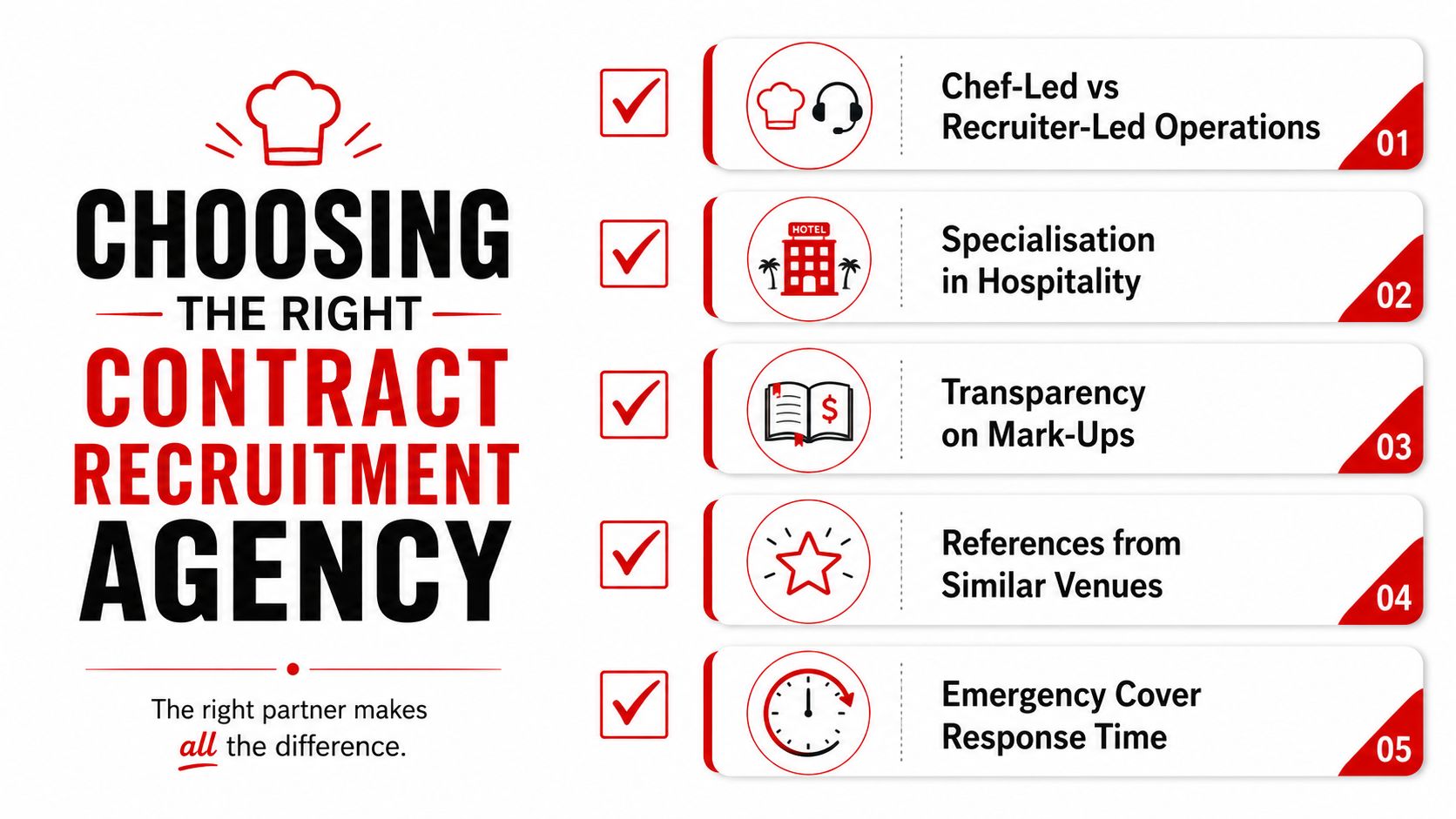
The quickest way to judge an agency is to ask how it behaves under pressure. A chef-led operation usually talks in practical terms, how quickly someone can start, who validates the candidate, what paperwork is required, and what happens if the first chef doesn't fit. A recruiter-led operation often talks about volume first and kitchen reality second.
What to ask before you book
Start with response time. A serious agency should be able to answer a call within two hours, respond by email within four, and tell you whether it can start a chef within 48 hours. It should also explain replacement guarantees, trial-shift options, DBS and right-to-work checks, insurance cover, references, and the exact contract terms around fees and payment.
The contract itself matters just as much. You want fee transparency, payment terms that are roughly around 30 days, and written confirmation of the assignment-versus-employment split under UK law. If an agency won't state those things plainly, it's not ready for a serious hospitality buyer.
A useful place to review a hospitality-focused agency model is this chef recruitment page, because the right agency should speak the language of kitchens, not just staffing.
What a good engagement looks like
A proper booking doesn't begin with a generic send-out. It starts with the venue giving the agency the menu style, section pressure, start time, uniform expectations, and the type of service that's failing. Then the agency matches a chef who can do the job, not just someone whose CV looks neat.
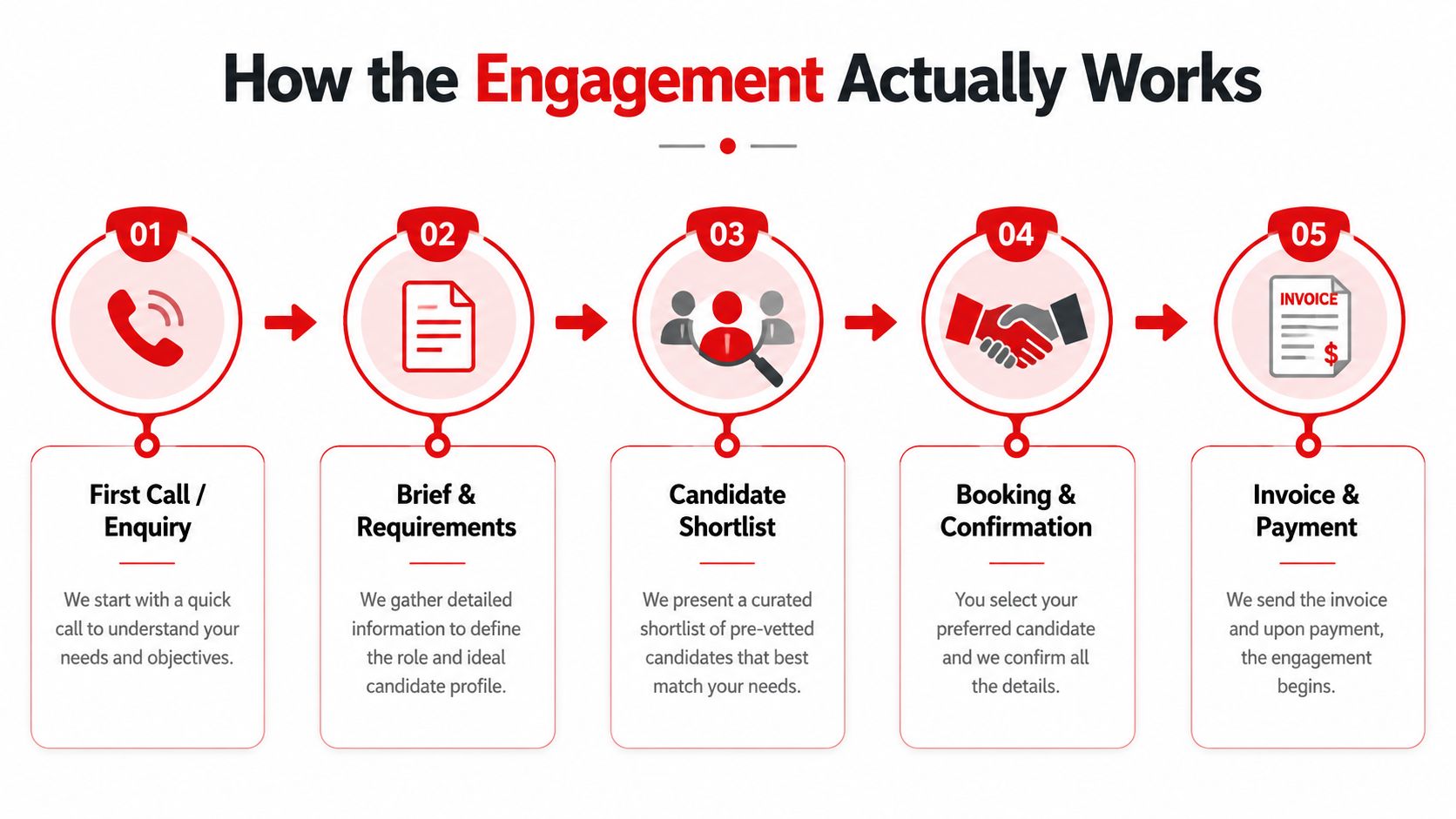
How the Engagement Actually Works
A strong agency process is boring in the best possible way. You make the enquiry, the agency responds quickly, the candidate is validated, the chef turns up with the right documents, and the invoice matches the agreed structure. When that happens, the venue can get back to service instead of chasing admin.
A simple booking flow
The first call or short-form enquiry should lead to a named chef being proposed quickly, with the agency checking the brief against real availability. After that, the candidate shortlist needs to be verified, not just assembled. The best operators keep the chain tight, because every delay between enquiry and start date is a chance for the shift to fall apart.
A multi-site operator in Bristol, Reading or Berkshire will usually need a more structured arrangement than a one-off pub cover. In those cases, a Premium-style plan with a dedicated account manager makes sense because the agency can keep a live handle on recurring gaps, seasonal peaks and site-specific requirements.
What to insist on in the SLA
Ask for time-to-submit, replacement terms, candidate validation, and gross-margin transparency. Then ask who handles the shift if something changes on the day. Those clauses tell you more about the agency's quality than a glossy brochure ever will.
Relief Chefs UK works as a nationwide chef staffing partner for venues that need relief chefs, temporary chefs, permanent chef recruitment, yacht chefs, villa chefs, and hospitality staffing support. If you need cover that's built around real kitchen pressure rather than desk-level assumptions, book it through a process that respects the service on the line.
Frequently Asked Questions About Contract Chef Recruitment
How much does a contract chef usually cost?
It depends on the role, region, urgency and day of the week. Weekend, bank holiday and Christmas cover usually costs more because the agency has to secure scarce availability and absorb the employment risk.
How fast can a chef start?
For short-notice sickness or seasonal demand, a good agency should be able to move quickly if the brief is clear and the paperwork is ready. In practical terms, the right service can move from enquiry to start very fast when the venue doesn't keep changing the requirements.
Who is the legal employer on a contract assignment?
Under the usual UK agency setup, the agency is the employer for payroll and compliance during the assignment, while the venue directs the day-to-day work. If a chef is working through a limited company, status and off-payroll rules need careful checking before the booking starts.
Can one agency cover multiple sites and different regions?
Yes, if the agency has proof of supply and a live operating model rather than a single-city pool. That matters for venues across Devon, Bristol, Wales, Berkshire, Dorset, Windsor, Reading and Slough, where availability and response speed can vary sharply.
If you need chef cover that's built around real kitchen pressure, speak to Relief Chefs UK about relief chefs, temporary chefs, permanent chef recruitment, yacht chefs, villa chefs, and wider hospitality staffing support. Visit Relief Chefs UK to request cover, check availability, and get a response from a team that understands what happens when service starts to wobble.