
It's 3.30pm on a Friday. The bookings board is full, a function has just confirmed extra covers, and your senior chef rings in sick.
At that point, most hospitality operators don't need theory. They need a competent chef, quickly, with the right paperwork, the right attitude, and the ability to walk into a live kitchen without slowing the pass down.
That's why temp staff agencies matter. In hospitality, they're not just a panic button for bad days. They're part of operational planning, just like food ordering, rota control, and supplier backup. If you run a pub in Devon, a boutique hotel in Dorset, a restaurant in Bristol, or a multi-site group across Wales and Berkshire, labour gaps are rarely random. They usually come from the same pressure points: short notice sickness, peak trade, holidays, recruitment delays, and churn in the kitchen.
Why Every Hospitality Manager Needs a Temp Agency Plan
A missing KP on a quiet Tuesday is manageable. A missing sous chef before a full Friday service is something else entirely.
Most operators have lived through some version of this. The head chef starts calling around. The GM checks old numbers. Somebody posts in a WhatsApp group. Someone else says they “know a lad who can help”. Two hours disappear, confidence drops, and the team starts service already behind.
That's not a staffing issue. It's a risk management issue.
In the UK, around 8 to 10% of total employment is in temporary or agency roles, and hospitality is among the hardest-hit sectors for agency dependence due to high turnover and seasonal demand, especially in regions like Devon, Bristol, Berkshire, and Dorset, according to this UK temp agency overview. For hospitality operators, that matters because temporary labour is no longer an occasional extra. It's part of how many venues stay open and protect standards.
What a proper plan looks like
A sensible temp agency plan starts before the emergency call.
It means knowing who you'll contact for same-day cover, who can handle a two-week holiday gap, and who can help when you need a permanent replacement but can't afford service disruption while you recruit. It also means deciding in advance which roles can be covered externally without damaging consistency.
Typical examples include:
- Same-day relief cover for chef sickness, walkouts, or no-shows
- Short-term temporary chefs during annual leave, refurbishment periods, or recruitment gaps
- Seasonal reinforcement for seaside towns, wedding venues, race fixtures, Christmas trade, and summer tourism
- Longer-term support while you recruit a permanent head chef or sous chef
A venue that plans this properly usually trades better under pressure than one that improvises.
Practical rule: if one absence can put your kitchen at risk, you need an agency plan before the absence happens.
Why general contingency isn't enough
Many operators think they already have a backup because they have a few old chef contacts in their phone. That isn't the same as having a dependable labour partner.
A real plan gives you speed, vetting, accountability, and some confidence over quality. It also reduces the chance that your management team spends half the day chasing cover instead of running the business.
For operators reviewing their options for short-term hospitality cover, temporary hospitality staffing support is where that planning usually starts.
Generalist vs Specialist What Kind of Agency Do You Need
Not all temp staff agencies solve the same problem.
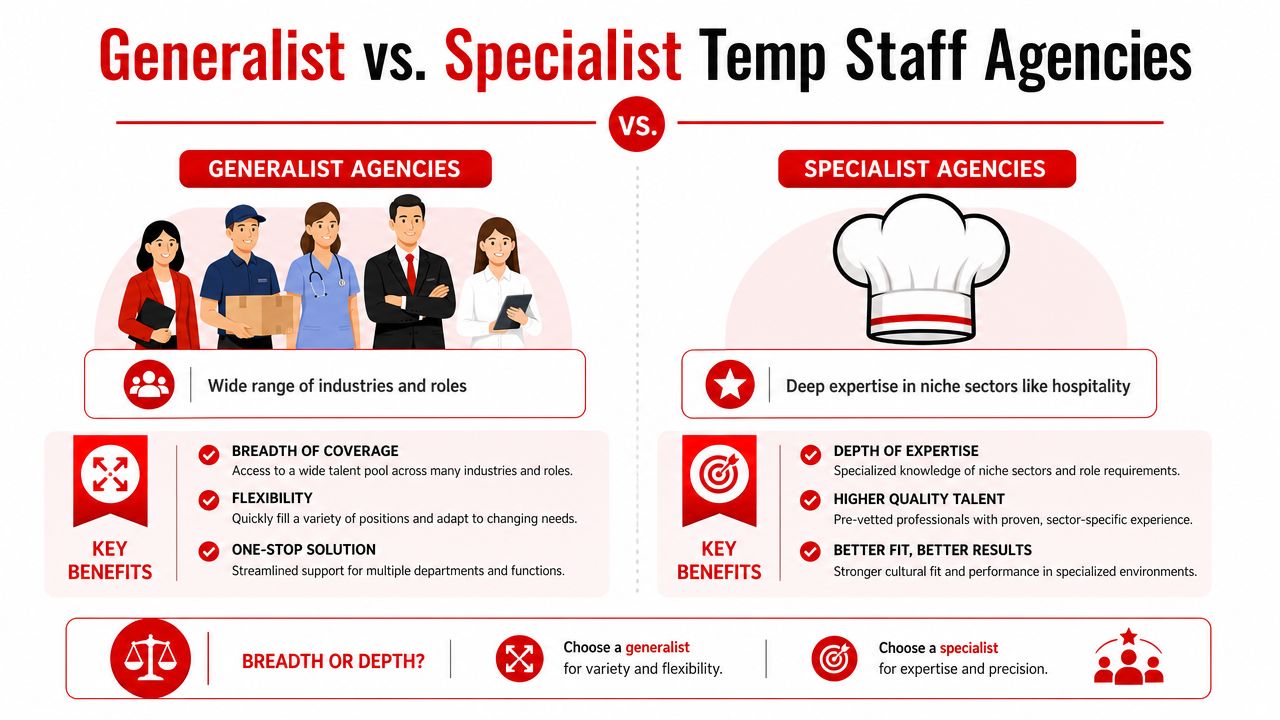
Some are broad labour suppliers. They cover office admin one day, warehouse work the next, then a kitchen porter shift after that. Others focus tightly on one trade and know exactly what good looks like in that environment.
The supermarket versus the butcher test
The easiest way to think about it is this.
A generalist agency is like a supermarket. It offers a bit of everything and can be useful when the job is simple, interchangeable, or low risk.
A specialist chef agency is more like a skilled butcher. It knows the exact cut you need, why you need it, and what happens if it gets that decision wrong.
That difference shows up quickly in hospitality. A generalist consultant may know they need to send “a chef”. A specialist understands the gap between a breakfast chef in a hotel, a volume banqueting chef, a pub sous chef, and a strong CDP who can handle a fresh-food service in Windsor on a busy Saturday.
What changes when the agency understands kitchens
Specialist agencies usually perform better in five areas:
| Area | Generalist agency | Specialist chef agency |
|---|---|---|
| Role understanding | Broad | Kitchen-specific |
| Vetting depth | Often generic | Focused on chef capability and service fit |
| Speed of matching | Can be fast, but less precise | Fast with better role alignment |
| Replacement handling | Variable | Usually stronger for urgent cover |
| Advice to operator | Limited operational input | Practical kitchen-based guidance |
That doesn't mean every specialist is good. It means the ceiling is higher when the agency understands hospitality.
A relief chef who looks fine on paper can still be the wrong fit if they've never worked a busy fresh-food line, can't organise mise en place, or need hand-holding during service.
Ad hoc cover versus a structured staffing relationship
Some venues only use agencies when things go wrong. That's ad hoc buying. It works, but it usually costs more in stress, management time, and service risk.
A stronger model is a structured relationship. That might mean a regular agency partner, agreed service expectations, priority access during peak periods, and a clear process for emergency call-outs, holiday cover, and permanent recruitment.
Monthly support plans can suit operators with repeat demand, such as:
- Independent pubs with a small core brigade
- Boutique hotels with variable occupancy and events
- Groups with multiple sites that need chef cover moved around quickly
- Private households, villas, and yachts needing discreet specialist placements
If you use relief chefs often, a planned arrangement usually beats repeated one-off scrambling.
The Benefits and Hidden Risks of Using Temp Agencies
Used properly, temp staff agencies protect revenue. Used badly, they create new problems you then have to pay to fix.
That's the commercial trade-off.
Where temp agencies genuinely help
In hospitality, the upside is practical.
A good temp chef can keep a Sunday lunch service running after a late call-off. A decent short-term sous chef can stabilise a kitchen while you recruit properly. Seasonal cover can stop your permanent team burning out during holiday spikes in Dorset, Devon, or other tourist-heavy areas.
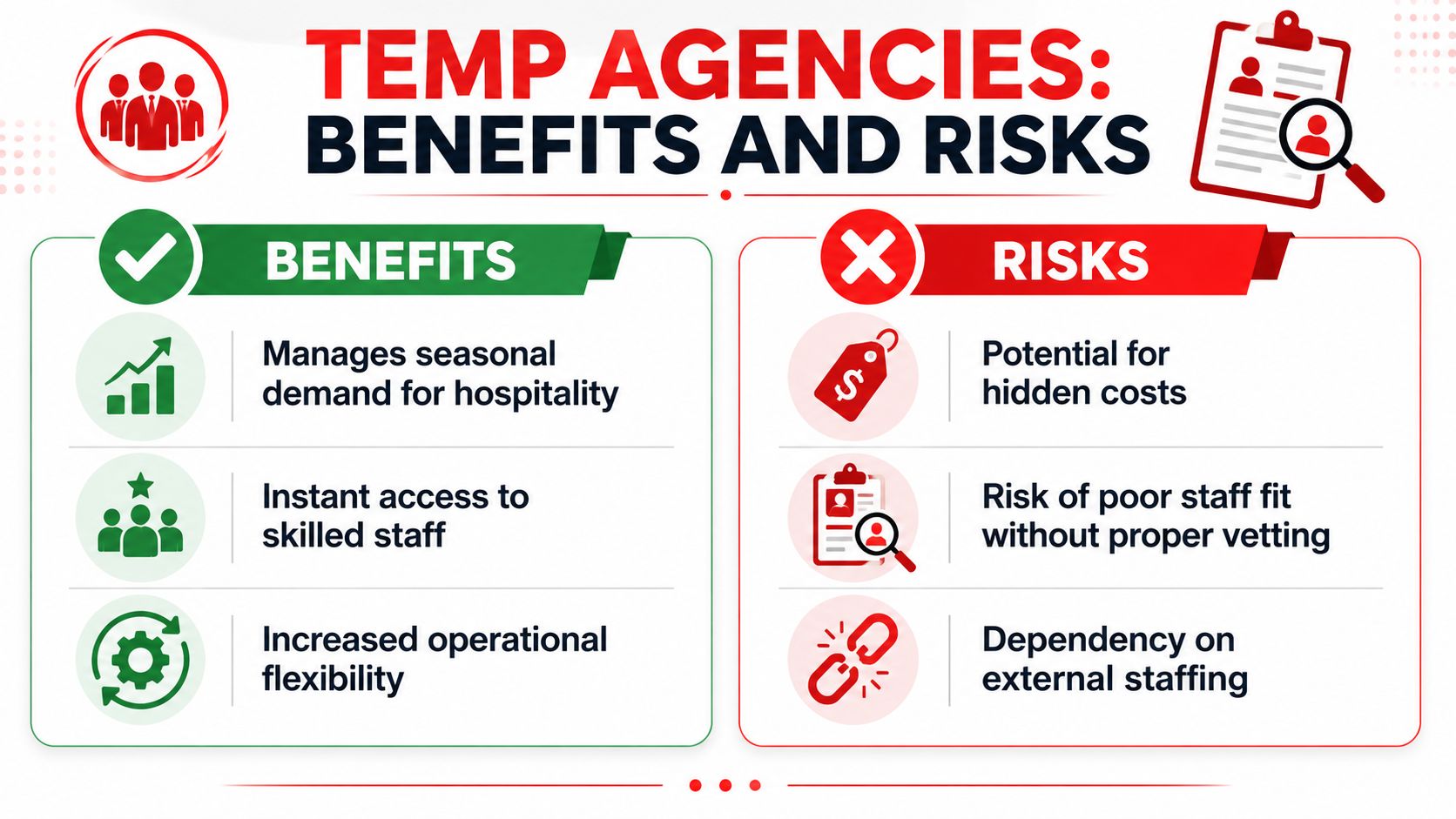
The main benefits usually look like this:
- Continuity of trade: you stay open, protect bookings, and avoid cutting menus unnecessarily
- Access to a vetted pool: you don't start every staffing problem from zero
- Flexibility in labour cost: you can buy cover when needed instead of carrying permanent cost you can't justify all year
- Operational breathing room: your managers can run the venue instead of spending the day trying to source emergency staff
For many sites, temporary staffing is less about convenience and more about protecting gross profit from preventable disruption.
Where agencies go wrong
The downside starts when buyers focus only on whether somebody is available.
A weak agency can send a chef who technically has experience but doesn't match your style of service, pace, food standards, or team structure. That's how you end up with someone who can work a fryer but can't handle your section, or someone who has hotel experience but freezes in a high-turnover gastropub kitchen.
The hidden costs usually come from:
- Poor matching, which drags the permanent team backwards
- Weak communication, leading to late arrivals and avoidable confusion
- No clear replacement process, leaving you exposed when the booking fails
- Unclear pricing, especially on urgent or unsocial shifts
A temp chef who can't perform doesn't just waste agency spend. They consume management time, lower team confidence, and can slow service.
The risk nobody should ignore
The biggest mistake I still see is informal hiring through social media, local groups, or word of mouth when a venue gets desperate.
A significant volume of temporary work is arranged informally, bypassing regulated agencies, and this is common in hospitality. That leaves venues exposed to risks such as fines for failing to verify right-to-work status, liability for accidents, and reputational damage from using unvetted staff, as noted in this review of informal temporary hiring risks.
That route can feel faster. It often isn't safer.
If you don't know who checked right to work, insurance status, or basic competence, the venue is carrying the risk whether you meant to or not.
For operators comparing formal labour supply options, contract and employment agency support is usually far safer than relying on unverified “day one” cover from social media groups.
Your Guide to Legal Compliance and Vetting Standards
Compliance isn't admin for admin's sake. It's how you avoid avoidable claims, protect guests, and keep the venue from inheriting somebody else's mess.
In hospitality, the pressure to fill a shift quickly can tempt managers to relax standards. That's exactly when standards matter most.
The non-negotiables every venue should expect
At minimum, a professional agency supplying chefs into your kitchen should have a documented process for:
- Right to work checks in the UK
- Identity verification
- Reference checking
- Food hygiene evidence where relevant to the role
- Insurance cover
- Assignment tracking so the booking is recorded properly
Those checks should happen before the chef steps into your site, not after the first shift has started.
A good agency also tells you what it has checked and what still sits with the venue. That split matters. If nobody is clear, responsibility gets blurred very quickly when something goes wrong.
The 12-week AWR issue managers need to understand
The Agency Workers Regulations 2010 matter more than many operators realise.
Under the UK's AWR, temp chefs gain rights to equal pay after a 12-week qualifying period, and professional agencies use integrated compliance systems to track this. That reduces non-compliance risk and supports faster, safer onboarding, according to this explanation of UK temp agency compliance systems.
For managers, the practical point is simple. If the same temporary chef stays in the same role at the same site long enough, the rules change. If your agency doesn't track that properly, you may not spot the issue until there's already a problem.
What proper vetting looks like in practice
A CV isn't a vetting process.
In kitchens, proper screening should test whether the chef can operate in the environment you run. For example:
- A hotel breakfast chef needs reliability, speed, prep discipline, and calm starts
- A pub sous chef needs section control, ordering awareness, and the ability to support junior staff
- A relief head chef needs menu understanding, leadership presence, GP awareness, and confidence dealing with owners or GMs
- A yacht or villa chef needs discretion as much as cooking ability
That's why specialist hospitality vetting usually works better than a generic recruitment script.
Good compliance should make short-notice staffing easier, not slower. If an agency's process is clumsy, you'll feel it most when you need cover urgently.
Questions to ask before you accept a booking
Use this quick test with any agency supplying chefs:
- Who completed the right to work check, and when?
- What references were taken, and were they hospitality-specific?
- Do you track assignment length for AWR compliance?
- What insurance is in place for supplied staff?
- If the chef is not suitable, what is your replacement process?
If the answers are vague, the risk is real.
Understanding Agency Pricing Models and Service Levels
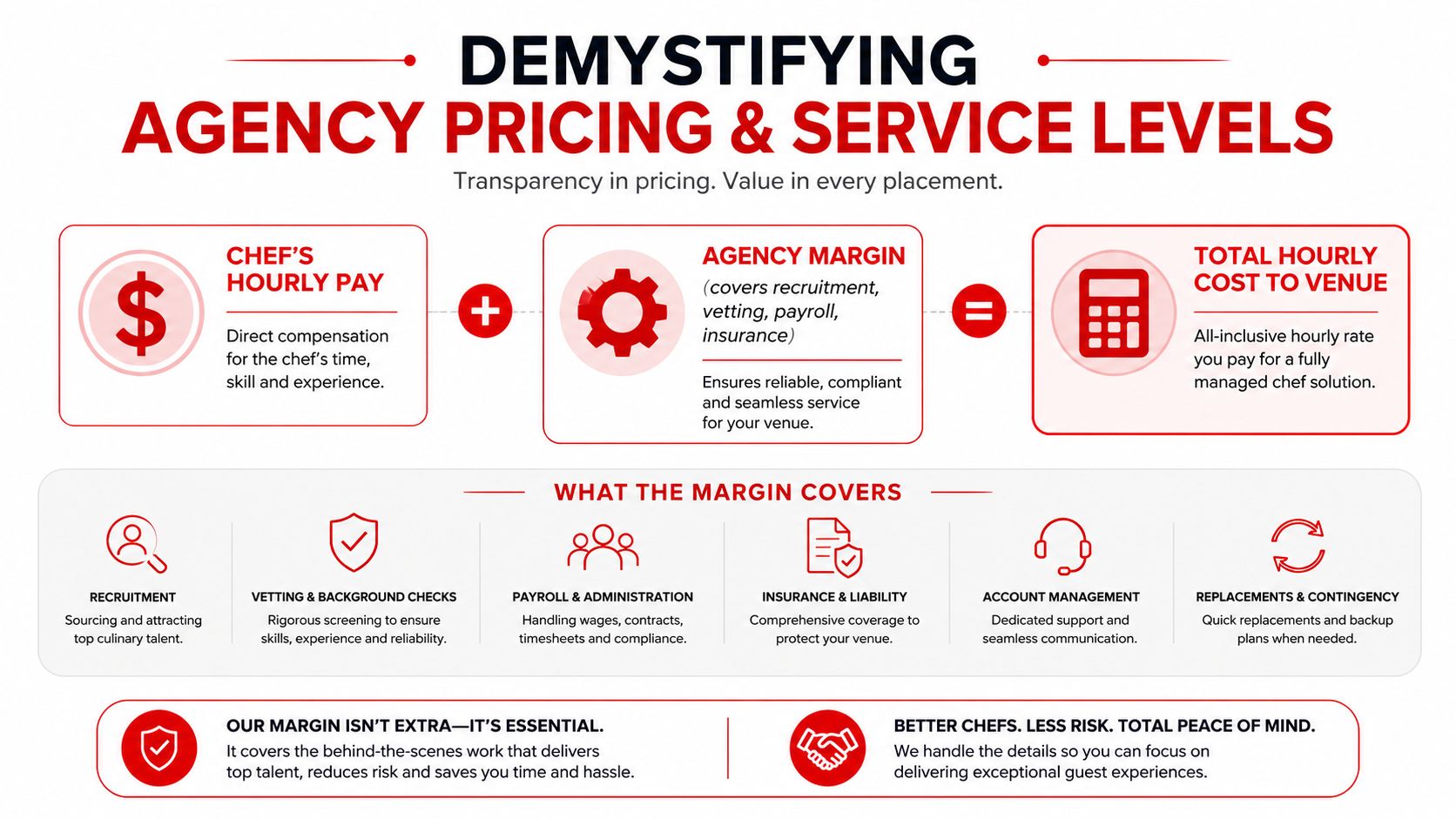
Agency pricing frustrates operators when it's opaque. It becomes much easier to accept when you understand what you're buying.
A temp chef rate isn't just the chef's pay. It usually includes payroll handling, holiday pay obligations, insurance, recruitment time, vetting, compliance checks, and the agency's margin.
What drives the rate
Several factors push agency pricing up or down:
- Notice period: same-day cover usually costs more than a planned booking
- Skill level: a senior sous chef or head chef commands more than a junior role
- Shift pattern: nights, split shifts, and difficult weekend bookings are harder to fill
- Location: demand pressure in places such as Windsor, Reading, Slough, or seasonal coastal markets can tighten supply
- Length of booking: longer temporary placements can be priced differently from emergency one-offs
The key issue isn't whether the rate is the cheapest in the market. It's whether the rate reflects a chef who can perform the job.
Why recent wage changes matter
Following the April 2024 National Living Wage increase to £11.44 per hour, temp agencies in hospitality have had to adjust mark-ups, typically 25 to 40%, to maintain margins, as outlined in this breakdown of staffing agency pricing pressure. For venues, that means two things. First, agency costs have genuine external pressure behind them. Second, pricing transparency matters more than ever.
When agencies can't renegotiate client rates easily, they either pass the cost on, cut service quality, or improve internal efficiency. The best partners tend to explain this clearly rather than hiding costs inside vague invoices.
What service level should come with the fee
Price without service standards is only half the buying decision.
When you compare temp staff agencies, ask what happens after you place the booking. You want to know:
| Service point | What good looks like |
|---|---|
| Response speed | Clear acknowledgment and fast decision-making |
| Booking confirmation | Written confirmation of role, shift, and rate |
| Vetting visibility | Clear explanation of checks already completed |
| Support during shift | Reachable contact if the booking changes |
| Failure handling | Replacement process if the chef cancels or underperforms |
For operators trying to benchmark labour cost properly, the cost of employing hospitality staff is useful context when comparing agency spend against direct employment.
How to Choose the Right Temp Chef Agency A Checklist
Most agency pitches sound fine on first contact. The difference only appears when you ask sharper questions.
This is the point where operators can separate a dependable specialist from a name on a spreadsheet.
Start with the core criteria below.
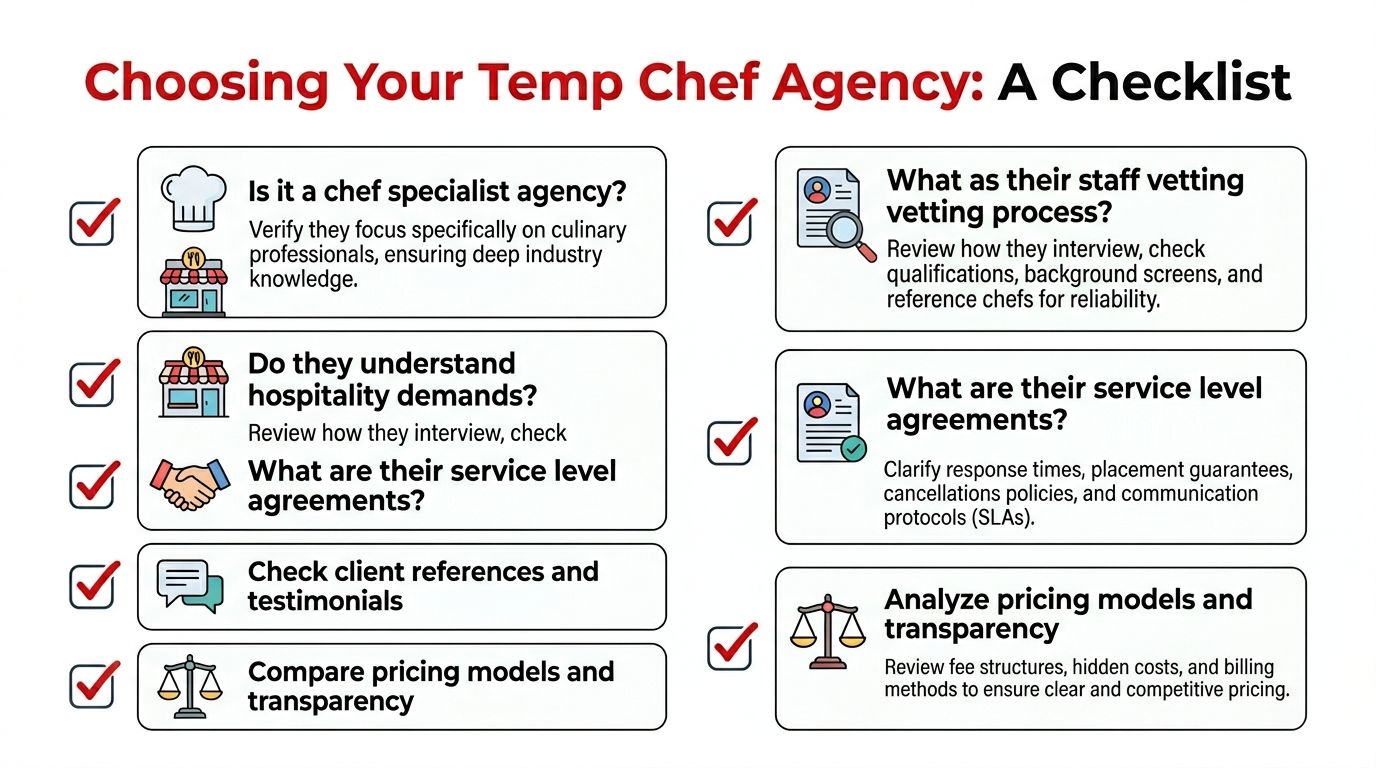
The shortlist test
Use this checklist before opening an account:
- Specialist focus: Do they mainly supply chefs and hospitality staff, or do they cover every sector under the sun?
- Kitchen understanding: Can they discuss service style, section needs, menu pressure, and brigade structure without sounding scripted?
- Vetting depth: Do they verify right to work, references, and practical role fit?
- Reliability policy: What happens if the chef cancels, arrives late, or isn't suitable?
- Communication: Can you get hold of somebody quickly when service is close?
- Pricing clarity: Are rates clear, or do hidden extras appear later?
- Range of support: Can they help with relief chefs, temporary chefs, permanent chef recruitment, yacht chefs, villa chefs, and wider hospitality staffing support if your needs change?
A broad service range matters because many venues don't only have one staffing problem. A site might need emergency relief today, a permanent sous chef next month, and discreet private placement support later in the year.
Later in your review process, it helps to see how agencies present themselves and their standards in practice:
Questions to ask the agency directly
Don't ask, “Can you help with chef cover?” Every agency will say yes.
Ask questions that force detail:
- Describe your process for a same-day emergency chef request in Bristol.
- How do you decide whether a chef is suitable for a fresh-food pub versus a hotel banqueting shift?
- What's your replacement process if the chef no-shows?
- Who is available out of hours if service problems arise?
- How do you brief chefs before they arrive on site?
The answers tell you whether they operate reactively or professionally.
A useful benchmark here is reliability. Nearly 40% of UK hospitality employers have suffered from agency staff no-shows during peak times due to poor vetting or communication, according to this hospitality temp staffing summary. That's why venues in places like Wales and Berkshire increasingly look for structured vetting and clear replacement guarantees.
Questions to ask the chef before the shift
A short call can save a bad service.
Try asking:
- What type of kitchens have you worked in most recently?
- Which section are you strongest on?
- How do you set yourself up when walking into a new kitchen?
- What do you need from the team in the first 15 minutes to get moving?
- Have you worked with fresh-food volume, banqueting, or gastropub service? Which is strongest for you?
You're listening for practical answers. Not polished ones.
The right temp chef usually sounds organised, calm, and specific. The wrong one often stays vague, overstates everything, or talks around the questions.
Frequently Asked Questions
What's the difference between a temp chef and a relief chef
In practice, they often overlap. A temp chef usually refers to any chef hired for a temporary period. A relief chef usually implies short-term cover for a gap that needs filling quickly, such as sickness, holiday, suspension, or recruitment delay.
Who is liable if there's an accident in the kitchen
That depends on the working arrangement, the booking terms, and the insurance structure in place. You should never assume it's obvious. Ask the agency to confirm insurance cover and responsibilities in writing before the shift starts.
Can a venue hire a temp chef permanently later
Yes, many operators use temporary cover as a way to assess fit before making a permanent offer. But the process should be agreed properly with the agency from the start so there's no dispute about transfer terms.
Are general temp staff agencies good enough for chef cover
Sometimes, but only if they understand kitchens and vet accordingly. For many hospitality businesses, specialist chef agencies are safer because they're better at judging skill level, service fit, and urgency.
What should I do when I need same-day cover
Call your chosen agency early, confirm the role clearly, send over service details, and avoid changing the brief halfway through the booking. Speed helps, but clarity helps more.
Do specialist agencies only cover restaurants
No. Many support pubs, hotels, cafés, event venues, private households, villas, and yachts as well as mainstream restaurant operations.
If your kitchen needs dependable cover, permanent recruitment support, or a stronger staffing plan across multiple sites, Relief Chefs UK is a trusted nationwide chef recruitment agency established in 2013. They support independent pubs, restaurants, boutique hotels, private households, yachts, and villas with relief chefs, temporary chefs, permanent chef recruitment, yacht chefs, villa chefs, and wider hospitality staffing support. With chef-led vetting, transparent pricing, 24/7 support, and fast response for urgent bookings across Devon, Bristol, Wales, Berkshire, Windsor, Reading, Slough, Dorset, and the wider UK, they're built for the realities of hospitality. Contact Relief Chefs UK to discuss short notice cover, seasonal pressure, or a long-term chef pipeline that keeps your kitchen stable.