
Friday night in a kitchen is never the time to discover the invoice has grown teeth. A general manager gets a sick call at 4pm, rings for relief, a chef turns up, service is saved, and then the bill arrives with extras that were never mentioned on the quote. That's the moment most venues realise they weren't buying chef cover, they were gambling on paperwork.
In hospitality, that gamble hurts most when margins are already tight and the next booking is already on the books. If you run a pub in Bristol, a hotel in Reading, or a restaurant in Windsor, you need to know what a relief chef will cost before service starts, not after the plates are cleared. A proper transparent pricing model solves the problem at the invoice level, not the slogan level, and it makes the next emergency cover easier to approve, easier to explain, and easier to trust.
The Friday Night Invoice Problem
The call always sounds the same. A head chef is off sick, the rota is already stretched, and somebody in the office says yes because service can't stop. Then a week later, the invoice lands with a line for something nobody discussed, and the mood changes fast.
That is the true cost of opaque chef staffing. The venue doesn't just pay more, it loses confidence in the supplier, and that makes the next booking slower, harder, and more defensive. If the partner can't explain the bill clearly, the manager starts checking every line, and that is wasted time for both sides.
Practical rule: if the quote isn't clear enough to show to an owner or finance lead without translation, it isn't clear enough for a busy kitchen.
Relief cover works properly only when the manager can see the total before they commit. That matters in independent pubs, boutique hotels, cafés, and multi-site groups because short-notice sickness, seasonal demand, and kitchen instability do not leave room for guesswork. If you want the hidden-cost risk broken down in plain English, start with the real cost of bad chef cover.
A good supplier doesn't wait for complaints to explain the maths. They show the rate, the extras, and the reason for any premium before the shift starts. That's the difference between a partner and a problem.
What a Transparent Pricing Model Actually Means
A transparent pricing model means the venue sees the full cost upfront, including the base rate and every unavoidable charge it will pay. If something can move the bill, it gets explained and agreed before cover begins, not buried in the invoice later.
That approach fits the UK legal backdrop. The Consumer Protection from Unfair Trading Regulations 2008 came into force on 26 May 2008, and they prohibit misleading actions and omissions in consumer transactions. The Price Marking Order 2004 also supports clear, upfront price information. In plain terms, a staffing quote should not hide material costs that change the buyer's decision. The Competition and Markets Authority has treated drip pricing as a consumer harm because it makes the headline rate look lower than the amount payable. For hospitality buyers, that means the number on the quote has to be the number the invoice grows from, not a teaser.
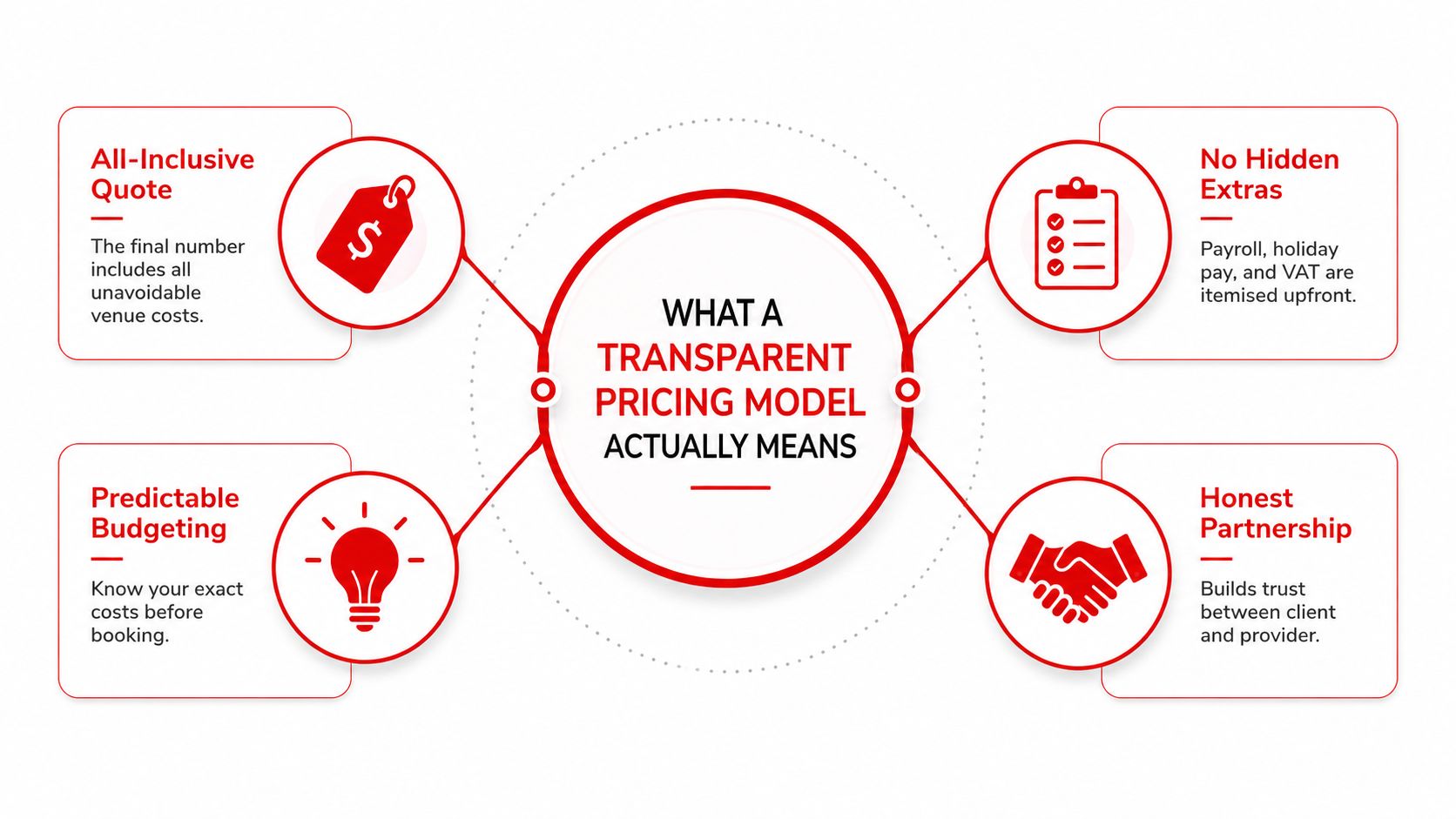
The working rule for chef staffing
For relief chefs and temporary chefs, transparency means the quote shows what the venue pays for:
- Base rate. The core cost of the chef's shift or hourly booking.
- Payroll oncosts. Employer costs such as National Insurance and pension.
- Holiday pay accrual. If it applies, it should be visible rather than assumed.
- Travel and mileage. Especially relevant for wider coverage across the UK.
- Shift premium. Any agreed uplift for unsocial hours, bank holidays, or urgent cover.
- VAT. If it applies, it belongs on the quote and invoice.
- Administration or insurance fee. Only if it is clearly labelled.
A quote can still be transparent even if those items are rolled into one honest total. What matters is that the buyer knows what sits inside the figure. If payroll oncosts are omitted, the rate is usually too low to be sustainable. If they're included, the quote can still be clean and fair.
For a practical reference on the cost base behind chef staffing, see the cost of employing breakdown.
The Building Blocks of a Chef Cover Quote
A legitimate UK chef staffing quote should never feel like a mystery bill. It should read like a working invoice, because that's what it becomes once the shift is done. If the numbers don't make sense before booking, they won't suddenly make sense after service.
| Line item | What it covers | Typical treatment |
|---|---|---|
| Base rate | The chef's pay for the shift or hour | Shown clearly on the quote |
| Payroll oncosts | Employer costs such as National Insurance and pension | Included upfront, either itemised or built into the total |
| Holiday pay accrual | Pay that builds during the booking period | Shown or rolled into the rate |
| Travel and mileage | Getting the chef to the venue | Listed when the location or notice period makes it relevant |
| Shift premium | Bank holiday, weekend, urgent, or unsocial-hour uplift | Disclosed before confirmation |
| VAT | Tax added where applicable | Shown separately if chargeable |
| Administration or insurance fee | Clearly labelled service cost, if used | Must be named and agreed |
Take a Saturday brunch cover in a Berkshire boutique hotel. If the quote starts with the chef's base pay and then adds payroll oncosts, holiday accrual, travel, and VAT, the manager can see why the final figure is higher than the headline rate. That's not a problem. That's honest costing.
The bad quote is the one that looks cheap because it hides the employer side of the bill. A low headline rate without oncosts usually means the supplier is squeezing margin somewhere else or planning to add it later. Either way, the venue ends up paying for the missing detail.
A clean quote doesn't need to be short. It needs to be readable.
The useful test is simple. If the supplier can explain each line in one sentence, the pricing is probably sound. If the explanation starts sounding like a defence, the bill is already in trouble.
Transparent Pricing vs Opaque Agency Fees
The easiest way to spot the difference is to compare the same shift two ways. Use a Saturday brunch cover and look at what the manager sees before approval.
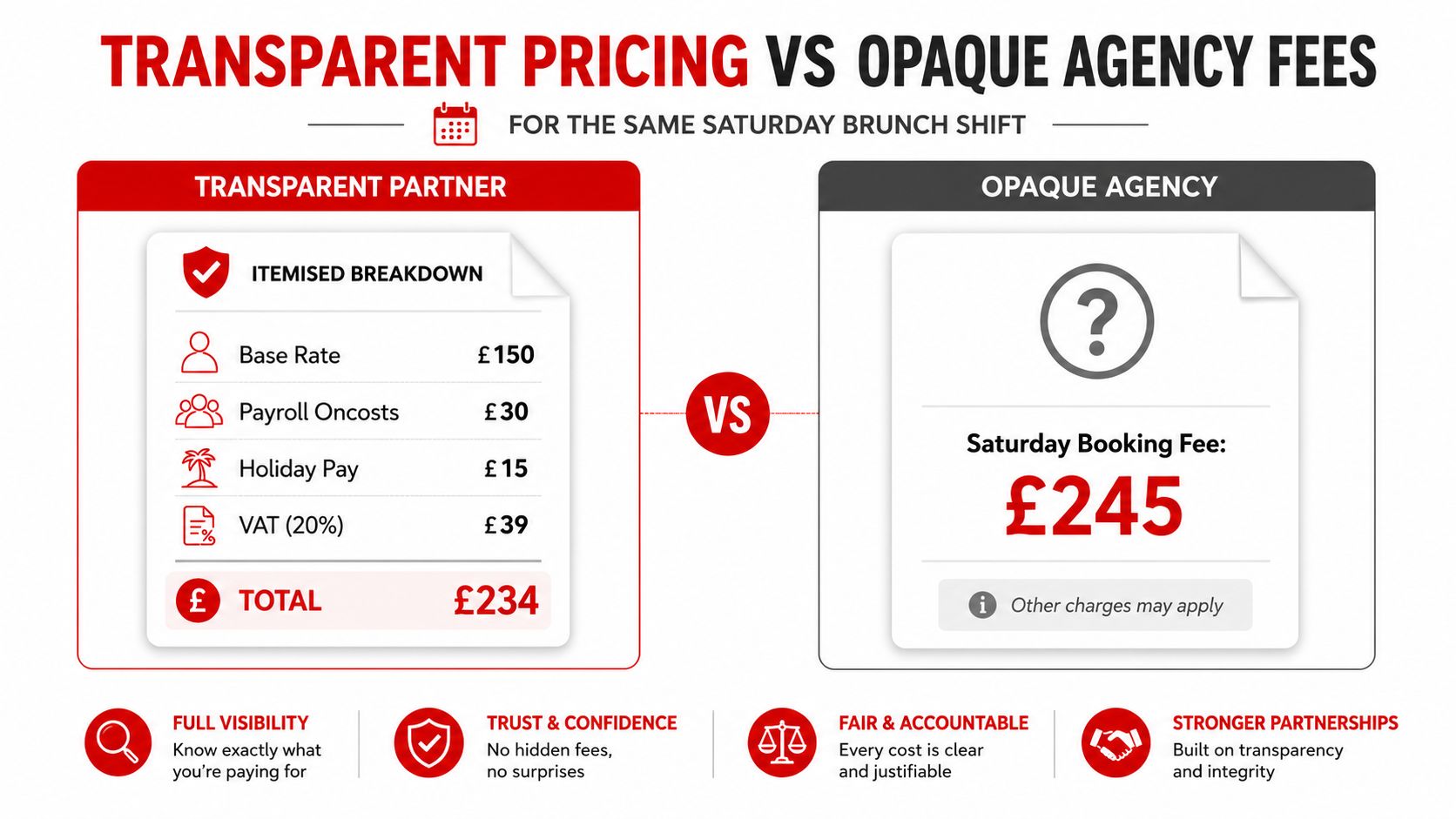
On the transparent side, the quote shows the base rate, payroll oncosts, holiday pay, VAT, and any agreed travel or premium cost. Relief Chefs UK says its model is built around transparent pricing with no hidden agency fees and full insurance, which is the sort of structure a general manager can budget against. On the opaque side, the agency flashes a tempting headline rate, then adds a compliance fee, a training levy, and a weekend surcharge after the conversation is already underway.
That second model does more than raise the bill. It creates invoice disputes because the finance team sees a number that was never discussed, and the kitchen manager has to defend a decision they didn't fully control. It also makes comparison pointless, because one quote is built for a spreadsheet and the other is built for surprise.
For anyone comparing agencies, read this note on contract employment agencies before you sign anything. The issue is not whether the rate sounds low. The issue is whether the final amount is the same number the owner approved.
A transparent quote gives you a defensible budget line. An opaque one gives you a conversation you shouldn't have to keep having. If a supplier won't spell out what's inside the number, assume the missing detail is where the profit sits.
The Evaluation Checklist Before You Book
Don't book chef cover on instinct alone. Use the phone call to test whether the supplier is organised enough to handle your kitchen when pressure hits.
Ask these questions before you commit
| What to check | What to ask on the phone |
|---|---|
| Written, itemised quote | “Can you send the base rate, oncosts, VAT, and any extras in writing before I confirm?” |
| Right-to-work and DBS checks | “Have the chef's checks already been completed?” |
| Insurance | “Do you carry public liability and employer liability insurance?” |
| Replacement cover | “What happens if the chef can't start?” |
| Response speed | “How quickly do you respond, and how fast can you deploy?” |
| Named contact | “Who owns this booking end to end?” |
A good partner answers without drift. Relief Chefs UK states that it responds within two hours and can deploy vetted, right-to-work-checked chefs within 48 hours, which is the kind of operational clarity a busy hotel or pub needs when the rota has already collapsed. You also want one named contact, not a call-centre shuffle, because the person handling the booking should understand the venue, the urgency, and the budget.
The point of the checklist is control. If the supplier can't tell you what's included, who is covered, and what happens if the booking changes, they're not ready for your busiest nights. Transparent pricing only works when the service behind it is just as organised.
Red Flags and Surge Pricing Explained Honestly
Some price changes are legitimate. A bank holiday, a Sunday service, a remote location in Devon or Wales, or same-day sourcing can all add real cost because they affect travel, availability, and the urgency of the booking. The problem starts when a supplier uses those conditions to hide margin instead of explaining delivery cost.
The clean way to do it is simple. If there's a surcharge for urgent cover, it should be written down before the shift starts and tied to a real reason. That way the manager can see whether the premium reflects the work or just the supplier's appetite.
The red flags are obvious once you know what to look for:
- Drip pricing. The quote looks fine until extras appear at checkout or on the invoice.
- Unnamed admin fees. Nobody mentioned them on the call, but they still land on the bill.
- Umbrella company deductions. The chef's take-home changes while the agency invoice stays vague.
- “From” prices. The headline figure has little to do with what most venues pay.
A fair price increase is easier to accept when the supplier discloses it directly. A pricing fairness study found that buyers judge an increase as fairer when the firm itself explains it rather than when they learn about it from someone else, which fits chef staffing perfectly. If a hotel in Berkshire needs urgent specialist cover, or a seaside venue in Dorset needs extra hands for a festival weekend, the reason for the surge should be visible before anyone signs off.
Later in the booking, the same rule still applies. If the invoice doesn't match the agreed surge condition, something went wrong in the paperwork, not the kitchen. The transparent partner removes that argument by putting the reason in writing first.
Here's the video version of the same problem, if you want to see how pricing opacity shows up in day-to-day staffing decisions.
Two Real-World Scenarios From UK Kitchens
A Bristol café gets hit by short-notice sickness on a Saturday market day. The owner calls for cover, a relief chef is booked within two hours, and the quote already includes travel across the city. When the invoice arrives, it matches the agreed figure to the penny, so the manager can move on instead of arguing over a surprise add-on.
A Berkshire hotel group takes a different route. It uses a Premium monthly plan with priority support, a dedicated account manager, and replacement guarantees for a summer block of cover. The monthly statements map cleanly to the agreed schedule, which matters when the kitchen team is stretched across weddings, breakfast service, and peak-season demand.
Those are two very different buying modes, and transparency works in both. Emergency cover needs speed and certainty. Planned cover needs structure and clean statements. Relief Chefs UK has served more than 400 venues since 2013, and the reason that matters is simple. Venues keep returning when the numbers stay consistent and the service stays usable under pressure.
Putting It Together and Getting a Written Quote
Pick three likely cover scenarios, one emergency shift, one weekend booking, one longer block. Ask each supplier for a written itemised quote for all three, then compare the totals and the small print, not the smile on the call. If a partner can't make the numbers clear in writing, they're not ready for your kitchen.
For temporary chefs, relief chefs, permanent chef recruitment, yacht chefs, villa chefs, and broader hospitality staffing support, choose the option that tells you the whole cost upfront. If you want a team that responds quickly, uses vetted chefs, and works from a transparent quote rather than a moving target, speak to the people who run kitchens as well as bookings.
Need a quote that shows the cost before service starts? Contact Relief Chefs UK for transparent chef staffing, relief chefs, permanent chef recruitment, yacht chefs and villa chefs, plus hospitality staffing support across the UK. Visit Relief Chefs UK and ask for a written itemised quote before your next emergency cover turns into an invoice dispute.