
A chef texts at 5.18 pm saying they're not coming in. The prep list is half-done, a wedding party is due at seven, the pastry section is already behind, and the owner is asking whether you can “just make it work”. That's the moment most venues discover whether they have crisis management support or just wishful thinking.
In hospitality, a crisis is rarely dramatic at first. It starts as one absence, one failed delivery, one allergen slip, one power cut, then the service wobble spreads across the whole venue. The cost isn't only lost covers, it's comped drinks, refund pressure, damaged reviews, and staff who know they've been set up to fail.

If you've ever run a Friday night with one section down and a queue building at the pass, you already know the problem. The question isn't whether a kitchen can survive pressure. It's whether it can survive pressure without burning through trust, cash, and team morale in the process. See also 7 kitchen disasters and how emergency relief chef booking helps.
When a Kitchen Crisis Hits Without Warning
A service can unravel in minutes. One chef calls in sick, the stock delivery misses its window, and the booking sheet still says fully committed. In Devon, Bristol, Wales, Berkshire, Windsor, Reading, Slough, or Dorset, the maths is the same. If the line cannot hold, the guests notice before the owner does.
That is why this topic matters to hospitality managers, not just PR teams. The risk sits in the kitchen first. A venue can have the right menu, the right sales forecast, and the wrong staffing reality on the day, and that is how a normal booking turns into a firefight.
Practical rule: if the pass is already stretched, one absence is never “just one absence”. It is a trigger that needs a decision, a cover call, and a revised service plan.
A smart operator does not wait for a perfect answer before acting. They decide whether to reduce the menu, reassign sections, bring in cover, or protect the booking by moving guests. That choice has to happen fast, because kitchen crises punish hesitation.
Start by looking at the failure point that hits your own venue most often. In some kitchens it is short-notice sickness. In others it is agency unreliability, supplier failure, or a food-safety issue that forces a stop. The shape of the problem changes, but the fix stays the same, a documented response that stops chaos from becoming a pattern.
For a kitchen team, the ugly part is that stress travels. One missing chef creates strain on prep, strain on plate times, strain on front of house, then strain on the guest experience. Without an agreed cover route, the whole venue ends up improvising under pressure. Read more in 7 kitchen disasters and how emergency relief chef booking helps.
What Crisis Management Support Means for Hospitality
In hospitality, crisis management support means a venue can keep trading safely when the plan breaks. The pressure shows up in the kitchen first. Staff disappear, suppliers miss, food safety is challenged, or weather and infrastructure disrupt the day, and the service still has to hold together.
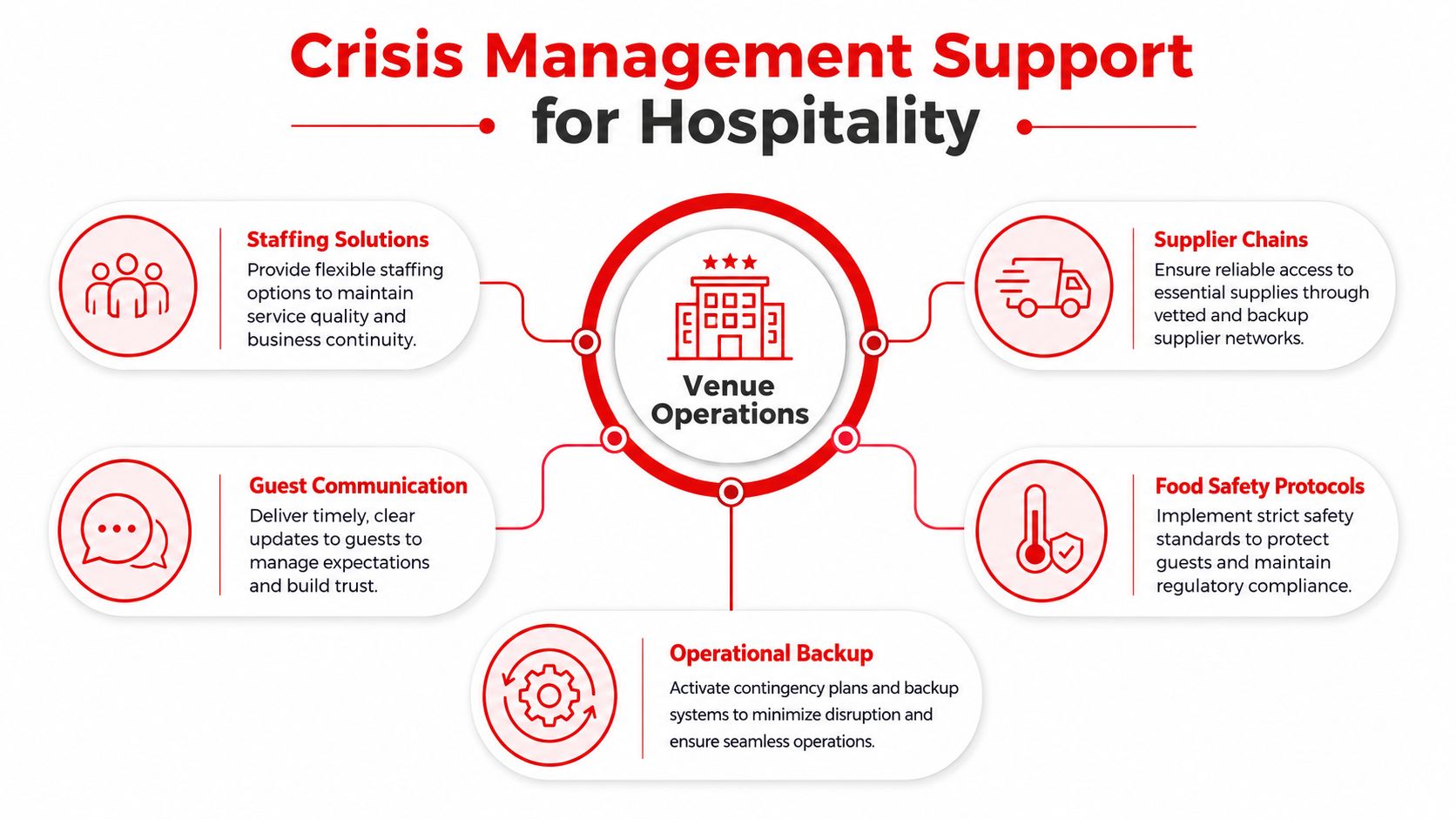
The four crisis patterns venues actually face
The first pattern is short-notice sickness and walkouts. A pub in Reading can lose its senior chef on a Saturday, or a hotel kitchen in Windsor can lose two line cooks during a peak dinner rush. The venue does not need theory, it needs cover that can step in cleanly and keep the pass moving.
The second pattern is agency reliability failure. A manager rings around, gets a promise, then the promised chef never arrives. That is a staffing-risk event, because the rota was built around a person who does not exist on site when the doors open.
The third pattern is food-safety and allergen incidents. A single label mistake or cross-contact concern can halt service, trigger guest complaints, and force a review of every process around it. At that point, the question is no longer who can cook. It is who can work safely inside the corrected system.
The fourth pattern is external disruption. Severe weather, supply-chain problems, and local infrastructure failure hit venues hard because hospitality runs on timing. A restaurant in Bristol or Dorset can have the right team and still lose the day if the building, the van, or the deliveries fail.
A strong response plan does not treat every crisis the same. It identifies the type of disruption early, then matches cover, communication, and food-safety actions to that specific risk.
The useful question is simple. If your closest risk is staffing, do you have a chef route? If it is continuity, do you have a backup plan? If it is communication, do you know who speaks, who approves, and who handles the floor while everyone else is in motion? The service continuity planning guidance should sit next to the rota, not in a forgotten folder.
The Five-Stage Crisis Response Framework
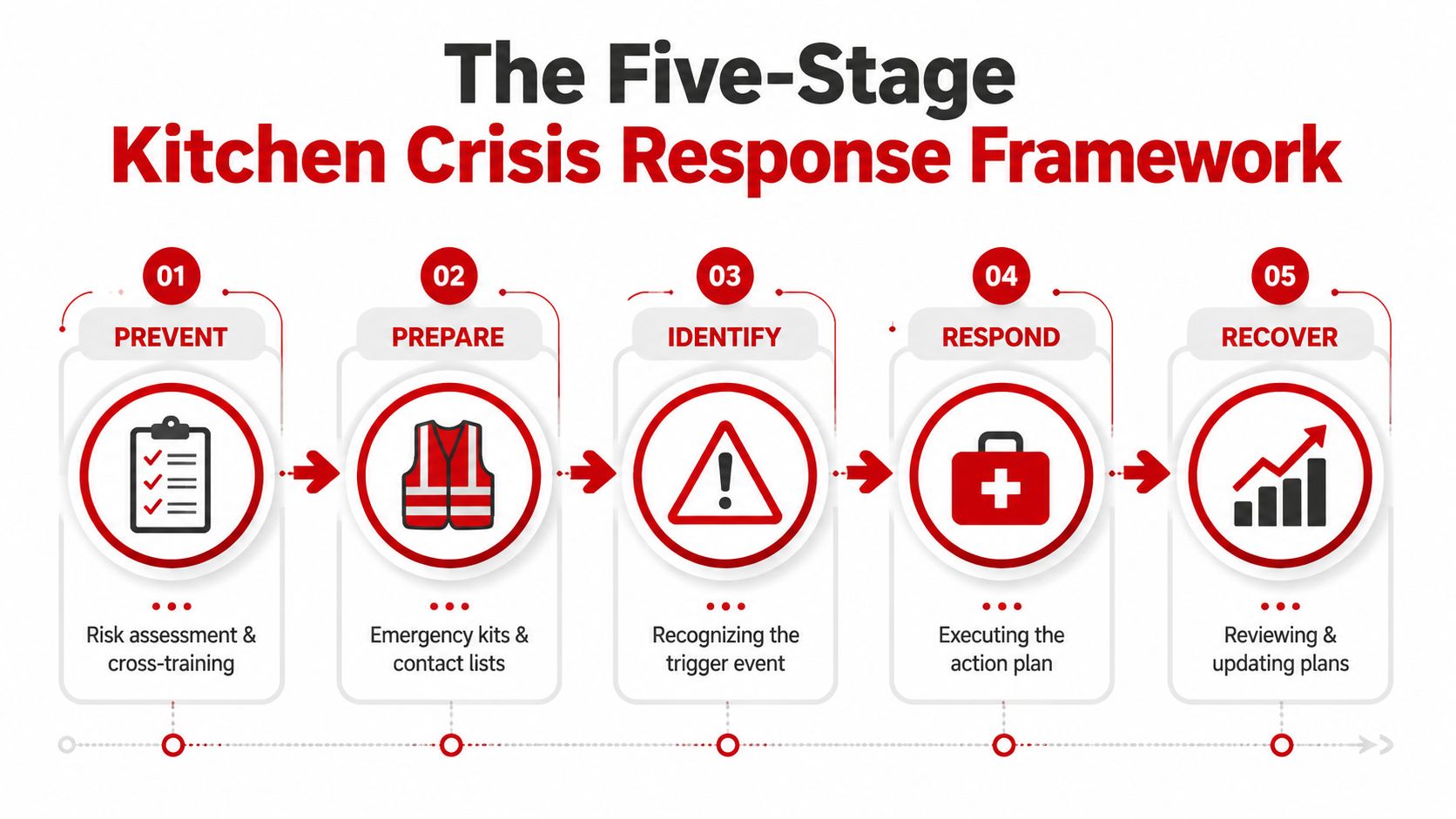
The cleanest way to manage a kitchen crisis is to treat it as a five-stage cycle, prevent, prepare, identify, respond, recover. That structure mirrors established crisis-management thinking, but the value is in the translation to kitchen life. A chef brigade understands action, not slogans.
Prevent and prepare before the rota breaks
Prevention starts with rota design. Cross-train the team so one absence doesn't remove an entire station from the service map. Keep supplier backups, basic contingency notes, and a realistic view of where the kitchen is fragile.
Preparation is paperwork that gets used. Contact lists, emergency cover partners, escalation notes, and a quick route to decision-makers matter because nobody has time to search for a buried email thread at 6.40 pm. The service continuity planning guide is useful here because it turns that thinking into something a venue can maintain.
Identify the real trigger, not just a bad shift
A bad shift is manageable. A real crisis is different, because the problem is no longer about effort, it's about capacity. The trigger is usually visible when prep slips past recovery, calls go unanswered, or a service is about to miss guests in a way that will spread into complaints and refunds.
Respond in the first hour
The first hour matters because it shapes everything that follows. One person should call cover. One person should stabilise the pass. One person should handle guest-facing messaging. That separation stops everyone doing a bit of everything and doing none of it well.
If the plan needs debate before action, it isn't a plan yet.
Recover properly
Recovery is where weak operators lose the lesson. The food may be out, but the risk doesn't end there. Staff welfare, refund decisions, handover notes, and a real post-incident review decide whether the same failure comes back next month.
The best crisis support systems don't end when service ends. They leave the venue better prepared for the next hit. That's the difference between firefighting and management.
Real Scenarios Venues Have Already Survived
A Berkshire gastro-pub had a head chef walk out mid-week after a pay dispute. Saturday's wedding booking for 80 was still on the books, and the owner had two choices, scramble with a half-formed brigade or bring in experienced cover fast. The venue chose cover, reduced the menu, and protected the event by keeping the service realistic.
The lesson was simple. When the crisis is staffing, ego is expensive. A tighter menu with a competent chef is better than a big menu with a broken pass.
A boutique hotel in Windsor found an allergen labelling error after service. No one wanted to guess, so the team stopped, reviewed the labels, notified the right people, and reset the process before the next sitting. That response was uncomfortable, but it was cheaper than pretending the issue would disappear overnight.
A small Bristol restaurant group lost power and refrigeration during a storm the week before Christmas. The stock risk was immediate, but the bigger risk was decision paralysis. The operators moved quickly, protected what could be salvaged, and used the incident to tighten their backup chain for future disruption.
These cases share the same structural truth. The venues that survive don't wait for perfect conditions. They make the hard call early, use a documented response, and keep ownership clear.
What these kitchens did right
- They acted on the trigger, not on wishful thinking.
- They chose the right level of cover, instead of forcing the team into an impossible shift.
- They documented the handover, so the next service didn't inherit confusion.
- They treated recovery as part of the incident, not an optional extra.
A venue in Devon or Dorset can learn as much from one good crisis response as from a month of quiet trading. The point isn't that these kitchens had no damage. The point is that they prevented one failure from becoming a habit.
Choosing the Right Cover When Things Go Wrong
When a crisis lands, operators usually face four options. Close, run short, call a generalist agency, or call a specialist chef partner. Each choice has a cost, but the hidden cost usually sits in service quality, guest trust, and how much of the team gets burned out in the process.
The cleanest way to compare them is side by side.
| Option | Typical response time | Chef quality & vetting | Food-safety assurance | Cost transparency | Service-risk |
|---|---|---|---|---|---|
| Close the venue | Immediate | N/A | High if fully closed, but trade stops | Clear, but revenue stops too | High reputational and commercial risk |
| Run understaffed | Immediate | Your own team carries the load | Variable under pressure | Looks cheap at first | Very high, because standards slip |
| Generalist agency | Can be slow or inconsistent | Often broad, not kitchen-specific | Depends on the individual supplied | Can be unclear once extras appear | Medium to high |
| Specialist chef partner | Fastest when the bench is ready | More likely to be kitchen-vetted | Stronger alignment with service needs | More transparent when terms are fixed | Lower, because the match is tighter |
Why generalist cover often fails in kitchens
A generalist agency can fill many roles, but kitchens are unforgiving. The pace, the equipment, the food-safety standards, and the pressure at the pass all punish weak matching. If the supplier doesn't know the kitchen brief, the issue is usually visible within the first hour.
That's why specialist cover matters. A chef partner understands the difference between someone who can stand in and someone who can protect a service. For venues that want to compare options properly, the hidden cost of bad chef cover is usually much larger than the agency fee line on the invoice.
What good cover should give you
- Speed to confirm, so the rota isn't hanging on uncertainty.
- A properly matched chef, so the person arriving can work the section.
- Clear food-safety expectations, so the team isn't guessing.
- Simple cost terms, so the owner can approve the decision quickly.
- Lower service risk, because the venue isn't using the wrong tool for the job.
A hotel in Berkshire, a pub in Wales, or a restaurant in Slough doesn't need a long procurement exercise when the dinner shift is about to start. It needs a cover route that's been thought through before the panic begins.
How Relief Chefs UK Fits Into a Rapid Response Plan
Relief Chefs UK works best when it sits inside the venue's response plan, not on the edge of it. The practical route is straightforward, a short form or phone call triggers a response within two hours, and fully vetted, right-to-work-checked chefs can start within 48 hours. That matters when you're trying to keep the line open rather than explain why it closed.
The company has served 400+ venues since 2013, and it's run by chefs rather than recruiters. That distinction matters in a crisis, because kitchen cover is never just about filling a gap, it's about understanding how a brigade works under pressure.
Relief Chefs UK also scales its support through monthly plans, Starter, Growth, and Premium, so a small Devon pub isn't buying the same structure as a multi-site Bristol group or a boutique hotel in Reading. It also supports wider hospitality staffing needs, including relief chefs, temporary chefs, permanent chef recruitment, yacht chefs, villa chefs, and broader hospitality staffing support across the UK, including Windsor, Berkshire, Wales, Slough, and Dorset.
The best cover plan is the one your team can activate without debate at the worst possible time.
If you need a practical benchmark, the decision point is simple. Do you want a one-off scramble, or do you want a cover partner that can slot into a documented continuity plan? For venues that care about service stability, the second option is the one that holds up under pressure.
Your Crisis-Ready Kitchen Checklist and Next Steps
Pin this in the office, not in a drawer. If the kitchen is hit by sickness, a walkout, a supplier failure, or a safety issue, the team needs the answer in front of them, not buried in someone's inbox.
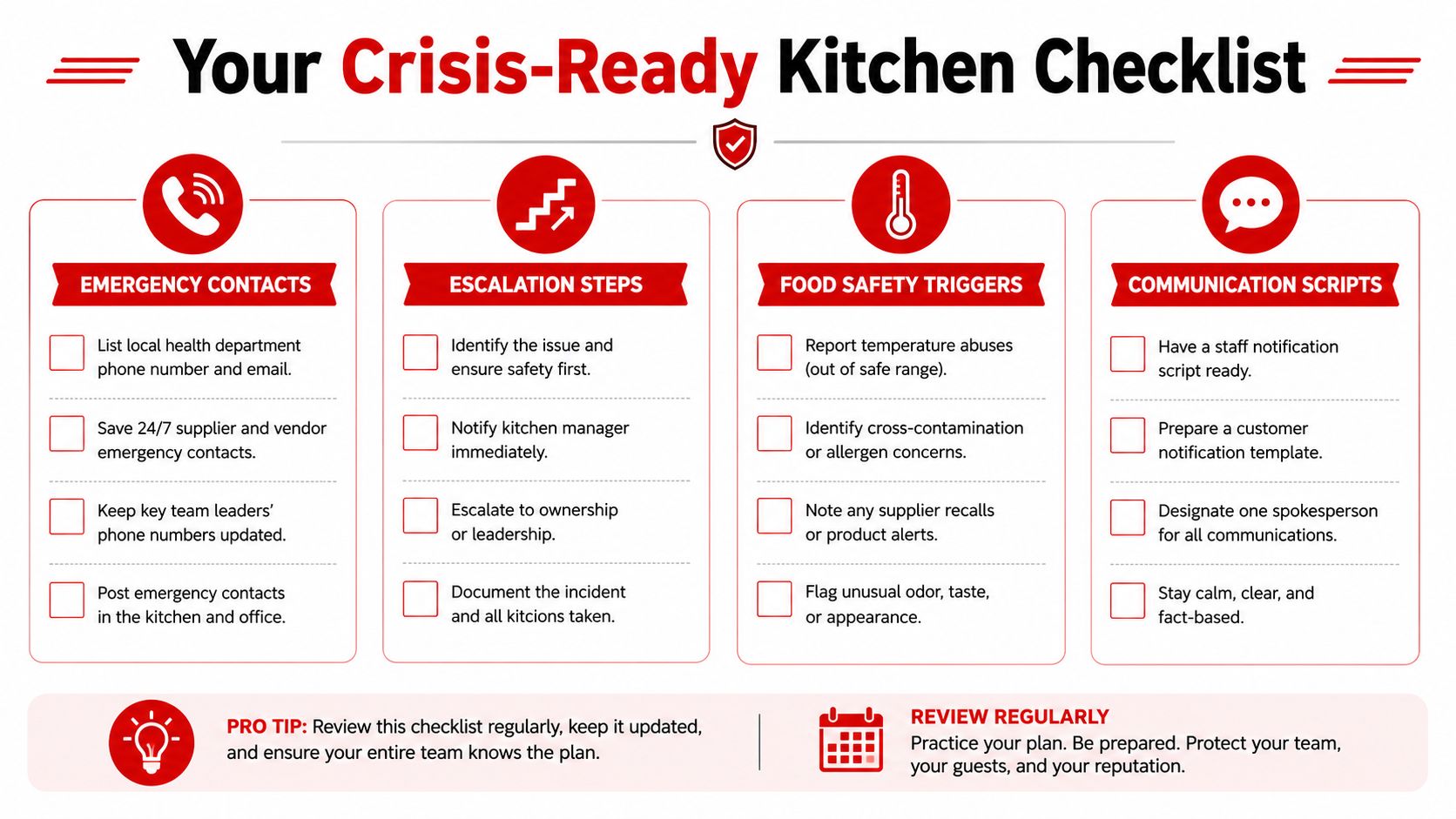
Print this and keep it close
- Emergency contacts, rota lead, owner, supplier reps, and cover partner.
- Escalation steps, who decides, who calls, and who handles the pass.
- Food safety triggers, labelling errors, contamination concerns, refrigeration failure.
- Communication scripts, what staff tell guests, what managers tell owners, what gets logged.
- Cover partner details, booking route, approved rates, and response expectations.
A crisis-ready kitchen is not the one that never gets hit. It's the one that knows what to do when the phone rings and the service is already under pressure. That's why planning, cover, and clear escalation have to live together.
Relief Chefs UK provides rapid chef cover, temporary chefs, permanent chef recruitment, yacht chefs, villa chefs, and hospitality staffing support designed for the moments when a venue can't afford guesswork. If your kitchen needs a response plan that actually holds under pressure, visit Relief Chefs UK and choose the monthly plan or urgent cover route that fits your venue today.