
Find Seasonal Jobs London: Top Staffing Partners
18 May 2026

Don't Let Staff Shortages Derail Your London Peak Season
The bookings are flooding in for Christmas, the terrace is full, or a major event is about to hit London and your rota is already breaking. One chef is off sick, another wants fewer hours, and your permanent team is carrying too much. That's when peak season stops being a commercial opportunity and starts becoming an operational risk.
For hospitality operators, seasonal jobs london isn't really a job-seeker topic. It's a continuity problem. If you can't secure reliable cover, service slows, standards dip, reviews suffer, and the team you do have gets burnt out fast. Job boards might give you volume, but volume doesn't keep a kitchen stable on a slammed Saturday.
London's temporary labour pool is active, but it's also competitive. The number of people in temporary work in London rose from 219,000 in the year to June 2024 to 269,000 in the 12 months to September 2025, according to The Standard's reporting on official labour market figures. That means candidates are out there, but so is demand.
The better approach is to choose staffing partners based on speed, vetting, role fit and whether they can deliver when the pressure is on. These are the options worth knowing.
1. Relief Chefs UK
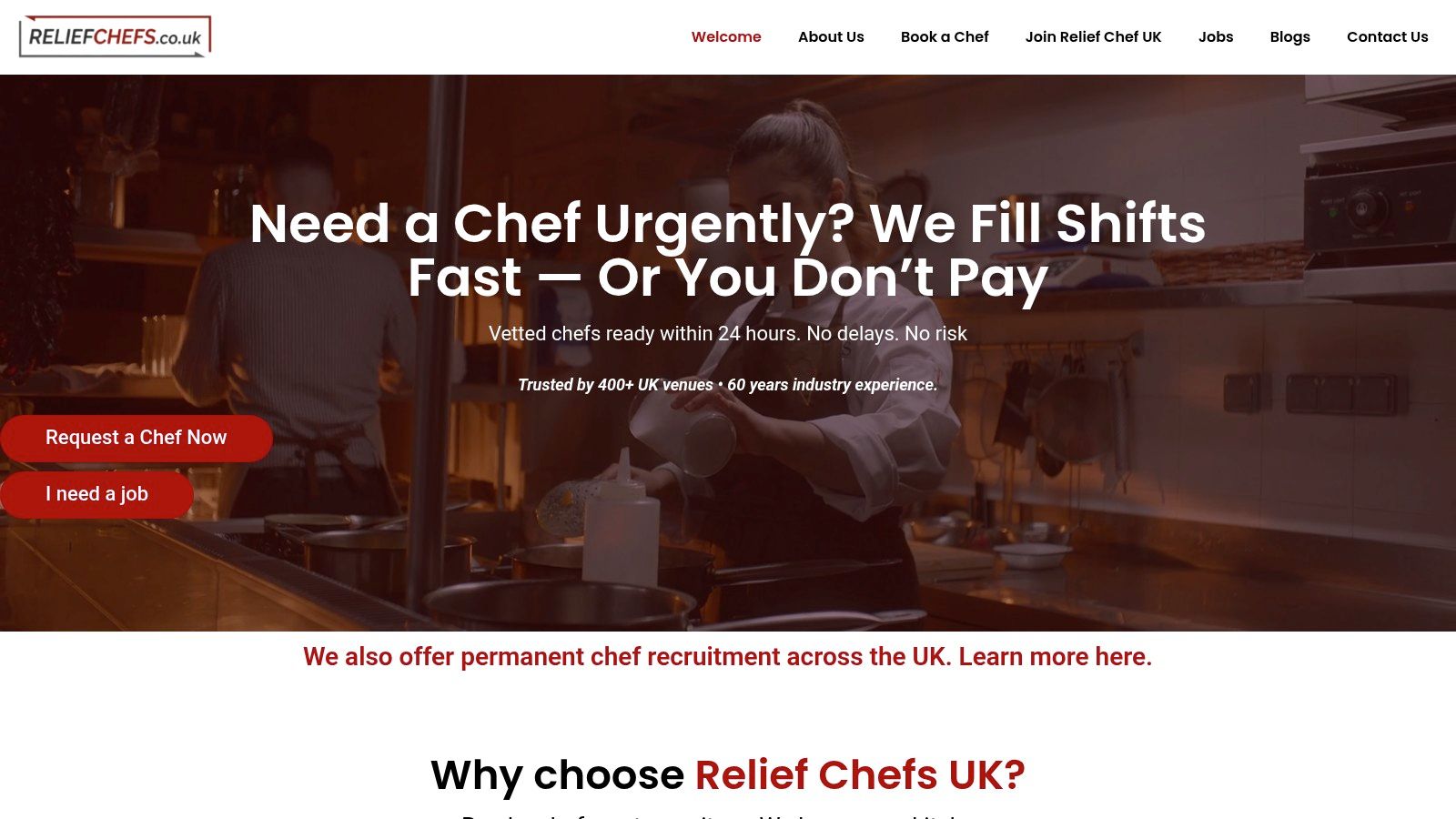
Saturday dinner is fully booked, a function has been added, and one chef calls in sick at noon. At that point, seasonal staffing stops being a recruitment task and becomes a revenue protection decision. Relief Chefs UK is built for that pressure point.
For London operators, the main value is clear. This is a chef-focused staffing partner, not a general temp supplier covering every category of shift work. That tends to produce better kitchen outcomes because the brief is narrower and the screening is tied to service reality: section readiness, handover discipline, food quality, pace, and whether someone can slot into your brigade without slowing everyone else down.
Why operators use them
Relief Chefs UK has been operating since 2013 and works with hundreds of venues across the UK. The team is chef-led, which matters when you need more than a CV match. In practice, that usually means quicker shortlists, fewer misfires, and less risk of paying for a shift that creates more pressure for the head chef than it removes.
Availability is part of the offer, but fit is the true commercial point. The recruitment team is available 24/7, and vetted, right-to-work-checked chefs can be arranged, subject to availability. That support helps, but the stronger advantage is that the agency understands what a busy kitchen can and cannot absorb at short notice.
Practical rule: If the gap sits on the pass, grill, sauce, or banqueting prep, specialist chef cover is usually the safer buy. Volume hiring works for some roles. It is less forgiving in a kitchen.
The model also gives operators options beyond emergency cover. Relief Chefs UK supports relief chefs, temporary chefs, permanent chef recruitment, temp-to-perm hiring, yacht chefs, villa chefs, and wider hospitality staffing support. That matters after peak periods, when a short-term fix often turns into a longer staffing decision.
Where it works best
This agency suits independent pubs, boutique hotels, restaurants, private dining teams, and multi-site groups that need kitchens to stay consistent through busy trading periods. It is also useful for operators managing sites beyond central London, where hiring pressure can spread across nearby regions as demand moves.
For employers reviewing seasonal jobs london, it can also help to see how agencies position roles to candidates. Relief Chefs UK's page on summer temp jobs in London gives useful context on the kind of temporary market you are competing in.
Pros
- Chef-led matching: Better fit for live kitchen environments under pressure.
- 24/7 support: The recruitment team is available around the clock, with chefs placed subject to availability.
- Compliance covered: Vetted, right-to-work-checked and insured cover.
- Flexible supply model: Support for single urgent shifts, ongoing temp cover, and permanent hiring.
- Broad operational reach: Useful for single sites, groups, and operators with regional spillover demand.
Cons
- Quote-based pricing: Rates and plan structure need a direct conversation.
- Harder edge cases remain: Very remote locations can still be difficult to fill at very short notice.
Use Relief Chefs UK when kitchen continuity matters more than getting the cheapest name on a rota.
2. Berkeley Scott
Berkeley Scott is one of the established names in UK hospitality recruitment, and in London that matters. A long-running temp desk usually means existing client relationships, a decent understanding of compliance, and a candidate pool that's already been worked hard across hotels, restaurants, events and contract catering.
For seasonal jobs london from an employer perspective, Berkeley Scott is a practical option when you need broad coverage rather than a niche specialist model. They can support both kitchen and front-of-house, which is useful if your pressure points move around the operation week by week.
Best use case
This agency makes sense when you need a recruiter with range. If your business includes restaurant service, banqueting, breakfast, events and agency chef cover all in the same trading period, one supplier with a broad temp desk can simplify things.
Trust for London reports that just over 5% of people in work in London are on temporary contracts, with that share staying broadly consistent over the past decade within a relatively narrow band. See Trust for London's temporary employment data. That supports the case for using experienced temp recruiters in the capital, because temporary hiring isn't a one-off spike. It's a regular feature of the labour market.
Berkeley Scott tends to work best when you know your demand pattern early and secure the dates before everyone else does.
Pros
- Broad hospitality reach: Useful for kitchens, front-of-house and event-heavy periods.
- Active London temp desk: Strong local market familiarity.
- Sector experience: Better than using a generic recruiter with no hospitality grounding.
Cons
- No public client pricing: You'll need a quote.
- Popular dates go fast: Christmas, major events and summer peaks can tighten availability quickly.
For operators wanting an established supplier with visible London hospitality activity, Berkeley Scott is worth having on your shortlist.
3. Off to Work
Off to Work is built for scale and presentation. If your peak season is tied to premium events, stadium activity, large Christmas parties, corporate hospitality or high-volume summer functions, they're one of the more credible names to look at.
The main advantage is operational breadth. You can bring in casual teams across bar, waiting, supervision and chefs, then keep continuity through their permanent recruitment arm if seasonal demand exposes a longer-term weakness in your labour plan.
Where they outperform
They're especially useful when your venue needs more than a single chef. A large event calendar can create pressure across every department at once. In that situation, managing separate suppliers for kitchen, front-of-house and supervisors gets messy fast.
Their event focus also lines up with a common London reality. When major dates hit, demand for flexible labour spreads beyond hospitality into other temporary and part-time work. Job-board signals in London show active temporary and part-time market-data roles, with listings such as 20 temporary market data jobs and 148 part-time market data jobs on Totaljobs in London. For employers, that's a reminder that flexible workers aren't only choosing between one hospitality venue and another.
If you also recruit around functions and event shifts, event staff jobs in London gives a useful view into the kind of staffing market you're competing in.
Pros
- Strong at scale: Useful for large venues and event-heavy trading periods.
- Joined-up service: Temp staffing, training and permanent recruitment under one roof.
- Good for premium operations: Better fit when guest-facing standards matter.
Cons
- Can be expensive at peak dates: Premium positioning usually comes with premium rates.
- Lead times matter: Top teams get booked early around major London events.
Off to Work is a strong commercial option when your seasonal problem is bigger than the kitchen alone.
4. Arc Hospitality Recruitment
Arc Hospitality Recruitment is particularly useful when the problem is speed. Their model is shaped around events, large fixtures and rapid shift deployment, which makes them attractive for London operators dealing with sudden demand spikes or all-hands trading days.
The tech-led shift broadcast approach is a differentiator. If you've got a gap and need confirmations quickly, that style of staffing can outperform slower consultant-led processes.
What to watch
Arc is strongest when your requirement behaves like an event. One-off surges, stadium dates, festival-style service, mass hospitality and citywide peaks all suit their model. If your need is steadier, like three weeks of consistent breakfast chef cover or a reliable CDP every Thursday to Sunday, you may want something more relationship-led.
Fast fill is useful. Stable repeat cover is better. Know which problem you actually have before choosing the supplier.
Their London event orientation is also a reminder that not all seasonal jobs london demand is equal. Some weeks are driven by tourism and terrace trade. Others are driven by the events calendar, where staffing competition intensifies overnight.
Pros
- Rapid deployment: Good for urgent, large-volume requirements.
- Wide role coverage: Front-of-house, supervisors and chefs.
- Vetted workforce: Better than posting ad hoc shifts into the open market.
Cons
- Less ideal for smaller ongoing needs: Event-led systems can feel too transactional for steady cover.
- Availability can mirror the event calendar: The biggest dates create the biggest squeeze.
For operators dealing with large London fixtures or heavy event trading, Arc Hospitality Recruitment deserves serious consideration.
5. Evolve Hospitality
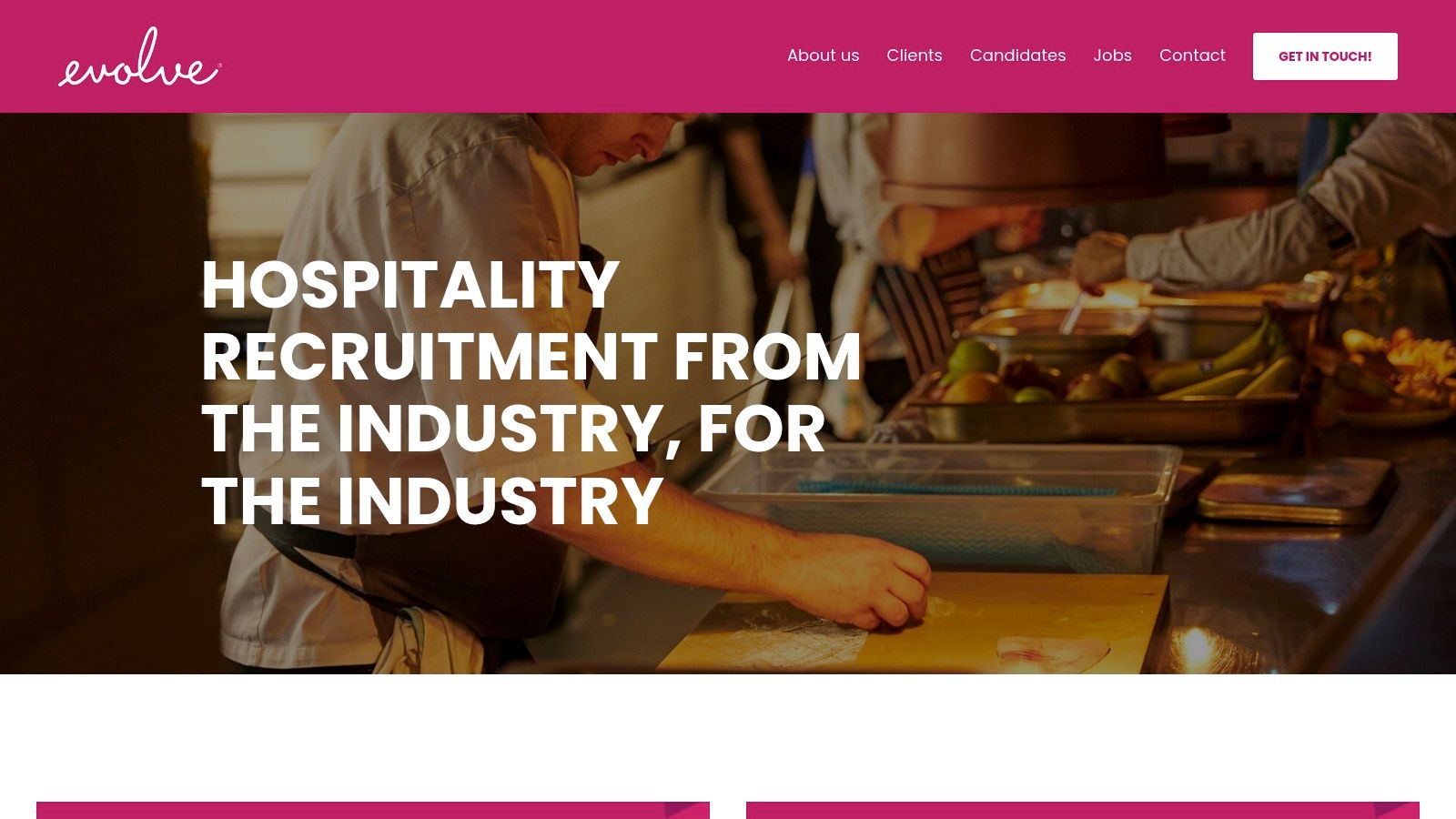
Evolve Hospitality is one of the better options when your concern is quality control. Plenty of agencies can send names over. Fewer put enough emphasis on onboarding, compliance and training to reduce risk once the person is on shift.
That matters most in kitchens where standards are tight and the margin for error is small. Hotels, premium restaurants and high-expectation event caterers usually need more than someone who's merely available.
Good fit for risk-aware operators
Evolve's onboarding and trade-testing emphasis makes them attractive if your business has been burnt before by weak agency cover. A chef who can't cope with your systems, pace or food safety expectations costs more than the shift fee. They slow the whole brigade down.
This sits against a wider market issue. Seasonal hiring advice often focuses on vacancy volume, but not whether the role is attractive enough to retain good people. From 1 April 2025, the National Minimum Wage for workers aged 21+ is £12.21 per hour, while the GLA's 2024 London Living Wage calculation is £13.85 per hour, as noted on Indeed's London temporary seasonal jobs pages. Employers who want better seasonal retention need to think beyond compliance and into whether the shift pattern and pay package are workable in London.
Pros
- Compliance-led approach: Helpful in quality-sensitive operations.
- Training pathways: Useful when standards matter as much as fill speed.
- Ongoing support: Suitable for peak periods that become longer staffing projects.
Cons
- Peak chef rates can rise: Higher-skilled temp cover rarely comes cheap.
- Experience can vary by consultant: As with many agencies, account handling matters.
If your seasonal pressure is serious enough that one weak shift can damage service, Evolve Hospitality is worth a look.
6. Blue Arrow (Hospitality & Catering)
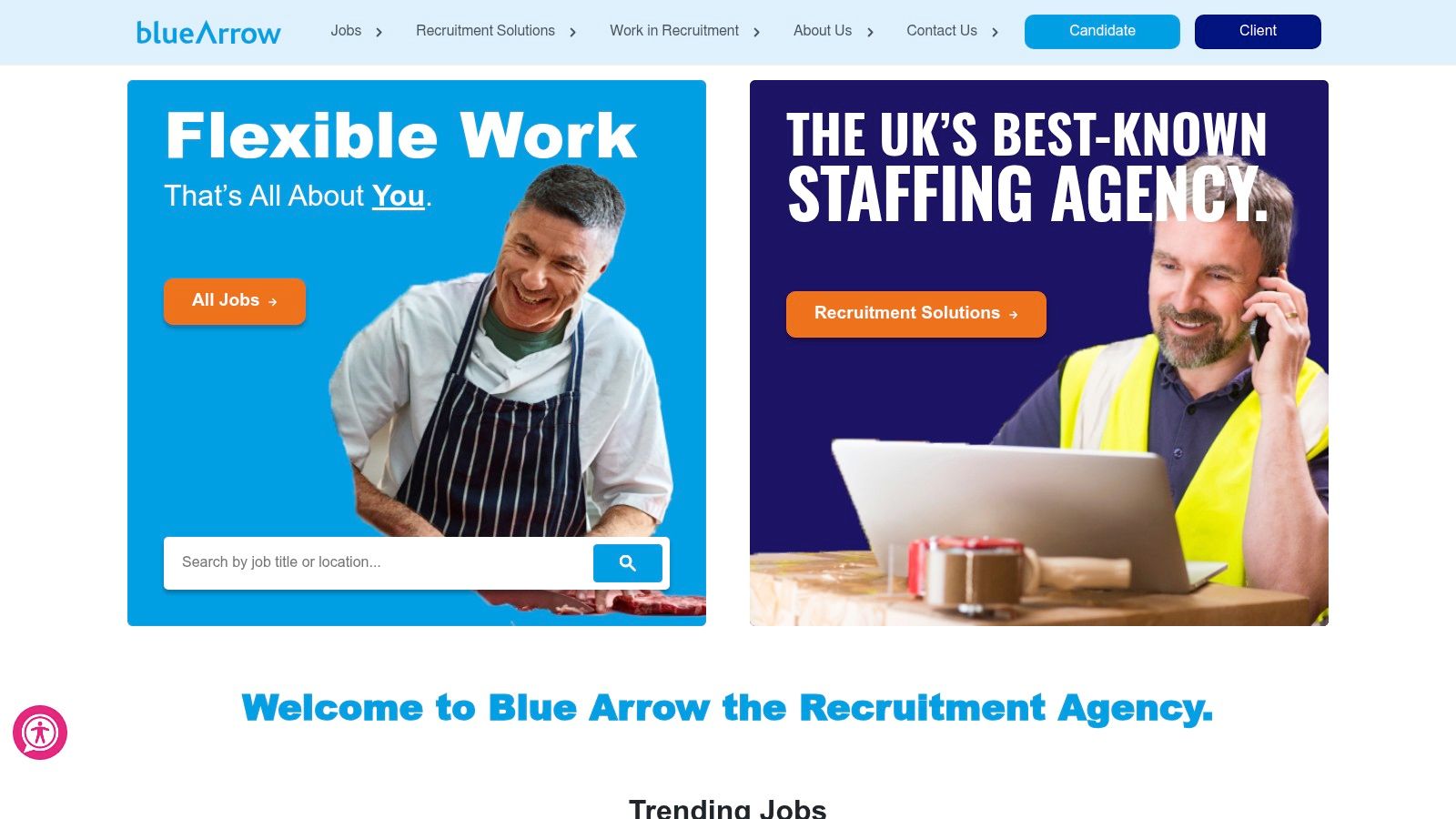
Blue Arrow brings scale. That's the headline. If you run multiple sites, need mixed role types, or want one supplier that can support both London and other regional operations, a large recruiter can make life easier.
For hospitality groups, that breadth is often more useful than a boutique service. One branch network, one process, one account structure. It's not glamorous, but it can be efficient when the problem spans chefs, catering assistants, baristas, kitchen porters and supervisors across several sites.
When scale beats specialism
Blue Arrow is often a sensible option for group operators with recurring seasonal patterns. If your London hotel needs chef cover, your Reading site needs front-of-house, and your Berkshire operation needs back-of-house support in the same fortnight, a bigger recruiter can absorb that complexity better than a niche local agency.
There is a trade-off. Large providers usually deliver process consistency, but not always the boutique feel or close kitchen understanding that specialist chef agencies offer. You'll need tighter briefing and closer performance management on your side.
Pros
- National and multi-site capability: Strong fit for groups.
- Broad role coverage: Useful across full hospitality operations.
- Mature processes: Helpful when volume and admin load are high.
Cons
- Less specific: You may need to work harder to get role fit exactly right.
- Candidate quality can vary: That's common in high-volume recruitment models.
For operators who value reach and process over a specialist kitchen-only focus, Blue Arrow Hospitality & Catering is a practical choice.
7. Indeed Flex (formerly Syft)
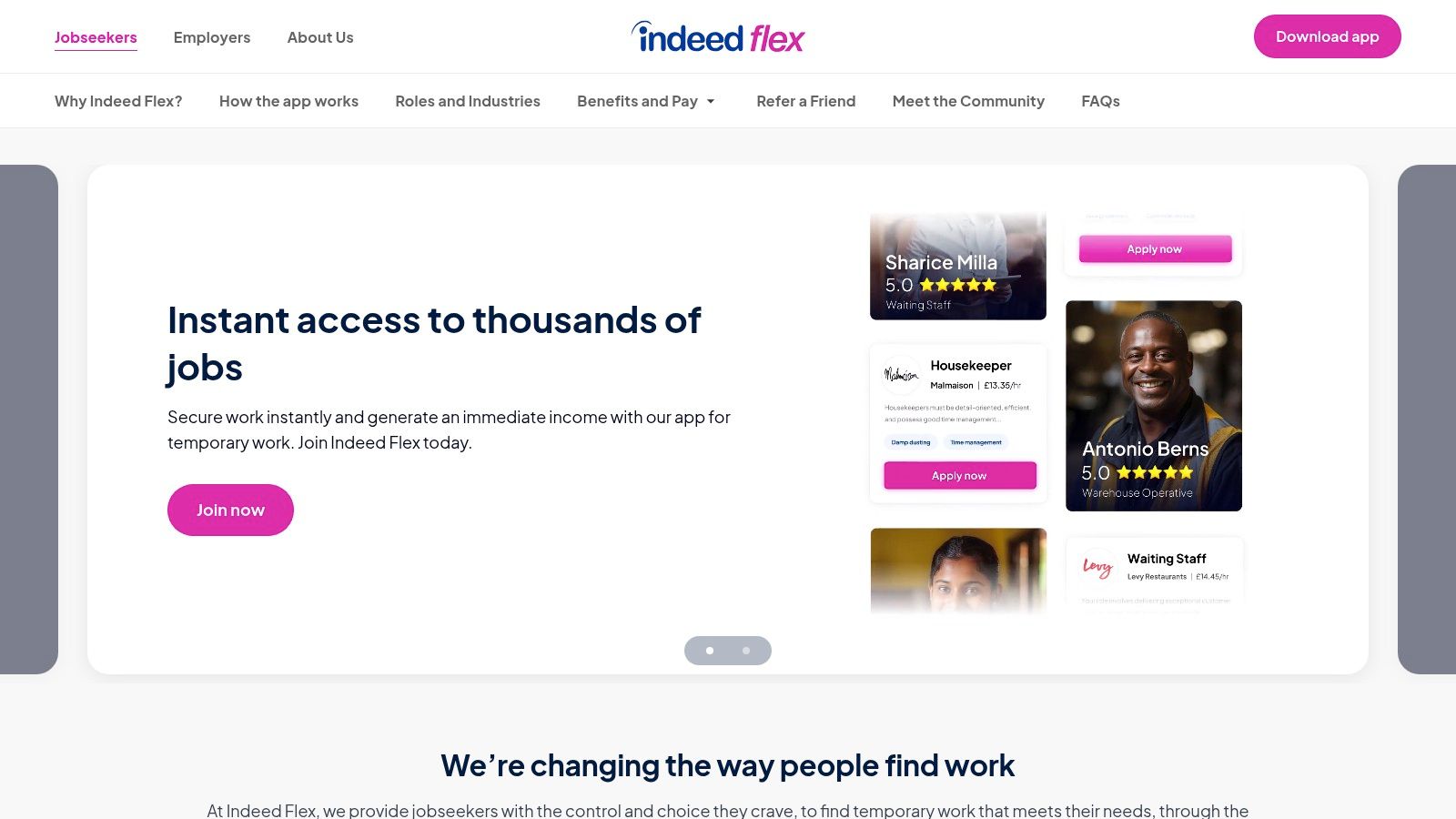
Indeed Flex is the fastest option on this list if your priority is shift-level flexibility. You post the work, push it into the app, and fill can happen quickly. For ad-hoc seasonal jobs london coverage, especially front-of-house or general support roles, that speed is attractive.
The app model is strongest when the role is clear, the shift is standardised, and your team can absorb a worker who doesn't need much hand-holding. It's less reliable if you need someone to steady a fragile kitchen or manage a section with confidence from the first hour.
Best for tactical cover
This works well for operators who need a labour marketplace rather than a staffing partner. If your issue is a sudden gap on a straightforward shift, the app can be efficient. If your issue is service risk, standards protection and kitchen leadership, use a specialist instead.
The wider hiring picture supports that caution. The REC's May 2026 Report on Jobs notes that hiring momentum was being tempered by the Gulf conflict and ongoing economic uncertainty. See the REC Report on Jobs. For hospitality operators, that means short-term staffing demand can move around quickly even when your own seasonal need remains strong.
If you want a local view of agency-style short-term work in the capital, agency work in East London is relevant to the kind of worker pool platforms compete for.
App fill is quick. Accountability is thinner. That's the trade-off.
Pros
- Fast booking: Good for last-minute shifts.
- Simple shift management: Useful for businesses comfortable with platform hiring.
- Large worker reach: Backed by a recognisable jobs brand.
Cons
- Availability varies by date and area: Especially on big London weekends.
- Quality can be uneven: Ratings help, but they don't replace proper specialist matching.
For tactical labour gaps rather than deep operational support, Indeed Flex can do the job.
Top 7 Seasonal Jobs Providers in London
| Service | 🔄 Implementation complexity | ⚡ Resource requirements | ⭐ Expected outcomes | 📊 Ideal use cases | 💡 Key advantages / tips |
|---|---|---|---|---|---|
| Relief Chefs UK | 🔄 Low–Medium: chef-run workflows, simple onboarding | ⚡ Moderate: vetted pool, quoted per role, 24/7 support | ⭐ High: reliable, professional, vetted cover | 📊 Independent pubs, cafés, boutique hotels, short-notice peak cover | 💡 Fast response (24/7 enquiries; short-notice chefs, subject to availability); contact for quote |
| Berkeley Scott | 🔄 Medium: traditional recruiter processes, quote-based pricing | ⚡ Moderate: dedicated London temp desk, experienced consultants | ⭐ Reliable: vetted chefs and steady temp supply during spikes | 📊 Hotels, restaurants, contract catering and London events | 💡 Broad reach and quick turnaround; peak dates can book out |
| Off to Work | 🔄 Medium–High: event logistics and onsite account management | ⚡ High: large event teams, training and onsite support | ⭐ High: strong delivery at scale with candidate briefings | 📊 Stadiums, premium events, large seasonal peaks | 💡 Single supplier for temps + training; expect premium rates at peaks |
| Arc Hospitality Recruitment | 🔄 Medium: platform-driven broadcasts, tech coordination | ⚡ Moderate–High: large temp pool and rapid shift distribution | ⭐ High for events: efficient fills for last-minute large shifts | 📊 Stadiums, arenas, festivals and citywide event surges | 💡 Best for event surges; less suited for steady small-site needs |
| Evolve Hospitality | 🔄 Medium: compliance-led onboarding and trade testing | ⚡ Moderate: vetted, trade-tested candidates and training access | ⭐ High: strong compliance reduces on-shift risk | 📊 Hotels, restaurants and high-profile events needing quality control | 💡 Good where compliance matters; premium pricing for skilled temps |
| Blue Arrow (Hospitality & Catering) | 🔄 Medium: mature, formal processes across branches | ⚡ High: national branch network for multi-site scaling | ⭐ Consistent: wide role coverage; candidate quality can vary | 📊 Multi-site groups, national seasonal staffing projects | 💡 Excellent for volume and reach; expect less boutique service |
| Indeed Flex (formerly Syft) | 🔄 Low: app-based self-serve shift posting and management | ⚡ Low–Moderate: very large, app-onboarded worker pool | ⭐ Variable: very fast fills but quality depends on vetting/ratings | 📊 Ad-hoc last-minute shifts and short-term spike cover | 💡 Instant fills and transparent shifts; monitor ratings for quality |
Your Next Step Secure Your Kitchen's Stability Now
Friday lunch starts badly. A chef calls in sick, agency options are thin, the KP is stretched, and your front-of-house team already knows ticket times are about to slip. By 2pm, the problem is no longer staffing. It is lost covers, guest complaints, pressure on the brigade, and a service that costs more than it makes.
That is how seasonal staffing works in London. It affects continuity, margin, and standards at the point where trading is strongest. Managers who treat it as a last-minute rota fix usually pay for it twice. First in rushed agency spend, then in weaker execution on the floor and in the kitchen.
The broader market for seasonal jobs in London stays busy because hospitality is competing with other flexible employers for the same workers. General temp supply can help with bars, waiting staff, runners, and event crews. Kitchen cover is a different decision. A chef who cannot handle your section, pace, or standards creates operational risk from the first service. General guidance on seasonal hiring rarely deals with that problem, even though hospitality demand rises sharply at the same time across pubs, hotels, restaurants and events, as reflected in National Careers Service guidance on seasonal work.
For operators, the primary choice is about risk tolerance. Platforms offer speed. Large agencies offer reach. Specialist chef support usually gives you a better chance of getting someone who can step into service, work cleanly, and steady the team without heavy supervision.
That is why specialist agencies matter in this market.
As noted earlier, Relief Chefs UK focuses on chef and hospitality cover for London operators who need reliable support rather than generic temp volume. That includes short-notice relief, longer temporary placements, permanent chef recruitment, and specialist placements where kitchen performance cannot dip.
If your peak period is approaching, make the call before the rota breaks. Secure cover while there is still choice in the market.
If you need dependable chef cover, permanent recruitment support, or short-notice help to keep service moving, speak to Relief Chefs UK. We support pubs, restaurants, boutique hotels, private households and hospitality operators across London and the wider UK with relief chefs, temporary chefs and long-term recruitment that works in practice.
Call the team.
Office 01392 715474 · info@reliefchefs.co.uk