
Employment Hotel London: A Practical Kitchen Staffing Guide
5 August 2026
You've got a rota hole, a chef has called in sick, and the next service isn't waiting for anyone to finish an advert. In London, that's normal, not exceptional. Hotel kitchens live with constant pressure, and the people who keep them moving need a hiring process that's fast, compliant, and realistic.
The London Hotel Kitchen Staffing Reality
At two hours before dinner, the problem is never abstract. The pass is set, the prep list is half done, and the sous chef has just texted that they're off with food poisoning. The head chef now has a section that nobody can cover, and every minute of delay makes service harder to rescue.
That's the daily reality behind employment hotel London searches. London hospitality supported 449,000 employee jobs in the May 2025 labour-market overview, and those jobs made up 6.9% of employee jobs in the city, which shows how much labour the capital is carrying every day (Shaw Trust hospitality report). That volume is useful context for managers, because it explains why cover is always under pressure, especially in hotels with multiple outlets or mixed dining formats.
The bigger point is practical. When the kitchen loses one person, the strain doesn't stay in one place. It lands on prep, on lunch handover, on banqueting, on dessert, and then on the team already picking up the slack.
Practical rule: if a hotel kitchen can't replace one person quickly, the issue isn't just staffing, it's operational fragility.
For independent hotels, city business properties, and boutique venues in Westminster or Kensington, the answer is rarely “post and wait”. It's a clear hiring decision made under pressure, with legal checks, realistic service expectations, and a plan for who can walk in and work. Relief Chefs UK, a nationwide chef recruitment agency established in 2013, exists for that kind of pressure, along with permanent chef recruitment, relief chefs, temporary chefs, yacht chefs, villa chefs, and wider hospitality staffing support.
The rest of this guide is built around that reality. If the kitchen needs to stay open, the process has to be designed for the room you're in.
Assessing Your Kitchen Staffing Needs Before You Hire
The first mistake is treating every gap as the same gap. A three-day sickness cover request, a six-week seasonal surge, and a permanent vacancy all need different answers, different budgets, and different expectations. If you blur them together, you end up paying for the wrong type of chef and still missing service standards.
London's labour pool is tighter than many operators like to admit. ONS local jobs data shows hospitality employee jobs in London fell from 243,656 in 2018 to 197,095 in 2023, a drop of 46,561 jobs over five years (ONS local jobs dataset). That doesn't mean chefs vanished, but it does mean the market is less forgiving when you need quick cover.
Start with the gap, not the advert
Write down what's missing before you write a job post. Is the role for a section chef, a strong all-rounder, or a specialist who can handle pastry, banqueting, or breakfast service without hand-holding? A chef who thrives in a weekend function hotel may be the wrong fit for a fine-dining property with precise plating and a slow, controlled pace.
A useful brief should include the following:
- Coverage window: short-notice, short term, or longer placement.
- Section knowledge: larder, pastry, banqueting, breakfast, grill, or multi-outlet support.
- Shift pattern: early starts, late finishes, split shifts, or rota flexibility.
- Operational pressure: high-volume covers, events, room service, or low-volume precision service.
- Standards required: menu familiarity, plating consistency, speed, or leadership.
Short rule: if the brief is vague, the hire will be vague too.
Match the hire to the service pattern
London hotels often run more than one food stream at once. Breakfast, all-day dining, room service, afternoon tea, events, and late service can all pull on the same team. If the gap is in a high-output section, you need someone who can move immediately. If it's for a long-term placement, you need somebody who can absorb the venue culture as well as the menu.
That's why this early assessment matters so much. It keeps you from over-specifying a short cover role or under-specifying a permanent vacancy. It also helps you decide whether to seek direct applicants, use an agency, or combine both.
As a working manager, I'd rather spend ten minutes defining the gap properly than two weeks correcting the wrong hire. The second option always costs more.
Sourcing Kitchen Talent in London's Competitive Market
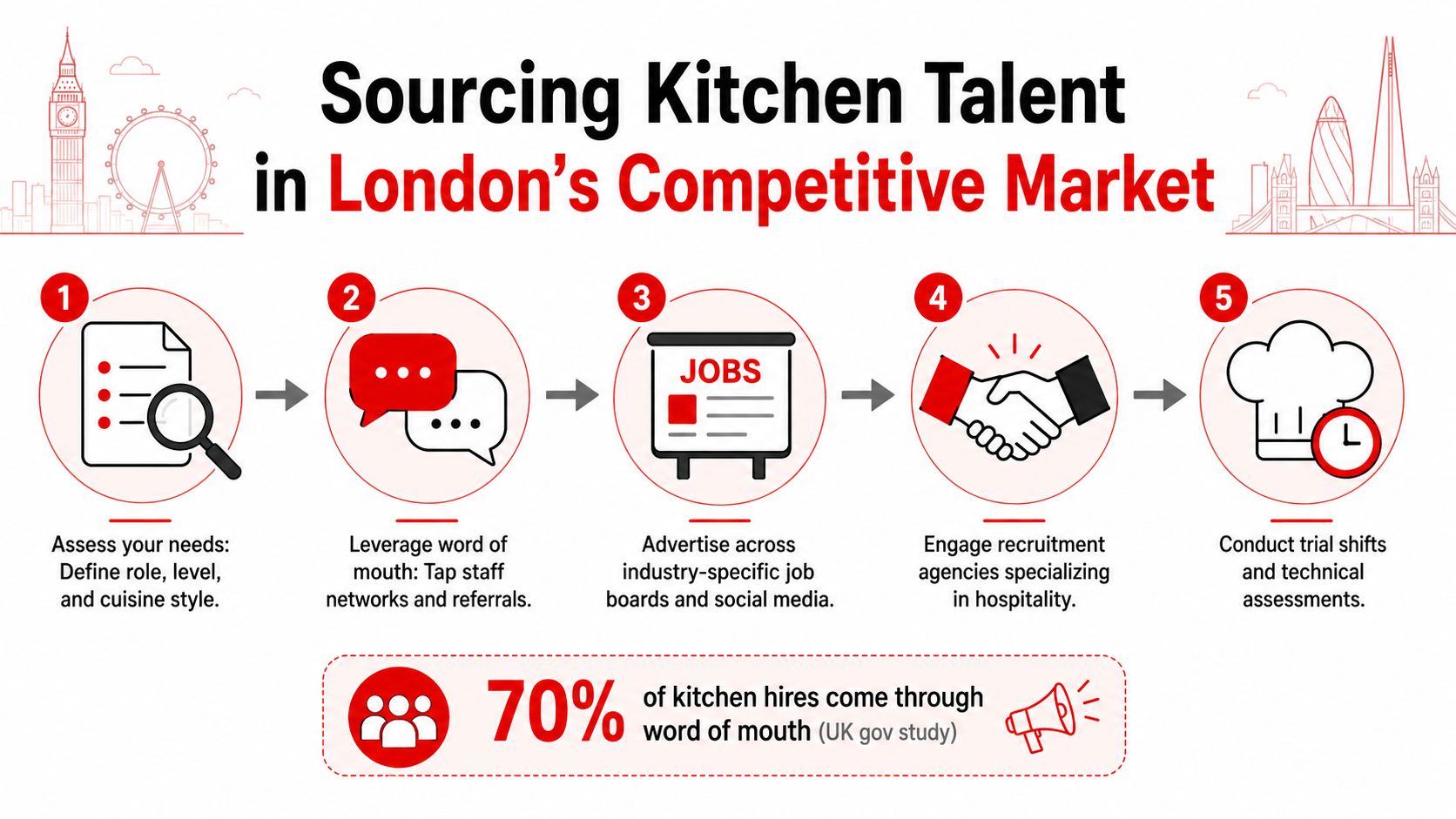
Once you know the gap, sourcing gets easier, but only if you use the right channels for the job. A UK government study on hotel labour-market enforcement found that recruitment still leans heavily on word of mouth and migrant networks, alongside job centres, employment agencies, and websites (UK government study). That spread tells you something important, the market is fragmented, and quality varies widely.
Use the channels that actually move fast
Start with referrals from your own team. A chef recommending someone else is usually giving you a live signal on reliability, not just skill. That matters in kitchens, because a technically competent chef who can't handle pressure is still a service risk.
Job boards and social media can widen the net, but they also create noise. If you use them, screen aggressively and move quickly. Slow replies lose candidates, and London chefs with decent options won't wait around while a manager leaves a CV in an inbox.
For venues in central London, Kensington, or Westminster, geography matters as much as experience. Commuting fatigue kills retention. A chef who already works or lives near the property is often a safer long-term bet than someone who faces a punishing cross-city journey every shift.
Build a sourcing stack, not a single tactic
One channel won't solve every staffing problem. Use a mix:
- Referrals for trusted names and cultural fit.
- Industry job boards for broad reach.
- Direct outreach for hard-to-fill roles.
- Agency support when the clock is against you.
A specialist hospitality agency can be the most practical option when the kitchen can't wait. Relief Chefs UK can fill temporary chef and relief chef needs, and its hospitality recruitment page sits here for venues that want a quicker route to vetted support, hospitality recruitment in London.
Response speed matters. A kitchen crisis doesn't pause for a normal recruitment cycle.
Use multiple routes, but don't confuse reach with quality. A crowded applicant list is useless if half the candidates can't start, can't travel reliably, or can't prove they're eligible to work.
Right-to-Work Checks, Vetting, and Legal Compliance
London hotels often recruit in a rush, but legal checks can't be rushed. Research on small London hotels found they rely heavily on migrant workers and informal recruitment, which is exactly why right-to-work checks need a disciplined process rather than a hopeful one (SAGE journal article). If you skip or delay checks, you're not saving time, you're storing up risk.
Make the compliance process routine
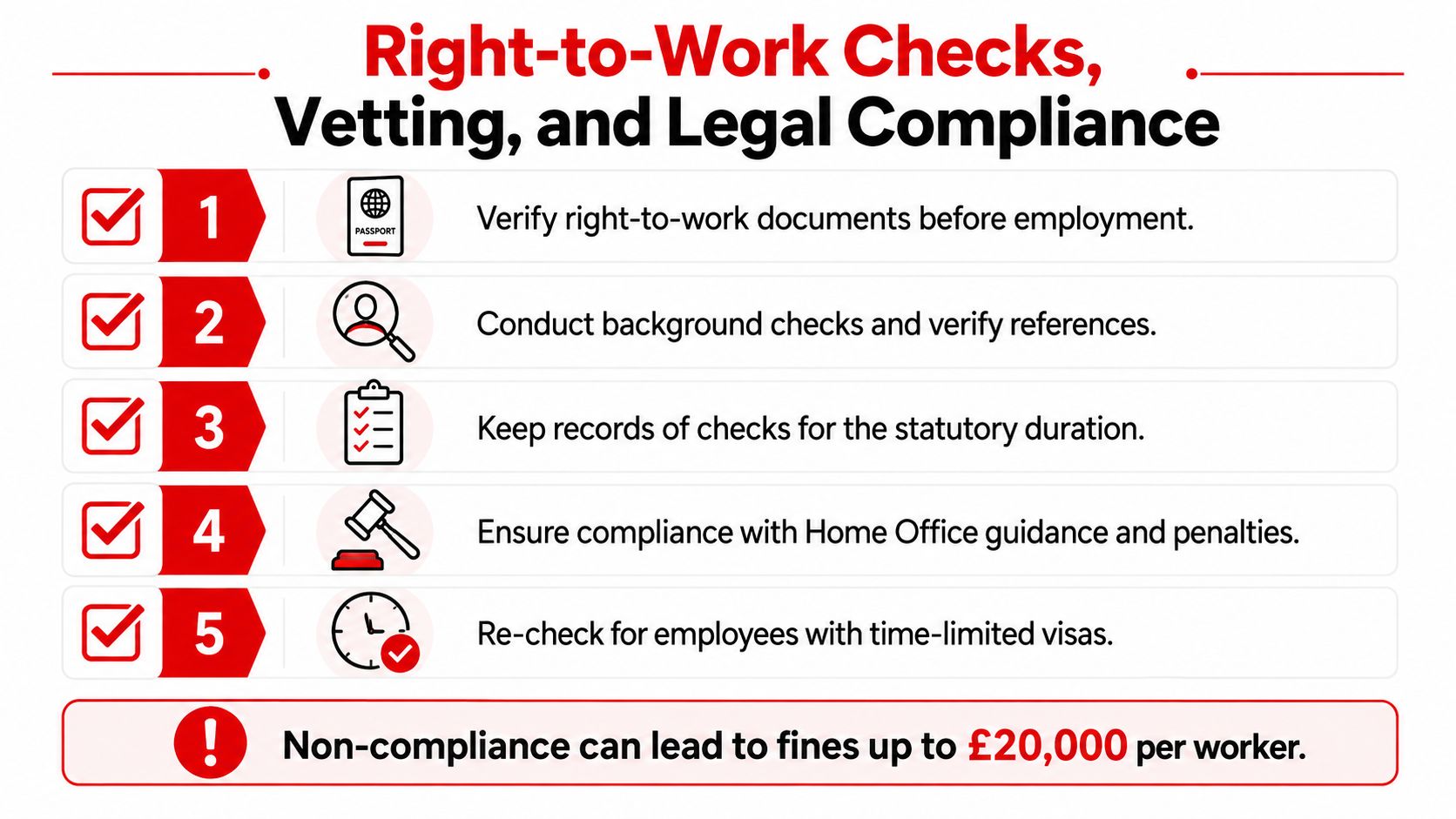
Every chef should complete a documented right-to-work check before they start. That means checking passports, visas, and immigration status against current Home Office requirements, then keeping your records in order. If the candidate's status is time-limited, re-checking is part of the job, not an optional extra.
Your vetting checklist should also include:
- Identity verification: confirm the person is who they say they are.
- Eligibility to work: complete the correct documentation before the first shift.
- References: request at least two recent employers and ask about reliability, pressure handling, and section competence.
- Qualifications: verify food hygiene and any specialist training.
- Insurance or role-specific checks: consider whether enhanced DBS checks are appropriate in private household or high-end residential work.
The GLA's hospitality guidance also pushes inclusive recruitment, pay transparency, flexible hours, and accessible application processes, while warning against long must-have lists and continuous-employment requirements. That matters in London because the strongest applicant may be the person with a CV gap, a caring responsibility, or a flexible-hours requirement, not the person with the prettiest timeline.
Keep the process simple enough to repeat
A good compliance system is boring. That's a compliment. If your team can't repeat it under pressure, it isn't a system, it's a folder of good intentions.
A specialist support route can help. If you want a structured route to right-to-work verification, Relief Chefs UK's process is set up around checked candidates and practical hospitality compliance, right-to-work verification.
Keep the paperwork tidy, keep the process consistent, and never let speed become an excuse for sloppy checks. A kitchen can recover from a late arrival. It can't recover easily from a compliance failure.
Onboarding and Managing Relief Kitchen Staff Effectively
Getting a chef in the door doesn't solve anything if they spend the first hour guessing where things are kept. Relief staff fail most often when the handover is weak, the brief is incomplete, or the venue assumes “they'll just know”. In practice, they won't.
Give them a working brief, not a welcome speech
A relief chef needs a written brief before they step on site. Cover the menu, the plating style, the pace of service, allergens, the key team members, and the person they should go to when they need an answer fast. If your venue has multiple outlets, spell out which section they're covering and what success looks like on that shift.
A short first-shift induction pays for itself quickly. Show the chef where the kit is, what the service rhythm looks like, and which standards are essential. That reduces mistakes and stops experienced chefs from wasting time on basic guesswork.
Practical rule: if a relief chef has to keep asking for the same information, the induction was too thin.
Rostering matters more than managers admit
Poor rostering creates fatigue, and fatigue creates errors. That is especially true when chefs are moving across multiple venues or stacking shifts in one week. If you're using relief cover regularly, track who worked, what they covered, and how they performed, so future matches get sharper.
You also need to be honest about expectations. Tell people the hours, the pay rate, the break pattern, and any extra duties before the shift starts. Hidden asks are one of the fastest ways to lose a reliable chef.
For longer placements, treat the chef like part of the operation rather than a disposable patch. Good kitchen people remember who respected their time and who didn't. That memory affects whether they come back when you need them next month.
Keep service standards visible
Consistency depends on clarity. A chef should know your garnish rules, portion expectations, and pass discipline before the first ticket lands. If your team uses checklists, prep sheets, or par levels, share them. If you don't, you're asking a relief chef to improvise inside someone else's kitchen, which is how standards slip.
If you manage multiple hotels or seasonal outlets, keep a simple performance log. Note reliability, communication, menu competence, and how they handled pressure. That record becomes much more useful than gut feeling when the next emergency hits.
Choosing Between Direct Hiring and a Specialist Agency
The decision isn't whether agency use is “good” or “bad”. It's whether your current staffing problem needs speed, control, or both. Direct hiring gives you control over the process, but it also means more admin, more follow-up, and more waiting when you need a body in the kitchen now.
The hotel-employment market is still large and active. A strong UK baseline shows the sector employed 383,647 people in 2026, up from 380,173 in 2025, which implies 0.9% year-on-year growth and a 4.6% CAGR from 2021 to 2026 (IBISWorld hotel employment data). That scale matters because it shows why hotels still need frequent replacement and short-notice cover, even in a broad labour pool.
Direct hiring versus specialist support
| Factor | Direct Hiring | Specialist Agency |
|---|---|---|
| Speed | Slower, especially for urgent gaps | Faster when cover is needed quickly |
| Admin load | Higher, because sourcing and vetting sit with your team | Lower, because the agency filters candidates |
| Control | Full control over advert, shortlist, and decision | Shared with the agency's matching process |
| Best use case | Permanent, long-lead roles | Relief cover, seasonal peaks, urgent shortages |
| Risk | Higher if the team is already stretched | Lower if the agency pre-vets properly |
A specialist agency is often the smarter move when service stability can't be compromised. Relief Chefs UK, established in 2013, sits in that bracket, with chefs rather than recruiters handling the match and a model built around vetted, right-to-work-checked candidates, employment agencies for chefs.
Use the right model for the right job
Direct hiring still makes sense for permanent leadership roles, where the venue can wait for the right fit. It also works when you want deep cultural alignment and have time to run a proper process. But for short-notice sickness, seasonal pressure, or a section that's already running too hot, a specialist agency gives you a cleaner operational answer.
A hybrid approach is often the best option. Keep direct hiring for long-term structure, and use agency support as the safety net when the rota breaks, because it will break at some point.
Taking the Next Step in Your Kitchen Staffing Strategy
Kitchen staffing doesn't fix itself, and every day you leave a gap open, the rest of the team pays for it. The pressure lands on service, on morale, and on the people already doing too much. That's how a staffing issue turns into a standards issue.
The useful part is that the process is manageable when you break it down properly. Assess the gap, source from channels that fit the urgency, complete the legal checks, onboard relief staff properly, and decide whether direct hiring or specialist support is the better fit for the moment you're in. That's the difference between reacting badly and running a kitchen with control.
Relief Chefs UK has been helping independent pubs, restaurants, private households, yachts, and boutique hotels across the UK since 2013, with temporary chefs, permanent chef recruitment, and wider hospitality staffing support available when kitchens need stability. If your London hotel needs cover for a sickness gap, seasonal pressure, or a longer placement, the fastest route is to speak to the team and get the right chef moving.
If your hotel kitchen needs reliable cover, call Relief Chefs UK and get matched with vetted chefs who can support service without slowing the operation down. Visit Relief Chefs UK to discuss relief chefs, temporary chefs, permanent chef recruitment, yacht chefs, villa chefs, and hospitality staffing support for your venue.
Call the team.
Office 01392 715474 · info@reliefchefs.co.uk