
UK Right to Work Verification: 2026 Hospitality Guide
8 July 2026
Friday afternoon. Your sous chef has walked, the weekend bookings are full, two agency numbers aren't answering, and the duty manager has found a candidate who says they can start tonight.
That's exactly when businesses make expensive mistakes.
In hospitality, right to work verification gets treated like admin until enforcement lands at the door. Then it stops being paperwork and becomes a survival issue. If you run a pub in Devon, a hotel in Windsor, a restaurant in Bristol, or a coastal site in Dorset that lives on seasonal trade, you already know how quickly staffing pressure turns into bad decisions. Short notice sickness, chef shortages, flaky agencies, last-minute banqueting, holiday cover, and unstable kitchen teams push managers to cut corners.
Don't.
The High Stakes of Hiring in a Hurry
A head chef leaving on a Friday doesn't just create a rota problem. It creates a compliance problem.
You still need service covered. Guests still expect standards. The kitchen still needs someone who can step in, run the pass, manage prep, and keep the team steady. But if you put someone on before their right to work verification is done properly, you're taking a risk that can hit harder than a bad weekend's takings.
The law isn't vague on this. The Immigration, Asylum and Nationality Act 2006 requires UK employers to check and retain original right to work documents in the correct format, and failure can lead to fines of up to £45,000 for first-time offenders and £60,000 for repeat offenders, as set out in DavidsonMorris guidance on UK right to work obligations.
Why hospitality gets caught out
Hospitality hiring moves faster than most sectors. You're not always recruiting for a polished notice period handover. You're filling gaps caused by:
- Short notice sickness that leaves a section uncovered for the weekend
- Seasonal demand that ramps up faster than recruitment can keep pace
- Chef shortages that force you to compromise on availability
- Agency reliability problems when promised cover doesn't turn up
- Kitchen instability after a resignation, dismissal, or burnout
That pressure leads to the same dangerous thought. “We'll sort the paperwork later.”
You won't. Service starts, the candidate stays, and the missing check becomes yesterday's problem until it becomes your biggest one.
In a busy kitchen, the wrong hire hurts twice. First in service. Then in compliance.
The sensible way to handle urgency
The best operators build compliance into the staffing plan, not after it. That means having a repeatable right to work verification process for direct hires and using flexible staffing solutions for hospitality teams when the kitchen needs immediate cover.
If you're running sites across Berkshire, Reading, Slough, Wales, or the South West, speed matters. So does proof. A chef who can start fast is only useful if the hire is compliant, documented, and defensible if anyone asks questions later.
The Core Right to Work Verification Process
Most managers don't need more legal jargon. They need a clean workflow they can use when a candidate is standing in reception with a knife bag and a start date.
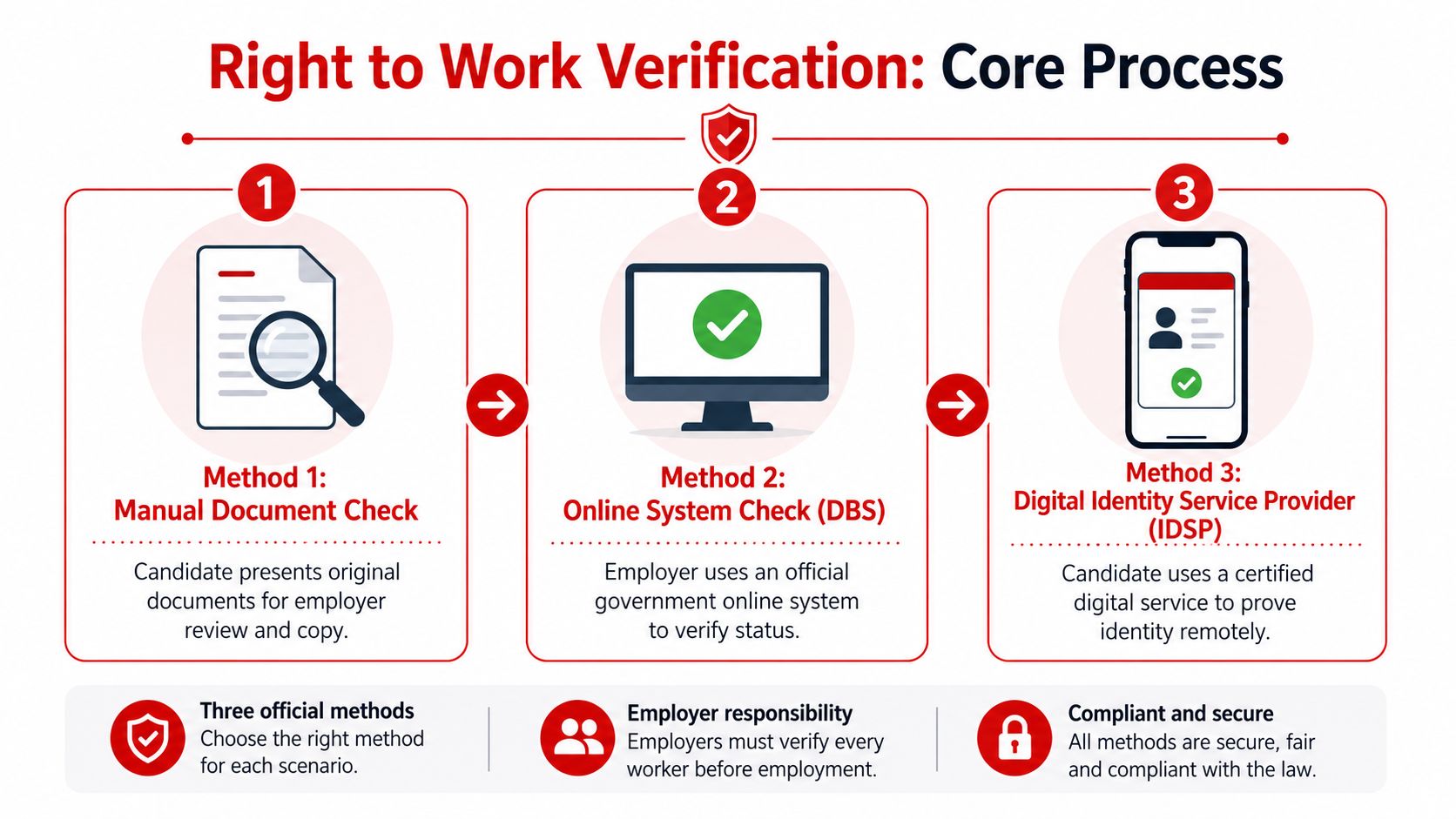
There are three routes to right to work verification in practice. Which one you use depends on the person's status and documents.
Start with the first question
Ask one thing first. How is this candidate entitled to work in the UK?
That answer tells you which path you're on:
| Route | Usually used for | What the employer does |
|---|---|---|
| Manual document check | Common for British and Irish citizens | See original documents in person and keep records |
| Home Office online check | People with digital immigration status | Use the share code and date of birth in the online system |
| Digital Identity Service Provider | Eligible British and Irish hires | Use a certified provider for identity verification |
Method one for original documents
For many British and Irish candidates, the check is still a manual one. The candidate shows original documents, you inspect them, and you keep a clear record.
This isn't a glance across the bar while taking a delivery. You need to look at the document properly, make sure it belongs to the person in front of you, and make sure the document supports the kind of work you're hiring them to do.
Use this approach when you're hiring, for example, a permanent chef de partie in Bristol, a breakfast chef for a boutique hotel in Berkshire, or a kitchen porter moving into a prep role in Wales.
Method two for online status
Some workers can only prove their status online. In those cases, the right to work verification check happens through the government service, not through a physical card or paper someone pulls from a wallet.
This is often where rushed managers go wrong because they treat a physical immigration document as enough. It isn't, if that worker's status has to be checked online.
Before you rely on any process, refresh your team on employment law compliance for hospitality staffing.
A quick visual summary helps if you're training supervisors:
Method three for a digital identity provider
For eligible British and Irish hires, a certified Digital Identity Service Provider can be used. This can help when speed matters and your managers need a cleaner process.
That said, don't confuse convenience with a free-for-all. The rules still matter. The method has to be appropriate for the worker, and your records still need to stand up if reviewed later.
Practical rule: If your team can't explain why they used a particular check method for that candidate, they probably shouldn't be using it.
The old COVID shortcuts are over
Some operators still think video calls and emailed documents are enough because that's how they hired during the pandemic. That's outdated.
The temporary remote adjustments ended, and in-person right to work checks were reinstated from 1 October 2022 after the COVID temporary measures expired on 30 September 2022, as noted by Reed Smith on the return to face-to-face checks. For new recruits, remote video verification on its own is not legally compliant.
If your managers in Reading, Slough, Devon, or Dorset are still accepting a passport photo by WhatsApp and a quick Teams call, fix that now.
Your Essential Document Checklist
Managers lose time by overcomplicating documents, then lose candidates by rejecting valid ones.
Hospitality hiring needs a checklist that works on the ground. Not every possible edge case. Just the documents you're most likely to see when hiring chefs, kitchen porters, front of house staff, and seasonal support.
What you'll usually see in hospitality
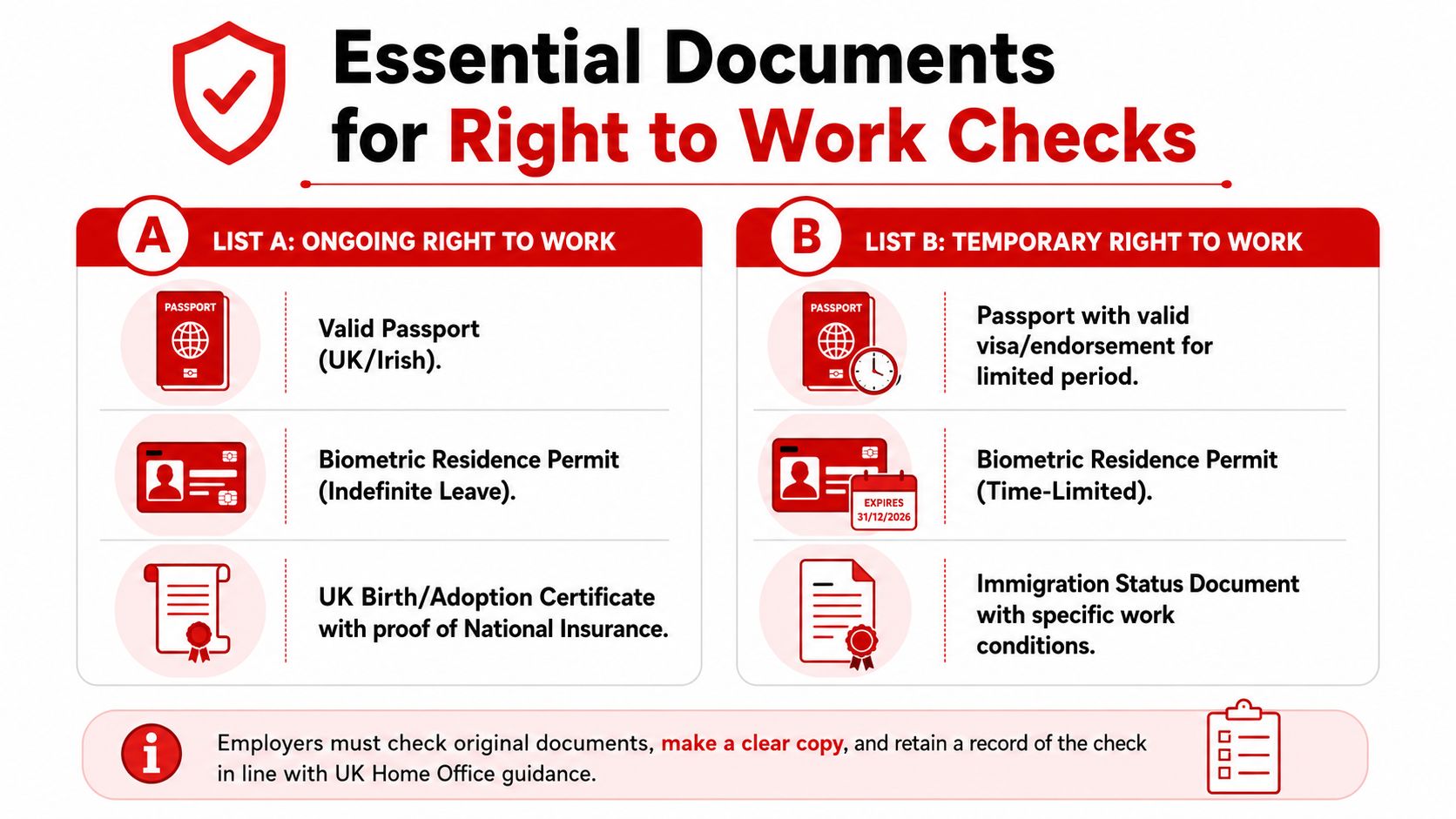
You'll generally come across two practical categories.
Ongoing right to work evidence
- British or Irish passport presented as part of a compliant check
- Birth or adoption certificate supported by proof of National Insurance
- Documents showing settled status or permanent entitlement, where the relevant route applies
Time-limited right to work evidence
- A passport with a valid visa or endorsement
- An immigration status document with conditions attached
- Digital status that requires an online confirmation
The point isn't to memorise every Home Office list entry. The point is to know when the candidate has ongoing permission, when their permission is time-limited, and when you must diarise a follow-up.
One rule many managers still get wrong
This catches out good candidates every week.
Expired British or Irish passports can still be acceptable if the worker also provides a second document such as a birth certificate or National Insurance number letter. GOV.UK confirms this, and the same source notes that 28% of UK hospitality employers reject valid applications unnecessarily because they misunderstand the rule, as explained on GOV.UK guidance for proving the right to work.
That matters in hospitality because decent candidates often need to start quickly. If you reject someone who is valid purely because their passport is out of date, you create your own staffing shortage.
A simple manager checklist
Use this on every hire before their first shift:
- Match the person to the document. Not the hairstyle from five years ago. The person standing in front of you.
- Check the document supports the role. Some candidates can work, but not without restrictions that affect your rota.
- Look for damage, tampering, or missing detail. Don't ignore a problem because you're desperate.
- Take and store a clear copy in the format your business uses consistently.
- Record when the check happened and who carried it out.
- Flag any re-check date immediately for time-limited status.
A pub in Wales hiring for a bank holiday weekend doesn't need a legal seminar. It needs a disciplined checklist. Same goes for hotels in Windsor or restaurants in Bristol trying to secure extra brigade support before a busy event run.
Mastering the Home Office Online Check
This is the part many managers still fumble. They see a physical BRP or BRC, it looks official, and they assume the job's done.
It isn't.
Since 6 April 2022, employers can't accept physical Biometric Residence Cards or Biometric Residence Permits as proof of right to work. Holders must prove status through the Home Office online service using a share code, and physical cards no longer provide a statutory excuse, as explained in DavidsonMorris guidance on right to work checks and share codes.
What a share code actually is
A share code is the worker's way of giving you controlled access to their current status through the government system. The worker generates it. You use it, together with their date of birth, to check their right to work online.
That matters because the online record reflects the person's current immigration position. A physical card can look fine even if the underlying status has changed.
How to run the check properly
For a hospitality manager, the process is straightforward:
- Ask the candidate for a share code before they start
- Get their date of birth
- Enter both details into the government checking service
- Review any work restrictions shown
- Keep the result record properly
If the system shows restricted hours, a limited period, or conditions that don't fit your rota, don't improvise. Work to what the system says.
Where businesses come unstuck
The common mistake is relying on appearances. A physical card in a wallet. A photocopy from a previous role. A candidate saying, “I've always worked here before.”
None of that protects you.
If the worker's status must be checked online, an old physical card is useless for compliance even if it looks perfectly valid.
For hotels, pubs, restaurants, private households, and event sites using short-term labour, the online route is often the safest one because it gives you current status direct from the Home Office, not guesswork based on a document someone still happens to be carrying.
Agency Relief Chefs and Temps The Compliance Shortcut
Hospitality businesses consequently waste time and create risk for themselves.
Managers often assume every pair of hands entering the kitchen triggers the same internal document process. That isn't always true. The rules around direct employees, self-employed contractors, agency workers, and relief chefs are not identical, and plenty of businesses blur them together.
That confusion costs time when you're already under pressure from late call-offs, split-site rotas, weddings, race days, summer trade, or Christmas bookings.
Direct hire versus agency supply
If you directly employ someone, your right to work verification responsibilities sit with you.
If you bring in non-employees such as independent contractors or short-term relief chefs through compliant agencies, the responsibility for right to work checks will typically remain with the agency. That matters because 32% of hospitality firms incorrectly assume they must verify every contractor, creating unnecessary admin and risk, according to HR Topics guidance on right to work responsibilities for contractors and agencies.
Why this matters in real kitchens
Take a common scenario. A hotel in Reading loses a banqueting chef before a weekend event. Or a pub in Slough needs emergency cover after a sickness call at midday. Or a restaurant in Devon needs a strong senior chef for a busy holiday period but doesn't want to rush a permanent hire.
In those cases, the smartest route is often not scrambling to onboard a direct employee at speed. It's using a compliant temporary staffing arrangement where the legal checks are handled where they should be handled.
That gives you:
- Less admin for already stretched managers
- Less compliance risk from rushed in-house decisions
- Faster deployment when service cannot wait
- Better kitchen stability because vetted relief cover is easier to slot into pressured brigades
The practical line managers should remember
Don't create work you don't legally need to create. And don't take on liability that belongs elsewhere.
Use direct hiring when you have the time and structure to do it properly. Use specialist temporary cover when the business needs speed, flexibility, and a compliant route into service. If your team handles temporary labour often, they should understand employment law for temporary staff in hospitality settings.
A relief chef sent through a compliant agency solves two problems at once. You fill the section, and you avoid dragging your managers into the wrong verification process.
That's especially useful in hospitality hotspots where staffing pressure never really switches off, from Bristol and Dorset to Berkshire and coastal seasonal locations.
Record Keeping and How to Avoid Common Pitfalls
A right to work verification check is only half done until the record is stored properly.
That's where confident employers come unstuck. 89% of UK employers said they were confident in conducting checks correctly, but 80% failed at least one compliance question in official government testing, according to the government's employer awareness and compliance findings.
What proper record keeping looks like
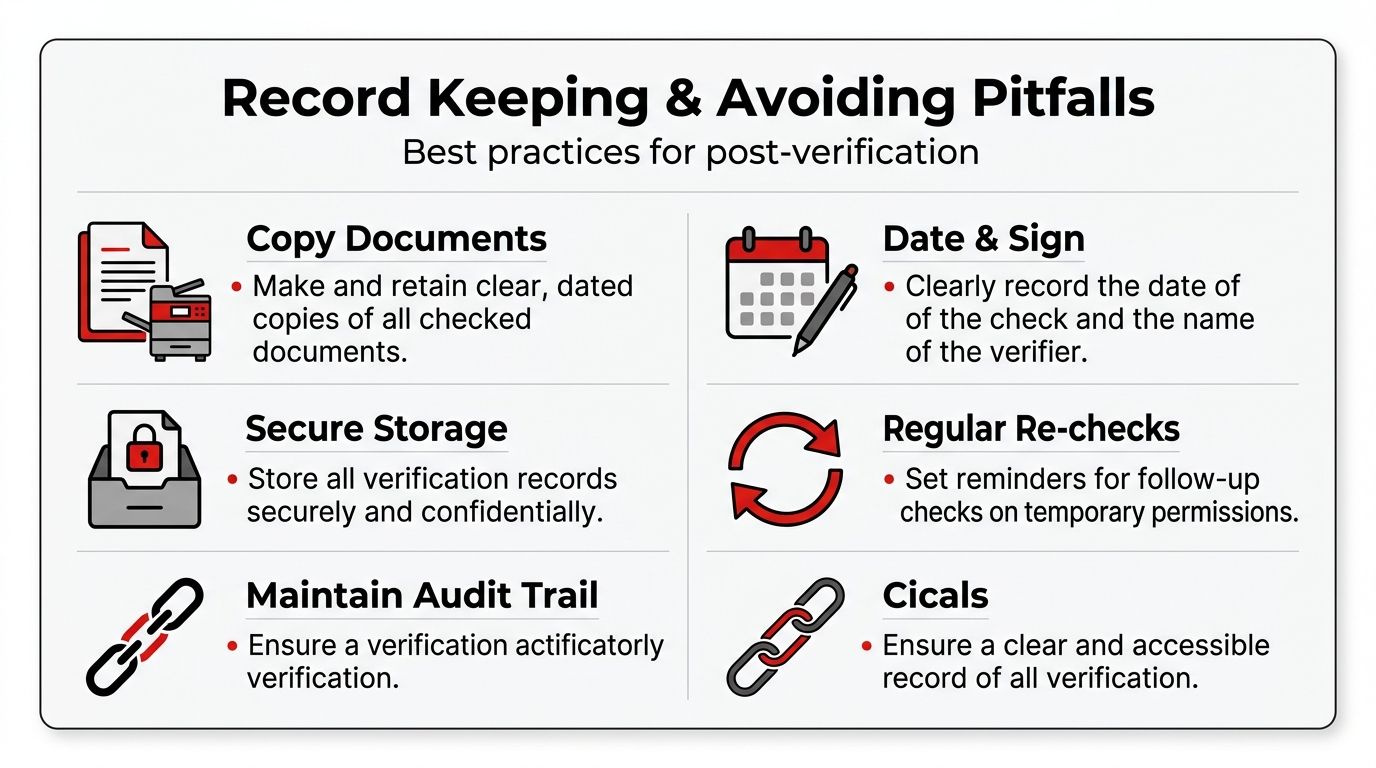
For hospitality operators, this is the clean standard:
- Keep a clear copy of the evidence checked
- Record the date the check was made
- Store the records securely
- Make records easy to retrieve if you need to prove what was done
- Retain them for the full employment period and for two years after employment ends
Where a worker has a temporary right to work, you also need a reliable reminder process for re-checking before the permission runs out. If there's a Positive Verification Notice involved, don't lose track of it. That's where messy admin turns into avoidable exposure.
The mistakes that keep repeating
In hospitality, the same errors come up again and again:
| Pitfall | What it looks like in practice | Result |
|---|---|---|
| Incomplete copy | A rushed passport image with missing detail | Weak record if challenged |
| No date recorded | Manager checked it but never documented when | Hard to prove compliance timing |
| Wrong follow-up | Temporary permission expires and nobody diarised it | Worker stays on without re-verification |
| Informal storage | Documents saved in random emails or phones | Poor audit trail and security risk |
The boring discipline that saves money
No one opens a restaurant to become a filing clerk. But the businesses that survive pressure are the ones that treat records as protection, not irritation.
Keep one standard process across every site, every manager, and every shift pattern. Compliance breaks when each venue invents its own version.
That matters even more for multi-site groups, independent hotels, and operators covering mobile teams across Wales, Bristol, Windsor, Reading, and beyond. One sloppy site can create a group-wide problem.
Frequently Asked Questions About Right to Work Checks
Do I need to check a relief chef supplied by an agency?
Usually, no, if the chef is supplied as a non-employee through a compliant agency arrangement. The responsibility will typically sit with the agency. Don't duplicate checks just because the chef is working in your kitchen for a short period.
Can a candidate use an expired British or Irish passport?
Yes, in the right circumstances. An expired British or Irish passport can still be acceptable when supported by the additional document covered earlier in this guide. Don't reject someone automatically because the passport date has passed.
What if a candidate's documents look suspicious or damaged?
Stop the process and escalate it internally. Don't guess. Don't let urgency bully you into approving something you're uncomfortable with. If the document or status route doesn't look right, treat that as a warning sign.
Do I need to do a fresh check if I hire someone directly who worked for me before?
If they're coming back as a new direct hire, handle the onboarding carefully and make sure your records are current and complete for that employment. Don't assume an old file is enough just because the person has worked a season with you before.
What about chefs with restricted work conditions?
Read the status result and rota accordingly. If the worker has limits attached to their permission, your scheduling must reflect them. A compliant hire can still become a non-compliant deployment if the rota ignores the conditions.
Is video checking enough if the candidate is remote?
No. The old pandemic shortcuts are not the standard now. If your team is still relying on video calls and emailed images alone for new starters, your process needs fixing.
If your kitchen is under pressure and you need compliant cover without the admin headache, contact Relief Chefs UK. Established in 2013, they support pubs, restaurants, boutique hotels, private households, yachts, and villas across the UK with relief chefs, temporary chefs, permanent chef recruitment, yacht chefs, villa chefs, and wider hospitality staffing support. When short notice sickness, seasonal demand, agency unreliability, or chef shortages put service at risk, they help keep kitchens stable with vetted nationwide staffing support.
Call the team.
Office 01392 715474 · info@reliefchefs.co.uk