
Friday afternoon. Full restaurant. Private dining booked. Residents already asking about dinner. Then your sous chef rings in sick, your agency chef doesn't answer, and the only person available says they're “self-employed” and can start in an hour.
That's the moment most hospitality operators stop thinking about law and start thinking about survival.
I get it. In Bristol, Devon, Berkshire, Windsor, Reading, Slough, Wales, Dorset and every other pressure-cooker hospitality patch in the UK, managers are constantly plugging gaps caused by sickness, walkouts, seasonal demand, unreliable agencies, chef shortages and kitchen instability. But the legal risk doesn't disappear because service starts soon. It gets worse when decisions are rushed.
Good operators treat employment law for temporary staff as an operating discipline, not admin. If you get it right, you protect margin, avoid disputes, keep payroll clean, reduce HR noise, and stop one emergency shift turning into a much bigger problem.
The Hidden Risks of Temporary Hospitality Staff
A bank holiday no-show rarely arrives on its own. It usually lands on top of a weekend rota gap, a stock issue, and a menu that only works if the kitchen stays organised. So the panic hire begins. A chef gets booked through a contact of a contact. Nobody checks status properly. Nobody confirms who pays holiday pay. Nobody is clear on insurance. Service goes ahead, but the underlying risk remains.
The biggest mistake I see is this. Managers think the problem is a missing body in the kitchen. It isn't. Instead, the problem is an undocumented working arrangement created under pressure.
In hospitality, that can mean all sorts of headaches:
- Pay disputes because the chef expected one rate and payroll processed another
- Holiday pay confusion because nobody decided whether it was accrued, rolled up, or included correctly
- Working time issues when a temp is thrown into back-to-back shifts without proper breaks
- Liability arguments if equipment is damaged, stock goes missing, or an accident happens
- Status challenges when someone labelled as freelance functioned as part of your team
A pub in Dorset in peak season feels this differently from a boutique hotel in Windsor, but the pattern is the same. If your staffing model is loose, your compliance is loose. And loose compliance costs money.
Practical rule: Don't ask only, “Can this person cook tonight?” Ask, “Who engages them, who pays them, what rights apply, and where does liability sit?”
That sounds heavy when you're trying to save a dinner service. It's still the right question. A fast fix that creates legal exposure isn't operationally smart. It's just delayed pain.
If you want a clear example of how emergency cover decisions can create wider business damage, this guide on the hidden cost of bad chef cover and emergency relief chef booking is worth reading. It addresses the core problem. Short-term staffing choices affect standards, team morale, guest experience and profit.
Worker Employee or Self Employed Explained
If you only remember one thing, remember this. What you call someone doesn't decide their status. The substance of the relationship does.
A lot of hospitality businesses get into trouble because they use the word “freelance” as if it solves everything. It doesn't.
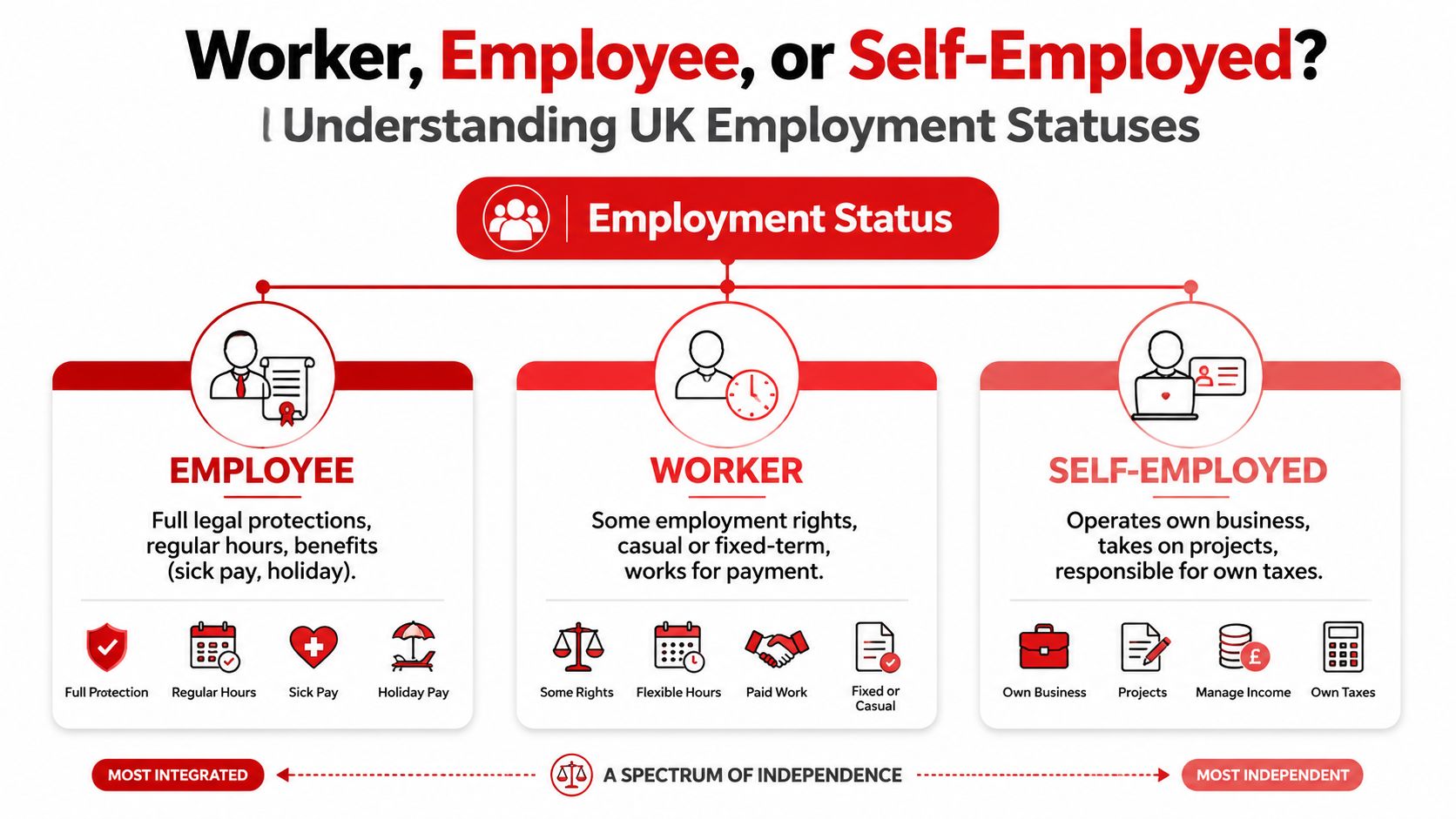
Employee
An employee is usually embedded in the business. Think of your salaried Head Chef, hotel breakfast chef on a regular rota, or a permanent CDP working set shifts under your direction.
The signs are familiar:
- Regular hours with an expectation they'll keep working and you'll keep offering work
- Direct control over how, when and where they do the job
- Integration into the team, systems, standards and management structure
- Fuller rights around dismissal, leave and other protections
This is the clearest category in most kitchens.
Worker
A worker sits in the middle. Many temporary hospitality arrangements fall into this category. A relief chef covering a run of shifts at a hotel in Reading, or a temp pastry chef brought in for an event season in Berkshire, may well be a worker rather than self-employed.
The practical test is simple. If you expect them personally to do the work, you tell them what shift to do, where to be, what standards to follow, and you pay them for that labour, worker status is usually the safer starting point.
Workers often have important rights, including rights around pay, holiday and working time. That's why this category matters so much in employment law for temporary staff.
Self-employed
A self-employed person runs their own business. They don't just turn up and work a line section under your Head Chef for a busy Saturday.
A better hospitality example is a consultant hired to redesign your menu, train your brigade for a limited project, or advise on kitchen flow. They usually control how the work is done, can work for multiple clients, invoice for the service, and carry more independence.
If you control the shift, the uniform, the timing, the kitchen systems and the output, don't kid yourself that the person is automatically self-employed.
The two questions that matter most
Lawyers use more detailed tests, but in operational terms I always start here:
Control
Who decides what the person does, when they do it, and how they do it?Mutuality of obligation
Are you expected to offer work, and are they expected to accept it?
If the answer to both points leans towards your business, be careful. You may be dealing with an employee or worker, not a contractor.
Why misclassification hurts
Get status wrong and the damage isn't theoretical. You can end up with tax problems, payroll corrections, disputes over holiday pay, arguments over notice, and tribunal exposure. It also wastes management time. You'll spend more hours untangling the mess than you saved by winging it.
That's why busy operators should avoid improvised status decisions in the middle of a staffing crisis. If the arrangement looks and feels like labour supplied into your operation, treat it seriously from the start.
Your Legal Duties Statutory Rights for Temps
Temporary doesn't mean optional. If someone works in your kitchen, basic legal rights can apply from the outset. That catches out a lot of hospitality businesses, especially when shifts are ad hoc and the rota changes daily.
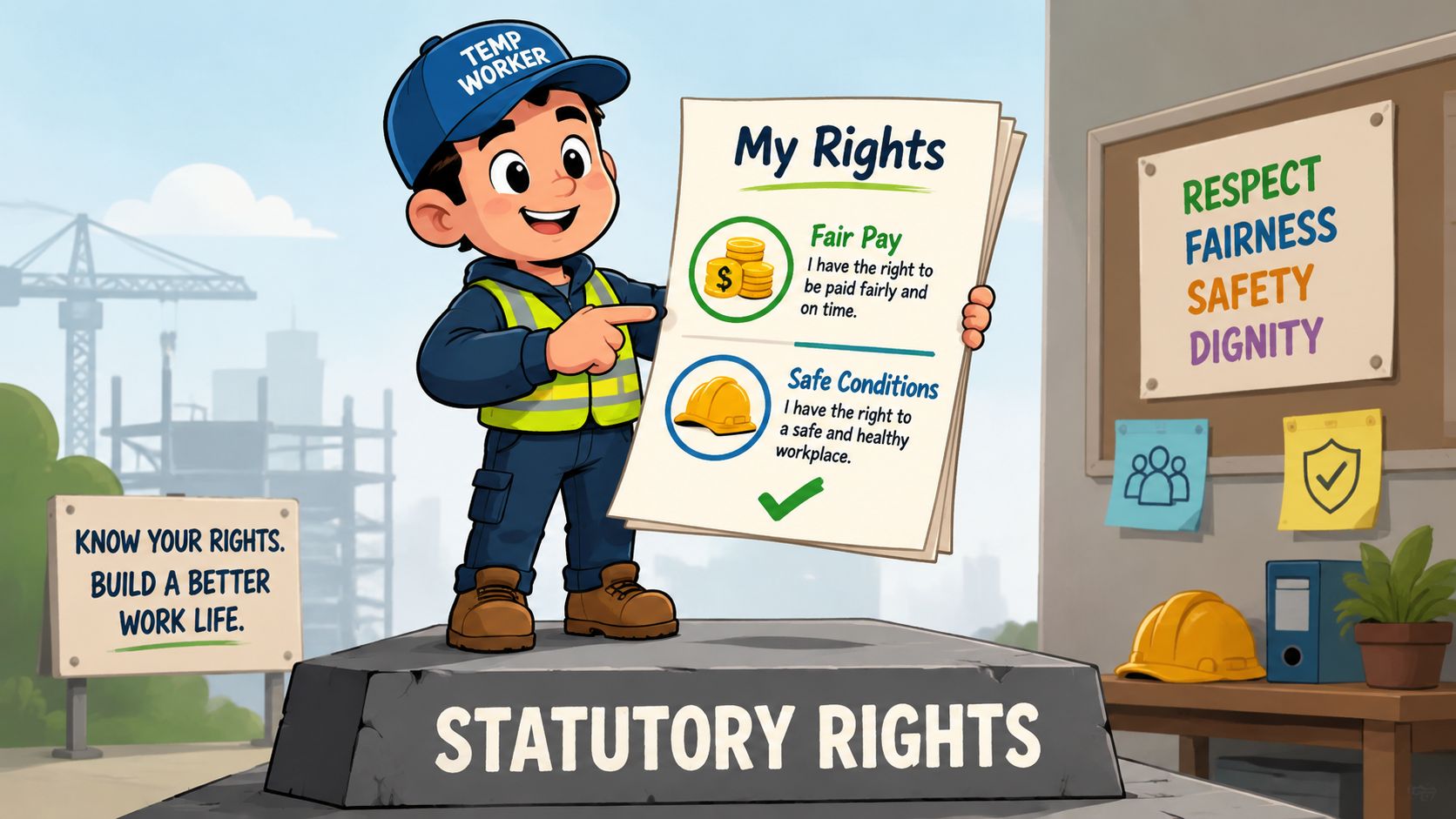
Pay must be lawful from the first shift
The first duty is obvious, but it's still where businesses slip. Temporary chefs and kitchen staff must be paid properly for the work they do. That includes making sure the pay arrangement is lawful, clear, and recorded.
Chaos causes mistakes:
- Shift overruns that aren't reflected in payroll
- Day rates that don't stack up once long hours are worked
- Unpaid trial shifts dressed up as “seeing how they get on”
- Confusion over deductions for meals, accommodation or kit
If you can't explain the pay model in one clean sentence, it isn't clean enough.
Holiday pay is not a technicality
Even short-term staff can accrue holiday entitlement. That means the old line, “They only did a couple of shifts so it doesn't apply,” is wrong-headed and risky.
For casual hospitality staff, managers often need a practical way to account for accrued holiday pay. Whatever method you use, it must be lawful, transparent and documented. Don't leave it sitting in someone's inbox as a payroll assumption.
A temp chef who works briefly can still build up holiday entitlement. Short assignment does not mean no entitlement.
That's one reason fluctuating labour is hard to run in-house when you're already managing food costs, guest complaints and service pressure in places like Wales or Windsor.
Breaks and working time still matter
Hospitality has a bad habit of acting as if legal rest rules belong to office jobs. They don't. A temporary chef doing doubles through a slammed weekend can still have rights around breaks and working time.
Managers need to check:
- Shift length and whether breaks are being given in practice, not just on paper
- Back-to-back bookings across multiple sites or employers
- Travel-heavy assignments for mobile chefs or specialist cover roles
- Fatigue risk in high-heat, high-pressure kitchens
A tired chef is not just a performance issue. It's a safety issue.
Here's a useful explainer on the wider framework:
Sick pay and basic protections
Sick pay rules can become messy fast when status, payroll route and assignment length aren't properly set up. That's why the responsible approach is to decide before the shift starts who the employer is, who processes pay, and who handles statutory obligations.
Don't leave the temp chef to figure that out after they've already worked.
What smart operators do
The best-run sites build a repeatable process. They don't renegotiate legal basics every time somebody calls in sick.
Use this operating rule:
- Confirm status early
- Record pay clearly
- Track hours accurately
- Deal with holiday pay deliberately
- Know who handles statutory payments
If your current model relies on memory, WhatsApp and verbal promises, it's too fragile for modern hospitality.
Agency PAYE Umbrella or Direct Hire Models
How you engage temporary staff matters almost as much as who you engage. In practice, most hospitality businesses use one of three routes. They hire directly, book through an agency using PAYE, or deal with an umbrella arrangement.
Each model can work. Each can also go wrong.
Direct hire gives control but creates admin
Direct hire can make sense if you already have strong payroll, HR admin and right-to-work processes. You engage the individual yourself, decide the terms, process the pay, and manage the record-keeping.
That sounds cheaper on paper. It often isn't once you factor in the time spent on onboarding, payroll setup, holiday calculations, status questions, and disputes when things go off-script.
It also puts more legal responsibility directly on your business.
Agency PAYE is usually the safest route for busy venues
For many operators, agency PAYE is the most commercially sensible option. The agency supplies labour through a structured arrangement, handles payroll through PAYE, and puts proper paperwork around the assignment.
That matters when you need a relief chef in Slough for a same-week rota gap, a temporary chef in Devon for holiday season pressure, or specialist support for yachts, villas, events and premium private households. Speed is useful. Speed with compliance is what protects the business.
A good breakdown of the practical differences between suppliers is in this guide to temporary staffing agencies for hospitality businesses.
Umbrella models need real caution
Umbrella companies sit between the worker and the end client. Some are legitimate. Some create confusion, especially when nobody in the venue understands who employs the worker, who deducts tax, or what happens if pay is challenged.
My view is simple. If a model is hard to explain to your GM, your payroll lead and the chef on shift, don't use it casually.
The more layers between your kitchen and the payslip, the more carefully you need to check who carries the legal duties.
Temporary Staffing Models Compared
| Factor | Direct Hire (Worker) | Agency PAYE (like Relief Chefs UK) | Umbrella Company |
|---|---|---|---|
| Speed | Can be slow if checks and payroll setup aren't ready | Usually faster for urgent cover | Varies depending on provider |
| Admin burden | High for the venue | Lower for the venue | Can look light at first, but queries often get messy |
| Status clarity | Your business must assess it | Agency structure often gives better clarity | Can be confusing if roles and responsibilities are poorly explained |
| Payroll handling | Managed by your business | Usually managed by the agency | Managed through umbrella arrangements |
| Holiday and statutory process | You must get it right | Usually handled within the agency model | Needs careful checking |
| Legal risk | Sits heavily with the venue | Shared through documented supply arrangements, but the venue still has obligations | Can be higher if the scheme is poorly run |
| Best use case | Planned short-term hires with admin capacity | Urgent chef cover, repeated temp needs, specialist placements | Only where the structure is fully understood and vetted |
Don't ignore equal treatment rules
If agency workers stay with you long enough, equal treatment issues can arise. That means your business can't assume all legal responsibility sits elsewhere forever. End-user clients still need to understand what applies on site, how long assignments run, and whether working conditions line up properly.
If a temporary role becomes permanent, review the transition carefully. Don't assume a temp-to-perm move is just a handshake and a new rota line. Contracts, continuity issues, and occasionally transfer rules can all come into play depending on the situation.
The Importance of Written Contracts for All Staff
A verbal agreement might get someone through the kitchen door. It won't protect you when there's a disagreement.
That's why every hospitality business should take written terms seriously for temporary staff. Not because it looks corporate. Because memory is useless once the shift is over and the argument starts.
Verbal deals create expensive confusion
Here's the common version. A head chef agrees a rate on the phone. The chef arrives expecting one thing. The business expected another. Nobody wrote down hours, break arrangements, holiday handling, notice, who supplies uniform, or who to contact if there's a problem.
Then one of three things happens:
- the chef walks before the next shift
- payroll gets challenged
- management spends days reconstructing what was supposedly agreed
That's a false economy.
What needs to be in writing
Employees and workers should receive a written statement of principal particulars on or before day one. In practical hospitality terms, that document should clearly set out the basics.
Include things like:
- Who the parties are
- Start date and role
- Pay rate and payment timing
- Hours or shift expectations
- Holiday entitlement
- Place of work
- Notice terms
- Any probation or assignment rules
- Key policies that apply on site
Short-term doesn't mean informal. It means concise and clear.
If you can't produce the written terms quickly, you're not ready to put that person into service.
Written terms also protect standards
This isn't just about legal defence. It helps operationally. A temporary breakfast chef in a hotel in Bristol needs different expectations from a villa chef in Devon or a yacht chef joining a UK-based assignment. Written terms stop assumptions from filling the gaps.
They also make ending an assignment cleaner if someone isn't the right fit. Without documented terms, even a straightforward disengagement can become personal, messy and time-consuming.
My recommendation
Use a proper written agreement for every temp arrangement. No exceptions. Keep it readable. Keep it specific. Make sure your site leadership knows where to find it before the chef starts.
Hospitality businesses that skip this step usually tell themselves they're being flexible. What they're being is exposed.
A Compliance Checklist for Hiring Temporary Staff
Managers don't need another lecture. They need a working checklist they can use before the shift is confirmed. If this isn't built into your process already, it should be.
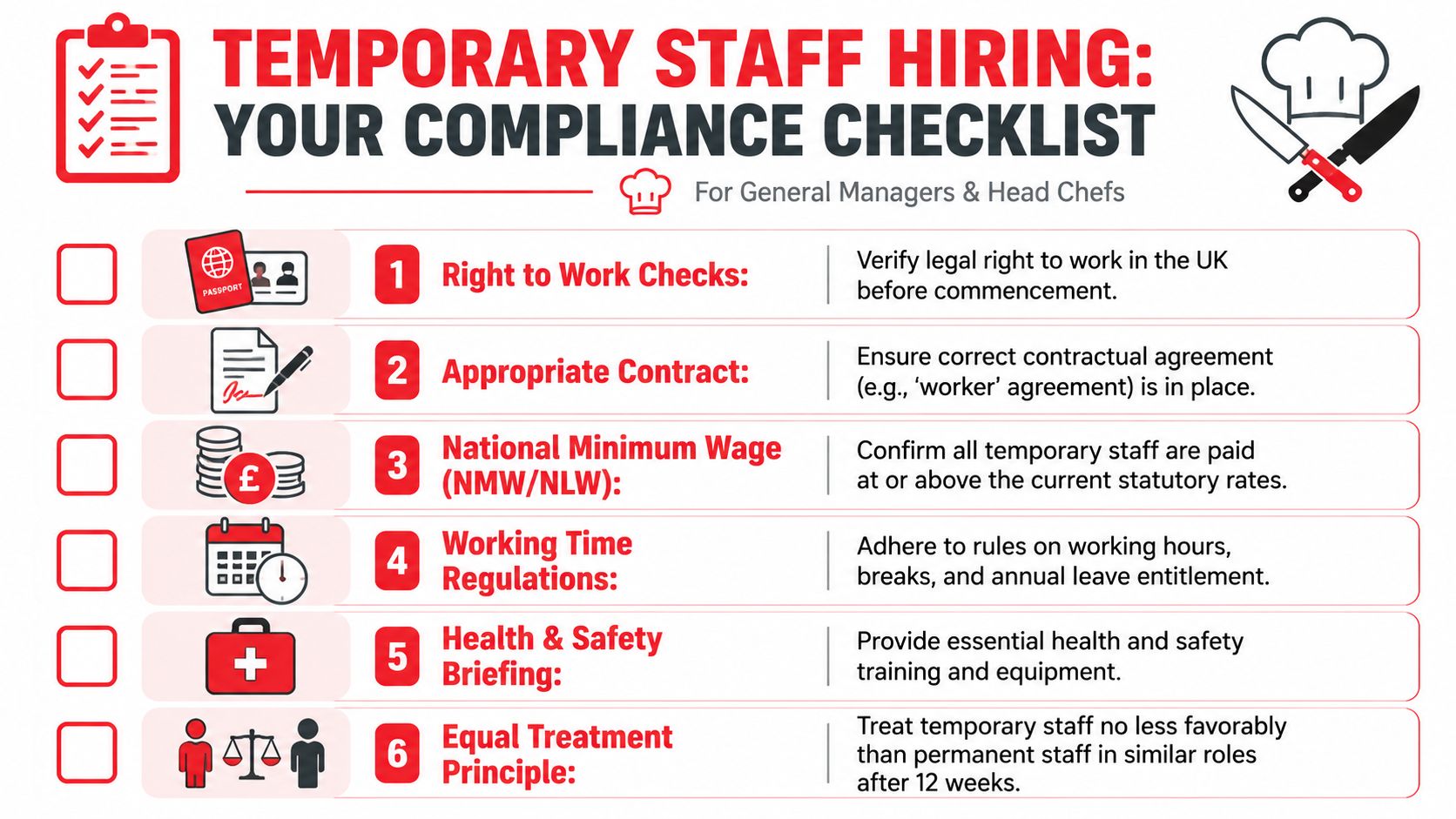
The pre-shift compliance list
Right to work
Verify the individual's right to work in the UK before they start. Don't accept vague assurances from a friend, former chef, or third party.Correct engagement model
Decide whether this is direct hire, agency supply or another structure. If you don't know who legally engages the worker, stop and fix that first.Pay and payroll route
Confirm who pays, how tax and National Insurance are handled, and who answers any wage query.Insurance
Check that employer's liability and public liability cover are in place and appropriate for the arrangement.Written terms
Make sure the agreement matches the actual working setup, not some recycled template from a different role.Working time and breaks
Review the actual shift pattern, especially if the person is being dropped into a pressured service or multi-day run.
The checks operators often forget
A lot of businesses cover the obvious bits and miss the quieter risks.
Health and safety briefing
Temporary doesn't mean they know your extraction system, allergen process, knife storage or fire exit route.Data handling
Staff records, ID documents and payroll information still need proper GDPR handling.Responsibility for holiday and statutory payments
Decide this before work starts, not after someone asks why their payslip looks wrong.
A concise legal overview helps if you need a second reference point. This page on employment law compliance for hospitality staffing is a useful one to keep on hand.
Good compliance is fast because the process is prepared. Bad compliance is slow because every emergency becomes an argument.
Why this becomes a competitive advantage
Most operators treat compliance as defensive. I think that's the wrong lens. Clean hiring processes help you secure better temporary staff, onboard them faster, avoid payroll disputes, and keep service standards stable during pressure periods.
That matters whether you run a gastropub in Berkshire, a coastal operation in Dorset, a city hotel in Reading, or a private hospitality setup needing villa chefs or yacht chefs. The businesses that handle staffing law properly usually run calmer services too.
Hospitality Employment Law FAQs
Do agency worker rules matter if I only book a chef for one shift
Yes, you still need to take the booking seriously. Some rights and responsibilities don't wait for a long assignment. The fact that the booking is short doesn't remove your duty to check who employs the chef, what terms apply on site, or whether pay and working conditions are being handled properly.
One shift can still create a dispute if the setup is sloppy.
A temp chef damaged expensive equipment. Who pays
It depends on the contract chain, the facts, and who had control. Start by checking the supply terms, any indemnities, your insurance position, and whether the damage arose from negligence, poor briefing, faulty equipment or an unsafe system of work.
Don't make deductions from pay casually. That's another area where operators create fresh legal problems while trying to solve the first one.
How do I end an assignment if the temp isn't good enough
Act quickly, but do it cleanly. Record the issue, remove the individual from duty if needed, and follow the relevant contractual route. If the chef came through an agency, notify the agency immediately and keep the communication factual.
Don't drift through multiple poor shifts because you feel awkward. In hospitality, weak performance spreads fast through service, standards and team morale.
Can I call a relief chef self-employed if they prefer it
No. Preference doesn't decide status. Reality does. If they work under your direction in your kitchen, using your systems, at times you decide, personal preference won't magically make the arrangement self-employed.
That's one of the biggest traps in employment law for temporary staff.
Are specialist roles like yacht chefs and villa chefs treated differently
The setting changes. The need for clear legal structure doesn't. Yacht chefs, villa chefs and private household hospitality staff can raise extra questions around jurisdiction, onboard living arrangements, travel, working patterns and who the actual employer is. Those bookings need tighter paperwork, not looser paperwork.
If anything, specialist placements deserve more care because the boundaries are less obvious than in a standard restaurant kitchen.
What should I do before the next staffing emergency hits
Build the process now. Agree your preferred hiring model, create a written checklist, train your managers on status and right-to-work checks, and stop relying on last-minute improvisation.
That's how you stay profitable under pressure. Kitchens don't become stable by accident. Operators make them stable with systems.
If you need compliant, dependable chef cover anywhere in the UK, contact Relief Chefs UK. Established in 2013, they support pubs, restaurants, boutique hotels, private households and yacht operations with relief chefs, temporary chefs, permanent chef recruitment, yacht chefs, villa chefs and wider hospitality staffing support. They're a trusted nationwide chef recruitment agency that understands short notice sickness, seasonal demand, chef shortages and kitchen stability because they've lived it. If your rota is exposed and service can't wait, get in touch and secure the right cover quickly.