

A UK hospitality business can carry insurance against a major property loss and still be badly exposed when its most important kitchen employee fails to arrive. That exposure is not theoretical. Analysis of 29,000 UK rebuild-cost assessments found that 81% of buildings were underinsured, with cover averaging only 63% of the amount required to rebuild (James Lindsay's underinsurance analysis).
The same principle applies to chef staffing. A promise of cover means little if the replacement arrives too late, lacks the required skills, or costs the venue another recruitment fee. Guaranteed replacement coverage should turn a failed booking into a controlled operational event, with a clear response time, a defined replacement window, matching standards and a named escalation route.
Introduction with Kitchen Crisis
At 3pm, a boutique hotel in Windsor is preparing for a full dinner service. The head chef calls to say they're ill and can't work. The sous chef is already covering a prep shortage, the front-of-house team is briefing on a new menu, and reservations are building towards a busy evening.
Within minutes, the general manager is calling agency contacts. The kitchen brigade is splitting responsibilities, suppliers are being checked, and someone is deciding which dishes might have to disappear from the menu. Morale drops before service has even started. If the business can't find competent cover, it may reduce sittings, delay plates, disappoint guests and lose revenue that can't be recovered.
This is the practical staffing equivalent of an underinsured building. The venue has a kitchen, equipment, stock and a menu, but it doesn't have enough dependable capacity to operate safely when one critical person is removed.
A replacement guarantee gives the business a defined response rather than a hopeful phone call. It should state who acknowledges the failure, how quickly a substitute is proposed, what “suitable” means, and whether the replacement is supplied without another fee. Relief Chefs UK's guidance on emergency relief chef booking reflects the fact that short-notice sickness, no-shows and agency unreliability need a process, not improvisation.
Understanding Key Concepts
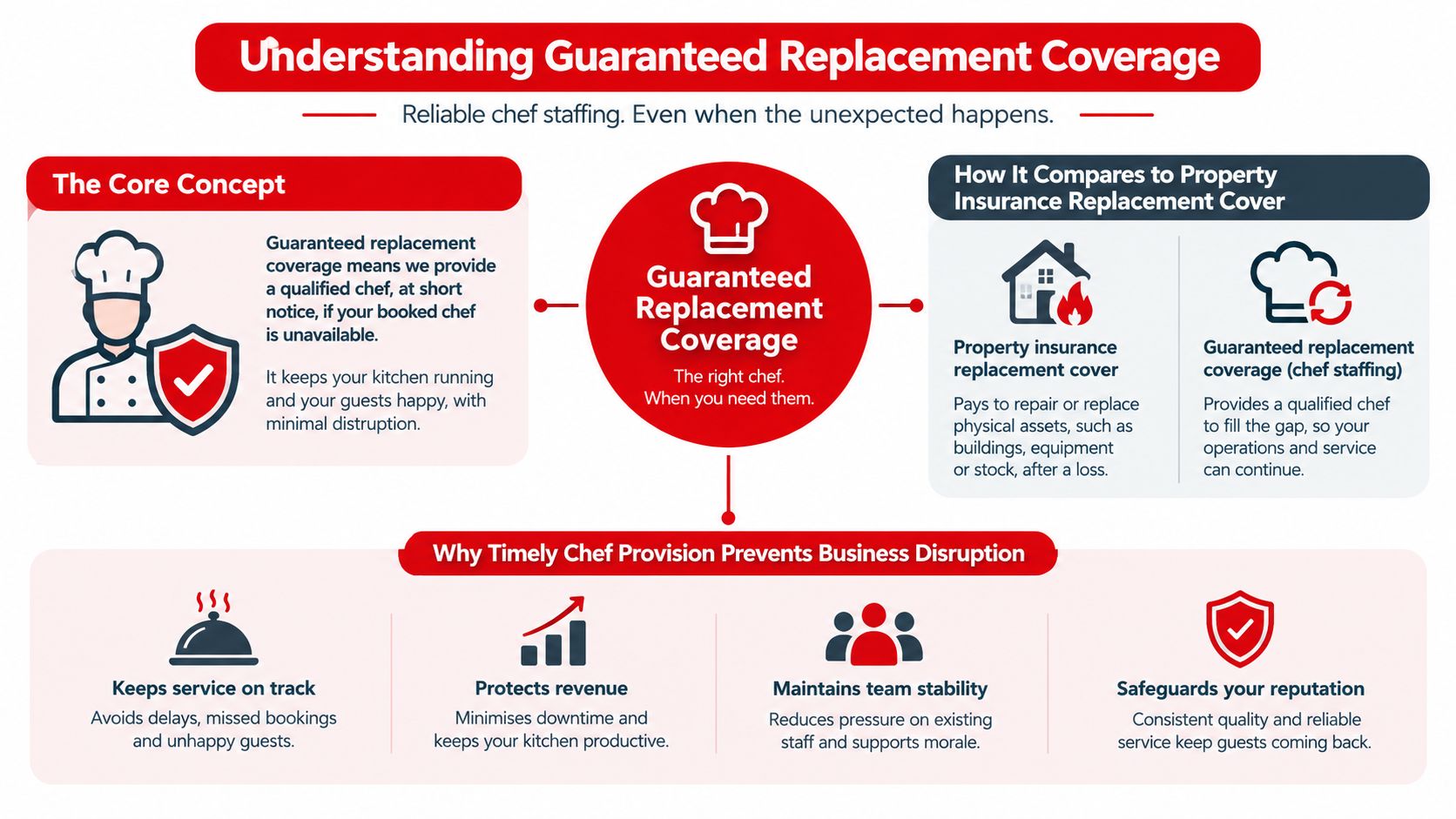
Guaranteed replacement coverage is a contractual promise to restore chef cover when an agreed booking or placement fails under defined conditions. Treat it as an operating safeguard, not a vague goodwill gesture. If the wording does not specify the trigger, the response clock, the standard for a suitable replacement and the fee treatment, the guarantee will fail when service pressure is highest.
The insurance comparison is useful because it clarifies what is being protected. In property, the argument is not just about having cover in place. It is about whether the basis of cover is strong enough to reinstate the building properly after a loss. In chef staffing, the equivalent test is whether the supplier is obliged to restore working kitchen capacity, not just send over another CV or another available name.
That distinction matters.
A weak guarantee focuses on activity. A workable guarantee focuses on outcome. For a hotel, pub or restaurant, the outcome is a chef who can turn up, fit the role, work safely, handle the menu and support service without forcing the team into damage control. Earlier evidence on underinsurance made the same point in a different context. The headline figure is less useful than the gap between what was assumed to be covered and what was needed on the day.
The five parts of a workable guarantee
Use a service agreement that makes five points measurable:
- Coverage scope. Define whether the guarantee applies to no-shows, failed attendance, early departure, unsuitable competency or another specific failure event.
- Response time. State when the supplier must acknowledge the issue and confirm active replacement action.
- Replacement window. Set the time allowed to produce substitute cover, measured from notice of failure or the booked start time.
- Matching standard. Spell out role level, section experience, cuisine fit, food-safety competence, right-to-work status and practical availability.
- Escalation route. Name the contact path for evenings, weekends and out-of-hours failures so the kitchen is not left chasing a generic inbox.
You also need a clean distinction between supplier failure and client change. A cancelled event, a reduced food offer or a revised brief should not be treated the same way as resignation, non-attendance or removal for poor performance.
Before any introduction is made, the agency should issue written terms that align with the Conduct of Employment Agencies and Employment Businesses Regulations 2003. Use clear service-level agreements for chef staffing so the promise is enforceable before a crisis starts.
Why It Matters for Hospitality
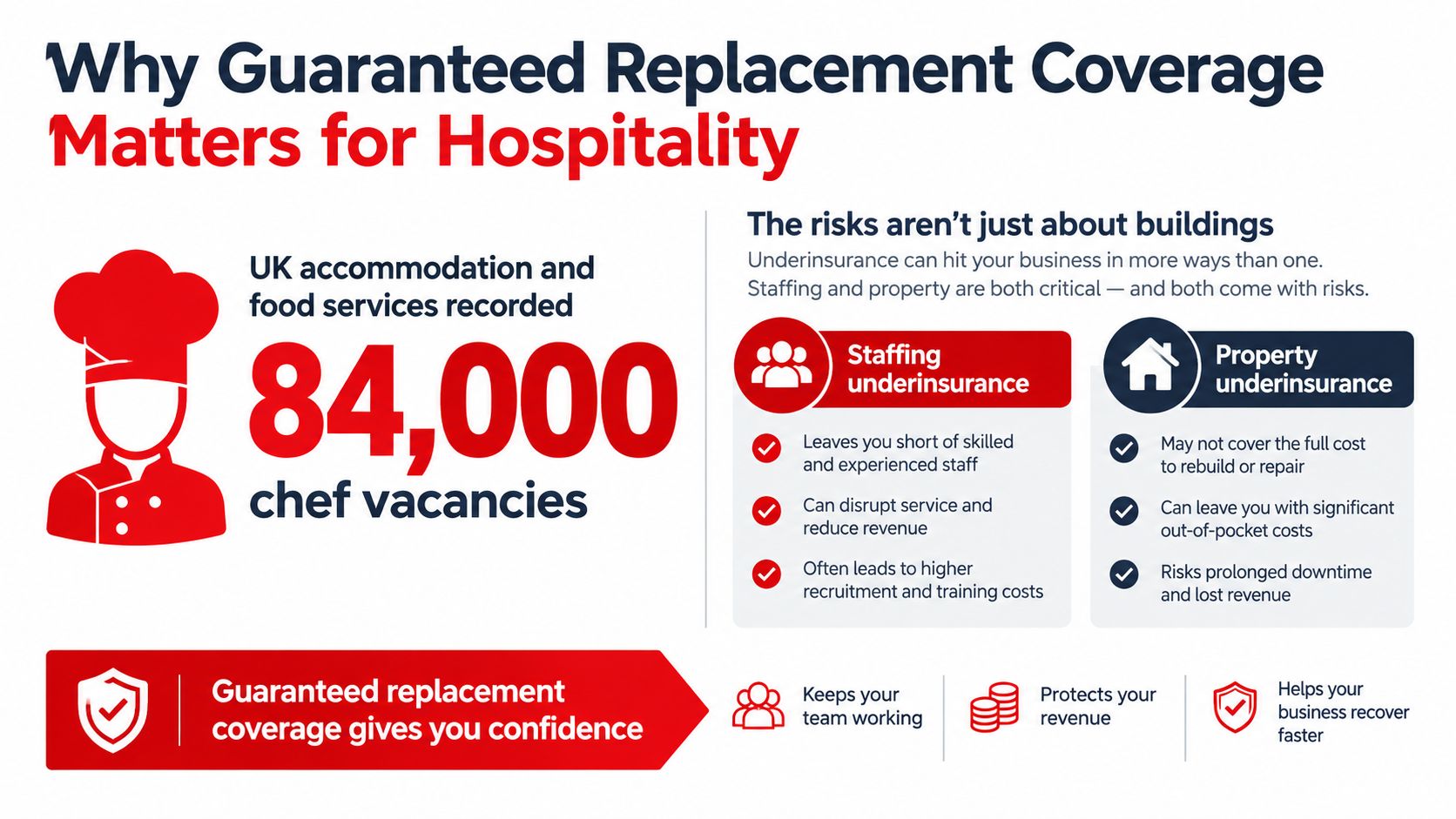
The sector still carried approximately 84,000 vacancies in early 2025, down from 107,000 a year earlier, a 21.5% reduction that still represented a substantial labour gap (Morning Advertiser coverage of hospitality vacancies). For operators, that is the point. A smaller vacancy number does not protect tonight's service.
A pub in Devon, a restaurant in Bristol and a hotel in Wales all face the same exposure. If a chef drops out close to shift start, you cannot create kitchen capacity on demand. You cut covers, compress the menu, push senior staff into the wrong station or pay overtime to hold the line. Guaranteed replacement coverage matters because it turns that staffing risk into a defined supplier obligation with clear service levels.
Measure continuity, not candidate volume
Hospitality buyers should stop judging agencies by how many CVs arrive. Judge them by whether service survives a failure. Six unsuitable profiles do nothing for a Saturday dinner service. One legally compliant, menu-ready chef who can step into the brigade does.
Use operational benchmarks that expose whether a guarantee will work under pressure:
- Acknowledgement, with a fixed time for confirming the failed booking.
- Response, with a target such as acknowledgement within two hours.
- Presentation, with a target such as a suitable substitute within 48 hours.
- Fulfilment, measuring how often urgent requests are covered.
- Early-failure rate, tracking replacements caused by non-attendance or poor suitability.
- Escalation, giving duty managers a direct route when the first option fails.
These measures matter because the hiring situation remains tight. RSM's hospitality employment analysis reported that hospitality payrolled employment fell from 2,111,898 in April 2025 to 2,100,827 in May 2025, while vacancies declined from 82,000 to 79,000 and were 19% lower year on year. A lower vacancy count still does not mean an experienced chef is easy to secure at short notice.
Practical rule: If a staffing guarantee does not define response time, matching standard, replacement window and cost responsibility, treat it as sales copy, not risk control.
How Relief Chefs UK Implements Replacement Coverage
Relief Chefs UK, established in 2013, treats replacement coverage as an operational service level, not a marketing promise. If a booked chef fails, the venue needs clear trigger points, named contacts, fixed response times and a written rule on who pays for the second search. That is how a staffing guarantee starts to work like a proper risk-control mechanism.
1. Acknowledge the failure quickly
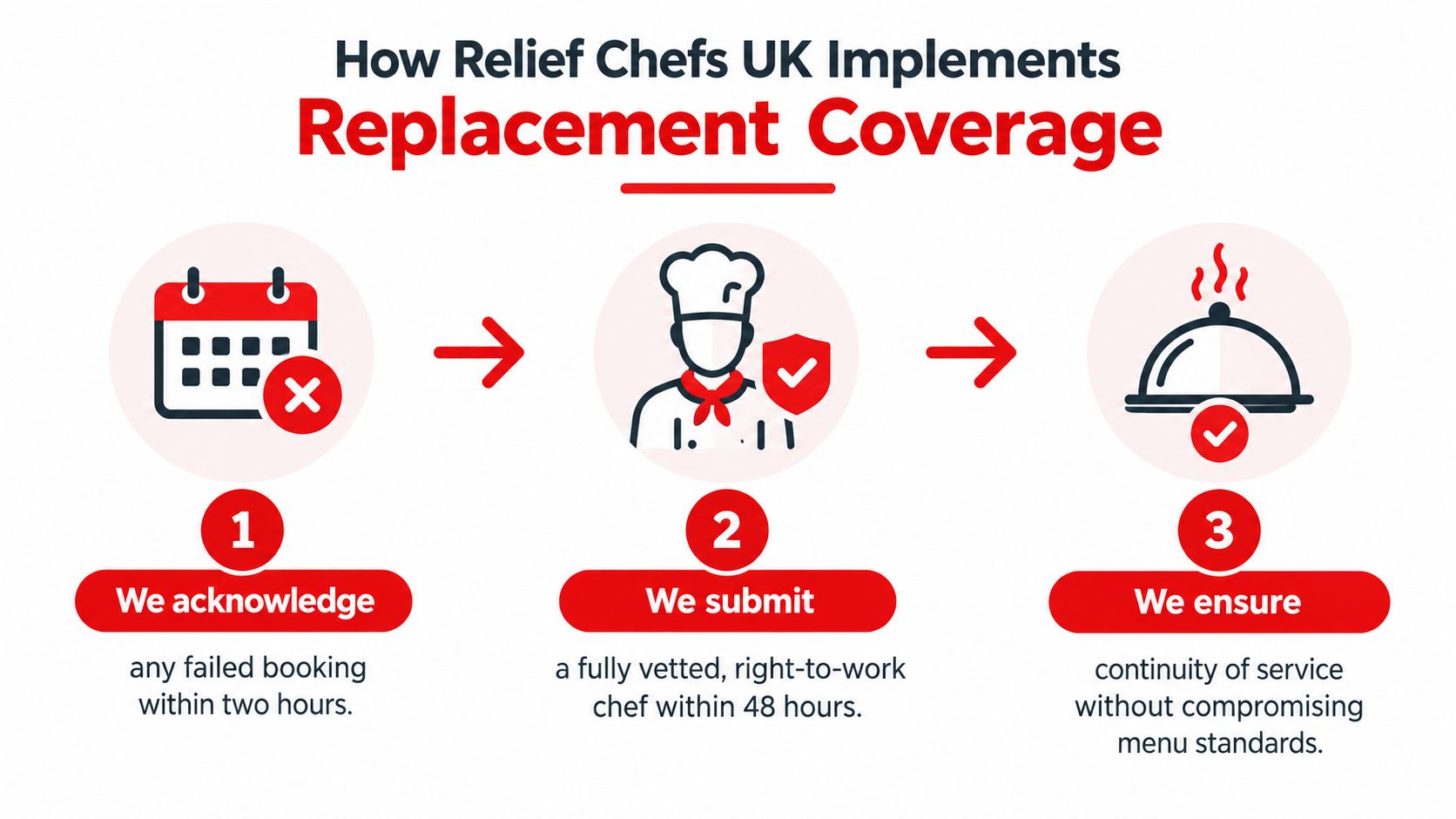
The first standard is simple. Once the client reports non-attendance, cancellation or a serious suitability issue through the agreed contact route, Relief Chefs UK should acknowledge the problem within two hours.
That acknowledgement matters because kitchen managers do not need silence. They need confirmation that the failed booking has been logged, the replacement process has started and someone owns the next step.
A useful incident log should capture the cause of failure, the affected shift or placement, the role level, service style, start time, travel constraints and any change to the original requirement. Written notification also needs to be practical. Email is usually the cleanest option because it creates a time-stamped record for eligibility under the agreement. If the chef is due on site that day, the phone call should come first, then the written confirmation should follow straight after.
Weak guarantees usually fall apart here. If the contract does not state how the venue must report the problem, when the agency must reply or who takes escalation calls outside office hours, the guarantee is too loose to protect service.
2. Present a vetted replacement
The second standard is quality under time pressure. Relief Chefs UK sets the target at submission within 48 hours, subject to the information the client provides and the type of assignment.
A replacement should arrive as a vetted match, not a rushed CV. That means checking right-to-work verification, relevant kitchen experience and practical fit with the site. A country house hotel covering breakfast and banqueting needs a different chef from a coastal pub running a compact seasonal menu with a small brigade.
Matching should be tested against a short operating checklist:
- Role level, such as sous chef, head chef or chef de partie.
- Cuisine capability, based on the menu and service format.
- Food-safety competence, especially for chefs supervising others.
- Availability, travel distance and realistic start time.
- Operational temperament, so the chef can slot into the existing brigade without causing another failure.
That is the bridge between insurance language and staffing delivery. A policy promise means little unless the replacement standard is precise enough to avoid a second claim on the same shift.
3. Apply the guarantee fairly
The commercial rule has to be explicit. For eligible clients on the Starter, Growth or Premium plans, a replacement supplied within the guarantee window should not trigger another recruitment fee when the failure falls inside the agreed terms.
Typical covered events include:
- Non-attendance, where the booked chef does not arrive.
- Cancellation, where the chef withdraws within the covered period.
- Unsuitability, where the chef falls below the agreed competency standard.
- Early failure, such as resignation or termination for performance within the stated eligibility window.
The agreement should also say what is excluded. Force majeure, client-led role changes, role withdrawal, redundancy and venue cancellations should sit outside the promise. The replacement window itself must be written down. employment agency agreement guidance notes 30 to 90 days as a typical range, with longer periods often used for more senior appointments.
If the first substitute cannot be secured, escalation should not depend on who happens to answer the phone. The client should have a named account manager and access to 24/7 recruitment support for urgent hospitality cover. That matters for breakfast operations, late dinner service, weddings and weekend trade, where delay turns a staffing problem into a service failure.
Benefits of Guaranteed Replacement Coverage
The strongest argument is continuity. A replacement guarantee gives a pub or hotel a defined route back to a functioning kitchen when sickness, non-attendance or a poor placement creates a gap. That matters during a Saturday dinner service, a wedding breakfast or a period when seasonal demand has already stretched the brigade.
Without coverage, managers may spend hours calling agencies, accepting the first available chef regardless of suitability or reducing the menu. Each choice carries a cost. A reduced menu can affect guest experience, while an unsuitable emergency hire can increase pressure on the permanent team and create another failure.
Compare the operating position
| Venue without a defined guarantee | Venue with guaranteed replacement coverage |
|---|---|
| Manager starts a new search from scratch | Provider reopens the search under agreed terms |
| Replacement quality depends on availability | Role, cuisine and competency standards remain clear |
| A second fee may be disputed | The agreement states when replacement is supplied without another fee |
| Escalation is unclear | A named account manager and support route are available |
| Menu changes become more likely | The venue has a stronger chance of preserving service standards |
The commercial calculation should compare the cost of downtime with the plan fee. A missed service can involve lost covers, wasted preparation, overtime for remaining staff, refunds, damaged reviews and a tired brigade. Those costs won't always appear on one invoice, but the general manager still carries them.
Guaranteed replacement coverage also improves planning. It doesn't replace a permanent recruitment strategy or a sickness contingency plan. It gives the business a second line of defence while it maintains its core kitchen team, uses relief chefs for urgent gaps and recruits permanent chefs for long-term stability.
For multi-site operators, the value is consistency. A group with venues in Berkshire, Windsor, Slough and Reading can define one replacement standard, one escalation process and one reporting approach. That makes agency performance easier to review and weakens the habit of solving every staffing problem as a one-off emergency.
Real Scenarios and Case Studies
The following examples show how the model works in practice. They're operational scenarios, not claims of historical client results, so the figures illustrate planning assumptions rather than measured case-study outcomes.
A Devon pub facing a late cancellation
A Devon pub has a head chef no-show two hours before dinner service. The venue has a fixed menu, a small brigade and a full booking list. The manager reports the failure, confirms the required competency and asks for a replacement who can protect the existing menu rather than prepare basic dishes.
Under a replacement process, the search begins immediately. A qualified relief chef is proposed and arrives in four hours for the evening service. The pub keeps its menu intact, avoids asking the sous chef to work an unsafe double shift and gives front-of-house a clear message to pass to guests.
The key lesson isn't the arrival time alone. The venue had already defined what “suitable” meant, so the replacement decision wasn't based solely on who happened to answer a phone.
A Berkshire hotel managing seasonal pressure
A Berkshire hotel expects higher covers on peak summer weekends and needs additional kitchen capacity. It uses priority support under a Premium plan to separate permanent recruitment from temporary operational cover. The hotel can add chefs for short-term demand without treating every seasonal requirement as a failed permanent placement.
That distinction matters because UK summer hospitality job postings were reported to be 25% lower year on year, while hospitality payrolled employment fell by 108,000 in the year to July 2025 (The Caterer's recruitment coverage). A permanent placement guarantee and a temporary staffing response solve different problems.

The hotel's manager should track service uptime, fulfilment, early departures and the number of shifts covered without menu disruption. It should also compare the plan's cost with emergency agency hiring, overtime and lost revenue. A clear report turns staffing from a reactive expense into a controllable operating risk.
Conclusion and Next Steps
Guaranteed replacement coverage is the staffing equivalent of protecting against a costly shortfall. It doesn't promise an unlimited payout or an interchangeable body. It defines the conditions under which a provider must act, the time allowed for response, the standards the substitute must meet and the circumstances that sit outside the guarantee.
For UK pubs, restaurants and hotels, that structure matters because sickness, no-shows, seasonal demand and chef shortages can destabilise a kitchen before a manager has time to react. A useful guarantee should include acknowledgement within two hours, a vetted and right-to-work-checked substitute within 48 hours, equivalent role and cuisine matching, clear exclusions and no additional replacement fee where the agreed terms apply.
Relief Chefs UK supports venues with relief chefs, temporary chefs and permanent chef recruitment, alongside staffing support for hotels, private households, yachts and villas. Its nationwide service is designed for businesses in Devon, Bristol, Wales, Berkshire, Windsor, Reading, Slough, Dorset and other hospitality centres that need dependable cover at short notice.
Contact Relief Chefs UK before your next peak period, not after the head chef calls in sick. Ask for a bespoke replacement-backed staffing plan, confirm the right service level and make sure your kitchen has a named escalation route for urgent cover. Since 2013, the business has built partnerships with 400+ venues, giving independent operators and hotel teams a practical route to protect kitchen stability.
Relief Chefs UK provides relief chefs, temporary chefs and permanent recruitment with replacement-backed support for pubs, restaurants, hotels, yachts and private households. Visit Relief Chefs UK to discuss your staffing requirements and arrange a dependable plan for short-notice sickness, seasonal demand and failed placements.