
You're on charter changeover, the previous chef has just called in sick, and the captain wants a replacement who can step aboard, satisfy guests, and pass compliance checks without slowing the itinerary. That's the test of a yacht chef agency, because the work is never just about cooking. It's about protecting the schedule, the guest experience, and the vessel's ability to operate safely and legally.
A strong agency understands that a galley vacancy on a yacht is not the same as a vacancy in a hotel kitchen. The margin for error is smaller, the storage space is tighter, and the paperwork matters just as much as the tasting plate. That's why maritime staffing has to be treated as a risk-management function, not a CV forwarding service.
Sudden galley vacancies
A yacht chef dropping out mid-rotation changes the day before anyone opens a larder door. Service stops being a culinary issue and becomes an operational one, because the captain still has guests to feed, timings to keep, and a reputation to protect.
A land-based recruiter can send a capable chef. That does not mean the chef is ready for a confined galley, unfamiliar provisioning systems, sea-sickness, or working under a flag-state framework. A vessel cannot absorb a weak hire in the same way a restaurant can muddle through a poor shift.
What goes wrong first
The first failure is usually practical, not dramatic. The menu no longer fits the available stores, the chef does not know the vessel's storage rules, or the team discovers too late that the paperwork is incomplete.
Practical rule: if the chef cannot board, cannot store, or cannot serve within the vessel's operating rules, the hire has not solved the problem.
That is why yacht management companies need a specialist partner that understands both hospitality standards and maritime constraints. A general agency may care about cuisine style. A maritime staffing partner has to care about whether the person can work on board and keep the vessel compliant.
For managers dealing with urgent yacht staffing options, the right starting point is a vessel-specific brief, not a generic chef search. Relief Chefs UK yacht crew support is an example of a service that starts with the vacancy's operational context, not just the job title.
Core Services Provided by Maritime Staffing Partners
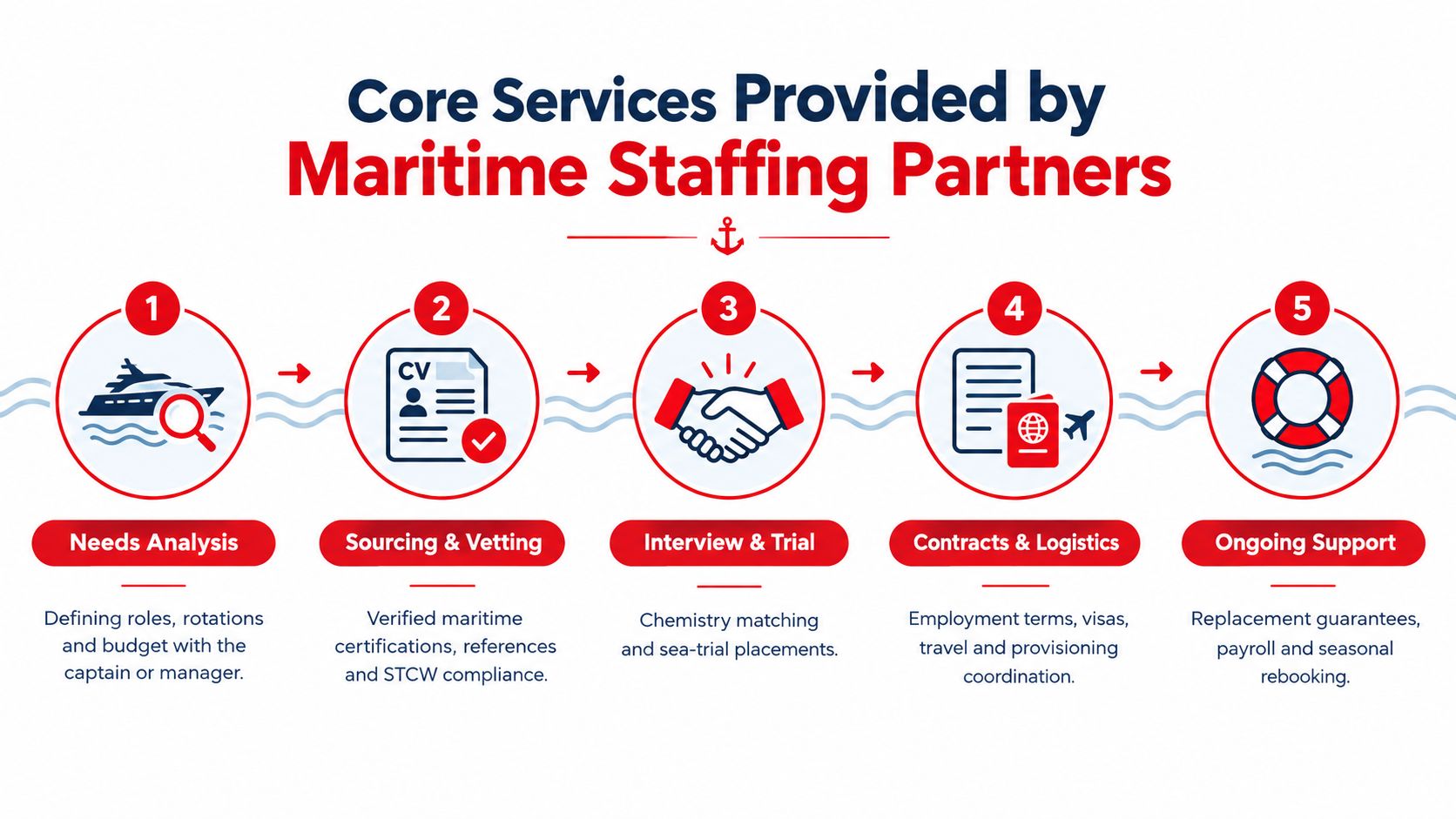
A serious yacht chef agency does much more than send a CV and hope for the best. It builds a placement around the vessel, the itinerary, the guest profile, and the compliance requirements, then keeps that placement stable after the chef arrives.
Emergency cover and planned placements
Emergency relief is about speed, but speed without screening is a mistake. A temporary yacht chef has to fit the vessel, the guest schedule, and the food-safety framework from day one, because there's no spare room for error at sea.
Planned placements work differently. They give the agency time to compare experience, availability, and vessel fit, which is where long-term stability comes from. That matters for owners, management companies, and charter operators who can't afford constant churn in the galley.
What a maritime staffing partner should manage
- Role definition: Clarify whether the vessel needs relief, seasonal cover, or a permanent appointment.
- Candidate filtering: Check credentials, references, and practical yacht experience before interview.
- Deployment logistics: Coordinate arrival timing, travel, and handover details so the chef boards ready to work.
- Ongoing support: Keep a replacement path open if the placement doesn't hold.
The same model is useful beyond a single yacht. Owners with multiple vessels, or managers balancing summer and winter rotations, need a staffing partner that can switch between emergency response and longer-term planning without losing control of standards.
That's where a nationwide agency with hospitality depth becomes useful, especially when the brief shifts from a one-off cover request to wider chef recruitment. Relief Chefs UK is one example of a staffing partner that covers relief chefs, temporary chefs, permanent chef recruitment, yacht chefs, villa chefs, and broader hospitality support.
Navigating Maritime Compliance and Medical Screening
An experienced restaurant chef is not automatically a legal crew member. That's the first mistake to avoid, because the vessel, not the kitchen CV, determines whether the person can work on board.
The UK Maritime and Coastguard Agency states that ship's cooks, catering staff, and anyone processing food in the galley must be suitably qualified in food hygiene or food safety in catering, with Level 2 as the minimum acceptable level for relevant ship's cooks and catering personnel. The same guidance also requires valid medical-fitness certificates for crew. For yacht managers, that means certification checks sit at the front of the hiring process, not the end.
The checks that matter before boarding
A proper screening process should cover the vessel's flag-state rules, the chef's food-safety certificate, and the medical documentation required for seagoing work. The UK Government also sets out that shipowners generally must not operate without a qualified ship's cook, subject to specific exceptions, so this isn't a nice-to-have administrative layer. It's core compliance.
The practical approach is simple:
- Verify food-safety status first.
- Confirm the medical certificate is valid for the role.
- Check whether the vessel's operating area changes the requirement.
- Store documentary proof before travel is booked.
The costly error is assuming a good chef is automatically a compliant crew member.
For sea-going vessels, the ENG1 seafarer medical certificate is a specific compliance item, and GOV.UK states a current fee of £115 for it. That makes medical screening a budget line and an operational gate, especially when cover is needed fast and the yacht can't wait for paperwork to catch up.
For yachts and management teams hiring in the UK, the role brief should be built around compliance as much as cuisine. Relief Chefs UK yacht chef job information is the sort of resource that should reflect those checks, not just the menu style.
Evaluating Technical Competency and Galley Resilience
A yacht galley asks more of a chef than a dining room ever will. British Marine points to flexibility under pressure, food-safety and storage knowledge, nutrition, seasonal and regionally limited ingredients, and the ability to work with restricted diets and allergies as core yacht-chef capabilities.
That means the agency's shortlist has to measure operational resilience as well as cooking skill. A chef with a strong restaurant background may still struggle if a key ingredient isn't available in port, the freezer load is tight, or the guest suddenly changes dietary requirements.
Land-Based Chef vs Yacht Chef Competency Matrix
| Operational Factor | Land-Based Restaurant Chef | Maritime Yacht Chef |
|---|---|---|
| Ingredient access | Can usually source quickly from local suppliers | Must work within provisioning windows and limited locations |
| Menu changes | Adjusts around supplier variations | Rebuilds menus around storage, guest needs, and what's already on board |
| Storage pressure | Larger back-of-house systems absorb mistakes | Must manage tight space, rotation, and safe storage carefully |
| Dietary handling | Serves a defined service style | Handles changing guest diets, allergies, and private preferences onboard |
| Working conditions | More predictable kitchen environment | Constrained galley, vessel movement, and rapid service expectations |
A sensible agency matrix also checks whether the chef can handle substitution planning without degrading the meal. That matters because luxury service on a yacht often means making quiet decisions in real time, not waiting for a supplier to rescue the service.
Operational insight: yacht recruitment fails when agencies overvalue pedigree and undervalue adaptability.
That's why a good shortlist should include proof of yacht or private-service experience, not just restaurant status. Michelin experience can be useful, but it isn't a substitute for knowing how to keep standards high when the vessel is remote and the larder is limited.
Managing Crew Fatigue and Safe Operational Handovers
Fast cover is not automatically safer. It only works when the handover is disciplined and the incoming chef understands how the vessel runs before service pressure starts.
Fatigue is a real risk in charter operations because the work rarely follows neat hospitality hours. When the galley runs hard and the handover is loose, the new chef inherits unknowns, from allergy notes to preferred provisioning habits. That's where mistakes happen, and those mistakes spread into guest service, team morale, and onboard confidence.
What a safe handover should contain
A proper handover should include the following:
- Allergen records: Document every dietary restriction and cross-contact risk clearly.
- Provisioning status: Show what's already on board, what's in transit, and what still needs ordering.
- Storage rules: Confirm where chilled, frozen, and dry goods are held.
- Authority lines: Make clear who signs off menu changes, provisioning changes, and guest requests.
- Rest and accommodation: Confirm where the chef sleeps, how downtime is protected, and who they report to.
The UK safety discussion around yacht crews has made it clear that long hours, limited recovery time, and weak speaking-up cultures create unnecessary risk. That's why emergency cover should never be treated as a last-minute hand-off and hope exercise.
For this reason, management teams should insist on handover documentation for yacht chefs before the incoming chef boards. The document trail matters because the chef is stepping into a live system, not arriving at a blank kitchen.
A relief chef who understands the vessel quickly can stabilise service. A relief chef who is dropped in blind can create more work than they solve.
Building a Proactive Staffing Pipeline for Peak Seasons
Waiting until the summer rush to find a chef is poor planning. By the time sickness, resignation, or a sudden charter extension lands, the best people are often already committed elsewhere.
The wider UK hospitality market has already shown why this is hard. BDO reported that the UK hospitality sector was short of 132,000 workers in 2023, while vacancies were 48% above pre-pandemic levels. That pressure doesn't stop at hotels and restaurants. It spills into yachts, villas, and private households, especially when everyone is hiring at once. BDO Hotel Britain 2025
Why approved pipelines win
An approved pipeline gives management teams a live shortlist before they need it. That shortens response time, reduces onboarding risk, and avoids the scramble that usually leads to weaker hires.
It also helps vessels in places like Devon, Bristol, and Wales, where short-notice cover often needs to balance local availability with travel practicality. The same logic works for independent hotels in Berkshire, Windsor, Reading, and Slough, where seasonal churn creates the same urgent demand for dependable chefs.
Practical rule: if recruitment starts after the crisis, the business is already paying for the delay.
For yacht operators, the smartest model is to keep vetted cover warm before the busy period starts. That includes seasonal reinforcement, back-up relief options, and a clear path to permanent appointments if a temporary placement proves strong.
Selecting the Right Agency for Your Vessel
The right yacht chef agency should be judged on what it checks, what it documents, and how it responds when something changes. A polished website means very little if the agency cannot produce a compliant chef at short notice or explain how it handles a failed placement.
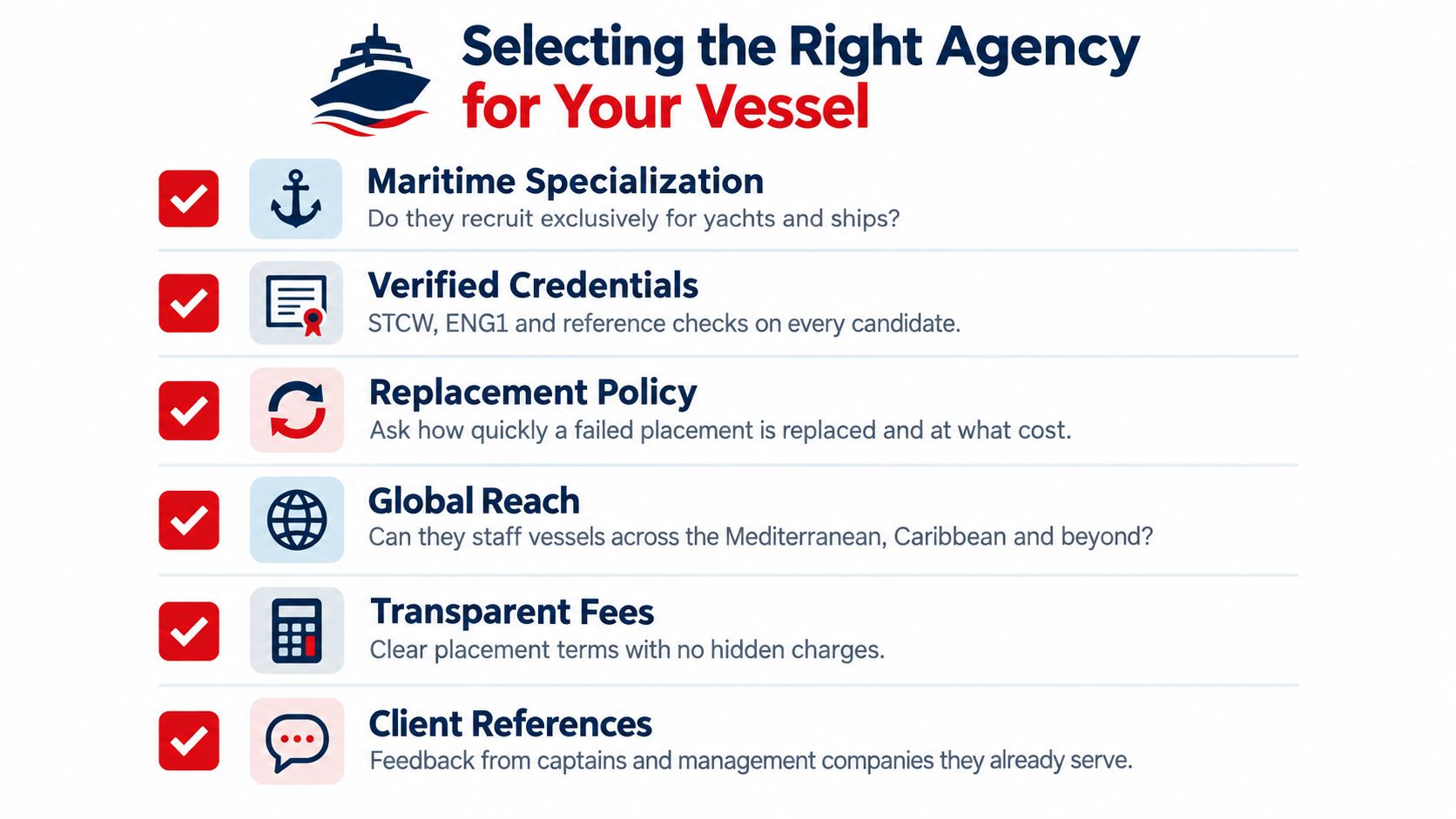
Use a direct checklist when you speak to a staffing partner.
What to ask before you commit
- Maritime specialization: Do they regularly recruit for yachts and understand vessel-based working conditions?
- Verified credentials: Do they confirm food-safety, STCW, and medical documents before placement?
- Replacement policy: If a chef doesn't work out, how quickly can they replace them?
- Transparent fees: Are the terms clear, or will extras appear later?
- Client references: Can they point to captains, management companies, or owners who already use them?
- Operational support: Will they help with handover, travel, and onboard readiness, or just send the candidate?
A trustworthy agency behaves like part of the yacht's shoreside team. It asks better questions, flags compliance gaps early, and understands that a bad placement is more expensive than a slow one.
Relief Chefs UK is a nationwide chef recruitment agency established in 2013, with support across relief chefs, temporary chefs, permanent chef recruitment, yacht chefs, villa chefs, and hospitality staffing. If you manage a yacht, a fleet, or a hospitality business that can't afford galley disruption, contact the team now, brief them properly, and secure cover before the next sickness call or seasonal gap puts your operation under pressure.
If you need yacht chef cover, a vetted temporary chef, or a longer-term staffing pipeline, speak to Relief Chefs UK about the vessel, itinerary, and compliance requirements you're working with. Visit Relief Chefs UK to arrange support that's built around maritime reality, not generic hospitality guesswork.