
Friday afternoon. The hotel is full for the weekend, a wedding party is due in, breakfast numbers are already looking heavy for the next morning, and your Sous Chef has just called in sick. Housekeeping is stretched, reception will get hit from mid-afternoon, and the agency that promised cover last month still hasn't sent over the paperwork for the last temp.
That's when a hotel staffing guide stops being a spreadsheet nobody opens and becomes an operating document that protects revenue.
Most managers don't struggle because they don't understand staffing. They struggle because hotel demand moves faster than static rotas. A quiet Tuesday can turn into a packed Friday. One no-show in the kitchen can affect breakfast, room service, banqueting, and staff morale in a single shift. One weak temporary hire can create more work than the absence you were trying to solve.
The hotels that stay steady usually do one thing well. They build a proper core team, then layer in flexible cover before they need it. That matters across the UK, whether you're running a boutique hotel in Dorset, a busy city property in Bristol, or a seasonal operation in Devon where demand swings quickly.
A workable staffing guide has to deal with real life. Sickness. Annual leave. Chef shortages. Short-notice functions. Unreliable casuals. Compliance checks. It also has to tell you, in plain terms, what cover you need, where the pressure points are, and which roles can't be allowed to fail.
Your 2026 Hotel Staffing Guide for UK Managers
The old version of a hotel staffing guide was often treated as a budgeting exercise. Useful for payroll meetings. Ignored in service. That doesn't work now.
In practice, a staffing guide is a formal document that maps fixed and variable labour across every department, so owners and managers can see approved roles, scheduled positions, and operational coverage at a glance. It exists to keep service standards stable while labour cost stays under control. When managers skip that discipline, they usually end up reacting to problems instead of preventing them.
What this looks like on the floor
A proper guide answers questions fast:
- Kitchen pressure points. Which shifts absolutely need a senior chef on site.
- Front desk pinch times. When arrivals and departures create queues.
- Housekeeping coverage. How many attendants are needed, not guessed.
- Fallback options. Which roles can be flexed, combined, or temporarily reduced.
A staffing guide only works if it matches live operations. If the document says one thing and the rota says another, the rota wins and the guide is useless.
That's why the strongest guides aren't theoretical. They're built around how your property really trades. A wedding-led hotel in Berkshire doesn't need the same staffing pattern as a corporate hotel in Reading. A manor house with high-touch dining can't plan kitchen cover the same way as a limited-service site with a lighter food offer.
The commercial reality
The pressure point for many hotels isn't just labour shortage. It's unreliable flexibility. Managers often have permanent vacancies, a small group of overworked regulars, and a rotating list of temporary contacts who may or may not answer the phone.
The answer isn't to run permanently lean and hope the team “pulls together”. That usually leads to burnout, overtime, weaker guest experience, and eventually more vacancies. The answer is to build a staffing model that expects volatility and still holds.
Building Your Core and Flex Staffing Model
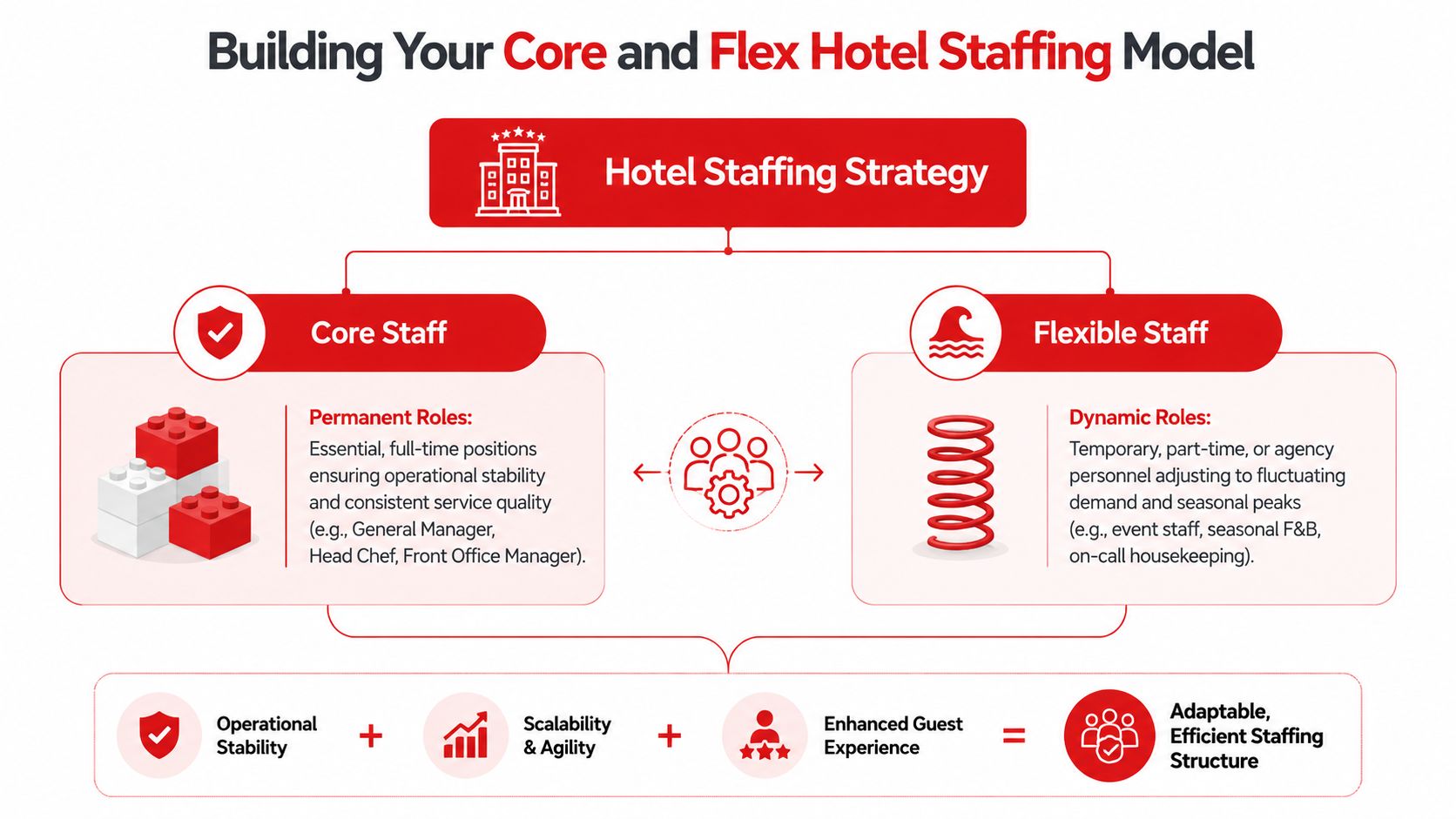
The most resilient hotel teams use a core-and-flex model. You keep a dependable permanent base for operational stability, then add a planned flexible layer for peaks, cover, and specialist gaps.
Hospitality staffing guidance recommends a workforce mix of about 60 to 70% full-time staff, 20 to 30% part-time staff, and 10 to 20% contingent or on-call workers, with labour cost tracked at 30 to 35% of revenue and overtime kept under 10% of total hours according to hospitality staffing strategy guidance from Tri Search.
What belongs in your core team
Your core team should hold the operational spine of the hotel. These are the roles where consistency matters most, where standards are set, and where weak handovers create expensive mistakes.
Typical core roles include:
- Leadership positions such as General Manager, Head Chef, Front Office Manager, and Head Housekeeper.
- Shift-critical operators who carry standards, train others, and solve problems without supervision.
- Culture carriers who know the property, the owners, the repeat guests, and the absolute essentials.
If you're too light here, your hotel becomes fragile. Every absence hits harder because no one is left to absorb pressure or coach temporary cover.
Where flex staffing actually helps
Flexible labour isn't there to replace management discipline. It's there to absorb volatility that a fixed rota can't handle.
That usually means:
- Weekend uplift in housekeeping, breakfast, banqueting, or bar service.
- Seasonal reinforcement in coastal and event-led markets such as Devon, Wales, Dorset, or Windsor.
- Short-notice kitchen cover when a Chef de Partie, Sous Chef, or breakfast chef drops out.
- Known surge windows around functions, events, school holidays, and local demand spikes.
Practical rule: Don't use flexible workers to patch a broken structure every week. Use them to protect a sound structure when demand moves.
What works and what doesn't
What works is a planned flex layer with clear role briefs, pre-agreed rates, and approved suppliers. You know which shifts are likely to need support, which department has first call on extra hours, and which manager signs off emergency cover.
What doesn't work is relying on a “list of people who sometimes help out”. Those lists decay fast. Numbers change. People take other jobs. Someone who was solid last summer may be unavailable when you need them most.
A stronger model looks like this:
| Team layer | Purpose | Typical use |
|---|---|---|
| Core permanent staff | Stability, standards, supervision | Daily operations, guest experience, training |
| Part-time team | Predictable flexibility | Weekends, breakfast, busy check-in periods |
| Contingent or on-call cover | Fast response to spikes and absences | Sickness, events, unexpected occupancy shifts |
How managers should apply this
If you're rebuilding a staffing guide, start with the roles that must never fail. In most hotels that means kitchen leadership, front office peak cover, and housekeeping production. Then identify where flexible staffing can protect service without inflating fixed cost.
For example, a Bristol city hotel may keep a stable front office and kitchen core, but hold flexible capacity for events and late-week trade. A boutique property in Slough or Berkshire may need less volume but stronger contingency for specialist kitchen cover, because one chef absence can take out the whole food operation.
The point isn't to have more people. It's to have the right mix of commitment and agility.
Defining Key Roles From Kitchen to Front of House
Job titles aren't enough. In a useful hotel staffing guide, each role needs a clear operational purpose, clear boundaries, and a realistic backup plan.
When role definitions are vague, temporary staff walk into confusion, permanent staff duplicate work, and managers end up firefighting. That's especially costly in kitchens, where one missing layer of supervision can quickly affect quality, speed, ordering, and hygiene standards.
Kitchen roles that need clear boundaries
A Head Chef owns standards, ordering, team structure, gross profit control, and service leadership. In a smaller boutique hotel, that may also include menu development, breakfast oversight, and rota planning. In a larger property, the role should stay focused on leadership rather than being dragged into every section.
A Sous Chef is the stabiliser. This role bridges leadership and execution, runs service when the Head Chef is off site, and keeps prep, section control, and junior support tight. If your staffing guide underdefines the Sous Chef, the whole kitchen can become over-dependent on one person.
A Chef de Partie should have a clearly assigned section and a clear standard for independent service. In some hotels that's breakfast and prep. In others it's banqueting, grill, pastry, or larder. The key is clarity. If you need cover, you want someone walking into a role that's properly scoped.
Front of house and support roles
Reception and guest service roles often look simple on paper and become chaotic in practice. A Front Office Manager is not just a scheduler. They control handovers, complaint recovery, guest flow, and peak-time support.
A Duty Manager often becomes the bridge role that keeps the day moving. In smaller hotels, this person may cover reception, guest queries, F&B oversight, and supplier issues in one shift. In bigger sites, they need tighter boundaries to stop accountability getting blurred.
For junior service and support roles, detailed briefs matter just as much. If you're reviewing entry-level support positions, this guide to catering assistant duties and responsibilities is a useful reference point for defining practical expectations.
Clear role design makes temporary cover easier. A relief chef can slot into a well-structured kitchen far faster than into one where every duty lives in somebody's head.
Adapt roles to the property, not the org chart
A boutique hotel in Dorset may need people who can move across breakfast, prep, light events, and basic stock control. Cross-training matters there because the team is smaller and every absence is magnified.
A larger hotel in Bristol or Wales may need more specialisation. Separate banqueting, breakfast, and a la carte responsibility can make sense when volume justifies it. The mistake is copying another hotel's structure without checking whether your own trade pattern supports it.
Use titles if they help. Build the guide around functions if you want it to work.
Sample Rotas for Managing Peak and Off-Peak Demand
The cleanest rotas come from workload, not habit. Effective staffing guides use 12 to 18 months of occupancy data to set department-specific productivity standards, with common benchmarks of 14 to 16 rooms per room attendant in standard hotels, 10 to 12 in luxury properties, and roughly one front office agent per 50 to 75 rooms according to hotel labour control guidance from Hospitality Institute.
That matters because average demand hides the underlying problem. Hotels don't get busy evenly. They get busy in waves.
Example one for a 40-room boutique hotel
Take a small boutique hotel with a restaurant, light events, and a stronger Friday to Sunday trade pattern. During quieter days, the kitchen may run comfortably with a compact team. On busy weekends, breakfast, dinner, and private dining create pressure fast.
In this kind of property, the rota should protect leadership and leave visible flex points.
A practical weekly kitchen pattern might look like this:
| Role | Mon | Tues | Weds | Thurs | Fri | Sat | Sun |
|---|---|---|---|---|---|---|---|
| Head Chef | On | On | Off | On | On | On | Off |
| Sous Chef | Off | On | On | On | Off | On | On |
| Chef de Partie | On | Off | On | On | On | On | Off |
| Breakfast Chef | On | On | On | On | On | On | On |
| Kitchen Porter | On | On | Off | On | On | On | On |
| Flex Relief Chef | Off | Off | Off | Off | On | On | Optional |
This is not a template to copy blindly. It's a way of thinking. The Flex Relief Chef slot is planned in advance for peak service. If trade softens, that shift can be released. If a function grows or a chef drops out, you already know where cover belongs.
Example two for a 150-room city hotel
A larger city hotel has different pressure. You may have breakfast, lounge service, room service, banqueting, and a heavier arrival pattern late afternoon. Here, rotas need overlap, not just coverage.
Front office is the obvious example. If arrivals bunch between late afternoon and early evening, one straight shift pattern won't be enough. You need overlapping reception cover, plus management presence when queues and guest issues start stacking up.
A larger kitchen rota also needs clearer segmentation:
- Breakfast production has to be protected regardless of late-night trade.
- Banqueting prep needs separate planning from restaurant service.
- Late service can't be allowed to strip labour from the following morning.
- Relief capacity should be attached to known risk shifts, not treated as a last resort.
What the staffing guide should tell you
The best rotas don't just show names against boxes. They show where risk sits.
For each department, your guide should identify:
- Minimum safe cover for service to run properly.
- Peak-shift uplift where occupancy, arrivals, or events create extra demand.
- Roles that can flex across departments with the right training.
- Roles that need external cover because the skill requirement is too high.
If you can't tell by looking at the rota which shifts are vulnerable, the rota is hiding risk rather than managing it.
For kitchen planning, that means knowing whether a missing Sous Chef can be absorbed internally or whether you need specialist cover. For front office, it means knowing when an extra trained pair of hands will shorten queues and calm pressure before complaints begin.
One practical option for those planned flex shifts is hospitality temp staff support, particularly where a hotel wants pre-arranged external cover for kitchen pressure points rather than making emergency calls on the day.
Recruitment Onboarding and UK Compliance Essentials
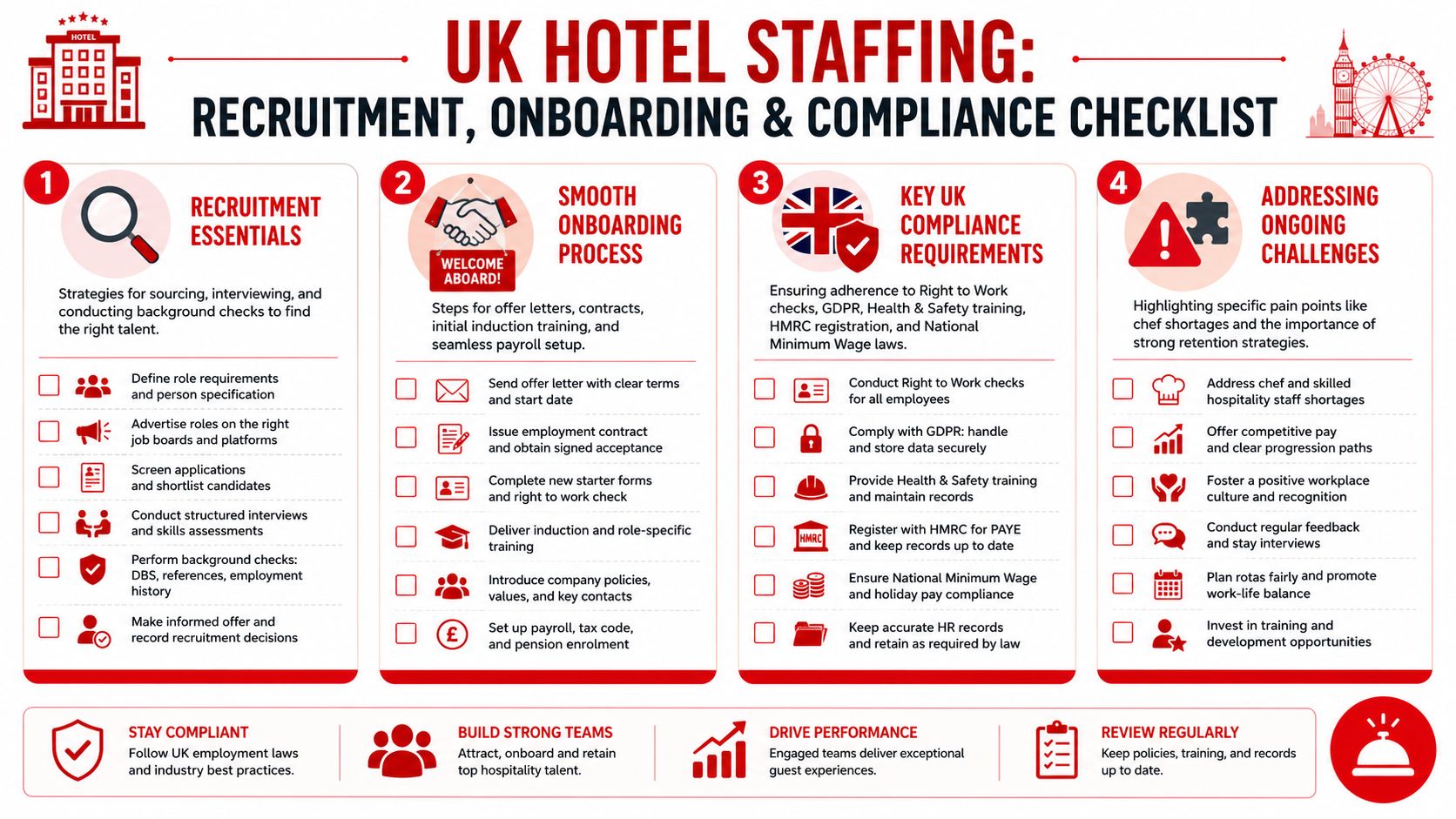
Most staffing failures don't start on the rota. They start much earlier, during rushed hiring, weak onboarding, or poor checks.
Hotels often lose time trying to solve chef shortages with speed alone. That usually creates a second problem. You fill a gap quickly, but you increase legal and operational risk because the checks weren't watertight or the brief was unclear.
The real risk in last-minute cover
For UK hotels, the hardest issue with urgent staffing isn't only speed. It's compliance. Employers have clear duties to check an individual's right to work before they start, which is why using an unvetted person at short notice creates obvious exposure, as outlined in guidance on last-minute hotel staffing shortages and compliance controls.
That risk gets sharper in kitchens. A chef walking into breakfast, banqueting, or private dining affects more than one service line. If their paperwork isn't right, or their experience doesn't match the brief, the problem spreads quickly.
What a safe onboarding process includes
A sound process needs more than a signed timesheet. At a minimum, managers should confirm:
- Right to Work status before the shift starts.
- Role fit against the section, service style, and seniority required.
- Food safety and site induction so the person knows the kitchen, hazards, and standards.
- Insurance and record keeping so there's a clear compliance trail.
That's one reason many operators prefer agency support for hard-to-fill roles. A specialist partner can narrow the field before the hotel sees the candidate. For operators reviewing long-term hiring gaps as well as shift cover, this overview of recruitment in hospitality is a practical place to start.
What managers should stop doing
A few habits create needless risk:
| Weak approach | Why it causes trouble |
|---|---|
| Hiring from informal recommendations only | Experience and paperwork often aren't verified properly |
| Treating all chefs as interchangeable | Breakfast, banqueting, volume prep, and fine dining are not the same brief |
| Rushing induction | Even strong temps need site-specific direction |
| Leaving checks to the last minute | This turns pressure into poor judgement |
Fast cover only helps if the person can legally start, walk into service safely, and hold the standard expected by your guests.
Good onboarding isn't bureaucracy. It's operational protection.
Your Contingency Plan for Last-Minute Staffing Gaps
When somebody walks out, calls in sick, or doesn't appear, you don't need theory. You need a decision path.
That's where a hotel staffing guide earns its keep. It should tell you what level of cover is missing, what the minimum safe replacement looks like, and whether the hotel can absorb the gap internally or needs outside support.
Start with the maths, not the panic
A staffing guide must calculate variable labour using a formula. One standard example is a 200-room hotel at 95% occupancy, which means 190 occupied rooms. If housekeeping requires 0.45 hours per room, that creates 85.5 total hours, and dividing by a 7.5-hour shift means the hotel needs 12 room attendants for that shift. That kind of planning model is explained in the earlier labour-control reference.
The same principle helps in a crisis. You need to know the actual gap. Not “we're short”. You need “we're one breakfast chef short”, or “we need one more experienced banqueting chef to protect dinner prep”.
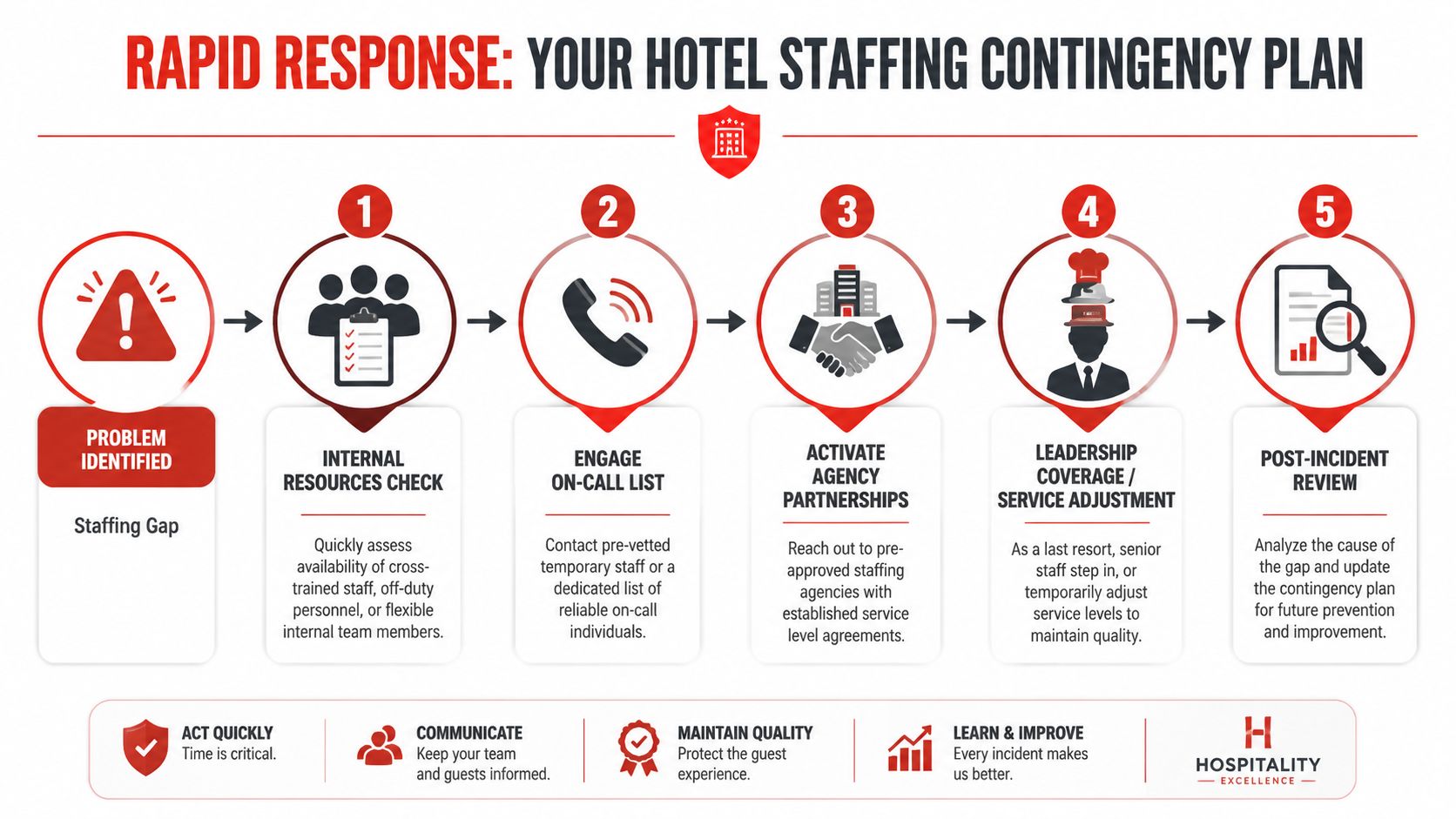
A practical response order
Use a simple escalation path:
Check cross-trained internal cover
Can a Sous Chef step into service leadership? Can a supervisor hold breakfast while another manager picks up admin?Call your approved on-call list
This only works if the list is current, pre-vetted, and role-specific.Activate pre-approved agency support
Not any agency. Only suppliers already cleared for paperwork, expectations, and communication.Adjust service only if needed
Reduce complexity before quality collapses. A tighter menu is better than a bad full menu.Review the failure after the shift
Was it sickness, poor rota design, burnout, or weak recruitment?
Here's a useful visual summary of that pressure-tested sequence:
Why casual backup lists often fail
Managers love the idea of a backup list because it feels low-cost. In practice, those lists are unreliable unless they're actively managed. People move, take permanent jobs, stop answering, or turn selective about shifts.
The stronger option is a pre-vetted external channel that already understands hotel kitchens and can respond quickly when a role is business-critical. That's where Relief Chefs UK fits for many operators. The service covers relief chefs, temporary chefs, permanent chef recruitment, yacht chefs, villa chefs, and wider hospitality staffing support, with nationwide relevance for hotels facing kitchen instability and short-notice gaps.
Don't wait until the busiest day of the month to decide who you trust for emergency cover. That decision should already be made.
A good contingency plan doesn't remove disruption. It stops disruption from becoming operational damage.
Your Hotel Staffing Questions Answered
Should a hotel staffing guide focus on headcount or workload
Workload. Headcount alone hides the actual pressure. A hotel can be comfortably staffed on paper and still fail at breakfast, check-in, or dinner if labour is placed at the wrong times or in the wrong roles.
Is it cheaper to rely on an in-house casual pool
It can look cheaper. It often isn't. Casual pools carry management time, chasing, rota uncertainty, inconsistent standards, and compliance administration. If a key casual doesn't turn up, you pay for the failure elsewhere through overtime, reduced service, or guest dissatisfaction.
What's the difference between a relief chef and a generic temp
A relief chef should be able to step into a live kitchen, understand service rhythm quickly, and work with less hand-holding. A generic temp may fill a space on the rota but still need substantial support. In a hotel kitchen, that distinction matters.
How often should a staffing guide be reviewed
It should be reviewed formally and also adjusted when trading patterns change. Renovations, menu changes, new event business, breakfast growth, and seasonal shifts all affect staffing reality. If your guide hasn't changed but your operation has, the guide is behind.
Can smaller hotels use the same staffing model as large city properties
The principle is the same. The execution isn't. Smaller hotels need broader, cross-trained roles and tighter contingency planning because one absence hurts more. Larger hotels can support greater specialisation but need stronger coordination across departments.
When should managers bring in outside support
Bring it in when the role is business-critical, when compliance risk is high, when the skill gap is specialised, or when internal cover would damage another part of the operation. Waiting until the service is already unstable usually costs more than acting early.
Does a staffing guide help with chef recruitment as well as shift cover
Yes, if it's built properly. A clear guide shows which roles are permanently under pressure, which shifts repeatedly need support, and where your structure is too dependent on one person. That gives you a cleaner brief for permanent hiring and a better trigger point for temporary reinforcement.
If your hotel needs a staffing plan that can handle chef shortages, short-notice sickness, and seasonal pressure without risking service, speak to Relief Chefs UK. Established in 2013, they support hotels and hospitality operators across the UK with vetted relief chefs, temporary chefs, permanent chef recruitment, yacht chefs, villa chefs, and broader hospitality staffing support. Contact the team to discuss urgent cover or a longer-term staffing solution.