
Saturday night. Full restaurant. Tickets hanging. A chef turns on a wet patch by the pass, goes down hard, and says they're fine while trying to get back on section.
That's the moment poor operators get exposed.
If your accident reporting procedures live in a dusty folder, you'll make bad decisions under pressure. You'll miss details, lose witness accounts, muddle the timeline, and turn a manageable incident into a legal, staffing, and reputational problem. In hospitality, accidents rarely arrive at a convenient time. They happen mid-service, during handover, with agency staff on shift, or when you're already covering sickness and running thin.
The grey areas are where venues get caught out. Minor burns. Slips with no visible injury. A temp chef who says they can carry on. A near miss with hot oil. A guest collision in a tight service corridor. If you don't record these properly, you don't just weaken compliance. You lose the evidence you need to protect the business and stop the same thing happening again.
Why Your Accident Reporting Procedures Matter More Than You Think
A busy Bristol kitchen doesn't fall apart because one person slips. It falls apart because nobody knows what happens next.
One manager sends the injured chef home without writing anything down. Another asks someone to “sort the book later”. By the time service ends, the floor's been cleaned, witnesses have gone, and the story has changed three times. If that chef wakes up the next morning unable to work, you're already behind.
That's why accident reporting procedures aren't paperwork. They're operational control.
The real risk isn't the incident. It's the mess after it
When reporting is weak, you create problems in every direction:
- For the injured person: treatment may be delayed, details may be disputed, and support becomes inconsistent.
- For the manager: decisions get made on memory, not evidence.
- For the business: insurers, regulators, and senior leadership all want a clear record.
- For the operation: one injury can trigger rota gaps, panic cover, menu reductions, and angry guests.
In hospitality, that quickly becomes a revenue issue. If one key chef is out and your team is already stretched, service standards dip fast. That's exactly why unstable kitchens end up relying on emergency cover. If that sounds familiar, read the hidden cost of bad chef cover and emergency relief chef booking.
Practical rule: If an incident interrupts service, changes a rota, or could later be questioned, record it properly the same day.
Under-reporting is a business risk
One reason strong procedures matter is simple. Incidents often never make it into the formal record. In British road-safety research, police reporting was estimated at 57.5% to 59.9% of road-crash casualties in one study, which shows how much can be missed when people rely on a single reporting channel, according to the published research on under-reporting.
Hospitality venues can't afford that culture.
A kitchen accident that isn't captured properly doesn't disappear. It just returns later as a grievance, absence issue, insurance dispute, or repeat accident. Good operators understand this. They treat the accident report as evidence, not admin.
Immediate Response What to Do in the First 15 Minutes
The first 15 minutes matter more than the form.
Your job is to take control, protect people, and preserve the facts before the shift wipes them out.
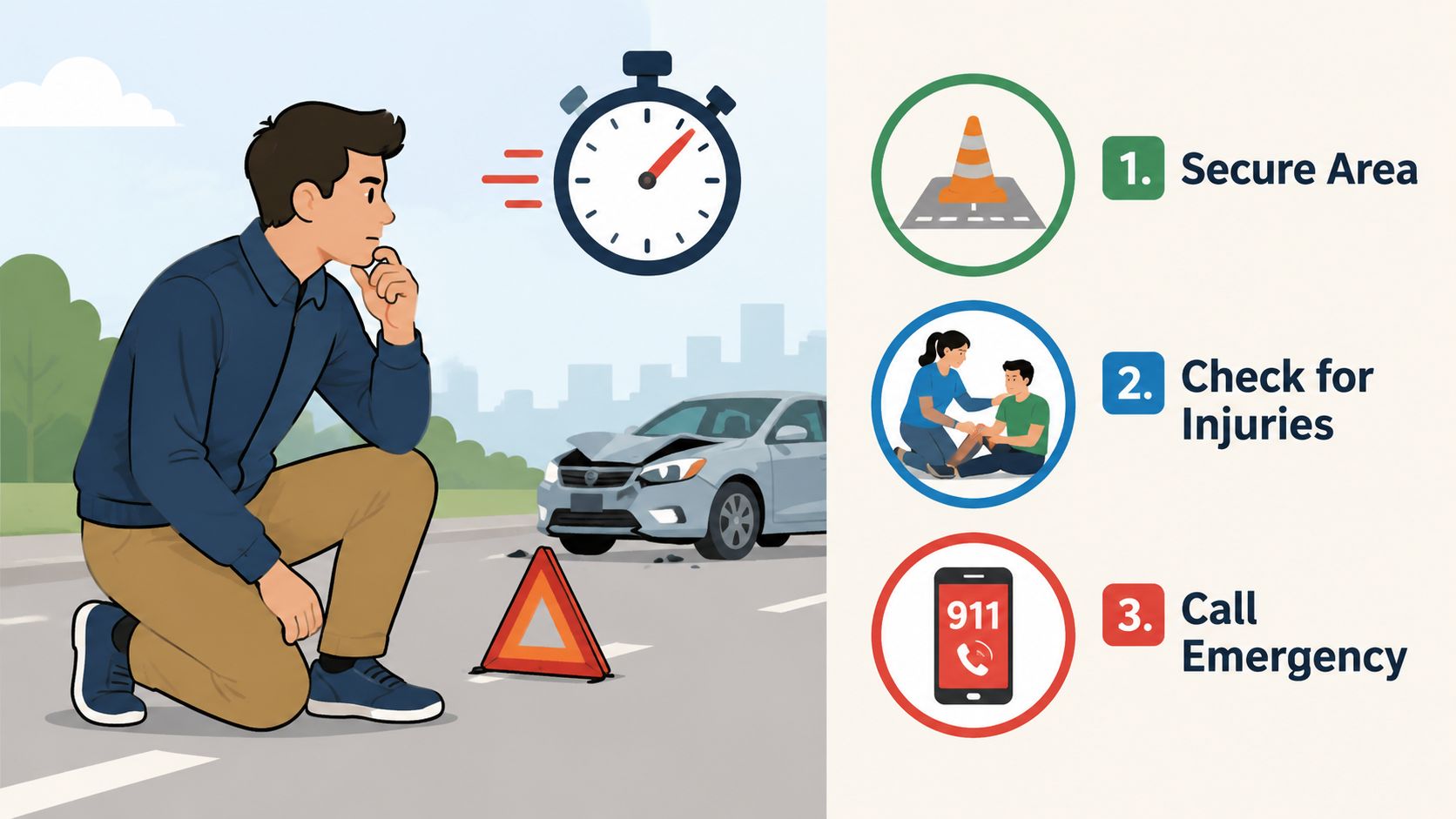
Secure the area first
If a chef slips, gets cut on a mandoline, or catches a burn from a pan handle, don't start with questions. Start with control.
Do this immediately:
- Stop the immediate hazard. Mop the spill, isolate the broken equipment, clear the gangway, turn off the appliance if needed.
- Protect everyone else. Keep other staff out of the area until it's safe.
- Preserve what matters. Don't destroy the scene before you understand what happened.
If the issue involves something temporary, such as spilled oil, a loose floor mat, or a crate left in a walkway, make a note of it before it disappears. Transient hazards are often the first facts lost.
Assess the person, not just the injury
Staff often downplay injuries because they don't want to leave the team short. Ignore that instinct. Make a calm assessment.
Focus on three things:
- What's visible: bleeding, swelling, restricted movement, burns, shock.
- What they're saying: pain, dizziness, numbness, nausea, difficulty standing.
- What happened: fall from height, contact with hot oil, impact with sharp equipment.
A deep cut from a mandoline might look manageable until the bleeding doesn't stop. A fall might seem minor until the person stiffens up later. Treat the person properly first. Service can wait.
If you let an injured chef “push through” without assessing them properly, you're not being tough. You're creating a bigger problem.
Keep service stable without creating confusion
The best managers are calm and blunt in these moments.
Tell one person to fetch first aid. Tell another to cover the section. Tell the rest of the team exactly what's changing. Don't let six people crowd around the incident, and don't let rumours travel faster than facts.
A clean command structure helps:
| Role | Immediate task |
|---|---|
| Duty manager | Takes control, assesses risk, decides next steps |
| First aider | Provides immediate care |
| Senior chef or supervisor | Reassigns section and keeps service moving |
| Witnesses | Stay available for a later account |
Don't rush into blame
If someone says, “He slipped because he was rushing,” stop that line of thinking.
At this stage, you need the event preserved, not explained away. Capture the basics, get the person safe, and make sure the scene and witnesses are still available once the immediate pressure drops.
Internal Documentation The Accident Book and Incident Forms
Once the person is safe and the service is under control, the reporting starts. Many venues then do the minimum and regret it later.
The accident book matters. Your internal incident form matters more.
A basic entry helps prove the incident happened. A detailed internal record gives you the evidence to defend the business, investigate properly, and decide whether the matter needs escalation. In practice, you need both.
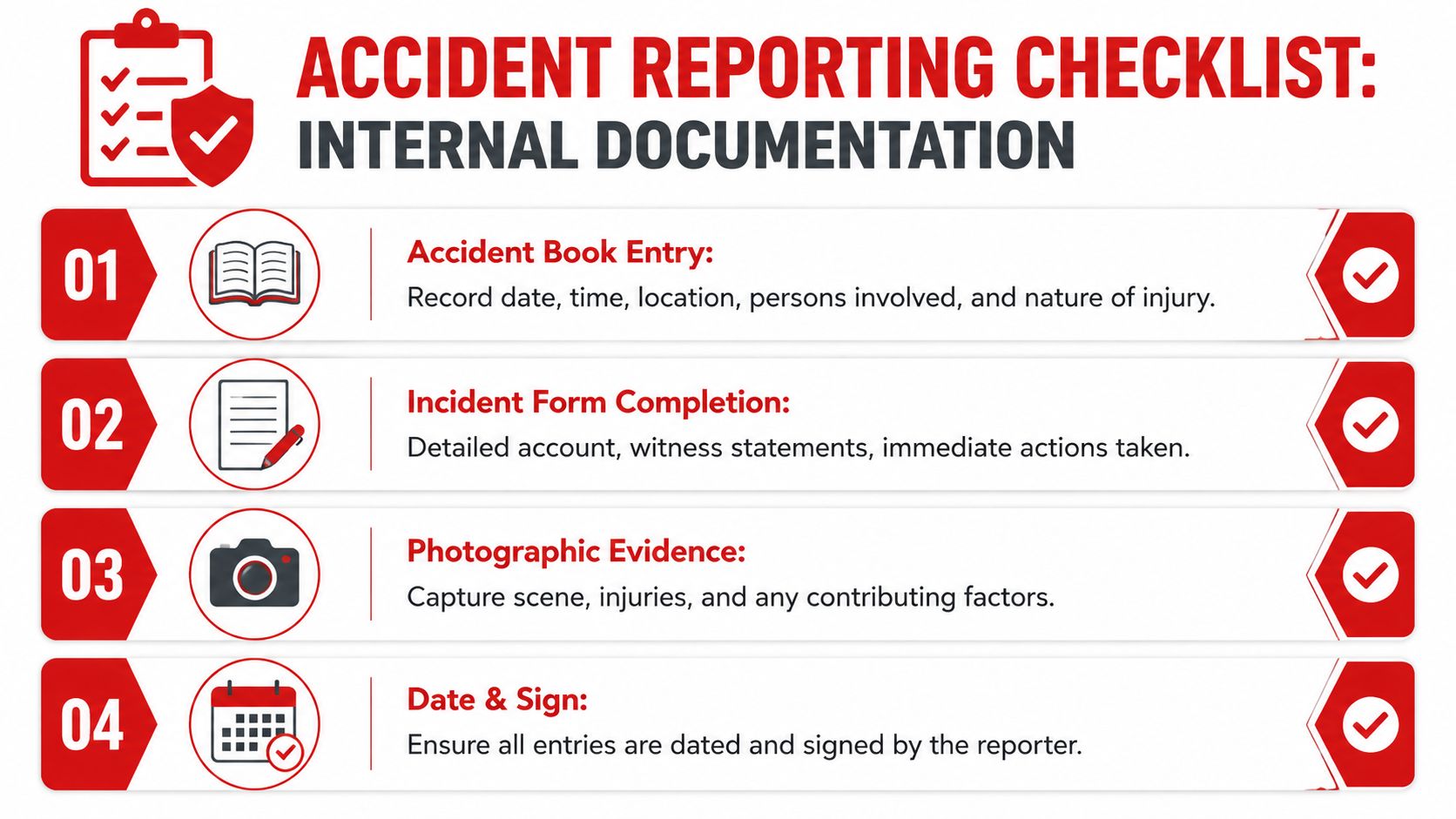
What must go in the record
UK guidance built around RIDDOR says a reportable event should capture precise details such as who was injured, when and where it happened, what occurred, witnesses, and immediate actions taken, because that information supports both compliance and prevention, as set out in this UK accident reporting guidance.
That means your internal documentation should include:
- Injured person details: full name, role, employment status, and contact details.
- Exact timing: date and time, not “during service” or “earlier this evening”.
- Precise location: pastry section, rear prep corridor, bar cellar stairs, loading bay.
- Factual event description: what happened in order, without guesswork.
- Nature of injury: burn, cut, slip, impact, strain, or near miss if no injury occurred.
- Immediate treatment: first aid, medical attention, ambulance, sent home, resumed work.
- Witness details: names and contact details of anyone who saw the event or immediate aftermath.
- Scene evidence: photographs, video, sketches, equipment condition, and any temporary hazard present.
Separate fact from opinion
Under these circumstances, poor reports become useless.
Write what happened. Don't write why you think it happened unless you're clearly moving into investigation. “Chef slipped on wet tiles near dishwasher entrance” is a factual event description. “Chef was careless” is an opinion, and a lazy one.
Use this simple split:
| Record type | What belongs there |
|---|---|
| Event description | Timeline, location, people involved, what was seen, what action was taken |
| Investigation note | Possible causes, missing controls, training issues, staffing pressure, equipment faults |
Non-negotiable: Complete the record on the same day. Waiting until tomorrow means details get cleaned away, forgotten, or softened.
Build a form your managers can actually use
If your internal form is too vague, managers will fill it badly. If it's too long, they'll avoid it. Keep it practical.
A solid form should prompt for:
- Chronology first: what happened before, during, and immediately after.
- People involved: injured person, witnesses, supervisor on duty.
- Physical evidence: photos, CCTV reference, damaged kit, floor condition.
- Follow-up actions: area made safe, equipment removed, rota changed, investigation assigned.
Good handovers matter here as well. If the injury happens on a split shift or close to changeover, the next manager needs a clean written record, not a verbal half-story. That's the same discipline that keeps kitchens stable in other high-risk moments. Strong handover documentation reduces confusion, finger-pointing, and missed follow-up.
Navigating Your Legal Duties Under RIDDOR
Most hospitality managers don't need a legal lecture. They need a fast decision process.
The foundation is RIDDOR, the Reporting of Injuries, Diseases and Dangerous Occurrences Regulations 2013, which came into force on 1 October 2013 and remains the core framework for reporting certain workplace injuries, occupational diseases, and dangerous occurrences in Great Britain, as outlined in the earlier UK guidance already referenced.
If you run a pub in Reading, a hotel in Slough, or a restaurant group across Berkshire, the question is simple. Is this incident reportable, and if yes, when?
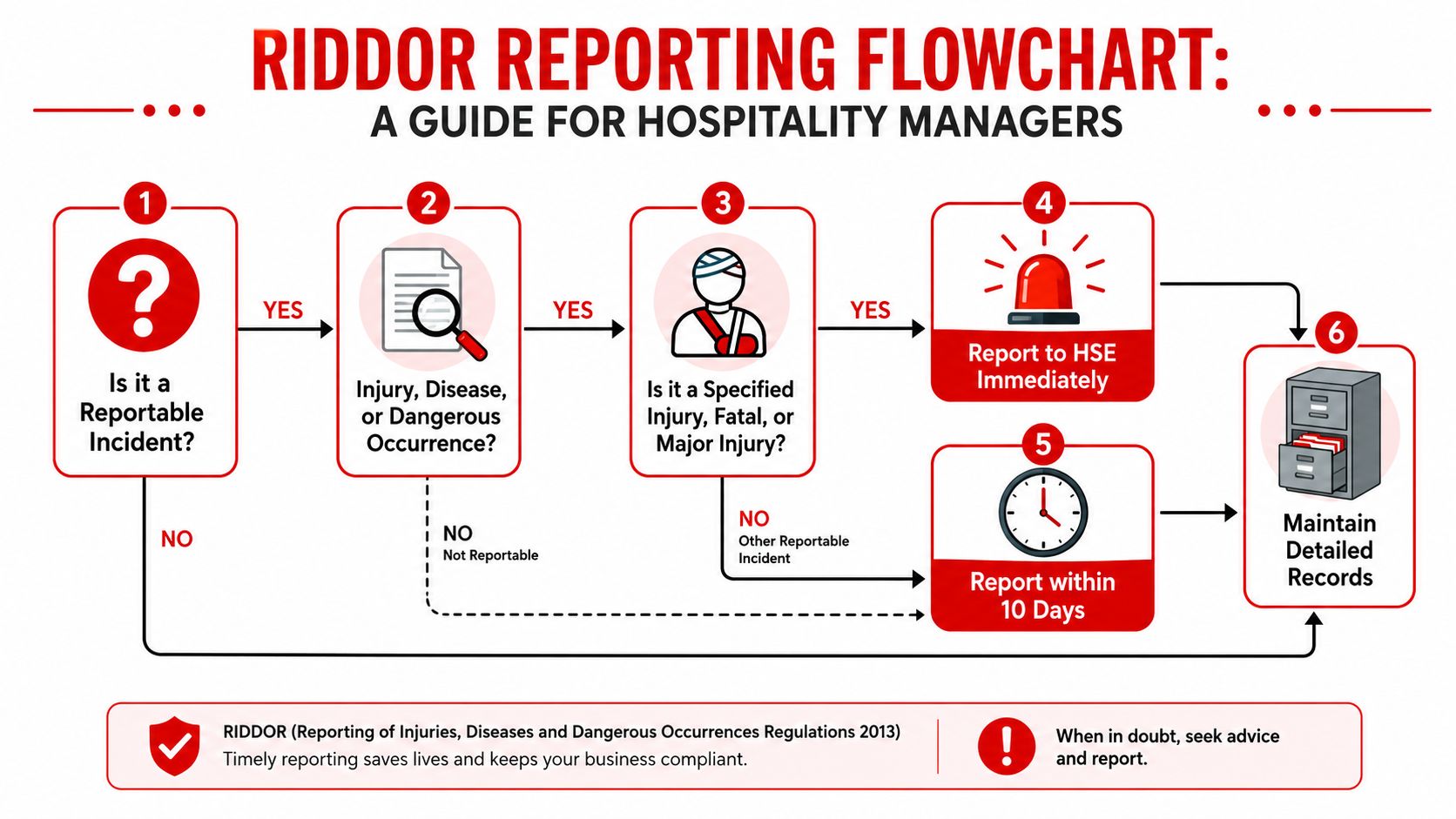
The reporting clock matters
Under RIDDOR, work-related fatalities, specified serious injuries, and over-seven-day incapacitations must be reported by the responsible person to the HSE. Fatal and specified-injury notifications are due without delay, and other reportable injuries are due within 10 days, according to the reporting timeline referenced here.
That timing is where many hospitality businesses get caught. Someone says they're fine, finishes the shift, and then phones in two days later unable to work. You still need to act quickly once the facts change.
A practical guide often helps more than a policy manual, so use this as your at-a-glance check.
RIDDOR reportable incidents in hospitality at a glance
| Incident Type | Description | Reporting Timeline |
|---|---|---|
| Fatality | A work-related death | Without delay |
| Specified serious injury | A serious reportable injury under RIDDOR | Without delay |
| Over-seven-day incapacity | Worker unable to do normal work for more than seven days after a work-related injury | Within 10 days |
| Dangerous occurrence | A reportable dangerous event such as a serious system failure or incident category covered by RIDDOR | Follow the applicable RIDDOR deadline |
| Occupational disease | A reportable work-related disease | Follow the applicable RIDDOR deadline |
Hospitality grey areas that need a decision
The law isn't hard. What's hard is the reality of service.
Here are the situations that usually cause hesitation:
- The injury looks minor during the shift: record it anyway, then monitor.
- The worker is agency, temporary, or a contractor: identify the responsible reporting route immediately and document who was supervising on site.
- The person is a visitor or guest: record the incident internally with the same discipline, even where RIDDOR may not apply in the same way.
- It was a near miss, not an injury: don't ignore it. Near misses expose weak controls before someone gets hurt.
This is useful context if you need a visual reference while briefing managers:
What good operators do differently
They don't wait for certainty before documenting. They log first, verify quickly, and escalate when the threshold is met.
They also assign responsibility clearly. One named person should own the decision to review, update, and report. If everybody assumes somebody else has handled it, nobody has.
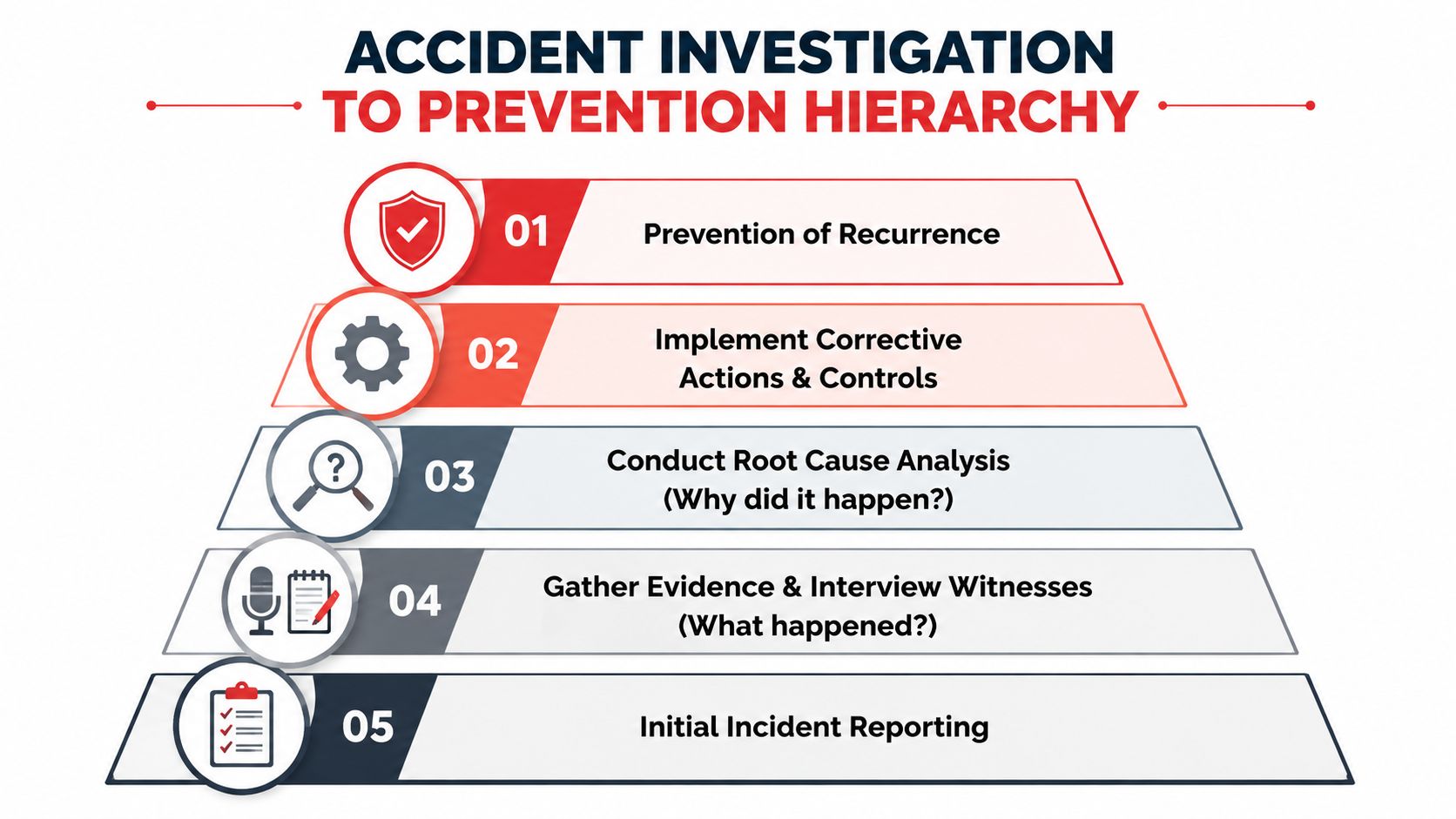
From Investigation to Prevention Turning Data into Action
A report on its own fixes nothing.
If your process ends with “accident book completed”, you haven't learned anything. You've just filed the problem. Value comes from turning the incident into a practical change that stops a repeat.
Build the timeline before chasing the cause
One of the most common mistakes in accident reporting procedures is mixing up the event and the explanation.
Investigation guidance warns against failing to separate the event description from root-cause analysis. The better approach is to build a chronology first, then use a structured method such as the five whys so you don't stop at the obvious trigger instead of the underlying control failure, as explained in this incident investigation guidance.
That matters in kitchens because the obvious answer is often the wrong one.
A chef cuts a hand. Fine. But why?
- Because the knife slipped.
- Why did the knife slip?
- Because the board moved.
- Why did the board move?
- Because there was no stable mat underneath.
- Why was the mat missing?
- Because prep stations were reset badly after deep clean.
- Why was that allowed?
- Because the closing check didn't include workstation setup.
That's a control problem, not just a careless moment.
Blaming the nearest person is fast. Fixing the system is what prevents the next injury.
What evidence actually helps
You don't need a dramatic investigation pack. You need reliable facts collected before they vanish.
Prioritise:
- Scene capture: exact location, floor condition, equipment position, lighting, and housekeeping.
- Witness accounts: short, factual, and taken early.
- Equipment status: was the slicer guard missing, was the oven door faulty, was the mat curled?
- Work context: was the team rushed, short-staffed, or working with an unfamiliar setup?
This last point matters more than some managers admit. A kitchen operating with last-minute gaps, unreliable agency arrivals, or too many doubles creates avoidable risk. Fatigue, poor handovers, and rushed prep all increase mistakes. If you're already juggling cover, read the operational reality of working with temp agencies and tighten your standards around supervision and briefing.
Turn findings into changes people can see
Investigation only matters if it leads to action.
Use a simple corrective-action log:
| Issue found | Corrective action |
|---|---|
| Wet area near dishwasher repeatedly causes slips | Change cleaning routine, add controls, assign floor checks during service |
| Staff using damaged or incomplete prep setup | Remove faulty kit, replace missing items, verify opening checks |
| New or temporary staff unclear on layout or hazards | Add a brief site induction before shift starts |
| Witness details or facts regularly missing | Train managers to complete same-day reporting before shift end |
You'll get better results if actions are specific, owned, and visible. “Improve safety awareness” means nothing. “Head chef to verify all prep stations before service” means something.
Accident Reporting FAQs for Hospitality Managers
These are the questions managers ask when the situation isn't neat, and most incidents in hospitality aren't neat.
Who reports an accident involving a temporary or agency chef
If the accident happens in your venue, during your shift, under your supervision, don't assume the agency is handling it.
Record it internally straight away. Confirm the worker's employment status. Notify the supplying agency promptly. If the incident may be reportable, identify who the responsible person is and don't leave that point vague. The venue usually has the clearest view of the scene, the witnesses, and the immediate facts, so your internal record needs to be watertight regardless.
Do I need to record accidents involving customers or other visitors
Yes. Record them properly.
Customer incidents can still trigger complaints, insurance issues, and reputational damage. A guest slipping near the toilets or being hit by a swinging service door may fall outside the employee-focused questions managers usually ask, but it still needs a factual record, witness details, and scene evidence. Treat visitor incidents seriously and consistently.
What counts as a near miss in hospitality
A near miss is an event that could have caused injury or damage but didn't, this time.
Examples include a pan of hot oil almost dropped in a busy pass, a crate left on stairs that someone catches at the last second, or a fridge door fault that nearly causes a hand injury. These matter because they expose weak controls before someone ends up off shift.
Record near misses when they show a hazard, not only when someone gets hurt.
What if the employee says they're fine, then reports pain later
This happens all the time.
Someone finishes the shift, then calls the next day saying their wrist has seized up or they've gone for medical attention. The key point is this. The reporting clock starts when the employer is notified of the changed circumstances, so you need to update the record and act promptly if reporting thresholds are met, as explained in this guidance on changed circumstances after an incident.
That means you should:
- Update the original report: don't create confusion with conflicting versions.
- Reassess reportability: the incident may now cross a threshold.
- Preserve evidence quickly: speak to the manager and witnesses before memories blur further.
Should I log small burns, cuts, and slips that don't cause time off
Yes.
Hospitality businesses get into trouble when they only record dramatic incidents. Small events show patterns. If one section keeps producing burns, if one corridor is a regular slip point, or if one piece of kit keeps causing minor cuts, you've got a control issue building in plain sight.
Who should own the accident reporting procedures in the venue
One named manager on every shift should own the immediate response and first record. Senior leadership should own the quality of the system.
That split works. The duty manager handles the incident. The general manager or operations lead checks follow-up, investigation, and any escalation. If that ownership is fuzzy, your process will fail when service pressure hits.
Relief Chefs UK supports hospitality businesses that need stable kitchens, dependable cover, and operators who understand real-world service pressure. Established in 2013, they work nationwide with pubs, restaurants, boutique hotels, private households, yachts and villas, providing relief chefs, temporary chefs, permanent chef recruitment, yacht chefs, villa chefs, and hospitality staffing support. If short notice sickness, seasonal demand, chef shortages, or unreliable agency cover are putting your venue at risk in Devon, Bristol, Wales, Berkshire, Windsor, Reading, Slough, Dorset, or anywhere else in the UK, contact Relief Chefs UK and get the right chef support in place before the next problem lands mid-service.