
UK Hospitality Employment Verification a Complete Guide 2026
14 July 2026
Friday is covered. The rota is patched. A new chef is due through the door at lunch, and on paper they look ideal. Then the first push hits, tickets stack up, the section slips, prep standards wobble, and your head chef starts firefighting instead of leading service.
That moment usually gets blamed on recruitment pressure, chef shortages, or bad luck. In reality, it often starts earlier with weak employment verification.
In hospitality, the mistake is usually the same. Managers check what they must check, glance at the CV, trust the urgency of the shift, and hope the rest takes care of itself. That might keep a kitchen moving for a day. It won't protect standards, team morale, or your margin when the wrong person lands in the middle of a busy service.
Why Verification is Your First Line of Defence
A bad hire in hospitality rarely fails unnoticed. It hits service, drains senior staff, unsettles the brigade, and leaves managers scrambling for cover again.
That matters even more in a market where operators are under pressure from staffing instability, rising employment costs, and constant short-notice gaps. In Devon, Dorset, Bristol, Wales, Berkshire, Windsor, Reading, Slough, and every other busy hospitality patch, the same problem keeps showing up. The shift still needs covering, but the cost of getting it wrong is much higher than many operations assume.
What failure looks like in a real kitchen
A chef can arrive with a tidy CV, a decent manner, and a legal right to work, yet still be the wrong person for the role. They might not cope with volume. They might exaggerate fresh food experience. They might have moved around so often that nobody has tested their reliability properly.
That's why employment verification isn't just an admin task. It's operational defence.
If you stop at the bare minimum, you're not really vetting a chef. You're just confirming they can enter the building and get paid. That doesn't tell you whether they can hold a grill section on a Saturday night, step into a hotel breakfast service without chaos, or work cleanly in a pub kitchen with one KP and a thin prep list.
Practical rule: Verify for service pressure, not just for paperwork.
Why it matters more now
UK hospitality relies heavily on international talent. Foreign-born workers accounted for 31.4% of the total UK hospitality workforce in 2025, compared with a cross-industry national average of 21.0%, which increases the practical importance of getting checks right for non-UK hires and mixed-status teams, as noted in UK hospitality labour market reporting.
That's not a problem. It's the reality of the sector. The problem is when managers treat all verification as one simple task and miss the extra care some hires require.
A solid process protects more than compliance. It protects kitchen stability when a sous chef goes off sick, when seasonal demand spikes, when agency cover turns out unreliable, or when a venue is already running lean. The cost of weak checking usually appears later in overtime, refunds, guest complaints, and managers filling gaps themselves. That's exactly why many operators end up learning the hidden cost of bad chef cover and emergency relief chef booking the hard way.
What good operators do differently
Good operators separate urgency from standards. They move fast, but they still verify properly.
They ask two different questions:
- Can this person legally work here
- Can this person do this job reliably
Those are not the same question. Treating them as if they are is where expensive mistakes begin.
Right to Work vs Employment History Explained
Many hospitality managers still blur two separate checks into one. That's where hiring risk starts.
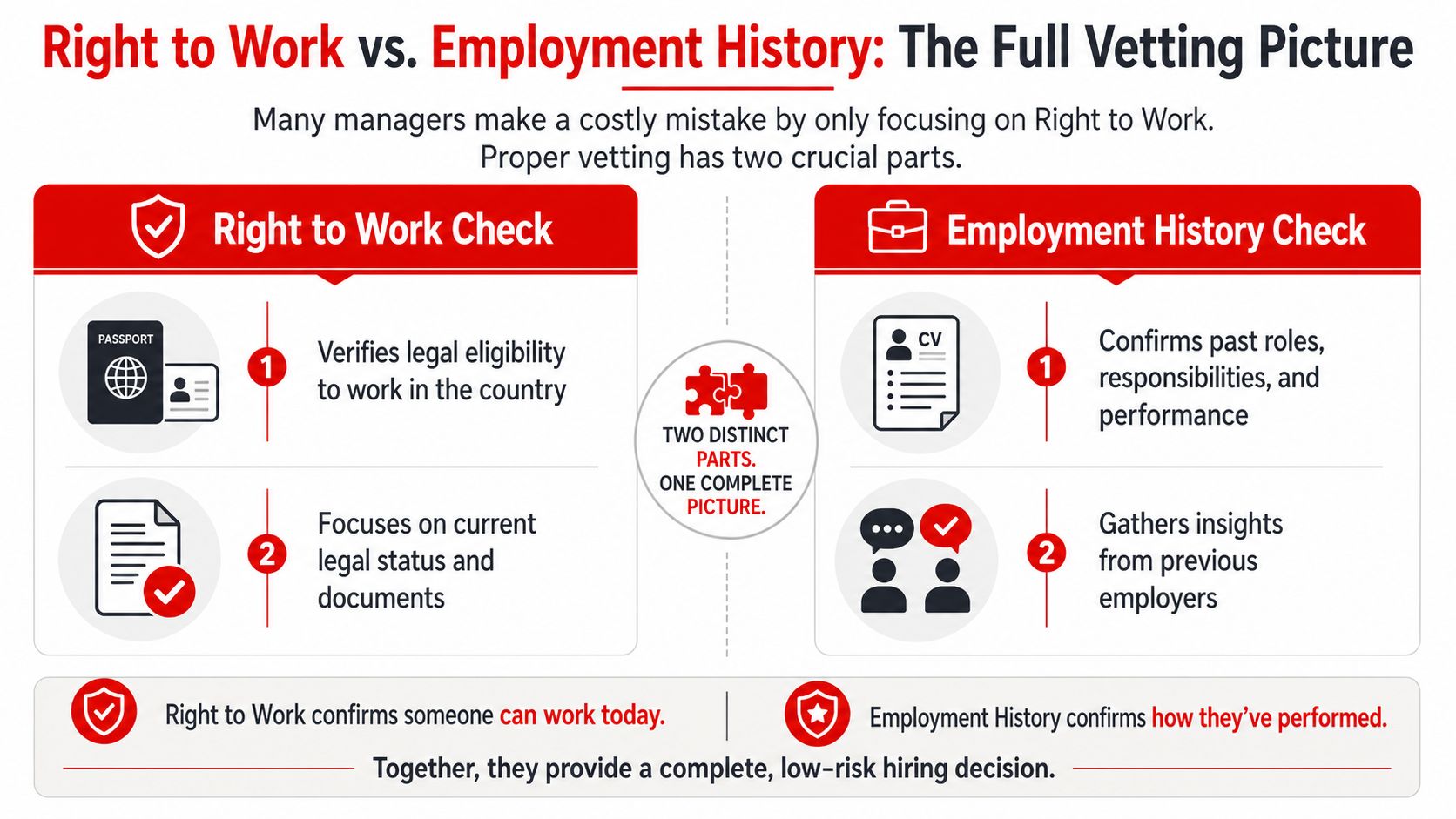
A valid Right to Work check answers a legal question. An employment history check answers an operational one. If you only complete the first, you may be compliant on immigration rules while still putting an untested chef into a critical shift.
The simplest way to think about it
Right to Work is the passport. It confirms legal permission to be employed in the UK.
Employment history is the driving test. It tells you whether the person can handle the vehicle you're about to hand them.
That distinction sounds obvious when written down, but in real kitchens it gets missed constantly. A manager gets a share code, sees that the person can work, and moves on. The assumption is that legal status equals suitability. It doesn't.
UK law requires Right to Work checks to avoid civil penalties, but it does not require employers to verify a candidate's actual employment history unless specific standards apply. A valid share code also does not confirm a chef's claimed experience or reliability, as discussed in this employer compliance analysis.
What each check is really for
Here's the practical difference:
| Check | What it confirms | What it does not confirm |
|---|---|---|
| Right to Work | Legal eligibility to work in the UK | Skill level, station competence, honesty on the CV |
| Employment history | Where they worked, when they worked, and whether the story holds up | Current immigration status on its own |
This is why a kitchen can still end up in trouble after doing the legal part correctly. The paperwork may be clean, but the candidate may still be unsuitable for a fast-moving gastropub in Bristol, a coastal hotel in Dorset, or a country house operation in Berkshire.
A share code can keep you compliant. It can't tell you whether the chef can run service.
The gap most venues leave open
The dangerous gap sits between compliance and due diligence. That gap gets bigger when the hire is rushed, temporary, or covering sickness at short notice.
Managers often assume temporary means lower risk because the person is only in for a few shifts. In practice, the opposite is often true. Temporary hires land in kitchens when pressure is already high. That means one weak chef can do more damage, faster.
If you need a practical starting point on the legal side, this Right to Work verification guide for hospitality hiring is the part most venues need to lock down first. Then comes the operational check, which is where many costly hiring mistakes still slip through.
How to Conduct a Bulletproof Right to Work Check
This is a mandatory part. If you get Right to Work wrong, the consequences are legal before they're operational.
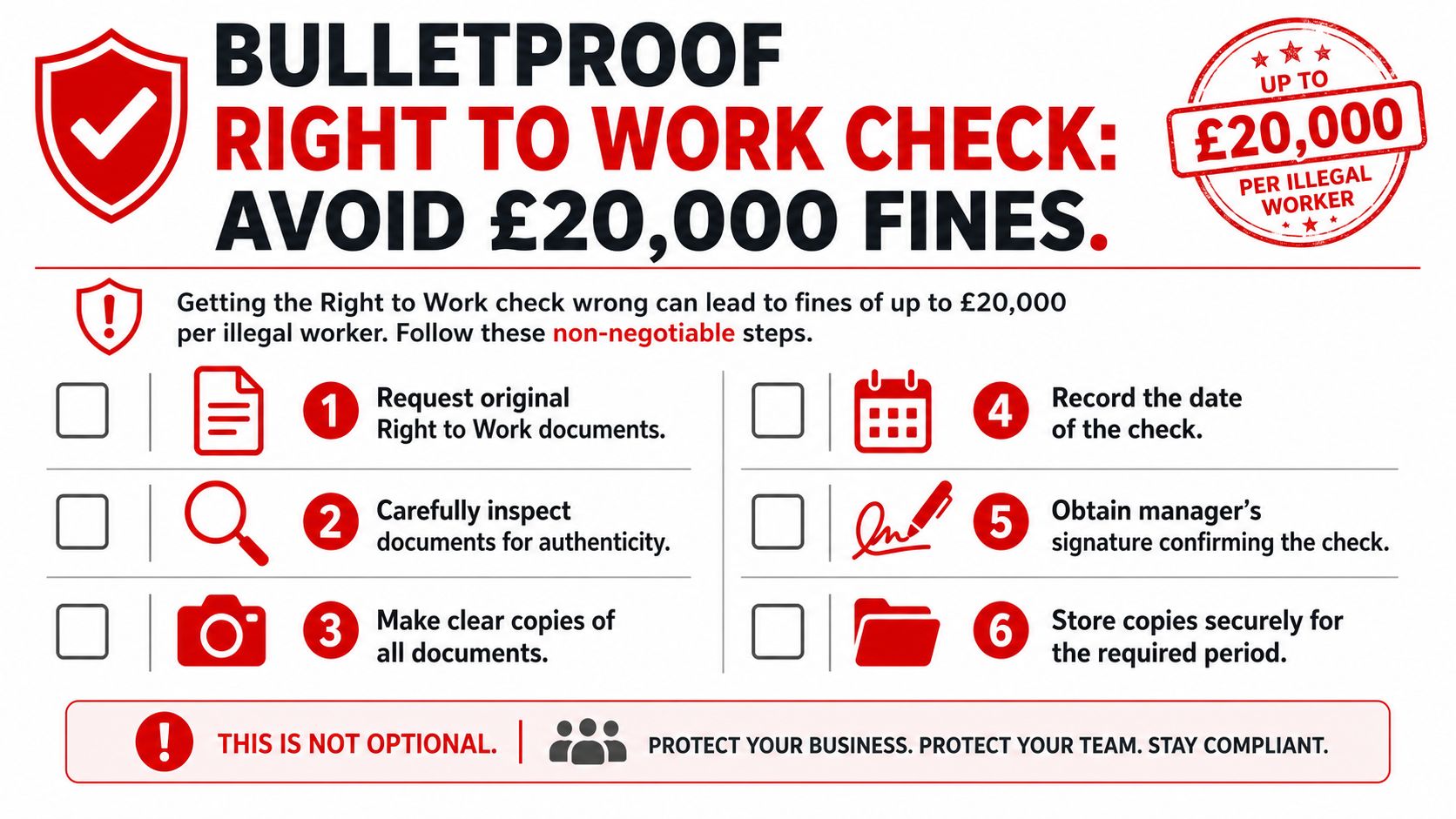
In the UK, employers must complete Right to Work employment verification before the individual starts any work, including trial shifts, to maintain a statutory excuse against civil penalties of up to £20,000 per illegal worker. For non-British or Irish citizens, the online checking service is mandatory, as explained in this hospitality Right to Work guidance.
For busy managers, the safest approach is a repeatable checklist, not memory.
The minimum process that must happen every time
If the candidate is not a British or Irish citizen, use the government's online checking service with their share code and date of birth before they do any work.
For managers juggling cover in Windsor, hotel staffing in Reading, or seasonal kitchens in Devon, the order matters:
- Get the share code first. Don't leave this until the chef arrives for prep.
- Check before any work starts. That includes unpaid trials, kitchen familiarisation, or a quick “just help us through lunch”.
- Review the result properly. Look at whether the person can work, whether there are restrictions, and whether the permission expires.
- Pay attention to limits. Student permissions can include working hour restrictions. If your rota breaks those limits, the problem sits with the employer, not just the candidate.
- Keep a clear record. Save the evidence of the check and store it securely.
What managers most often get wrong
The biggest mistake is timing. A venue gets desperate, the chef seems credible, and the manager says, “Start now, we'll sort the documents later.” That is exactly the wrong way round.
The second mistake is treating the result as a yes or no only. Some permissions come with conditions. If the online result shows restrictions, you need to understand them before the shift goes live.
A third issue is inconsistency. One candidate gets checked properly. Another gets waved through because they came recommended by a friend, another chef, or a previous agency. That inconsistency causes problems fast when records are reviewed.
Manager's checklist: If the check isn't complete before the shift, the shift doesn't start.
Here's the practical standard to hold:
- Before service: Check status before any prep, trial, or induction starts.
- During review: Read restrictions instead of just looking for a green light.
- After checking: Save the result in a secure staff file with the date attached.
The government process is straightforward when someone in the team owns it and follows the same routine every time.
A short visual guide helps if you need to train duty managers or site managers quickly:
A workable standard for multi-site hospitality teams
If you run more than one site, don't let each location invent its own version of compliance. Use one process, one file standard, and one sign-off point.
That matters for pub groups, hotel collections, and operators moving chefs between venues. A chef who worked one compliant shift at one site still needs the process documented properly for the employing business. Good systems remove guesswork. Weak systems rely on whoever is on duty remembering what to do.
Verifying a Chef's Real Experience and Reliability
A valid visa doesn't prove a chef can handle a section.
That's the part too many venues learn after the shift starts. The CV says fresh food, banqueting, high volume, team leadership. Service begins and none of it holds up. Basic references don't always fix that either, especially when they only confirm dates and job titles.
Why CVs and light references fall short
Candidates know what hospitality employers want to hear. “Worked under pressure.” “Strong on service.” “Can lead a small team.” None of that means much until you test whether the work history is real and whether previous employers would hire them again.
Start with the basics, but don't stop there:
- Check role fit: Ask what sections they ran, not just the title they held.
- Test scale: Clarify whether “busy” meant a village pub lunch trade or a hotel pushing covers and functions at once.
- Probe reliability: Ask former employers about timekeeping, attitude, hygiene, and how much supervision they needed.
A polished CV can still hide weak experience, and a rushed phone reference can miss the obvious.
For candidates presenting a long list of kitchens, this guide on writing a CV for a chef is useful because it shows how experience should be laid out clearly. It also helps you spot when the timeline is vague, padded, or inconsistent.
The strongest check most venues still ignore
Employers can now use HMRC PAYE records to verify an individual's employment history over the past five years, revealing precise employment dates and taxable income from official records rather than relying only on references, as explained in this HMRC employment history verification walkthrough.
That matters because false references and “alibi mills” still exist. A friendly mobile number on a CV is not proof. HMRC records are much harder to fake.
Used properly, this gives you a cleaner picture of whether the candidate worked where they claimed, and roughly when. It won't tell you whether they were brilliant on sauce or poor on organisation, but it does tell you whether the employment story is built on something real.
If the dates on the CV, the reference, and the official record don't line up, stop and ask why before you book the shift.
What to ask a previous employer
Don't ask, “Were they good?” Ask questions that force specifics.
Try these instead:
- What section did they hold most often?
- Would you put them back into your kitchen during a busy Saturday service?
- Did they need close supervision?
- Were there any attendance or conduct issues?
- What sort of menu and volume were they working with?
The best verification process mixes documentary proof with honest operational questions. That's how you find out whether the candidate is reliable, not just employable.
Common Verification Pitfalls and Legal Traps
Most verification failures don't come from deliberate rule-breaking. They come from rushed decisions, patchy records, and managers trying to solve tonight's rota problem with tomorrow's admin.
That's where legal and operational risk meet.
The mistakes that keep causing trouble
Some errors are obvious. Others look small until they create a real dispute.
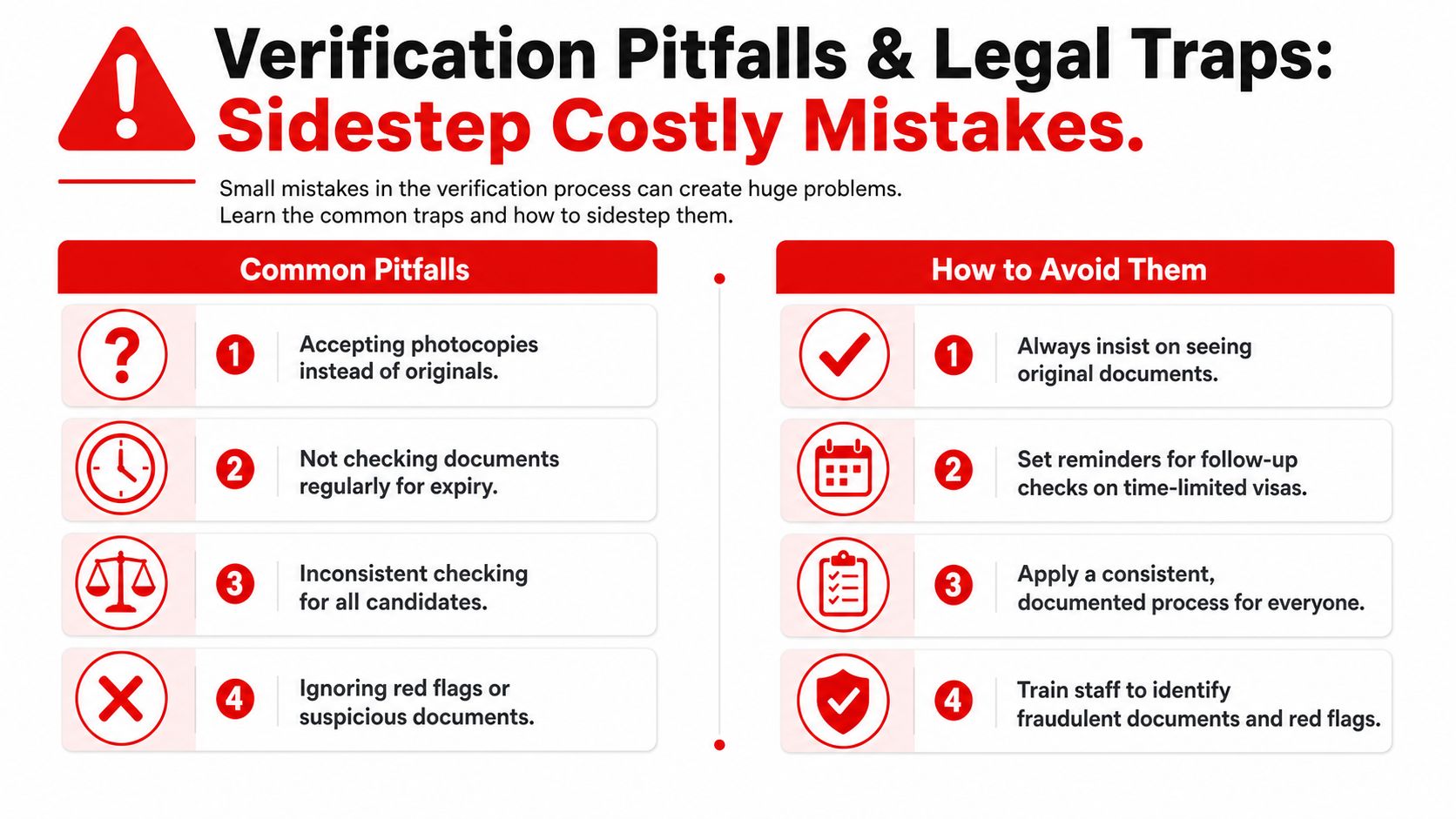
Here are the common ones:
- Late checks: Letting someone start first and checking later because the kitchen is short.
- Inconsistent process: Scrutinising one candidate but accepting another on trust.
- Weak document handling: Saving incomplete records or losing proof of the date a check was made.
- Reference shortcuts: Calling a personal contact and treating that as proper employment history verification.
- Ignoring red flags: Overlooking unexplained gaps, vague job titles, or references that avoid direct answers.
These problems show up everywhere from independent pubs in Wales to boutique hotels in Bristol. Pressure changes the pace of hiring, but it doesn't change the standard you're expected to meet.
The GDPR issue many managers miss
There's another risk that gets far less attention. Under UK GDPR and ICO guidance, pre-employment vetting is classed as particularly intrusive, and employers must tell candidates why information is being collected, who will see it, and how long it will be kept before proceeding, according to the ICO guidance on pre-employment vetting.
That matters if you're using third-party checks, requesting detailed history, or investigating discrepancies.
A fast process still has to be a transparent process.
| Pitfall | Better approach |
|---|---|
| Candidate isn't told what checks are happening | Explain what you're checking, why, who handles it, and retention arrangements |
| You collect more than you need | Limit checks to what is relevant for the role |
| A discrepancy appears and you reject immediately | Give the candidate a fair chance to explain |
Candidates should never be left guessing what you're checking or why you're checking it.
What a safer process looks like
A sound process is simple and documented:
- Tell the candidate upfront: Explain the vetting steps before you begin.
- Use only relevant checks: Don't gather extra personal information because it might be useful later.
- Let people respond: If dates don't align or a gap appears, ask for an explanation.
- Keep the process even: The same role should trigger the same checks each time.
Managers often think legal problems come from big dramatic failures. In reality, they often come from ordinary sloppiness. One missing record, one unchecked restriction, one unexplained discrepancy handled badly. That's enough.
The Smart Solution Vetted Chefs on Demand
At a certain point, the issue isn't whether verification matters. It's whether your team has the time and discipline to do it properly every single time while also running service.
Most hospitality businesses don't. Not consistently.
A head chef covering ordering, prep, staff issues, supplier calls, and weekend rota gaps isn't in the best position to become an immigration compliance specialist and an employment investigator as well. Neither is a GM trying to keep bedrooms full, breakfast on track, and labour under control.
Why operators outsource this part
The best reason to use a specialist staffing partner isn't convenience. It's risk control.
When the need is urgent, standards usually slip first. That's when managers accept a recommendation without checking it, rely on a rushed phone call, or push someone into a trial shift without the full process being complete. Outsourcing to a specialist removes a lot of that pressure because the screening work is already built into the supply model.
That's particularly useful when you need:
- Relief chefs for same-week gaps
- Temporary chefs during holidays, sickness, events, and peak season
- Permanent chef recruitment for harder-to-fill leadership roles
- Yacht chefs and villa chefs where trust and discretion matter as much as food quality
- Wider hospitality staffing support across multiple sites
What works better than ad hoc hiring
Ad hoc hiring often fails for the same reasons. The venue is rushed, references are thin, the brief is vague, and nobody really tests whether the chef suits the site.
A specialist agency with hospitality knowledge can tighten that up by checking Right to Work, work history, references, and suitability before the chef ever reaches your pass. That matters whether the job is a one-week hotel contract in Berkshire, a short-notice pub shift in Wales, or a permanent appointment in Bristol.
There's also a commercial point here. Kitchens need continuity. Every bad placement forces the team to re-train, re-brief, re-check, and recover service standards. Good vetted cover protects the guest experience and stops the senior team getting dragged back into basic firefighting.
Why Relief Chefs UK fits this market
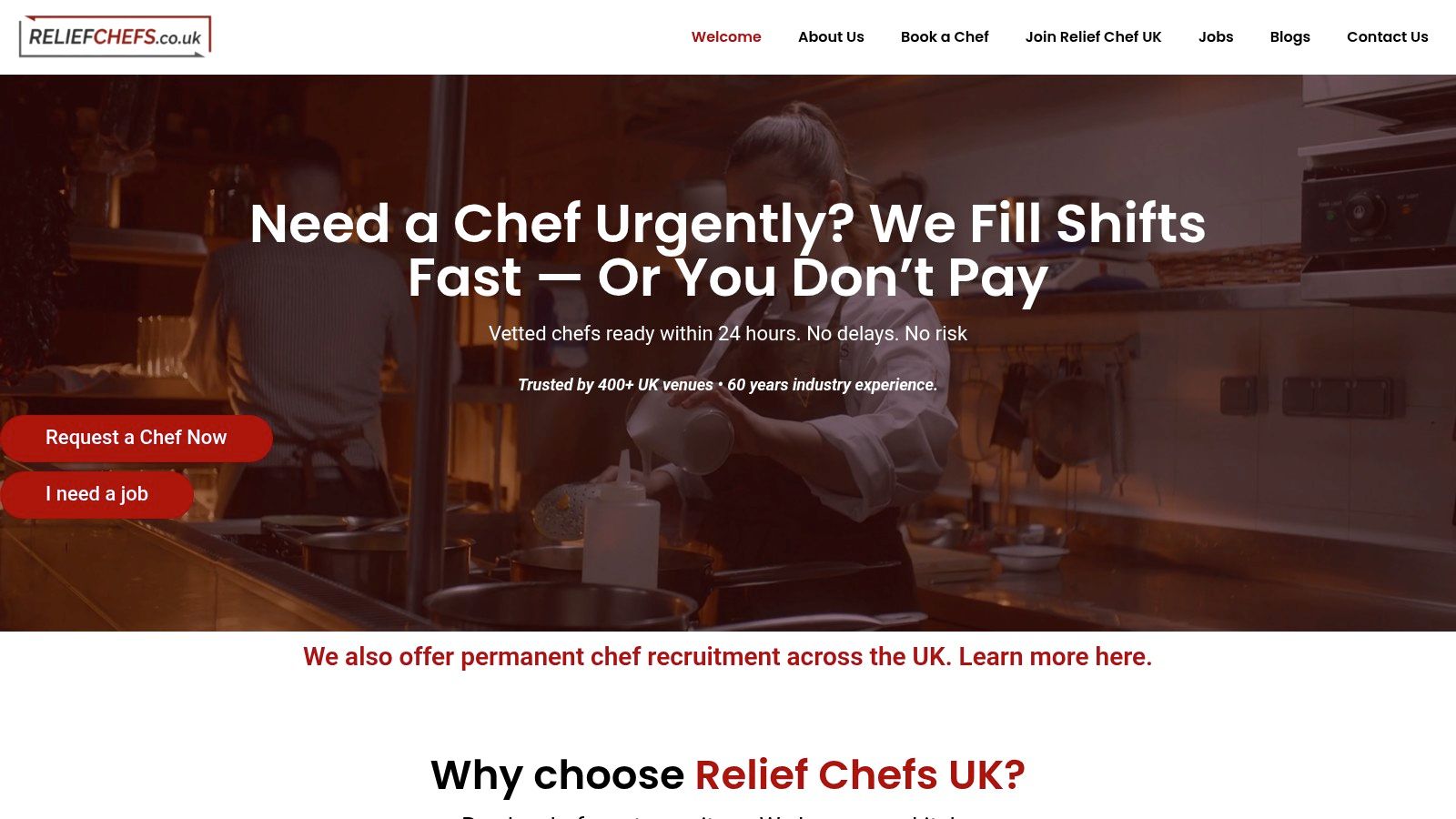
For operators that need a practical nationwide option, Relief Chefs UK has been established since 2013 and works across the UK with independent pubs, restaurants, boutique hotels, private households, yachts, and villas. The business covers relief chefs, temporary chefs, permanent chef recruitment, yacht chefs, villa chefs, and broader hospitality staffing support.
The value is straightforward. When a trusted staffing partner has already handled the verification process, your team can focus on service, standards, and guests instead of chasing paperwork and second-guessing CVs.
Employment Verification Frequently Asked Questions
Managers usually don't struggle with the idea of employment verification. They struggle with the grey areas. These are the questions that come up most often on the floor and in the office.
Can a chef do an unpaid trial shift before checks are finished
No. If someone is doing any work at all, the Right to Work position must be checked first.
That's where many venues slip. They call it a trial, a stage, kitchen observation, or a quick unpaid hand. If the person is doing work before the check is complete, you're taking risk you don't need to take.
The safe rule is simple:
- No prep before checks
- No service before checks
- No unpaid trial before checks
Is a DBS check part of employment verification
Not usually for standard hospitality roles.
A DBS check is separate from Right to Work and separate from ordinary employment history checks. It may become relevant if the role is in a setting such as a school, care home, or another environment where safeguarding duties apply. If that applies to your venue, decide it based on the setting and role requirements, not as a default add-on for every chef vacancy.
What records should we keep
Keep clear evidence of the checks you've carried out, when you carried them out, and what result you relied on.
In practice, that usually means retaining copies or saved results from the Right to Work process, along with supporting notes from your employment history checks where relevant. Store them securely, keep access controlled, and make sure site managers know where the records sit.
What if a reference or history check raises a discrepancy
Don't ignore it, but don't jump straight to rejection either.
The sensible approach is to pause the hire and ask the candidate to explain the issue. Dates can be muddled. Business names can change. Payroll timing can confuse things. Some discrepancies have a perfectly reasonable explanation. Others expose a clear problem. You only find out which by asking.
Small discrepancies deserve a proper question, not a rushed assumption.
What if we need a chef urgently tonight or tomorrow
Urgency doesn't remove the need for verification. It just means your process has to be organised enough to happen quickly.
That's where many businesses benefit from having a staffing partner already in place rather than starting from scratch every time someone calls in sick. The better your process is before the emergency, the less chance you'll make a poor decision when pressure lands.
Does employment verification matter for temporary hires as much as permanent ones
Yes, and often more.
Temporary chefs usually arrive when the kitchen is already under strain. They can have a major impact within a single shift. If the person is wrong for the role, you don't get a long bedding-in period. You get immediate disruption during service.
If you need vetted chef cover without the usual guesswork, contact Relief Chefs UK. Since 2013, Relief Chefs UK has supported hospitality businesses across the country with relief chefs, temporary chefs, permanent chef recruitment, yacht chefs, villa chefs, and dependable hospitality staffing support. Whether you're dealing with short notice sickness in Bristol, seasonal pressure in Devon, hotel recruitment in Berkshire, or urgent kitchen cover anywhere else in the UK, the team can help you secure reliable chef cover fast.
Call the team.
Office 01392 715474 · info@reliefchefs.co.uk