
A Friday service can unravel long before the first main course leaves the pass. The head chef rings in sick, the sous chef is already on prep, and the rota that looked fine at 10 a.m. suddenly leaves the kitchen exposed, the dining room booked out, and the front-of-house team explaining delays they can't control. That's the moment a recruitment agency for chefs stops being an optional supplier and starts acting like operational insurance.
The key question isn't whether you need cover. It's whether you've got a way to protect service without turning every absence into a fire drill. For pubs, restaurants, hotels, private households, yachts and villas, the answer usually comes down to one thing, a chef staffing partner that can supply relief chefs, temporary chefs, and, when needed, a route into permanent chef recruitment without breaking kitchen standards.
| Deployment choice | Best fit | What it protects |
|---|---|---|
| Same-day relief cover | Sudden sickness, no-show, emergency absence | Service continuity and guest bookings |
| Short-term temporary chef | Holiday peaks, planned leave, rota gaps | Rota stability and team workload |
| Permanent chef recruitment | Ongoing vacancies, succession planning | Long-term kitchen structure and consistency |
| Temp-to-perm placement | Trial before commitment | Reduced hiring risk and better fit |
A good agency doesn't just send a body with knives. It gives an operator enough time to keep the pass running, enough flexibility to avoid closing sections, and enough vetting to stop one rushed booking from becoming a week of damage control. For operators comparing options, the practical test is simple, can the agency cover tonight, can it support the next month, and can it help you make a permanent decision without gambling the service.
The True Cost of an Uncovered Kitchen Service
A head chef call-off four hours before a full Friday booking is where the true cost of staffing shows up. The obvious loss is the missed shift, but the bigger hit is what follows, slower tickets, reduced menu availability, stressed sections, and managers pulled away from guests to patch over a kitchen problem they didn't create.
That's why the hidden cost of bad cover matters so much, and why this guide on the hidden cost of emergency relief chef booking should be read alongside any staffing decision. If the kitchen can't deliver the service it sold, the venue doesn't just lose labour efficiency, it risks reputation, repeat bookings, and team morale in one go.
What an uncovered shift actually does
An uncovered section rarely stays contained. One absence forces the remaining chefs to stretch across prep, service, cleaning, and pass coordination, which is exactly how standards slip. FOH then starts comping dishes, pushing back covers, or smoothing over delays that could have been avoided with competent cover in place.
Practical rule: if the service can't be maintained without one person doing two jobs, the rota was never resilient enough.
When the emergency booking pays for itself
The break-even point isn't theoretical. If the cost of cover is less than the value of the service you'd otherwise lose, the booking is usually justified. That value includes saved bookings, avoided cancellations, protected gross margin, and the manager time you don't burn trying to recruit in a panic.
For independent pubs and boutique hotels, the mistake is treating staffing like a fixed cost instead of a revenue safeguard. A kitchen that can't operate reliably on short notice is fragile, and fragility gets expensive quickly when bookings are already in the diary. The smarter approach is to treat emergency chef cover as a revenue-protection tool, not an admission of failure.
Why linear staffing models keep breaking
A rota built only around “usual” demand assumes people will always be there. In hospitality, they won't. Short-notice sickness, unexpected resignations, and holiday peaks all hit at the same time venues are least able to absorb disruption.
That's why the best operators keep a live relationship with a chef agency before the crisis arrives. They're not buying panic cover, they're buying continuity, and continuity is what keeps service standards intact when the kitchen suddenly loses a key pair of hands.
Why UK Hospitality Can No Longer Rely on Local Talent
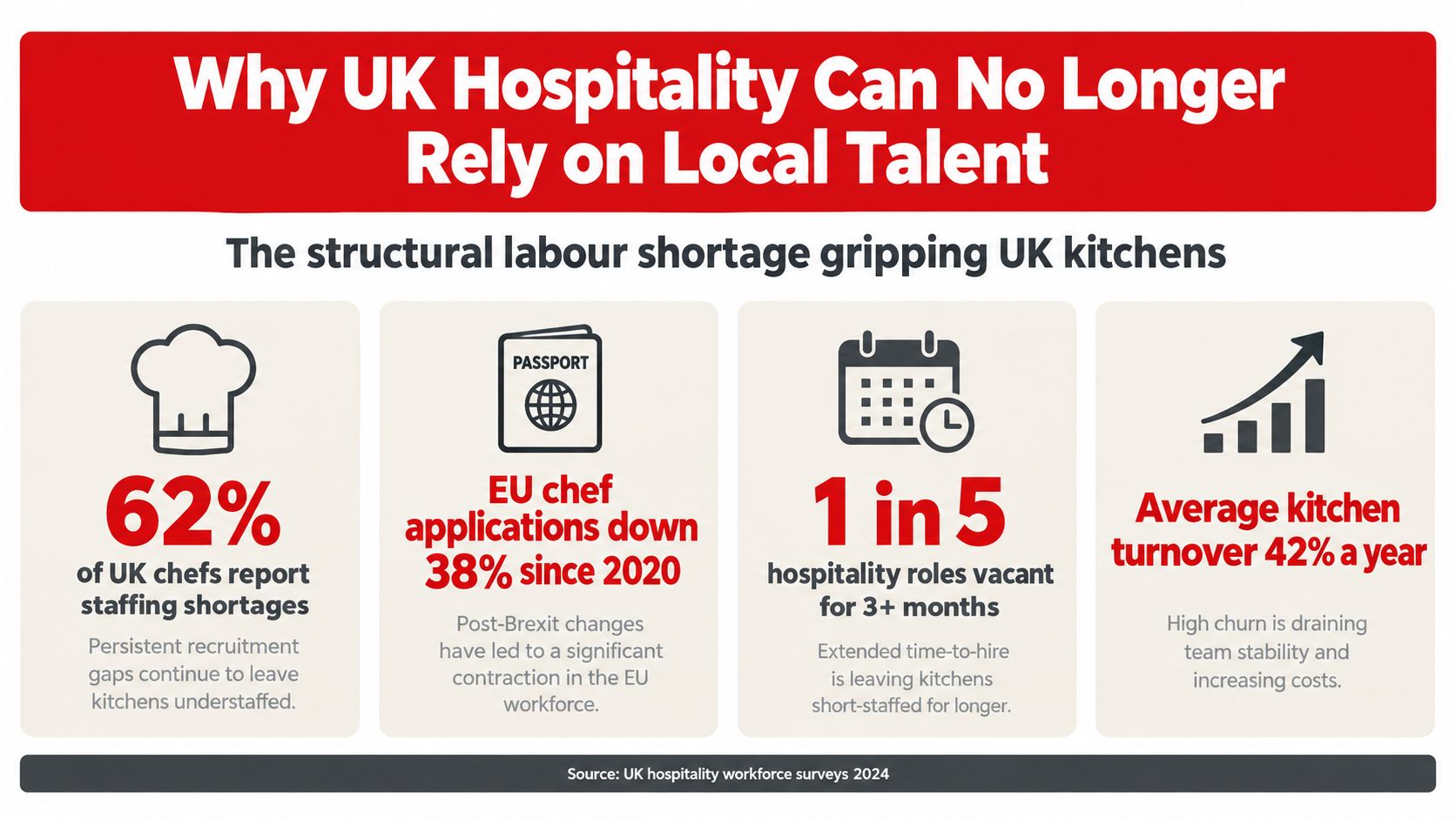
A kitchen can look fully staffed on paper and still be one call away from failure. The labour picture in UK hospitality is still shaped by shortage, churn, and uneven recovery. The Office for National Statistics reported that between 23 August and 5 September 2021, 30% of hospitality businesses said vacancies were harder to fill than usual, compared with 13% across all industries. In the same analysis, the UK had 1,034,000 vacancies in June to August 2021, the highest level since the series began in 2001, and hospitality vacancies were 59.1% above the January to March 2020 pre-pandemic level. ONS hospitality vacancy data
When the local pool is thin, the cost shows up as cancelled covers and overtime, not as an empty spreadsheet cell. That matters because local hiring only works when there's enough local supply, as we cover in our guide to skills shortage solutions. In Devon, Dorset, Wales, Berkshire, Windsor, Reading and Slough, the usual pool can be thin, especially when every venue is chasing the same few candidates. A nationwide recruitment agency for chefs widens the search when the postcode lottery stops producing answers.
Chefs sit at the centre of the shortage
The government's Construction and Hospitality Shortage Review said chefs made up 60% of hospitality applications through the immigration system, and that 63% of total hospitality employment was at RQF levels 1 to 2 and therefore ineligible for the Skilled Worker route. Government shortage review
That creates a real operating constraint. You cannot assume immigration will fill every gap, and you cannot assume local recruitment will produce the right chef fast enough either. The practical response is a broader candidate pipeline, tighter right-to-work controls, and a staffing partner that can move while service is already under pressure.
Regional demand changes the game
A hotel in Bristol may need support from South Wales or the South West. A seasonal pub in Dorset may need a relief chef who can start while the summer rota is still being repaired. A restaurant group in Berkshire may need a wider network across Reading, Windsor and Slough to keep its kitchens covered without waiting on local applicants.
Operational truth: if your business depends on one town's talent pool, your rota depends on luck.
Relief Chefs UK, established in 2013, works across the UK with relief chefs, temporary chefs, permanent chef recruitment, yacht chefs, villa chefs and wider hospitality staffing support. That nationwide model matters because a constrained local labour market is now the operating environment, not a temporary inconvenience.
The post-Brexit reality
A post-Brexit market also means the sourcing strategy has to be more disciplined. The occupation with the clearest shortage evidence is still one of the most important food-service roles, so the agency's job is not just to find someone available. It is to find someone compliant, experienced, and deployable fast enough to protect service.
Comparing Temporary Relief and Permanent Placements
The mistake many operators make is using the same hiring logic for two different problems. A same-day absence needs a temporary chef. A recurring vacancy needs a permanent chef recruitment process. Mixing those up wastes time, raises costs, and leaves the kitchen exposed for longer than it should be.
A temporary placement is about service continuity. A permanent hire is about structural stability. One keeps the pass open tonight, the other reduces the chances of tonight's problem repeating next month.
| Operational Trigger | Recommended Solution | Primary Benefit |
|---|---|---|
| Same-day sickness | Relief chef | Immediate service protection |
| Holiday cover | Temporary chef | Rota stability without overloading the brigade |
| Seasonal peak in Bristol, Devon or Dorset | Temporary chef | Extra capacity during known pressure points |
| Repeated absence in the same role | Permanent chef recruitment | Long-term fix to recurring disruption |
| New venue opening | Permanent hire with temporary backup | Controlled launch and less operational risk |
| Trial period for a senior chef | Temp-to-perm placement | Better hiring decision with less exposure |
When relief cover is the right call
Relief cover makes sense when the issue is immediate. If the kitchen is facing a no-show, an illness call, or a sudden gap in the roster, the objective is to keep the service standards intact without pausing the business while recruitment catches up. That's where a short-term chef with the right experience can save the service from collapse.
The best use of relief work is often defensive. It gives the existing brigade room to breathe, prevents overtime from spiralling, and stops managers from burning out while trying to recruit at the same time.
When permanent hiring is the real fix
If the same role keeps reopening, the issue isn't just staffing. It's structure. That might mean the site is underpaying, the hours are unsocial, the role is poorly defined, or the business has outgrown its current model.
Permanent recruitment works best when the venue can define what good looks like, write a realistic job brief, and interview without panic. If service is already slipping, bring in temporary support first, then run the permanent search properly.
How to choose between them
Use service volume, cancellation exposure, and rota lead times as the main filters. If a missing chef would force menu cuts, reduce covers, or overload the rest of the brigade, relief cover is the immediate answer. If the vacancy is recurring and the operation needs a stable long-term appointment, permanent hiring should run in parallel.
For temporary kitchen cover, see the temporary kitchen staff service page. The smartest operators don't treat temporary and permanent hiring as competing ideas, they use both to keep the kitchen stable while they solve the root problem.
What Fully Vetted Actually Means in Practice
“Fully vetted” is only useful if the agency can show what was checked and when. In a busy kitchen, that should mean more than a polished CV and a quick phone call. It should mean a clear audit trail that proves the chef is legally deployable, operationally suitable, and safe to put on the pass.
The checks that matter
A serious agency should be able to show the basics without hesitation. That starts with right-to-work verification, which should be documented properly and checked before placement. It also includes references, role history, food-safety competence, and any certificates that affect safe kitchen deployment.
For roles where it's relevant, the file should also show whether a DBS check was required, how the agency handled payroll status, and what process exists if the chef fails to meet standards on site. If those answers are vague, the vetting is probably vague too.
Who still owns the kitchen
Agency cover doesn't transfer operational responsibility away from the venue. The kitchen team still controls supervision, HACCP procedures, allergen communication, and working-time compliance during service. The agency may handle recruitment admin and payroll, but the venue remains responsible for how the chef is used on the day.
Practical rule: vetted doesn't mean unmanaged, and it never means unsupervised.
That distinction matters because a chef can be legal to work and still be wrong for a specific kitchen. A well-run agency should help you avoid that mismatch, not pretend paperwork alone is enough.
What to ask before the chef arrives
Ask for the exact documents, not a verbal promise. Check whether the agency can confirm identity, right to work, references, and any relevant food-safety or allergen training before the shift starts. Then make sure your own team knows who is supervising the chef once they walk in.
The standard should be simple. If a candidate is fully vetted, the agency can explain every step, and the venue can still run a safe service without relying on guesswork.
Matching Chef Cover to the Venue
A boutique hotel in Windsor needs a different chef profile from a high-volume pub in Dorset. A private household wants discretion, consistency, and a calm presence in the kitchen. A yacht or villa booking calls for adaptability, clean working habits, and the ability to keep standards high in a space that punishes poor planning.
Matching the service model to the venue
Independent restaurants usually need flexibility. Weekend demand rises, service style shifts, and the right temporary chef has to slot into an existing team without slowing the pass. Multi-site hotel groups need a steadier pipeline, often with senior chefs who can move between sites and hold the same standards in each kitchen.
Private households, yachts and villas sit in a different category. A chef's technical ability matters, but so does discretion, pacing and the ability to run the kitchen without creating friction. A generic match often fails here because the service environment changes the brief.
What operators in tourist areas should expect
Tourist-heavy areas create their own staffing pressure, especially where demand rises faster than the local pool can respond. A seasonal pub in Cornwall may need a chef who can run a two-chef brigade alone. A coastal hotel in the South West may need cover for room service, banqueting and breakfast prep in the same week. That kind of pressure usually needs more than one answer, temporary cover now and a permanent recruitment plan behind it.
Research commissioned by Caterer.com found that 64% of hospitality businesses were most concerned about recruiting chefs throughout the year, and 85% were actively recruiting outside their immediate area to secure reliable talent. Hospitality and Catering News report
Why wider search areas work
A narrow local search is often too slow for urgent kitchen work. Broadening the radius lets operators compare experience, service style, and availability instead of waiting on one town's applicant pool. A hotel in Bristol may need candidates who can step into conference service as well as à la carte. A restaurant group in Berkshire may need support across Reading, Slough and Windsor, where one site might need lunch cover while another needs a chef who can handle a late booking spike.
A nationwide agency helps build a response around the venue's actual need, not just the nearest postcode. That keeps kitchen stability intact when local recruitment stalls.
The Commercial Case for a Chef-Led Agency
A chef-led agency understands the difference between a candidate who looks good on paper and one who can survive a Friday night service. That matters commercially, because the wrong placement costs time, money, and confidence. The right one keeps the kitchen steady and reduces the chance of repeat disruption.
What chef-led actually means
In practice, it means the people handling the booking understand section pressure, service rhythm, prep discipline, and what it takes to step into an unfamiliar brigade. They'll ask different questions from a generalist recruiter, and they'll usually spot the warning signs earlier.
The commercial upside is straightforward. Better matching reduces churn, replacement requests, and the hidden cost of re-training someone who was never right for the role. It also makes it easier to build a supplier relationship that doesn't need constant firefighting.
What operators should expect from the partnership
Transparent pricing matters because hospitality budgets don't tolerate surprises. Replacement cover should be clear before the first booking. Support should be available when the service is under pressure, not only during office hours.
If you're comparing suppliers, one option is Relief Chefs UK, a nationwide partner established in 2013 that supplies relief chefs, temporary chefs, permanent chef recruitment, yacht chefs, villa chefs and broader hospitality staffing support. The point isn't the label, it's whether the agency can back up its promise with practical availability, clear terms, and chefs who can operate under pressure.
Commercial rule: if the agency can't explain how it protects the shift, it probably doesn't protect the business.
Why waiting costs more than booking now
Most kitchens don't plan staffing until the pressure is already visible. By then, managers are reacting instead of choosing. Securing contingency cover before the next resignation, illness spike or seasonal rush gives the business more control and fewer bad decisions made under time pressure.
Frequently Asked Questions About Chef Recruitment
How fast can a relief chef be deployed?
It depends on location, role level, and the brief you give the agency. For urgent cover, the fastest placements come when the venue is clear about cuisine, service style, start time and expectations.
What should I send before booking a chef?
Send the rota need, kitchen style, hours, site location, and any food-safety or allergen requirements. The clearer the brief, the less likely you are to get a mismatch.
Who checks right to work?
The agency should handle the right-to-work process for the chef it supplies, and the venue should still keep proper records on site. Don't assume one party's paperwork removes the other party's responsibility.
What if the chef doesn't fit the kitchen?
Ask how the agency handles replacement cover before you book. A proper partner should be able to explain the process clearly, including what happens if the chef isn't suitable once the shift starts.
Do I need relief cover or permanent recruitment?
If the problem is immediate, use relief or temporary cover. If the same vacancy keeps reappearing, move to permanent chef recruitment and solve the cause, not just the symptom.
If your kitchen can't afford another service interruption, talk to Relief Chefs UK about relief chefs, temporary chefs, permanent chef recruitment and wider hospitality staffing support. Visit Relief Chefs UK to request cover, compare options, and get a staffing plan that protects service before the next rota crisis hits.