
At 4pm on a Saturday in Bristol, a commis chef sends a sickness message. The head chef is already running a section, the sous chef is covering prep, and the pass is starting to buckle before the first serious wave of tickets arrives. The temptation is to make a few frantic calls and hope somebody competent answers.
That approach treats the symptom, not the operating problem. Temporary kitchen staff should be part of your resilience plan, alongside your permanent rota, training pipeline and service standards. Short-notice sickness, annual leave, seasonal demand, menu launches and pre-opening trials are predictable pressures. A venue that plans for them protects its kitchen stability. One that doesn't leaves the remaining team to absorb the absence until standards, morale and guest experience suffer.
When a Last-Minute Walkout Is Only the Start
The commis's message is only the first failure in the chain. The prep list gets redistributed, the chef de partie loses help, and the head chef spends the opening hour moving between stations instead of managing service. A delayed garnish becomes a delayed starter. A delayed starter pushes the pass harder, which increases mistakes and makes every later table more difficult to recover.
The cost isn't limited to the absent person's wage. Food can be wasted when service is reorganised badly, guests may receive refunds or complimentary items, and experienced chefs may stay late to finish work that should have been completed earlier. A single uncovered shift can cost a 60-cover restaurant more than £2,000 once food waste, refunds and overtime stack up, although the exact result depends on the menu, staffing model and service failure.
Practical rule: If the same type of absence has disrupted service before, it belongs in the rota plan, not in a contingency folder.
Build cover before the phone rings
Start by listing the shifts your operation can't safely run short. That might be a CDP on a broad menu, a breakfast chef in a hotel, a pastry chef during a wedding weekend, or a kitchen porter whose absence leaves chefs washing equipment during service. The right response isn't to cover every possible gap with agency labour. It's to identify the stations where one missing person creates a cascade.
A useful cover plan records:
- Critical stations: Note which sections require an experienced chef and which can be combined without lowering standards.
- Known pressure dates: Mark Christmas services, festival periods, summer terraces, menu changes and trial openings well in advance.
- Named alternatives: Keep details for chefs who understand your cuisine, equipment and pace.
- Escalation contacts: Decide who can approve a booking when the general manager or head chef is unavailable.
Relief cover also protects permanent recruitment. A temporary chef can keep the rota functioning while you search properly for a permanent appointment, rather than forcing a rushed hire because the next service is exposed. The practical distinction between a strong staffing operation and a fragile one is often whether somebody has already decided what happens at 4pm on a Saturday.
For a useful failure-prevention checklist, review seven kitchen disasters that emergency relief chef cover can prevent.
Why UK Kitchens Cannot Staff Their Way Out Anymore
A Friday service in Bristol can be fully booked, the rota can look complete, and one delayed or absent chef can still expose the whole kitchen. That risk reflects a wider labour shortage, not poor recruitment alone. The Office for National Statistics accommodation and food services vacancy series, JP9O, recorded a peak of 177,000 vacancies in 2022, an average of 162,000 across 2022, 126,000 in 2023, 98,000 in 2024, 79,000 across 2025, and 71,000 in the three months to May 2026. The figures cover the wider market rather than chefs alone, but kitchen workers operate within it. The sustained pattern explains why short-notice cover has become part of normal operations. ONS vacancy series JP9O
Chef-specific evidence points in the same direction. A People 1st report estimated that the UK needed an additional 11,000 chefs over the following five years to meet demand and replace staff. It also put chef labour turnover at about 40%, with nearly 94,000 chefs changing jobs each year and around 19,000 leaving the profession entirely. People 1st chef shortage report
What those figures mean on the rota
For an operations manager, a persistent vacancy market creates three direct pressures:
- Permanent hiring takes longer. The right chef may not be available when a vacancy opens, particularly outside major cities and in coastal or seasonal locations.
- The permanent rota carries hidden risk. A full schedule can fail when one person is sick, on annual leave or delayed by transport.
- The service loses flexibility. Managers may shorten opening hours, remove menu items or pull senior chefs onto routine sections instead of letting them lead the kitchen.
A 2021 BBC report, citing UKHospitality, described a sector shortfall of about 188,000 workers, with front-of-house staff and chefs among the acute shortages. BBC report on the hospitality labour shortfall The local effect varies across Devon, Dorset, Wales, Bristol, Berkshire, Windsor, Reading and Slough. Venue type, transport links and service pattern can change the available pool from one booking to the next.
| Metric | Latest figure or trend |
|---|---|
| Accommodation and food services vacancies | 71,000 in the three months to May 2026, after high vacancy levels in earlier years, according to ONS data |
| Additional chefs needed | 11,000 over the following five years, in the People 1st report |
| Chef labour turnover | About 40%, with the same report estimating nearly 94,000 annual job changes |
| Profession exits | Around 19,000 chefs leaving the profession, according to the same People 1st evidence |
| Current sector vacancy position | UKHospitality reports 132,000 vacancies, 48% above pre-pandemic levels, in its workforce campaign evidence |
Permanent recruitment still builds leadership, consistency and kitchen culture. It cannot absorb every absence while the labour market remains tight. Recurring temporary cover is a planned response to a permanent shortage, giving multi-site operators and venues with extended opening hours a second staffing layer. The sensible model is to use relief chefs deliberately, with clear role requirements, verified paperwork and a rota plan, rather than treating each booking as a fresh emergency.
Sourcing Temporary Kitchen Staff the Right Way
The wrong chef usually enters the operation through a rushed sourcing decision. A generic contact promises availability, the venue gives minimal information, and the person who arrives has never worked your menu type or service rhythm. The booking may be technically filled, but the kitchen still carries the risk.
Use a sourcing ladder. Start with the option that gives you the strongest knowledge of the chef, then escalate when its capacity or speed isn't enough.
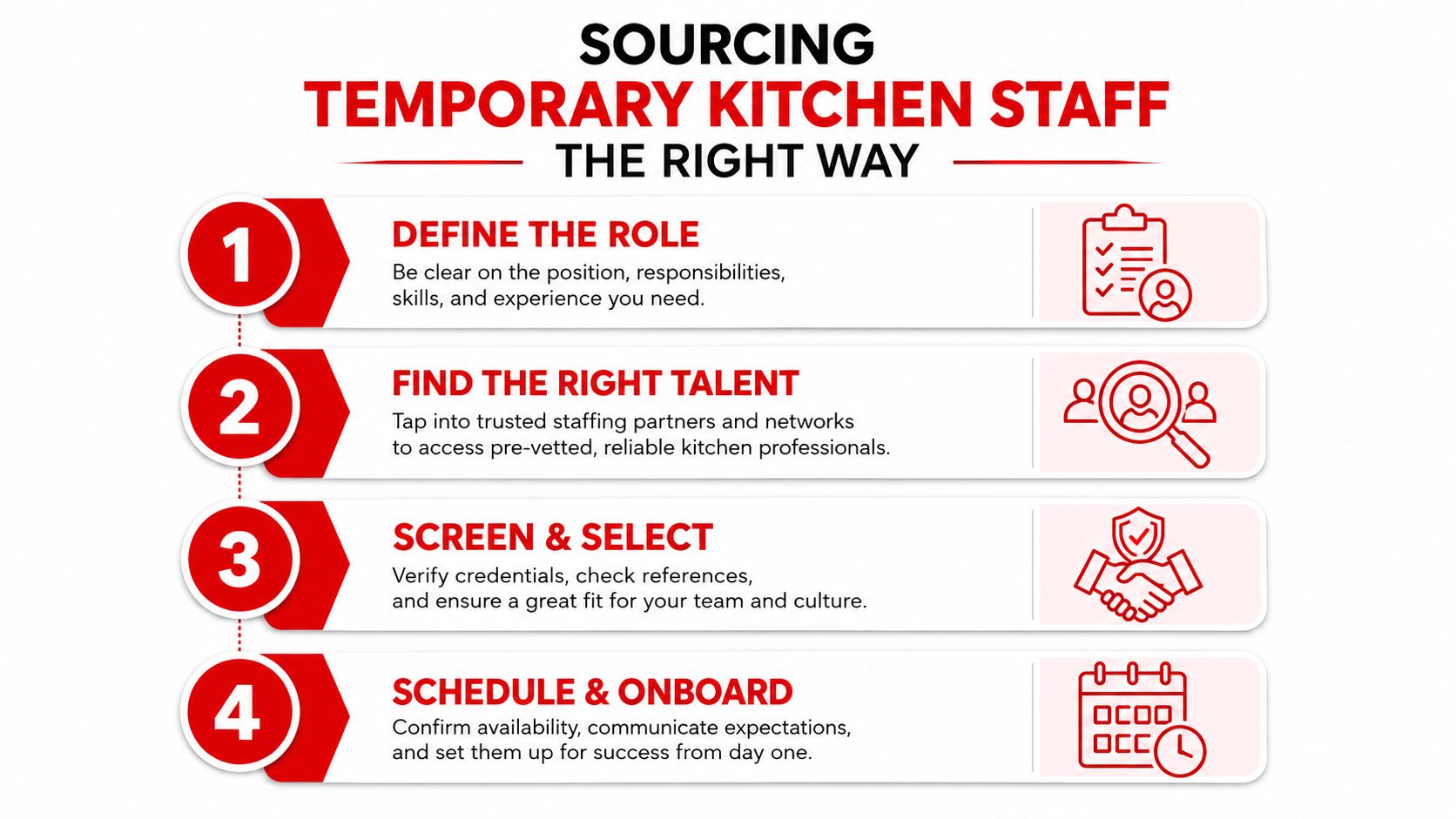
Four levels of cover
First, use an in-house relief bank. Keep a live list of vetted regulars, their strongest sections, travel limits and availability. This works well for planned leave and familiar service patterns, but the bank becomes unreliable if you don't update it after every shift.
Second, call chefs you've personally worked with. A freelance network gives you better insight into pace, attitude and technical ability. Its limitation is scale. A chef who suits a gastro-pub in Devon may not be the right choice for a high-volume hotel in Windsor, and your personal contacts may already be committed.
Third, use a specialist hospitality agency. This is the sensible escalation point when your own network can't cover the shift, particularly when you need a chef in a different region or section. A specialist partner should understand the difference between a breakfast chef, a CDP, a pastry chef, a yacht chef and a senior sous chef.
Finally, use a high-street generalist only as a last resort. It may produce a name quickly, but speed without kitchen-specific vetting can create more work for the head chef.
The escalation decision
Book known faces seven or more days ahead where possible. Escalate to a specialist partner within 72 hours of identifying a likely gap, rather than waiting until the shift becomes an emergency. Reserve same-day calls for a provider that can dispatch somebody who has worked the relevant menu type and can confirm compliance before arrival.
Pin this flow beside the rota:
- Known absence: Offer the shift to a vetted regular.
- No suitable response: Contact your freelance network and check section experience.
- Capacity or location problem: Send the full brief to a specialist hospitality agency.
- Same-day emergency: Give the agency service times, cuisine, section and arrival deadline, then confirm the chef's identity and right-to-work evidence.
The cheapest contact isn't always the cheapest outcome. A chef who needs constant instruction can consume the head chef's attention during the very service the booking was meant to protect.
Vetting, Right to Work and Onboarding Without Drama
A chef can arrive on time, cook well and still create risk if the paperwork or handover is incomplete. Vetting needs to happen before Friday afternoon, with a repeatable process that protects the venue, the permanent team and the chef taking the shift. An agency's assurance does not replace the venue's legal responsibility.
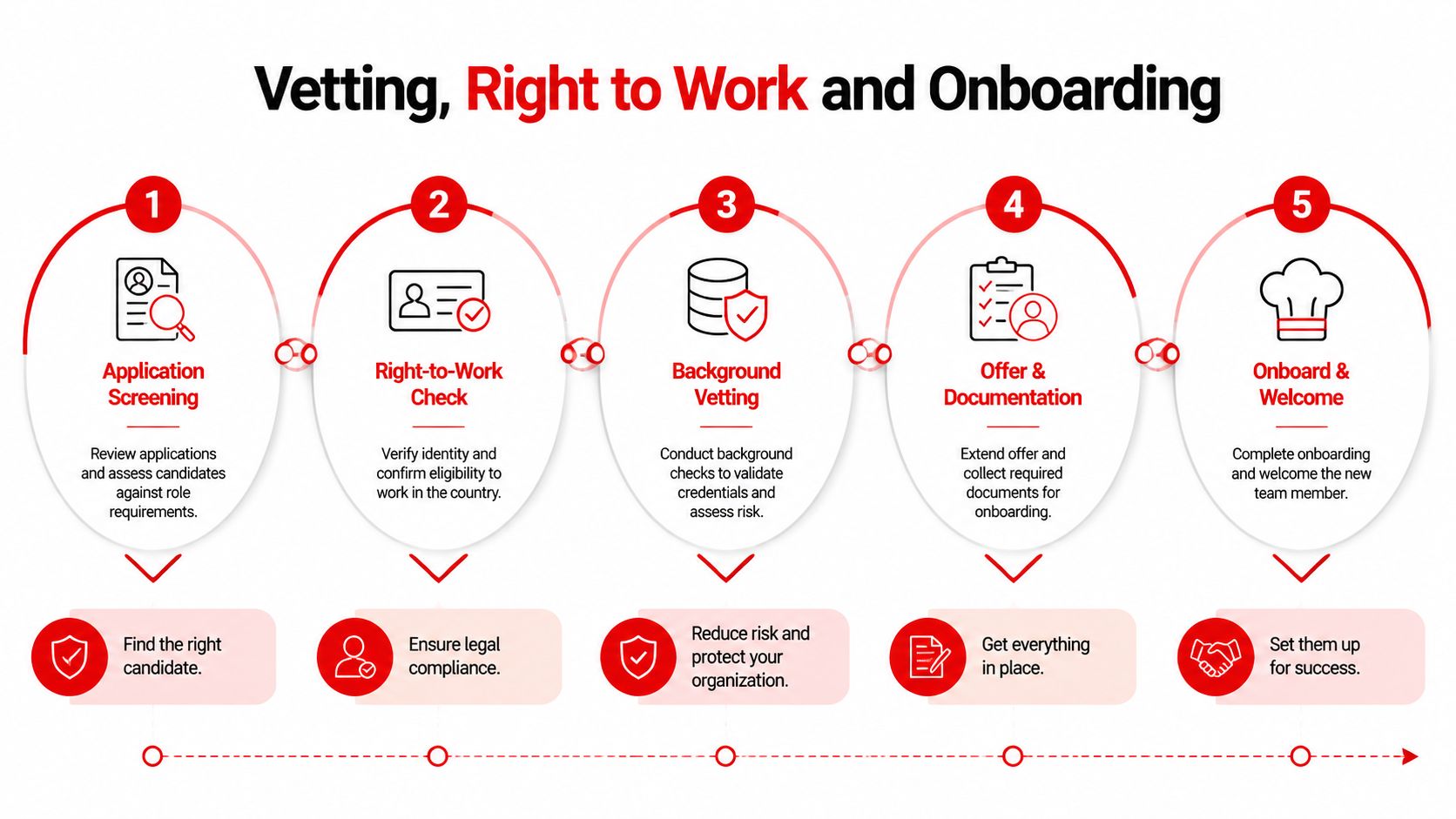
The five checks that matter
Start with Right to Work verification. Complete the official online share-code check where it applies, or inspect the required physical documents and retain the relevant copies or confirmations. A clear Right to Work verification process creates an audit trail. Time-limited visas also require follow-up checks, and the venue remains responsible even when a third party introduces the chef. Keep expiry dates visible rather than relying on memory.
Chase references by phone. Ask at least two industry referees about punctuality, knife skills under pressure, section competence and team behaviour. Email-only references rarely show whether a chef can work independently on a busy pass, so ask direct questions about the service conditions they have handled.
A paid trial on a quieter service gives better evidence than a conversation over coffee. Watch how the chef sets up, labels food, responds to corrections, communicates with porters and maintains pace as tickets build.
Make the handover specific. Give the chef menu specifications, allergen controls, service times, equipment quirks, timesheet instructions and the name of the person running the shift. Include practical details that affect output, such as a combi oven that runs hot or prep stored in another building.
The best onboarding document is short enough to use and detailed enough to prevent assumptions.
Check rota fit before the chef travels. Confirm the actual hours, transport route, parking or access arrangements, dress code and any restrictions. Store the details in one PDF template, so the head chef or duty manager can complete the process consistently in under 30 minutes per new temporary worker.
The legal position continues beyond the first shift. UK government guidance says agency workers have day-one rights, including access to facilities and vacancy information, and receive equal treatment after 12 weeks regarding key employment conditions. Government guidance for temporary agency workers should sit with the onboarding records, particularly when the same chef returns for repeat placements.
Use the following briefing to see how the checks can be handled in practice.
Matching Cover Models to Your Service Pattern
Not every staffing gap deserves the same booking model. Treating a recurring absence as an emergency creates unnecessary administration and often leaves the venue with a different chef every time. Treating a genuine same-day crisis as a planned booking is equally unrealistic.
Three cover tiers
| Tier | Lead time | Best for | Booking method |
|---|---|---|---|
| Emergency cover | Same day or next day | A sudden sickness absence, walkout or missing CDP at a gastropub, hotel or fine-dining service | Immediate request with full shift and section brief |
| Seasonal cover | Four to eight weeks ahead | Christmas, festival weeks, summer terraces and holiday-driven venues | Retainer or block-book arrangement |
| Ongoing cover | Recurring day of week or week-on, week-off | Multi-site operators, care home catering contracts and restaurants with extended opening hours | Named chef or regular relief rota |
Emergency cover should be reserved for gaps that can't wait. Give the provider the menu breadth, section, service times and expected independence level. A broad menu with a missing experienced chef is different from a narrow operation where a capable commis can be supported.
Seasonal cover works best when you batch the requirement. Instead of making separate calls for every weekend, provide the full calendar, likely shift patterns and venue locations. That reduces administration and gives the staffing partner a clearer view of the commitment. For planned seasonal orders, the operating benchmark in this model is a 90% fill rate, but any provider should explain how it calculates and manages that figure before you rely on it.
Ongoing cover is the strongest option when the same gap appears repeatedly. If a chef is absent every Tuesday, the operation runs week-on, week-off, or several sites need the same section covered, ask for a named chef rather than a succession of unfamiliar workers.
Decision rule: One-off absence means emergency cover. A repeating absence means ongoing cover. A calendar-driven peak means one seasonal order.
This model suits varied UK locations. A boutique hotel in Dorset may need seasonal reinforcement, while a pub group across Bristol and Wales may benefit from a recurring relief chef who knows the group's standards. A hotel cluster around Berkshire, Windsor, Reading and Slough may need a broader pipeline that combines temporary chefs with permanent chef recruitment.
The Real Cost of a Failed Shift and What a Good Agency Fixes
Hourly rate is the wrong starting point for evaluating temporary kitchen staff. The relevant question is what the venue loses when a shift fails, and what controls the staffing partner provides to reduce that exposure.
A failed Saturday service at a 120-cover restaurant can cost roughly £8,000 to £12,000 once lost covers, complimentary drinks, refunds, overtime and reputational damage are counted. That range is an operating estimate, not a universal tariff. The impact varies with bookings, menu complexity, staffing depth and how quickly management responds.
A premium agency rate of £22 to £28 per hour for a vetted CDP can look high beside the direct wage of a permanent employee. The comparison changes when the alternative is a disrupted service, an exhausted senior team and guests who don't return.
What the staffing partner should fix
Transparent pricing matters first. Ask whether late bookings, specialist diets, travel or difficult-to-fill locations trigger additional charges. A clear quote lets you compare the cost of cover with the cost of failure rather than discovering an uplift after service.
A replacement guarantee is the second control. If a chef fails to arrive or is sent home because they aren't fit for work, the agency should state how quickly it will provide a replacement and whether that replacement carries an additional charge. A verbal promise isn't enough. Put the process in the booking terms.
Insurance and recourse complete the protection. Confirm that the arrangement includes public and employer's liability insurance, and establish the contractual position if a chef is unfit for work or causes avoidable operational damage.
The wider risk is explained in this guide to the hidden cost of poor chef cover. A chef-led staffing partner should also understand allergens, HACCP routines, section capability and the difference between being available and being deployable.
The margin isn't automatically waste. When the provider has done the vetting, compliance, matching, dispatch and replacement work, it functions more like operational insurance. The venue still needs to manage the shift properly, but it shouldn't have to gamble service quality on the first available name.
Action Plan and How to Book Cover Today
A duty manager should be able to move from identifying a gap to sending a complete booking brief without searching through old messages. Keep the information in one place and make the first call useful.

The booking sequence
- Confirm the gap. Check the absence, service requirement and whether the permanent team can cover safely without compromising another station.
- Write the shift brief. Include date, start and finish times, cuisine, section, expected covers, dress code and pay band.
- Capture the rota. Send a screenshot or clear copy so the provider understands the wider team structure.
- Prepare the venue details. Note the HACCP folder location, key station par levels, key-fob or access-code arrangements, and the head chef or general manager's contact number.
- Send the request. Ask the agency to confirm the chef's experience, Right to Work position, arrival time and replacement process.
- Run arrival and handover checks. Confirm identity on arrival, brief allergens and equipment, then spend the first part of the shift checking the chef understands the section.
For planned requirements, don't wait until the week of service. Share the seasonal calendar or recurring rota pattern early, particularly for coastal venues, holiday sites, hotels and event-heavy operations. The earlier the provider can match cuisine, seniority, travel and dates, the less likely you are to accept a poor fit.
Relief Chefs UK, established in 2013, provides nationwide relief chefs, temporary chefs, permanent chef recruitment, yacht chefs, villa chefs and broader hospitality staffing support. Its operating model is chef-led, with a short request route, vetted chefs, Right to Work checks and support for independent pubs, restaurants, hotels, private households and yacht management companies.
For emergency, next-day and planned bookings, ask the provider to state its average confirmation time and what information it needs to meet that target. Don't accept an unqualified promise of speed. A fast response is only useful when the chef can work the section and arrive legally prepared.
Use one intake form for both immediate and strategic needs. You can book a single shift today, or request a 12-month cover quote that maps recurring absences, seasonal peaks and permanent recruitment requirements across your sites.
FAQs
What are temporary kitchen staff used for?
They cover short-notice sickness, annual leave, seasonal demand, menu launches, pre-opening trials and recurring rota gaps. The strongest operations use them as a resilience layer rather than waiting until a service is already failing.
How quickly can a temporary chef start?
Availability depends on the role, location, cuisine and compliance position. Emergency, next-day and planned bookings should be handled as separate service levels, with the provider confirming realistic timing before accepting the shift.
What should a venue check before a chef starts?
Confirm identity and Right to Work evidence, retain the required records, check references and brief the chef on allergens, menu specifications, equipment, service times, access and timesheets. The venue remains responsible for its own onboarding and operational controls.
Should I use temporary or permanent chef recruitment?
Use permanent recruitment to build the core team and temporary chefs to protect service while you recruit, during predictable peaks or where a recurring gap doesn't justify an immediate permanent appointment. Many multi-site operators need both.
Can temporary staffing support yachts and private households?
Yes, but the brief must include the vessel or household environment, cuisine, service expectations, travel arrangements, accommodation where relevant and required documentation. Yacht chefs and villa chefs need a different match from a high-volume pub kitchen.
How do I avoid the wrong chef?
Give the staffing provider a complete section brief, not just a job title. State menu type, equipment, service pace, team structure, required independence and any allergen or dietary requirements. Ask how the chef was vetted and what happens if the match fails.
Contact Relief Chefs UK for a single emergency shift, recurring temporary kitchen staff or a 12-month cover plan across your venues. The team can also support permanent chef recruitment, yacht chefs, villa chefs and wider hospitality staffing, so visit Relief Chefs UK and send the details of the gap before the next service is exposed.