

A chef rings in on a Saturday morning and says they're sick. The bookings are already full, the sous is covering two sections, and the only local contact who might help is either on another pass or not the right fit for your kitchen. By lunchtime, the actual problem isn't just getting a body in the door. It's keeping service stable, protecting standards, and stopping one absence from turning into a bad night for guests and staff.
That's why temp agency hospitality has moved from emergency back-up to normal operating practice in UK kitchens. The pressure isn't temporary, either. UKHospitality told Parliament the sector vacancy rate sat between 10% and 16%, equivalent to roughly 210,000–336,000 unfilled roles, while over 600,000 hospitality jobs were lost during the pandemic and more than 8,000 venues permanently closed (BBC coverage of the parliamentary evidence). When the labour pool is tight and the rota is fragile, the right cover partner is part of how a venue stays open, not a last-minute favour.
When a Chef Walks Out and Service Is Six Hours Away
The worst moments are always ordinary at first. A message comes in before breakfast, a chef has called off, and the board is already scribbled with covers you can't afford to lose. The front of house team can feel the shift before the pass even opens, because every gap in the kitchen lands somewhere else, in delayed starters, stretched sections, and more apologising to guests than anyone should have to do on a Friday.
What actually breaks first
The first thing that fails is rarely the menu. It's the rhythm. One missing chef can throw out ticket times, force a station to be doubled up, and put pressure on the team still standing.
A manager can patch a rota for a night, but that patch often comes with hidden costs. Overtime creeps in, food prep gets compressed, and service starts leaning on memory instead of process. That's where mistakes show up, and the room notices.
Practical rule: if a single absence can force you to cut menu items, slow covers, or close a section, you don't have a staffing hiccup, you have a capacity problem.
That's why many operators now treat a specialist agency as part of the operating model. A local pub in Devon, a restaurant in Bristol, a boutique hotel in Windsor, or a wedding venue in Wales can't afford to rely on luck or informal contacts when the weekend is already committed. The question isn't whether the business will need cover again. It's whether the cover process is fast, reliable, and well suited to hospitality.
For a useful incident checklist, see seven common kitchen disasters and how emergency relief booking helps.
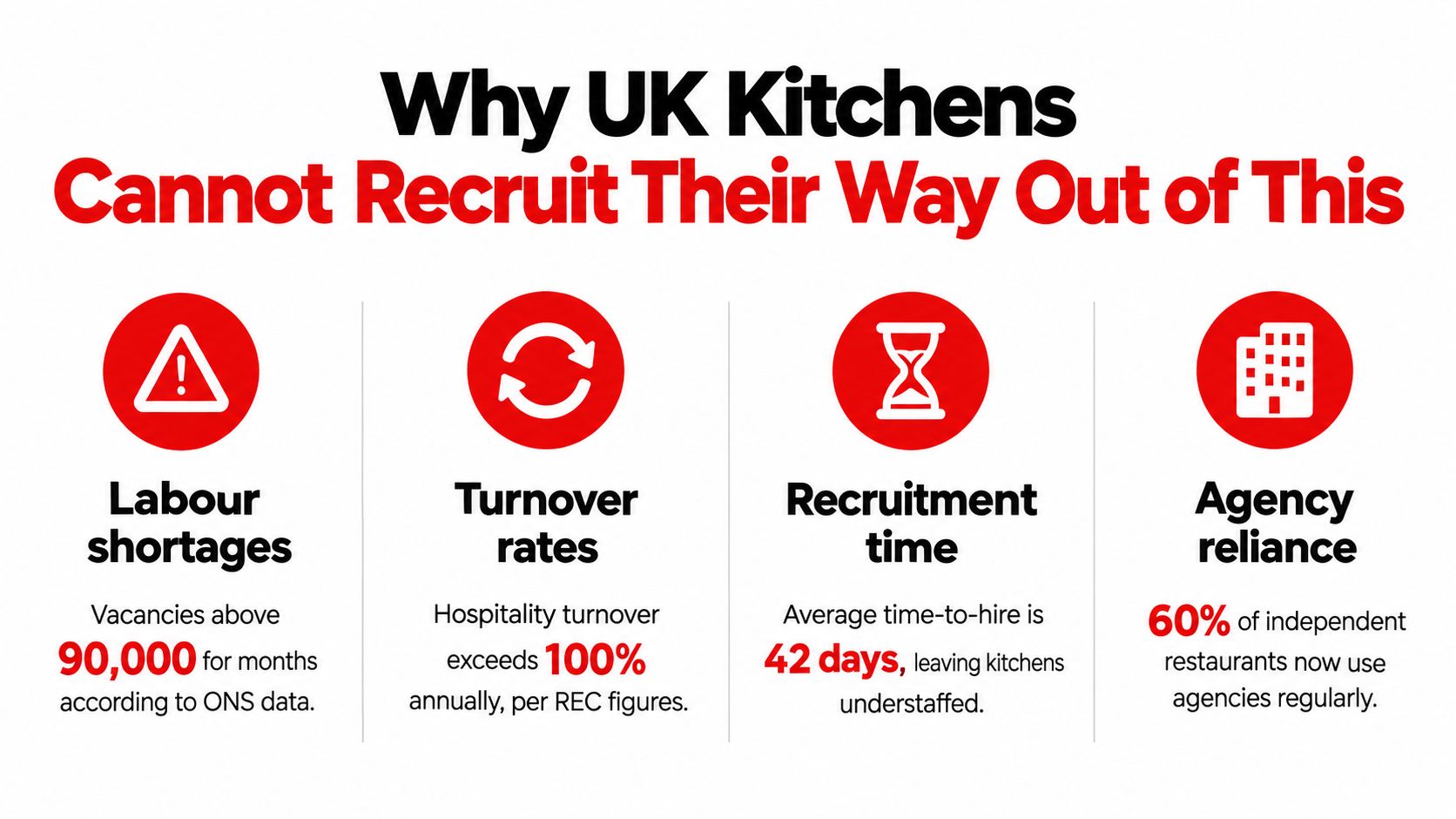
Why UK Kitchens Cannot Recruit Their Way Out of This
Kitchen recruitment keeps breaking down because the pressure is in the market itself. Hospitality has been carrying tight labour supply for years, and turnover keeps draining teams just as quickly as managers can replace them.
Supply is tight, but demand is uneven
Hospitality vacancies in November 2022 to January 2023 were 72% higher than in January to March 2020, compared with 42% across the wider economy, and hospitality turnover sits at 52%, the highest rate among UK sectors (NetSuite industry analysis). That matters on a live rota. You are not just looking for a chef, you are looking for someone who can turn up, hold the pace, and cover the right section without creating another gap somewhere else.
REC data also showed 93,661 hospitality and catering job postings in November 2024. Postings fell 3.6% between October and November 2024, after a 2.9% increase in the same period in 2023 (REC labour market tracker). That does not clear the pressure. It shows how uneven the market is, with some venues cutting shifts, delaying hires, or holding spend while the kitchen still has to open on time.

Why geography and skill now matter more than headcount
A job posted in London does nothing for a coastal pub in Dorset on a Friday afternoon. A strong chef in one town will not solve a breakfast shift in Berkshire if travel time kills the economics. The main constraint is shortage by location, season, and skill level.
Temp agency hospitality solves a capacity problem, not just a headcount problem. It gives operators a way to cover peaks without pretending overtime will stretch forever or that every vacancy can be filled before service starts. That matters in places where trading swings hard, including Devon, Dorset, Wales, Bristol, Reading, Slough, Windsor, and the wider Berkshire corridor. In those markets, demand changes faster than a standard recruitment campaign can keep pace.
How a Temp Agency Hospitality Booking Actually Works
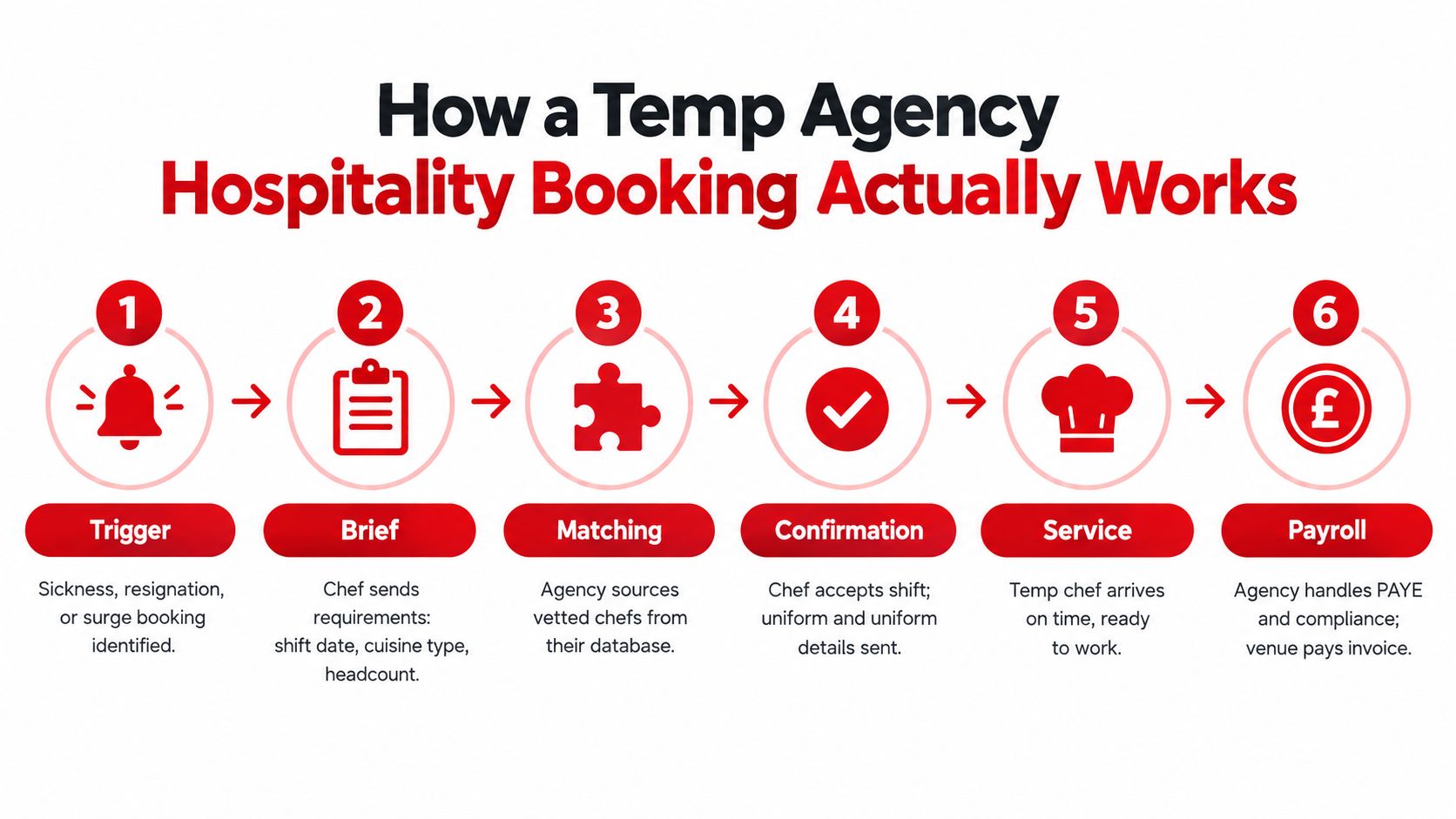
A decent booking process should feel calm, even if the reason for the booking isn't. The chef has gone sick, the wedding party has been moved forward, or the permanent sous has handed in notice. The venue needs someone briefed, vetted, and ready to work, not a pile of messages and crossed fingers.
The parts that should happen fast
The first step is a clean brief. That means shift date, cuisine style, service volume, section responsibility, kit, travel limits, and whether the chef needs to step into supervision or just cover prep and service. Without that detail, you're asking for a bad match.
A serious agency then checks fit before it sends anyone. That means right-to-work confirmation, reference checking, and a proper read on whether the chef has worked the right kind of service before. If the agency can't explain how it matches a pastry cover differently from a grill or banqueting booking, it's not doing the job properly.
A good booking is measured in response time, fit, and certainty, not just hourly cost.
A proper process also needs a clear rate card and a named contact who can keep the booking moving. Venues should know who's responsible for the shift if plans change and who's replacing a chef if the first option drops out. That's the difference between a recruitment list and an operating partner.
For a practical breakdown of agency working roles, see what a chef agency actually does.
What good feels like on service day
The best bookings are boring in the right way. The chef turns up briefed, brings the right kit, understands the pass, and starts earning their keep quickly. No manager should have to spend the whole evening translating the business into basics.
That's especially important when the cover is there to save a service rather than merely fill a chair. A generic temp app might send a body. A proper hospitality agency sends someone who can work a kitchen without turning the shift into a training exercise.
Three Types of Cover and When Each One Fits
A Friday night kitchen does not fail in one way. A chef calls in sick, a banquet runs late, or a venue knows the Christmas rota will strain before the first booking lands. Same-day relief, planned seasonal cover, and rolling weekly cover each solve a different problem, and the wrong choice usually shows up as either wasted spend or a service gap.
Same-day relief for things that go wrong now
Use same-day relief when the rota has already broken. Sickness, a walkout, or a late withdrawal after the rota is locked leaves no room for a long briefing chain. The value is speed, but speed only works if the chef can step into the pass and function without slowing the room down.
For an independent Bristol restaurant, that can mean keeping covers on the board instead of closing early. For a hotel with bedrooms sold and dinner booked, it means service keeps moving rather than turning away every table that arrives.
Planned cover for known peaks
Seasonal cover should be booked before the pressure hits. Christmas parties, summer tourism in Devon and Wales, weddings in Berkshire, and any weekend with a hot pass all belong in this category. Festive hiring data for late 2024 showed strong demand but uneven month-on-month momentum, which is why late booking is not a safe plan.
Planned cover works best when the venue accepts the spike early and books around it. A Windsor hotel running Christmas dining should be speaking to its staffing partner in October, not waiting until the week before the first event.
Rolling weekly cover for longer recruitment gaps
Rolling weekly cover sits between emergency relief and a permanent hire. It suits the period when a restaurant is recruiting but still needs continuity on the line. That arrangement keeps standards steadier, protects the rest of the brigade from burnout, and gives the head chef time to hire properly instead of taking the first available name.
The strongest operators use all three types in the same year. Emergency relief handles the unplanned gaps. Planned cover deals with predictable peaks. Rolling support bridges the weeks when a permanent role is still open. That mix is what keeps service stable across a messy trading calendar.
Compliance, Insurance, and Who Actually Owns the Risk
The moment a temp chef walks into your kitchen, the commercial question changes. It's not only about cooking the food. It's about who is responsible for supervision, health and safety, payroll, notice, and what happens if the booking changes at short notice.
The rules that matter on a real shift
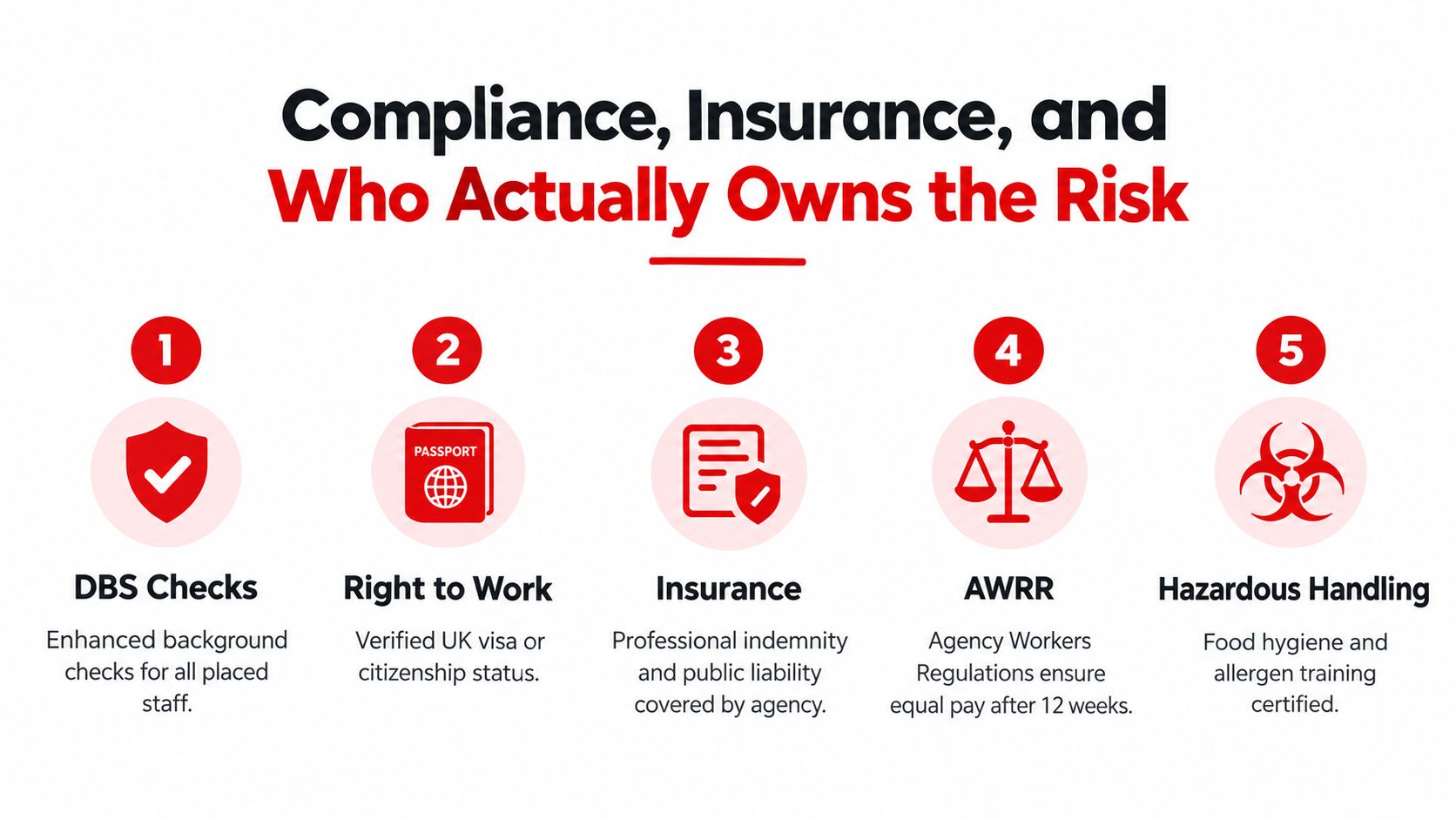
Under the Agency Workers Regulations 2010, an agency worker must receive information about relevant vacancies from day one, and after 12 weeks in the same role with the same hirer becomes entitled to the same basic employment conditions as a directly recruited employee, including pay, working time, rest periods, breaks, night work and annual leave (UK Government guidance).
The newer layer is the Employment Rights Act 2025, which sets out rights around guaranteed-hours offers, reasonable notice of shifts, and payment when shifts are cancelled, moved, or shortened at short notice (legislation). In practice, that means the venue and the agency need to be clear about who tracks the notices, who records cancellations, and who pays what when a shift changes.
Operational rule: if nobody can explain where the duty sits, the duty probably hasn't been managed properly.
Who carries which part of the load
The hirer keeps responsibility for the kitchen environment, supervision, food safety, and day-to-day control. The agency normally handles payroll, National Insurance, Statutory Sick Pay arrangements, and the working-time side of the placement. That split needs to be written down before the chef starts, not argued over after a cancelled shift.
Insurance matters just as much. A venue should expect evidence of public liability, employer's liability, and professional indemnity, because a temp booking without proper cover creates a risk the kitchen didn't budget for. For a practical legal checklist, see employment law for temporary staff.
How a Multi-Site Operator Uses Cover Through a Peak Season
A sensible group doesn't wait until the rota cracks. It sequences cover by site, by season, and by the kind of risk each venue carries. The Bristol restaurant is the permanent recruitment priority, the Dorset pub is the planned summer booking, and the Wales venue is the emergency stopgap when a wedding weekend suddenly loses a chef.
A workable summer pattern
Start with the Bristol site. If a permanent sous or head chef role is open, keep the kitchen moving with rolling weekly cover while recruitment is active. That stops the core team from burning out while the business interviews properly instead of rushing the first available candidate.
Move next to the Dorset coastal site. If summer trade is already building, that cover should be booked well before the peak, with enough time to match the right service style and the right travel arrangement. The point is to protect trading without forcing the restaurant into expensive last-minute scrambling.
Then the Wales venue gets the emergency lane. A second chef drops out 36 hours before a wedding party, the agency calls its vetted pool, and service still goes ahead with the right person in the right room. That is what a good cover partner is for, moving between planned and reactive work without making the operator re-paper everything.
What this protects in practice
It protects revenue, because bookings still run. It reduces overtime burn, because the permanent team isn't carrying every hole. It lowers food-safety exposure, because the kitchen isn't improvising with exhausted staff. And it protects reputation, because guests remember a smooth service far longer than they remember your staffing problems.
ONS figures analysed by RSM UK showed 2,100,827 payrolled employees in accommodation and food services in May 2025, down 4.6% year on year, while vacancies fell from 82,000 in the three months to April 2025 to 79,000 in the three months to May, but still remained 19% below the 98,000 recorded a year earlier (Restaurant Online reporting RSM UK analysis). Operators are planning against this reality.
Choosing a Temp Agency Hospitality Partner You Can Trust
The wrong agency looks cheap until the chef arrives unbriefed, late, or unsuitable. The right one gives you confidence before the shift starts and a replacement path if something changes. That's the standard every venue should demand.
Questions that separate an agency from a database
Ask who vets the chefs, how references are checked, and what right-to-work process sits behind the booking. Ask what insurance is in place, what happens if the chef doesn't work out, and whether the pricing is transparent or padded with extra fees.
Also ask how quickly they reply. If the agency can't move fast enough to confirm cover, it won't help when the rota collapses. If it can't explain replacement cover for commissioned hours, it's not thinking about the operator's risk.
Red flags worth walking away from
Be wary of generic platforms that pass work to freelancers without much oversight. Be wary of subcontracting chains where nobody can explain who vetted the person in your kitchen. And be wary of rates that look too good to be true, because they usually are.
Relief Chefs UK is one option in this space, established in 2013, run by chefs, and built around short-notice chef cover, permanent recruitment, and wider hospitality staffing support, including yacht chefs and villa chefs. The practical value is in the process, not the slogan.
Keeping UK Kitchens Open with the Right Cover Partner
Temporary agency hospitality is no longer a contingency that sits at the edge of the business. It's part of how UK venues manage capacity, maintain standards, and stay open when the rota turns ugly. The operators who handle it well treat cover as a planned function, not a panic call.
This week, audit where sickness, annual leave, and seasonal peaks could break your service. Book known busy periods earlier than you think you need to. Then choose a chef-led partner that can move between emergency relief, planned placements, and permanent recruitment without weakening compliance or service quality.
If your kitchen needs reliable temporary chefs, seasonal cover, or a permanent recruitment pipeline, Relief Chefs UK can help match the right chef to the right service quickly. Visit Relief Chefs UK to request cover, and include your location, cuisine, and dates so the team can confirm the best fit without delay.