
A Friday evening service is about to start when your head chef calls in sick. The sous chef is already covering prep, bookings are full, and a relief chef appears available at short notice. The temptation is obvious: agree the rate, send over the address and get the chef through the kitchen door.
That approach can keep a service moving, but it can also leave the business exposed. Right to work checks for employers must be completed before the worker starts, even when the replacement is needed for one shift, a busy weekend or a seasonal rush. For hospitality operators, compliance isn't separate from continuity. It protects the kitchen, the business and the people responsible for keeping service running.
The Hidden Risks of Last-Minute Staffing in Hospitality
A hotel in Windsor, a pub in Devon and a restaurant in Bristol can face the same staffing problem. A chef cancels, the agency offers a replacement and the duty manager has minutes to make a decision. If the manager relies on a phone conversation, an old photocopy or an assumption that another business has already checked the worker, the legal protection may not exist.
The UK's formal employer civil-penalty regime has operated since 2008, and employers must complete the prescribed check before employment begins. A compliant check creates a statutory excuse, which can protect the employer from a civil penalty if the worker is later found to be working illegally. The Home Office employer guidance on right to work checks sets out the process.

Speed doesn't remove the employer's responsibility
A common failure occurs when a manager says, “The chef has worked through agencies before, so this will be fine.” That may be operationally understandable, but it doesn't demonstrate that the correct check was completed for the employer, the person or the work being offered. It also doesn't confirm that permission remains current.
The risk is higher in kitchens that use changing pools of seasonal, agency-supplied or temporary staff. A worker may be permitted to work in the UK but still have restrictions that affect the role or pattern of work being offered. A chef supplied for a late-night service therefore needs more than a name and a mobile number in the rota.
Practical rule: No chef, kitchen porter or agency worker should start a shift until the required check has been completed, recorded and matched to the individual arriving at the venue.
Short-notice cover also creates a handoff problem. If a staffing partner performs the check, the venue still needs a clear process for confirming who was checked and what work that person can undertake. Managers should know which organisation retains the evidence, who handles follow-up checks and what happens if the supplied worker changes.
The operational cost of poor cover is explored in this guide to the hidden cost of a bad chef cover booking. The wider lesson is simple: emergency staffing needs a faster process, not a weaker one.
Understanding the Three Legal Routes for Right-to-Work Checks
UK employers can use three recognised routes. The right choice depends on the worker's documents and immigration status, but every route must be completed before work starts if the employer wants the statutory excuse.
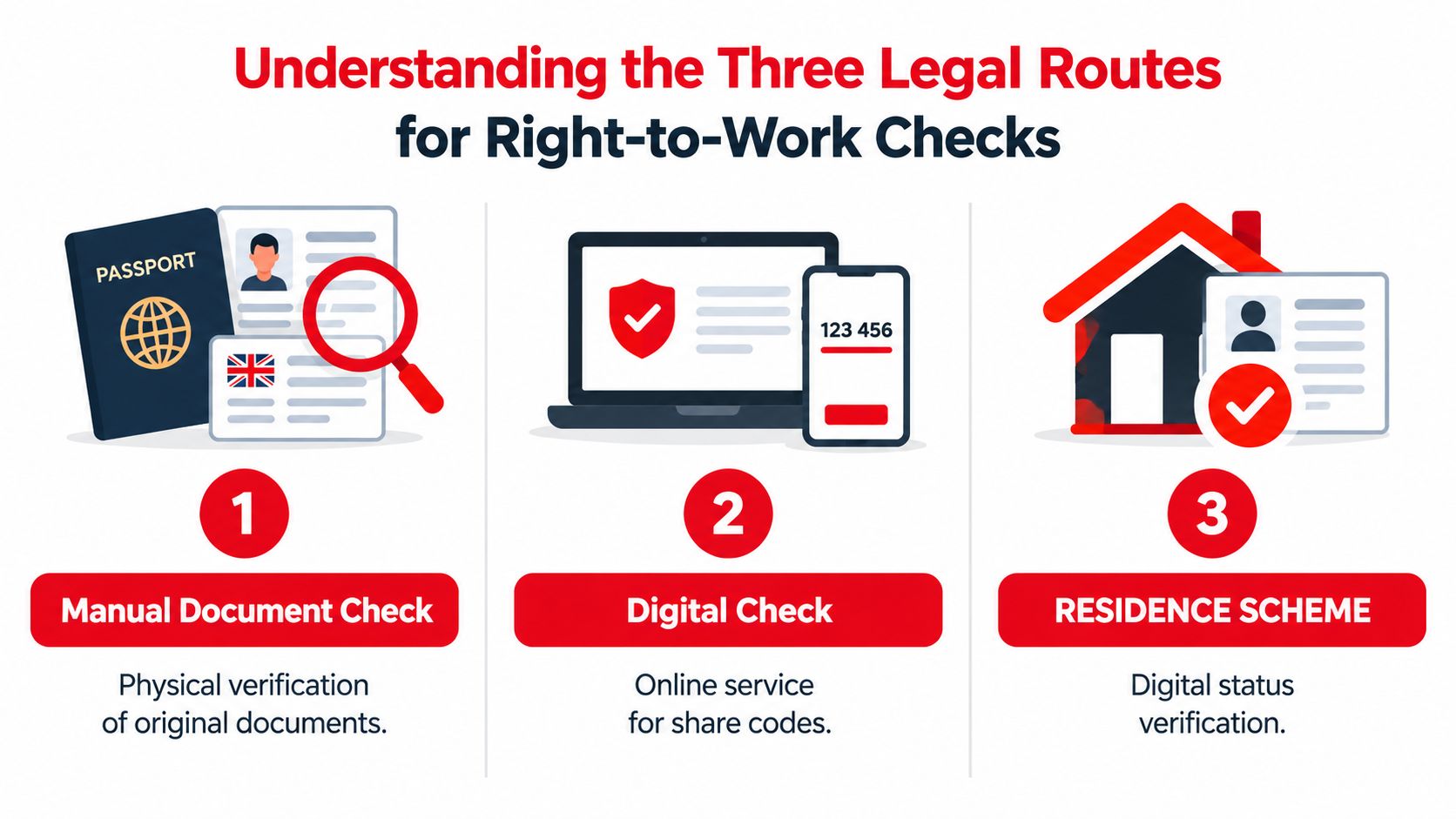
Manual document checks
The manual route involves examining the worker's original acceptable documents. The employer must check the documents in the applicant's presence, establish that they're genuine and belong to the person presenting them, and confirm that they permit the specific work offered.
This route can be practical when an available relief chef has suitable original documents but hasn't provided a share code. It still requires a proper examination and a retained copy. A quick glance at a passport isn't enough.
Home Office online checks
A worker with digital immigration status can provide a share code for an online check. The employer enters the share code and the worker's date of birth into the Home Office service, then checks the returned photograph against the person attending the interview or starting work.
The employer must also confirm that the displayed business or employer name is correct and review any restrictions or expiry date shown. This route is often efficient for remote recruitment and rapid staffing, but the result must be saved with the other employment records.
Eligible digital identity service providers
An employer may also use an eligible registered digital identity service provider where the worker and documents fall within the service's permitted scope. This can help larger hotel groups or multi-site operators standardise checks, although the business must understand what the provider verifies and what evidence it returns.
| Route | Useful when | Employer must retain |
|---|---|---|
| Manual | Original acceptable documents are available | Clear document copies and check date |
| Online | The worker has digital status and a share code | Online result, check date and work restrictions |
| Digital provider | The worker and check are eligible for the service | Provider evidence and the relevant audit trail |
The Home Office right to work checklist confirms that the check applies to employees, apprentices and workers engaged under a worker's contract. It also makes the practical rule clear: the check must be completed before the first shift, not after the kitchen has opened.
Mastering Manual Document Checks for Temporary Chefs
Manual checks fail when managers treat them as a document collection exercise. The job isn't just to take a photograph of a passport. The employer must follow all three stages of the prescribed process and create evidence that another person could understand later.
Start by asking the worker to provide either acceptable List A or List B documents. List A documents can establish an ongoing right to work, while List B documents relate to time-limited permission and may require a repeat check. Don't accept an informal substitute because the worker is urgently needed.
Examine the documents with the worker present
Check the original documents in the applicant's presence, unless the applicable process permits an online or approved digital route. Compare the photograph and personal details with the person in front of you. Look for inconsistencies in names, dates of birth, document numbers, photographs, visible alterations and other signs that the document may not belong to the worker.
The check must establish four practical points:
- Genuineness: The documents appear authentic and haven't been altered.
- Ownership: The documents belong to the individual presenting them.
- Permission: The worker is permitted to work in the UK.
- Role restrictions: The permission covers the specific work and conditions being offered.
For a time-limited worker, check the expiry date and any restrictions before agreeing the rota. A chef may have permission that doesn't cover every role, every employer or every working arrangement. If the evidence is unclear, pause the start date and obtain the correct clarification rather than allowing the worker into service.
Copy, date and retain the evidence
Make a clear copy of each relevant document, including the information needed to show what was checked. Record the date the check was completed and keep the evidence securely for the duration of employment plus two years, as set out in the Home Office employer guide to right to work checks.
A photocopy without a check date is weak evidence. So is a file that can't be matched to the chef on the rota. Use a consistent file name, restrict access to authorised staff and connect the record to the worker's contract or booking.
Businesses using contractors should also define responsibility before the booking. The guidance on right to work checks for self-employed contractors can help operators identify what must be agreed with a staffing partner. The venue should never assume that a third party's process removes the need for a clear audit trail.
The Real Cost of Non-Compliance, Fines and Reputational Damage
The financial risk changed materially in February 2024. The maximum civil penalty for employing an illegal worker increased from £20,000 to £60,000 per illegal worker, while the starting point for a first breach became £45,000 under the updated code of practice. These figures are set out in the Home Office code of practice on preventing illegal working.
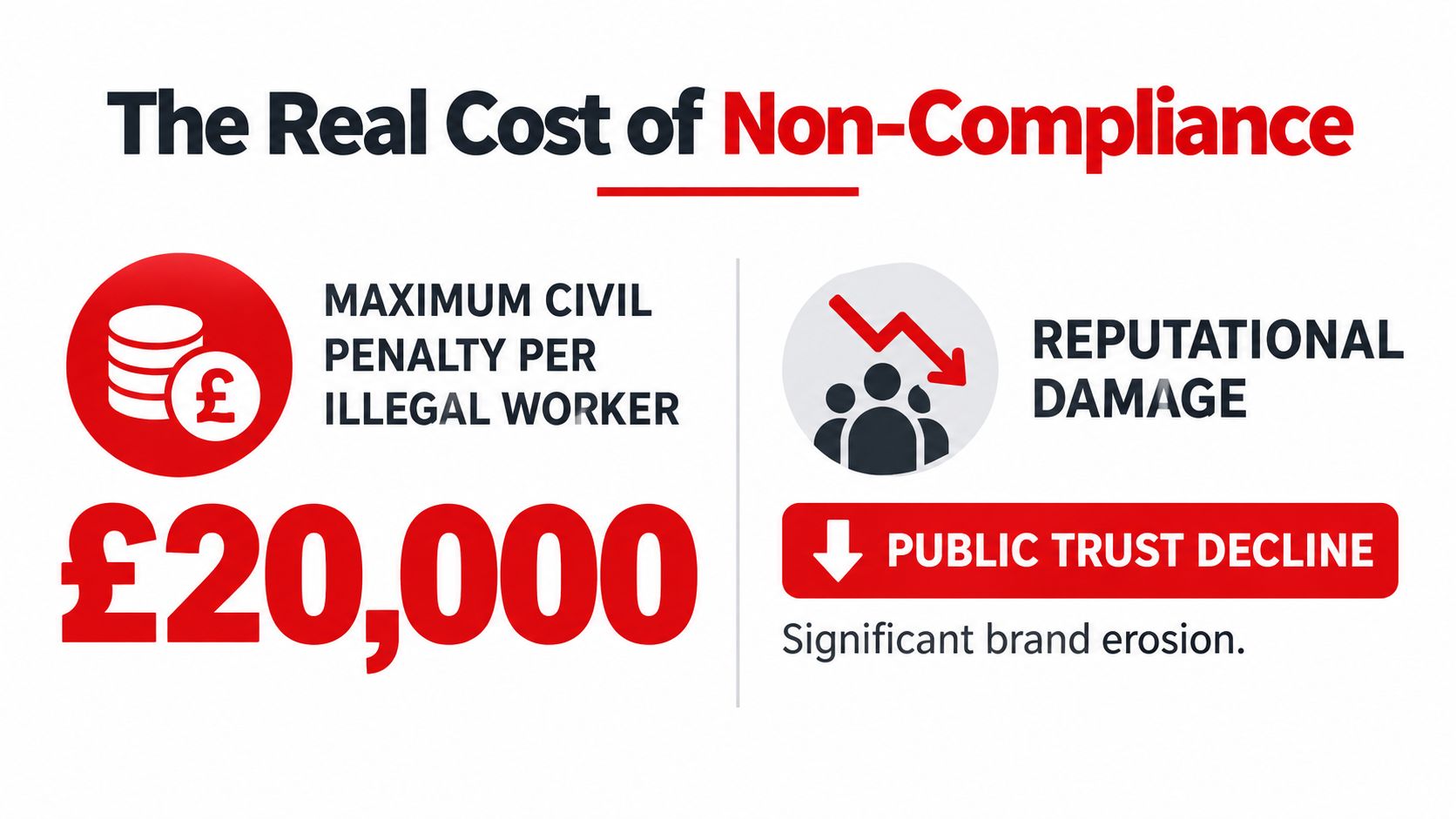
The visual above reflects an earlier penalty figure. Employers should use the current figures in the code of practice, not rely on an old checklist, printed infographic or inherited staff handbook. A single incorrect appointment can therefore create exposure that is far greater than the cost of arranging compliant emergency cover.
Enforcement is active
Between January and November 2023, the Home Office issued more than 1,400 right-to-work civil penalties, an increase of 40% compared with the same period in the previous year. The total value of penalties issued during those eleven months exceeded £26 million, which was 45% higher than in the equivalent period of the previous year, according to Home Office research on employer awareness and self-reported compliance.
The research also found that 80% of employers had heard of at least one penalty for non-compliance. 59% recalled a fine, while 57% recalled the possibility of criminal conviction, imprisonment and an unlimited fine. Those figures don't make compliance automatic, but they show that the risk is widely recognised and actively relevant to employers.
The damage extends beyond the invoice
A penalty can disrupt cash flow, but the consequences don't stop there. A pub group, hotel or restaurant may face difficult questions from owners, investors, landlords, insurers, staff and customers. A business known for weak employment controls can also find recruitment and agency relationships harder to manage.
The cheapest time to solve a right-to-work problem is before the chef is booked, not after an inspection or dispute.
For a kitchen in Reading, Slough, Berkshire or Dorset, the practical calculation is straightforward. A rushed booking may fill a rota gap, but it isn't a sound booking if the employer can't demonstrate the prescribed check. Compliance is part of the staffing decision, alongside skill, availability, rate and reliability.
How Relief Chefs UK Simplifies Compliance and Staffing
Hospitality operators don't usually struggle because they don't care about compliance. They struggle because the problem arrives at the worst possible time. A sickness call comes in during breakfast service, a wedding weekend approaches, or seasonal demand rises across a whole region. The general manager then has to recruit, check, brief and manage a replacement while the kitchen is already under pressure.
Relief Chefs UK is a nationwide chef recruitment agency established in 2013. Its services include relief chefs, temporary chefs, permanent chef recruitment, yacht chefs, villa chefs and wider hospitality staffing support. The business supplies right-to-work-checked chefs for urgent cover, giving venues an option when they need capability and compliance handled through an organised staffing process.

What a specialist partner changes
A specialist agency can reduce the number of separate tasks landing on a head chef or duty manager. Instead of searching an untested contact list during a Friday-night crisis, the operator can request a chef whose experience and work eligibility have already been considered as part of the placement process.
That doesn't mean the venue can stop thinking about its responsibilities. It should still confirm the booking details, identify the worker arriving and agree who retains the statutory-excuse evidence. The staffing partner and venue need a clear handoff, particularly where the chef is a contractor, agency worker or supplied substitute.
Match the staffing solution to the operation
A small café may need temporary cover for a short absence. A country-house hotel may need seasonal reinforcement. A yacht or private household may require a chef with a very specific service background. A multi-site group may need permanent recruitment alongside an ongoing relief pipeline.
The more useful question is not, “Can someone start tomorrow?” Ask instead:
- Availability: Can the chef cover the actual shift pattern and location?
- Capability: Can they run the section, menu and service standard required?
- Compliance: Has the correct right-to-work route been completed and recorded?
- Continuity: Is there a plan if the booking changes or the chef becomes unavailable?
That approach supports kitchen stability in Devon, Bristol, Wales, Windsor and other UK hospitality hotspots. It also prevents compliance from being treated as an afterthought whenever agency reliability or chef shortages put pressure on the rota.
Best Practices for Ongoing Compliance and Record-Keeping
A right-to-work check is not a box to tick once and forget. The employer needs a repeatable system that works when the business is calm and still functions when the kitchen is short-staffed.
Build the process around a worker-level record. Each file should show who was checked, which route was used, what evidence was reviewed, when the check took place and what restrictions or expiry dates apply. Keep the record with the employment documentation so a manager can retrieve it quickly without searching through personal messages or separate booking spreadsheets.
Use an expiry register
Time-limited permission needs active monitoring. Create an expiry register for every worker whose right to work has an end date, then schedule a follow-up check before that date. Don't rely on memory, a diary note held by one manager or a chef saying that an application is still in progress.
A practical register can include:
- Worker identity: Name and the internal booking or employee reference.
- Check route: Manual, Home Office online service or eligible digital provider.
- Completion date: The date the prescribed process was finished.
- Permission end date: The date shown by the relevant evidence.
- Permitted work: Any restriction affecting the role or working pattern.
- Owner: The person responsible for arranging the next check.
- Evidence location: The secure folder or system where the record is stored.
The employer must retain evidence for the duration of employment plus two years. That requirement makes secure storage important, especially for businesses with high staff turnover. The record should be legible, access-controlled and connected to the correct person rather than stored as an unlabelled image.
Standardise the process for every worker
A fast process still needs to be fair. Ask every prospective worker to demonstrate their right to work, and don't select people for extra scrutiny because of nationality, accent, appearance or perceived immigration status. The Home Office guidance on right to work checks and discrimination risks is clear that employers need a consistent approach.
Use the same checklist for a permanent sous chef in Cardiff, a seasonal kitchen porter in Dorset and an emergency relief chef in Berkshire. Consistency protects the business from two risks at once: illegal working and discriminatory treatment.
Audit the handoff with agencies
If a staffing partner completes the check, put the responsibility in writing. Confirm:
- Who performs the check.
- Which route is used.
- Who retains the evidence.
- How the venue identifies the supplied worker.
- Who monitors time-limited permission.
- What happens when a replacement chef is sent.
Review the process against the latest Home Office guidance, particularly when the business changes its staffing model or starts using a new agency. Don't allow an urgent booking to create a new exception to the process.
A kitchen can be flexible about menus, suppliers and shift patterns. It shouldn't be flexible about whether a worker is checked before starting.
Use a clear right to work check form as part of the onboarding workflow, then make managers responsible for completing it before the first shift. Train deputies and duty managers as well as senior operators, because the person handling a Saturday-night replacement is often not the person who normally manages recruitment.
The result is a stronger operating model. Good records protect the business, good scheduling prevents missed follow-ups and a reliable staffing partner reduces the pressure that causes rushed decisions.
Relief Chefs UK provides nationwide relief chefs, temporary chefs, permanent chef recruitment, yacht chefs, villa chefs and wider hospitality staffing support, with right-to-work-checked chefs available for urgent cover. When sickness, seasonal demand or chef shortages threaten your next service, visit Relief Chefs UK to discuss compliant staffing support for your kitchen.