
A chef calls in sick just before Friday service. Your pub in Devon is full, the head chef is already covering prep, and a temporary replacement is available for the evening. The temptation is to take a photograph of a passport, accept the chef's assurance, and get them into the kitchen.
That shortcut creates a problem. A right to work check form isn't just a signature from the worker or a note saying that someone “looks fine”. It should show that the employing business completed the correct prescribed check, before employment began, and retained the evidence needed to support its statutory excuse.
Why the Right to Work Check Form Matters for Your Kitchen
A busy kitchen makes compliance feel like an administrative burden. In practice, a properly completed form is part of the operating system that keeps a venue open. If a relief chef arrives for a wedding in Windsor or emergency cover is needed at a hotel in Bristol, the manager still needs a reliable record before the first shift starts.
A UK employer must complete a prescribed right to work check before a worker starts employment to establish a statutory excuse against liability for an illegal-working civil penalty. The accepted routes are a manual document check, a Home Office online check, or, where applicable, verification through the Employer Checking Service, as set out in the official employer right to work checklist.
The practical point is simple. A CV, agency introduction, interview note, or verbal confirmation isn't a substitute for the prescribed process. If the check is completed after the chef has started work, the timing problem cannot be repaired by backdating a form.
Kitchen rule: Treat the right to work check as a pre-shift control, just like confirming the rota, food safety arrangements, and the person responsible for the pass.
For an independent pub, the form also clarifies responsibility. The business should know which entity employs the chef, who completed the check, what work the chef is allowed to perform, and whether another check will be needed. That matters when temporary chefs move between sites in Dorset, Berkshire, Wales, or other hospitality hotspots.
The best process is fast because it is organised, not because it removes the evidence. A short form with the right fields lets a manager make a staffing decision without allowing service pressure to dictate an unlawful shortcut.
The Essential Fields of a Compliant Right to Work Check Form
A compliant form must record an actual verification process, not just a candidate declaration. Before the chef starts, the employer needs to establish that the individual is permitted to perform the specific work being offered. The Home Office employer guidance supports a record that captures the method, result, identity match, and any restrictions.
Use these fields in your template:
- Worker details: Record the worker's full name and link the record to the employing business and assignment.
- Check method: Select manual document check, Home Office online share-code check, or approved digital verification service.
- Date completed: Record the date the check was carried out. This must be before employment begins.
- Evidence details: Enter the relevant document details or share-code information. For an online check, record the result produced by the Home Office employer service.
- Outcome and restrictions: State whether the worker is permitted to do the proposed work and note any limits on the type or duration of work.
- Checker identity: Add the name or identifier of the manager, business representative, or authorised verifier who completed the check.
- Identity confirmation: Confirm that the photograph or identity information corresponds to the person presenting for work.
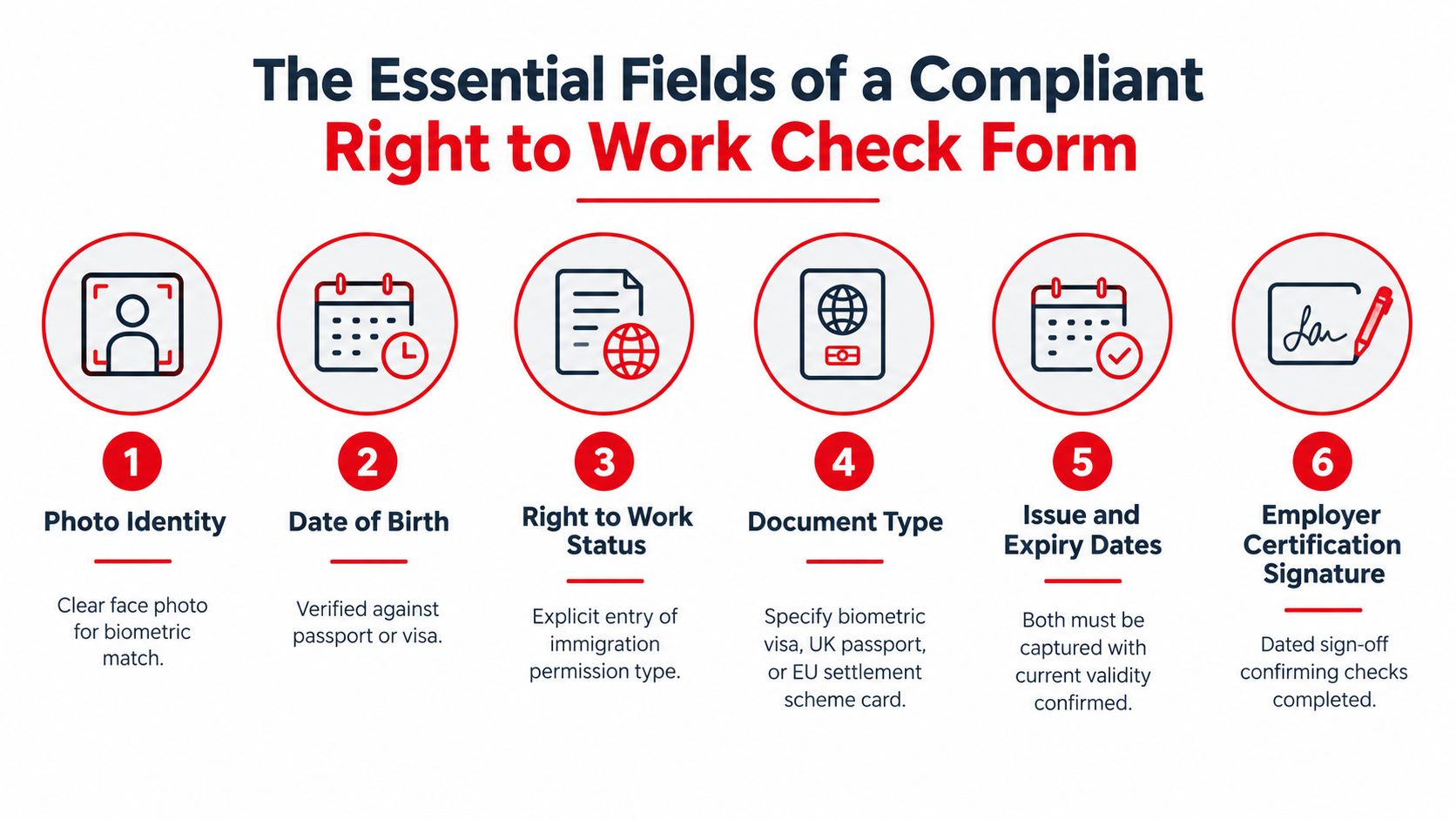
For a chef placement, add the venue or assignment reference, the role being offered, and a follow-up date where permission is time-limited. These fields help a hotel group distinguish a verified worker from an unverified applicant when several chefs are being onboarded at once.
A signature still has a place, but it certifies a completed process. It doesn't replace the underlying documents, online result, dates, and restriction notes. Businesses can also review right to work verification for hospitality staffing when building a repeatable onboarding process.
Navigating Manual Checks Versus Digital Verification Methods
The correct method depends on how the worker proves their status. A manager shouldn't choose a route based on speed alone, nationality, accent, or appearance. The form needs to show which route was used and preserve the evidence generated by that route.
A manual check involves inspecting acceptable original documents, checking that they are consistent and valid, confirming that the photograph matches the person, and keeping a clear copy. The form should identify the document type, relevant details, date of completion, verifier, and any restriction or follow-up requirement.
An online Home Office check works differently. The applicant supplies a share code and date of birth, and the employer uses the Home Office employer service to view the profile. The employer should retain the resulting profile, including permitted work and any expiry or follow-up date. British and Irish citizens generally prove status through documents or an approved identity route rather than an online share code.
Approved identity-document service providers offer another route where applicable. The provider's result and audit record should be retained with the form, rather than reduced to a tick box saying “verified”.
The system has developed from a document-led process into a mixed manual-and-digital model. Employers have been able to use the Home Office online checking service for digitally verifiable immigration status since 2019, and accredited identity-document service providers could also verify British and Irish citizens digitally from April 2022, according to the Home Office employer awareness survey.
Temporary COVID-19 arrangements allowed checks through video calls and accepted scanned documents, but those arrangements ended on 30 September 2022. A scanned passport sent casually by text message isn't automatically a compliant route just because it appears clear.
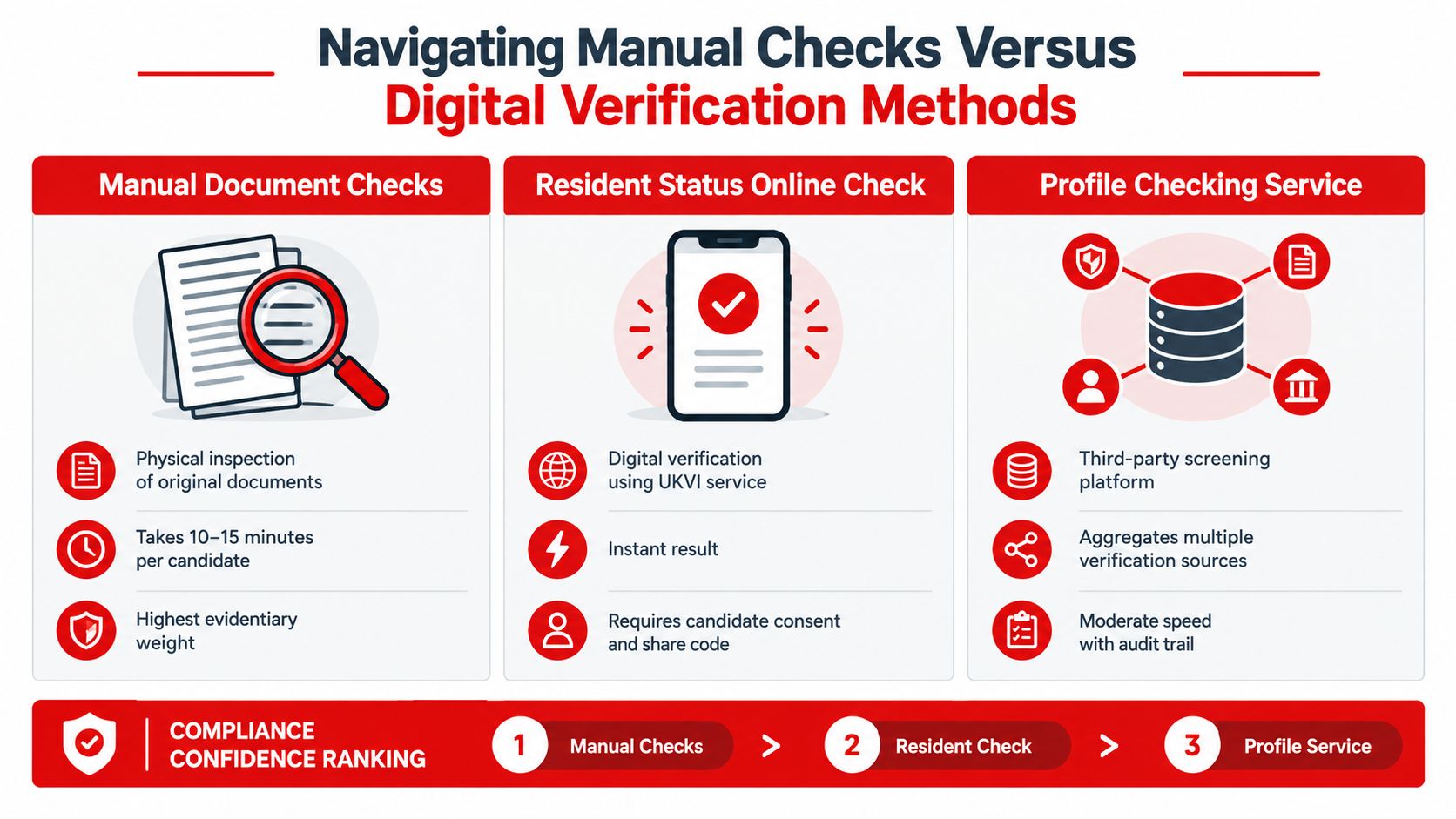
The form should therefore contain a clear route selection. That prevents a manager in Reading from recording a manual check when the worker needed an online share-code check, or assuming that a British passport photograph received from a candidate is enough without inspecting the applicable original document or using an approved route.
Retention Rules and Data Privacy for Employment Records
Completing the form is only half the job. The employer must retain a clear copy or record of the evidence and securely record the check date. Writing a date on an otherwise undocumented copy doesn't create a reliable record.
Paper records can work, but electronic storage is often easier for multi-site hospitality teams. The Home Office guidance on checking a job applicant allows records to be stored electronically in a format that cannot be manually altered, such as a scanned PDF or JPEG.
Keep the record for the entire employment period and for two years after employment ends, then securely destroy it. That applies whether the chef works permanently at one hotel, provides seasonal cover at a pub, or completes temporary assignments through a staffing arrangement.
A practical folder or digital workflow should include:
- A stable file reference: Link the form, evidence, assignment, and employing entity.
- Controlled access: Allow only authorised managers or HR staff to view sensitive identity records.
- An amendment trail: Record any legitimate correction without overwriting the original evidence.
- The original online response: Save the Home Office result as received, not just a typed summary.
- A destruction date: Schedule secure deletion after the retention period ends.
- A follow-up alert: Flag time-limited permission for review before it expires.
Personal data needs protection, but privacy controls shouldn't make evidence impossible to retrieve. A manager covering a hotel in Windsor should be able to locate the correct record quickly, while casual staff shouldn't have open access to passports, immigration profiles, or date-of-birth information.
The same discipline belongs in wider employment law compliance for hospitality businesses. A form stored in an editable spreadsheet with no access control may be convenient, but it leaves questions about who changed it, when they changed it, and whether the retained evidence is complete.
Avoiding Common Pitfalls in Hospitality Staffing Compliance
The most common mistake is confusing evidence with a record. A worker may provide a genuine document, but the employer still needs to show when the check happened, which route was used, what the result was, and that the check was completed before the first shift.
A second mistake is allowing the CV or agency introduction to carry too much weight. Those materials help with recruitment and role suitability. They don't establish a statutory excuse. The Home Office right to work checklist makes the distinction clear.

A rushed venue can also create discrimination risk by checking some candidates more aggressively than others. The same compliant process should apply to every candidate. Asking for extra immigration evidence because someone appears or sounds foreign isn't a proportionate compliance system.
Consider a restaurant in Slough hiring two temporary chefs for seasonal demand. One candidate presents original documents, while another has digital immigration status. The employer should use the applicable route for each person, record both checks consistently, and avoid treating nationality as the trigger for the decision.
Useful controls include:
- Use one template: Keep the same core fields for permanent, temporary, relief, and seasonal chefs.
- Choose by status: Select manual, online, or Employer Checking Service routes based on the evidence available.
- Reject informal assurances: Escalate uncertainty rather than allowing the chef to start while someone “looks into it”.
- Separate recruitment from compliance: Keep interview notes and right to work evidence as distinct records.
- Check the assignment: Confirm the verified worker is linked to the correct employing business and proposed work.
Speed improves when managers know what to request and where to save it. It doesn't improve when staff accept whatever screenshot arrives first.
Managing Repeat Checks for Time-Limited Visas
A time-limited right to work changes the manager's job after onboarding. The original check creates only a time-limited statutory excuse, so the form needs an expiry or follow-up date and a named person responsible for acting on it.
The risk is easy to see in a seasonal kitchen. A chef may work reliably through a busy period, and the venue may extend the placement without anyone reviewing the permission date. The rota continues, but the original record no longer covers the whole period of employment.
Record the follow-up date in the form and in the business calendar. Assign it to a named manager, not to a general inbox or an assumption that the agency will remember. The manager should begin the follow-up process before permission ends and retain the new result with the original record.
Operational safeguard: Never treat a repeat check as an HR task that can wait until the next quiet period. Put ownership beside the date when the first form is completed.
There are two practical evidence routes. A manual follow-up may require inspection of acceptable original documents and a new clear copy. An online follow-up requires the worker's share code and date of birth, followed by retention of the Home Office profile. Neither route should be replaced by a text message from the chef saying that an application has been submitted.
Where an employee has made an in-time immigration application, appeal, or administrative review and the matter remains outstanding, the employer should use the Home Office Employer Checking Service. The current employer guide to right to work checks explains the role of that service in pending cases.
The Impact of Staffing Shortages on Compliance Speed
Hospitality businesses are being asked to recruit quickly while dealing with short-notice sickness, seasonal demand, chef shortages, agency reliability problems, and the need to keep kitchen teams stable. Industry analysis of ONS data reported that hospitality employment fell by 69,000 jobs, or 3.2%, between October 2024 and May 2025, increasing pressure on venues to onboard workers quickly, as explained in the UKHospitality response on labour supply.
That pressure doesn't alter the legal sequence. A venue can't accept every photograph, screenshot, or candidate declaration just because service starts in a few hours. The correct route depends on the worker's status, and official guidance distinguishes manual document checks, Home Office online checks, and identity-document validation services.
A fast workflow looks like this:
- Identify the employing business: Confirm which hotel, pub group, restaurant, or staffing business is employing the chef.
- Request the correct evidence: Tell the candidate what information is needed for the applicable route.
- Complete the check before work starts: Don't allow a first shift while the record is incomplete.
- Save the result immediately: Attach the copy or online profile to the completed form.
- Apply the same process: Use consistent checks for every candidate, regardless of nationality or perceived background.
- Set the follow-up alert: Record a named owner where permission is time-limited.
This approach allows a manager in Cardiff, Bristol, Devon, or Berkshire to move quickly without making speed the enemy of compliance. It also avoids the false choice between a stable kitchen and a defensible staffing record.
Leveraging Vetted Relief Chefs for Faster Compliance
Many operators reduce pressure by using a specialist staffing partner rather than starting every temporary placement from scratch. The agency still needs a clear arrangement with the employing business, and the venue should understand who completed the check, what evidence was retained, and which restrictions apply.
That distinction matters. “Pre-checked” should mean there is an auditable process behind the statement, not merely that a recruiter has spoken to the chef. Before the first shift, the venue should confirm the assignment, the employing entity, and the records available for inspection.
Relief Chefs UK, established in 2013, provides relief chefs, temporary chefs, permanent chef recruitment, yacht chefs, villa chefs, and wider hospitality staffing support across the UK. Its vetting process includes right to work verification, and its operating model is designed for independent pubs, restaurants, private households, yachts, boutique hotels, and multi-site hospitality groups.

For a hotel in Dorset or a restaurant group around Bristol and Berkshire, the value is operational rather than theoretical. A specialist partner can handle candidate sourcing and initial vetting while the venue concentrates on the role, induction, site requirements, and service. The business should still maintain clear responsibility for its own compliance obligations and records.
The chef employment agency service is one option for operators who need flexible cover without weakening the check process. It can support urgent sickness cover, seasonal reinforcement, permanent recruitment, and longer-term kitchen stability.
Step-by-Step Guide to Completing the Form Template
A signature isn't evidence by itself. Neither is a CV, a passport image sent by text, an interview note, or an agency introduction. The form becomes useful only when it records the prescribed check and links the result to the person and work being offered.
Use this workflow from offer to first shift.
Start with the assignment
Record the worker's name, employing entity, venue, role, start date, and whether the placement is temporary, permanent, or relief cover. This prevents a verified record for one business or assignment being casually reused for another arrangement.
Select the route
Ask how the worker will prove their status. Choose manual document inspection, a Home Office online share-code check, an approved digital identity route, or the Employer Checking Service where applicable. Don't ask the candidate to choose a route based on what seems easiest. The available status and evidence determine the route.
Complete the verification
For a manual check, inspect the acceptable original documents, compare the information, confirm the identity match, and make a clear copy. For an online check, use the share code and date of birth in the employer service, then save the resulting profile and note permitted work and any follow-up date.
Record the decision
Enter the date completed, checker's name or identifier, evidence details, result, restrictions, and identity confirmation. If anything doesn't match, pause the start date and escalate. Don't use a blank signature box to conceal an unresolved question.
Store and monitor
Save the form and evidence in the controlled record system. Add the destruction date and, where permission is time-limited, a follow-up alert owned by a named manager.
The finished record should allow another authorised person to understand what happened without asking the chef to repeat the story.
Quick Reference Checklist for Hospitality Managers
Before a chef starts work, review the completed form against this short control list:
- Worker identified: Is the full name linked to the employing business and assignment?
- Route recorded: Does the form state manual, online share code, approved digital service, or Employer Checking Service?
- Date captured: Was the check completed before the first shift?
- Evidence retained: Is there a clear document copy or the original online result?
- Identity matched: Did the photograph or identity information correspond to the person presenting for work?
- Restrictions noted: Does the record state permitted work and any limits?
- Verifier named: Can the business identify who completed the check?
- Follow-up set: Is a time-limited permission date assigned to a responsible manager?
- Storage controlled: Is the record protected from informal alteration and accessible to authorised staff?
- Destruction scheduled: Is secure destruction planned after employment ends and the retention period has passed?
A manager should be able to answer these points without relying on memory, a WhatsApp thread, or a candidate's verbal assurance. That standard keeps emergency staffing practical while protecting the venue's legal position.
Relief Chefs UK supplies vetted relief chefs, temporary and permanent chef recruitment, yacht and villa chefs, and wider hospitality staffing support for UK venues dealing with short-notice gaps. To discuss compliant chef cover for your pub, restaurant, hotel, or multi-site operation, visit Relief Chefs UK and make an enquiry.