
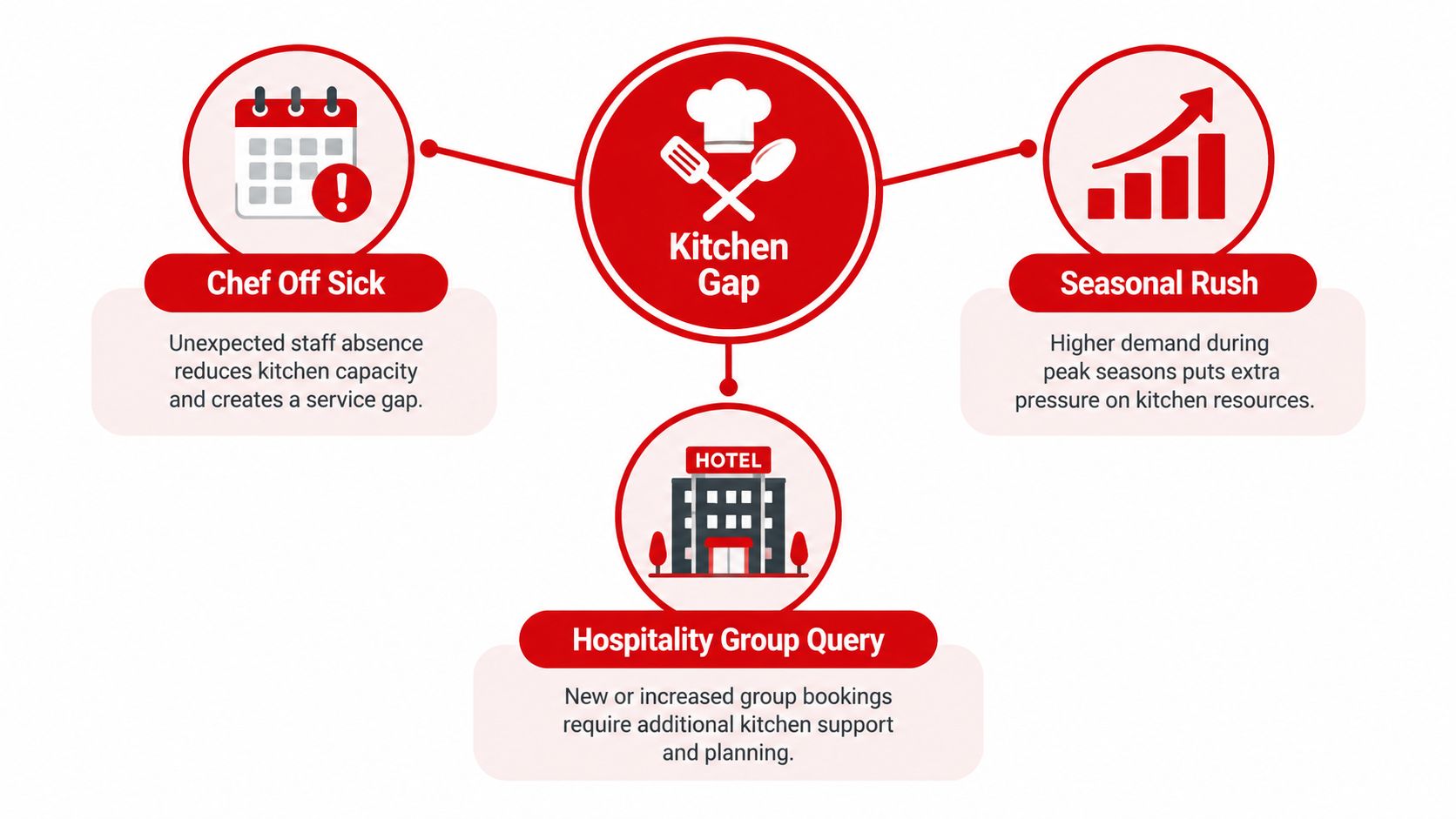
A Friday service is approaching, your sous chef is off sick, and the rota has no spare pair of hands. The general manager is deciding whether to call an agency, close a section, simplify the menu or investigate a longer-term catering arrangement. That decision becomes harder because “contract caterer” is often used to describe several very different services.
A contract caterer runs an agreed food operation for another organisation. A relief chef supplies short-term kitchen expertise while the venue keeps control. An in-house team remains directly employed and managed by the business. Those models solve different problems, carry different risks and suit different types of venue.
The kitchen gap that started your search
At a hotel in Bristol, a chef's short-notice sickness can affect breakfast, a wedding lunch and evening service on the same day. In Devon or Dorset, seasonal demand can increase covers quickly while the local recruitment pool remains tight. In London, a multi-site group may have a more strategic question, whether outsourcing several food operations would reduce management pressure.
The immediate problem looks like a staffing gap. The underlying decision is about operational control. Who chooses the menus? Who approves suppliers? Who checks allergen information? Who pays when labour costs rise? Who finds a replacement when the scheduled chef doesn't arrive?
A contract caterer is an external food-service operator appointed under a commercial agreement to design, procure, prepare, serve and manage food operations for another organisation. Common clients include schools, hospitals, workplaces, defence sites, visitor attractions, hotels and other institutional settings. The caterer does not just send a chef. It takes responsibility for a defined service.
The agreement should set out menus, staffing, purchasing controls, reporting, service levels and performance conditions. UK public-sector specifications commonly require compliance with food-safety law, supplier controls, traceability, allergen management and documented procedures through the Government Buying Standard for Food and Catering Services.
The difference between catering and chef cover
A relief chef agency deals with the operational gap without necessarily taking over the food operation. The pub, restaurant or hotel normally retains control of its menu, suppliers, recipes, standards and guest experience. The agency's responsibility is to provide an appropriately skilled chef for an agreed shift, booking or placement.
An events caterer may be appointed for a defined function. A contract caterer usually operates continuously under a formal agreement, often with performance reporting and agreed service levels. Those distinctions matter when a boutique hotel in Windsor needs a chef for wedding-season peaks, but doesn't want to hand over its entire kitchen.
The UK contract catering sector is substantial. A 2017 British Services Association sector profile quantified activity at approximately £5.7 billion in annual foodservice-business turnover, £3.1 billion in gross value added and 163,000 people employed across chefs, nutritionists, front-of-house staff and other roles. The same profile recorded 2,072 UK foodservice enterprises and approximately £2.4 billion procured annually in food and catering services.
Practical test: if the provider is responsible for the whole operating system, you're considering contract catering. If you need a capable chef to protect a service while your team remains in control, you need flexible chef cover.
Before signing anything, require measurable commitments for:
- Food quality: agreed standards, recipes, presentation and permitted substitutions.
- Staffing coverage: minimum numbers, skill levels, absence cover and escalation contacts.
- Compliance: HACCP controls, allergen procedures, training and traceability.
- Service performance: opening times, response times, complaint handling and audit rights.
- Commercial remedies: what happens when the provider misses a service level or fails to supply staff.
If your immediate issue is an uncovered shift rather than a full operating model, start with a structured staff shortage solution rather than assuming a large contract is the answer.
How the model works on the ground
A contract caterer converts forecasts, budgets, nutrition requirements and site restrictions into a controlled production and service operation. In a workplace restaurant, that may mean planning menus around expected weekday demand, managing procurement, scheduling chefs and reporting waste to the client.
In a hotel, the same discipline may cover breakfast, banqueting, staff dining and an à la carte outlet. The operator must adapt to different service periods while keeping purchasing, recipes, food safety and staffing under control.

What the client is buying
The day-to-day work normally includes:
- Demand planning: translating occupancy, bookings or predicted footfall into production volumes.
- Menu engineering: balancing nutrition, budget, customer expectations and kitchen capability.
- Supplier control: approving suppliers, checking deliveries and maintaining product traceability.
- Production management: applying HACCP-based controls through storage, preparation, cooking, chilling and service.
- People management: planning rotas, training staff and arranging cover for absence.
- Performance reporting: tracking food quality, waste, complaints, staffing and agreed financial measures.
The contract should make the operating rules visible. Ask for opening hours, minimum staffing, food-cost expectations, waste targets, complaint response times, menu-change procedures, substitution rights and escalation routes.
Britain's leading contract caterers recorded like-for-like sales growth of 7% in Q1 2024, 10% in Q2 2024 and 7% in Q3 2024, with the second-quarter result marking the thirteenth consecutive quarter of growth after COVID-19 disruption, according to the UK Contract Catering Tracker. That operating scale makes consistency important, but scale alone doesn't guarantee a good fit for an independent venue.
A client should expect the caterer to provide evidence rather than broad assurances. Review sample reports, audit processes, staffing plans and the method used to handle an absent chef before awarding the contract.
Contract catering compared with relief cover and in-house teams
The right model depends on how much responsibility you want to transfer. Contract catering offers the broadest operational handover. Relief cover solves a defined staffing problem while leaving the venue in charge.
A hotel in Windsor may keep its own executive chef and recipes but bring in temporary chefs for wedding peaks. A pub group in Berkshire may prefer a permanent recruitment pipeline supported by relief cover. A care setting or workplace restaurant may want a managed service because it lacks the internal capacity to run procurement, compliance and staffing itself.
| Model | Who controls menu | Duration | Cost basis | Replacement risk |
|---|---|---|---|---|
| Contract catering | Usually the caterer, subject to client approval | Ongoing commercial agreement | Agreed fee, cost reimbursement, concession or hybrid structure | Allocated through service levels and contract remedies |
| In-house team | Venue management and head chef | Permanent employment | Wages, employment costs, food and operating overheads | Venue carries absence and recruitment risk |
| Relief cover | Venue retains control | Shift, booking, peak period or short-term placement | Agreed chef or staffing fee | Provider should define replacement and escalation arrangements |
| Permanent hire | Venue management and appointed chef | Permanent employment | Salary and employment costs | Venue carries recruitment and retention risk |
Control versus convenience
Contract catering can remove a large management burden. It can also reduce your direct control over recipes, suppliers, staffing decisions and the guest experience unless the agreement protects those areas.
Relief cover is more targeted. If your head chef is absent on a Saturday, a vetted relief chef can step into the existing operation, follow your recipes and keep the service open. You're not buying a new food operation. You're buying continuity.
Permanent recruitment is the strongest long-term option where demand is stable and the venue has a clear culture to build. It takes longer to secure and doesn't remove the need for emergency cover while recruitment is under way.
Keep the whole food operation outsourced only when you genuinely want to outsource responsibility. Don't sign a broad catering contract to solve a single rota gap.
Commercial contract models and pricing structures
Price comparisons become misleading when proposals use different risk structures. The National Audit Office identifies cost-plus or management-fee, performance-guarantee, fixed-cost, semi-fixed-cost, nil-subsidy and concession or franchise models as the main commercial structures for UK contract catering.
Six structures, different risks
- Cost-plus or management fee: the client reimburses operating costs and pays an agreed management fee. This gives the caterer room to protect delivery, but the client carries more exposure to food and labour inflation.
- Performance guarantee: payment is linked to defined commercial or service outcomes. The contract must state exactly how performance is measured.
- Fixed cost: the client pays an agreed amount, while the caterer carries more risk if volumes or operating costs change. The provider will price that risk into the proposal.
- Semi-fixed cost: some costs remain fixed while others vary with volumes, staffing or agreed triggers.
- Nil subsidy: the catering operation is expected to fund itself from customer income. This can suit commercially viable sites, but weak demand can affect service pressure.
- Concession or franchise: the caterer pays rent or a percentage of turnover for use of the premises. This is common in visitor attractions, stadium environments and some hotel food and beverage outlets.
The model must match demand. A seasonal Dorset venue should challenge any fixed-volume assumption. A workplace restaurant with predictable usage may be better suited to a structured management fee. A hotel with variable occupancy needs clear rules for minimum staffing, opening hours and cost changes.
Ask every bidder to state:
- What meal volumes underpin the proposal?
- Who absorbs food, wage and employer-cost increases?
- Are mobilisation, equipment or menu-change charges separate?
- What staffing level is guaranteed?
- Which reports will the client receive, and when?
- What happens when demand falls or rises sharply?
Use a transparent pricing model when comparing flexible staffing, so the fee reflects the actual cover required rather than hiding replacement or management costs inside a broad package.
Compliance, food safety and the written agreement
A contract caterer's promise is only as reliable as the controls written behind it. The food-safety system should follow HACCP principles across supplier approval, specification, delivery, storage, preparation, cooking, chilling, service and disposal.
The client should see hazard assessments, monitoring records, corrective actions and review procedures. Supplier verification matters because weak controls can introduce unsafe or incorrectly labelled ingredients before the kitchen even starts production.
Allergen information must work during service
Government guidance requires food businesses serving non-prepacked food to provide allergen information for every item containing one of the 14 legally recognised allergens, including cereals containing gluten, eggs, fish, milk, peanuts, soya and tree nuts, as set out in the official allergen guidance.
Buffet operators must provide information for each item separately. Businesses taking orders online or by telephone must provide it before the purchase is completed and again when the food is delivered.
A thorough specification requires:
- Recipe control: an up-to-date recipe and allergen matrix.
- Supplier evidence: current product information and controlled substitutions.
- Staff competence: training for kitchen, service and front-of-house teams.
- Incident handling: a clear escalation route for guest questions or errors.
- Audit access: the client can review records and test the process during service.
The agreement should also allocate responsibility for temperature records, cleaning schedules, staff training, incident reporting and communication with guests or service users. A contract can transfer day-to-day operations without removing the client's need for oversight.
Ask to see the traceability exercise, allergen process and recent audit evidence before award. Don't wait for an incident to discover that responsibility was assumed rather than assigned.
Regulatory frameworks can differ across England, Wales, Scotland and Northern Ireland. Obtain suitable legal and food-safety advice before signing, especially where the operation serves vulnerable people or manages multiple sites.
Hidden costs and the real value calculation
The cheapest headline fee is rarely the cheapest operating decision. Compare the total cost of a successfully covered service, including reliability, food quality, compliance, management time and revenue lost when a kitchen cannot deliver.
A 2025 UK food-sector report recorded catering inflation of 3.8% in May 2025 and noted that minimum-wage and employer National Insurance increases introduced in April 2025 added pressure to labour-intensive hospitality businesses, as reported in the UK food and drink report.
What a proposal may leave out
Check for:
- Minimum-volume commitments: charges that remain even when occupancy or bookings fall.
- Inflation indexing: clauses that increase fees when labour or food costs rise.
- Mobilisation charges: one-off costs for taking over the operation.
- Menu-change fees: charges for changing recipes, suppliers or service formats.
- Service exclusions: tasks that sit outside the quoted operating scope.
- TUPE exposure: employment-transfer responsibilities when an existing service changes hands.
- Equipment responsibility: repairs, replacement and capital expenditure.
- Absence cover: the cost and response process when a scheduled chef is unavailable.
The staffing environment makes this calculation more urgent. Payrolled UK hospitality employees fell by 108,000 in the year to July 2025, while vacancies fell by 7,000 over the three months to July, as operators reduced hiring after tax changes introduced in April, according to The Caterer's report on hospitality employment.
A reliable provider should report fill rates, replacement speed, complaints, waste, food-cost performance and missed services. For an independent hotel or pub, management hours saved and bookings protected can matter more than a small difference between quoted fees.
If an uncovered shift is your main risk, calculate the cost of failed cover before choosing a contract. A bad chef cover emergency can affect the kitchen, service team, guest reviews and future bookings long after the original absence.
When to choose contract catering versus a relief chef partner
Choose contract catering when you want to transfer responsibility for an entire food operation. It fits organisations with consistent service requirements, defined volumes and limited internal capacity, particularly schools, hospitals, workplaces and large institutional sites.
Choose relief or temporary chef cover when you want to retain control but need dependable staffing. That is usually the better answer for sickness, holidays, sudden group bookings, seasonal peaks and recruitment gaps.
Match the model to the venue
A multi-site pub group in Berkshire may need a reliable pipeline of chefs who can move between venues without changing the group's food identity. Permanent recruitment can build the core team, while relief cover protects services during vacancies and absence.
A boutique hotel in Windsor may keep menus and suppliers in-house but require extra chefs for weddings and busy weekends. A seasonal venue in Dorset may need reinforcement across the summer calendar without carrying a full permanent payroll outside peak periods.
A yacht management company has a different requirement again. It may need specialist yacht chefs who understand provisioning, guest expectations and the constraints of working at sea. A private household or villa operator may need a villa chef with the right experience and discretion rather than a general contract catering team.
The hiring market is not forgiving. The employment figures reported by The Caterer show why venues need a replacement plan before the rota fails, not after it has already closed a section.
A clear decision rule
- Choose contract catering when you want a managed food operation, formal performance measures and broad responsibility transferred.
- Choose relief chefs when the venue controls the operation but needs immediate, skilled cover.
- Choose temporary chefs when the requirement runs beyond a single shift but may not justify permanent employment.
- Choose permanent recruitment when demand is stable and you want to build a long-term team.
- Choose a hybrid when permanent staff need dependable support during peaks, sickness and recruitment campaigns.
A nationwide chef recruitment agency established in 2013, with a two-hour response and chefs who can start within 48 hours, can be a practical partner for venues that need both immediate cover and a longer-term pipeline. The important point is to select a provider that understands your kitchen rather than treating every booking as a generic shift.
Common questions and how to move forward
Is a contract caterer the same as a relief chef agency?
No. A contract caterer manages an agreed food operation, often including menus, purchasing, staffing, compliance and reporting. A relief chef agency supplies temporary kitchen expertise while the venue normally retains operational control.
What should a catering agreement include?
Set out the service scope, opening hours, menus, staffing minimums, purchasing rules, food-safety controls, allergen procedures, reporting, complaint handling, audit rights, replacement arrangements and remedies for failure. Include clear rules for unexpected demand, equipment and cost changes.
How can I test a caterer's compliance before award?
Request the HACCP-based food-safety system, supplier-approval process, traceability exercise, allergen matrix, training records and recent audit or inspection outcomes. Ask how the team handles an allergen question during a busy buffet or a substituted ingredient arriving at short notice.
What happens if the caterer can't supply a chef?
The contract should specify minimum staffing, notice periods, escalation contacts and the remedy for missed cover. If the provider can't protect the service, the client needs a clear right to arrange alternative staffing without ambiguity.
What support can a venue use instead?
A suitable staffing partner may provide relief chefs, temporary chefs, permanent chef recruitment, yacht chefs, villa chefs and wider hospitality staffing support. Flexible monthly Starter, Growth and Premium plans can suit small pubs, cafés, independent hotels and multi-site groups when the requirement changes throughout the year.
For venues in Devon, Bristol, Wales, Berkshire, Windsor, Reading, Slough, Dorset and other UK hospitality hotspots, the next step is practical. State the role, dates, service style, location and skill level required, then ask how quickly a vetted, right-to-work-checked chef can be introduced.
Relief Chefs UK provides relief chefs, temporary chefs, permanent chef recruitment, yacht chefs, villa chefs and wider hospitality staffing support for venues that need dependable cover without handing over their entire food operation. Contact Relief Chefs UK today with your location and staffing gap, and get matched with the right chef quickly so your kitchen stays open and standards stay high.