
A Saturday service is fully booked, the head chef has called in sick, and 180 covers are already on the books. At 4pm, a freelance relief chef arrives after being found through a WhatsApp group. The natural reaction is to hand over a set of whites, point towards the pass and worry about the paperwork later.
That's how venues get caught out. Right to work checks for self employed contractors are not a passport exercise first. They're an employment-status decision first. You need to establish whether the chef is self-employed, is a worker or employee, or is being sponsored through an arrangement the venue hasn't properly understood.
The practical control is simple. Triage the status before requesting documents, then apply the correct right-to-work process and retain a defensible record. The right to work verification guidance from Relief Chefs UK can support the document side, but it shouldn't replace the status decision.
When a Relief Chef Turns Up on Friday Night
The busiest kitchens create the worst conditions for compliance. A last-minute sickness, a seasonal booking in Devon, a wedding at a Berkshire country house or a full Saturday service in Bristol can leave an operations manager making decisions from the bookings inbox while the brigade is already preparing.
The wrong question is, “Have we seen the chef's passport?” The first question is, “What is this working relationship in reality?”
A contractor who sends an invoice, supplies their own whites and agrees to a shift through an agency may still be working as a worker or employee if the venue controls the work closely. Fixed shifts, direct supervision, integration into the brigade and an obligation to provide personal service can all point away from genuine self-employment. The job title on the booking email won't settle that.
Operational rule: classify the engagement before you decide which documents to request.
The Home Office states that employers don't have a legal duty to carry out statutory right-to-work checks on self-employed individuals because the scheme is directed at employees rather than independent contractors. It also states that sponsors must check any worker they sponsor, including self-employed people, to meet sponsor duties. Read the Home Office employer immigration checks guidance alongside your actual staffing model, not in isolation.
That creates a compliance split for hospitality businesses. A genuinely self-employed chef may sit outside the usual employer check regime, but a sponsored worker does not. If the arrangement isn't genuinely self-employed, treating it as exempt can leave the venue without the evidence it needs.
This matters whether you run a hotel in Windsor, a restaurant in Reading, a pub in Dorset or a seasonal operation in Wales. Start with the relationship, not the passport. The workflow below takes the booking from status triage to a file that can withstand scrutiny.
The Two-Layer Control Every Venue Should Run
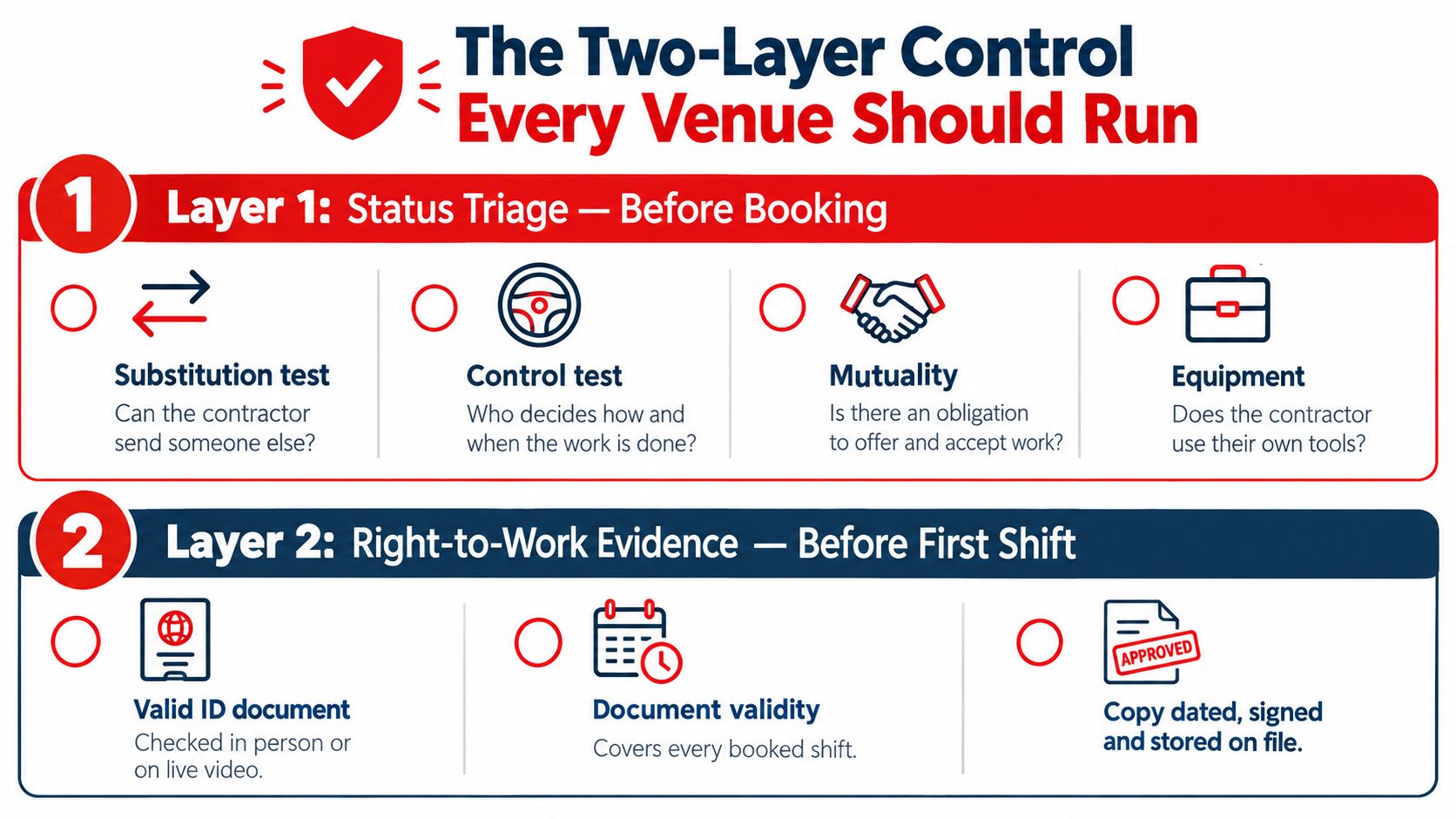
Run two controls, in order, for every contractor booking.
Layer one is status triage
Before confirming the shift, record the facts that show how the engagement will operate:
- Substitution: Can the contractor send a suitably qualified replacement, or must the named chef personally attend?
- Control: Who decides the hours, method, menu execution and pace of work?
- Mutuality: Is the venue obliged to offer future work, and is the chef obliged to accept it?
- Financial risk: Does the contractor carry responsibility for correcting poor work, supplying equipment or managing costs?
- Integration: Will the chef operate as part of the venue's brigade under a head chef, or provide an independent service with defined responsibility?
A short written assessment on the purchase order is better than an assumption in a manager's head. If the chef chooses when and how to work, can provide a substitute, carries genuine commercial risk and operates independently, the facts may support self-employment. If the venue sets every shift, directs the work minute by minute and expects personal service, the label deserves challenge.
Layer two is the right-to-work decision
Once status is assessed, decide whether a statutory check is required. For a direct employee, it is. For a self-employed contractor, the Home Office position is different. For a sponsor licence holder, sponsor duties can require checks for sponsored workers regardless of the label attached to the engagement.
The common mistake is to run one employee onboarding process for everyone. That creates unnecessary administration and still doesn't answer whether the contractor was misclassified. The opposite mistake is equally dangerous, because assuming every invoice-issuing chef is exempt can leave a venue exposed.
For practical handling of employment relationships, keep your contractor process aligned with employment law for temporary staff. The document check is only the second control. Status triage decides whether you need it and what evidence belongs in the booking file.
Three Accepted Routes for a Statutory Check
When the engagement requires a statutory right-to-work check, the Home Office recognises three routes. Choose the route that fits the person's status, documents and arrival pattern. Don't let a Friday-night booking dictate a non-compliant shortcut.
| Route | Best For | Speed | Evidence Trail |
|---|---|---|---|
| Manual document check | A chef who can attend the venue before work and holds acceptable original documents | Immediate when documents are available | Copy of the original documents, check date and checker's record |
| Online share code | A chef with an eligible digital immigration status or digital profile | Fast for agency bookings and known candidates | Online result, share code details, date of birth and profile photograph match |
| Identity Document Validation Technology | Eligible UK and Irish citizens being onboarded remotely | Useful where an in-person meeting isn't practical | Identity-provider validation record and employer confirmation |
The manual route involves checking original documents from the prescribed lists with the individual present. For a hotel in Slough booking a chef for a single emergency shift, this can work if the chef reaches the property early enough for the manager to inspect the document properly.
The online route uses the Home Office service and is free of charge. The employer enters the individual's share code and date of birth, confirms that the result permits work in the UK and permits the specific role, then checks that the photograph matches the person presenting for work. This is often the cleanest route for an agency-supplied chef with an established digital record.
IDVT is suitable for eligible UK and Irish citizens where the process is being handled remotely, such as a yacht chef being prepared for a booking away from the management office or a specialist being engaged for a country-house venue. It isn't a substitute for assessing status, and it doesn't remove the need to follow the applicable evidence and follow-up rules.
A check must cover the actual engagement. If permission has an expiry date, diarise the follow-up check before the chef returns. Keep the booking system, agency record and compliance file aligned.
Running the ID Check Without Missing a Beat
A manager checking a chef's documents is usually also dealing with deliveries, front-of-house questions and a rota gap. Use a fixed workflow so the pressure of service doesn't turn a legal check into a glance at a phone photograph.
Before the shift
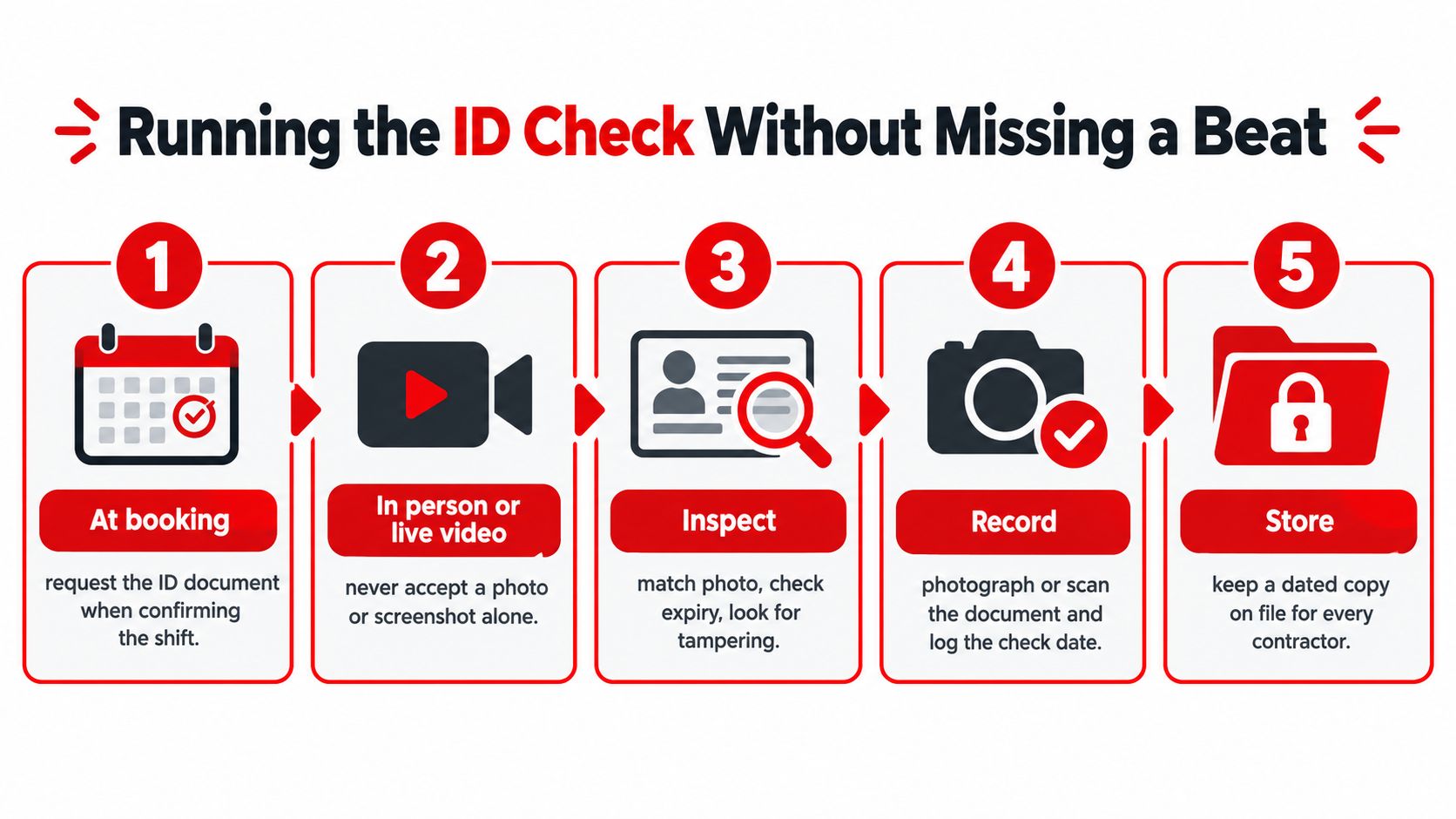
Request the relevant evidence when confirming the booking. Tell the contractor that the check must be completed before work begins and explain whether the venue will use a manual document check, an online share code or an IDVT provider.
For a manual route, inspect the original document with the individual present. A live video inspection may support identity handling in some workflows, but a photograph or screenshot sent by WhatsApp isn't enough as a standalone substitute for the applicable check.
Check the document against the current Home Office acceptable list. Match the photograph to the person in front of you, confirm the date of birth and expiry details, and look for inconsistencies or signs of tampering.
Record the result
For a manual check, copy the relevant documents and record the date. Add the time, document type, reference number where applicable, the name of the person who completed the check and the outcome.
For an online check, enter the share code and the date of birth used to access the result. Confirm that the online profile permits work and that the role is allowed. Compare the displayed photograph with the chef presenting for the booking. Don't accept the existence of a share code as proof without reviewing the result.
A useful booking-file note looks like this:
- Person checked: Full name as shown on the evidence.
- Engagement: Venue, role and booked shift.
- Route: Manual, online or IDVT.
- Identity: Photograph matched and date of birth confirmed.
- Permission: Result permits the specific work.
- Record: Date, time, document details and checker recorded.
- Follow-up: Review date diarised where permission is time-limited.
The Home Office checklist requires employers to check original documents with the individual present for manual checks and copy them with the date recorded. For online checks, it requires the employer to review the result, confirm the work and role permission, and satisfy themselves that the photograph matches the person presenting for work. The Home Office right-to-work checklist provides the working reference.
Keep the dated evidence for the required statutory retention period, rather than keeping passport scans indefinitely without a retention policy. Store access securely and restrict it to people who need it for staffing or compliance.
Where Hospitality Buyers Actually Get Caught
A Bristol hotel group once booked a pastry chef as “self-employed” through a referral. The chef invoiced the hotel, but the working arrangement looked much closer to a worker relationship. The venue had focused on the invoice and had not documented why the contractor classification was appropriate.
That type of failure is more serious than a missing tick on a checklist. Home Office enforcement data recorded 677 civil penalties with a total value of £42 million in 2026 Q2, following 561 penalties worth £32.6 million in Q1, as reported in the Home Office enforcement activity data. The maximum civil penalty for employing someone without the right to work increased to £60,000 per illegal worker in February 2024, according to the same government source.
The ranked failure list
| Pitfall | Typical Trigger | Penalty Exposure |
|---|---|---|
| Misclassifying an employee or worker as self-employed | Set shifts, close direction and personal service | Potential illegal-working exposure if the required check was missed, plus wider employment-status consequences |
| Relying on an expired share code or permission | Rebooking a chef without reviewing the follow-up date | Loss of the statutory excuse where the required check is no longer current |
| Keeping the wrong document | Saving a supplier summary instead of the required check evidence | Weak defence if the engagement is later challenged |
| Failing to re-check a returning contractor | Treating a previous booking as permanent clearance | Missing a new check where permission or status requires it |
| Accepting a photocopy from a supplier without verifying responsibility | Assuming the agency's email is enough | No clear audit trail showing who checked what and when |
A venue in Bristol, Cardiff, Windsor or Devon should make the booking owner accountable for closing the record. The agency may have performed the check, but the agreement should say what evidence it supplies and what the venue can inspect.
Don't build a process around fear of every contractor. Build it around allocation of responsibility. The government guide says businesses are strongly encouraged to ensure contractors and labour providers check people they employ, engage or supply, while the direct statutory position depends on the working arrangement and whether the venue is a sponsor.
The Misclassification Risk Nobody Talks About
The document failure is visible. The status failure is usually buried in the rota.
Consider the Bristol hotel group's pastry chef. The venue booked the chef as self-employed, but the practical indicators pointed elsewhere:
- The hotel set the shifts.
- The chef wore branded whites.
- The chef was expected to work personally and exclusively.
- A line manager directed plating and service decisions.
- The relationship continued with one supplier for nine months.
Those facts don't become independent because payment arrives against an invoice. They describe a chef integrated into the operation and directed as part of the hotel's team. If an HMRC inquiry reclassifies the relationship, the venue can face backdated PAYE, National Insurance and pension issues. The missing passport scan isn't what created that exposure. The classification did.
What the booking form should test
Ask practical questions before the chef accepts the work:
- Can the chef provide a substitute?
- Can the chef refuse work without penalty?
- Does the chef control the method and timing of the service?
- Does the chef work for multiple clients?
- Does the chef carry meaningful financial risk?
- Does the venue provide the tools, uniform and detailed supervision?
- Is the chef operating an independent service or filling a vacancy in the brigade?
No single answer decides the issue. The pattern does. A yacht chef hired for a defined independent assignment may look different from a chef placed on a hotel rota, reporting to a sous chef and following the same procedures as permanent staff.
The invoice describes how you pay the chef. It doesn't prove how the relationship works.
This is why contract and employment agency support should sit alongside right-to-work administration. A sound supplier process records the status reasoning, identifies who carries each checking responsibility and prevents a manager from using “self-employed” as a convenient shortcut.
Government guidance also recognises that self-employed people generally don't have employment rights, while some independent contractors can still fall within worker categories. For hospitality, misclassification is the primary control risk because it can make the document process wrong before anyone opens the file.
Sample Contractor Brief and Next Steps
Standardise the brief before the emergency happens. A contractor should receive the same core information whether the booking is for a pub in Dorset, a hotel in Reading, a seasonal kitchen in Wales or a private villa.
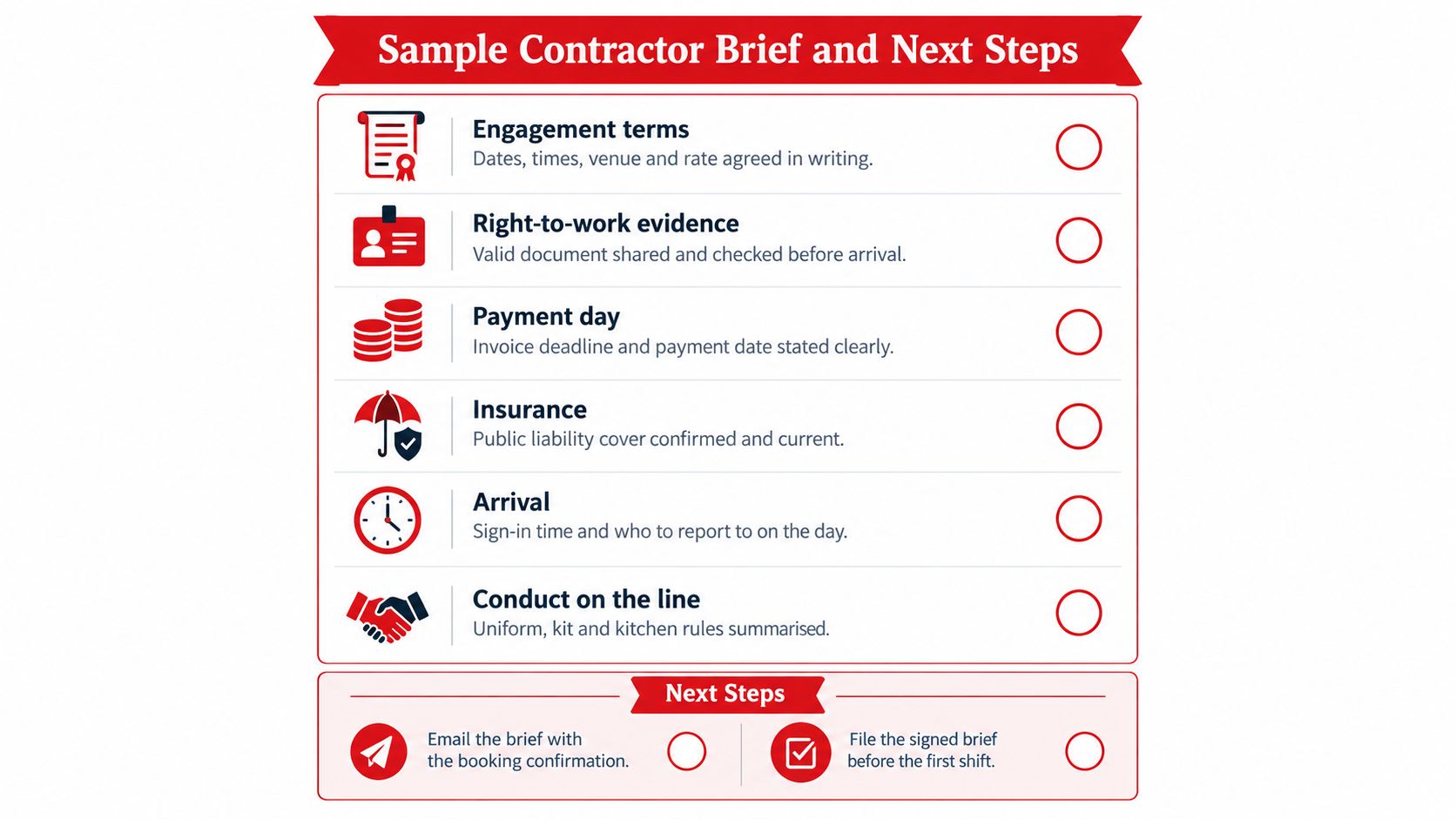
Copy-ready contractor brief
Engagement terms: Confirm the venue, role, dates, shift times, reporting manager, rate and whether the engagement is direct or supplied through an agency.
Right-to-work evidence: State what must be provided and checked before arrival where the engagement requires a statutory check. Explain that a photo or screenshot alone won't be accepted as a completed verification record.
Payment: Set the invoice deadline, payment day and process for disputed hours in writing.
Insurance: Request confirmation of current public liability cover where the contractor is operating as an independent business.
Arrival: Give the sign-in time, entrance, parking instructions, uniform requirements and the person to contact on arrival.
Conduct on the line: Set out kitchen rules, allergen procedures, food safety expectations, phone use, breaks and escalation routes.
Supplier wording worth using
Add a clause along these lines to the supplier agreement:
“The supplier confirms that it has assessed the status of each person supplied and will complete any right-to-work checks required for the engagement. The supplier will retain dated evidence and provide it to the venue on request. The venue may review the evidence and may refuse access where the required information has not been provided before work begins.”
Don't present that clause as a transfer of every legal duty. It allocates an operational responsibility and gives the venue an inspection right. The venue still needs to understand whether it is directly employing the chef, sponsoring the worker or receiving a genuinely self-employed service.
Attach a one-page booking checklist:
- Status: Triage completed and outcome recorded.
- Responsibility: Venue, agency or sponsor duty identified.
- Evidence: Correct route selected and completed where required.
- Identity: Photograph and person matched.
- Record: Copy, result, date and checker stored.
- Return booking: Follow-up date reviewed before confirmation.
- Service: Arrival, conduct and kitchen expectations acknowledged.
Relief Chefs UK is a nationwide chef recruitment agency established in 2013, supplying relief chefs, temporary chefs, permanent chef recruitment, yacht chefs, villa chefs and wider hospitality staffing support. Its operating model gives venues another option when they need pre-checked staffing rather than a last-minute freelance search.
Relief Chefs UK can help cover short-notice sickness, seasonal demand and kitchen gaps with vetted chefs and documented right-to-work processes, from independent pubs and restaurants to hotels, yachts and private villas. Visit Relief Chefs UK to request temporary cover or discuss a permanent recruitment requirement before the next service is at risk.