
Staffing Agency Near Me: UK Hospitality Guide 2026
5 September 2026
The fastest way to find a usable staffing agency near me is to choose a pre-vetted partner that confirms cover at short notice, not days later. That matters in a sector where 1,058,300 temporary or contract workers were on assignment in the UK on any given day in 2023, according to REC-linked industry data.
At 4pm on a Friday, nobody cares whether an agency's office is five miles away. They care whether a qualified chef can arrive before service, understands the menu, clears compliance checks and won't destabilise the kitchen. A map search gives you distance. A dependable staffing partner gives you a realistic answer.
The Friday Night Your Chef Calls In Sick
The prep list is printed. The boards are wiped down. Deliveries are checked, the bookings are climbing and the pass is ready for service. At 4pm, your head chef calls in sick. The sous chef is already off shift, and the commis team can't carry the kitchen alone.
The general manager has about 90 minutes to make a decision. First come the personal contacts, then the staff group chat, then the desperate call to another venue nearby. One chef is already working, another doesn't drive, and a third has the right experience but can't confirm transport. A generic search for a staffing agency near me produces several listings, but not a single clear answer about who is available tonight.
By 4.30pm, the problem isn't finding a phone number. It's finding a vetted chef who can legally work, understands the required station and can reach the venue in time.
Why the next 90 minutes matter
A venue can sometimes reduce the menu, move a manager into the kitchen or close a section. None of those options is free. Prep gets abandoned, stock may be written off, tables wait longer and the front-of-house team starts comping dishes to calm frustrated guests. A poor Friday service can also affect Saturday bookings when guests share reviews or decide not to return.
The closest agency may still be the wrong agency if it has no chef available, takes hours to respond or sends someone without the skills your menu demands. A chef who has only worked breakfast service isn't an answer to a busy à la carte dinner. Neither is a candidate whose paperwork hasn't been checked.
Service rule: A nearby chef isn't useful if the agency can't confirm their availability, compliance and role fit before the shift starts.
What a workable response looks like
A proper emergency process starts with one call or request, followed by direct questions:
- Availability: Can the agency confirm a chef for the required service window?
- Capability: Has the chef handled the relevant menu, station and equipment?
- Compliance: Has the agency completed the required right-to-work process and retained evidence?
- Reliability: What happens if the chef cancels or fails to arrive?
- Communication: Who owns the booking from confirmation to clock-out?
Relief Chefs UK provides emergency relief chef cover across the UK, but the broader lesson applies to any agency you assess. Locality is only useful when it supports speed, vetting and a reliable route to service.
The rest of this guide gives you a repeatable way to prevent the next Friday from becoming a crisis. You'll learn how to define “near me” properly, test an agency before relying on it and build cover into your operation before the rota starts breaking.
What Near Me Actually Means for UK Hospitality
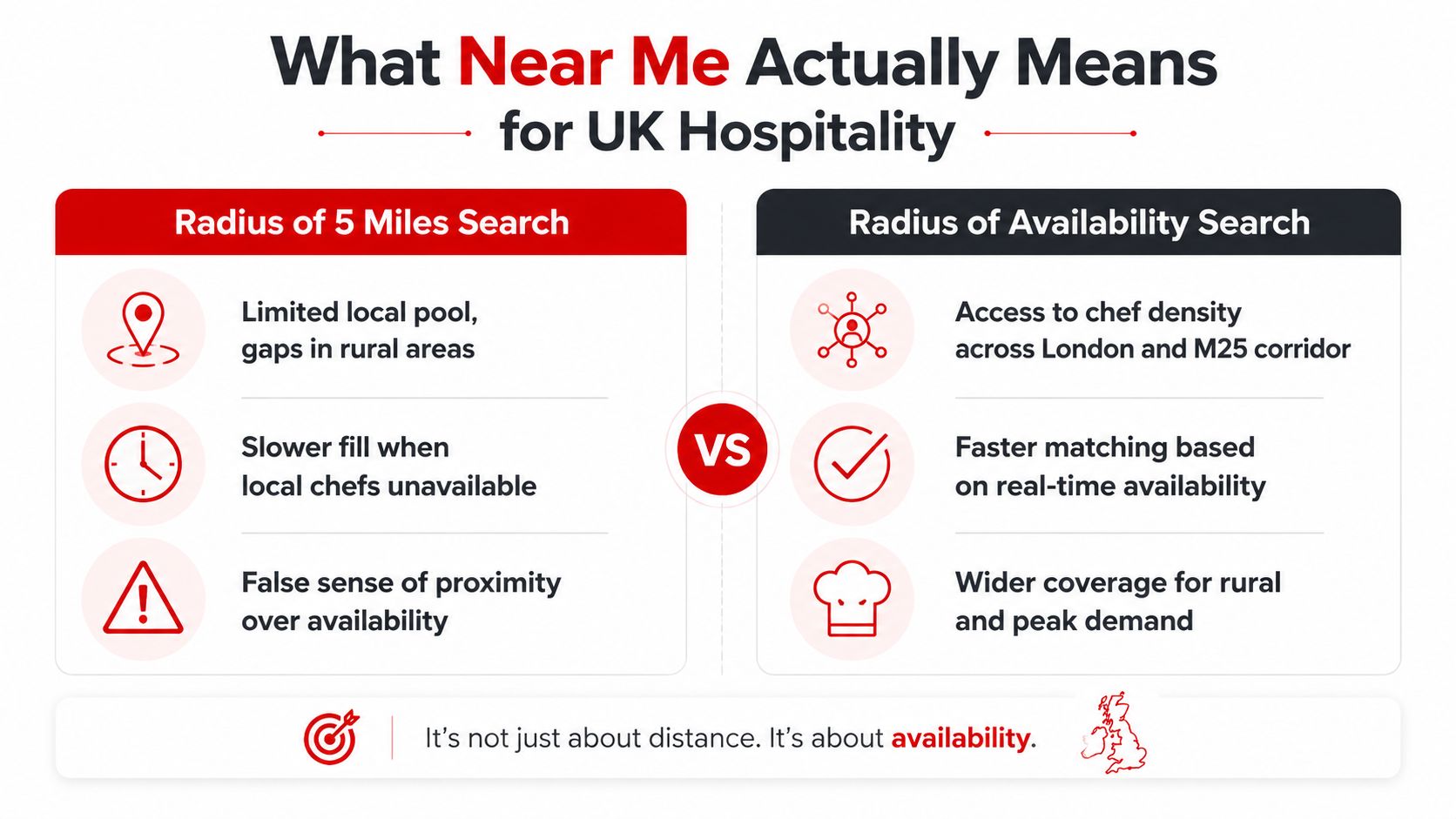
A radius-of-five-miles search makes sense for a parcel delivery. It isn't enough for chef cover. Hospitality needs a radius-of-availability search, because the useful question is not “Which agency has an office nearby?” but “Which vetted chef can reach this kitchen and perform this service?”
London and the M25 corridor usually offer deeper labour pools than rural Devon, the Cotswolds or the Scottish Highlands. Even then, local supply can disappear during busy periods. A venue in Cowes may need yacht expertise rather than a land-based restaurant chef, while a property in St Mawes may need someone willing to travel for a seasonal booking.
Local demand changes the meaning of proximity
Summer puts pressure on coastal counties, the South West and tourism-heavy postcodes. Christmas creates a different pattern, with hotels, pubs and restaurants competing for chefs who can handle party menus and extended service. Yacht and villa work can also pull candidates away from conventional local placements.
The pressure is already substantial. UKHospitality reports about 132,000 hospitality vacancies, described as 48% above pre-pandemic levels, while chef shortages vary by role, from 10% for head chefs to 21% for production chefs. Those figures come from UKHospitality's workforce campaign.
A separate hospitality employment update put accommodation and food-service vacancies at about 71,000 in the three months to May 2026, down from the 2022 peak of 177,000. The same analysis cautions that lower vacancies reflect weaker hiring demand and cost pressure, not a resolved labour shortage. It also cites roughly 77,000 vacancies in the September-to-November 2025 quarter, around three vacancies per 100 workers, compared with 2.3 across all industries.
Use three filters, not one postcode
When you assess an agency, rank it against these filters:
- Confirmation speed. Can it tell you who is available, not promise to search?
- Vetting depth. Does it verify right to work, references, qualifications and the chef's actual specialism?
- Geographic reach. Can it move suitable chefs into Devon, Bristol, Wales, Berkshire, Windsor, Reading, Slough, Dorset and other hospitality hotspots when the local pool dries up?
A restaurant-owner survey cited by Vivid Hospitality's 2026 recruitment coverage found 60% expected staffing shortages to persist in 2026. That makes seasonal reach more valuable than a nearby office address.
Define “near me” as a service-level promise. You need an agency that can confirm a compliant, suitable chef within a usable window, wherever that chef is based.
Vetting a Local Chef Staffing Agency Step by Step
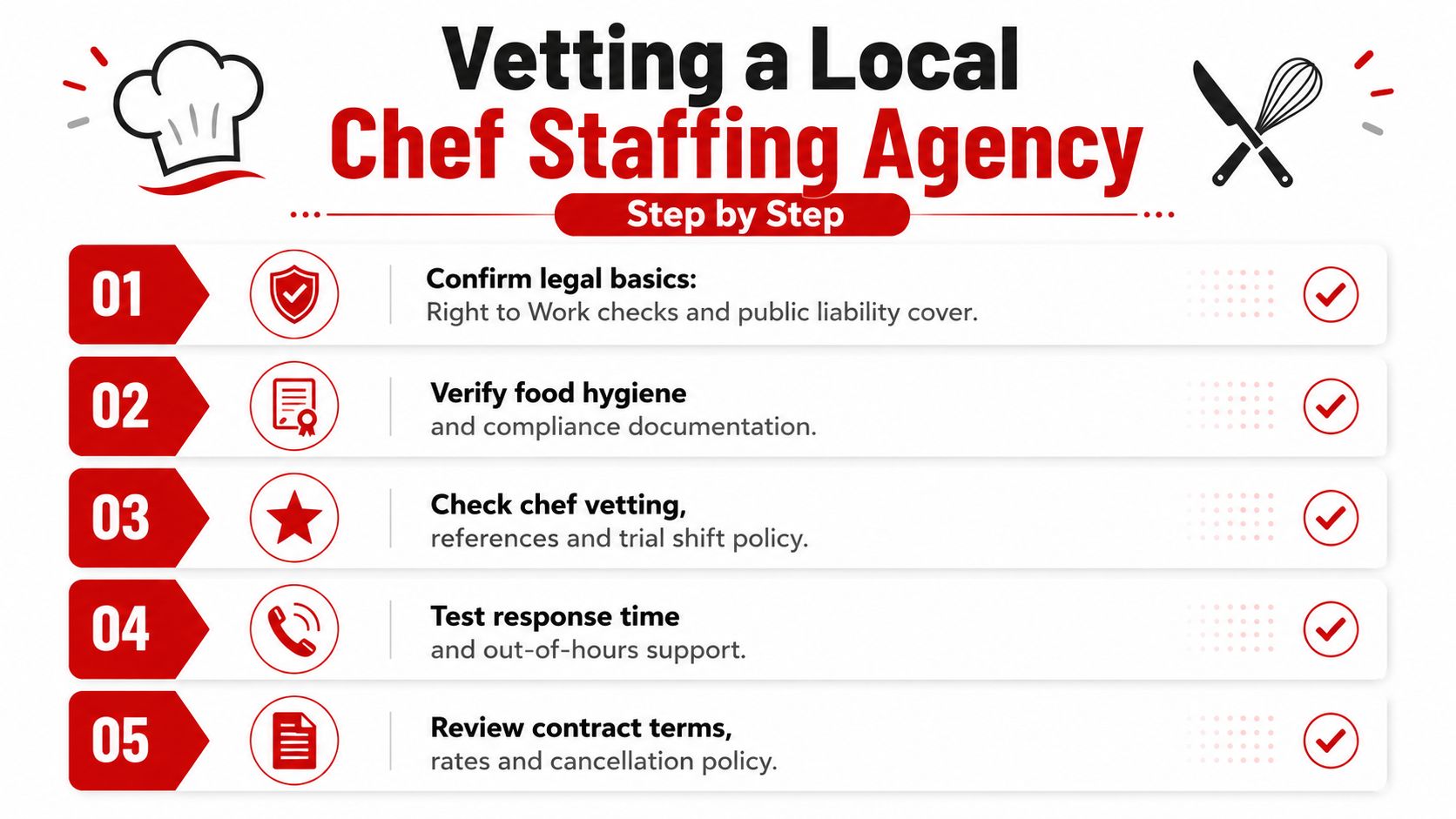
An agency should earn a place on your emergency contact list before you need it. Don't wait until a chef calls in sick to discover that the supplier can't explain its insurance, replacement process or right-to-work checks.
Start with legal and financial protection
Ask for confirmation of right-to-work procedures, public liability cover, employer liability insurance and PAYE or umbrella arrangements. You also need a named complaints route. If the agency avoids these questions, stop there.
The Home Office requires employers to check original or approved digital documents, inspect the photograph and date of birth, compare the individual with the document and retain a clear copy of the check. Correct use of the prescribed methods can provide a statutory excuse against civil penalties for illegal working, as explained in the government right-to-work guidance.
For a short-notice chef booking, the check still needs to happen before employment begins. A visual glance at a document isn't enough if the agency doesn't preserve evidence or track a time-limited permission that needs a follow-up check.
Test the depth behind the profile
Ask how the agency verifies:
- References: Are they taken from named employers, or accepted without confirmation?
- Food safety: Can the agency provide relevant food hygiene documentation?
- DBS checks: Are they available where the role or household requires them?
- Specialisms: Can the agency distinguish fine dining, pastry, production cooking, allergen control, yacht work and private household service?
A chef's job title doesn't tell you whether they can run your pass. Ask for a short profile covering experience, strengths, availability and the last relevant venue.
Test the response before you sign
Call outside normal office hours. Ask for a written response window, the escalation contact and the process for a no-show. An agency that can't respond clearly when you are testing it won't become more organised during a Friday service.
Review the cancellation policy, any kill fee, notice requirements and replacement guarantee. Then ask for the contract, not a verbal summary. Chef recruitment and employment agency support should be judged by the same standard as any other supplier.
End the conversation if the agency requests unexplained cash payments, refuses to share compliance documents or won't put its service promise in writing. Those aren't minor administrative weaknesses. They're warning signs that become expensive when the booking goes wrong.
Reading a Quote Without Getting Burned
A cheap hourly rate can become an expensive shift once you add minimum hours, travel, cancellation exposure and last-minute charges. Compare quotes using the same assumptions, or you're comparing a headline number with a real operating cost.
Separate the chef's pay rate from the venue's charge rate. The difference pays for recruitment, checks, payroll administration, insurance, support and the agency's margin. A gap of £4 to £6 can be normal in this model, but a much wider unexplained difference deserves questions about what service you're receiving.
Strip every quote to three figures
Before you approve a booking, write down:
- Charge rate: What will the venue pay per hour or day?
- Minimum commitment: How many hours will be charged, even if service finishes early?
- Notice period: What happens if the booking changes or the chef cancels?
Then check whether travel time is charged at the full rate, whether holiday pay is included or accrued, whether there is a last-minute uplift and whether the quote uses an hourly or day rate. A day rate may look cleaner, but it can hide a longer minimum commitment.
| Line Item | Low-Cost Agency | Mid-Tier Agency | Relief Chefs UK |
|---|---|---|---|
| Charge structure | Headline rate may exclude extras | Usually itemised, confirm assumptions | Transparent pricing model and stated inclusions |
| Minimum hours | Check carefully | Usually documented in the quote | Confirm before booking |
| Last-minute cover | May carry an uplift | May carry an uplift | Ask for the applicable rate before confirmation |
| Cancellation | Often tightly restricted | Contract-dependent | Review cancellation and replacement terms |
| Support | Limited escalation | Account or office support | Confirm the support route for your plan |
Use transparent chef staffing pricing to understand what is included, but don't select an agency on price alone. The right comparison is total cost against response time, fit and the damage avoided when service continues normally.
Commercial test: If two agencies cost a similar amount, choose the one that gives you the clearest confirmation, replacement and cancellation terms.
A broker with thin vetting can create extra work for your head chef, increase supervision and leave you exposed when the worker isn't suitable. The lowest quote only wins if the chef arrives, performs and completes the shift.
Interview Questions and Trial Signals That Reveal a Chef's True Fit
A 15-minute phone screen won't replace a proper reference, but it will expose obvious mismatches before you put a stranger on the pass. Run the call yourself, or give the script to the kitchen manager.
Start with the menu rather than the CV. Ask the chef to explain the dishes they would expect to prep first, which ingredients create allergen risks and how they'd organise a station when the ticket queue grows.
Use questions that force practical answers
Ask:
- “Which part of this menu would you want clarified before arriving?”
- “How do you prevent an allergen order from being contaminated during a busy service?”
- “Tell me how you'd take over a ticket queue you didn't write.”
- “What do you check first when stock or equipment isn't where the brief says it should be?”
- “Which station can you run confidently without close supervision?”
- “What information do you need from us before the shift?”
Good chefs ask questions back. They want to know the menu, equipment, service style, team structure and expected covers. A candidate who agrees to everything without asking how the kitchen operates may be confident, or may not understand the assignment.
Watch the trial shift, not the performance pitch
On the day, look for practical signals:
- First tickets: Does the chef establish a sensible rhythm without rushing plates blindly?
- Line control: Do they rotate stock, label products and keep their section organised?
- Communication: Do they call clearly and tell the pass when a component is delayed?
- Allergen discipline: Do they follow the venue's procedure instead of improvising?
- Breakdown: Do they leave the station clean, safe and properly stored?
- Handover: Do they record low stock, prep requirements and unresolved issues?
Red flags include no questions before arrival, vague references, reluctance to taste the existing menu and pristine whites paired with no evidence of real pass experience. Appearance isn't proof of ability, but a chef who can't explain how they work under pressure is a risk.
Don't judge the trial only by speed. Kitchen stability matters more than one impressive plate. You need someone who can slot into your brigade, protect standards and leave the next shift with a useful handover.
Your 30 Day Contingency Playbook With Relief Chefs UK
The strongest response to a staffing crisis is prepared before the crisis. You don't need to replace your existing rota or commit every shift to an agency. You need a tested layer of cover for sickness, seasonal peaks, holidays, sudden bookings and hard-to-fill skill gaps.
Relief Chefs UK is a nationwide chef recruitment agency established in 2013, offering relief chefs, temporary chef staffing, permanent chef recruitment, yacht chefs, villa chefs and wider hospitality staffing support. Treat the relationship as an operational system, not just a phone number.
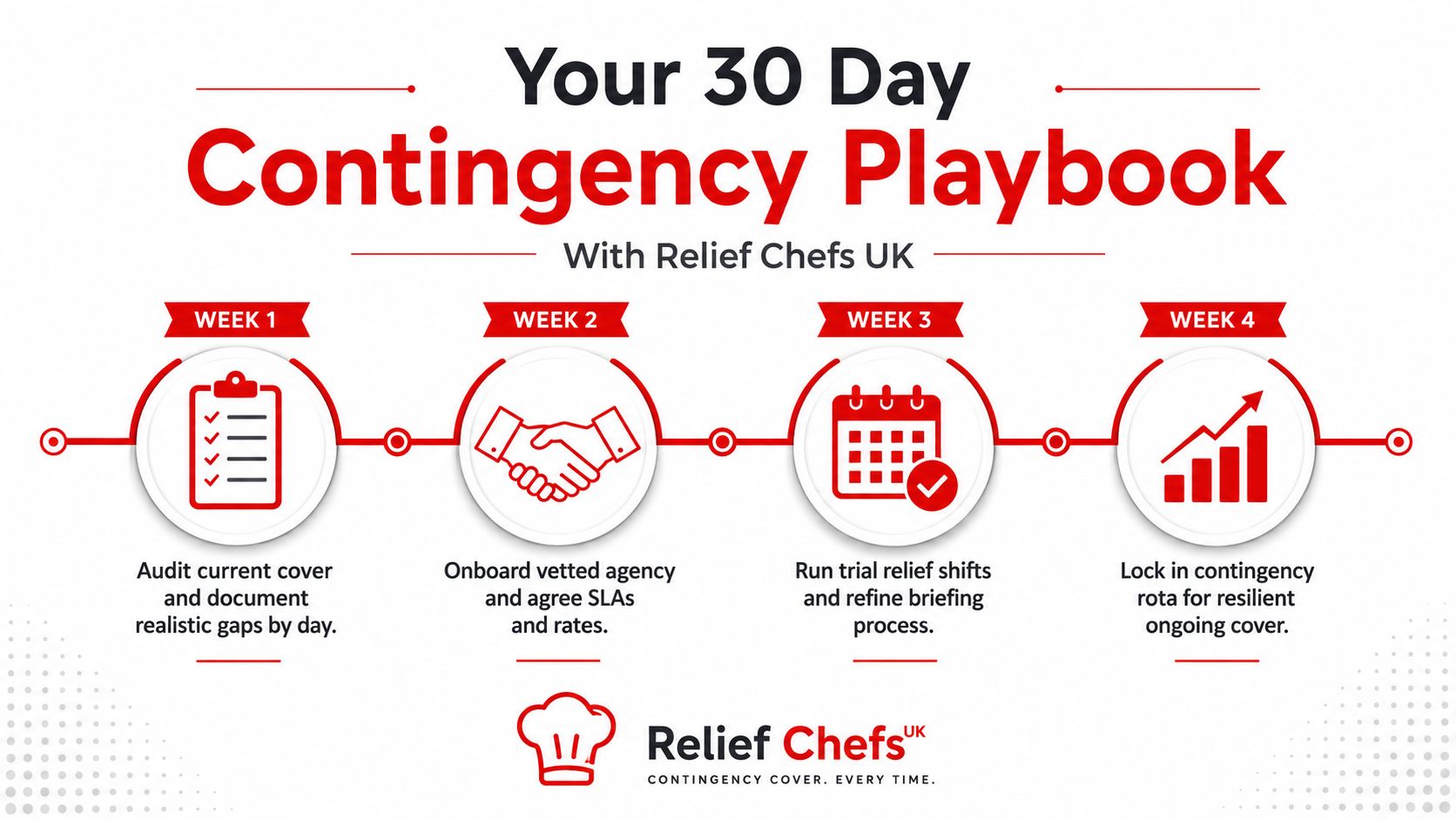
Week one, audit the gaps you actually have
Review the last rota and list where cover failed. Separate:
- Shift pattern: Breakfast, lunch, dinner, split shifts and overnight work.
- Skill band: Commis, chef de partie, sous chef, head chef and specialist roles.
- Notice type: Short-notice sickness, planned holiday, seasonal reinforcement and permanent vacancy.
- Location: Main site, rural property, coastal venue, yacht, villa or multi-site operation.
- Service risk: Which absence forces you to cut the menu or reduce trading hours?
Don't write “need more chefs”. Write “Friday dinner, grill section, short notice” or “summer breakfast cover, hotel kitchen, early start”. Specific briefs produce better matches.
Week two, build the briefing pack
Register with your chosen agency and send the information a chef needs to work safely:
- Current menu and menu changes.
- Allergen matrix and kitchen food-safety procedures.
- Equipment list, pass layout and induction notes.
- Parking, accommodation and transport information.
- Uniform expectations and contact details for the shift lead.
- Expected service style, staffing level and likely pressure points.
This preparation helps a temporary chef arrive ready to contribute instead of spending the first hour asking basic questions. It also gives the agency a clearer basis for matching experience to the role.
Week three, run a controlled test
Request cover for a lower-risk shift using a known menu. Measure the response from first contact to confirmation, the quality of the chef profile, the accuracy of the briefing and the manager's feedback after service.
Ask the chef what information was missing. Ask the agency what would have improved the match. Fix the briefing pack while the consequences are small.
Week four, formalise the pathway
Agree the rate card, escalation contacts and written service level. Include notice expectations, the no-show process, cancellation terms and the replacement guarantee. Decide who can authorise an emergency booking so nobody loses time seeking approval while the kitchen is exposed.
Relief Chefs UK states that venues can request cover by phone or short form, with support for short-term cover and longer placements. Its service model includes fully vetted, right-to-work-checked chefs, insurance and flexible support for venues ranging from independent pubs to hotel groups. Confirm the terms that apply to your own booking before relying on them operationally.
A sound contingency plan can cover a Devon pub, a Bristol restaurant, a Welsh hotel, a Berkshire event venue, a Windsor dining room, a Reading operation, a Slough contract kitchen or a Dorset coastal property. The postcode changes. The discipline doesn't.
The aim is simple: replace frantic personal calls with a rehearsed cover pathway. When the next chef phones in sick, your manager should know who to contact, what information to send and what confirmation must arrive before service.
If your kitchen needs reliable cover for sickness, seasonal demand or a permanent vacancy, contact Relief Chefs UK for vetted relief chefs, temporary and permanent recruitment, yacht and villa chefs, and wider hospitality staffing support. Send your location, service requirements and skill gap, then build a cover plan that protects your next service instead of waiting for the next crisis.
Call the team.
Office 01392 715474 · info@reliefchefs.co.uk