

A chef calls in sick at 10:30, the evening bookings are full, and the sous chef is already covering two sections. By lunch, the general manager isn't looking for a perfect long-term recruitment campaign. They need a competent pair of hands who can arrive, read the kitchen, protect service and leave the team stronger than they found it.
That pressure explains why temp agencies jobs have become a deliberate route for chefs and cooks across the UK. Seasonal demand, short-notice sickness, persistent chef shortages and the need to keep a kitchen stable all create work for people who can adapt quickly. Hospitality vacancy pressure has remained severe, with UKHospitality reporting that the sector's vacancy rate was still 63% above pre-pandemic levels in January 2023 (UKHospitality labour data response). Parliamentary evidence also placed the sector vacancy rate at at least 10% and potentially as high as 16%, equivalent to roughly 210,000 to 336,000 unfilled roles, with chefs among the most affected positions (Parliamentary evidence from UKHospitality).
A temp booking can mean variety, immediate income, a way into a better hotel or a route towards a permanent role. It can also expose a chef to poorly organised kitchens, unclear pay and agencies that don't understand the difference between a commis, a CDP and a chef who can take control of a section during a Saturday service.
This guide takes the chef's side. It covers where to find suitable work, how to register quickly, how to pass vetting, how to turn a trial shift into repeat bookings and what UK agency-worker rights mean in practice. Relief Chefs UK is a nationwide chef recruitment agency established in 2013, and its model is built around hospitality staffing rather than generic office recruitment. The same standards apply whether you're looking for a shift in Devon, a hotel booking in Berkshire or seasonal work near Bristol.
Introduction Why Temp Agency Work Suits Chefs Right Now
Temporary work suits chefs because kitchens rarely experience staffing pressure in a neat, predictable pattern. A hotel in Windsor may need extra breakfast cover during a busy weekend. A restaurant in Dorset may lose a line cook before dinner. A pub in Wales may need a chef who can step into a familiar section without spending the whole shift asking where the gastronorms are kept.
The chef who succeeds in agency work understands that flexibility isn't the same as being available for everything. You choose the shifts that fit your skills, travel limits and preferred kitchen environment, then communicate those boundaries clearly. An agency would rather know that you can reliably cover garde manger and pastry support than hear that you're available for every role and discover on arrival that the booking doesn't suit you.
The UK has measured temporary employment through official ONS datasets for years. The ONS publishes quarterly data for temporary employees, including the EMP07 series, based on the Labour Force Survey (ONS temporary employees dataset). By March 2024, the government estimated that about 900,000 people were working in temporary jobs through an agency, and around 140,000 of them also reported being on zero-hours contracts (ONS temporary employees dataset). That overlap shows why agency work can offer flexibility, while also explaining why chefs should ask precise questions about shifts, notice and security.
A career tool, not a waiting room
Some chefs use agency shifts to test different brigades before committing to a permanent position. Others use them to stay active between seasonal contracts, build contacts with head chefs or manage family commitments. A strong booking gives you more than a day's work. It gives an operator evidence that you can be trusted under pressure.
Practical rule: Treat every agency shift as an audition for the next booking, even when nobody calls it a trial.
The best agencies want reliable chefs who arrive prepared, follow the agreed brief and communicate early when circumstances change. They don't need theatrics. They need someone who can keep standards steady when a station is under-prepped, a delivery is late or the service plan changes.
Where to Find Temp Agencies Jobs That Actually Fit Hospitality
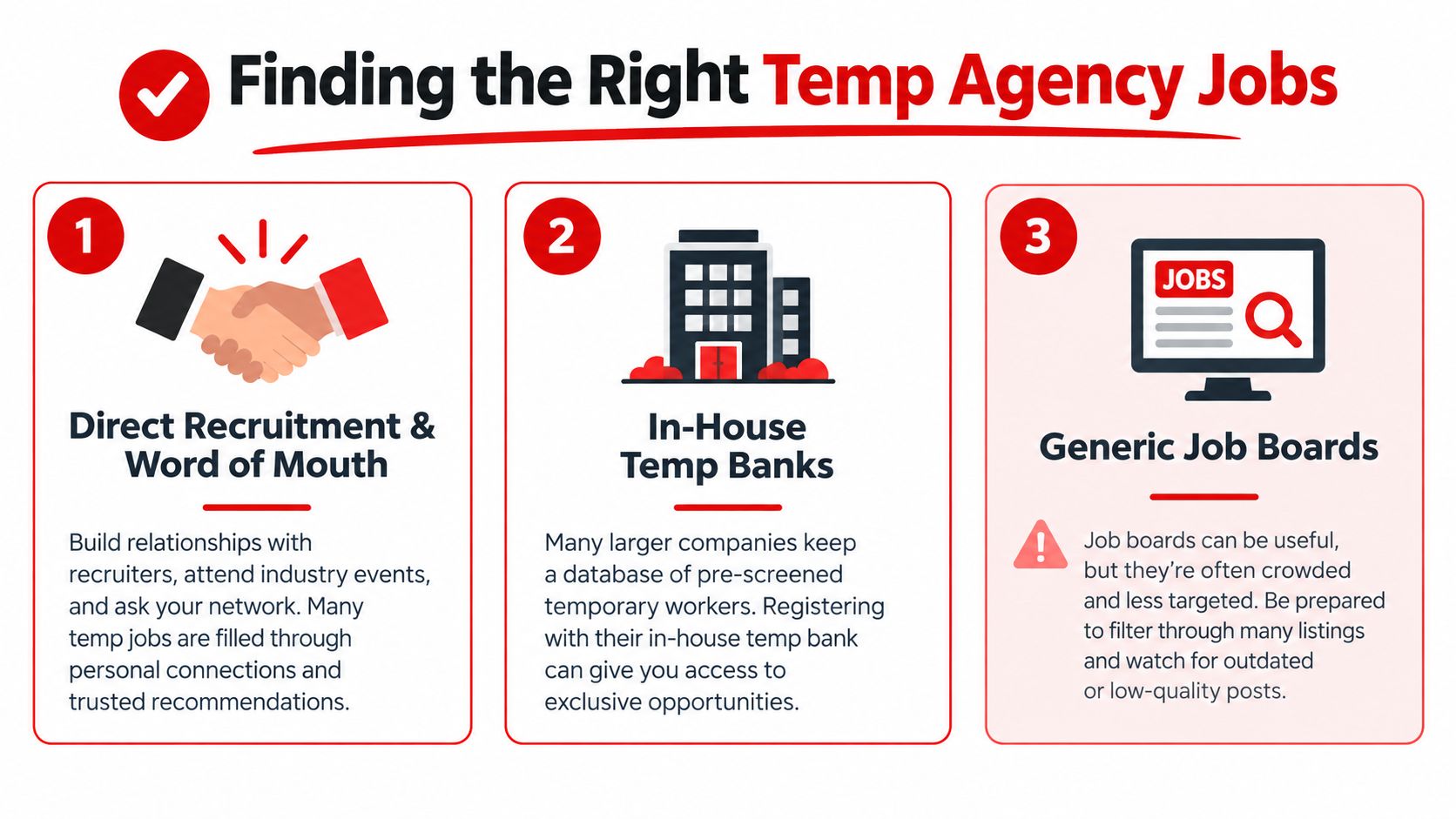
The fastest route to suitable hospitality work is usually a specialist agency, direct referral or established temp bank, not a generic advert aimed at every type of worker. Recruitment evidence for temporary staff in the UK indicates that just over half of employers use direct recruitment as their main route, while word of mouth and in-house temp banks are more common than media advertising, which was the main method for only about 10% of respondents (Recruitment and Employment Confederation research).
That matters to chefs because a pre-qualified bench can be contacted immediately. A generic job board may produce plenty of applications, but it doesn't tell the venue whether an applicant can handle a six-burner range, a high-volume breakfast or a section with incomplete prep.
Specialist versus generalist agencies
A generalist agency may have broad reach, but its consultant might not understand why a chef who can run a larder section isn't automatically suitable for pastry. A specialist chef agency should ask about your sections, covers handled, cuisine, service style, kitchen leadership and equipment experience before offering a booking.
Use this comparison before registering:
| Question | Specialist chef agency | Generalist agency |
|---|---|---|
| Does the recruiter understand brigade roles? | Usually, because kitchen work is central to the service | It depends on the individual consultant |
| Can it distinguish relief cover from permanent recruitment? | Often clearly | Sometimes less clearly |
| Is short-notice availability useful? | Usually, if the chef is already vetted | May depend on a broad labour pool |
| Can it match yacht, villa or private-household work? | More likely where those services are established | Less likely |
| What should you check? | Vetting, rate clarity and kitchen fit | Whether hospitality is a genuine focus |
Search locally as well as nationally. A chef in Devon may find strong opportunities through local hotels, pubs and event caterers, while Bristol, Wales, Berkshire, Windsor, Reading, Slough and Dorset each have different patterns of hotel, restaurant, contract catering and private work.
The temporary work agency service for chefs is one route to consider when you want a recruiter that understands relief cover and hospitality assignments.
Filters that save time
Before you upload a CV, ask:
- Kitchen knowledge: Can the recruiter explain the section and expected covers?
- Booking detail: Will you receive venue, start time, dress code, menu and contact information?
- Vetting: Does the agency check identity, right to work, references and relevant certificates?
- Pay clarity: Is the rate clear before you accept, including holiday pay arrangements?
- Support: Who answers if the venue changes the booking or you have a problem during service?
A useful agency doesn't just forward your name. It matches your actual capability to the kitchen's immediate problem. That saves you from arriving at a role you can't perform and saves the venue from repeating the same staffing mistake.
How to Choose the Right Temp Agency and Get Registered Fast
Registration should feel like professional onboarding, not a vague promise that someone will call when work appears. Before you commit, check whether the agency has a documented vetting process, full insurance, clear pay information, reasonable response times and a practical replacement process if a booking fails.
Relief Chefs UK, for example, offers relief chefs, temporary chefs, permanent chef recruitment, yacht chefs, villa chefs and broader hospitality staffing support. A specialist agency is particularly useful when your experience sits outside a standard restaurant role, or when you want assignments that match a defined section rather than any available kitchen job.
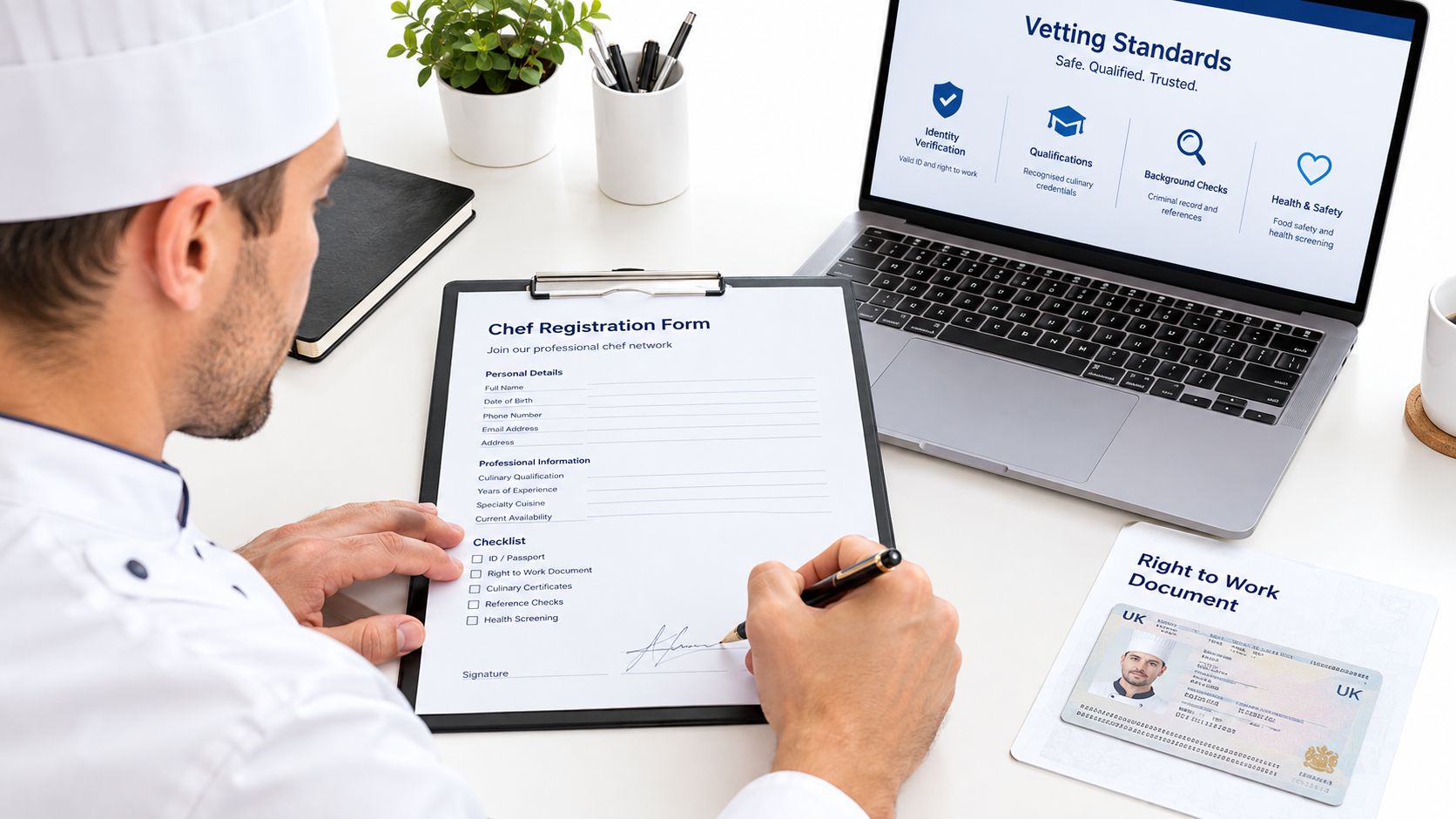
Prepare your registration pack
Send a clean, current pack rather than making the consultant chase basic information.
CV: List recent kitchens, job titles, sections, cuisines, service types and leadership responsibility. “Chef” is too broad. “CDP, banqueting and larder, high-volume hotel service” tells the agency where you fit.
Right-to-work evidence: Provide the documents the agency requests promptly. The agency and venue need confidence that you can legally start the assignment.
Certificates: Include food hygiene training and any other relevant qualifications. Don't claim certificates you can't evidence.
References: Give contact details for people who can comment on punctuality, consistency and kitchen conduct. A reference that only confirms your title isn't as useful as one that explains how you worked during pressure.
Portfolio: Keep photographs selective. A few clear examples of your food, plating or event work are more useful than a crowded gallery with no context.
Uniform and kit: Have clean chef whites, safe footwear, knives and any personal essentials ready. A venue shouldn't need to solve your basic preparation before service.
Ask the questions before you accept
A good registration conversation should establish your travel range, earliest start, preferred shifts, section strengths and limitations. Be honest about allergens, dietary requirements, heavy lifting, split shifts or transport. Concealing a limitation may secure one booking, but it won't create repeat work.
Ask whether the agency can respond within two hours and whether suitable chefs can start within 48 hours. Those are practical service expectations described for Relief Chefs UK, not a guarantee that every shift will be available. Also ask about replacement cover, support hours, payment timing and whether there are any worker charges.
The chef employment agency registration route should leave you knowing exactly what happens next. If the agency can't explain the process, the booking information or the pay breakdown, keep looking.
A fast registration is useful only when the information behind it is accurate.
Nailing Interviews and Trial Shifts to Secure Repeat Bookings
A trial shift isn't a chance to perform a television version of yourself. The head chef wants to know whether you can join an unfamiliar brigade, understand the brief and make service easier. Your first ten minutes often reveal more than an ambitious plate.
Arrive early enough to change, store your belongings and find the pass without rushing. Introduce yourself to the chef in charge, ask where the hand-wash station, walk-in, dry store and waste points are, then confirm your section and priorities. If the booking says larder but the kitchen needs help with prep, clarify what takes priority instead of guessing.
Show control through ordinary actions
During the interview, describe what you do under pressure. Explain how you organise a section, communicate delays, manage tickets and protect food safety. A CV that says “worked in busy kitchens” is weaker than a clear example of taking over a disorganised station and restoring a workable prep list.
On the shift:
- Read the section first: Check par levels, prep, labels, dates and equipment before service starts.
- Build a short plan: Identify what must be cooked, what can wait and what the pass needs from you.
- Communicate early: Tell the sous chef when a component is short, not when the first ticket is already waiting.
- Respect the house system: Adapt to the kitchen's ticket calls, plating standards and storage rules.
- Reset as you go: Keep boards, pans, cloths and utensils under control so the next task doesn't become a search exercise.
Suppose you arrive to find an under-prepped larder station and a queue of tickets building. Don't blame the absent chef. Tell the sous chef what is missing, suggest the fastest safe sequence, then execute it. If a colleague walks out during service, don't abandon your own station to become the hero. Ask the chef in charge where your effort has the greatest effect.
Leave evidence of reliability
The last impression matters. Wipe down your section, return equipment, label usable prep and report shortages or waste clearly. Thank the chef, then tell the agency promptly how the shift went and whether you'd take similar work again.
What gets you rebooked: Calm communication, clean standards and useful work without constant supervision.
Avoid criticising the venue to other staff, negotiating a different rate in the middle of service or disappearing at the end without a handover. If the kitchen was unsafe or the booking materially differed from the agreed role, report that fact to the agency with specific details. Professionalism doesn't mean accepting poor treatment. It means handling the issue in a way that protects your record.
The guide to working for a temp agency is useful preparation before you accept your first assignment.
Know Your Rights Pay and How to Negotiate Fair Rates
Agency chefs need to understand the difference between an attractive headline rate and a clear pay arrangement. Ask whether the quoted figure includes holiday pay, whether deductions apply and when payment is made. Don't accept “we'll sort it after the shift” as a substitute for written confirmation.
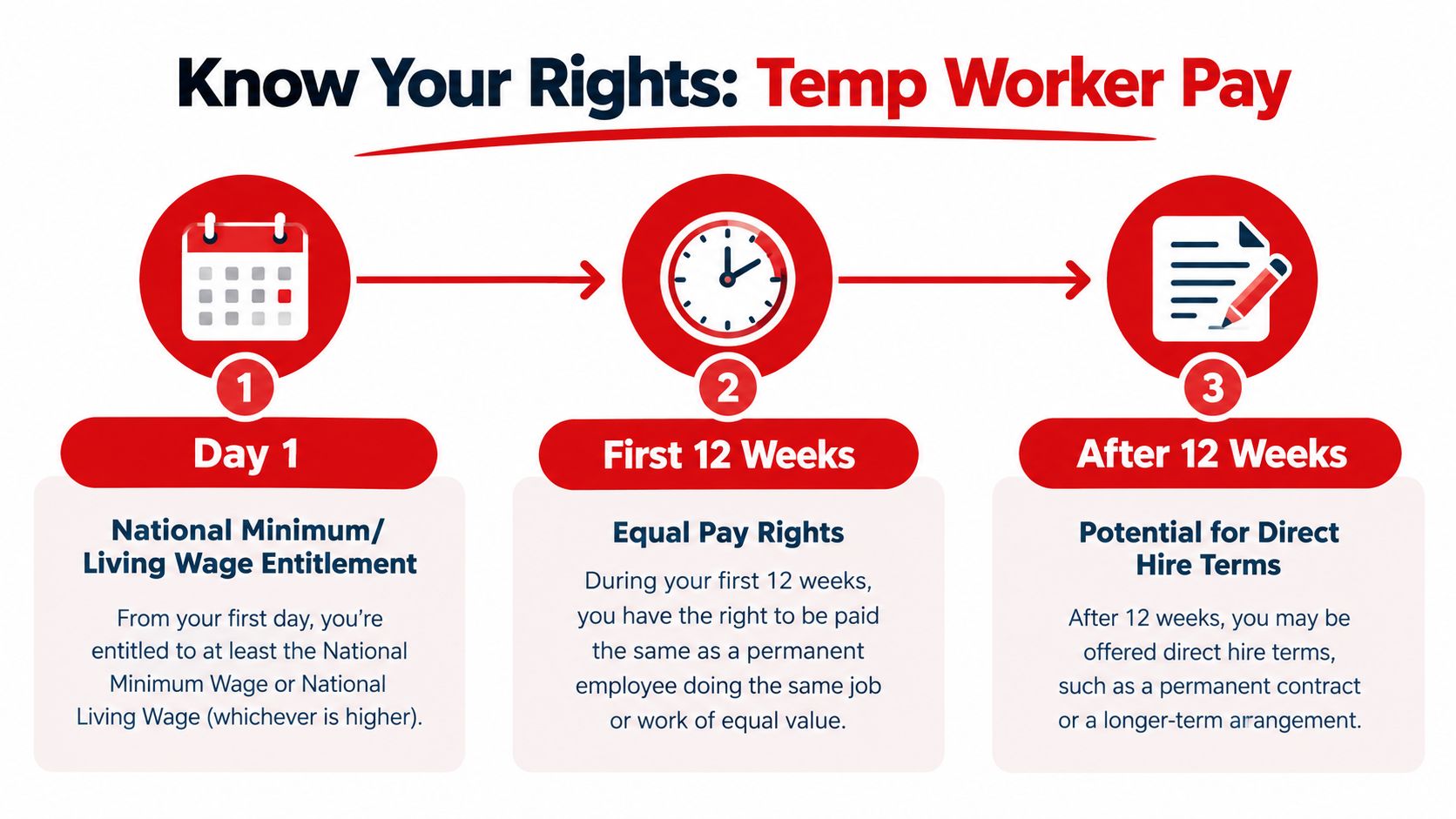
Under the Agency Workers Regulations 2010 guidance, agency workers receive access from day one to facilities and information about relevant vacancies. After a 12-week qualifying period in the same role, they gain rights to the same basic employment and working conditions as comparable direct hires.
GOV.UK explains that agency workers are entitled from day one to protections including the National Minimum or Living Wage and a minimum holiday entitlement. After 12 weeks, they qualify for equal treatment on pay, working conditions and automatic pension enrolment (temporary agency worker rights on GOV.UK).
Questions to ask before taking a booking
Use the booking call to establish the complete arrangement:
- Rate: What is the basic hourly rate, and is holiday pay shown separately?
- Hours: What are the confirmed start, finish and break arrangements?
- Travel: Is travel time or mileage covered, or is the venue within your own travel limit?
- Unsocial hours: Does the booking include early mornings, nights, weekends or split shifts, and is the rate different?
- Role: Are you covering a section, assisting the brigade or acting as the senior chef?
- Cancellation: What happens if the venue cancels after you've accepted?
- Payment: What timesheet approval is required, and when should payment arrive?
You can negotiate more effectively when you know the value you bring. A chef who can take a section without supervision, manage allergens and keep service moving has a stronger case than someone who presents only an availability window. Still, don't confuse negotiation with accepting a role outside the agreed brief.
Agencies earn trust by showing the full pay breakdown. If a recruiter avoids direct answers about deductions, holiday pay or pension arrangements, treat that as a warning. Good flexibility has clear terms behind it.
Maximising Bookings and Choosing a Long Term Agency Partner
Repeat bookings come from being dependable in ways that kitchen managers remember. Keep your availability accurate, answer messages promptly and say no early when a shift doesn't work. A late cancellation can damage a venue's service and an agency's relationship, while an honest refusal lets the recruiter find someone else.
Don't fill every available day to appear committed. Exhaustion creates mistakes, lateness and poor communication. Give the agency a realistic pattern, such as breakfast cover on selected weekdays, evening restaurant shifts or seasonal hotel work in a defined region. A recruiter can sell a reliable pattern more easily than vague enthusiasm.
Measure the relationship, not just the rate
After several bookings, assess the agency against the things that affect your working life:
| Measure | What good looks like |
|---|---|
| Fill speed | You receive suitable options rather than random vacancies |
| Kitchen standards | The venue brief matches what you find on arrival |
| Support | Someone responds when the booking changes |
| Pay clarity | Your rate and deductions are understood before work |
| Repeat bookings | Venues request you because the agency records your strengths |
| Development | The agency can discuss temporary, permanent or specialist paths |
Feedback works both ways. Tell the recruiter which kitchens were well run, which assignments matched your skills and which problems need recording. Ask whether a venue would consider you for repeat shifts or a permanent position. A temporary assignment can become a route into permanent chef recruitment when both sides see a strong fit.
For operators reading this from the other side, the same principle applies. Relief Chefs UK provides nationwide relief chefs, temporary chefs, permanent chef recruitment, yacht chefs, villa chefs and hospitality staffing support for pubs, restaurants, hotels, private households and multi-site groups. Its published service model includes 24/7 support, transparent pricing, insurance, replacement guarantees and a dedicated account manager, with 400+ venues having used the service (Relief Chefs UK).
If you're a chef, choose an agency that records your real capabilities rather than adding your name to a database. If you're a business owner or head chef, don't wait until the first sickness call to build a dependable bench. Contact Relief Chefs UK for vetted temporary chef cover, same-day relief where available, permanent recruitment and wider hospitality staffing support across the UK. Tell the team your location, section requirement and timescale so they can match the response to the service problem.