
Friday evening. Two kitchen porters and the sous chef call in sick. A 120-cover wedding party arrives in two hours, the prep list is still open, and your phone tree has run out of names. The team you do have is already deciding which jobs to abandon first.
That failure doesn't stay in the kitchen. Service slows, guests notice, the general manager starts apologising, the remaining chefs work beyond safe limits, and the venue risks losing repeat business. You may still serve the meal, but the brand damage, staff exhaustion and lost margin remain after the last plate leaves the pass.
Choosing an event staff agency during that crisis is too late. The right partner should already understand your venue, your busiest dates, your standards and your escalation route. This guide gives you the procurement and contingency playbook to put in place before the next sickness call, festival peak or wedding weekend.
When Your Event or Service Is on the Line
A wedding, conference, hotel function or festival can lose control before guests see the problem. One missing chef may force the head chef to teach a replacement, rearrange prep and supervise service at the same time. The first decision is therefore not whether an agency has someone available. It is whether that person can enter your operation prepared, work safely and contribute without constant direction.
The UK has a substantial temporary workforce. Between July and September 2024, about 1.50 million people were working temporarily, representing 5.2% of all employees, according to UK labour-market reporting on temporary and seasonal work. That supply helps agencies cover one-off dates and seasonal demand. Availability still does not prove suitability.
The operational cost of weak cover
A replacement with only basic café experience may fill the rota while creating a larger operational problem. Your head chef must explain the menu, check every task and reorganise the brigade during wedding preparation. The shift is covered on paper, but the venue pays through slower work, heavier supervision and greater service risk.
Judge the agency against four outcomes:
- Guest experience: Staff must match the service style, from plated dining in Windsor to a hotel banquet in Berkshire or a high-volume event in Bristol.
- Kitchen stability: Relief cover should remove pressure, not create another training burden for the chef in charge.
- Team resilience: A dependable standby option stops the permanent team absorbing every absence.
- Commercial control: Confirm the full cost, cancellation exposure and replacement commitment before approving the booking.
Operational rule: A filled rota is not protected service. Assess the agency by its response when the first booking goes wrong.
Build the relationship before the emergency
Arrange a discovery call while service is stable. Explain your menus, equipment, accommodation arrangements where relevant, shift patterns, access requirements and the vacancies that cause the greatest disruption. Ask the agency to describe its response if a chef cancels on the morning of a function.
Then test the answer with three realistic scenarios: short-notice sickness in Devon, a seasonal restaurant gap in Dorset and simultaneous hotel demand across Wales. A serious provider will ask about skill requirements, travel, start times and supervision before offering a candidate.
Make the relationship operational, not transactional. Agree who can approve a substitute, how quickly you receive an update, which roles require a second option and when the agency escalates a failure. Record those decisions so the next manager on duty can act without rebuilding the conversation.
Accommodation and food service vacancies were recorded at 109,000 between November 2023 and January 2024, according to the UK temporary and seasonal hospitality labour overview. Persistent staffing pressure makes a maintained pipeline more useful than a promise to search only after you call. Keep the agency involved between bookings, review completed shifts and correct recurring mismatches before peak dates arrive.
What a Good Event Staff Agency Actually Looks Like
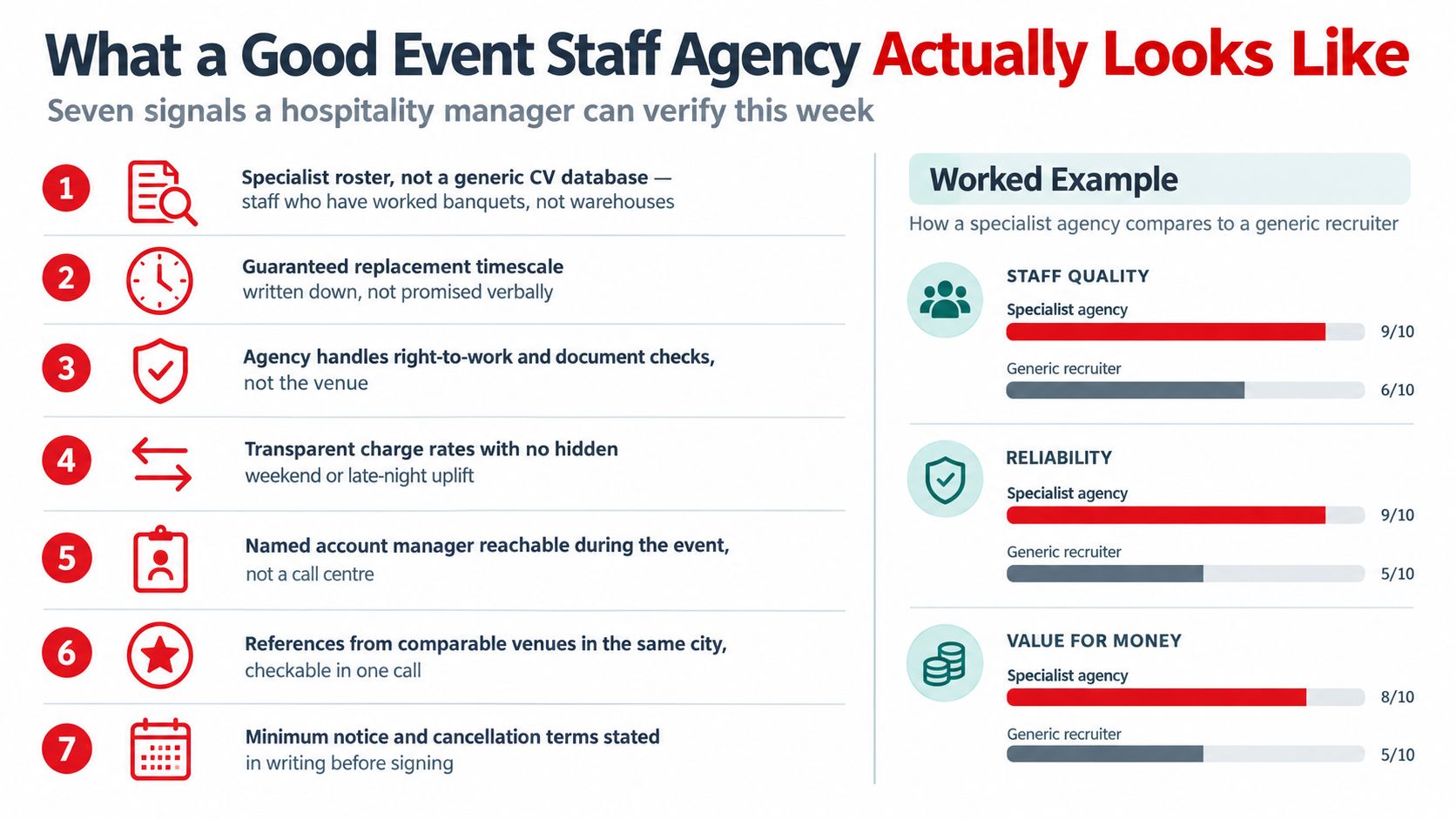
A good event staff agency can explain its operating process without hiding behind polished recruitment language. You should be able to establish, during one discovery call, who owns your account, how candidates are checked and what happens when someone fails to arrive.
Use the following checklist before you compare rates.
Evidence beats promises
Specialist hospitality experience comes first. Ask for examples of comparable venues and roles. A provider serving hotels, private estates, restaurants and event caterers should understand banqueting, prep shifts, breakfast service, plated meals, bars and kitchen porter duties. Named references are more useful than a claim to cover “all sectors”.
Candidate depth matters by role. Don't accept a general statement about a large database. Ask how many suitable people are available for chefs, kitchen porters, waitstaff, bartenders, supervisors and event managers in your area. The relevant question is whether they can cover your Friday night in Slough, not whether they have an impressive national mailing list.
Response times must be written down. Ask when you'll receive the first candidate profile, who contacts you outside office hours and how quickly a replacement is sourced. A verbal promise disappears under pressure.
Induction should be visible. Find out whether staff receive an in-person or video briefing, role-specific instructions and venue information before arrival. You want evidence that the agency prepares people for your environment.
Checks need ownership. The agency should explain its right-to-work process, identity checks, references, relevant DBS arrangements and training records. You shouldn't be left chasing missing documents on the morning of an event.
References must be comparable and checkable. Speak to a hotel, restaurant, event caterer or private venue that has used the same service. Ask specifically about no-shows, replacements, timesheet accuracy and communication during difficult shifts.
Accountability continues after the event. A named account manager should review failures, record performance and improve future matching. A call centre that only takes bookings can't manage an operational partnership.
Score agencies after one call
Score three agencies from poor to strong against these areas:
- Sector understanding: Can the contact discuss real hospitality workflows?
- Local supply: Can they describe coverage around your venue?
- Vetting: Will they confirm what evidence is held and who checks it?
- Escalation: Is there a named decision-maker during service?
- Commercial clarity: Are rates, cancellation terms and replacement rules documented?
- References: Can you contact a comparable client?
- Continuity: Will the same team learn your standards over time?
The exercise exposes the difference between an agency that sells availability and one that manages risk.
Matching Agency Models to Your Venue Type
The right commercial model depends on how often you need cover and how expensive a staffing failure is. A single rural pub doesn't need the same arrangement as a conference venue running a packed event calendar.
Three models, three different trade-offs
| Model | Best fit | Trade-offs |
|---|---|---|
| Pure temporary cover | Seasonal restaurants, independent pubs, private venues and single-site operators with occasional gaps | Flexible commitment, but no guaranteed priority unless written into the agreement |
| Permanent-plus-temporary recruitment | Multi-site groups, hotels and growing restaurant operators needing both long-term hires and short-term cover | Broader support, but the agency relationship needs clear ownership between permanent and temporary recruitment |
| Subscription retainer | Conference venues, stadium caterers and high-volume event caterers requiring priority booking and defined service levels | Stronger continuity and escalation, but may include minimum spend, exclusivity or recurring commitment |
Pure temporary cover is the cleanest option when your demand is irregular. Use it for a wedding venue in Dorset, a seasonal hotel in Devon or a restaurant that needs a relief chef after short-notice sickness. Confirm whether the agency offers priority for known peak dates, because a flexible arrangement can leave you competing with larger accounts.
Permanent-plus-temporary support suits operators with recurring recruitment pressure. A hotel group across Berkshire and Reading may need a permanent head chef while using temporary chefs to protect service during the search. The advantage is one supplier understands the role, the culture and the urgency. The risk is paying for a wider service than your sites use.
A retainer is justified when a missed booking creates serious operational or contractual exposure. Conference centres, stadium caterers and event companies should negotiate priority access, response times, replacement guarantees and a named account manager. Don't accept exclusivity or minimum spend without checking that the agency can demonstrate the capacity to honour it.
For event-specific requirements, compare your options through event recruitment support from Relief Chefs UK, then ask every provider to put priority access and escalation terms in writing.
Pricing, Fees and the Real Cost of Cover
The hourly rate on an agency quote is only the starting point. Your landed cost can include worker pay, holiday pay accrual, employer National Insurance, agency margin and invoice surcharges. If you compare only the headline figure, you may choose the cheapest supplier and discover the most expensive invoice.
A simple example shows why. A £16 per hour quote can become £24 to £28 per hour all-in once the full cost structure and possible extras are applied. Treat that as an illustration for checking the quote, not as a universal market rate. The actual amount depends on the agreement, role, timing and applicable charges.
Ask for a complete rate card
| Cost Component | Quoted Rate | Actual Cost | Notes |
|---|---|---|---|
| Worker pay | £16 per hour | Confirm in writing | Establish what the worker receives |
| Holiday pay accrual | Included or separate | Confirm in writing | Ask whether it appears on the invoice |
| Employer National Insurance | Included or separate | Confirm in writing | Don't assume the headline rate includes every employment cost |
| Agency margin | Included | Confirm in writing | Request a fixed mark-up where possible |
| Short-notice premium | May be separate | Confirm in writing | Clarify the trigger and calculation |
| Weekend or late-night uplift | May be separate | Confirm in writing | Ask for each applicable window |
| Cancellation fee | May be separate | Confirm in writing | Check the notice period and fee basis |
| Mileage, travel or uniform | May be separate | Confirm in writing | Agree approval rules before booking |
The supplied commercial guidance identifies 15 to 30% uplift for bookings made with under 24 hours' notice as a common short-notice premium, so ask whether your provider applies it and how it is calculated. Never allow “weekend rate” or “late booking fee” to sit undefined in a contract.
Reconcile invoices every week
Match each invoice against the approved booking, actual clock-in and clock-out time, role, location, agreed rate and any authorised extras. Record cancellations separately, then check whether the fee matches the contract rather than accepting an automatic charge.
Demand pay-versus-charge transparency, a fixed mark-up rather than a percentage uplift on overtime and a cap on surcharges. A clear pricing structure is easier to forecast and gives your finance team a fair basis for challenging errors. Review transparent pricing for hospitality staffing before agreeing to a rate that looks attractive but leaves the risk with your venue.
Contract Terms You Should Never Skip
A staffing contract should protect service continuity, not merely authorise an invoice. Read it as if the booking has already failed. If the agreement doesn't tell you who responds, how quickly they replace the worker and what remedy applies, it isn't ready for signature.
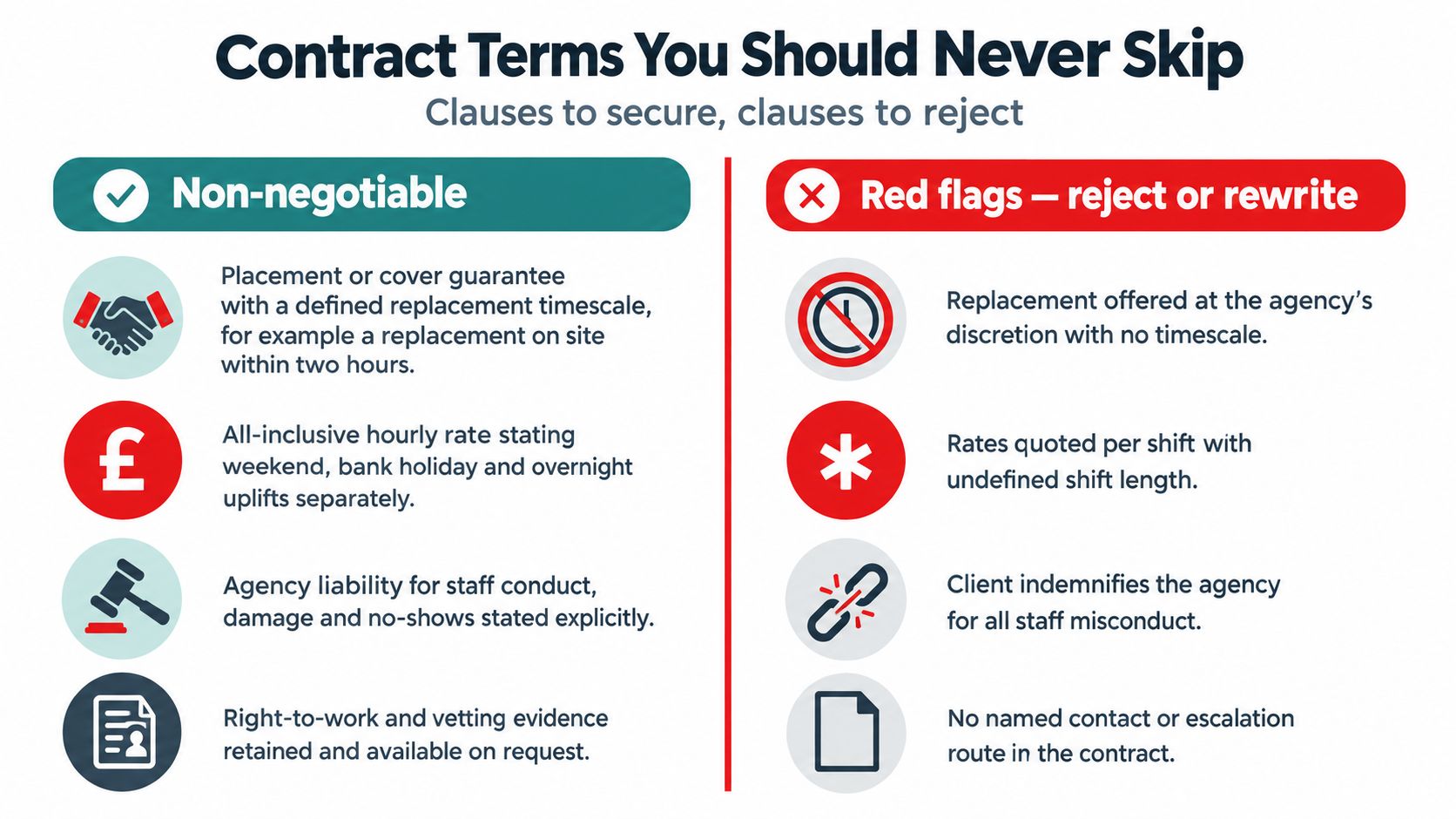
Put service protection in black and white
Secure a cover or placement guarantee with a defined replacement timescale. Four hours is the minimum acceptable standard for a serious hospitality operation, and high-risk events may need a faster commitment. The clause should state when the clock starts, what counts as a suitable replacement and what happens if the agency misses the deadline.
Define liability for substandard work, misconduct, damage and no-shows. The remedy doesn't need to be unlimited, but it must be meaningful and available within a stated window. Require the agency to investigate performance complaints promptly and agree how evidence, timesheets and manager reports will be handled.
Insurance needs careful attention. Set £5 million public liability as the minimum, with £10 million preferred for high-volume venues, and request sight of the current certificate. Confirm employers' liability, indemnity wording and whether the policy responds to the roles and locations you use.
Payment terms should be 30 days net maximum unless you have a strong reason to agree otherwise. Include a clear dispute process so a genuine invoice query doesn't become a service disruption.
Contract test: If a clause protects the agency when its worker fails but offers no remedy for your venue, rewrite it before signing.
Reject terms that weaken your leverage
Look for automatic renewal without a clear notice route, uncapped short-notice premiums and wording that lets the agency waive replacement guarantees at its discretion. Reject undefined shift lengths, unclear overtime rules and clauses that allow charges to change without your approval.
Be cautious with broad exclusivity, non-solicit and intellectual property terms. You shouldn't be prevented from hiring a reliable temporary worker permanently without a reasonable, clearly priced conversion arrangement. Likewise, the contract must not transfer all responsibility for staff misconduct to the venue through an overly broad indemnity.
Take this checklist into negotiation:
- Replacement: Is the timescale defined and enforceable?
- Cancellation: What notice is required, and what fee applies?
- Insurance: Are the limits and certificates stated?
- Liability: Does the agency stand behind conduct, damage and no-shows?
- Payment: Is the term no longer than 30 days net?
- Termination: Can you exit after chronic failure?
- Exclusivity: Are restrictions narrow, proportionate and priced?
- Escalation: Is a named contact included?
Compliance, Insurance and Vetting Essentials
Compliance should run as one documented sequence. Don't treat right-to-work evidence, insurance and food safety training as separate admin tasks that different people assume someone else has completed.
The UK Government guidance on agency workers' rights defines an agency worker as someone contracted with an agency who works temporarily for a hirer. After 12 weeks in the same job, the worker qualifies for equal treatment, including equal pay, automatic pension enrolment and paid annual leave. Your booking process should flag repeated assignments early so payroll and operational teams don't overlook the qualifying period.
Use one five-stage check
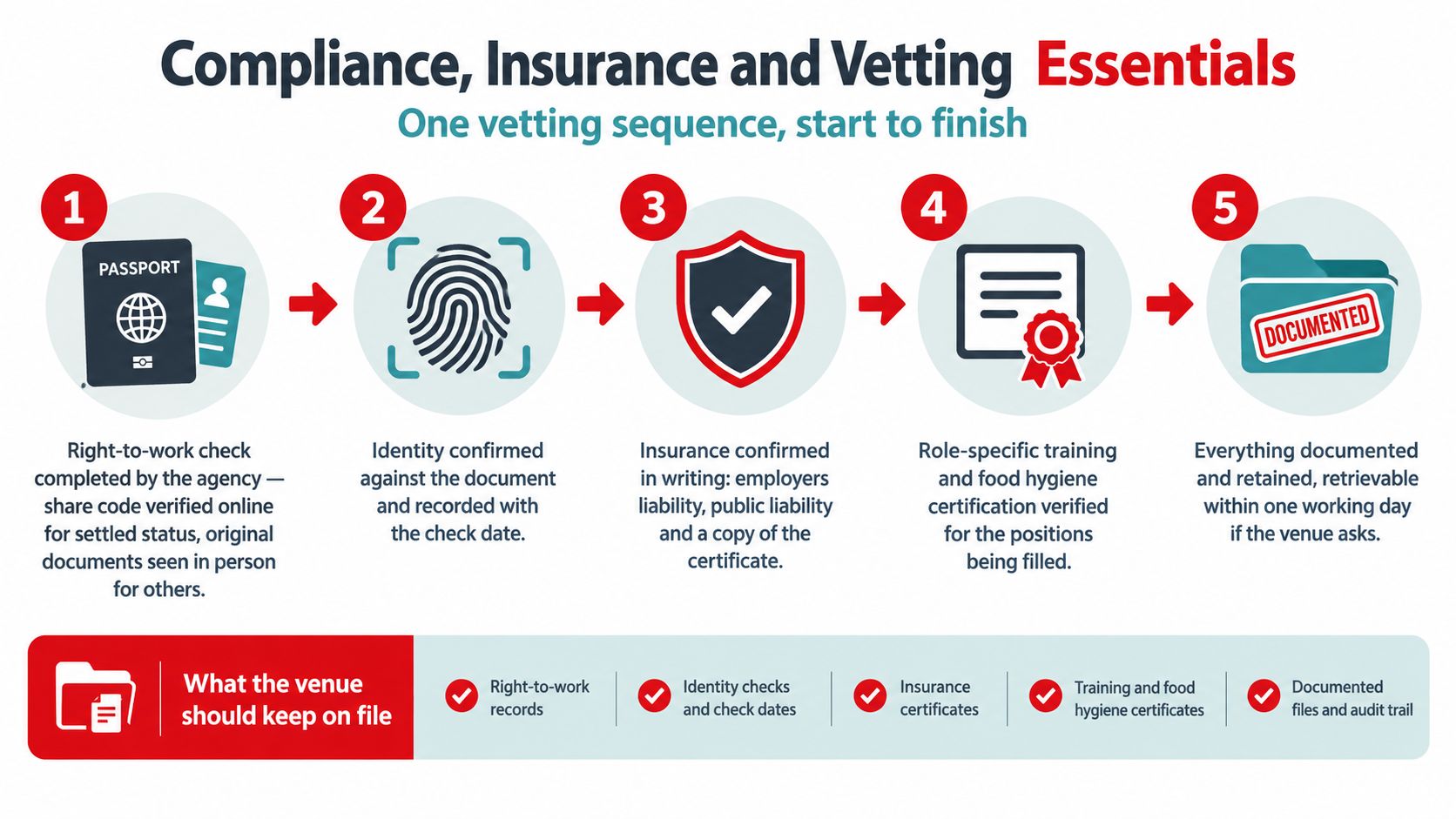
First, confirm the right to work. Ask the agency to complete and retain the appropriate evidence, such as a verified share code, physical document inspection or an eVisa record. Request written confirmation before the worker arrives, and make sure the record can be retrieved.
Second, confirm identity. The name on the booking, identity evidence and agency records must match. Ask when the check was completed and how discrepancies are escalated.
Third, verify insurance. Obtain current employers' liability and public liability certificates. Check that the policyholder, coverage and limits match the work being supplied.
Fourth, match training to the role. Kitchen cover should come with relevant food hygiene and allergen training records. Customer-facing roles may require a basic DBS check where the responsibilities justify it. References should cover two recent comparable placements, not merely a personal character statement.
Fifth, retain an audit trail. Your venue should be able to request the relevant documents and receive them through the agreed process within a practical timescale. Use the agency's employment verification process to establish exactly what is checked and retained.
Account for the post-2025 route changes
The post-July 2025 immigration position demands closer sourcing discipline. From 22 July 2025, most hospitality roles could no longer be sponsored for first-time Certificates of Sponsorship, with limited transitional cases preserved, as outlined in UK agency guidance on catering recruitment. Agencies and employers should therefore avoid assuming that overseas recruitment will solve an immediate event staffing gap.
Build a UK-ready pool, verify status before presenting a candidate and keep role descriptions accurate. Compliance isn't a final document check. It's how you prevent a last-minute cancellation, an unlawful placement and avoidable disruption to service.
Why a Chef-Run Specialist Beats a General Recruiter
Scale doesn't automatically produce safe hospitality cover. A large general recruiter may have more administrative infrastructure, but that doesn't mean its consultant can distinguish a competent banquet chef from someone whose experience won't survive a pressured service.
UKHospitality reports 132,000 vacancies in the sector and says chef shortages range from 10% for head chefs to 21% for production chefs, which explains why temporary chef cover remains an operational requirement for many kitchens (UKHospitality workforce information). BDO also identifies chefs, bartenders, waiters, hotel managers and housekeeping staff among the most sought-after hospitality workers, particularly where venues depend on overseas recruitment (BDO Hotel Britain 2025 report).
What operational experience changes
A chef-led specialist can test capability in practical terms. The interview can cover section control, prep sequencing, allergen communication, stock discipline, pass pressure and the difference between a commis, chef de partie, sous chef and head chef. That vocabulary helps the agency reject a poor match before your kitchen pays for the mistake.
Specialist agencies can also assess redeployment more intelligently. A chef who fits a boutique hotel in Wales may not suit a high-volume wedding venue near Bristol. A yacht chef needs a different profile again, while a villa chef may need autonomy, discretion and private-household experience. Fit affects the amount of supervision your permanent team must provide.
Post-event accountability is the third advantage. A chef-run provider can review whether the worker met the brief, arrived prepared and worked safely, then use that feedback for future bookings. A generalist recruiter often treats the shift as completed once the timesheet is signed.
| Criterion | Chef-Run Specialist | Generalist Recruiter |
|---|---|---|
| Candidate assessment | Tests hospitality skills and service context | May rely heavily on CV keywords |
| Short-notice matching | Understands role urgency and kitchen hierarchy | Can provide broad availability without detailed fit |
| Redeployment | Recommends adjacent roles based on venue and service | May search a general pool |
| Post-event review | Can discuss operational performance with managers | Often focuses on attendance and administration |
| Best use | Relief chefs, temporary chefs and hospitality-specific cover | Multi-site estates needing mixed hospitality and non-hospitality staffing |
Still, a generalist can be the better choice for a multi-site estate that needs hospitality, facilities, administration and non-hospitality cover from one procurement framework. For chef recruitment and event kitchen resilience, verify the founder's background, vetting depth, sector references and replacement guarantee before choosing size over specialism.
Relief Chefs UK provides nationwide support for relief chefs, temporary chefs, permanent chef recruitment, yacht chefs, villa chefs and wider hospitality staffing needs, including event cover. Visit Relief Chefs UK to discuss your next booking, agree a practical contingency plan and secure the right chef support before service is at risk.