
A captain calls on a Friday afternoon. The yacht leaves from a UK marina early the following week, the current chef is unavailable, and guests are already expecting polished food. A restaurant chef may have the technical ability to step into service, but a yacht chef job demands more than cooking well. The replacement must be ready to live aboard, manage provisions, work safely at sea, feed guests and crew, and produce the right documents before joining.
That distinction matters to chefs and employers from Devon, Dorset and Wales to Bristol, Berkshire, Windsor, Reading and Slough. A yacht galley can offer stronger earning potential than many land-based kitchens, but it also brings maritime compliance, close living conditions and sole responsibility. This guide sets out what captains assess, which certificates matter, how to present your experience and how hospitality businesses can secure dependable yacht, villa and temporary chef support.
What a Yacht Chef Job Really Involves
A yacht chef isn't a restaurant chef working in a smaller kitchen. On board, the same person may plan breakfast for crew, prepare a preference-led lunch for guests, organise stores, monitor waste, manage the food budget and clean down a confined galley before the next service begins. On a sole-chef vessel, there may be no commis, sous chef or emergency cover.
The work starts before the pan goes on. You may need to turn an uncertain supply run into a workable menu, account for dietary requirements and keep enough flexible food available if weather, guest plans or arrival times change. A chef who can cook excellent fish but can't control stock, substitutions or timing will struggle quickly.

The galley is a whole operation
Captains and owners judge more than the finished plate. They look for:
- Guest service: Can you interpret preference sheets and deliver refined food without constant direction?
- Crew meals: Can you provide filling, varied food consistently while guest service takes priority?
- Provisioning: Can you order sensibly, check deliveries, rotate stock and work with limited storage?
- Hygiene: Can you maintain safe food handling standards in a busy, moving environment?
- Temperament: Can you live and work respectfully with the same crew throughout a rotation?
- Financial control: Can you keep purchasing aligned with the agreed budget?
A practical example is a yacht leaving a Devon marina with a mixed guest group, limited refrigeration and a late change to the itinerary. A land-based chef might call a supplier or send a team member to collect replacements. On board, you may have to redesign the meal around what is available, protect service quality and explain the change calmly to the captain.
Vessel type changes the hiring brief
The title can conceal major differences. A head chef on a larger yacht may lead a galley team, while a sole chef carries the entire food operation alone. A commercial or charter yacht also faces different regulatory obligations from a private yacht, and the vessel's operating area can determine whether formal certification is compulsory.
That is why yacht chef recruitment needs a more exact brief than “experienced chef wanted”. Relief Chefs UK places yacht chefs alongside relief chefs, villa chefs and permanent hospitality candidates, matching the chef's operating experience to the vessel, contract and service expectations rather than relying on restaurant job titles alone.
Practical rule: A yacht-ready chef proves reliability before service starts. Menus, stores, hygiene records and contingency plans matter as much as presentation.
Essential Qualifications and Certificates You Need
A strong culinary background won't replace missing maritime paperwork. For UK-relevant yacht chef jobs, candidates should treat certification as a compliance checklist and confirm the exact vessel requirements before accepting an offer.
Start with maritime safety and medical fitness
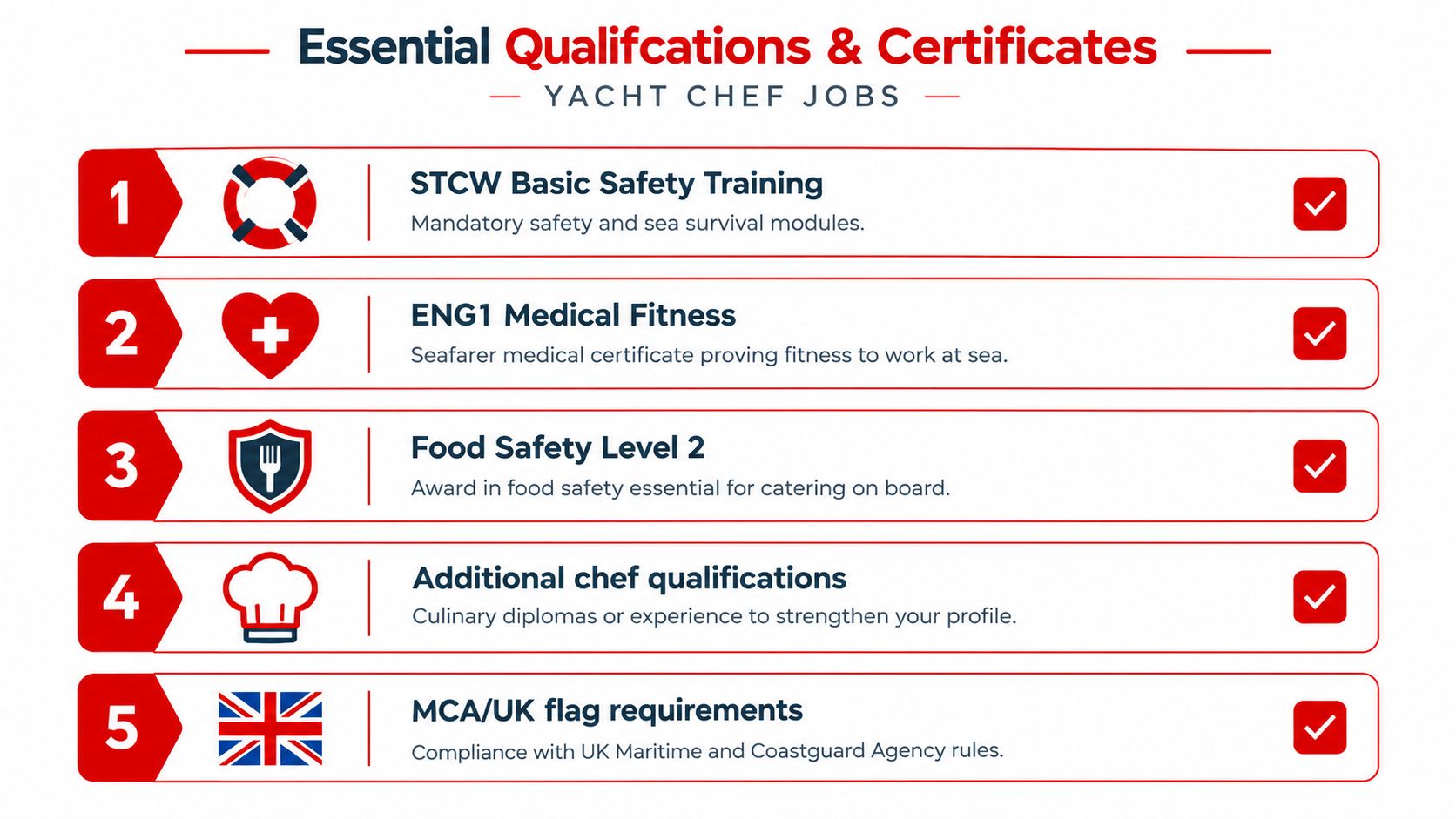
STCW Basic Safety Training is the core maritime safety requirement commonly requested for commercial yacht crew. The training covers personal survival techniques, fire prevention and firefighting, elementary first aid, and personal safety and social responsibility. These subjects explain why a yacht chef needs more than a standard kitchen qualification. You're part of the vessel's operating crew, not a shore-based contractor visiting for service.
You'll also commonly need an ENG1 or equivalent seafarer medical certificate. It confirms that you're medically fit to work at sea. Arrange the medical early because a chef who has completed culinary training but can't provide acceptable medical evidence may not be able to join the vessel.
Food safety is a baseline, not a bonus
UK guidance states that ships' cooks, catering staff and other people handling food in the galley on UK-flagged vessels should be suitably qualified in food hygiene or food safety in catering, with Level 2 identified as the minimum acceptable level. A practical guide to chef qualifications can help candidates organise their wider training record, but the vessel's flag and operating pattern still need checking.
The usual document pack should include:
- STCW Basic Safety Training, with the required safety modules completed.
- ENG1 or an accepted equivalent medical certificate.
- Food Safety Level 2, as the minimum catering baseline identified in UK guidance.
- Ship's Cook Certificate, where the legal threshold applies.
- Culinary qualifications and verified employment references, which support the hiring decision even where they aren't maritime certificates.
Know when the Ship's Cook Certificate applies
The UK Maritime and Coastguard Agency requires a ship's cook certificate for vessels operating beyond 60 miles from a UK safe haven when they carry more than 10 seafarers on board. Applicants must be at least 18, have at least one month of seagoing service, complete the prescribed training and hold an ENG1 or equivalent medical certificate. The UK profession guidance sets out the formal framework.
The modern requirement follows the Maritime Labour Convention changes introduced in 2014, with a compliance deadline referenced as 5 February 2015 for affected yachts in UK guidance on implementation. Private yachts and some smaller vessels can be treated differently, so don't assume that every yacht chef job carries the same legal requirement. Ask whether the yacht is commercial or private, which flag it operates under, how far offshore it travels and how many seafarers it carries.
Building Experience and a Yacht Ready CV Portfolio
A restaurant CV usually leads with covers, section leadership and cuisine. A yacht CV must make a captain confident that you can protect service, stores and crew relationships without a full brigade behind you.
Start with a clear profile that states your strongest service type, dietary capability, provisioning experience and willingness to live aboard. “Experienced fine dining chef” is less useful than “Independent chef experienced in guest menus, crew catering, ordering, stock rotation and multi-service delivery.” The second version gives a captain something operational to assess.
Translate shore experience into galley evidence
A chef from a boutique hotel in Bristol, Bath or Berkshire may already have relevant experience, even without sea time. Explain the working conditions and decisions, not only the venue name.
Useful evidence includes:
- Solo responsibility: Describe occasions when you ran a kitchen or service with limited support.
- Multiple menus: Show how you separated guest, staff, breakfast, lunch and evening requirements.
- Provisioning discipline: Mention ordering, supplier substitutions, delivery checks and stock rotation.
- Dietary control: Explain how you prevented cross-contamination and maintained reliable alternatives.
- Cost awareness: Show how you worked within budgets without lowering standards.
- Pressure management: Give an example of late bookings, sickness or a sudden menu change.
A chef who has kept a Dorset restaurant operating through short-notice sickness may have a better foundation for a sole-chef yacht role than a fine-dining chef who has always worked with a large brigade. The transferable skill is independent control.
Make the portfolio easy to verify
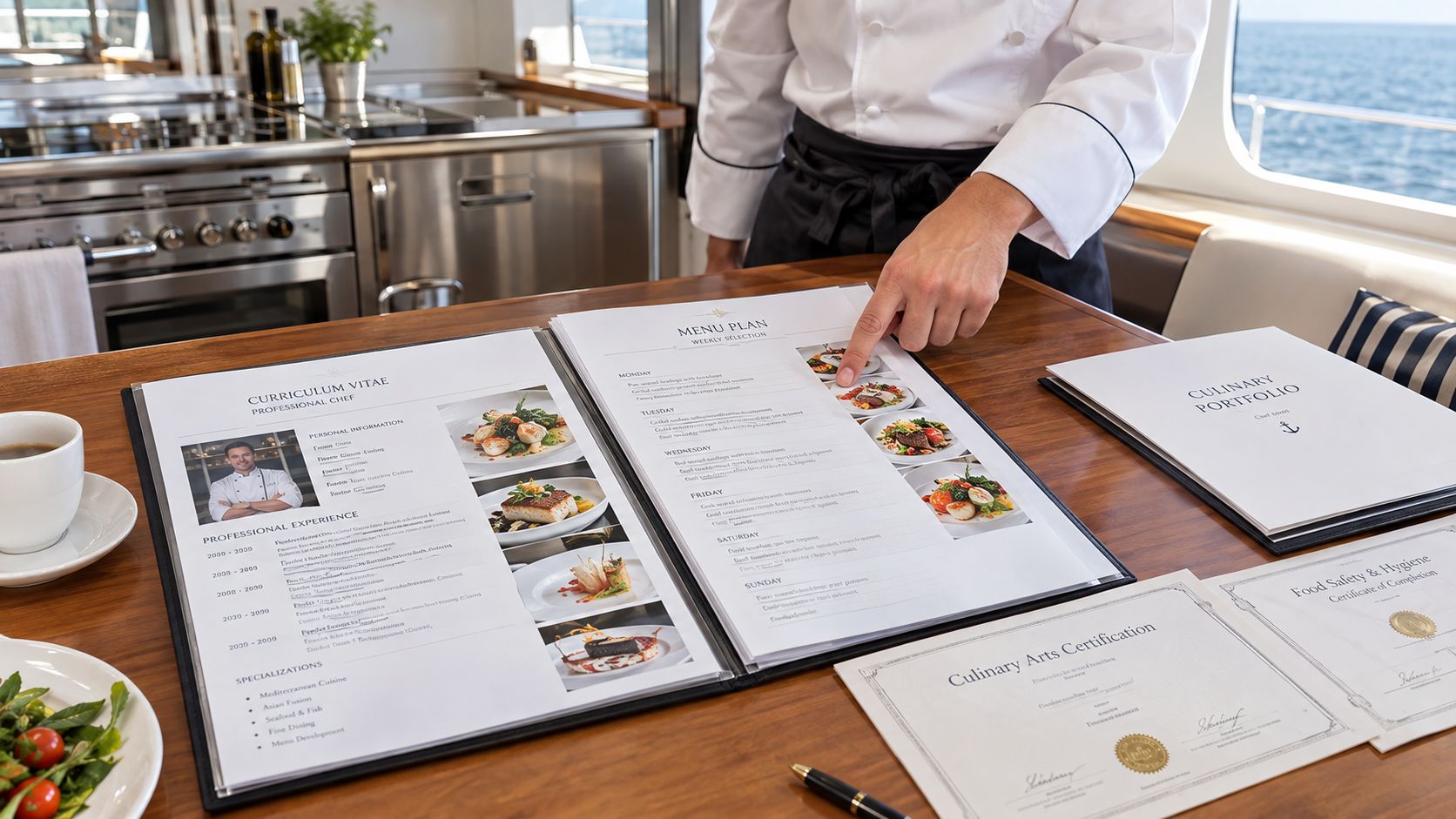
Keep the portfolio concise and practical. Include sample menus for different guest preferences, crew meals, breakfast service and dietary alternatives. Add photographs that show clean presentation, but don't rely on decorative plates alone. Captains need to see range, consistency and judgement.
List certificates with issue and renewal details, identify the medical status clearly and provide references who understand your reliability. If you haven't worked at sea, don't disguise that gap. Instead, show live-in private household, villa, chalet or remote hospitality experience and explain how you've managed autonomy, logistics and guest expectations.
A specialist yacht chef qualifications guide can help candidates understand the common paperwork expected by yacht employers. Keep scanned documents organised in one folder so an agency or management company can review them without chasing attachments.
Where to Find Yacht Chef Jobs and How to Apply
Mass applications rarely work well for yacht chef jobs. Captains and management companies need a chef who fits the vessel, itinerary, guest profile and crew structure, so a targeted application is more persuasive than sending the same CV to every advert.
Use the right hiring route
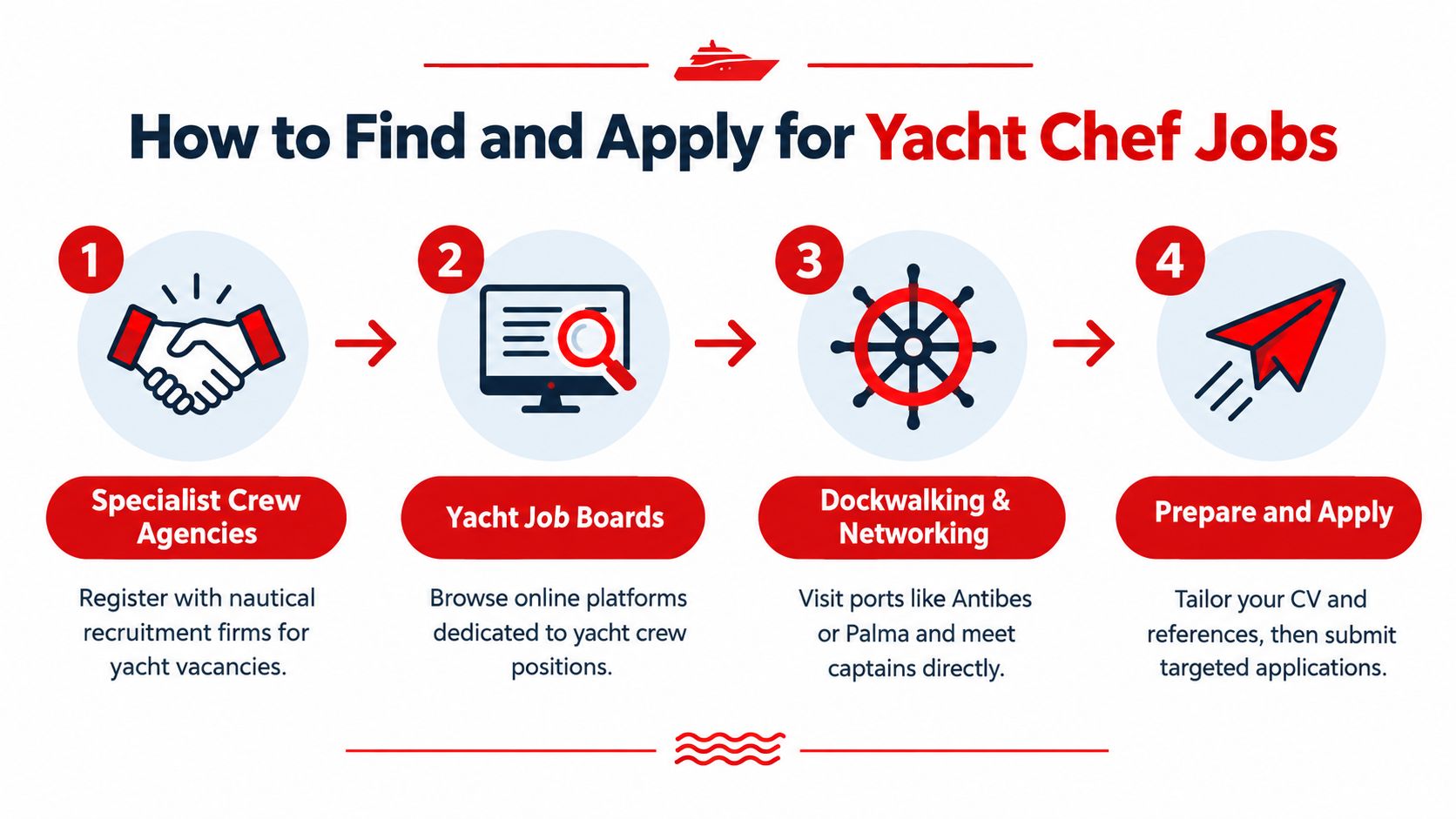
Specialist crew agencies are useful when you need help matching certificates, experience and availability to a specific yacht. Register with accurate dates, current documents, preferred contract type and realistic cuisine strengths.
Yacht job boards give you a view of current requirements, but read every advert carefully. A listing that appears to be a chef role may involve sole responsibility, crew catering, heavy provisioning or a particular medical and safety document set.
Dockwalking and networking can work in established yachting hubs such as Antibes and Palma, as well as UK marinas. It only works when you're prepared, presentable and able to provide a concise CV and document status. A dockside introduction isn't a substitute for certification.
Direct approaches to yacht management companies can suit chefs with a credible portfolio and strong references. Keep the message short, explain your availability and identify the type of vessel or service you can support.
Apply like an operator
Before applying, prepare your passport, right-to-work evidence, STCW documents, ENG1 or equivalent medical evidence, food safety certificate, references and a professional photograph. If a document is pending, say so plainly and give the expected completion position. Vague answers create doubt when a yacht is hiring against a departure date.
Seasonal availability also matters. Mediterranean and Caribbean programmes create periods of concentrated recruitment, so chefs who can make themselves available around a vessel's movement may be easier to place. UK candidates should also consider nearby alternatives, including villa chef work in Devon and Dorset or private household roles around Windsor, Reading and Slough.
For businesses, the same discipline applies in reverse. A yacht management company should provide vessel type, flag, cruising area, crew numbers, guest expectations, galley equipment, contract terms and joining date. Relief Chefs UK, established in 2013, provides offshore catering recruitment support alongside yacht, villa, temporary and permanent chef placements. That kind of complete brief reduces unsuitable submissions and avoids losing time to candidates who cannot legally join.
Follow up with one useful message rather than repeated generic emails. Confirm availability, documents, location and the type of service you can deliver. Captains remember candidates who make the next decision easier.
Interviews Trial Days Contracts Pay and Benefits Explained
A yacht interview tests judgement as much as cooking. You may be asked how you'd handle a preference sheet, provision for an uncertain itinerary, feed crew during guest service or respond when a delivery arrives incomplete. On a trial day, hygiene, organisation, pace and communication are visible from the moment you enter the galley.
Prepare a short menu plan that shows flexibility rather than excessive ambition. Include a crew meal, a guest lunch, a dietary variation and a practical back-up option. The best answer isn't always the most elaborate dish. It is the plan that protects timing, storage and standards.
Compare the pay context
The UK land-based benchmark is useful, but it doesn't describe a yacht contract. A neutral UK salary source places the average chef at about £25,300 gross per year (UK chef salary benchmark), while a UK salary page specifically identifies private yacht chef pay at about £45,000 per year. Yacht listings also show different structures, including £4,500 to £6,500 per month for a six-month live-aboard chef role and €8,500 per month for a 65m yacht head chef, as reported in the same UK-facing salary data.
| Role Type | Typical Pay Band | Key Variables |
|---|---|---|
| UK land-based chef | About £25,300 gross per year | Venue, seniority, location and contract |
| Private yacht chef | About £45,000 per year | Yacht size, privacy, duties and tax treatment |
| Live-aboard yacht chef | £4,500 to £6,500 per month in a recent UK listing | Six-month contract, vessel, rotation and responsibility |
| Yacht head chef | €8,500 per month in a recent listing | 65m yacht, seniority, team and guest expectations |
The strongest independent benchmark available for UK-facing recruitment places yacht chef roles commonly in the €3,000 to €6,500+ monthly range, depending on seniority and yacht size (yacht crew salary guide). Treat every band as a starting point, not a promise. Confirm whether the figure is gross or net, the currency, overtime, tronc, leave, travel, insurance, accommodation and meals.
Read the contract, not just the headline figure
A higher monthly rate can be poor value if the chef is expected to run every meal alone with no meaningful leave or replacement cover. A lower rate may be reasonable on a smaller programme with a clear rotation, paid travel and defined crew-only responsibilities.
Ask these questions before signing:
- Is the role sole chef, crew chef, sous chef or head chef?
- How many people must you feed, and how often are guests aboard?
- What are the rotation, leave and joining arrangements?
- Are overtime and tronc included or separate?
- Who pays for travel, medicals and required training?
- What insurance and accommodation arrangements apply?
- Which documents must be valid before embarkation?
Current UK yacht listings include roles advertising £43,000 to £48,000 per annum plus overtime and tronc, while another London yacht head chef listing asks for STCW, Food Safety Level 2 or higher and an ENG1 medical (UK yacht chef vacancies). Those details show why comparison must include the full contract, not salary alone.
Life On Board and Your Next Steps to Get Hired
Living aboard removes the separation between work and home. The galley may be compact, storage can be unforgiving and guest plans can change quickly. You'll work close to the crew, share the consequences of poor communication and need enough resilience to maintain standards when the season becomes intense.
The practical safeguards are simple. Keep a written prep and provisioning system, label food clearly, maintain a dependable crew-meal plan and build flexible dishes around what is available. Don't make every service dependent on a complicated technique or a single supplier. A calm chef uses preparation to preserve creativity, not to prove how much pressure they can tolerate.
A focused route into the role
- Check the vessel requirement first. Confirm private or commercial status, flag, operating area and crew numbers.
- Complete the core documents. Prioritise STCW, ENG1 or equivalent medical fitness and Food Safety Level 2.
- Assess the Ship's Cook position. If the UK threshold applies, check the one-month sea service, age, training and medical prerequisites.
- Rebuild your CV around operations. Show solo service, provisioning, dietary control, crew meals and budget responsibility.
- Prepare a compact portfolio. Include menus, photographs, references and certificate status.
- Register with relevant agencies and boards. Apply selectively and respond quickly when a credible brief matches your experience.
- Keep shore-based options open. Villa chefs, private household chefs and temporary placements can build the autonomy that yacht employers value. A private household chef agency can be relevant for chefs moving between live-in and maritime work.
Hospitality businesses face the same pressure from the other side. Short-notice sickness, seasonal demand, agency reliability and ongoing chef shortages can destabilise a yacht programme, hotel kitchen or independent restaurant. Relief Chefs UK supports yacht management companies and venues across the UK, including businesses in Devon, Dorset, Wales, Bristol, Berkshire, Windsor, Reading and Slough, with relief chefs, temporary chefs, permanent recruitment, villa chefs and wider hospitality staffing support.
The most employable yacht chef combines food quality with maritime readiness, accurate paperwork and the maturity to operate without constant supervision. The most reliable employer provides a complete brief, checks compliance before interview and agrees the commercial terms before asking someone to join.
Relief Chefs UK can help yacht management companies and hospitality businesses source vetted yacht chefs, relief chefs, temporary cover, villa chefs and permanent kitchen talent across the UK. Visit Relief Chefs UK to submit your requirements or register your availability, and start a focused conversation about the right chef for your next service.