
Wales Chef Staffing: A Complete Guide for Venues (2026)
23 April 2026
A full restaurant, a bar three deep, rooms sold out, and a bank holiday forecast that’s finally gone your way. Then the phone rings. Your sous chef is down with sickness. Your KP has already said he can’t stay late. Your head chef is staring at a prep list that still isn’t finished, and front of house is asking whether you can keep the full menu on.
That’s a familiar shift in wales.
For independent pubs, boutique hotels, coastal restaurants and country house venues, chef cover isn’t an abstract recruitment issue. It’s service, margin and reputation colliding in real time. One absence can force a reduced menu. Two can wipe out your weekend trade. If the replacement isn’t strong enough, you still pay the wage but lose guest confidence anyway.
I’ve seen the same pattern across Welsh operations again and again. The venues that cope aren’t always the biggest or the best funded. They’re the ones that stop treating staffing as a last-minute panic and start handling it like an operational risk. They know where the pressure points are, when demand spikes, and which parts of the rota can’t fail.
That matters even more in a market as uneven as wales, where busy city trading, remote rural sites, seasonal coastlines and post-industrial labour shortages all pull in different directions. Generic agency promises don’t solve that. You need kitchen cover that turns up, can run service, and doesn’t create more work for the team you’ve already got.
Relief Chefs UK has been operating since 2013, and the practical appeal is straightforward. It’s a chef staffing partner built around relief chefs, temporary chefs, permanent chef recruitment and wider hospitality staffing support for venues that need cover without the usual guesswork. For operators dealing with sudden absences, this kind of support sits in the same category as backup refrigeration or emergency maintenance. You hope you won’t need it today, but you can’t afford not to have it ready.
The Saturday Night Scramble A Familiar Story in Welsh Hospitality
A village pub in west wales can trade all week, then get hit with a surge the second the weather turns and the caravans fill up. A Cardiff site can look stable until a major event packs the city and every late booking wants food. A hotel in Snowdonia can be calm at breakfast and stretched by dinner when walk-ins, residents and a function all land at once.
That’s why the staffing test rarely comes on a tidy Tuesday afternoon. It comes when the business is already under pressure.

What the crisis actually looks like
A chef calls in sick mid-afternoon. The booking sheet is full enough that cancelling service isn’t realistic, but thin enough margins mean you can’t just throw labour at the problem either. The head chef starts making bad compromises.
Typical reactions look like this:
- Cut the menu badly: You remove dishes that carry decent spend and keep the easiest plates, even if they don’t drive profit.
- Move weak cover into key sections: A breakfast cook ends up on garnish. A junior chef handles the pass. Standards slip fast.
- Drag management into service: The GM runs food, the owner peels potatoes, and nobody is left managing the guest experience.
- Borrow from tomorrow: Prep gets rushed, cleaning gets delayed, and the next shift starts behind.
None of that is unusual. It’s what happens when the rota has no resilience.
Practical rule: If one sickness call forces you to change the menu, your kitchen is running too close to failure.
Why Welsh venues feel this harder
In wales, distance makes everything slower. Talent pools are patchy. Some areas have strong demand but limited housing. Others have solid local loyalty but a very small pool of experienced chefs who can step in at short notice. A city venue and a rural inn might both need cover urgently, but they’re solving very different problems.
That’s where operators get caught. They think they need “an agency chef”. What they need is someone who can walk into that exact service, that exact menu style, that exact level of volume and pressure, and keep trade moving.
If you’ve dealt with the same scenario more than once, it’s worth reviewing your emergency cover process before the next one lands. The kitchen failure points in this guide line up closely with the situations described in these common emergency booking scenarios for hospitality kitchens.
What works and what doesn’t
What works is simple, even if it isn’t easy:
- Keep a live priority list: Know which sections must be covered to preserve service.
- Document service-critical dishes: A relief chef can stabilise faster when specs are clear.
- Set a call-out sequence: Don’t waste an hour deciding who contacts whom.
- Protect the pass: If the pass collapses, everything collapses.
What doesn’t work is hoping the team will “pull together” indefinitely. They will, once or twice. After that, fatigue turns into mistakes, then resignations.
Understanding the Welsh Hospitality Staffing Market in 2026
The Welsh labour picture doesn’t behave like a simple tourist economy. Operators who reduce it to “summer gets busy” usually end up underprepared. The staffing problem is structural, not just seasonal.
In 2023, Wales’ services sector accounted for 73% of total Gross Value Added, compared with 81% across the UK, according to the Welsh Government economic and fiscal report. For hospitality businesses, that matters because it confirms how much day-to-day trading depends on service delivery staying stable, even in a broader economy with a stronger production footprint than many other parts of the UK.
Why that matters on the kitchen floor
A lot of managers hear economic data and switch off. They shouldn’t. In practical terms, a service-led environment puts constant pressure on venues to maintain standards through staffing volatility. Guests don’t lower expectations because a region has recruitment friction. They still expect breakfast on time, a smooth lunch service, and a dinner menu that doesn’t collapse halfway through the evening.
That creates a blunt operational truth. If your kitchen staffing fails, your business fails visibly.
Three consequences follow for operators in wales:
| Pressure point | What it means in practice | Commercial effect |
|---|---|---|
| Service dependency | Revenue relies heavily on guest-facing delivery | Labour gaps hit takings fast |
| Uneven labour supply | Some areas can’t replace chefs quickly | More rota stress and reduced menus |
| Competition for proven chefs | Good chefs are choosing between multiple employers | Retention costs time and money |
Cardiff isn’t the whole market
One mistake I see repeatedly is copying staffing assumptions from bigger city sites and applying them across the country. Cardiff can support a broader labour pool and a different style of recruitment. A venue in Ceredigion, Pembrokeshire or inland Powys often can’t.
That changes how you hire and how you plan. In thinner labour markets, speed matters less than fit. A fast booking is useless if the chef can’t handle volume, misses basic prep discipline, or needs hand-holding through service.
Stable kitchens usually come from repeatable systems, not heroic last-minute improvisation.
What good operators do differently
Stronger operators in wales tend to separate chef staffing into three lanes rather than treating every shortage the same:
- Emergency cover: Sudden sickness, no-shows, family emergencies, spike weekends.
- Planned temporary cover: Holiday blocks, maternity cover, seasonal uplift, menu relaunches.
- Permanent recruitment: Replacing core brigade roles that keep reopening.
That distinction matters because each lane needs a different response time and a different level of vetting. A chef who’s right for a short relief booking may not be right for a long-term head chef appointment. A permanent hire who interviews well may still be useless for immediate crisis cover.
For venues that don’t want to build all of that in-house, chef recruitment support for temporary and permanent kitchen roles can take pressure off the management team. The key is to use external help as part of operations, not as a panic button after the rota has already broken.
Navigating Peak Seasons and Regional Staffing Hotspots
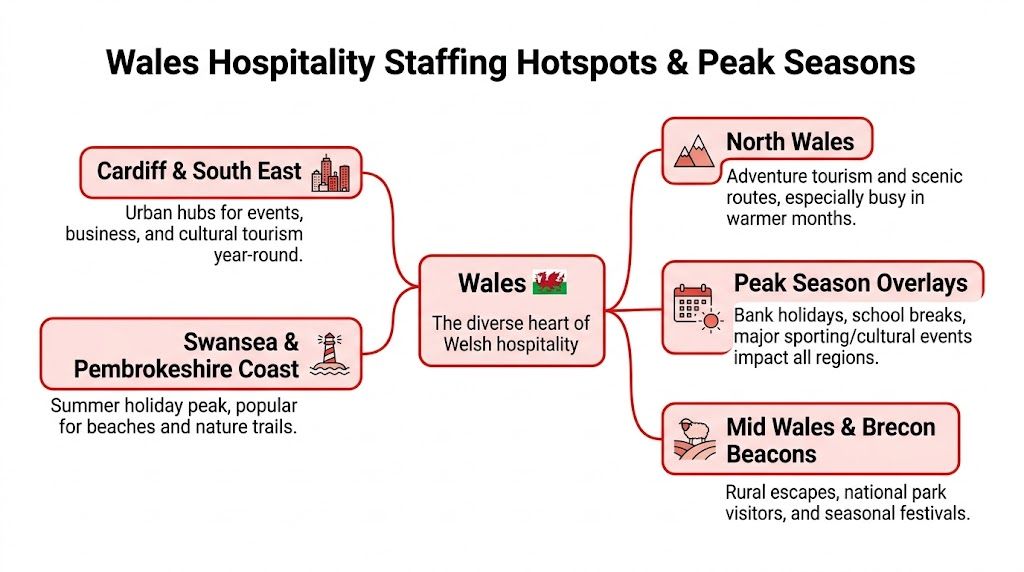
Wales doesn’t have one hospitality market. It has several, and they peak for different reasons. Coastal summer demand, city events, heritage tourism, walking traffic and destination dining all create different staffing patterns. If you use one labour plan for the whole country, you’ll either overspend or get caught short.
The country’s visitor pull isn’t hard to understand. Wales has over 600 castles, more per square mile than any other country in Europe, which the Wales.com facts page identifies as part of a heritage offer that drives tourism. For hospitality operators, that translates into concentrated pressure around historic towns, event weekends and holiday periods when visitors cluster in the same places.
Regional demand isn’t uniform
The practical mistake is assuming every Welsh venue needs the same cover profile. They don’t.
A city hotel in Cardiff often needs chefs who can handle banqueting, breakfast volume and event-driven surges. A Pembrokeshire inn may need steady all-rounders who can carry a small team through long summer trading days. A North Wales site near major outdoor attractions might need stronger daytime throughput and flexible prep discipline during school holidays.
Here’s a working calendar many operations teams would recognise.
| Region | Peak Season(s) | Primary Drivers | Typical Staffing Demand |
|---|---|---|---|
| Cardiff and South East | Spring event periods, summer, Christmas, major match and concert dates | Business travel, stadium events, city breaks, parties | Banqueting chefs, breakfast cover, strong service chefs, last-minute event support |
| Swansea and Pembrokeshire Coast | Late spring through summer, bank holidays, school breaks | Beach tourism, family travel, coastal dining, staycations | Grill chefs, pub cooks, all-round relief chefs, seasonal brigade reinforcement |
| North Wales | Warmer months, bank holidays, school holidays | Scenic tourism, outdoor activities, touring routes, destination weekends | Breakfast chefs, gastro pub support, chefs comfortable with mixed resident and non-resident trade |
| Mid Wales and Brecon Beacons | Holiday weekends, festival periods, walking season, Christmas house parties | Rural escapes, events, weddings, countryside tourism | Small-team chefs, function support, relief cover for owner-led kitchens |
What to plan for by region
Cardiff and South East
This market moves fast. When the city fills, it fills quickly. Operators often underestimate how event traffic changes not just covers but the timing of demand. You may need an extra chef because service compresses into a shorter window, not because total covers look dramatic on paper.
Useful planning habits here include:
- Build event-date rotas early: Don’t wait for final booking pace if the city calendar already points to pressure.
- Protect breakfast and banqueting separately: One team rarely covers both well under strain.
- Use proven relief for match weekends: New starters can struggle with pace and volume.
Swansea and Pembrokeshire Coast
Coastal trade has a habit of arriving all at once. Warm weather, school breaks and bank holidays can transform a manageable rota into a stretched one in a matter of days. Venues that rely too heavily on a small local team often burn them out by mid-season.
What works better is carrying planned seasonal support before the obvious peak lands. If you wait until everyone else is hiring, your options narrow fast.
North Wales
Geography plays a more aggressive role in dictating staffing. Travel time matters. Accommodation matters. Shift patterns matter. Good chefs may be willing to work the season, but not if the logistics make every day harder than the job itself.
The more remote the venue, the earlier the staffing conversation needs to start.
Mid Wales and Brecon Beacons
Rural venues need versatility above all. You’re often not staffing specialist sections. You’re staffing the ability to keep a compact kitchen calm. A chef who can prep, organise, plate and communicate cleanly is worth more here than a narrow CV full of branded sites.
A few hard truths about timing
Seasonality in wales is predictable in broad terms, but not tidy in daily operation. Demand can spike on weather, local events and late domestic bookings. That means operators need two plans at once:
- A baseline rota that can trade normally.
- A surge plan for short bursts of demand.
For businesses operating across multiple regions, or also covering nearby markets such as Bristol, Devon or Dorset, consistency matters even more. One route operators use is 24/7 recruitment support for urgent and planned hospitality cover, particularly when they need the same process to work for both urban and remote sites.
Common Staffing Nightmares and How to Solve Them for Good
The worst staffing problems aren’t dramatic. They’re repetitive. One sickness. One no-show. One resignation at the wrong time. Then another. Before long, the kitchen isn’t being managed. It’s being patched together.
In wales, that cycle is harder to break in rural and coastal areas where replacement options are thinner.

The pressure is visible in the available data. One cited summary states that rural areas in wales such as North Wales and Pembrokeshire face a 25% higher vacancy rate for chefs than England, and over 30% of Welsh chefs are aged 50+, making reliable temporary cover more important for operators trying to keep kitchens stable, as noted in this background summary on geography and labour context. Even if you set the exact figures aside, most managers reading this will recognise the underlying problem immediately.
Nightmare one, the short-notice sickness call
This is the classic Saturday problem. A key chef drops out. Everyone left on shift works harder, but output still drops. The menu shrinks. Tickets slow. Complaints rise.
The fix isn’t “work with any agency that can send a body”. That usually creates a second problem.
A better response looks like this:
- Pre-define critical roles: Know whether your biggest risk is breakfast, grill, sauce, pastry or pass.
- Keep updated briefs ready: Menu style, service volume, equipment quirks and allergens need to be documented.
- Use chefs who are already vetted and right-to-work checked: The less admin on the day, the better.
- Track who performed: Keep your own notes on reliability, speed and fit.
Relief Chefs UK is one operational option here. It was established in 2013 and provides relief chefs, temporary chefs, permanent chef recruitment, yacht chefs, villa chefs and wider hospitality staffing support, with an experienced recruitment team available 24/7 to help find the right cover, subject to availability. For managers, that matters because emergency cover only works if someone can move quickly without creating a compliance problem.
Nightmare two, the no-show who was meant to save the shift
Every operator has had this one. You thought the gap was covered. It isn’t. You lose an hour calling around while the prep list gets further away from you.
What doesn’t work:
- Relying on verbal maybes
- Booking unknown freelancers without references
- Assuming a CV equals service readiness
What does work is confirming availability, transport practicality, start times and section capability before the shift becomes critical.
If cover can’t realistically get to the site and start cleanly, it isn’t cover. It’s wishful thinking.
Here’s a useful walkthrough on what reliable emergency kitchen cover should look like in practice:
Nightmare three, constant churn in core roles
This one hurts more because it looks manageable until it isn’t. You lose a chef de partie, then your junior sous starts talking about leaving, then the head chef has no appetite to train another replacement from scratch. Recruitment becomes a full-time side job for someone who already has a real one.
The answer is usually a split strategy:
| Problem | Weak response | Better response |
|---|---|---|
| Core vacancy | Rush the first acceptable hire | Use temporary stability while recruiting properly |
| Burnout in the brigade | Keep extending hours | Add short-term support before fatigue turns into exits |
| Seasonal overload | Hope permanent staff absorb it | Bring in planned temporary reinforcement |
Nightmare four, the agency chef who makes more work
Some temporary chefs help. Some only fill a timesheet. Managers know the difference by the end of service. The wrong temporary chef drains the head chef, confuses prep, ignores systems and leaves the kitchen messier than they found it.
The way around that is brutally practical. Stop buying “availability” and start buying “fit”.
Look for:
- Section confidence: Can they run the station you need covered?
- Volume control: Can they stay composed when checks stack up?
- Standards discipline: Do they respect specs, labelling and hygiene routines?
- Temperament: Do they steady a team or unsettle it?
That applies whether you need a one-day stopgap, a three-week holiday cover chef, or a more specialist placement such as a yacht chef or villa chef for private hospitality work linked to the region.
Legal and Regulatory Essentials for Hiring Chefs in Wales
Most operators think about legal checks when they hire permanently. That’s too narrow. Temporary cover can expose exactly the same risks if the process is sloppy.
The reason this matters more now is that wider economic uncertainty punishes avoidable mistakes. The Welsh construction sector index was 18.8% below 2022 levels by 2024 Q4, according to the Economic Intelligence Wales annual report. Hospitality may not be construction, but the lesson for operators is obvious enough. When conditions are unstable, you can’t afford self-inflicted operational risk.
Right to Work isn’t optional
If you hire directly, the checks are your responsibility. If you bring in temporary chefs, you still need confidence that those checks have been done properly by whoever supplies them. A missing document, an unclear status check or a rushed assumption can become a serious problem later.
The practical areas to control are straightforward:
- Right to Work verification: Confirm it before the chef starts, not after a busy weekend.
- Identity matching: Documents need to match the person who arrives on site.
- Records retention: Keep the proof organised and accessible.
- Role clarity: Know whether the booking is temporary cover, trial shift, or a route into permanent hire.
Post-Brexit habits still matter
Some operators are still using old recruitment habits from a looser labour market. That catches people out. A chef being recommended by someone you trust doesn’t remove the need for checks. Neither does urgency.
A safe rule is to treat every hire, short or long, as if it might be audited later. If the paperwork would embarrass you in six months, it isn’t good enough today.
Compliance should remove pressure from service, not add to it.
Agency use and risk control
A professional staffing partner can reduce the admin burden, but only if their process is sound. Ask direct questions:
- Have Right to Work checks already been completed?
- Are chefs reference checked and identity verified?
- Who holds the records if there’s a query later?
- What happens if the chef isn’t suitable or can’t attend?
Those aren’t legal niceties. They’re operational questions. The point isn’t to create paperwork for the sake of it. The point is to avoid a scenario where your business is already stretched and then has to untangle a preventable compliance issue on top.
Keep the process simple
For most venues, the strongest model is this:
| Hiring situation | Best approach |
|---|---|
| Urgent sickness cover | Use pre-vetted chefs with completed checks |
| Seasonal contract | Confirm status, references and terms before day one |
| Permanent chef recruitment | Interview properly, verify thoroughly, document everything |
That discipline gives managers something they rarely get enough of in hospitality. Predictability.
From Crisis to Cover Success Stories from Welsh Venues
The best proof of any staffing plan is what happens when the pressure arrives. Welsh venues don’t need theory. They need service to stay intact when the rota breaks.

Wales has already reinvented itself economically once. Historical data compiled by the Welsh Government shows the country grew from under 600,000 people in 1801 to over 2 million by 1901 during industrialisation, then shifted over time toward a more service-led economy, as outlined in the Digest of Welsh historical statistics. Hospitality businesses now sit inside that newer economy, and they need support systems that match the demands of modern trade.
A Brecon Beacons pub that kept the weekend
A family-run pub had a bank holiday booking pattern that looked healthy but manageable until one chef went off sick. The owners could have cut the menu and tried to limp through with reduced covers. Instead, they brought in temporary kitchen support and protected the core offer.
The result wasn’t glamorous. It was better than that. The kitchen stayed calm, service stayed consistent and the regulars never saw the panic behind the scenes.
A Pembrokeshire hotel that protected standards
A boutique coastal hotel needed longer cover rather than a one-off rescue. Maternity leave created a gap right in the period when the business expected strong seasonal demand. Hiring badly would have created more work for the head chef and risked standards slipping in a visible way.
They used a temporary chef arrangement to stabilise the brigade while keeping the recruitment timeline sensible. That gave the business breathing room. Breakfast stayed organised, dinner service held together, and management didn’t have to force a rushed permanent hire.
A Cardiff restaurant that stopped firefighting
A busy city restaurant had a different problem. It wasn’t one dramatic crisis. It was repeated friction. Weekend pressure, chef movement, sudden absences and the drain of constantly re-covering the rota. The kitchen wasn’t collapsing, but it wasn’t settled either.
What improved things was ongoing staffing support rather than one heroic booking. Once the operator treated cover as part of regular planning, not a last-ditch fix, the team had room to operate properly again. Fewer scramble calls. Better handovers. Less management time wasted on emergency chasing.
Strong staffing support doesn’t just fill gaps. It protects the culture and rhythm of the kitchen.
The commercial takeaway
These stories aren’t about miracles. They’re about removing fragility.
For pubs, hotels and restaurants in wales, the gain usually shows up in ordinary but vital ways:
- Menus stay on
- Head chefs stop carrying impossible rotas
- Guests experience consistency
- Managers regain time to run the business
That’s the value of temporary chefs, permanent recruitment support and specialist hospitality staffing. Not drama. Stability.
FAQs About Securing Reliable Chef Cover in Wales
The questions below usually come up after a manager accepts the basic truth that chef shortages in wales aren’t going away. Once you’re at that point, the decision becomes practical. How quickly can cover arrive, how reliable is it, and how much risk are you taking on?
| Question | Answer |
|---|---|
| How quickly can temporary chef cover usually be arranged in wales? | It depends on location, role level and timing. City sites generally have more options than remote venues, but speed is only useful if the chef can actually do the job. Good operators keep emergency cover routes ready before they need them. |
| Is rural wales harder to cover than Cardiff or Swansea? | Yes, usually. Travel time, local labour depth and accommodation all affect availability. That’s why rural venues benefit from planning holiday cover and peak trading support earlier than city businesses. |
| Should I use relief chefs only for emergencies? | No. They’re useful for sickness, but also for holidays, seasonal trade, recruitment gaps, menu relaunches and protecting the brigade during busy periods. The best use of temporary cover is often preventative, not reactive. |
| What’s the biggest mistake venues make when booking a temporary chef? | Booking for speed alone. If the chef isn’t right for the section, style of food or pace of service, the head chef ends up carrying them. That solves the rota problem on paper but not in reality. |
| Can temporary cover help while I recruit permanently? | Yes, and often that’s the safest approach. It gives you time to interview properly instead of hiring in a panic because the kitchen is already under strain. |
| Do I need different types of chefs for pubs, hotels and private hospitality? | Absolutely. A pub chef, a banqueting chef, a breakfast specialist, a yacht chef and a villa chef may all be strong professionals, but the work is different. The booking brief needs to match the operation. |
What to ask before confirming any chef cover
A quick screening checklist saves a lot of grief later.
- What section will they run? Be specific. “General kitchen support” is too vague.
- What sort of service have they handled? Volume, style and pace matter.
- Can they realistically get to site? This is especially important in rural wales.
- What checks have already been completed? Don’t leave compliance until after the shift.
- Who do I call if there’s a problem? Support matters most when something changes suddenly.
When permanent recruitment is the better answer
Not every staffing issue should be solved with short-term cover. If your rota is repeatedly failing in the same place, that’s often a sign that a core position needs filling properly.
Permanent chef recruitment is usually the better route when:
- You keep reopening the same vacancy
- Your head chef is covering management gaps instead of leading
- You’re relying on overtime to keep service going
- The menu is limited by staffing rather than demand
Temporary and permanent recruitment shouldn’t compete with each other. They should work together.
How operators reduce repeat crises
The kitchens that recover fastest tend to do a few things consistently well:
- They forecast pressure dates early.
- They know which roles are business-critical.
- They keep staffing records and performance notes.
- They don’t confuse a filled shift with a solved problem.
That last point matters most. If your kitchen only survives because the same two people keep overextending themselves, you haven’t built resilience. You’ve postponed the next failure.
What good cover should feel like
When chef cover is right, the kitchen settles quickly. The pass feels controlled. Prep gets done properly. Front of house stops chasing updates every ten minutes. Guests never know there was a staffing issue in the first place.
That’s the standard worth aiming for in wales. Not just someone in whites, but someone who protects the service.
If your venue in wales needs dependable chef cover, seasonal reinforcement, permanent recruitment support or specialist staffing for private hospitality, contact Relief Chefs UK. The right support keeps kitchens open, standards steady and profitable trading on track when the rota comes under pressure.
Call the team.
Office 01392 715474 · info@reliefchefs.co.uk