
Friday evening. One chef is off sick, a section is running with agency cover, the bar is four deep, and a server asks whether the fish special is safe for a guest with a milk allergy. If your answer depends on one senior chef's memory, you don't have an allergen system. You have a gamble.
That's the operational reality in pubs, hotels and restaurants across Devon, Bristol, Berkshire, Wales, Dorset and every other busy hospitality patch in the UK. Menus change, suppliers switch, prep gets rushed, and temporary staff walk into kitchens that assume local knowledge. Standard allergen awareness training often looks fine on paper and still falls apart in service.
The businesses that handle this well don't treat allergens as a compliance box. They build a working system that survives staff turnover, short notice sickness, seasonal pressure and the handover between permanent and temporary chefs.
Why Standard Allergen Training Fails Modern Kitchens
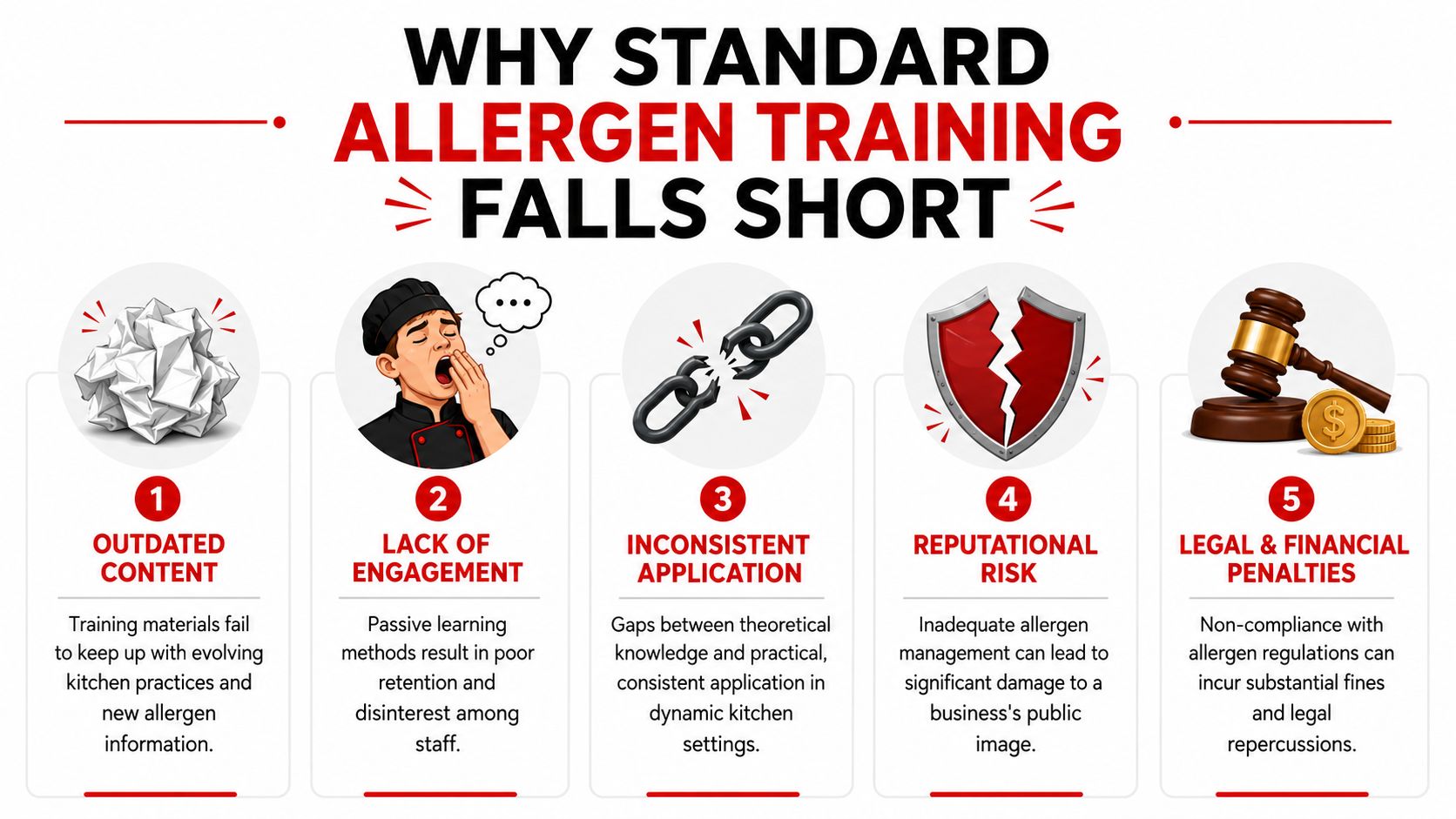
Most operators think the risk sits in the classroom. It doesn't. The risk sits on the pass, in the walk-in, on a chopping board used for the wrong garnish, or in a pan that should never have been shared during a busy service.
In the UK, approximately 2 million people have a diagnosed food allergy, and around 10 deaths occur annually from food-induced anaphylaxis. For kitchen operations, 68% of allergic reactions in food service stem from cross-contamination during preparation, not incorrect labelling according to this UK food allergy training data. That's why a laminated allergen matrix on its own doesn't protect anyone.
The legal bit matters, but it's not enough
UK operators already know the basics. Staff need training. The 14 major allergens must be identified and communicated. Pre-packed for direct sale food has stricter labelling duties under Natasha's Law. None of that is optional.
What gets missed is this. A venue can be technically aware of the law and still run an unsafe service because the day-to-day controls are weak. Legal knowledge doesn't automatically create clean handovers, disciplined prep zoning, or confident front-of-house escalation.
Practical rule: If your allergen process only works when your head chef is on shift, it doesn't work.
High-turnover kitchens break generic training
Most off-the-shelf allergen awareness training assumes a settled brigade, stable recipes and staff who know where everything lives. That's not how many kitchens operate now.
A pub in Dorset might bring in relief cover for a weekend wedding. A boutique hotel in Windsor may need a breakfast chef at short notice. A restaurant in Bristol might swap a supplier midweek because deliveries failed. In each case, the weak point is the same. The site relies on unwritten knowledge.
Common failure points look like this:
- Outdated allergen files that haven't caught up with a new supplier or product swap
- Loose verbal briefings instead of a clear induction process
- FOH overconfidence when answering guest questions without checking the current spec
- Shared equipment habits that creep back in during peak service
- Temporary chef assumptions that “the usual system” matches what they used elsewhere
The biggest myth in allergen management
The myth is that basic training equals control.
It doesn't. Basic training gives people vocabulary. Control comes from repeatable site systems, clear accountability and kitchen discipline under pressure. That's why modern allergen management has to be built for turnover, not for ideal staffing.
If you're running independent pubs, hotel kitchens or multi-site operations, the pressure is familiar. Chef shortages, unreliable agencies, seasonal spikes and last-minute sickness all push kitchens into reactive mode. Allergen safety is usually the first thing owners say matters and the first thing weak systems expose.
Designing Your Core Training Modules
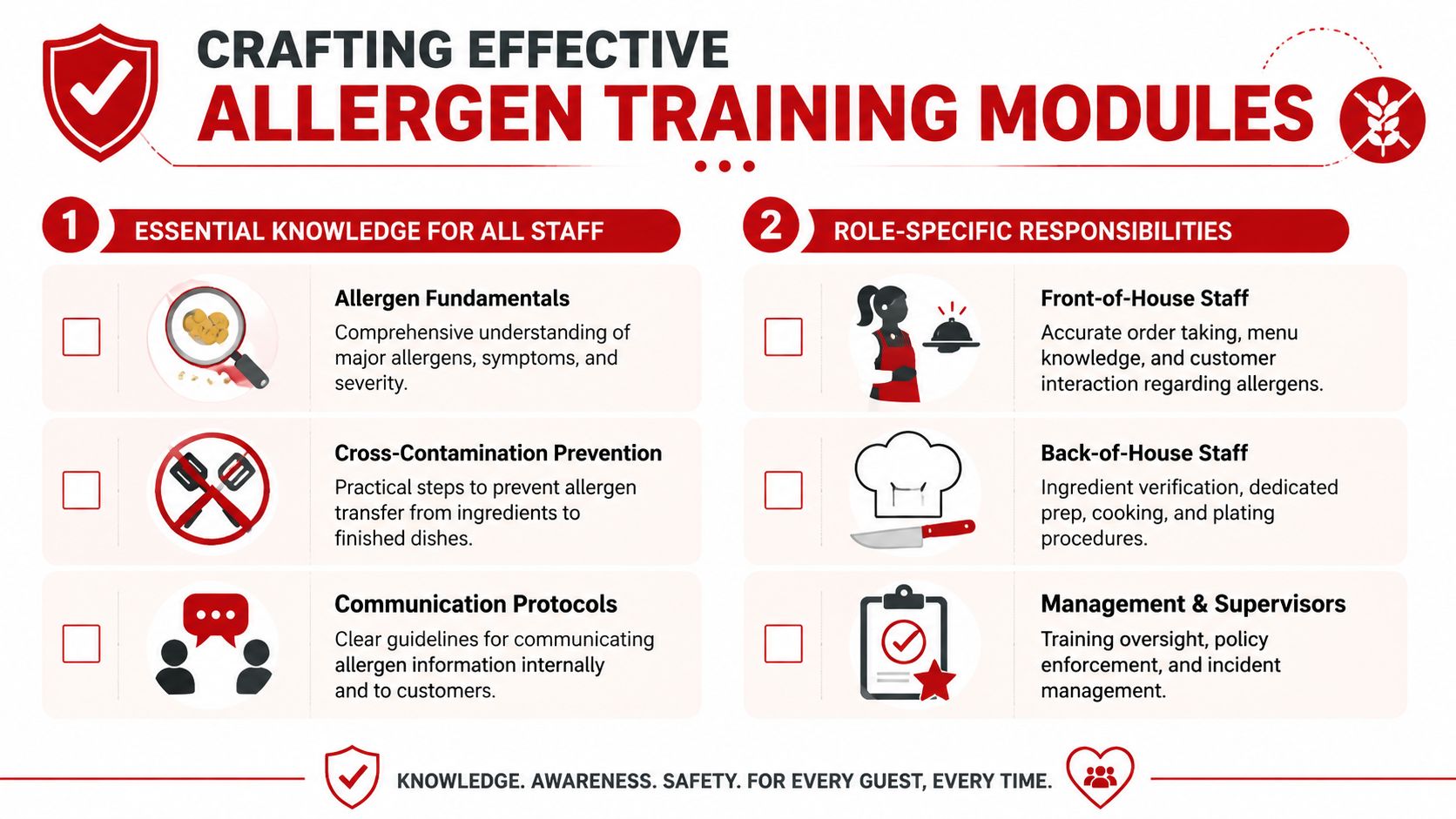
Good allergen awareness training is role-specific. Don't give the same briefing to a KP, a section chef, a breakfast supervisor and a restaurant manager and assume the job's done. Each role needs different knowledge, different decision rules and different escalation points.
A successful method must cover the 14 major allergens required by UK law, and a pilot study found that targeted training improved restaurant staff's correct allergen answers by 9%, showing that role-specific content closes real knowledge gaps, as outlined in this training study video.
Essential knowledge for kitchen teams
Kitchen training has to go beyond “know the allergens”. The ultimate test is whether cooks can stop allergen transfer when service gets messy.
Build your kitchen module around these essential elements:
- Ingredient verification: Chefs must check labels against the current recipe spec, not memory. If a supplier changes mayonnaise, stock paste, spice mix or dessert base, the allergen profile may change with it.
- Storage discipline: Raw materials containing allergens need clear separation. That means designated shelves, sealed containers and labels that survive a busy walk-in.
- Prep control: Staff need a site rule for dedicated boards, utensils, cloths and clean-down between tasks. A “quick wipe” isn't a control.
- Pass communication: A dish marked for an allergy order must trigger a clear verbal and visual handoff from prep to pass to runner.
- Substitution protocol: If an item runs out, nobody substitutes garnish, sauce or side components until the allergen information is checked and updated.
A simple kitchen checklist often works better than a long training document. Keep it visible, signed off and tied to service prep.
Kitchen teams don't fail because they've never heard of allergens. They fail when the process relies on speed, memory and assumptions.
Critical skills for front-of-house
FOH mistakes are different. They usually happen at the point of promise. A guest asks a direct question, a team member wants to be helpful, and an answer gets given before the kitchen or allergen matrix is checked.
Train front-of-house on decision-making, not just menu knowledge.
FOH must be able to do these four things
Pause and verify
No guessing. No “I'm pretty sure”. Every allergy query goes through the current approved source.Use the exact allergen information system
That might be a matrix, recipe file, digital spec sheet or daily briefing pack. It must be current and easy to access.Escalate unusual requests
Complex modifications, tasting menus, specials and off-menu requests go to a supervisor or chef in charge.Close the loop with the guest
Confirm what was checked, what's safe, and whether the kitchen can confidently serve the dish.
Management and supervisors
Managers need their own module too. Their role is enforcement.
A General Manager or Head Chef should be able to audit whether induction happened, whether menu changes triggered allergen updates, and whether the training sits inside wider safety practice. That's one reason allergen procedures should sit alongside related control systems such as COSHH regulations in UK hospitality, not in a separate file nobody opens.
A useful test is this short table:
| Role | What they must know | What they must never do |
|---|---|---|
| FOH | Where approved allergen info is stored | Guess or paraphrase |
| Chef de Partie | Site prep controls and recipe verification | Plate an allergy order without checks |
| Sous Chef | Shift briefing and escalation protocol | Assume previous deliveries match current stock |
| GM / Duty Manager | Induction records and file control | Treat allergen training as HR paperwork |
Choosing the Right Training Delivery Method
The best delivery method depends on your operation, not on what a provider prefers to sell. A country pub in Devon with a small core team needs something different from a hotel in Reading with breakfast, banqueting and lounge service. A site using frequent temporary chefs needs speed and consistency more than theory-heavy classroom time.

In-person workshops
Face-to-face training is strongest when you need staff to practise judgement. It works well for mock guest conversations, menu walk-throughs, allergy order handoffs and supervised kitchen drills.
It's also the easiest format for exposing bad habits. A trainer can spot the chef who uses the wrong spoon, the supervisor who gives vague instructions, or the server who sounds confident but doesn't know the escalation route.
The downside is disruption. Pulling a full team off rota is hard, especially in seasonal locations and lean operations.
E-learning modules
Online training is useful for baseline consistency. It gives every starter the same core language, covers legal responsibilities and can be completed before or during induction.
For businesses dealing with short notice sickness, agency gaps and rolling recruitment, e-learning is practical because it's repeatable. A new temporary chef can complete the baseline learning quickly, then move into the site-specific briefing on arrival.
What it doesn't do well is prove behaviour in service. People can pass a module and still mishandle an allergy order on the line.
Blended training
For most hospitality businesses, blended delivery is the strongest option. Use digital learning for foundation knowledge, then follow it with a site induction, a practical walk-through and live observation during service.
That gives you three layers:
- Baseline knowledge before the shift
- Site-specific application on arrival
- Manager verification during actual work
If you use temporary labour, blended training is usually the only format that matches the reality of handovers, changing menus and unfamiliar kitchens.
A practical way to choose
| Situation | Best fit | Why |
|---|---|---|
| New permanent team opening a site | In-person plus follow-up | Builds shared standards from day one |
| Pub using short-term relief chefs | E-learning plus tight induction | Fast onboarding without skipping controls |
| Hotel with multiple departments | Blended | Keeps standards aligned across service styles |
| Seasonal venue in Wales or Dorset | Blended with refreshers | Handles turnover without starting from scratch |
Don't choose the cheapest format in isolation. Choose the one your managers will reliably maintain when the rota changes and service is under pressure.
Assessment Certification and Defensible Record-Keeping
Training that can't be evidenced is weak. If an Environmental Health Officer asks who was trained, when they were trained, what they were trained on and how competence was checked, you need an answer in minutes, not after a scramble through inboxes.
Many certified programmes require a minimum pass mark of 80% in a multiple-choice assessment, and that benchmark is used by providers of qualifications such as the Foundation Certificate in Food Allergen Awareness Level 2, as shown on this training course reference. That's useful, but the certificate is only one part of a defensible system.
What a good assessment actually looks like
A multiple-choice test is fine for confirming fundamentals. It isn't enough on its own for operational competence.
Use two layers:
- Knowledge check: allergen identification, site rules, escalation path, emergency basics
- Scenario check: “A guest asks about sesame in a special that changed this morning. What do you do?” or “The gluten-free garnish tongs were used on another section. What happens next?”
The scenario element matters because it reveals whether staff can apply the rule in a live setting.
Your training matrix is part of your defence
Every site should have a simple, current training matrix. Not a complicated HR spreadsheet that nobody updates. A live working record.
It should show:
- Name and role
- Start date
- Date of allergen induction
- Modules completed
- Assessment result
- Manager sign-off
- Refresher date
- Any restrictions pending further training
Keep it accessible to managers and easy to show during an inspection.
Record the right things, not everything
Operators often overcomplicate this. You don't need a pile of paperwork. You need clean evidence.
A solid file set includes:
- Current allergen policy
- Induction checklist
- Training matrix
- Assessment records
- Menu and supplier update log
- Incident and near-miss reports
If there is an issue, your incident process should sit within the same discipline as your wider accident reporting procedures in hospitality. That helps managers respond consistently instead of improvising under pressure.
Auditors and enforcement officers look for signs that your process is alive. Current records prove that managers are running the system, not filing it away.
Embedding Allergen Safety into Daily Operations
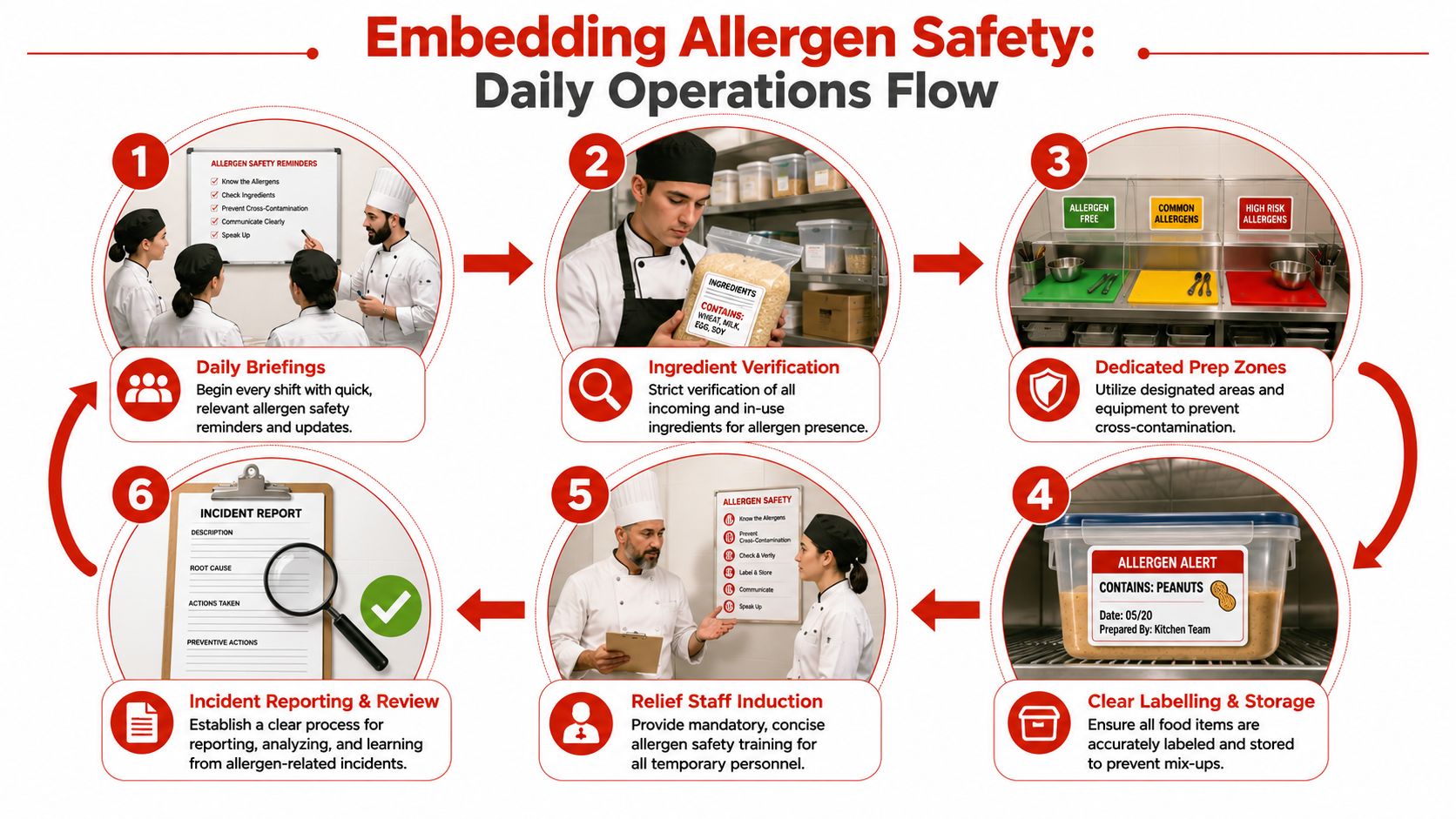
Most allergen failures don't come from missing policy. They come from drift. A file goes out of date. A supplier sends a substitute. A prep chef changes the garnish. A relief chef starts service without a proper handover. Then everybody assumes someone else checked.
Daily operations are more important than the training certificate.
The Food Standards Agency states that allergen training must happen on induction, yet only 29% of businesses formally verify this for temporary staff, and 53% of incidents involve staff who are unaware of where allergen information is stored, according to the FSA's allergy training guidance. If you use flexible labour, that should shape your operating model.
Build a shift-ready system
A kitchen that handles allergens well tends to do the same few things every day, without fail.
Daily controls that work
- Run a pre-service allergen huddle: Cover specials, substitutions, known stock issues and any menu items with changed ingredients.
- Check incoming stock before use: If a product has changed, it doesn't go into service until the allergen information is confirmed.
- Use named prep zones: Allergy-safe preparation needs a defined area, clean equipment and a clear owner.
- Mark allergy orders clearly: The ticket, verbal call and plating handoff should all identify the allergy.
- Stop silent substitutions: No one swaps chips seasoning, dessert garnish, burger bun or sauce without checking the impact.
Make temporary staff safe fast
Many sites frequently struggle in this area. They think previous experience equals safe deployment. It doesn't. A strong chef can still fail in a new kitchen if the site hides the information or assumes local knowledge.
Your induction for any relief or temporary chef should answer these questions immediately:
| Question | What the chef must know before service |
|---|---|
| Where is the allergen information? | Exact file, folder, board or digital system |
| Who signs off allergy orders? | Named shift lead |
| What equipment is dedicated? | Boards, pans, utensils, fryer rules if relevant |
| What changed today? | Specials, supplier substitutions, removed items |
| What happens if unsure? | Stop, escalate, verify, then proceed |
A good handover solves half the risk. That's why a written kitchen handover documentation process matters so much in high-turnover operations.
Temporary staff should never need to “work it out as they go”. If they do, the site has already failed them.
This short training video is useful for reinforcing service expectations with mixed teams:
Review near misses properly
Near misses are valuable if managers treat them as operational lessons. If a wrong garnish nearly goes out, if FOH used an old matrix, or if a temp chef couldn't locate the allergen folder, don't just fix the moment. Change the system.
That may mean relabelling storage, changing briefing order, moving the matrix to the pass, or shortening the induction into a one-page shift starter. The best systems are usually simple enough to survive a slammed Saturday night.
From Compliance to Confidence Your Next Step
Operators who get this right earn more than compliance. They build trust with guests, confidence in the team and resilience in the rota. That matters when staffing is volatile and menus are under pressure.
The wider labour market makes this even more important. As of early 2025, UK hospitality had 132,000 vacancies, 48% above pre-pandemic levels, according to UKHospitality's workforce campaign data. In March 2026, UK hospitality vacancies were reported at 69,000, but that reflected operators cutting hours and closing quiet days rather than roles being properly filled, while 170,000 sector jobs were lost in the thirteen months following the October 2024 Budget according to this hospitality staffing analysis. You can't separate allergen safety from staffing stability anymore.
The commercial upside of doing this properly
A robust allergen system protects service. It reduces hesitation on the floor, shortens decision time in the kitchen and gives managers a clear structure when they bring in cover. It also protects reputation. Guests notice when a team answers clearly and checks properly.
In practical terms, confidence looks like this:
- A GM in Slough can bring in short-term cover without rewriting the whole shift.
- A Head Chef in Bristol can change a supplier and know the update process is clear.
- A hotel manager in Berkshire can show training records and live controls without panic.
- A pub owner in Devon or Wales can keep trading through sickness and holiday gaps without compromising standards.
What to look for in a temp chef partner
If you rely on temporary chefs, your staffing partner is part of your allergen control. That isn't a soft point. It's an operational one.
You need a partner that understands kitchens, sends vetted chefs who can follow site systems quickly, and respects induction instead of treating it as optional admin. Reliability matters. So does communication. If the chef arrives late, under-briefed, or mismatched to the site, your risk rises before prep even starts.
This is one area where agency choice directly affects food safety. A dependable temp chef partner isn't just covering a rota hole. They're helping you keep the kitchen stable when your permanent team is stretched.
If your business needs dependable kitchen cover without lowering standards, contact Relief Chefs UK. Established in 2013, they support independent pubs, restaurants, boutique hotels, private households, yachts and villas across the UK with relief chefs, temporary chefs, permanent chef recruitment, yacht chefs, villa chefs and wider hospitality staffing support. They're a nationwide chef recruitment agency built around operational reality, including short notice sickness, seasonal demand, agency reliability, chef shortages and kitchen stability. If you need vetted chef cover that can slot into a disciplined allergen-safe operation, get in touch with Relief Chefs UK now.