
Bartender Manager Jobs: A Guide to Landing Your Role
10 August 2026
You've probably already done the hard part. You can work a busy bar, keep guests happy, and survive the Friday-night rush without falling apart. The question with bartender manager jobs is whether the next step is a genuine management role, or just a senior bartending title with extra grief attached.
That distinction matters in the UK because hospitality is still a high-pressure labour market. The ONS reported 1.84 million jobs in accommodation and food service activities in 2024, and that scale, plus persistent vacancy pressure, helps explain why employers bundle stock control, rota cover, and customer service into one role so often ONS-based labour market context. In other words, the title can sound bigger than the authority behind it.
Moving Beyond the Bar Itself
A manager title only means something if it changes what you own. If you're still just pulling pints, jumping on the till, and covering gaps all shift, you're not really stepping into leadership, you're being stretched thinner. The best bartender manager jobs move you from serving drinks to running a trading engine.
The real step up is operational
That means watching stock, labour, service pace, and margin, not just the quality of the garnish. A proper manager thinks in terms of rota stability, supplier reliability, and whether the team can keep trading when someone calls in sick on a Saturday night. That's why roles in pubs, hotels, restaurants, and event-led venues can feel very different from a senior bartender post with a manager label.
Practical rule: if the advert talks about sales, stock, scheduling, compliance, and team performance, you're probably looking at a management role. If it mostly talks about cocktails and guest energy, it may just be an experienced bartending job.
Read the advert like an operator
A vague posting is a warning sign. Ask who owns the budget, who approves ordering, who signs off rotas, and who handles training and discipline. If the answer is “you'll do a bit of everything”, that can mean authority, but it can also mean the venue hasn't separated responsibilities properly.
Relief Chefs UK sees the same pattern across hospitality more broadly. Run by hospitality people, not just recruiters, it sits in the same practical world where staffing gaps, short-notice sickness, and seasonal peaks make or break a service.
What good looks like
A strong management role usually gives you enough control to improve standards. You should be able to influence rota design, reduce wastage, tighten handovers, and set expectations for the team. If you can't shape those levers, you're probably not in a true management post yet.
Finding Genuine Management Opportunities
Good roles don't always sit neatly on the biggest job boards. The better bartender manager jobs often come through specialist hospitality agencies, direct venue contact, and trade relationships built before the vacancy appears. That matters in cities and regions where venues need cover fast, especially in hospitality-heavy areas such as Bristol, Dorset, Berkshire, Devon, Windsor, Reading, Slough, Wales, and the wider South West.

Go where serious employers actually hire
Specialist hospitality recruiters are useful because they know whether a role is real management or just title inflation. They also tend to understand what venues need when the pressure hits, such as short-notice sickness cover, seasonal demand, or a venue trying to keep service stable through a tough trading week. If you're searching for movement, don't rely on one channel.
A direct approach still works. Independent pubs, boutique hotels, and restaurants in busy centres often hire through direct contact when they trust the candidate and need someone who can start quickly. A short, confident message with your availability, licence knowledge, and shift coverage experience can open doors faster than a generic application.
Use relief and temporary work as a filter
Short-term assignments are one of the easiest ways to test whether a venue really gives managers authority. If you're trusted to run a shift, handle cash-up, and coach junior staff, you're seeing the actual job. If your role is limited to pouring drinks while someone else makes every call, you've learned something useful without wasting months.
For employers, the operational pressure is obvious. Hospitality vacancies were still high in recent years, and the sector has relied heavily on flexible cover to protect trading continuity. That is exactly why a venue's hiring route tells you as much as the job title itself.
Questions that expose the truth
Ask these before you commit:
- Who owns staffing decisions? If the answer is unclear, authority may be limited.
- Who handles ordering and stock checks? That shows whether the venue trusts managers with real control.
- How much autonomy is there on rosters and spending? This reveals whether the role is strategic or just supervisory.
- What happens during holiday trading or sickness absence? This tells you how much pressure lands on one person.
A good opportunity won't dodge those questions. It'll answer them plainly, because venues with proper structure know how the role fits.
Crafting a CV That Shouts Commercial Acumen
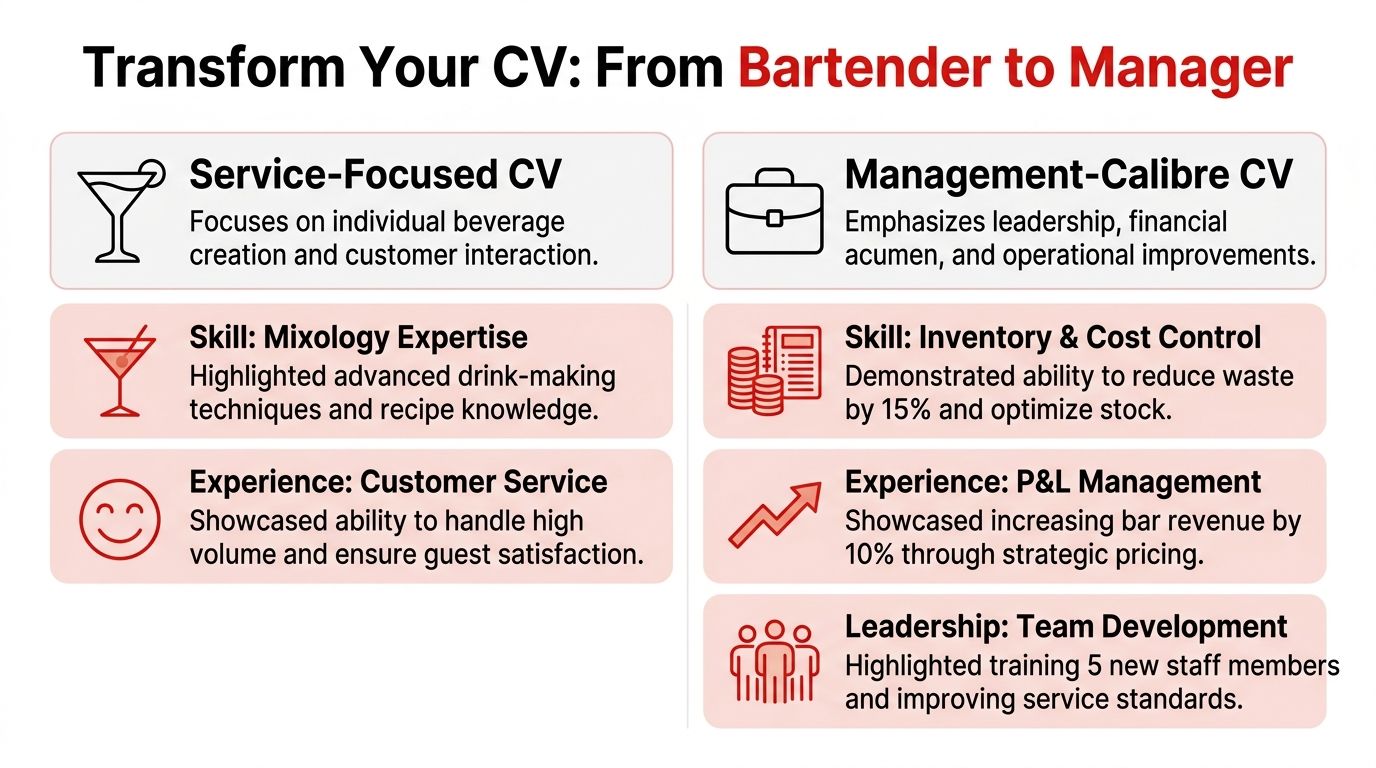
A bartender CV that only lists drink skills won't land a management interview. Employers filling bartender manager jobs want evidence that you can protect revenue, stabilise a team, and keep the bar operating under pressure. Your CV should read like an operations summary, not a memory of every cocktail you can make.
Rewrite every line around outcomes
If your current CV says you “maintained a clean bar”, that tells the employer almost nothing. If you can say you introduced a better closing routine, reduced handover chaos, or improved stock visibility, say that instead. The point is to show control, not effort alone.
Practical rule: shift every bullet from task language to result language. Managers are hired for what changes because they're there.
Here are the kinds of shifts worth making:
- From drink-making to consistency: show that you kept service standards stable during peak periods.
- From stocking to inventory control: show that you managed ordering, rota-linked prep, or variance checks.
- From team support to training: show that you onboarded juniors or improved shift readiness.
- From customer service to commercial awareness: show that you helped protect sales flow, table turns, or upsell standards.
Make the top third of the CV do the heavy lifting
The opening profile should say what kind of manager you are becoming. If you've worked in fast-paced pubs, hotel bars, or restaurants, make that clear. If you've handled late-night trade, weekend peaks, or cover for absent supervisors, include that too.
You don't need to invent achievements. You do need to frame real experience in business language. For example, “supported bar team during busy service” is weak. “Helped maintain service flow during peak covers and kept stock handover organised” is stronger because it tells the employer what changed.
Match the job description, not the fantasy version
The strongest CVs mirror the actual needs of the venue. If the advert mentions inventory control, scheduling, compliance, and guest recovery, your CV should show those areas clearly. Relief Chefs UK uses that same practical logic across its hospitality work, including its barman job description, where role clarity matters as much as speed.
Mastering the Managerial Interview
Interviewers for bartender manager jobs are rarely trying to find the person who can make the flashiest drink. They're looking for someone who can keep a team steady, hold standards, and make sensible calls when the room gets messy. If you answer like a star bartender, you'll probably lose to someone who sounds like an operator.
Prepare for commercial questions, not party tricks
Expect questions about supplier pressure, wastage, staffing gaps, and late-service problems. A strong answer doesn't need theatre. It needs a calm explanation of what you'd check first, who you'd speak to, and how you'd protect service.
If asked how you'd handle a supplier cost increase, don't jump straight to blame. Talk about checking menu mix, reviewing pour control, comparing stock use against sales, and protecting the highest-margin items first. That's the mindset of a manager who understands the business.
If asked about stocktakes, explain the process clearly. You should be able to walk through a daily close, count reconciliation, variance checks, and follow-up on breakages, comps, and wastage. If your answer sounds fuzzy, the interviewer will assume your control systems are fuzzy too.
Show that you can manage people without drama
Late arrivals, repeated lateness, and underperformance come up fast in hospitality. A good answer should show you can document issues, speak privately, stay fair, and protect the team's service standards without turning every correction into a row. Strong managers don't avoid difficult conversations, they handle them early.
Good interview answer shape: problem, check facts, act quickly, document clearly, follow up consistently.
Don't ignore compliance
UK hospitality employers must verify right to work, and alcohol service has to sit within licensing obligations under the Licensing Act 2003 framework. Managers need documented procedures for age checks, refusals, incident logging, and staff refreshers licensing and compliance focus. If you can talk about those processes naturally, you immediately sound more credible.
Use interview examples that show you understand the risk side of the job. That doesn't mean becoming legalistic. It means proving you can keep the venue trading safely when the pressure rises and the room is full.
Venue Types Responsibilities and Salary Ranges
Not every management job feels the same. A busy city pub, a boutique hotel, a restaurant bar, and a yacht all need someone who can lead, but the rhythm, pressure points, and decision-making are different. The right role depends on whether you want pace, polish, variety, or a more specialist environment.
The pay picture also matters. In 2024, the median gross annual pay for bar staff was £24,646, while food and drink service managers had a median gross annual pay of £32,205, a gap of £7,559 UK pay comparison. That gap shows why management feels like a step up, but it also shows the role still sits in a modest pay band compared with many other supervisory tracks.
Compare the venue types before you apply
| Venue Type | Key Responsibilities | Essential Skills | Typical Salary Range (£) |
|---|---|---|---|
| High-turnover city pub | Covering service rushes, stock control, rota gaps, cash-up, and team discipline | Speed, resilience, shift control, clear handovers | Varies by venue and experience |
| Boutique hotel bar | Guest standards, compliance, premium service, coordination with rooms or events | Discretion, presentation, licensing awareness | Varies by venue and experience |
| Fine dining restaurant bar | Wine service, table coordination, menu pairing support, tight stock governance | Precision, communication, attention to detail | Varies by venue and experience |
| Luxury yacht | International clientele, compact stock planning, service consistency, high discretion | Adaptability, organisation, calm under pressure | Varies by contract and itinerary |
What changes from one venue to another
A pub manager may spend half the night protecting flow. A hotel bar manager may spend more time on presentation and guest experience. A restaurant bar manager often has to work closely with the kitchen, especially when drinks need to match a menu rhythm and service pace. On yachts, logistics and discretion become much more important because the environment is smaller, more private, and less forgiving.
That's why a role can be a brilliant fit for one person and a poor fit for another. If you like systems and control, a venue with clearer structure may suit you better. If you thrive on speed and unpredictable service, a high-volume bar may be the better test.
For anyone comparing offers, the salary calculator can help you think about pay against venue demands, instead of judging a role by title alone.
Accelerate Your Career with Relief Management Gigs
Relief work isn't a detour. For the right person, it's a fast way to prove you can step into different venues, understand different teams, and hold service together when there's no room for hesitation. That matters in hospitality because managers are often judged most harshly when staffing is tight and the usual team is under strain.
Why relief work speeds up credibility
A short-term assignment shows whether you can read a venue quickly, set standards without friction, and earn trust in days rather than months. It also exposes you to different operating styles, which is invaluable if you're aiming for a stronger permanent role later. Employers remember the person who arrives prepared, stays calm, and leaves the bar better organised than they found it.
That's why flexible hospitality cover is often a better career move than waiting for the perfect permanent posting. It gives you proof, not just promises. It also helps you build relationships with operators who need dependable management support when a team member is off or a busy period lands unexpectedly.
Use the route that fits your stage
If you're still building experience, temp and relief shifts give you exposure to more venues without the politics of a long hiring process. If you're already experienced, they can be a smart way to keep earning, keep learning, and stay visible to employers who need people they can trust. Relief Chefs UK also publishes opportunities through its working for a temp agency page, which makes it easier to understand how flexible hospitality cover fits into a wider career path.
The best candidates treat relief work as an audit of their own standards. If you can walk into a new site, spot the weak points, and stabilise service quickly, you're no longer just looking for a title. You're proving you can do the job.
If you're hiring and need dependable hospitality cover, or you're a manager ready to move into a role with real authority, contact Relief Chefs UK and speak to a team that understands the pressures of live service. Visit Relief Chefs UK to discuss relief chefs, temporary chefs, permanent chef recruitment, yacht chefs, villa chefs, and wider hospitality staffing support that keeps venues trading properly.
Call the team.
Office 01392 715474 · info@reliefchefs.co.uk