

Friday service is approaching, the bookings are climbing, and your head chef has just handed in notice. You need kitchen cover quickly, but rushing into the first available candidate can create a second problem, a chef who can't handle the menu, pace, team or compliance requirements.
That's the reality behind chef hire UK searches. Hospitality employers are competing for a limited pool while dealing with sickness, seasonal trade, unreliable applicants and changing immigration rules. The answer isn't just to pay more or post another advert. You need a hiring system that matches the role, timing and location.
Defining What Your Kitchen Actually Needs
Before you call an agency or publish a vacancy, answer four questions. A vague brief wastes time because candidates and recruiters can't assess the fit properly.
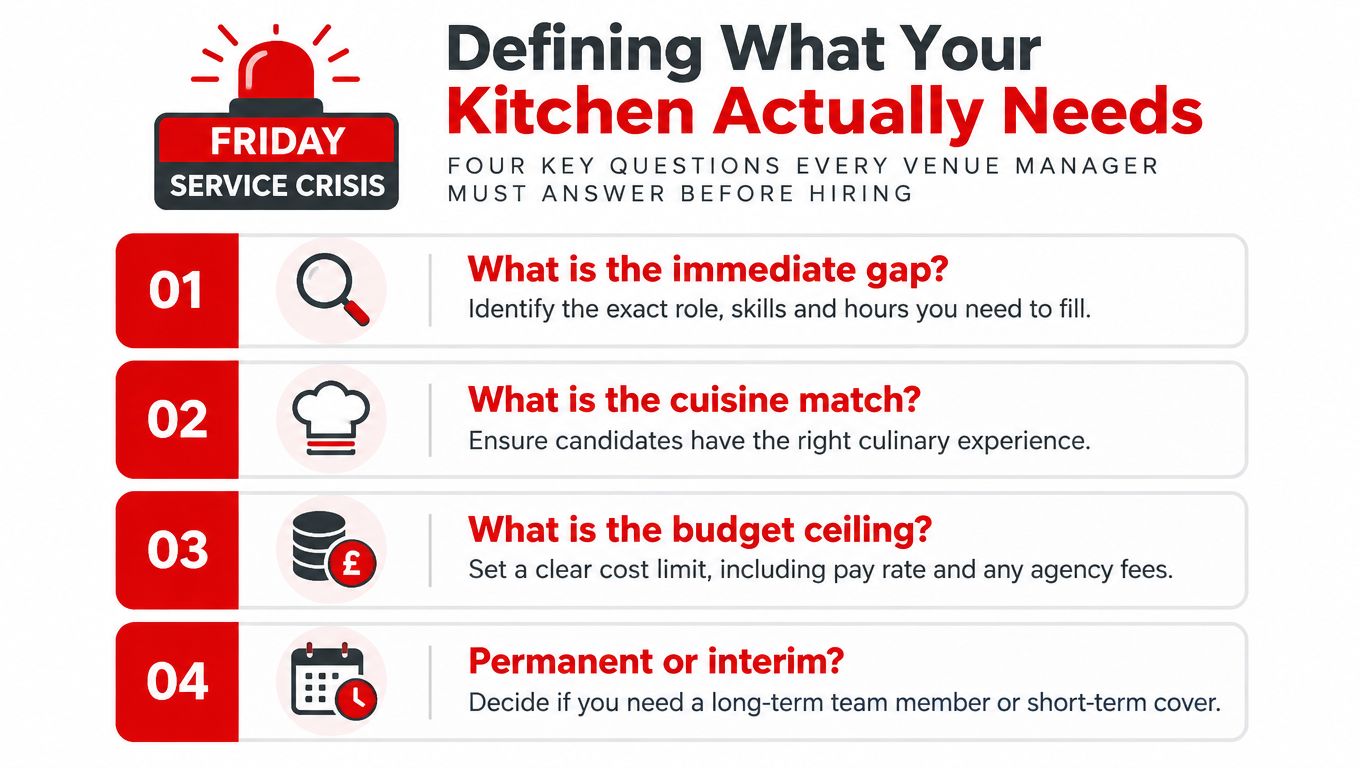
Start with the immediate gap
Is the vacancy for a sous chef, chef de partie, general chef or head chef? A general chef may need to move between sections, while a sous chef must also supervise prep, manage service and support the head chef. If your menu depends on pastry, butchery, fish preparation or another specialist skill, state that at the beginning.
A candidate who can produce strong pub food may still be wrong for a pastry-heavy hotel operation. Equally, a technically impressive chef may struggle if your kitchen needs someone who can lead a small team hands-on.
Define the working arrangement
Confirm whether you need a permanent full-time hire, part-time support, a fixed-term appointment or split shifts across multiple sites. Include the expected service pattern, weekend requirements, start and finish times, and whether the chef will work breakfast, events or late service.
A chef who can work evenings but not breakfast won't solve a hotel vacancy, however good their CV looks.
Lock in dates and notice
Write down the first required shift, expected duration and notice period. “Urgent” means something different to every recruiter. Cover needed tomorrow requires a different search from a permanent appointment planned several months ahead.
For a coastal venue in Devon or Dorset, secure summer cover before demand arrives. A Bristol hotel preparing for an event-led spike needs its brigade confirmed well before the rota becomes unmanageable.
Set the real budget
Budget the all-in cost, not just the advertised pay or day rate. Consider agency charges, holiday accrual, employer costs, travel, accommodation where relevant, trial shifts, uniforms and the management time needed to train a replacement.
Practical rule: If you can't describe the role, dates and budget in one page, you aren't ready to recruit.
Create a short brief containing the role level, cuisine, service style, covers, shift pattern, start date, contract type, pay range, location, parking or accommodation details, compliance requirements and decision-maker. Give the same document to every candidate or agency. It prevents unsuitable referrals and lets a good chef decide quickly.
Choosing Between Temporary Permanent and Relief Cover
The right hiring model depends on the length of the gap and the amount of training your kitchen can absorb. Don't choose temporary cover just because you used it last time, and don't force a permanent hire into a vacancy that exists only because of maternity leave or a short trading spike.
| Hiring Model | Typical Day Rate (GBP) | Lead Time | Best For | Key Risk |
|---|---|---|---|---|
| Temporary chef | £180 to £260 | Short notice to planned | Sickness, maternity and defined short-term gaps | Limited commitment and repeated reliance |
| Permanent chef | Salary-based | Planned recruitment | Stable brigade, leadership and culture | Replacement disruption if the hire fails |
| Relief agency chef | £200 to £300 | Often 24 to 48 hours | Emergency cover, peak periods and flexible capacity | Higher visible rate than direct payroll |
These benchmarks are cited in the UK chef hire rate benchmark. The figures aren't interchangeable. A specialist head chef for a complex menu sits in a different market from a general chef supporting prep and service.
Permanent recruitment
A permanent chef gives you continuity, ownership and the chance to build kitchen culture. The trade-off is slower recruitment and a greater cost when the appointment fails. Your team must spend time interviewing, trialling, onboarding and correcting mistakes while the new chef learns your systems.
Permanent recruitment works when the role is in fact ongoing, the menu is stable and your existing brigade has enough capacity to train properly. It's a poor choice when you need someone for a defined trading window or when service is already under pressure.
Temporary chefs
Temporary chefs suit a known, limited absence. They can cover sickness, family leave or a short contract without forcing you into a rushed permanent decision. They can also help you protect service while you assess whether a vacancy should become a permanent role.
The risk appears when temporary cover becomes the operating model. Weekly bookings can cost more than a properly planned appointment, and a rotating line-up makes consistency harder. Use temporary chefs to create breathing space, not to avoid deciding what your kitchen needs.
Relief agency cover
Relief agency cover sits between direct hiring and ad hoc temp bookings. A specialist agency can maintain a pool of pre-vetted chefs, handle payroll administration and provide replacement support when a booking changes.
This model makes sense when your pressure point is speed. If your head chef is absent tomorrow, your priority is a competent, compliant chef who can work your service, not a perfect long-term CV. Relief Chefs UK provides nationwide relief chefs alongside chef recruitment services for hospitality employers, so venues can use flexible cover while making a considered permanent appointment.
Where to Source Reliable UK Chefs
Every sourcing channel solves a different problem. The mistake is using a general job board for an emergency or expecting a social media post to find a senior chef who can take ownership of a busy brigade.
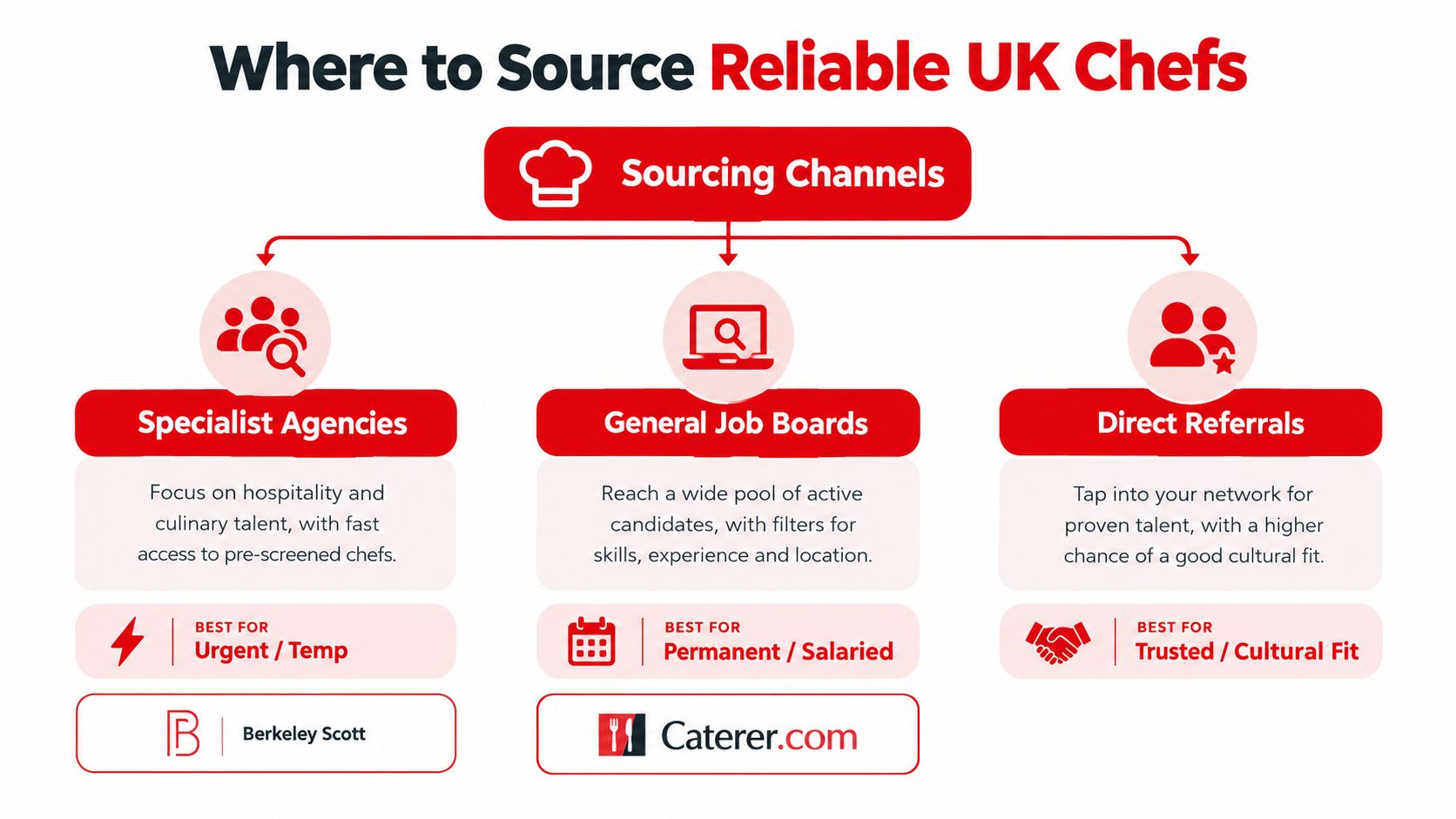
Match the channel to the deadline
Specialist hospitality agencies, including Berkeley Scott, Jubilee and Anchor Concierge, are built for temporary and relief requirements. You pay for speed, candidate filtering and payroll administration, but the channel is appropriate when a sickness call lands before service.
Caterer.com, Indeed and Hosco are more useful for permanent or salaried roles where you have time to advertise, interview and complete checks. They give you reach, but your team must manage the response, sift applications and verify every claim.
Direct referrals remain particularly valuable for senior roles. Ask trusted head chefs, suppliers and local hospitality contacts who they would rehire. This works well in rural and coastal areas, where a generic advert may attract volume without producing the right experience.
Use local networks intelligently
Instagram and Facebook hospitality groups can fill junior or general chef gaps at low advertising cost. They also require heavy filtering. Ask for specific examples of menu experience, confirm availability by phone and never treat an attractive profile as proof of reliability.
For a venue in Wales, Devon or Dorset, include travel expectations and accommodation information in the first message. For Bristol, Berkshire, Windsor, Reading and Slough, identify event calendars, hotel demand and commuting patterns before you set shift times.
A sensible order of attack is simple:
- Emergency cover: Contact a specialist relief agency first.
- Planned permanent hire: Use job boards and direct recruitment.
- Senior appointment: Activate head chef and supplier referrals.
- Repeat staffing: Keep a live list of chefs whose work you've already observed.
This video gives managers another practical perspective on sourcing and staffing:
Don't rely on one supplier. Build relationships with two or three reliable sources, record who responds, and track whether candidates arrive prepared and match the brief.
Vetting Right-to-Work and Compliance Checks
A chef mustn't step behind the pass until the essential checks are complete. Compliance isn't an administrative detail you can tidy up after a successful service. It protects the business, the chef and the reputation of the venue.
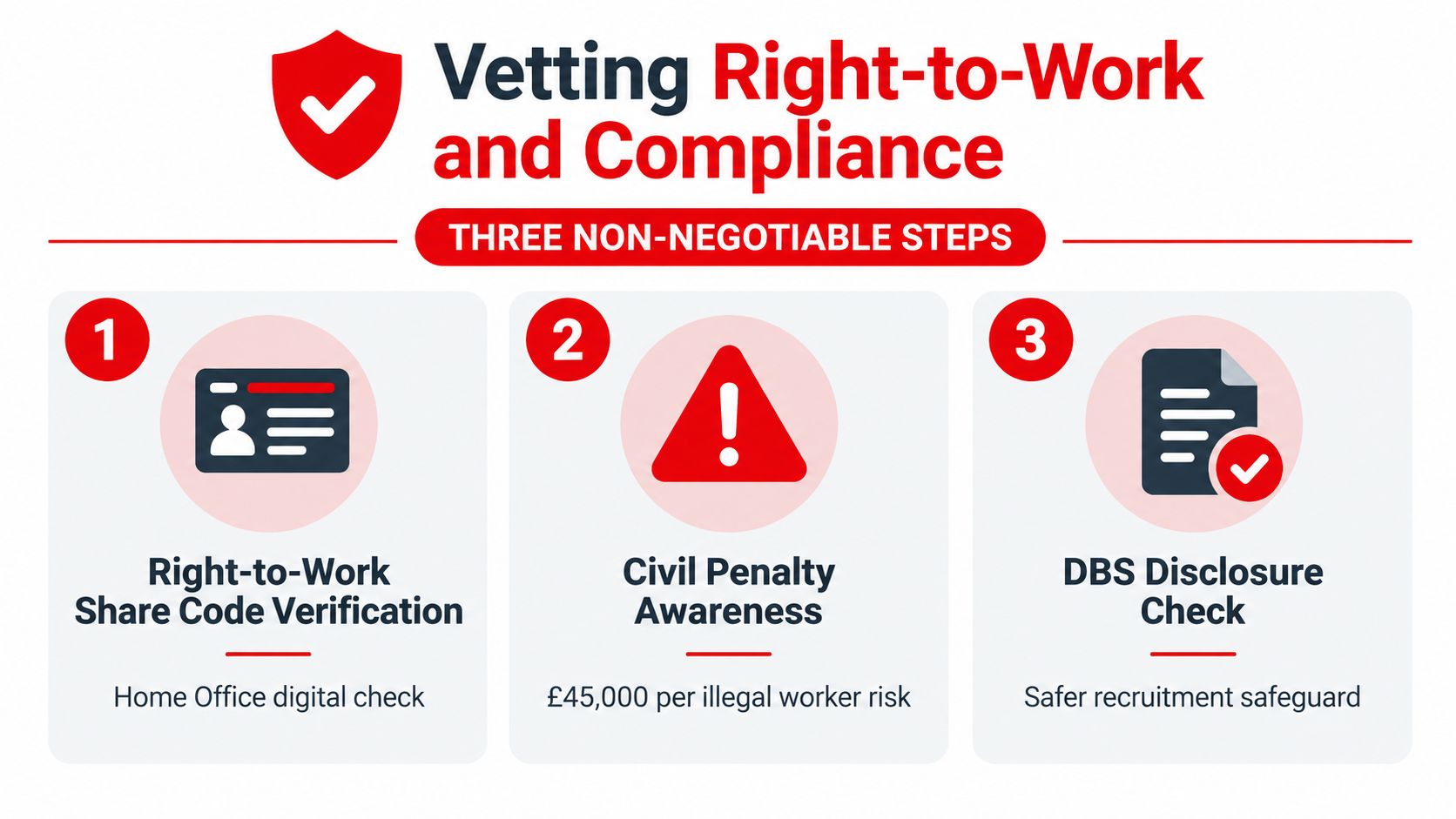
Verify the person, not a screenshot
For a chef using digital immigration status, obtain the Home Office share code and complete the online right-to-work check. Keep the result and date in your records. A screenshot without a date doesn't demonstrate a repeatable verification process.
Where a physical document is permitted, inspect it properly, compare the person to the photograph and retain the required evidence. Record any expiry date and set a reminder before permission ends.
The civil penalty can reach £45,000 per illegal worker for a first breach, according to the UK chef hiring compliance guidance. Repeated breaches can reach £60,000 per illegal worker, so informal checks create a serious financial and operational risk.
Check kitchen-specific safeguards
Right-to-work evidence is only one part of a sound screen. Before the first shift, confirm:
- Identity: Match the chef's identity across documents, booking records and references.
- Experience: Check the actual cuisine, section and service volume they've handled.
- Food safety: Verify food hygiene training and any venue-specific requirements.
- Allergens: Confirm allergen awareness, especially where the chef will write specials or supervise others.
- References: Ask former employers about attendance, conduct, consistency and pressure handling.
- Criminal record screening: Use DBS or basic screening where the role and setting justify it.
A reference that only confirms dates tells you very little. Ask whether the chef arrived reliably, followed systems and supported the brigade during difficult services.
Before service: Check identity, right to work, certificates, references, availability, uniform and arrival instructions.
A UK-based chef with a clean, documented share-code check is usually the lowest-friction option for a 2026 booking. Use the same process every time, including for a chef recommended by someone you trust. A documented right-to-work verification process keeps the decision auditable.
Why Relief and Agency Chefs Matter in 2026
The international recruitment fallback has changed. After the 22 July 2025 Skilled Worker rule shift, chef roles effectively stopped being eligible for new Skilled Worker sponsorship when the UK raised the threshold back to RQF Level 6. Existing pre-July 2025 visa holders can extend under transitional rules, but employers can't treat sponsorship as a dependable route for bringing new chefs into ordinary hospitality roles. This change is outlined in the 2026 industry report on chef staffing.
That leaves venues more dependent on domestic and already-authorised labour. It also makes pre-vetted agency networks more valuable, because the agency has already invested in identifying chefs who can legally work in the UK and can respond when a vacancy appears.
Demand is moving quickly. Chef postings rose 83.4% year on year, from 23,103 in Q2 2025 to 40,395 in Q2 2026, while total hospitality and catering vacancies reached 237,601, up 18.4% year on year, according to the latest chef vacancy analysis. That increase means a venue can't assume a suitable chef will still be available after a slow internal approval process.
The historic picture is also structural. A UK government shortage review cited chefs as a major hospitality user of the immigration system, with 3,581 chef-related sponsor licence users, while its evidence included 26,000 chef vacancies in one table. UK Hospitality evidence cited sector vacancy rates of at least 10% and potentially 16%, equivalent to roughly 210,000 to 336,000 unfilled roles, with chefs among the acute shortages. These figures appear in the UK hospitality staffing benchmark.
| Criterion | Before July 2025 | After July 2025 |
|---|---|---|
| New sponsorship route | Chef sponsorship could be considered under the previous threshold | New chef sponsorship is effectively unavailable under the raised RQF Level 6 threshold |
| Existing visa holders | Existing arrangements could continue | Pre-July 2025 holders may extend under transitional rules |
| Practical recruitment pool | International recruitment was a possible fallback | Domestic and already-authorised chefs carry greater importance |
| Operational response | Employers could plan around overseas pipelines | Employers need stronger local benches and relief arrangements |
Relief cover protects revenue when sickness, family leave or an unexpected trade spike removes a key member of the brigade. It also lets a venue scale capacity without carrying permanent payroll risk for every peak period. In 2026, that isn't a stop-gap. It's a practical staffing layer.
Pay Rates Contracts and Hidden Hiring Costs
Managers often compare a permanent salary with an agency charge and conclude that direct employment is automatically cheaper. That comparison misses the costs attached to recruitment, absence, compliance, holiday cover and management time.
For planning purposes, the benchmark in the source material places sous chef salaries at £32,000 to £38,000, head chef salaries at £42,000 to £55,000, and agency day rates at £180 to £260, depending on region and specialism. Use those figures as budgeting reference points, then request a role-specific quotation rather than presenting them as a guaranteed tariff.
Put every cost on the page
A direct hire may involve advertising, interviews, paid trial shifts, uniform and PPE, induction, training, pension contributions, employer costs and holiday cover. An agency booking may carry a higher visible rate, but the agency typically absorbs payroll administration, holiday accrual and the operational work of supplying a replacement.
The cost of employing a chef should therefore be compared with the full cost of maintaining cover, not just the hourly or annual headline.
| Cost Item | Direct Permanent Hire | Agency Relief Chef |
|---|---|---|
| Recruitment | Advertising, interviews and internal time | Included in agency service |
| Payroll administration | Managed by the venue | Managed by the agency |
| Holiday and absence cover | Additional rota or relief cost | Booked separately as required |
| Compliance checks | Venue responsibility | Agency-led, with venue oversight |
| Training | Usually substantial for a new hire | Venue induction still required |
| Replacement risk | Venue carries the disruption | Depends on the agency's replacement terms |
| Flexibility | Lower once contracted | Higher for defined bookings |
Contracts need operational detail
A chef contract should state the notice period, working hours, pay, location, overtime approach, confidentiality, exclusivity and holiday arrangements. If the business may place the chef on garden leave, make that provision clear and obtain suitable employment advice.
Recipe ownership also deserves attention. If a chef creates menus, recipes, photographs or training material for your business, the contract should define who owns that work. Don't assume ownership is obvious because the chef created it during employment.
For relief bookings, confirm the rate, minimum shift, cancellation terms, travel arrangements, accommodation, uniform expectations, reporting line and replacement process in writing. A five-minute confirmation prevents a long dispute after service.
Fixing Common Chef Hiring Problems
Most kitchen staffing failures are predictable. No-shows, menu mismatch and seasonal shortages don't need to become recurring crises if you design controls before the rota is under pressure.
Stop treating confirmation as optional
A booking isn't secure because someone accepted a message earlier in the week. Confirm the chef, shift time, location, contact number, uniform, parking, menu and reporting manager the night before. Ask the chef to reply clearly, then keep a backup contact available.
For critical services, use a relief agency that has a defined replacement process. The purpose isn't to expect failure. It's to make sure one failed journey or sudden illness doesn't close a section.
Test menu fit under pressure
A CV can show where a chef worked, but it can't prove they can manage your kitchen. A chef who is comfortable with a small à la carte menu may struggle during a large wedding breakfast, while a high-volume operator may not have the precision your tasting menu demands.
Use a paid trial shift with clear measures:
- Prep discipline: Check organisation, labelling, cleanliness and pace before service.
- Technical match: Set a task from your actual menu rather than a generic cooking exercise.
- Communication: Watch how the chef calls for support and responds to instruction.
- Service control: Assess whether they maintain standards when tickets build.
- Team effect: Ask the existing brigade whether the chef added calm or friction.
A trial shouldn't be free labour or an unstructured audition. Explain the duties, pay the chef properly and give a decision promptly.
Plan for the calendar, not the crisis
UK hospitality demand is seasonal. Summer trade generally peaks from June to September, while Christmas party demand begins from late November, with bookings often committed weeks ahead, according to the 2026 hospitality staffing cost guidance.
The location changes the response. Cornwall and the Scottish Highlands can experience major swings between off-peak and summer activity. London and Manchester hotels may spike around major events, while restaurants face concentrated Christmas-party pressure, as described in hospitality HR commentary on regional seasonality.
A venue in Devon should build a summer bench early. A Bristol or Manchester operation should map event dates. Hotels around Windsor, Berkshire, Reading and Slough need to align rooms, functions and kitchen capacity. Dorset and Welsh venues should plan travel and accommodation rather than assuming local availability will solve every peak.
Track three things after each booking: arrival reliability, menu fit and service performance. Keep a live availability list, retain the chefs who deliver, and maintain two or three sourcing relationships. Hiring then becomes a system you can operate, not a panic you repeat.
Relief Chefs UK supplies nationwide relief chefs, temporary chefs and permanent chef recruitment support, with options for yacht chefs, villa chefs and wider hospitality staffing needs. If sickness, seasonal trade or a hard-to-fill vacancy is putting service at risk, visit Relief Chefs UK and send your requirements for practical chef cover.