
A Friday service in a Bristol pub is already behind before the first ticket prints. One chef has called in sick, the relief cover is finding the dry store, and the junior on pans is carrying a hot tray through a wet route because nobody has cleared the spill. The tray slips, the chef is burned, and a control that existed on paper was never applied on the pass.
That pattern is familiar across Devon, Wales, Berkshire, Windsor, Reading, Slough, Dorset and other busy hospitality areas. Kitchen safety is a staffing problem as much as a compliance problem. Short-notice sickness, seasonal demand, agency reliability, unfamiliar chefs and late-night closes all put pressure on routines that only work when people know the kitchen and have enough time to follow them.
The UK framework has developed from equipment safety into a wider system covering hygiene, contamination control, safe equipment use and employer duties. The legal history includes the Cooking Utensils (Safety) Regulations 1972, which took effect on 1 April 1973, followed by the Health and Safety at Work etc. Act 1974 and later food hygiene reforms built around HACCP principles. The chronology is outlined in this history of UK food safety regulation.
A written rule isn't a control unless the chef on a busy Saturday understands it, can follow it and has the time and equipment to do so. The practical answer is a frontline toolkit, a disciplined hygiene system, clear allergen ownership, sensible COSHH controls, and an induction process that gives permanent and relief chefs the same baseline.
Why Kitchen Safety Breaks Down in Busy UK Venues
The most dangerous moment often isn't a dramatic equipment failure. It's the final cover gap, when one person is trying to plate, move pans, answer the pass and keep an eye on a junior chef. A temporary chef may be competent, but still not know which sink is reserved for handwashing, where the wet chemical extinguisher is stored or which board the venue uses for raw poultry.
Small kitchens develop workarounds because service has to continue. A cloth gets used on three surfaces. A knife goes into the pot wash because the sink is full. A chef closes alone and leaves the mop bucket across the only route to the bins. Those habits become invisible to the permanent team and confusing to an agency chef arriving for one shift.
The risk is measurable. UK accommodation and food services recorded around 64,000 non-fatal workplace injuries in 2024/25, while there were 4,233 formal RIDDOR reports in 2023/24, 5% higher year on year and 13% above 2021/22 levels, as detailed in this UK catering and hospitality injury overview. Slips and trips accounted for 1,486 RIDDOR incidents in 2023/24, and manual handling represented more than 30% of injuries reported to the HSE from the food and drink sector, around 1,700 acute injuries per year, according to the same source.
Why the written system fails
A local EHO can visit without warning, but the bigger test happens every service. A venue may have a signed cleaning schedule, yet nobody checks whether the temporary chef understands the chemical store. It may have a risk assessment, yet the closing manager permits lone working without a clear escalation route.
The recurring weak points are predictable:
- High staff turnover: New starters learn by copying whoever is nearest, including unsafe shortcuts.
- Seasonal menu changes: New equipment, ingredients and prep methods arrive before the risk assessment catches up.
- Relief cover: A chef can cook well and still be unfamiliar with storage, allergen controls and emergency arrangements.
- Lone closing: The last person in the kitchen may be dealing with heat, chemicals, waste and wet floors without support.
- Late trading: Fatigue makes rushing more likely, particularly after a sickness call or a heavy booking.
Practical rule: If a relief chef can't understand the kitchen's non-negotiables within the first part of the shift, the induction is too vague.
The fix doesn't require a new folder of policies. It requires a staffing plan that protects the routine. Relief Chefs UK, established in 2013, provides relief chefs, temporary chefs and permanent chef recruitment for venues that need continuity across ordinary service, seasonal peaks and short-notice sickness. Its wider hospitality staffing support also covers yacht chefs and villa chefs, where site-specific procedures matter just as much as culinary ability.
The Frontline Safety Toolkit Every Chef Should Know
A safety toolkit should work as one connected system. Good footwear helps a chef stay upright, but it won't compensate for a blocked route. A cut-resistant glove helps during butchery, but it won't make a knife safe in a crowded sink. Managers need to check how each control performs during service, not just whether the item exists.
PPE that matches the task
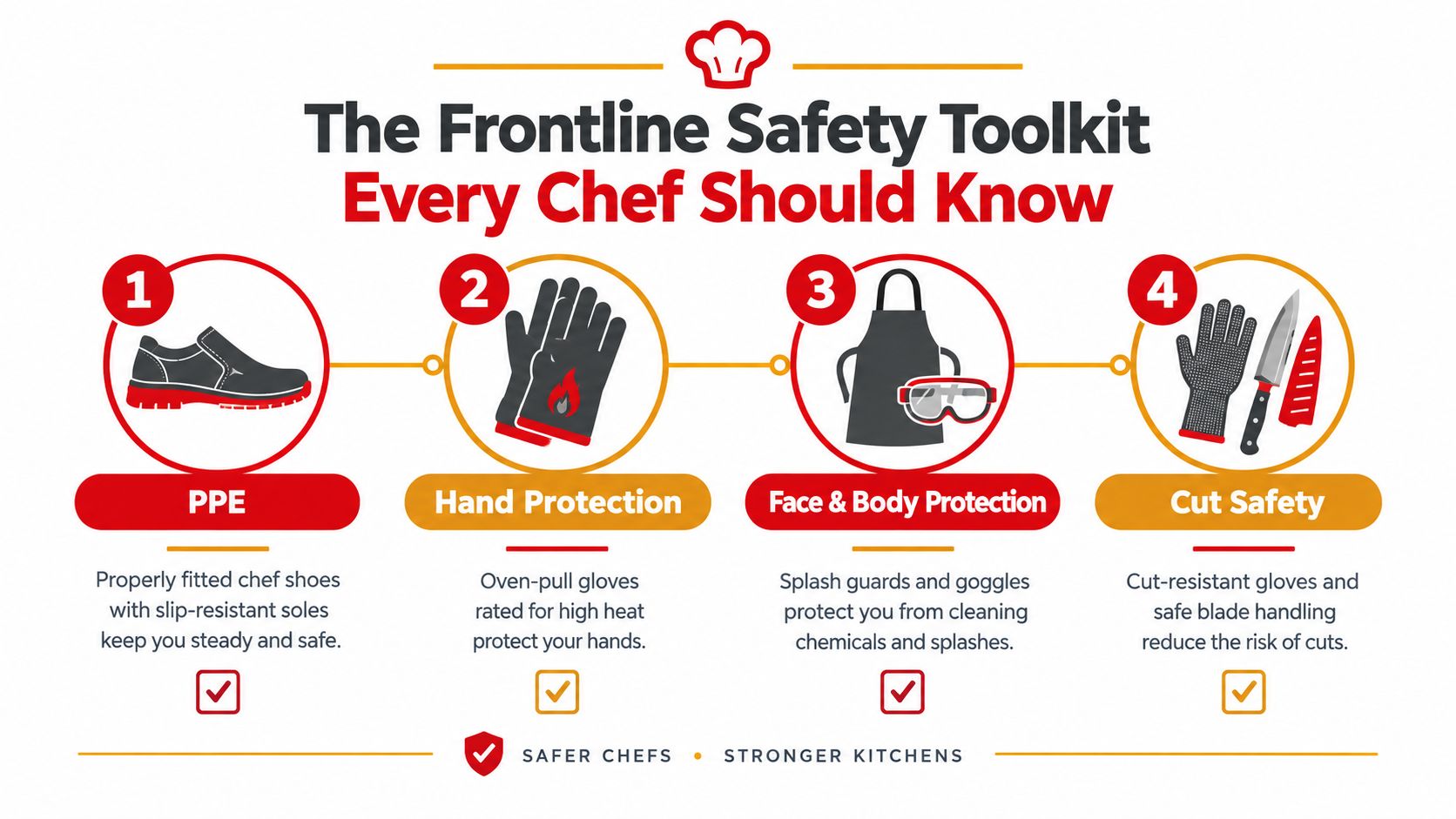
Chef shoes should fit properly and have slip-resistant soles. Oven pulls need heat-resistant gloves, while butchery may require a suitable cut-resistant glove. Aprons protect clothing and skin from splashes, and hair restraints remain important wherever loose hair could contaminate food.
Don't leave PPE in a locked office or a distant staff room. Keep it where the task happens, check its condition and show a relief chef the location before service begins.
Knife handling is a workflow issue
Start with a stable board and a suitable grip. Keep the blade controlled, pass a knife handle-first, and never leave a knife in a sink where another person can't see it. A sharpening routine matters because a blunt blade needs more force, which makes slips more likely, but sharpening should be carried out using the venue's approved method and equipment.
A Saturday night example is simple. The relief chef reaches for a pan stored above the knife rack, knocks a blade loose and catches it instinctively. Better storage prevents the incident before technique is tested.
Fire controls must be visible
Staff should know the location of the fire blanket, escape routes and appropriate extinguishers before lighting the range. A chip-pan or deep-fat fryer fire needs a Class F wet chemical extinguisher, not water. Water can spread burning oil and turn a contained fire into a serious event.
Keep extraction filters clear and arrange professional grease-cleaning at intervals appropriate to the system and its use, following the relevant TR/19 expectations. Managers should also check extinguisher condition and access as part of their routine, rather than discovering a blocked cabinet during an emergency.
Manual handling starts with layout
Store heavy trays between sensible rack heights, avoid overloading shelves, and keep trolley routes clear. A hot pan that is awkward to grip should be moved with assistance, particularly when steam, narrow doors or a crowded pass remove the handler's view.
Most burns in small kitchens come from rushing during the final cover gap, not from the equipment itself. Pin one short rule beside the pass for each pillar:
- PPE: Wear the protection required for the task before starting it.
- Knives: Carry blades visibly, pass handles first and never leave them in a sink.
- Fire: Raise the alarm, isolate heat only if safe, and use the correct extinguisher.
- Handling: Reduce the load, clear the route and get help with hot or awkward items.
Food Hygiene and Cross-Contamination Control
HACCP works when the kitchen treats each control as part of a chain. Handwashing prevents contamination entering the process. Separation stops it moving between workstreams. Cooking reduces hazards where the process allows it, and cleaning removes residues that would otherwise transfer to the next preparation task.
Start with hands and movement
Wash hands with warm soapy water for at least 20 seconds before preparing food, after handling raw food, touching waste, cleaning, using phones, touching doors or cash, and after toilet use, following this UK food safety handwashing guidance. A dedicated hand basin mustn't become a temporary pot-wash station, even during a rush.
Set a clear policy for clean nails, restrained hair and jewellery. The important point isn't the poster. It's placing the handwash step before every contamination transition, including when a relief chef moves from raw prep to ready-to-eat plating.
Separate the workstreams
Use colour-coded boards where they help the brigade, but don't rely on colour alone. Label raw meat trays, keep raw and ready-to-eat foods apart, and use separate cloths for preparation and service. Clean and disinfect boards, tables and knives after raw-food contact, as set out in this UK kitchen hygiene guidance.
A shared sink is a common failure point. So is the agency chef who starts prep without being shown the raw storage, handwash points and probe location. The manager should walk the chef through the physical route, not just point to a laminated diagram.
HACCP critical limits at a glance
| Hazard | Critical limit | Check frequency | Corrective action |
|---|---|---|---|
| Hand contamination | Wash with warm soapy water for at least 20 seconds | Before each contamination transition | Stop work, wash hands and replace contaminated gloves or utensils |
| Raw to ready-to-eat transfer | Separate foods, boards, knives and trays, then clean and disinfect after raw contact | At each task change | Stop the task, isolate affected food and clean the work area |
| Inadequate cooking | 70°C for 2 minutes, or an equivalent safe combination | Each relevant batch or dish during verification | Continue cooking and recheck with a clean probe |
| Probe contamination | Clean and disinfect the probe between samples | Every sample transition | Re-clean the probe and repeat the reading |
| Poor cleaning control | Named daily, weekly and monthly tasks completed | At the scheduled task time | Complete the task, record the action and escalate repeated misses |
The cooking temperature guidance for UK food businesses gives equivalent combinations of 60°C for 45 minutes, 65°C for 10 minutes, 75°C for 30 seconds, or 80°C for 6 seconds. Those checks only help when the probe is clean, used correctly and linked to a recorded corrective action.
Put the daily sheet on the pass and require every chef, including relief cover, to sign it before service, not after. For practical control of surfaces and utensils, use this cross-contamination prevention guidance as a prompt when reviewing the kitchen's HACCP routine.
Allergens and Occupational Health Risks Most Kitchens Overlook
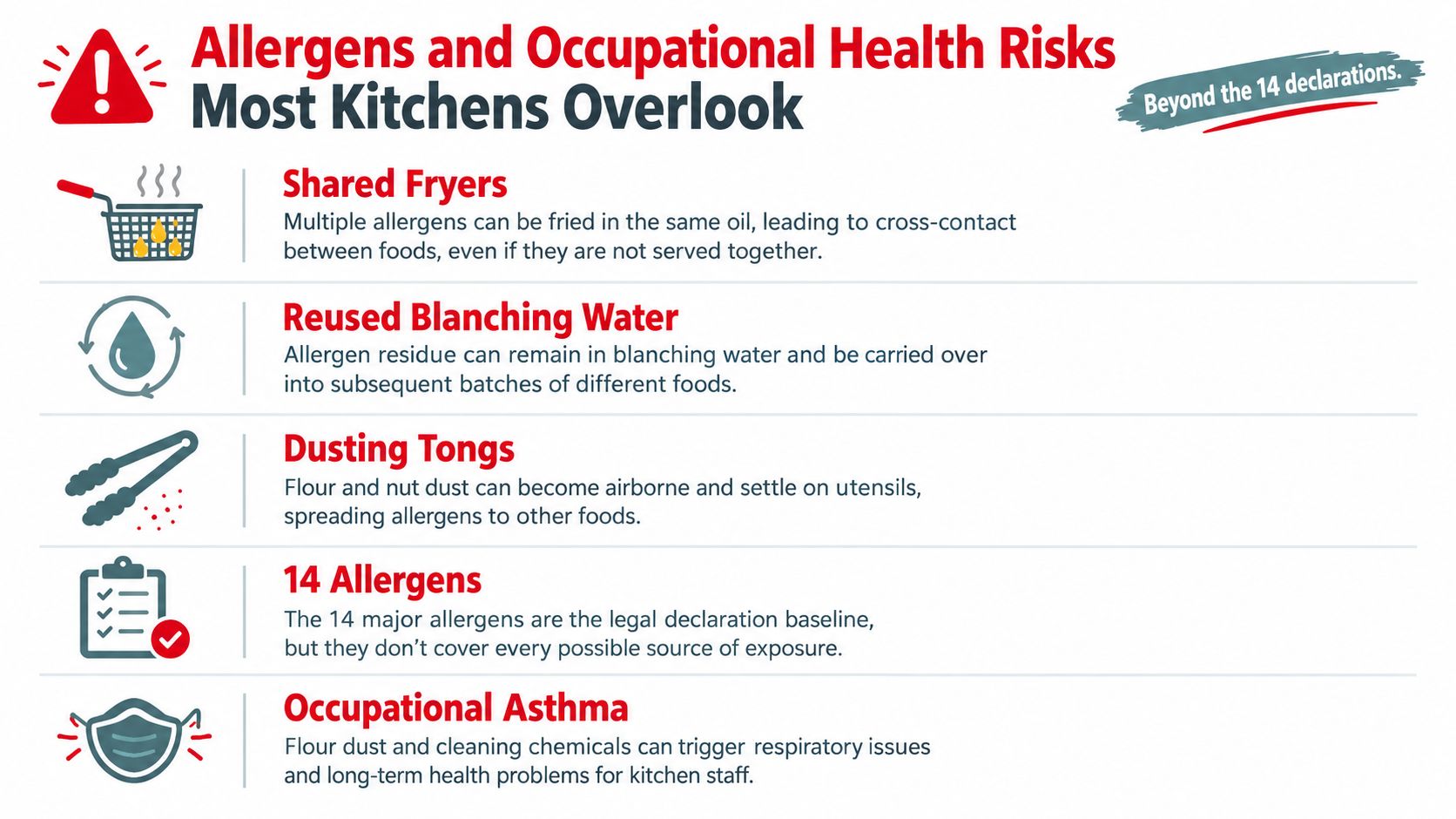
Allergen control fails in the gaps between recipes and actions. A menu may identify an allergen intentionally, but cross-contact happens when a shared fryer, reused blanching water or dusty tongs transfer residue into a dish that wasn't meant to contain it.
The legal declaration baseline doesn't describe every working exposure. A busy pub or hotel kitchen should ask where flour dust settles, which fryer basket is used, whether a plate has passed through an allergen-positive station, and how a recipe change reaches the person taking the order.
Control cross-contact at the station
Cooking doesn't remove allergens. Shared cooking oil can transfer risk, so fryer segregation needs to be explicit rather than assumed. Use dedicated utensils where practicable, mark allergen-positive equipment, clean surfaces between tasks and communicate recipe changes immediately.
Natasha's Law labelling requirements also affect some loose items and made-to-order settings. Businesses must update allergen information when recipes or ingredients change and make sure staff know when an allergen-free meal has been ordered. The Food Standards Scotland allergen guidance reflects the current UK-specific expectations and was updated in 2026.
A short briefing before service should cover the day's substitutions, shared equipment and named person responsible for answering allergen questions. Relief chefs need that information during induction, not after a guest challenges the dish.
Protect the people doing the work
Occupational health problems are slower than a cut or a burn, but they can remove an experienced chef from the rota for much longer. Repeated wet work, cleaning products and frequent handwashing can contribute to dermatitis. Fine prep and awkward repetitive movements can contribute to musculoskeletal strain, particularly when a short-staffed team repeats the same task for an entire service.
HSE guidance says catering employers must assess significant risks, train staff and carry out health surveillance where appropriate for dermatitis or musculoskeletal risks. Its catering health and safety guidance also supports reducing direct contact with water and cleaning products and using tools such as tongs where possible.
Use a quick daily skin check, rotate repetitive prep where the operation allows, and record early symptoms rather than waiting for a chef to stop working. A properly managed first-aid response also matters when a burn occurs. The aim isn't paperwork for its own sake. It is keeping skilled staff healthy enough to deliver safe service.
For managers building a consistent baseline, allergen awareness training can support the venue's own recipe, labelling and communication process.
COSHH, Fire Safety and Incident Response
Commercial kitchens contain hazardous substances that staff often treat as ordinary stock. Degreasers, descalers, sanitiser concentrates and oven-cleaning chemicals can damage skin and eyes, release harmful vapour or contaminate food-contact surfaces when stored or used badly.
Make COSHH practical
Start with the Safety Data Sheet and the label pictograms on each bottle. Staff don't need a chemistry lesson, but they do need to know what the hazard symbol means, which PPE applies, what to do after a splash and where the product belongs.
Store degreasers and descalers away from food and food-contact surfaces, with access controlled where appropriate. Never decant a chemical into an unmarked spray bottle. If a labelled five-litre container is replaced with a plain trigger bottle, the next user may not know whether it contains sanitiser, descaler or a dangerous concentrate.
Ventilation matters during oven and extraction cleaning. Use the specified gloves and eye protection, never mix products, and train the person completing the task. A cleaning schedule should name the task, product, dilution, responsible role and sign-off point.
Keep fire arrangements usable
Fire controls fail when access is blocked by crates, the blanket is hidden behind a dry store or staff don't know which extinguisher is suitable. Keep escape routes clear, make the extinguisher location part of induction and include extraction cleanliness in the planned maintenance routine.
For a fryer fire, switch off the heat if it is safe to do so, raise the alarm and use the wet chemical extinguisher only if trained and able to act without putting yourself at risk. Never throw water onto burning oil.
Run the same incident sequence every time
A duty manager needs a simple process that works while guests are still in the building:
- Stop: Halt the task and prevent further exposure or injury.
- Secure: Isolate the equipment, chemical or area and keep others away.
- Treat: Call the trained first aider or emergency services as the situation requires.
- Log: Record what happened, who was involved, the time, location and immediate controls.
- Report: Check whether the event meets RIDDOR reporting requirements and preserve the relevant records.
Use the venue's accident reporting procedures to keep the response consistent. The next morning, an inspector will expect more than a verbal account. Keep the risk assessment, training record, cleaning or maintenance record, witness details and corrective action together.
Training and Induction Templates for Permanent and Relief Chefs
A relief chef arriving at 4pm for dinner service doesn't need a long lecture. They need a structured walk-through that proves they know the controls before they touch a knife, fryer or allergen-sensitive order.
Use the same induction for permanent starters and temporary cover. The venue may shorten the language, but it shouldn't lower the standard.
A practical 60-minute sequence
| Time | Topic | Output |
|---|---|---|
| First 10 minutes | Kitchen tour, exits, handwash points and staff facilities | Chef can identify emergency routes and the dedicated hand basin |
| Next 10 minutes | PPE, footwear, knife storage and section equipment | Chef selects suitable PPE and demonstrates safe knife storage |
| Next 10 minutes | Raw and ready-to-eat storage, boards and trays | Chef explains the separation route for the assigned section |
| Next 10 minutes | Allergen board, recipe changes and order communication | Chef identifies the allergen lead and explains the escalation process |
| Next 10 minutes | Probe location, temperature records and corrective actions | Chef demonstrates probe cleaning and records a check correctly |
| Final 10 minutes | Chemical store, fire equipment, first aid and incident reporting | Chef locates controls and explains what to do after an incident |
Don't measure completion by signatures alone. Ask the chef to show the hand basin, select a board, find the probe, point out the chemical store and explain what happens when an allergen-free meal is ordered. An observation-based pass is quicker and more reliable than a form completed after service.
Give relief chefs a pocket standard
Print or laminate a small card with the venue's essential rules:
- Separate: Raw and ready-to-eat boards, trays and utensils.
- Check: Cooking and holding temperatures using a clean probe.
- Label: Ingredients, prepared food and allergen information according to the venue process.
- Report: Incidents, damaged equipment and near misses to the duty manager.
- Know: The first-aid lead, fire exits, chemical store and person responsible for allergens.
Agency chefs shouldn't be expected to reverse-engineer a kitchen's habits. Relief Chefs UK vets temporary kitchen staff against baseline requirements and can supply cover that is introduced to the venue's procedures rather than sent through the door. That distinction matters when a hotel in Windsor, a restaurant in Reading or a seasonal operation in Devon needs dependable cover at short notice.
A Weekly Compliance Routine and Your Next Step
A weekly routine works because it assigns safety to ordinary management time. It doesn't depend on someone remembering a policy during a busy Saturday service.
Use the week to find small failures
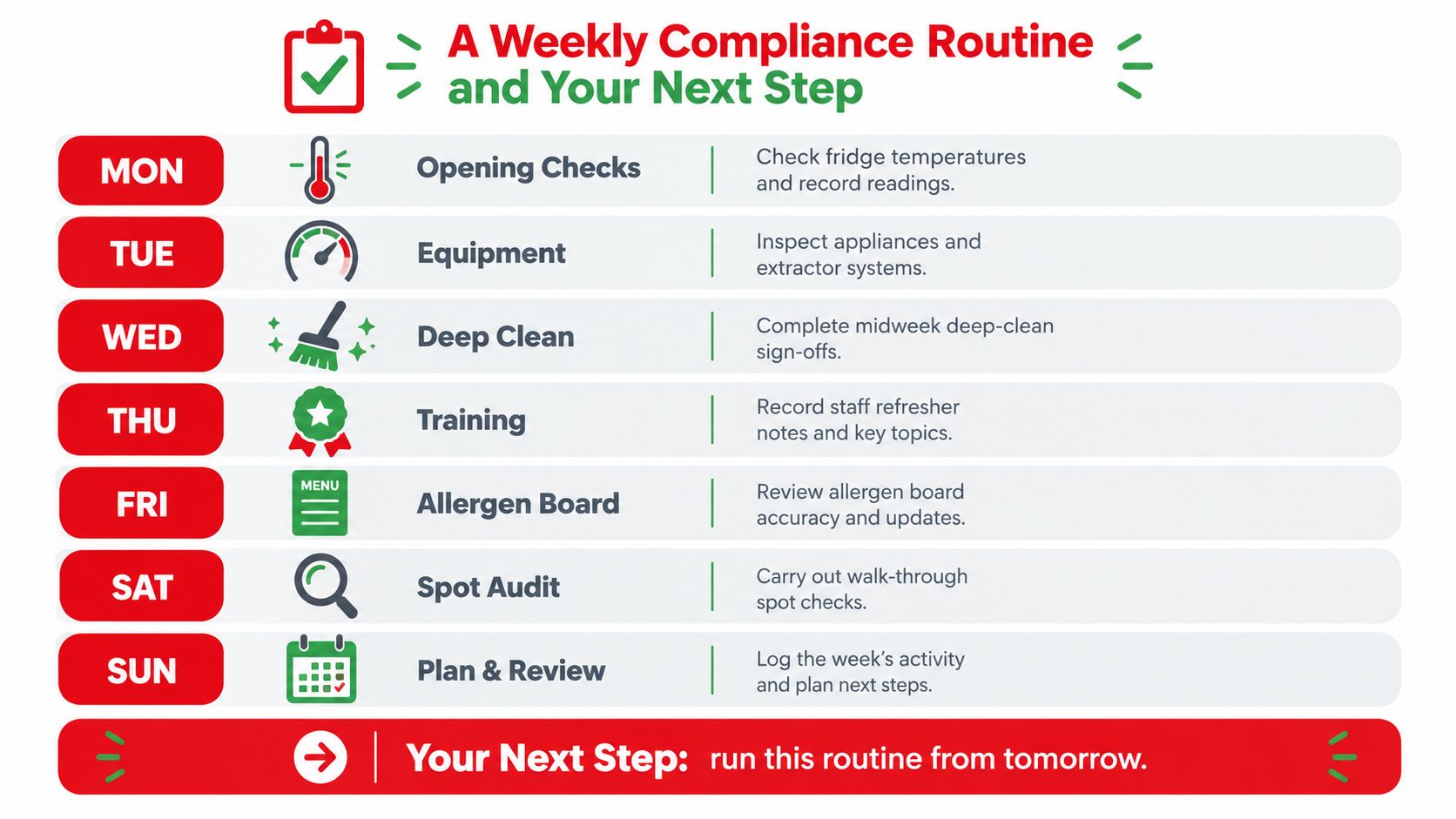
- Monday: Complete opening fridge checks and review the previous week's corrective actions.
- Tuesday: Inspect appliances, extraction access and equipment condition.
- Wednesday: Sign off the midweek deep clean, including floors, storage areas and difficult-to-reach surfaces.
- Thursday: Record refresher training needs and check that new or relief staff understand the kitchen layout.
- Friday: Review the allergen board, substitutions, recipe changes and shared equipment controls before peak service.
- Saturday: Run a spot audit while the kitchen is operating, not only when it is empty.
- Sunday: Brief the next team, close outstanding actions and plan cover for the coming week.
The frequent audit failures are ordinary ones. Cleaning schedules go out of date. COSHH data sheets can't be found. Chemicals are decanted into unlabelled bottles. Temperature records are filled in retrospectively. A written system becomes a liability when it shows that the venue recorded checks nobody performed.
Protect the routine when staffing changes
A sickness call on Saturday can undo a careful week if the replacement chef arrives without a site induction. Seasonal demand exposes the same weakness in coastal Devon, Dorset and Wales, while city venues in Bristol, Slough and Reading can lose stability when several kitchens compete for the same limited pool of chefs.
Build a cover plan around the controls you already use. Share the induction card, name the duty manager, prepare the section and make the first service check part of the relief chef's arrival. Temporary cover should protect your safety culture, not require the team to improvise a new one.
Relief Chefs UK provides nationwide relief chefs, temporary chefs, permanent chef recruitment, yacht chefs, villa chefs and wider hospitality staffing support for pubs, restaurants, hotels and private operations. Contact Relief Chefs UK to arrange dependable cover that keeps your kitchen staffed, your induction standards intact and your safety routine working when sickness or seasonal demand hits.