
Chef Recruitment Cornwall: A Practical 2026 Guide
9 September 2026
A Saturday service in Cornwall can unravel before the first ticket reaches the pass. A chef calls in sick, another has already left, and the rota that looked manageable on Monday no longer covers prep, service and close. In a small pub, restaurant or hotel kitchen, one missing chef doesn't create a minor inconvenience. It can delay food, exhaust the remaining team and turn booked covers into lost revenue.
That's reality behind chef recruitment in Cornwall. Seasonal demand, a thin local labour pool, short-notice sickness, unreliable attendance and housing constraints all affect whether a kitchen can keep trading at the standard its guests expect. A practical recruitment plan must therefore do more than publish a vacancy. It must protect service tonight, build a dependable pipeline for the season and give permanent hires a reason to stay.
Why Cornish Kitchens Are Under Acute Pressure Right Now
A typical August Saturday in a Padstow harbour pub can expose the weakness in a small brigade quickly. The weather is good, bookings are full and the kitchen is preparing for a heavy service. Two chefs call in sick, another team member has left during the week, and around 140 covers are booked. There is no spare capacity to absorb those gaps.
Many Cornish kitchens run with one or two chefs supported by a kitchen porter. That keeps payroll under control in quieter months, but leaves little resilience when seasonal demand rises or someone fails to arrive. Prep is cut, sections are combined and tickets slow down. The head chef remains on the line instead of managing the kitchen, while the team finishes the night questioning whether the workload is sustainable.
Cornwall's visitor economy concentrates demand into a short trading window. A missed shift during peak season therefore carries more operational weight than one during a quieter month. A late cover decision can determine whether a venue accepts bookings confidently, reduces its menu or closes a section.
Practical rule: Treat every small Cornish brigade as a business-critical system. If one absence can stop service, name a backup before publishing the rota.
The staffing problem also connects directly to retention. A chef who arrives to an unmanageable section, unclear allergen controls, poor handover and no transport support may leave quickly, even when the vacancy sounded attractive. The wider hospitality industry challenge is therefore operational as well as commercial.
Housing and travel make the local fill-rate problem harder. A candidate may accept the role in principle, then withdraw after checking the commute or discovering that suitable accommodation is unavailable. That is the context for chef recruitment in Cornwall. Operators need to test those practical details before an offer, not after the first missed shift.
Build protection into the rota:
- Identify fragile shifts: Mark services where losing one chef would force a reduced menu or closure.
- Cross-train sensibly: Ensure at least one team member can cover key prep and core sections.
- Keep a relief option ready: Start arranging cover before the sickness call.
- Brief candidates properly: Share the menu, service style, location, transport expectations and working hours before acceptance.
- Review after every peak: Record what failed, then adjust staffing instead of repeating the same emergency.
Reliable chef recruitment in Cornwall starts with this operational assessment. The next absence may still happen, but it should not be the first time the business considers cover.
Why Chef Recruitment in Cornwall Is Structurally Tight
Cornwall's staffing problem isn't a matter of writing better adverts. Hospitality is a major local employer, and chefs represent 26.1% of hospitality job roles, the largest single occupational group in the sector, according to this UK hospitality employment evidence paper. The same paper records hospitality employment in Cornwall and the Isles of Scilly moving from 19,760 in one year to 18,720 the next, before recovering to 19,800, showing how exposed local staffing capacity can be to change.
A separate Cornwall visitor-economy labour-market report puts sector employment at about 35,695 people, with 47% full-time and 53% part-time. That mix matters for chef recruitment. Part-time workers can provide valuable cover, but a venue may struggle to turn fragmented availability into a rota that covers early prep, split shifts, late service and consecutive peak days.
The local constraints behind the vacancy
Cornwall also competes with hospitality employers elsewhere in the South West. National pressure affects local supply, while the county's seasonal demand can rise faster than the available workforce. UKHospitality evidence submitted to Parliament recorded sector vacancy rates of at least 10%, potentially reaching 16%, equivalent to approximately 210,000 to 336,000 unfilled roles, with chefs among the most acute shortage occupations. Those figures are reported in the UKHospitality written evidence submitted to Parliament.
Housing and travel add another layer. A chef may accept a role in St Ives, Falmouth, Newquay, Padstow or a rural pub, then withdraw after discovering that accommodation is unavailable or the commute is unrealistic. A salary that looks acceptable on paper may not work when the candidate must fund expensive short-term housing, rely on limited public transport or travel long distances after a late finish.
That's why a London-style recruitment timeline often fails in Cornwall. Permanent recruitment should begin well ahead of the intended start date, while seasonal venues need to secure key roles before demand becomes visible in the rota. Use the local evidence to plan early rather than assuming a vacancy will be filled through a last-minute advert.
| Metric | Cornwall | South West average |
|---|---|---|
| Chef share of hospitality roles | 26.1% | Not stated in the available evidence |
| Hospitality employment, Cornwall and Isles of Scilly | 19,760, falling to 18,720, then recovering to 19,800 | Not stated in the available evidence |
| Visitor-economy employment | About 35,695 | Not stated in the available evidence |
| Full-time and part-time mix | 47% full-time, 53% part-time | Not stated in the available evidence |
The table shows why a precise Cornwall-versus-South West vacancy ratio can't be presented responsibly from the available evidence. Operators should instead track their own time to shortlist, candidate withdrawals, travel objections and failed starts. Those measures reveal the local fill-rate problem more accurately than a generic national benchmark.
Where to Source Chefs That Will Actually Show Up
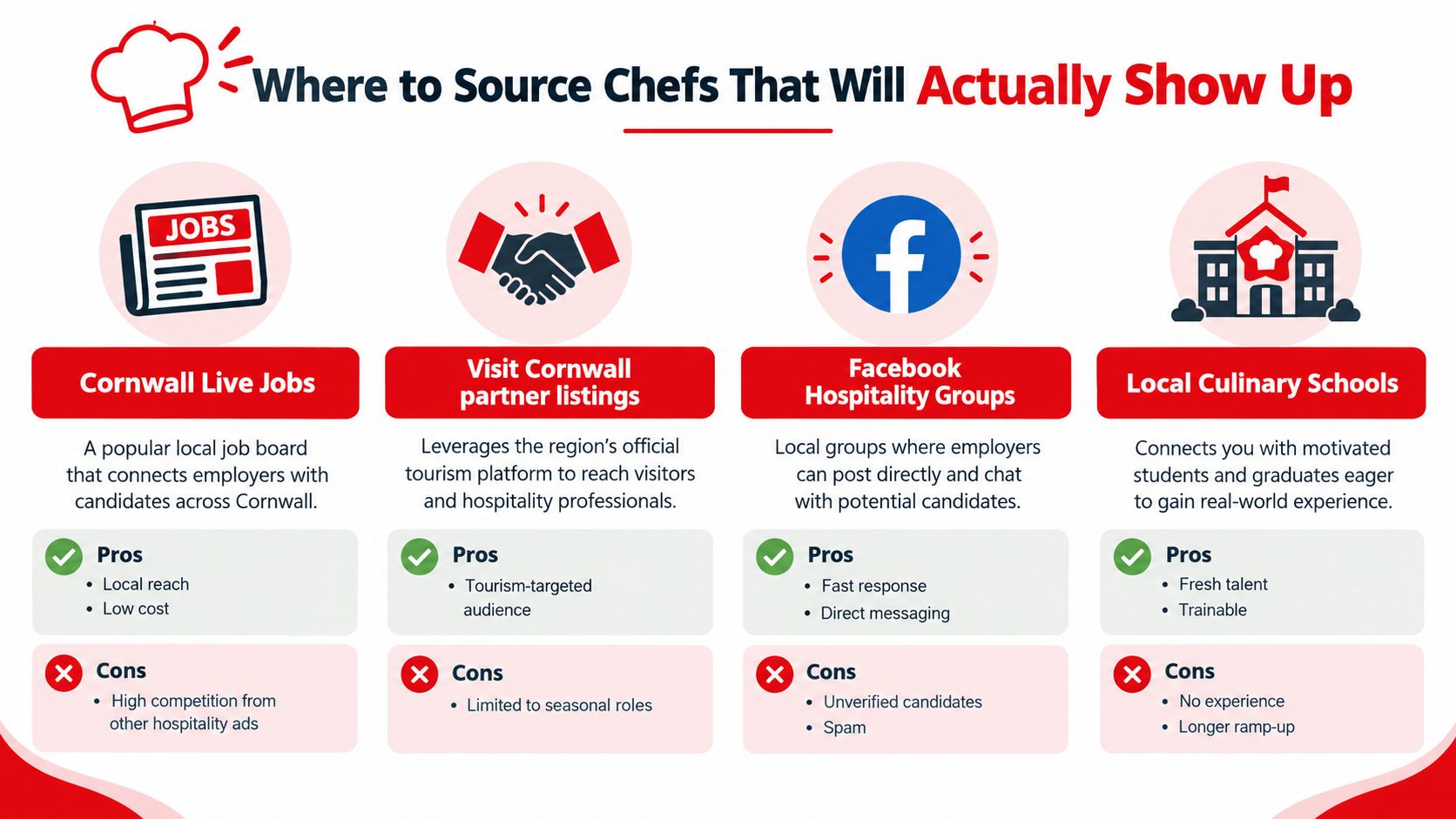
Source candidates in layers. No single channel consistently delivers every level of chef, and the cheapest advert isn't always the lowest-cost route if it produces no-shows or unsuitable trials.
Local job boards, including Cornwall Live Jobs, can reach people already living in the county. Visit Cornwall partner listings can put seasonal opportunities in front of tourism-focused applicants. Their weakness is reach. They may not attract a chef currently based outside Cornwall who needs a clear relocation offer, and both channels compete with many other hospitality vacancies.
Social media gives you speed and personality. Facebook communities such as Cornwall Hospitality Jobs can generate direct replies, while an Instagram post from the kitchen team can show the menu, team culture and working environment more openly than a polished advert. TikTok kitchen walk-throughs can help culture-led hiring, particularly when the venue has a distinctive food offer. The trade-off is verification. Profiles don't confirm skill, reliability, right to work or availability, so every response still needs a structured screening process.
Use colleges and referrals deliberately
Truro and Penwith college pipelines can introduce fresh talent, but a work placement isn't a guaranteed hire. Students need supervision, clear learning objectives and a realistic path into paid employment. They can become strong commis or junior chefs, but they won't immediately replace an experienced section leader during a full summer service.
Specialist hospitality agencies offer a different exchange. You pay for access, vetting and speed, but the candidate may be available sooner and already understand professional kitchen expectations. The sensible comparison isn't agency fee versus free advertising. Compare the cost of an unfilled service, manager time spent screening, repeated interviews and a failed start.
- Former staff: Contact chefs who left on good terms before advertising. They already know your standards and site.
- Team referrals: Offer a clear referral incentive, then ask the referring employee to describe the actual shift pattern.
- College contacts: Build relationships before the season, not when every venue is competing for graduates.
- Specialist agencies: Use them for urgent gaps, hard-to-fill sections and candidates relocating into Cornwall.
- Social content: Show the kitchen, food and working conditions rather than posting only a job title.
The strongest candidates usually arrive through a trusted referral, a well-managed specialist agency or a direct conversation with someone who understands the venue. Local boards and social media remain useful, but they need fast replies and firm screening. Candidates who receive vague details often stop responding, while applicants who get a clear role brief can decide quickly whether the job works for them.
For businesses that need access to a wider pool, agency chefs across the South West can supplement local sourcing without treating every vacancy as a permanent replacement exercise.
Vetting, Right-to-Work and Compliance Checks You Cannot Skip
A chef shouldn't handle a cover until the manager knows who they are, whether they can legally work and whether their skills match the kitchen. Speed matters in Cornwall, especially for sickness cover, but skipping checks transfers the risk to the operator.
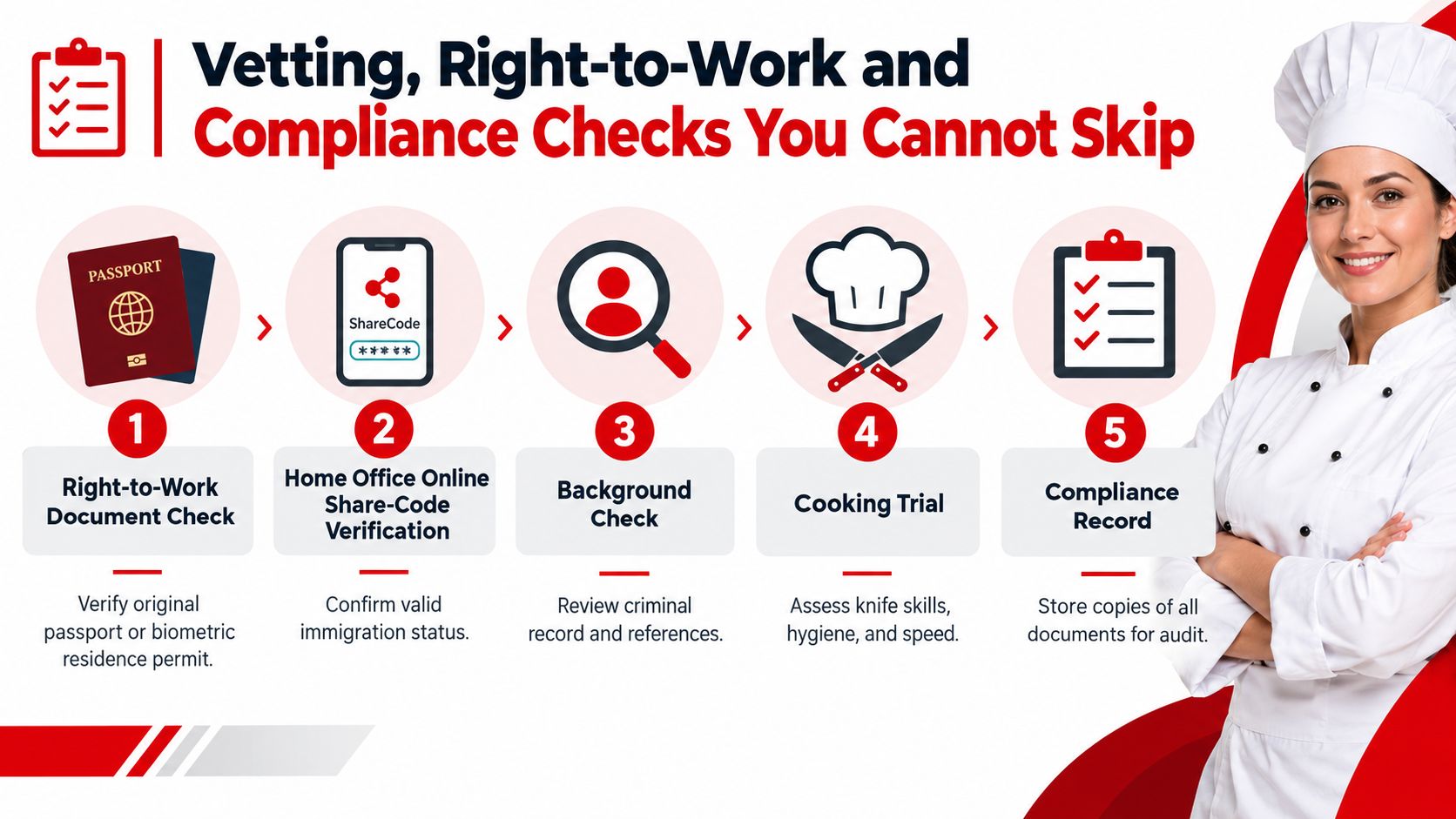
Start with right to work. British and Irish passport holders may provide acceptable original documents for inspection, while many non-UK applicants require a Home Office online share-code verification. Check the candidate's immigration status, permitted work and any restrictions before confirming shifts. Don't assume a previous employer's check covers your business, and don't rely on a photograph sent through a messaging app when the required verification process calls for an original or online check.
The basic sequence should be consistent:
- Verify identity and contact details: Match the person attending the shift to the documents and confirm their current address and phone number.
- Check right to work: Inspect acceptable originals or complete the Home Office online share-code process, then record the result.
- Take professional references: Ask a former head chef about attendance, section competence, hygiene, pace, teamwork and the reason the chef left.
- Confirm qualifications: Request evidence of allergen awareness and Level 2 Food Hygiene where relevant to the role.
- Assess practical ability: Use a proportionate cooking trial covering knife skills, organisation, hygiene, communication and speed.
Match checks to the venue
An Enhanced DBS check may be appropriate for kitchens serving vulnerable groups, but it isn't a universal substitute for hospitality references. Pubs may also need to check whether a role requires personal-licence responsibilities. Ask about health and fitness to work in a sensible, non-discriminatory way, focusing on the duties, safe working conditions and any adjustments required.
Keep a clear compliance file. Record what you checked, when you checked it and who completed the check. The operational requirement is not just to collect paperwork, but to make sure the documents relate to the individual placed on the line.
Right-to-work verification support can help managers create a repeatable process, particularly when temporary chefs arrive at short notice. Never let urgency turn into an undocumented placement. The cost of a failed compliance process can include enforcement action, disrupted service and reputational damage, while a consistent checklist protects the business and the chef.
Temporary, Permanent or Seasonal Contracts Compared
Cornwall venues often make the wrong hiring decision because they choose a contract before examining the rota. A permanent chef isn't automatically the answer to a summer spike, and a temporary chef isn't a sensible fix for a role that remains open throughout the year.
The available evidence doesn't provide reliable, verified figures for Cornish day rates, permanent salary bands or seasonal contract costs. Rather than inventing prices, use the table below as a decision framework and obtain a written quote or salary recommendation for the exact role, location, hours and accommodation arrangement.
| Contract Type | Typical Cost | Flexibility | Best Fit | Risk |
|---|---|---|---|---|
| Temporary chef | Agreed shift or assignment rate, plus any applicable agency charge | High, cover can be matched to specific gaps | Sickness, urgent absence, events and short peaks | Availability may change, and the chef needs a strong site briefing |
| Permanent hire | Salary, employer costs, recruitment cost and onboarding time | Lower once contracted, but strong for stable weekly demand | Year-round kitchens with a recurring role | A slow process or weak onboarding can lose the candidate |
| Seasonal fixed-term contract | Agreed salary or hourly arrangement, holiday entitlement and any accommodation or travel support | High during a defined trading window | Summer tourism, Easter demand and planned seasonal growth | The offer may fail if housing, travel or end date aren't clear |
Choose from the service pattern
Choose temporary cover when the rota has an immediate hole and the business needs continuity without committing to a long-term appointment. Choose a permanent hire when the same duties appear week after week and the kitchen needs ownership, development and consistency. Choose a seasonal contract when demand has a clear start and end, provided the venue can explain accommodation, transport, hours and expected workload.
The contract must describe more than the title. State cuisine, section, shift pattern, pay structure, accommodation arrangements, tips, break expectations, start date and who manages the chef on site. Candidates can accept a role and still withdraw if those details emerge after the offer.
For any model, calculate the cost of failure. Include reduced covers, overtime for existing staff, manager time, menu limitations and the effect on guest reviews. A slightly more flexible arrangement may cost more per shift but protect revenue during a critical service. The right comparison is operational cost against operational risk, not headline pay alone.
Onboarding Chefs So They Stay Past Their First Month
A chef can be technically capable and still fail in a new kitchen because nobody explained the layout, suppliers, menu or decision-making structure. Cornwall's rural sites create extra practical challenges, from transport and accommodation to unfamiliar equipment and remote deliveries. Good onboarding removes uncertainty before it becomes frustration.
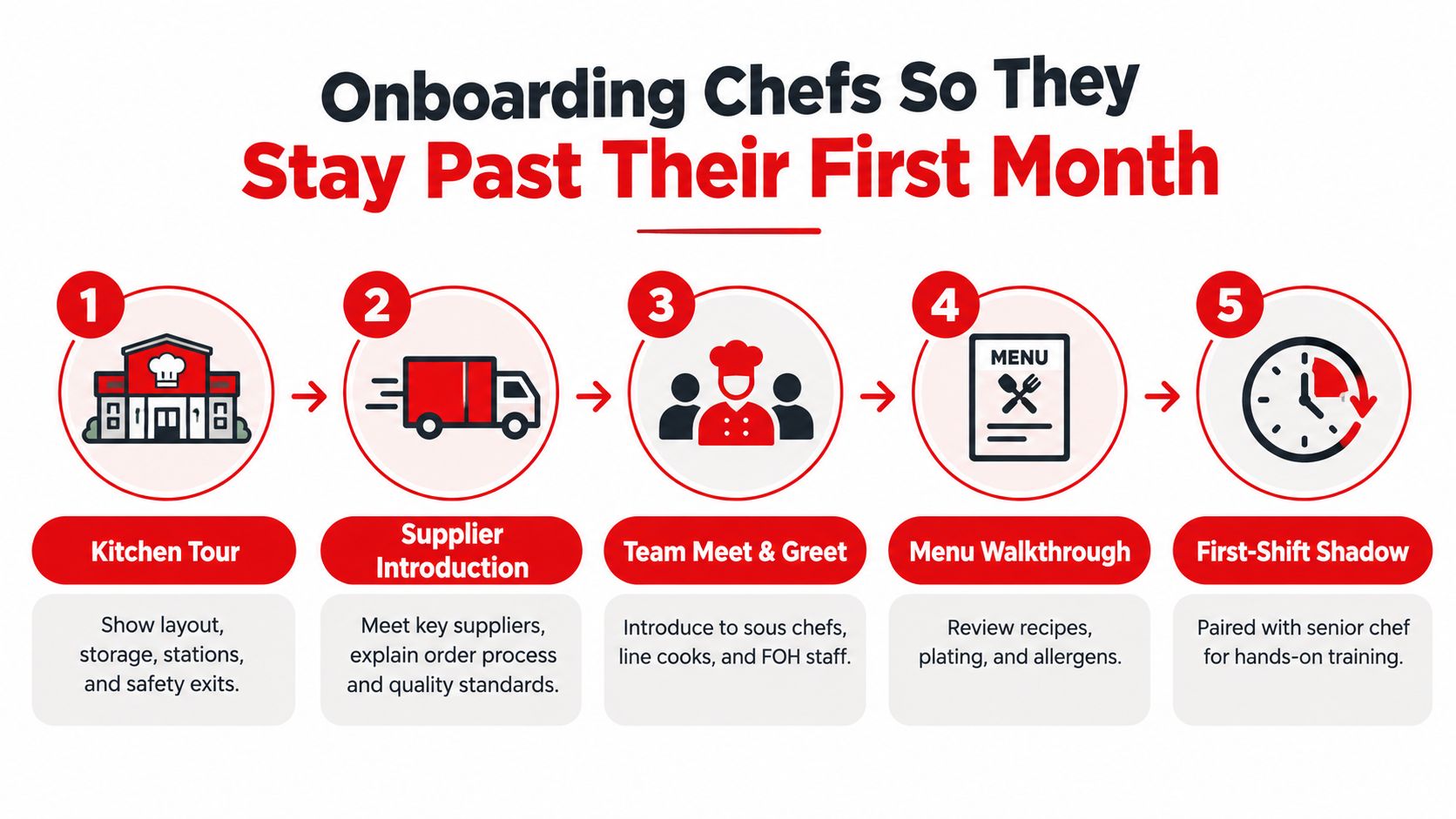
Use the first week to answer the questions a new chef may feel awkward asking. Show storage, fridges, freezers, dry goods, waste points, staff facilities, fire exits and emergency contacts. Introduce key suppliers and explain ordering deadlines, delivery access and the quality standard expected for local produce.
Walk the chef through the allergen map dish by dish. Don't hand over a folder and assume it has been read. On sites with log stoves, clifftop gas storage or other location-specific hazards, explain the safe system of work and who controls it.
Make the first shifts useful
A trial shift should test the job rather than create free labour or burn out the existing team. Give the chef a defined section, explain the expected output and pair them with someone who can answer questions. Watch how they organise mise en place, label food, communicate during pressure and recover when a task changes.
Use a simple first-week plan:
- First shift: Tour, introductions, hygiene expectations and station setup.
- Early shifts: Shadow a senior chef, learn the menu and complete supervised prep.
- Midweek review: Check pace, section fit, rota understanding and any practical barriers.
- First busy service: Confirm who leads, which dishes can be paused and how communication works.
- Thirty-day conversation: Ask what is working, what isn't and what would make the role sustainable.
Retention often depends on practical support. Signpost accommodation rather than leaving a relocating chef to search alone. For rural pubs, explore shared transport or coordinated lifts for late finishes. Explain tip distribution clearly and apply it consistently.
The manager should also check whether the rota matches the agreed role. A chef promised steady daytime work may leave if every shift becomes a late close, while a seasonal worker may need a clear end date to plan their next move. A structured review at 30 days gives both sides a chance to fix issues before the chef accepts another offer.
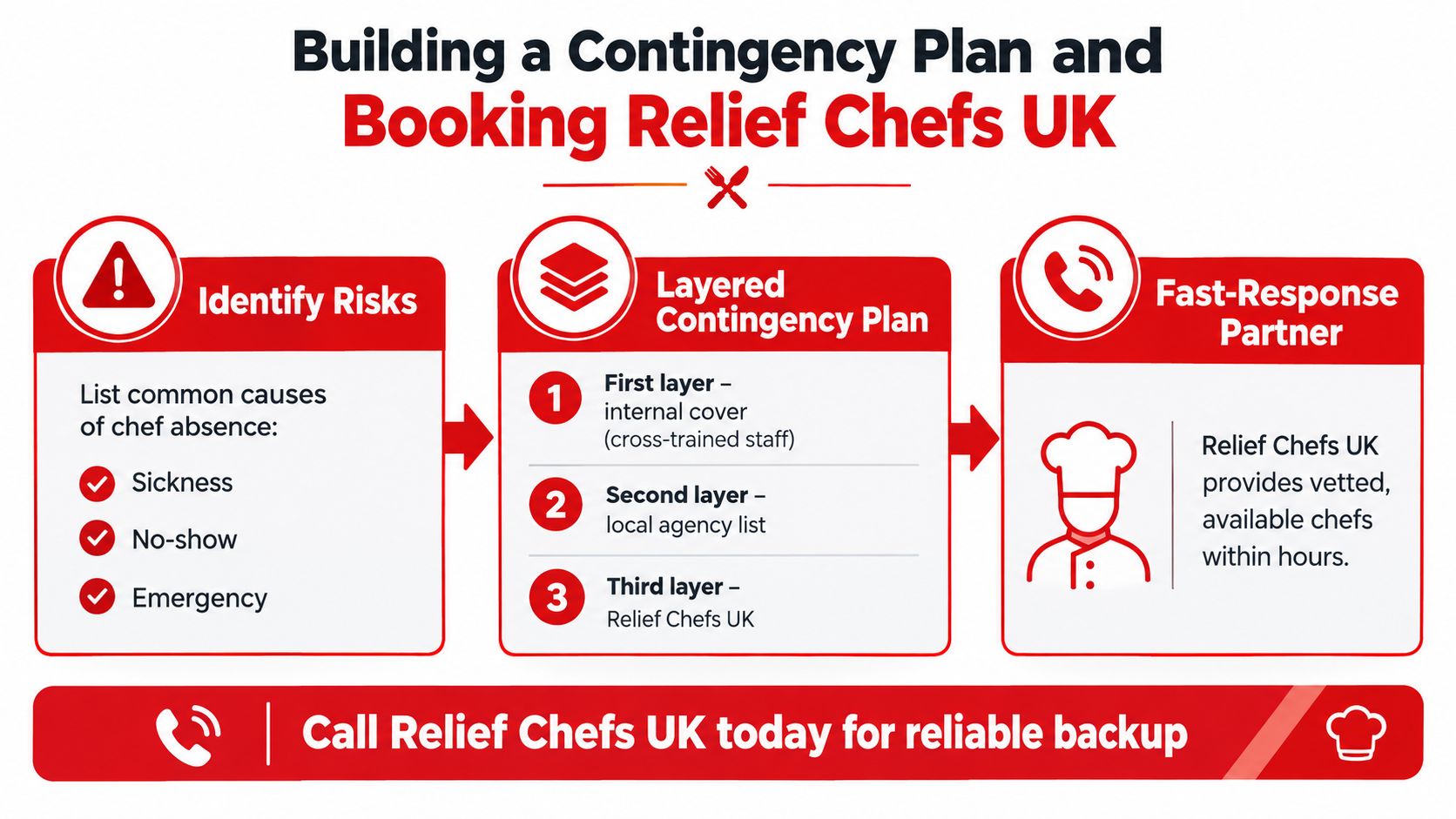
Building a Contingency Plan and Booking Relief Chefs UK
A Friday sickness call can expose a weak rota before prep begins. A workable Cornwall staffing plan uses three layers, because short-notice absence, a short gap and a seasonal surge require different decisions.
Set a trigger for each situation:
- No-show or short-notice sickness: Contact your backup partner before morning prep, then decide whether to simplify the menu, move staff between sections or secure relief cover.
- Absence lasting one to two weeks: Review internal coverage, protect rest days and book a temporary chef instead of loading every shift onto the same team.
- Forecast Easter or August demand: Reserve a seasonal block four to six weeks ahead, confirming dates, cuisine, sections and expected service volume.
The booking brief needs operational detail. Include the venue location, parking or transport information, cuisine, menu style, section, allergens, equipment, shift times, dress code, rate structure and on-site contact. “Chef needed in Cornwall” gives a recruiter too little to match reliably, particularly when accommodation and late transport affect whether a candidate accepts.
Relief Chefs UK is a nationwide chef recruitment agency established in 2013. It offers relief, temporary and permanent chef recruitment, plus yacht chefs, villa chefs and wider hospitality staffing support. Its stated process allows venues to enquire by phone or short form, speak to a recruitment team available 24/7, review vetted and right-to-work-checked candidates, and arrange chefs for the dates needed, subject to availability and suitability. Check the details of its chef staffing service against the role, location and timing you need to cover.
Keep the plan visible
Put the contact process in the duty manager's folder and kitchen office. Record the decision-maker, approval limit, candidate requirements and point at which bookings must be reduced. Review the plan before busy periods and after every emergency placement.
The UK market remains competitive. A 2026 trade report on chef vacancies recorded chef postings rising 83.4% year on year in Q2 2026, from 23,103 to 40,395, while hospitality and catering postings rose 18.4% to 237,601. For Cornwall operators competing with venues across Cornwall, Devon, Bristol, Wales, Berkshire, Windsor, Reading, Slough and Dorset, a vague brief or delayed decision can cost an available chef.
Keep upcoming rota gaps, required sections and likely peak dates ready to share. Starting the conversation before a Friday-night crisis leaves more workable options, especially when seasonal demand and local housing restrict the available pool.
Relief Chefs UK provides vetted relief and temporary chefs for sickness cover, seasonal demand and short-notice gaps, alongside permanent recruitment and specialist yacht and villa chef placements. Visit Relief Chefs UK to discuss Cornwall staffing requirements and establish a backup plan before the next service is at risk.
Call the team.
Office 01392 715474 · info@reliefchefs.co.uk