
Chef Recruitment Dorset: Essential 2026 Guide
4 May 2026
You know the feeling. Friday is full, the terrace is booked, rooms are turning, and your head chef texts at 8:12am to say they’re not coming in. You don’t need another lecture about “the talent market”. You need someone competent on section, someone who can walk into your kitchen, read the menu, keep standards up, and stop the day from turning into a slow-motion mess.
That’s why chef recruitment Dorset has become less about hiring in the traditional sense and more about protecting service. In Dorset, the problem isn’t just finding chefs. It’s finding chefs quickly enough, safely enough, and reliably enough that the kitchen doesn’t wobble every time one person goes off sick, hands in notice, or burns out in peak season.
If you run a pub, boutique hotel, restaurant, holiday venue, yacht operation, or private household on the South Coast, slow recruitment is expensive. It drains management time, rattles your brigade, and pushes your existing chefs closer to the door. The smart move is to stop treating chef hiring as a one-off task and start treating it as an operational risk that needs a proper staffing plan.
The Dorset Hospitality Paradox Why Finding Chefs is So Hard
Dorset sells the dream. Strong visitor demand. Great produce. Busy seaside trade. Packed weekends. Guests who expect quality. Owners who want consistency. On paper, that should make hiring easier.
It doesn’t.

The harder Dorset works, the harder kitchens are to staff. Existing content on chef recruitment rarely deals with the urgent short-notice reality. Meanwhile, UK hospitality vacancies were at 12.2% in Q1 2025, with the South West facing a 15% chef shortfall and a 43% drop in EU-born hospitality staff since 2019. That’s the pressure point most owners feel.
Busy venues create fragile kitchens
A Dorset kitchen can look fine from the outside and still be one absence away from trouble. The menu is set. Bookings are healthy. Reviews matter. But behind that, many teams are running thin.
One strong sous leaves and the head chef starts covering sections. One CDP goes off sick and prep slips. One KP walks and chefs start washing up at close. That’s not a recruitment issue in the abstract. That’s a live commercial risk.
A full diary means nothing if the kitchen can't execute it.
The market changed and many operators still hire like it’s 2018
A lot of businesses are still using slow, old-school methods for a fast, unstable staffing problem. They post an advert, wait, interview whoever appears, and hope the person sticks. That approach falls apart when the candidate pool is tight, the season is short, and the gap is immediate.
In Dorset, that mismatch is brutal for:
- Seaside pubs: Sunny weekends can turn average trade into all-day pressure fast.
- Boutique hotels: Guests won’t forgive breakfast delays, poor room service, or an uneven dinner service because you’re short in the kitchen.
- Independent restaurants: One weak shift can hurt repeat business and team morale in the same night.
- Private households, villas, and yachts: Discretion, presentation, and fit matter just as much as cooking ability.
Expectations rose while staffing depth fell
Guests aren’t lowering the bar because chefs are hard to find. They still expect speed, standards, and consistency. Owners feel squeezed from both sides. Wage pressure is real. Service pressure is worse.
That’s the Dorset paradox. The better the local hospitality opportunity, the more exposed your business becomes if your staffing model is reactive. If your answer to every kitchen problem is “we’ll advertise and see who applies”, you’re already behind.
Mapping Your Dorset Chef Recruitment Options
Most Dorset operators have three real choices. Hire directly. Use a traditional recruitment agency. Or use a flexible staffing partner for temporary cover and targeted placements. Each route has a place. The mistake is using the wrong one for the problem in front of you.
The scale of the market alone tells you why this gets difficult. Glassdoor lists 45 personal chef jobs in Dorset, Jobsite reports 115 chef jobs within 20 miles, and Totaljobs identifies 118 within 10 miles. For one independent venue, cutting through that noise is a job in itself.
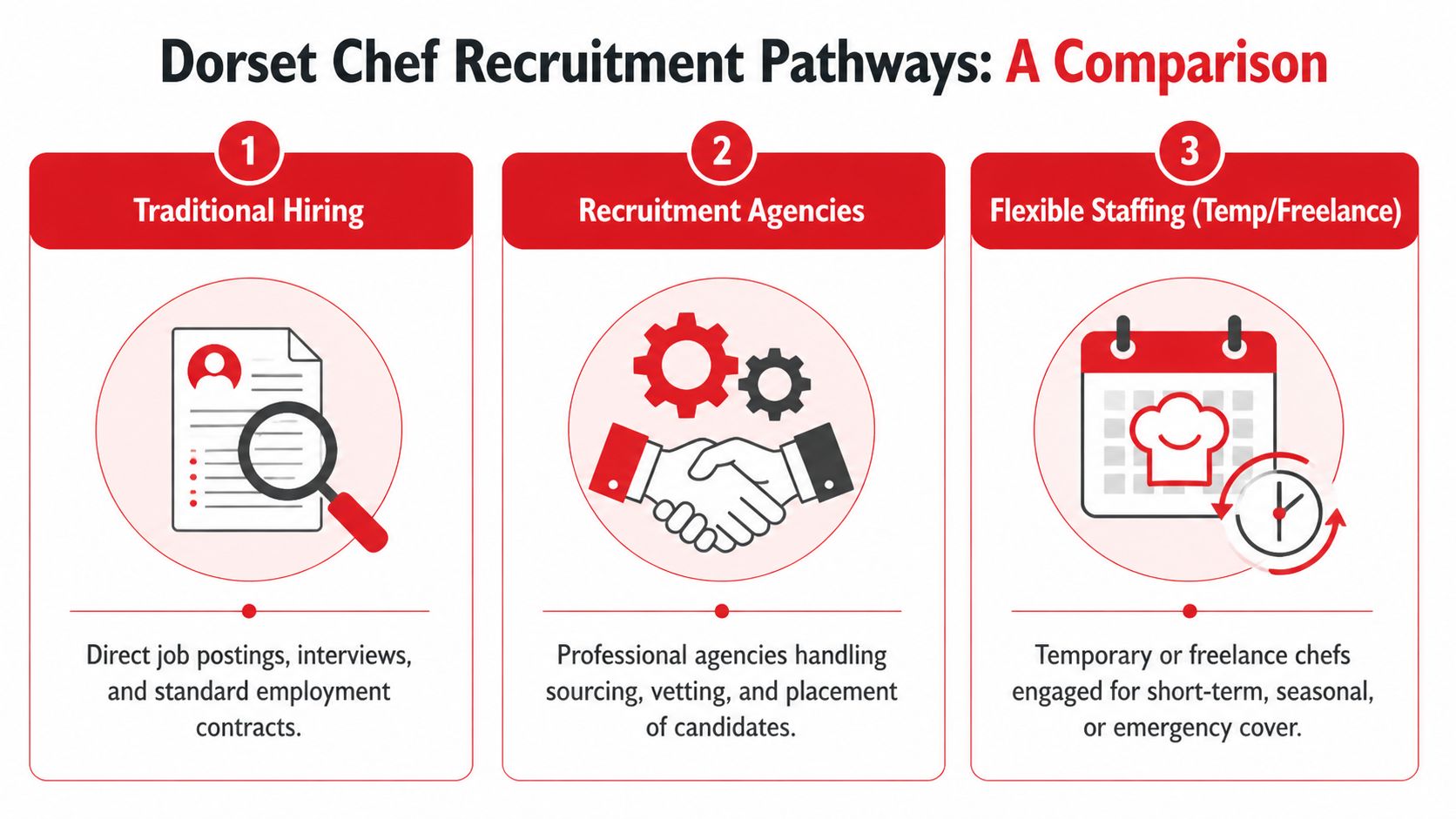
Option one is DIY hiring
This is the route most operators start with. You place ads, ask for referrals, post on social, sift CVs, arrange interviews, and hope someone suitable turns up.
That can work when the role isn’t urgent and you’ve got management bandwidth. It’s less sensible when your head chef is already doing doubles and your GM is screening CVs between breakfast and check-in.
Where DIY hiring makes sense
- Permanent team building: Good if you’re recruiting well ahead of need.
- Culture-led hiring: Useful when fit matters as much as skill.
- Low urgency roles: More realistic when the kitchen is stable enough to wait.
Where it breaks down
- Short notice gaps: Ads don’t solve tonight’s service.
- Admin burden: Every application, call, trial shift, and no-show lands on your team.
- Weak filtering: A CV can look clean and still hide poor reliability or inflated ability.
Option two is a traditional recruitment agency
A standard agency can help if you want a permanent chef and don’t want to do the sourcing yourself. They’ll usually handle advertising, shortlisting, and introductions.
The issue is speed and kitchen understanding. Some agencies know hospitality well. Plenty don’t. If the person screening candidates has never run service, they can miss obvious red flags.
Here’s the blunt version. A recruiter can tell you a chef has “good experience”. A proper operator wants to know whether they can handle a busy pass, step into a fresh food pub, support banqueting, or manage breakfast and evening service in the same property.
Option three is flexible staffing
This is the route many Dorset businesses should use more often. If the problem is emergency cover, peak season reinforcement, holidays, or bridging a permanent gap, flexible staffing is usually the practical answer.
You bring in temporary chefs, relief chefs, or freelance support when you need them. That gives you room to breathe, protects standards, and stops the permanent team getting hammered while you make longer-term decisions.
A specialist option for the area is Dorset chef agency support, which focuses on chef cover and recruitment for local venues that need short-term stability as well as permanent hiring help.
Side by side comparison
| Route | Best for | Main advantage | Main drawback |
|---|---|---|---|
| DIY hiring | Planned permanent recruitment | Full control | Slow and management-heavy |
| Traditional agency | Permanent placement support | Outsourced sourcing | Can be detached from real kitchen pressures |
| Flexible staffing | Seasonal demand, sickness, urgent gaps | Speed and adaptability | Not a substitute for building your entire permanent brigade |
Practical rule: Use direct hiring for planned growth, agencies for selected permanent roles, and flexible staffing for risk control.
If your kitchen is already under strain, don’t force a permanent recruitment process to solve a temporary crisis. That’s how owners end up making rushed hires, overpaying for poor fit, or burning out the team they’ve still got.
The True Cost of Hiring a Chef in Dorset
Most owners look at salary first. That’s understandable, but it’s also where plenty of bad decisions start.
The advertised salary is only the visible part. The actual cost sits underneath it. Think of chef hiring like an iceberg. The salary is the bit above the water. Everything dangerous is below the surface.
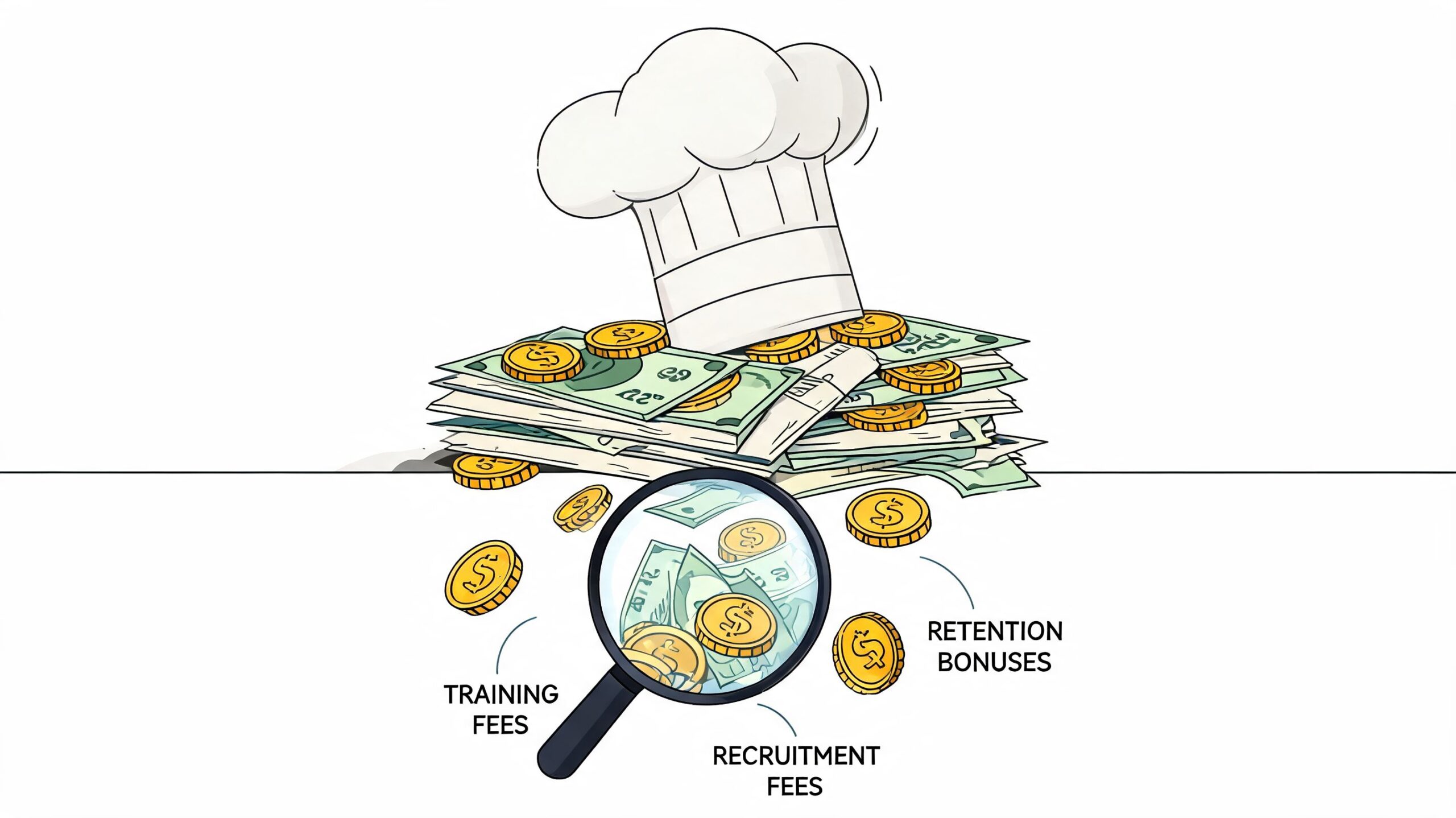
Dorset’s visible salary bands run from Exec Chef roles at £75K down to Commis roles at £33K, with the county average salary at £28.5K. Those figures matter, but they don’t tell you what hiring costs the business.
The salary is only the starting point
When you hire a permanent chef, you’re not just buying labour. You’re committing to the full employment package, plus the time and friction that come with it.
Below the surface, the cost stack usually includes:
- Manager time: Writing adverts, screening applicants, arranging interviews, calling references, and dealing with dropouts.
- Onboarding drag: Induction, menu training, systems training, supplier knowledge, and service integration.
- Operational disruption: Senior chefs spending time training instead of leading service.
- Bad-hire risk: If the person can’t cope, your kitchen pays for it before payroll ever catches up.
For a small pub or hotel, management time is often the hidden killer. Every hour spent chasing applicants is an hour not spent on labour control, GP, guest experience, rotas, or standards.
Slow hiring causes expensive behaviour
When recruitment drags, operators start making poor commercial choices. They cut the menu too late. They overwork the core team. They ask agency staff to plug holes without a clear plan. They keep weak performers because replacing them feels too painful.
None of that is cheap.
A delayed hire can push overtime up, increase mistakes, and make your best chefs question whether they should stay. Once your stronger people start looking elsewhere, the cost of one vacancy spreads into a wider team problem.
The expensive hire isn’t always the one with the highest salary. It’s often the one that takes too long, lands badly, and destabilises the kitchen.
Predictable cost beats drifting cost
A sharper approach is needed from operators. A fixed, transparent staffing solution is often easier to control than a vague permanent recruitment process that keeps dragging on. Predictable cost supports better decisions.
If you’re weighing up the numbers properly, use a full employment view, not just the advertised wage. A useful starting point is this guide to the cost of employing, which helps operators think beyond salary alone.
A better financial question
Don’t ask, “What salary do we need to offer?”
Ask these instead:
- How quickly do we need the gap covered?
- What does delay do to service and team stability?
- Are we solving a permanent need or a temporary one?
- What management time are we burning?
That’s the commercial lens. Chef recruitment Dorset isn’t just a hiring exercise. It’s cost control, risk control, and service protection rolled into one.
A Practical Guide to Vetting and Legal Checks
Plenty of staffing mistakes happen before the chef even starts. A rushed interview, a vague reference, a friendly chat that gets mistaken for due diligence. Then the person arrives, struggles with pace, doesn’t understand the section, or creates a compliance problem you should have spotted earlier.
If you’re hiring chefs in Dorset, vetting can’t be casual. It needs to be systematic.
Start with right to work and identity
This is the first gate, not an afterthought. Check identity documents properly. Check right to work before the shift starts, not halfway through the first week when payroll asks awkward questions.
Make sure your records are organised and current. If you use a temp, freelance, relief, or permanent chef, the principle is the same. No kitchen pressure justifies sloppy checks.
References need to be useful, not polite
A lot of references are worthless because people ask weak questions and accept vague answers. “Would you re-employ them?” is more useful than “Were they good?” Ask about reliability, punctuality, attitude under pressure, food safety, and whether the chef performed the level of role stated on the CV.
Try this structure when speaking to a referee:
- Ask about role reality: Did they work as head chef, sous chef, CDP, or just cover parts of that brief?
- Ask about pressure: Could they handle volume, service pace, and staff management?
- Ask about conduct: Any issues with lateness, walkouts, conflict, or consistency?
- Ask what support they needed: Strong chefs still need induction, but weak chefs often need carrying.
If the referee sounds careful, clipped, or oddly neutral, pay attention. Hospitality people usually speak plainly when they sincerely rate someone.
Technical checks matter more than a polished CV
A chef can interview well and still be wrong for your kitchen. You need proof of competence, not confidence. That means checking practical fit.
For most businesses, the essentials include:
- Food safety awareness: Not just certificates, but sensible working habits.
- Menu relevance: A banqueting chef may not suit a small fresh-food pub. A strong pub chef may not suit a high-end private household.
- Section discipline: Can they prep properly, hand over cleanly, and work without chaos?
- Allergen seriousness: No room for casual thinking here.
- Cleanliness and organisation: Watch their station. It tells you a lot.
Kitchen test: If you wouldn’t trust them to run a busy Saturday without hand-holding, don’t hire them because they interviewed well.
Trial shifts need structure
Many operators waste trial shifts. They bring a chef in, let them potter around, then decide based on whether the person seemed nice. That’s not a trial. That’s theatre.
A proper trade test should show:
- How they set up
- How they communicate
- How they take instruction
- How they work at pace
- How they leave the section
You don’t need to create a circus. You need enough real work to see whether they can function in your environment.
Outsource the risk if you haven’t got time to do it properly
Many independent operators get caught. They know the checks matter, but they haven’t got the hours to do them properly while running the venue. So they cut corners.
That’s dangerous. If you need short-term cover or specialist recruitment support, use a partner that handles vetting before the chef reaches your site. Relief Chefs UK, established in 2013, provides relief chefs, temporary chefs, permanent chef recruitment, yacht chefs, villa chefs, and wider hospitality staffing support with right-to-work checks and pre-vetted chefs as part of the process.
That doesn’t remove your need to brief properly. It does remove a large chunk of hiring risk and admin.
Managing Seasonal Spikes and Emergency Gaps
Dorset doesn’t trade evenly. You know that already. A wet Tuesday in February isn’t the same business as a hot Saturday in August. The problem is that many staffing plans still assume a flat year.
That’s why kitchens get caught out.
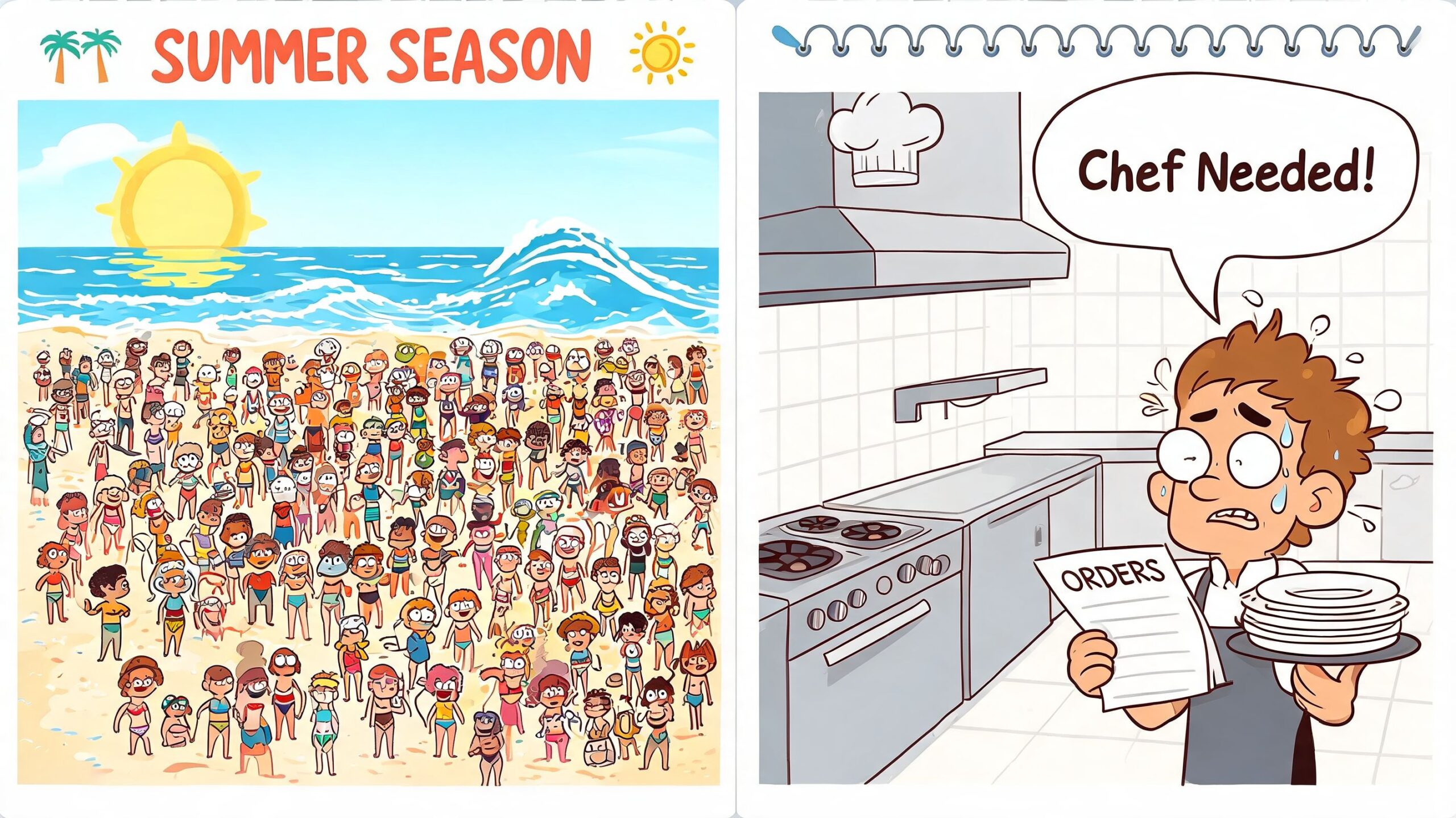
Dorset’s 7.5 million annual visitors drive kitchen staffing needs up by 30-50% between May and September, with 96 chef jobs listed within 5 miles on Caterer.com and 115 within 20 miles on Jobsite. That tells you two things. Demand surges hard. Everyone is recruiting at the same time.
Seasonal pressure breaks static staffing models
If you run a coastal pub in Bournemouth, a hotel in Poole, a food-led inn near Lyme Regis, or a holiday-led operation anywhere on the county’s busy routes, your labour demand shifts quickly. A permanent core team matters, but it rarely covers the whole trading pattern cleanly.
Static staffing models fail because they assume:
- your sales pattern is predictable
- your team availability is stable
- recruitment lead times are manageable
- your kitchen can absorb absence without knock-on damage
That’s fantasy in a seasonal county.
Emergency gaps are a different category of problem
A resignation with notice is one issue. A short-notice sickness call is another. Don’t confuse them.
When a chef drops out suddenly, your choices get ugly fast. The head chef works another double. The menu gets cut. Standards drop. Front of house starts apologising. Or you shut covers and lose trade you were counting on.
That’s why emergency cover should be planned before the emergency happens.
If your only staffing plan starts after someone calls in sick, you don't have a staffing plan.
Build a tiered cover model
The sensible approach is to separate your staffing into layers:
| Layer | Purpose | Typical use |
|---|---|---|
| Core brigade | Maintains standards and culture | Everyday trade |
| Planned flex cover | Supports peaks, holidays, events | Summer, weddings, functions |
| Emergency relief | Protects service at short notice | Sickness, no-shows, walkouts |
temporary chef cover in Dorset becomes operationally useful. Not as a panic purchase, but as part of a proper cover model that keeps the kitchen stable when trade spikes or the rota breaks.
Practical moves Dorset operators should make now
Don’t wait for bank holiday chaos. Do the groundwork earlier.
- Map your pressure dates: Bank holidays, school holidays, weddings, festivals, and major local events should already be in your staffing calendar.
- Flag weak points in the rota: If one sous, one breakfast chef, or one CDP absence would hurt service, that role needs backup planning.
- Decide what flex looks like: You may need relief chefs, temporary chefs, or support while recruiting permanently.
- Brief external cover properly: Menu specs, prep lists, supplier setup, allergens, and service style should be documented before anyone arrives.
The operators who cope best in Dorset aren’t always the ones with the biggest teams. They’re the ones who accept volatility and plan for it.
Why Relief Chefs UK is Dorset's Staffing Partner
In Dorset, a staffing partner has to understand kitchens, not just CVs. That’s the dividing line. If the person supplying chefs doesn’t understand sections, service pace, prep discipline, pressure points, and brigade dynamics, they’re guessing.
That’s why chef-led staffing models work better in hospitality. You need someone who can judge whether a chef is suited for a pub, hotel, yacht, villa, or restaurant, not someone who just matches job titles.
What operators should look for
A useful staffing partner should solve four problems well.
First, speed. A slow response is no help when your issue is immediate.
Second, vetting. You need right-to-work checks, real screening, and confidence that the chef can walk into a live kitchen.
Third, range. Dorset operators don’t all need the same thing. One week it’s a relief sous. Next month it’s a permanent head chef search. Another site may need yacht chefs, villa chefs, or wider hospitality staffing support.
Fourth, clarity. If the pricing, process, and availability are vague, the relationship gets expensive quickly.
Why this matters commercially
A chef shortage doesn’t just create a vacancy. It changes behaviour inside the business. Managers compromise. Teams get stretched. Standards wobble. Guests notice. Strong staff get fed up covering for a broken rota.
That’s why speed and reliability are not “nice to have” in staffing. They are operating requirements.
Relief Chefs UK delivers fully vetted and insured chefs to over 400 UK venues, backed by 60+ years of combined experience. In practical terms, that means venues have a route to short-term cover before service standards fall apart.
Where the model fits best
This kind of support makes the most sense in situations such as:
- Short-notice sickness: When tonight’s service is the problem, not next quarter’s labour plan.
- Seasonal reinforcement: Extra depth during visitor peaks and event periods.
- Permanent recruitment gaps: Temporary support while you search properly instead of hiring in a panic.
- Specialist placements: Yacht chefs, villa chefs, or chefs for higher-expectation private settings.
- Multi-site support: Operators who need consistency across more than one kitchen.
The other reason this approach works is simple. It gives owners room to make better decisions. If service is protected, you can recruit permanent staff carefully instead of grabbing whoever is available.
My blunt advice to Dorset operators
Stop treating every staffing issue as a recruitment advert. Some problems need a permanent hire. Some need temporary cover. Some need both in sequence.
If your kitchen is under strain, the order matters:
- Stabilise service
- Protect the existing team
- Buy time
- Recruit properly
Too many operators reverse that. They advertise first, wait too long, and let the kitchen absorb the damage in the meantime.
Good staffing support doesn't replace management. It gives management enough breathing room to run the business properly.
Relief Chefs UK has been operating since 2013. For Dorset pubs, hotels, restaurants, yachts, villas, and private households, that matters less as a badge and more as a practical point. Established operators usually have a clearer process, wider chef networks, and fewer surprises when things get urgent.
Your Next Step to a Stable Kitchen
Friday dinner service is fully booked. Your sous chef calls in sick at noon. The head chef is already covering prep, the KP is due to finish early, and you still have 90 covers to feed. At that point, slow recruitment is not an HR problem. It is a revenue problem.
That is the mistake many Dorset operators keep making. They judge staffing decisions by wage cost alone and ignore the bigger losses caused by delay. A vacant chef role means slower service, a tired team, weaker standards, poor reviews, wasted management time, and guests who do not come back. The longer you wait for the perfect permanent hire, the more expensive that gap becomes.
So act like an operator, not a hopeful recruiter.
Review your kitchen against these three questions:
- Where does one absence cause immediate service risk?
- Which role requires a permanent hire, and which gap needs fast temporary cover?
- Who can send a suitable chef quickly enough to protect trade?
If you cannot answer those clearly, fix that this week.
The right next step is simple. Stop relying on overtime, favours, and last-minute panic to hold the kitchen together. Put a staffing plan in place that covers both long-term hiring and urgent gaps, so you are not paying for recruitment delays with lost service and burnt-out staff.
Relief Chefs UK can be part of that plan. Have a direct conversation with the team about your pressure points, your rota risks, and how quickly you need cover when a vacancy or absence hits. If you run sites beyond Dorset, in places like Devon, Bristol, Wales, Berkshire, Windsor, Reading, or Slough, the commercial logic stays the same. Stable kitchens come from fast response, clear planning, and fewer expensive surprises.
Frequently Asked Questions About Chef Recruitment in Dorset
What’s the difference between a relief chef and a temporary chef
In day-to-day hospitality use, the terms often overlap. A relief chef usually refers to short-term cover brought in to protect service during sickness, holidays, vacancies, or busy spells. A temporary chef can mean the same thing, though some operators use it more broadly for fixed-term support.
What matters is the brief. Be clear whether you need emergency cover, seasonal reinforcement, or a bridge while recruiting permanently.
Should I hire permanently or use temporary cover first
If the kitchen is already unstable, cover first is often the wiser move. It protects service and stops your permanent team taking the full hit while you recruit. Once the rota is under control, you can assess the permanent role properly.
That’s usually cheaper than rushing a hire who turns out to be wrong.
How quickly should a staffing partner respond
Fast. If your issue is operational, a reply two days later is pointless. You need a clear process, quick communication, and realistic timescales.
The best partners will tell you quickly whether they can help, what kind of chef fits the job, and what information they need from you.
Can a staffing partner help with more than pub and hotel kitchens
Yes. Many hospitality operators now need support across different environments. That can include restaurants, cafés, boutique hotels, private households, villas, and yachts.
The key is using a partner that understands the difference between those settings. A chef who suits a busy food-led pub may not suit a private villa role, and vice versa.
What should I prepare before requesting chef cover
Keep this practical. Have the following ready:
- Shift pattern and dates
- Menu style and service level
- Kitchen team structure
- Site location
- Any accommodation details
- Allergen, compliance, or venue-specific requirements
The better your brief, the better the fit.
If your Dorset kitchen needs reliable chef cover, temporary support, or permanent recruitment help, speak to Relief Chefs UK. You’ll get a straight answer, a practical plan, and support that’s built around keeping service running.
Call the team.
Office 01392 715474 · info@reliefchefs.co.uk