
Temporary Chefs Dorset: Expert Relief for Your Kitchen
3 May 2026

Friday dinner is full. One section is already running lean. Then the phone goes and your chef calls in sick.
If you run a pub, hotel, restaurant, café, yacht kitchen or private hospitality operation in Dorset, that moment isn’t unusual. It’s become part of the job. The main problem isn’t the single absence. It’s what happens next when there’s no plan, no backup and no reliable route to cover.
Most operators start with the same moves. They message old staff, post in local groups, ring around contacts and hope someone decent is free. Sometimes that works. Often it doesn’t. You either get nobody, or you get someone who isn’t right for the section, the pace or the standard your guests expect.
Your Guide to Finding Temporary Chefs in Dorset
A Dorset kitchen can unravel quickly when one chef drops out at the wrong time. It might be a seafront restaurant in Bournemouth with a packed terrace, a village pub heading into Sunday lunch, or a boutique hotel near Lyme Regis with residents expecting breakfast, lunch and a proper dinner service. Once the rota breaks, every other problem arrives at once. Prep slips. Standards dip. The head chef gets dragged back onto a section. Managers start firefighting.

This isn’t just your venue having a bad week. Dorset is a tight hiring market. Recent listings showed 92 temporary chef jobs in the county on Caterer.com, while the Dorset LEP Q1 2024 report recorded 2.8% unemployment among working-age people, falling to 2.2% in Dorset Council, which tells you exactly why vacancies are hard to fill and stay open for longer (temporary chef jobs in Dorset on Caterer.com).
What panic hiring usually looks like
Most rushed hiring decisions follow a familiar pattern:
- The local Facebook post: Fast to publish, slow to produce anyone credible.
- The friend of a friend: Available, maybe. Suitable, unclear.
- The old CV on file: Out of date, not checked, often not interested.
- The desperate compromise: You bring in someone who can cook, but not necessarily at the level your kitchen needs.
That approach feels cheaper in the moment. It rarely is once service starts.
Practical rule: The cost of the wrong temp chef isn't the invoice. It’s the service issues, wasted prep, team friction and the tables you can’t turn properly.
The better route is to treat temporary cover as part of kitchen planning, not a last-minute gamble. Dorset operators who stay steadier through peak periods usually have a system. They know what level of chef they need, how quickly they need them, what information must be checked, and who they call first.
The difference a staffing plan makes
A proper plan doesn’t remove pressure. It stops pressure turning into chaos. If you already know where your backup chef pipeline comes from, your decisions get cleaner. You can protect service, keep permanent staff from burning out and avoid handing your reputation to whoever happens to answer a message.
For venues that need a county-specific staffing route, chef agency support in Dorset is usually more practical than relying on generic adverts alone. It gives you a clearer way to secure cover when the kitchen can’t wait.
Why Finding Good Chefs in Dorset Is So Hard
Dorset has the sort of market that looks attractive from the outside and difficult from the inside. Trade can be strong. Tourism brings demand. Independent venues have character. But those same factors make staffing harder, especially when you need temporary chefs Dorset businesses can trust on short notice.
The first issue is volume. A lot of hospitality businesses are competing for the same pool of chefs at the same time. Existing coverage of the search term often leads straight to job boards, but that misses the underlying problem. What’s underserved is the shortage of relief chefs for independent pubs and boutique hotels during peak tourist seasons, not just the existence of open roles. The pressure is supported by data showing South West hospitality vacancy rates rose 15% year on year in 2025 Q3, while Dorset’s 1,200+ pubs faced 25% higher seasonal turnover than the national average (temporary chef market signals for Dorset and the South West).
A Dorset kitchen needs more than a CV
A busy pub in Bridport doesn’t need a vague applicant who “has restaurant experience”. It needs someone who can walk in, understand the pass, hold timing on mains, keep the grill under control and not fall apart when the ticket rail fills.
A boutique hotel in Sandbanks or a coastal venue in Weymouth often needs a different type of cover. Breakfast service has to be tight. Functions need organisation. Dietary management can’t be sloppy. The chef has to fit the operation, not just the job title.
That’s where job boards often fall short. They show availability, not suitability.
Why ad-hoc hiring fails under pressure
Operators usually run into the same problems when they rely on generic listings or informal contacts:
- Skill mismatch: A chef may be fine on paper but wrong for your menu, section or service pace.
- Weak commitment: Someone who says yes in the morning may disappear by the afternoon.
- No meaningful vetting: Right-to-work, references and reliability are often assumed, not checked properly.
- No fallback: If the booking collapses, you’re back to square one with service still coming.
Dorset doesn’t just need more chefs. It needs more chefs who can arrive, adapt and hold standards without hand-holding.
The local market makes reliability more valuable
The county has a broad spread of hospitality businesses. Village inns, premium pubs, wedding venues, seafront restaurants, hotels, yachts and private households all compete for labour. In places such as Devon, Berkshire, Windsor, Reading and Slough, operators face similar patterns. Seasonal surges expose every weak point in a staffing process. Dorset is no different.
That’s why the core trade-off isn’t agency versus no agency. It’s predictable cover versus unpredictable cover. If you only focus on finding someone available, you miss the bigger question. Can they effectively protect the service you’re trying to run?
The Foolproof Process for Sourcing and Vetting Chefs
Most staffing mistakes happen before the chef ever enters the kitchen. The problem usually isn’t effort. It’s that the process is rushed, inconsistent or based on hope. If you want temporary chefs Dorset venues can rely on, use a repeatable workflow.
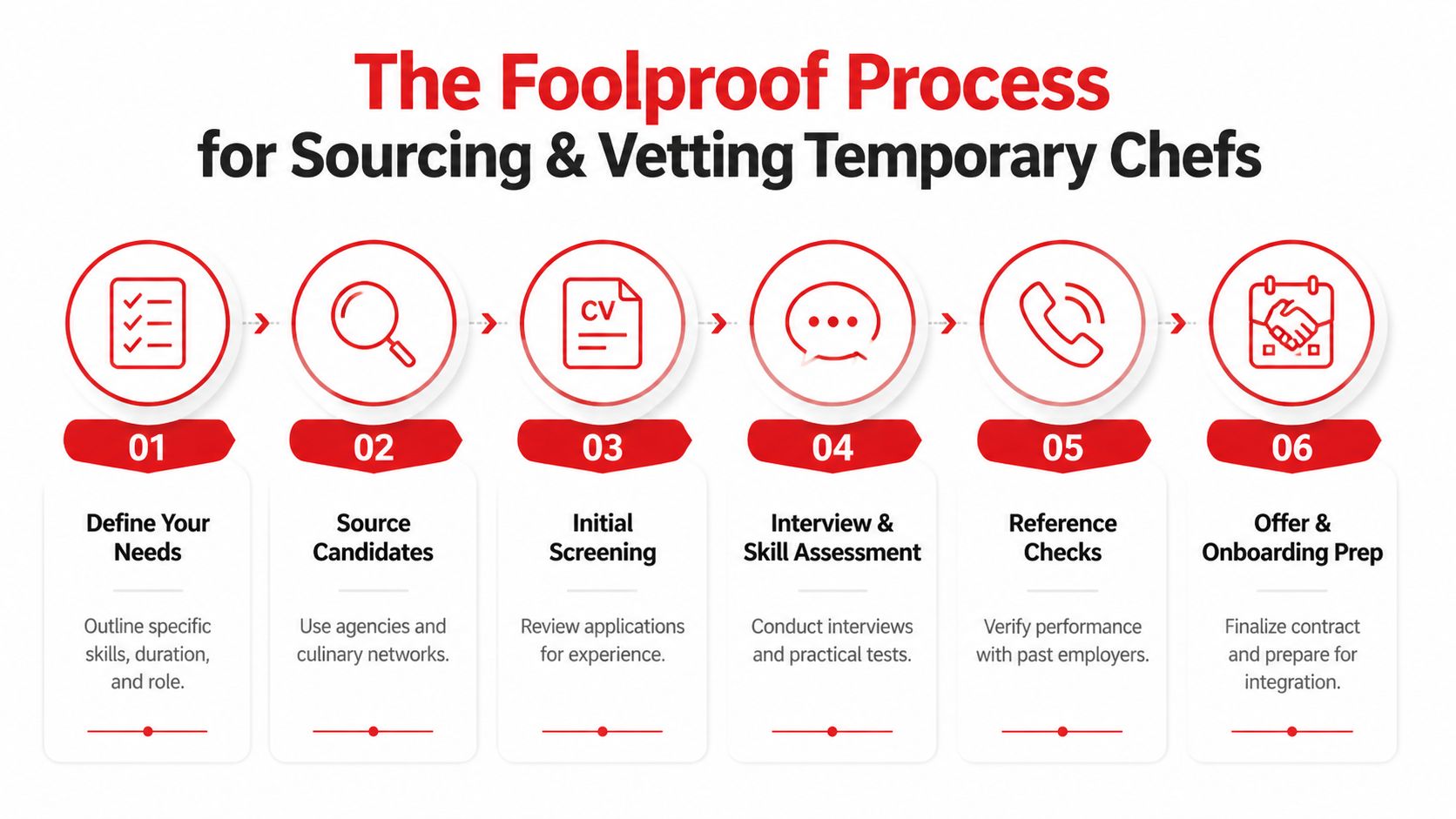
Start with the role, not the shortage
Don’t ask for “a chef”. That’s too vague and it creates bad matches.
Define the actual need in operational terms:
Section and level
Is this a grill chef for volume service, a senior CDP for sauce and garnish, a breakfast chef, a sous-level stand-in, or event cover?Duration
One shift needs a different type of candidate from a two-week block, a holiday cover booking or a rolling weekend requirement.Service environment
Pub food, hotel dining, fine dining, banqueting, yacht catering and private villa work all require different habits and standards.Expected independence
Can this chef be plugged straight into service, or will they need close direction from your head chef?
If you don’t define that clearly, you’ll get broad availability instead of the right fit.
Choose your sourcing route carefully
Not every sourcing method carries the same level of risk. Social media and personal networks can help in a pinch, but they aren’t a system. They depend on luck and memory.
A more structured route usually includes a specialist temp staffing partner, culinary networks, past trusted freelancers and an internal bench of previous cover staff. For operators managing regular demand swings, hospitality temp staff support is usually easier to scale than one-off outreach every time a rota fails.
Here’s the practical difference.
| Method | Strength | Weak point |
|---|---|---|
| Social media post | Quick to publish | Unclear vetting and low commitment |
| Personal contacts | Useful for emergencies | Limited pool and inconsistent availability |
| Job board advert | Broad reach | Slow for urgent shifts |
| Specialist chef staffing route | Better fit and faster filtering | Requires a proper brief from the venue |
Vet reliability, not just cooking ability
A strong CV can still give you a weak shift. What matters is whether the chef turns up, adapts and performs.
A tiered reliability model is one of the clearest signs that the staffing process is built properly. Data on temporary chef staffing shows that a tiered reliability system can produce a 25-30% improvement in attendance rates and a 40% reduction in last-minute no-shows compared with non-tiered agency models. The same benchmark reports 92% first-time match satisfaction in South West England against a 78% industry average (reliability benchmarks for relief kitchen staffing).
That matters because no-show risk is one of the biggest hidden threats in temporary staffing. A chef who’s slightly more expensive but arrives is usually cheaper than the one who doesn’t.
Kitchen reality: Reliability is a skill. If a staffing source doesn’t measure it, you’re taking that risk yourself.
Use a hard vetting checklist
Before confirming any temporary chef, check these points:
- Right to work: This should be verified, not assumed.
- Relevant experience: Ask where they’ve worked and what type of volume, menu style and section responsibility they handled.
- Reference quality: A proper verbal reference tells you more than a forwarded CV.
- Food safety habits: You’re looking for someone who understands standards, not just recipes.
- Availability accuracy: Confirm dates, shift times, travel and start expectations clearly.
- Attitude in pressure: A capable temp chef stays calm, asks the right questions and doesn’t oversell.
One useful test is how they describe service. Good chefs talk specifically. They’ll mention covers, sections, pace, prep systems, allergens, equipment, handovers and standards. Weak candidates stay general.
Match the chef to the site, not the county
Dorset isn’t one market. A chef who suits a high-volume coastal pub may be wrong for a private yacht, and someone strong in events may not suit a breakfast-heavy hotel operation.
When you brief a candidate or staffing partner, include details such as:
- Menu style and service rhythm
- Brigade size
- Whether accommodation is available
- Kit and equipment quirks
- Expected handover level
- Guest profile
That saves time and cuts misfires.
Onboarding a Temporary Chef for Instant Kitchen Stability
A temporary chef can still fail in a good kitchen if the handover is poor. The first hour matters more than the booking form. If your onboarding is rushed, even an experienced chef wastes time finding basic information that should have been ready before they arrived.

Send the brief before they walk in
A temporary chef should know the essentials in advance. That means address, parking, start time, dress expectations, menu style, section, service volume and who they report to. If there’s a breakfast start, a split shift, a function, or a Sunday roast menu that dominates the day, say so early.
Don’t leave basic logistics until arrival. A chef who turns up calm and informed settles faster.
Run a proper kitchen handover
Keep the handover short, but make it useful. A strong fifteen-minute tour is usually enough if it covers what matters.
Include:
- Section layout: Show fridge locations, dry stores, pass, extraction, bins and wash-up flow.
- Equipment notes: Flag anything temperamental, unusual or safety-critical.
- Non-negotiables: Allergens, plating standards, cleaning expectations and ticket communication.
- Prep status: Be honest about what’s done, what’s missing and what service pressure is likely.
A temp chef doesn’t need a lecture. They need the facts that let them work safely and confidently.
Introduce them properly to the team
Some permanent teams get tense when cover comes in. They worry the temp won’t pull their weight, won’t understand the menu, or will create more work than they remove. That attitude changes quickly when the introduction is handled properly.
Set the tone yourself. Make roles clear. Tell the brigade what section the chef is covering, who they answer to and what support is needed in the first part of shift. A clean introduction avoids the cold start that makes handovers clumsy.
Give them one point of contact
Too many kitchens let three people brief the same temp chef in three different ways. That causes mistakes.
Appoint one lead. Usually that’s the head chef, sous chef or duty manager. If priorities change during service, those changes should come from one person. Temporary chefs work best when communication is direct and stable.
Calculating the True Cost and ROI of Temporary Cover
Owners and managers often focus on the day rate first. That’s understandable, but it’s too narrow. The actual comparison isn’t “agency chef versus payroll cost”. It’s “covered kitchen versus exposed kitchen”.
Benchmark data for temporary chef deployment in Dorset shows an 18-22% cost premium over permanent staff but also 35% faster response to peak-season gaps. The same benchmark says blended staffing models of 70% permanent and 30% temp delivered 15% higher profitability for multi-site groups and an 82% reduction in burnout (cost and staffing model benchmarks for chef hiring). That’s the commercial case in plain terms. Paying more for cover can still save money if it protects revenue and stops your core team breaking down.
What understaffing really costs
When a kitchen runs short, the losses usually show up in places operators don’t always total properly:
- Reduced sales: You trim the menu, cap covers or stop taking walk-ins.
- Guest damage: Delays, inconsistent food and complaints hit repeat trade.
- Team fatigue: Permanent chefs work longer and harder, then quality slips.
- Management drag: Senior staff spend time covering gaps instead of running the business.
- Recruitment churn: Burned-out chefs leave and create another vacancy.
That’s why “cheaper” cover often turns out more expensive over a month or a season.
Staffing options compared
| Method | Speed | Cost | Vetting quality | Risk |
|---|---|---|---|---|
| Direct last-minute hire | Variable | Looks lower at first | Inconsistent | High |
| Casual freelancer from a post or contact | Fast if available | Variable | Often unclear | Medium to high |
| Planned temporary chef cover | Faster when process is established | Higher headline cost | Stronger | Lower |
| Permanent-only model with no backup | Slow when gaps open | Lower on paper | Strong when staffed | High during absence or peaks |
What good temporary cover buys you
The value isn’t just labour. Good cover buys continuity.
It keeps your menu live. It protects standards on busy shifts. It reduces the chance that your head chef ends up chained to a section all week. It also gives you breathing room when you’re recruiting permanently, which matters for pubs, hotels and groups that can’t afford rushed hires.
Owner’s view: The invoice is visible. The cost of a broken service usually isn’t, but it’s often bigger.
Risk and compliance matter too
When you bring in anyone to work in your kitchen, you carry practical and legal exposure. You need confidence around right-to-work checks, insurance, site expectations and basic professional standards. Informal hiring routes often leave too much of that sitting with the venue.
A properly run staffing arrangement reduces uncertainty. You’re not just paying for a chef. You’re paying for a cleaner process, better accountability and less chance of being caught out at the worst possible moment.
Your Dorset Temporary Chef Questions Answered
Managers usually ask the same practical questions once they move past the panic stage. Fair enough. You need to know how fast cover can be found, how flexible the arrangement is, and whether temporary chefs Dorset operators book can work across very different environments.
How quickly can cover usually be arranged
The honest answer depends on the level of chef, the shift pattern, the location and how specific your brief is. A broad request with no detail slows everything down. A clear brief moves faster.
If you know the section, start time, expected service, menu style and booking length, your chances of getting the right chef improve immediately. Last-minute cover is always easier when the venue has already decided what “good enough” means.
Can temporary chefs work in yachts and private villas
Yes, but those bookings need a tighter match. Yacht chefs and villa chefs need more than restaurant competence. They often need discretion, flexibility, stronger guest awareness and confidence in smaller or more bespoke working environments.
That part of the market is also growing. A frequently raised question in Dorset is how multi-site groups or yacht companies can build a scalable pipeline of temporary chefs. Industry data linked to that question points to a 20% increase in boutique hotel and yacht staffing via specialist platforms after 2025, alongside 12% growth in Dorset’s coastal tourism, which is one reason demand for vetted ongoing cover has increased (relief chef demand around Dorset groups and yacht operations).
How do you match a chef to a pub or hotel properly
The answer is detail. A good match isn’t based on title alone.
For a pub, you need to know if the pressure sits in grill, fryer, Sunday lunch, desserts or all-day food. For a hotel, you need to know whether breakfast is the pressure point, whether functions are in the mix, and how much autonomy the shift requires. The more specific the brief, the better the match.
What works for multi-site groups
Single-site businesses often think shift by shift. Groups can’t afford to. They need a pipeline.
That usually means agreeing a standing process for cover requests, escalation, role definitions and preferred chef profiles across sites. Planned, recurring cover can work well here because it makes planning easier than buying staffing ad hoc every time a rota collapses. The same applies to larger coastal operations, wedding venues, cafés with seasonal spikes, and premium hospitality businesses that need regular backup rather than emergency-only support.
Is temporary cover only for emergencies
No. The best use of temporary cover is often planned cover. Holiday blocks, menu changeovers, event periods, probation gaps and permanent recruitment delays are all good reasons to bring in support before the kitchen is under strain.
The strongest operators don’t wait for a breakdown. They build resilience before the pressure lands.
If your kitchen needs dependable cover, permanent chef recruitment, or specialist support for pubs, hotels, yachts, villas and hospitality groups, contact Relief Chefs UK. Established in 2013 and run by chefs, not recruiters, Relief Chefs UK helps venues secure vetted relief chefs, temporary chefs and longer-term staffing support without the usual chaos. If you're dealing with sickness, seasonal pressure or ongoing recruitment gaps, get in touch and lock in a staffing plan before the next service tests your team.
Call the team.
Office 01392 715474 · info@reliefchefs.co.uk