
Friday night. Full bookings. Functions running late. The head chef phones in two hours before service with a sickness bug, the sous chef is already covering prep, and the one agency chef you used last time still hasn't sent paperwork. That's how kitchens fall apart. Not because the food is poor, but because one absence lands on a team that was already stretched.
For independent pubs, boutique hotels, restaurants and multi-site groups, kitchen staffing is the weak point that turns a manageable issue into lost covers, guest complaints, refunds and exhausted managers. The wider market isn't helping. UK hospitality vacancies remain at 132,000 open roles, which is 48% above pre-pandemic levels, with over 60% of businesses reporting staff shortages that force reduced opening hours or closures in core areas like chefs and housekeeping, according to UK hospitality staffing trends for 2025.
A proper contingency planning guide for hospitality has to start there. Not with corporate language. Not with theory. With the reality that if your kitchen loses one key chef at the wrong time, the whole operation can wobble.
Introduction Why Every Service Is One Call Away from Disaster
A service rarely collapses all at once. It starts with one gap.
The breakfast chef doesn't show at a hotel in Reading. The CDP in a Windsor gastropub leaves mid-week. A seasonal rush hits a coastal site in Devon and the rota has no slack left in it. Managers then do what managers always do when there's no plan. They ring around, beg favours, cut menu items, move bookings, and hope the team can carry it.
That approach works once. It doesn't protect a business.
Where the pressure lands first
Kitchen instability spreads fast:
- Revenue takes the first hit because you cap covers, shorten trading hours or cancel private dining.
- Standards slip next when tired chefs rush service and simplify dishes on the fly.
- Front of house absorbs guest frustration even when the problem started in the kitchen.
- Good staff start looking elsewhere if every busy week feels like crisis management.
In places like Bristol, Dorset and Wales, the pattern is familiar. Holiday trade jumps. Events fill rooms. The menu stays ambitious. The labour market stays tight. One sick call turns into an operational problem before lunch.
Practical rule: If your kitchen can't lose one key chef without changing service, you already have a contingency risk.
What usually fails in real life
Most operators think they have a backup plan. Usually they have a list of numbers, a few part-timers who might help, and a senior chef who's already doing too much.
What doesn't work:
| Common fallback | Why it fails |
|---|---|
| Ringing general agencies on the day | Availability is uncertain and quality varies |
| Asking existing staff to just cover it | Burnout rises and standards drop |
| Cutting the menu without a plan | Margin and guest experience both suffer |
| Leaving the GM to solve it manually | Response is slow and inconsistent |
A real contingency planning guide starts with one hard truth. In hospitality, chef cover is not a side issue. It's business continuity.
What Contingency Planning Means for Your Kitchen
In kitchen terms, contingency planning means one thing. What happens when a key part of service breaks, and who does what next?
It isn't a dusty folder. It isn't an annual exercise written for insurance and ignored by operations. It's a documented response for keeping the kitchen trading when the plan for the day has already failed.
The official position matters here. The UK Government's National Contingency Plan, published in June 2024, establishes a mandatory national framework for risk management, requiring businesses in critical sectors to maintain documented contingency protocols that include insurance plans and communication strategies, as set out in the UK Government National Contingency Plan guidance.
What that means in a hospitality setting
For a pub, hotel or restaurant kitchen, a contingency plan should answer these questions clearly:
What has gone wrong
Short-notice sickness, chef no-show, supplier failure, equipment breakdown, or an unexpected spike in demand.Who makes the call
Head chef, general manager, operations manager, or duty manager. One owner per incident.What gets protected first
Core service, food safety, guest communication, payroll control, and team welfare.Which backups are approved
Cross-trained staff, reduced menu, temporary chef cover, delayed prep, altered service flow, or a limited booking cap.
The difference between planning and scrambling
A proper kitchen plan is written down and usable under pressure. It should include:
- A trigger point that tells the team when to activate the plan
- Named responsibilities so nobody wastes time deciding who's in charge
- Approved communication steps for kitchen, front of house and senior management
- A staffing fallback route that has already been checked, not invented mid-service
- Insurance and record keeping so decisions are documented if a wider incident follows
Contingency planning is the difference between a bad day and a lost trading week.
What good plans look like
Good plans are plain English, practical and short enough to use during a real shift. One page for chef absence is more valuable than twenty pages nobody will read.
Weak plans tend to be vague. They use phrases like “source agency cover if needed” without naming who contacts whom, what information is required, or how long the business can safely wait before changing service.
A kitchen contingency planning guide should always be built around the operation you run. A forty-cover inn in Berkshire has different pressures from a hotel in Slough, a private villa, or a yacht chef placement. The format can stay simple, but the staffing risks must be specific.
Identifying Your Kitchen's Critical Failure Points
Most venues don't fail because of one dramatic event. They fail because several smaller weaknesses line up on the same day.
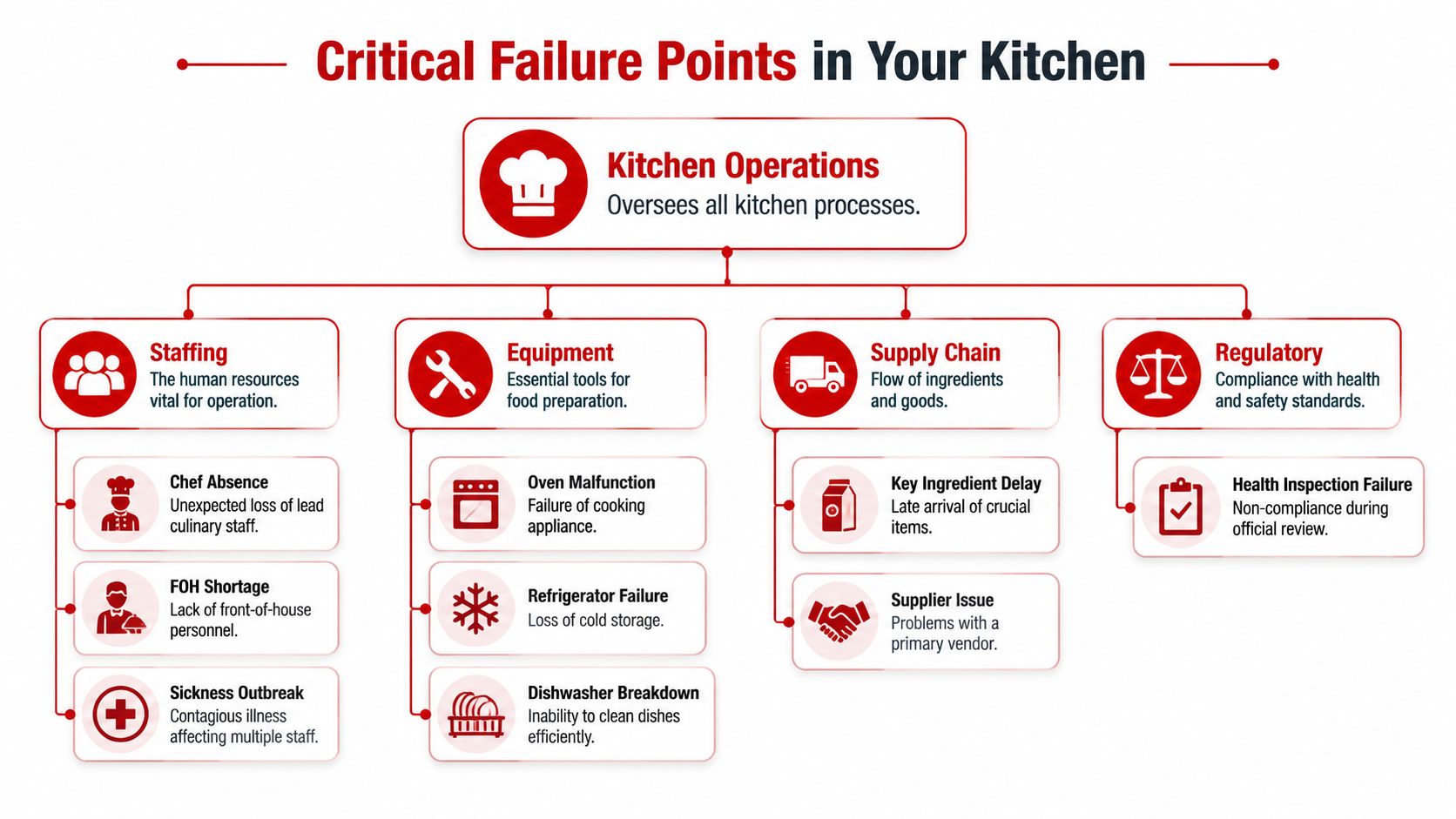
A useful way to assess risk is to stop thinking in broad categories like “staffing issues” and start naming exact failure points. Which absence hurts most. Which supplier can't be replaced quickly. Which piece of equipment changes your whole service model if it goes down.
A formal business impact process sounds corporate, but the operational point is straightforward. A Business Impact Analysis indicates that 65% of UK pubs face operational paralysis if their primary chef pipeline is disrupted for more than 48 hours, according to business continuity guidance for hospitality. That should sharpen your priorities immediately.
Start with your actual points of dependence
In most hospitality businesses, the list looks something like this:
Key chef dependency
One head chef, sous chef or senior CDP carries too much knowledge, too much prep control, or too much pass responsibility.Thin rota design
The schedule works only if nobody is ill, delayed, injured or on emergency leave.Supplier concentration
One butcher, one fish supplier, one produce route. If they fail, menu engineering gets ugly quickly.Single-point equipment risk
One combi, one walk-in, one extraction issue, one dishwasher. Service slows or stops.Compliance exposure
Missing paperwork, weak handovers, unclear allergen control, or no documented cover process.
Use a simple likelihood and impact filter
Don't overcomplicate it. Score each risk by how likely it is and how badly it damages service.
| Failure point | Likelihood | Impact | Priority |
|---|---|---|---|
| Chef sickness before service | High | High | Immediate |
| Weekend supplier delay | Medium | Medium to high | High |
| Oven malfunction | Medium | High | High |
| FOH shortage affecting turn times | High | Medium | Medium |
| Inspection issue from poor records | Low to medium | High | High |
This gives managers something practical. You're not trying to predict everything. You're deciding what must have a pre-agreed answer.
Examples from the ground
A seaside venue in Devon may rank seasonal demand spikes and accommodation-related recruitment gaps as top risks. A boutique hotel in Bristol may worry more about breakfast cover, banqueting peaks and pastry capability. A pub in Dorset may survive with a reduced menu for one night, but not a full weekend without a reliable chef pipeline.
The strongest contingency plans are built around the shift patterns, menu complexity and local labour realities of the site.
The mistake is treating all risks as equal. They aren't. Your primary staffing gap deserves more attention than a remote scenario you may never face. In most kitchens, the first critical failure point is still the same one. Chef cover.
Your Staffing Focused Mitigation and Response Plan
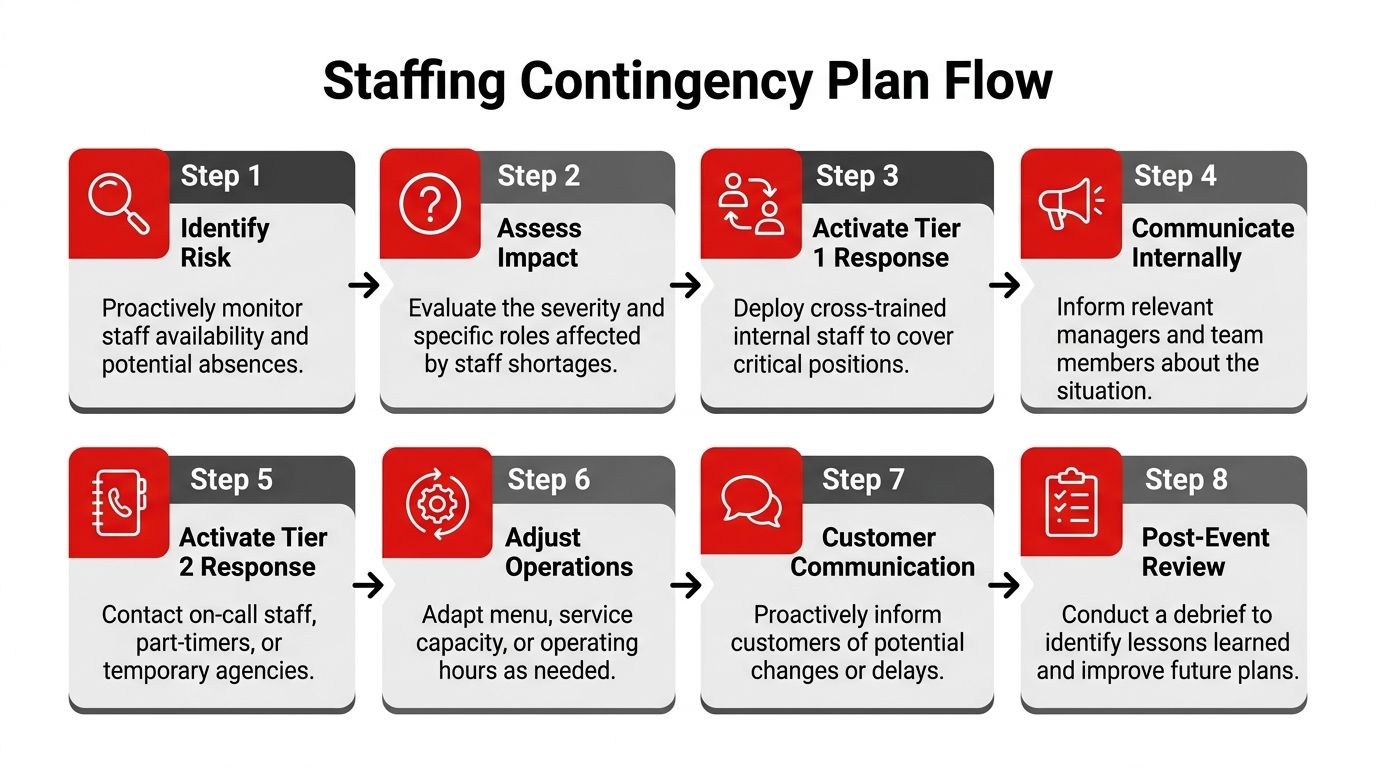
Once you've identified chef absence as the main threat, the next step is to build a response that works at speed. Most kitchens don't need another policy. They need a workflow.
The reason this matters is simple. NIST 800-34 emphasises defined recovery time objectives, but 63% of UK independent pubs report recovery time objectives exceeding 72 hours for chef cover due to a lack of pre-vetted staffing pipelines, according to this practical guide to NIST 800-34 contingency planning. In commercial terms, that's too slow. A kitchen can't sit exposed for three days and call that resilience.
Put this process somewhere the duty team can use it.
Build a two-tier response
Tier 1 is internal stabilisation.
This buys time, not a full solution.
- Move strongest available chef to the critical station
- Strip the menu to dishes the reduced team can execute well
- Pause non-essential prep or specials
- Freeze discretionary bookings if service risk is rising
- Alert front of house early so guest expectations stay realistic
Tier 2 is external chef cover.
In this tier, many operators still lose hours. They haven't pre-set the process, so every call starts from zero.
What your emergency staffing workflow should include
A good staffing response plan should spell out:
Trigger
Chef sickness, no-show, walkout, injury, or confirmed shortage for a peak period.Decision maker
One person authorises external cover. Usually the GM, ops lead or head chef.Venue brief
Site name, role needed, start time, shift pattern, section expectations, accommodation if relevant, and dress or kit requirements.Risk level
Is this a same-day emergency, next-day gap, or multi-week requirement.Operational fallback
Reduced menu, delayed opening, limited covers, or event restructuring if cover isn't confirmed fast enough.Handover pack
Allergens, supplier notes, prep lists, opening and closing routines, and key contact numbers.
For a more detailed operational framework, many hotel teams also benefit from reviewing a specialist hotel staffing guide alongside the contingency plan.
What works and what doesn't
What works is pre-vetted chef cover, right-to-work checks completed in advance, and one contact route that can act quickly. What doesn't work is relying on broad agency lists where every booking becomes a fresh screening exercise.
Short-notice sickness in a Berkshire hotel isn't the same as planned seasonal reinforcement in Wales. One needs emergency deployment. The other needs staffing depth for weeks or months. Your contingency planning guide should cover both, but the process should still be simple enough for a duty manager to activate without debate.
This short walkthrough is worth sharing with your management team when you build the plan:
Operational test: If your team can't source safe, competent chef cover fast enough to protect the next two services, the staffing plan isn't finished.
Building Your Communication and Escalation Protocol
A staffing crisis gets worse when five people assume someone else has made the call.
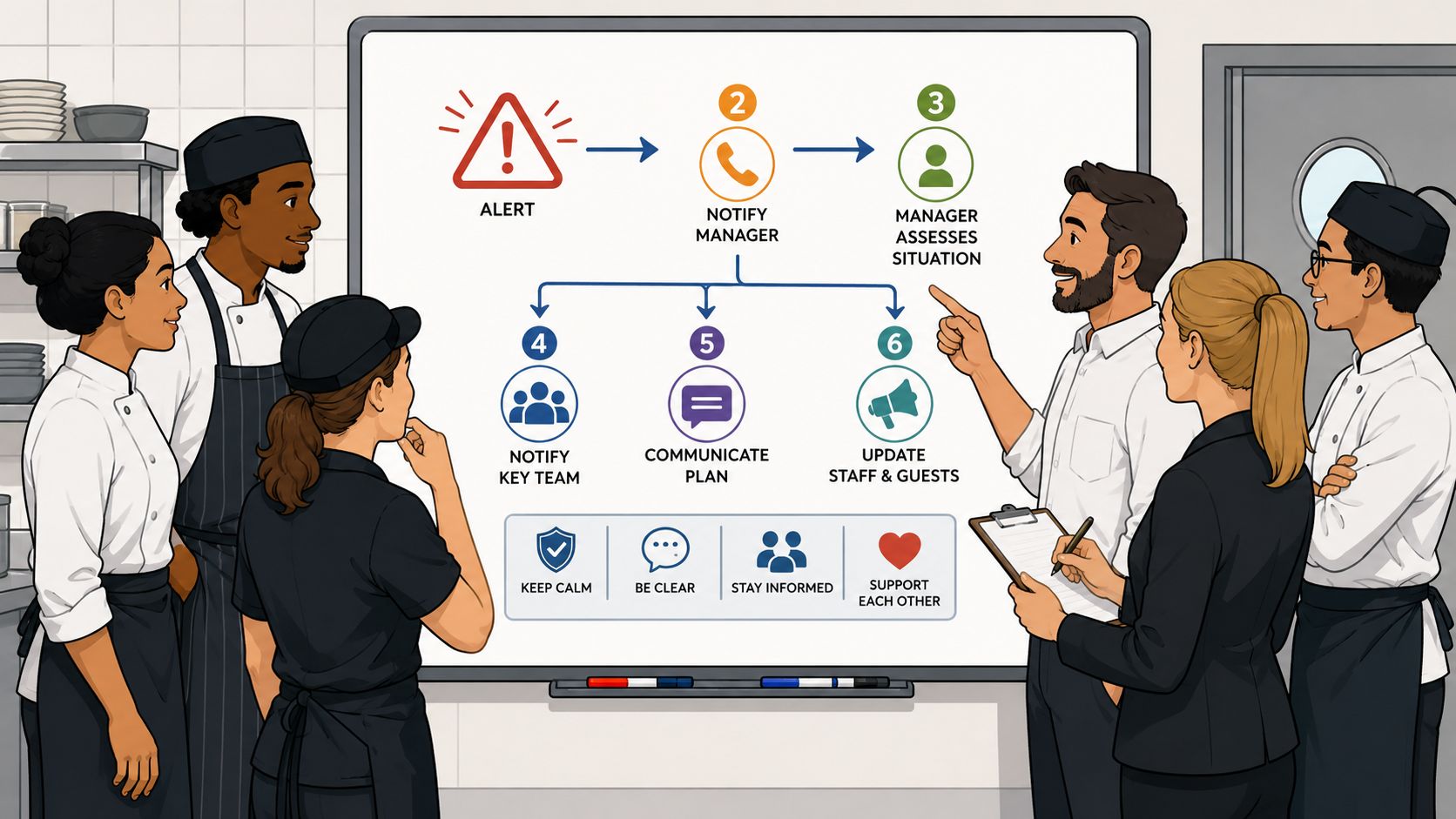
Communication needs to be brutally clear. One trigger. One chain of contact. One escalation route. If the breakfast chef in Bristol calls in at 5.30am, the duty manager shouldn't be deciding from scratch who to notify, what to say, or when to escalate to senior management.
Keep the chain short
The best kitchen escalation trees are small. They don't involve everyone.
A practical version looks like this:
| Incident | First contact | Second contact | Escalation point |
|---|---|---|---|
| Same-day chef sickness | Head chef or duty manager | GM | Ops lead or owner |
| No-show for key shift | Duty manager | GM and FOH lead | External staffing partner |
| Multi-day chef gap | Head chef | GM | Regional ops or owner |
| Full brigade pressure during event week | Head chef | GM | Group support |
What every call should include
Don't let the first five minutes disappear into confusion. Every escalation message should contain:
- Role missing such as breakfast chef, sous chef or CDP
- Shift timing including start, finish and handover pressure points
- Service exposure breakfast, lunch, dinner, banqueting, weddings, events
- Current fallback who is covering now and for how long
- Decision deadline the latest safe time to confirm cover or reduce service
Document the handover before you need it
A relief chef walking into an unfamiliar kitchen needs useful information fast. That means recipe specs, allergen controls, opening routines, prep expectations, and site contacts should already be standardised. A simple handover documentation process saves time and cuts mistakes on the first shift.
Fast cover without proper handover creates a second problem. The kitchen is staffed, but not stable.
Make escalation part of normal operations
The venues that handle disruption best don't treat escalation as a special event. They rehearse it informally through ordinary management discipline. Current rotas are visible. Contact lists are up to date. Managers know when they can reduce the menu and when they need immediate external help.
That's what removes panic. Not optimism. Not goodwill. Process.
Testing Reviewing and Legal Considerations
A contingency plan that hasn't been tested is just paperwork.
Hospitality changes too quickly for static plans. Chefs leave. Menus change. Trading patterns move. A site that was manageable in spring can become fragile by the time Christmas bookings, weddings or summer traffic arrive. The labour market only adds to that pressure. The hospitality sector lost 59,000 workers in the past 12 months according to Office for National Statistics data, making it the worst-hit sector in the UK labour market and necessitating constant updates to staffing contingency plans, as reported in this hospitality labour crisis update.
Test with realistic scenarios
Don't test the plan with vague discussion. Use situations your managers recognise.
Examples:
- Windsor hotel with a chef walkout before a wedding weekend
- Berkshire pub losing its sous chef on bank holiday Friday
- Devon coastal restaurant facing illness across multiple team members during peak trade
- Slough hotel kitchen covering breakfast and banqueting with reduced brigade depth
Run the scenario as a tabletop exercise. Ask the team to talk through each decision in order. Who is called first. When bookings are reviewed. Which menu items are cut. When external support is authorised.
Review triggers that matter
Your plan should be reviewed whenever one of these happens:
- Leadership change in the kitchen or site management team
- Menu redesign that increases section complexity
- Supplier change on core products
- New trading pattern such as seven-day service, events, weddings or seasonal extension
- A failed incident response where the current process clearly didn't hold
Don't ignore the legal and insurance side
A documented contingency plan helps with more than operations. It supports duty of care, shows managers acted in a structured way, and can strengthen your position if an incident creates an insurance issue or formal complaint.
That doesn't mean every venue needs a massive compliance manual. It means your plan should show:
- Who approved the response
- What operational decisions were taken
- How guest safety and food safety were protected
- What communication was sent internally and externally
- What changed afterwards
A tested plan protects service. A documented plan protects the business after service.
The best operators review after every meaningful incident. Not to assign blame. To remove failure points before they repeat.
Downloadable Checklists and Real World Scenarios
A contingency planning guide only earns its keep if the team can use it on a bad day.
That's why checklists beat theory. In practice, managers need one-page tools they can print, keep at the pass, and hand to the duty team without explanation.
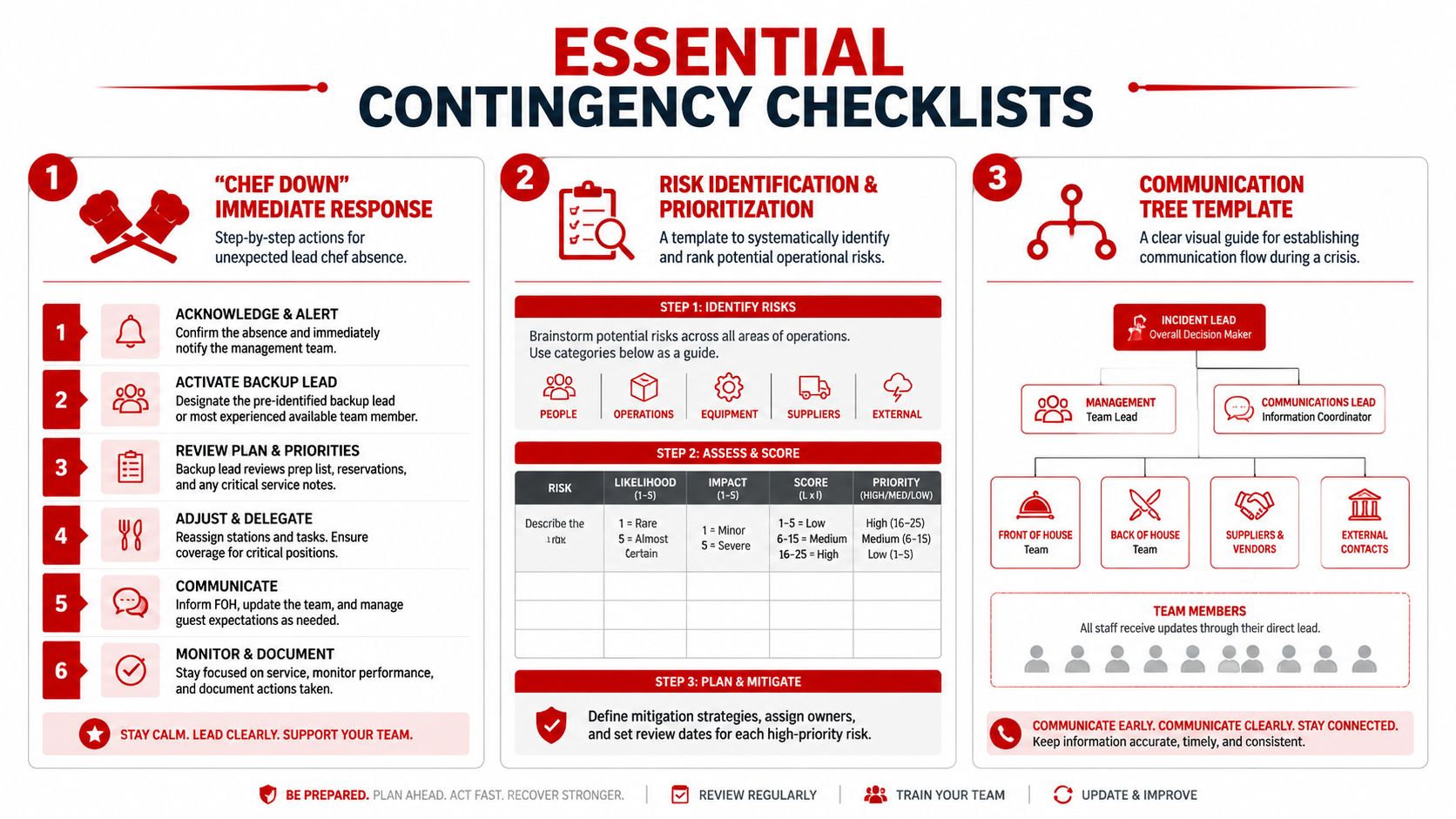
Three checklists worth keeping on site
Chef Down immediate response
This should cover first notification, section reallocation, menu reduction triggers, booking review, and the point where external cover must be called.Risk identification and prioritisation sheet
A simple template that lists your venue's top kitchen risks, likely impact, and approved fallback actions.Communication tree template
Names, mobile numbers, role responsibilities, and escalation order for each type of staffing problem.
For a practical example of what an emergency response can look like in service, this guide to kitchen disasters and emergency relief chef booking is worth keeping in the same folder as your internal checklists.
Real world scenarios managers recognise
A few scenario walkthroughs sharpen the plan better than generic policy writing.
| Scenario | Pressure point | Best response focus |
|---|---|---|
| Sudden sous-chef resignation in a Berkshire gastropub | Leadership gap on pass and prep planning | Protect menu execution and secure experienced interim cover |
| Festival rush in Wales with team illness | Volume increase and rota collapse | Narrow offer, extend prep support, bring in temporary chef capacity |
| Boutique hotel in Dorset losing breakfast cover | Early service risk and guest expectation | Prioritise breakfast continuity and simplify hot line output |
| Private villa booking with chef cancellation | Service quality and client confidence | Replace with specialist cover and tighten briefing documents |
| Yacht departure with last-minute chef issue | Immediate deployment and self-sufficiency | Confirm role fit, provisioning notes and guest dietary brief |
Keep the pack lean
The biggest mistake is overbuilding the paperwork. If your checklist pack becomes a manual, nobody will use it in the moment.
Aim for:
- One-page emergency actions
- One-page contact tree
- One-page role brief for incoming chef cover
- One-page post-incident review form
That gives managers enough structure to act without burying them in administration.
Frequently Asked Questions about Contingency Staffing
How quickly can a venue realistically secure relief chef cover
Speed depends on how prepared the venue is before the crisis starts. If the brief is clear, the handover notes are ready, and the business has already thought through role level, shift times and accommodation needs, response is much faster. If managers start gathering basics after the sickness call, they lose valuable time.
The issue isn't only how fast a chef can be found. It's how fast a safe and workable booking can be confirmed.
What's the difference between a standard temp agency and a specialist chef staffing partner
A general temp agency often works across many sectors and job types. That can be fine for broad labour supply, but kitchen cover is different. You need someone who understands section pressure, service style, pace, food safety, and whether the venue needs a strong breakfast chef, a pub all-rounder, a banqueting chef, a yacht chef or a senior hotel operator.
Specialist chef staffing support is usually stronger when the role is skilled, urgent or operationally sensitive.
What information should a manager have ready before requesting emergency chef cover
Have these details in front of you:
- Site and location including whether accommodation is available
- Role required such as head chef, sous chef, CDP or breakfast chef
- Start date and shift times
- Service style pub, restaurant, hotel, event, private household, villa or yacht
- Menu level and section expectations
- Length of cover same day, short term, seasonal, or permanent backfill
- Essential conditions allergen controls, driving requirement, live-in, or banqueting experience
If this information isn't ready, the booking slows down.
Do temporary chefs really help with kitchen stability
Yes, if they're used properly. Temporary chefs shouldn't be treated as random emergency labour dropped into a broken system. They work best when there's a defined role, a proper handover, realistic menu expectations and clear reporting lines.
Poorly briefed temp cover creates friction. Well-briefed temp cover protects service and buys management time to fix the wider staffing issue.
Should contingency plans cover permanent recruitment as well
They should. A strong contingency planning guide doesn't stop at tomorrow's shift. It should also address what happens if a chef leaves permanently, if a site keeps depending on relief cover, or if seasonal demand exposes a long-term recruitment gap.
That means your staffing plan should account for:
- Immediate emergency cover
- Short-term temporary chefs for continuity
- Permanent chef recruitment where the rota has a structural hole
- Specialist placements for yachts, villas and private households where fit matters as much as skill
How often should the staffing side of the plan be updated
Any time the kitchen changes in a meaningful way. New menu. New head chef. New supplier setup. New event load. New opening pattern. A staffing contingency plan that matched the business six months ago may already be outdated.
Is this only relevant for larger hotels and groups
No. Smaller businesses usually feel chef loss harder because they have less slack in the rota. An independent pub in Devon or a boutique hotel in Reading can be more exposed than a large branded site if too much knowledge sits with one or two people.
That's why contingency planning matters most where the team is lean.
If your kitchen needs reliable cover, permanent chef recruitment, or specialist support for relief chefs, temporary chefs, yacht chefs, villa chefs and wider hospitality staffing, contact Relief Chefs UK. Established in 2013 and working nationwide across hotspots including Devon, Bristol, Wales, Berkshire, Windsor, Reading, Slough and Dorset, they help independent pubs, restaurants, boutique hotels and private clients keep service moving when staffing pressure hits.