
Friday lunch service is looming. Two chefs are already stretched. One's called in sick. Your food order landed higher than expected. Energy bills haven't eased. Front of house is asking whether you can keep the full menu on, and accounts wants a reason margins have slipped again.
This is the situation for a lot of operators in Windsor, Bristol, Reading, Devon, Wales and every other hospitality hotspot trying to keep standards up while costs keep moving in the wrong direction.
Operational cost reduction used to be a finance exercise. It isn't now. It's an operations discipline. The venues that protect margin are usually the ones that know exactly where money leaks out of the business, then fix those leaks without wrecking guest experience, team morale or kitchen stability.
For pubs, restaurants and hotels, the biggest wins rarely come from blunt cuts. They come from tighter labour control, better menu decisions, cleaner supplier management, less waste, and a staffing model that can handle short notice sickness, seasonal demand and the reality of chef shortages across the UK.
Why Operational Cost Reduction Is Now Survival
A lot of operators still talk about cost control as if it's a temporary response to a rough patch. It isn't. It's the new baseline for running a viable hospitality business.
The market is still moving forward. The UK hospitality market is valued at $63.80 billion in 2026 and is projected to grow to $78.28 billion by 2031 at a CAGR of 4.18%, while also facing pressure from rising wages, unpredictable food prices and escalating energy costs. Growth in the market doesn't automatically mean healthy profit at venue level. Plenty of sites are busier on paper and still weaker on margin.
Government support helped many businesses through recovery. Restart Grants, VAT reductions and business rates relief bought some breathing space. That breathing space has gone. What's left is the operator's ability to run a tighter ship than the venue down the road.
Cost reduction isn't the same as cost cutting
Cheapening the offer is usually where managers go wrong. They slash prep hours, overload the remaining chefs, reduce cleaning support, trim menu quality, and wonder why reviews soften and regulars stop spending.
Practical rule: Cut waste first. Protect standards second. Only then look at structural change.
Good operational cost reduction is precise. It asks better questions.
- Which shifts are habit, not demand-led
- Which menu lines drain margin and add complexity
- Which supplier increases have slipped through without challenge
- Which equipment faults are creating hidden labour and energy waste
- Which staffing gaps are forcing expensive firefighting
The venues that cope best tend to build resilience into the operation before the next problem lands. That includes proper rota planning, a shorter menu where needed, disciplined stock control, and a realistic service continuity plan for hospitality operations so one absence doesn't put the whole week at risk.
The real trade-off operators face
The trade-off isn't cost versus quality. It's uncontrolled cost versus controlled cost.
If you don't actively manage labour, purchasing, maintenance and service continuity, the business pays anyway. It pays through overtime, waste, rushed agency cover, broken service, staff burnout and lost repeat trade.
That's why operational cost reduction now sits at the centre of hospitality management. Not in the background. Right at the centre.
Find Your Hidden Cost Drains with an Audit
Most venues already know costs are too high. Far fewer know exactly where the avoidable spend sits. That's why the first move is an operational audit, not a knee-jerk cut.
Run it with your GM, head chef, finance lead and whoever controls rotas and ordering. Don't keep it as a spreadsheet exercise. Walk the building, check the kitchen, review invoices, and compare what the numbers say with what the team does on shift.
Start with where cash leaves the business
Pull the last few trading periods and review spend by category. Don't just look at totals. Look for drift.
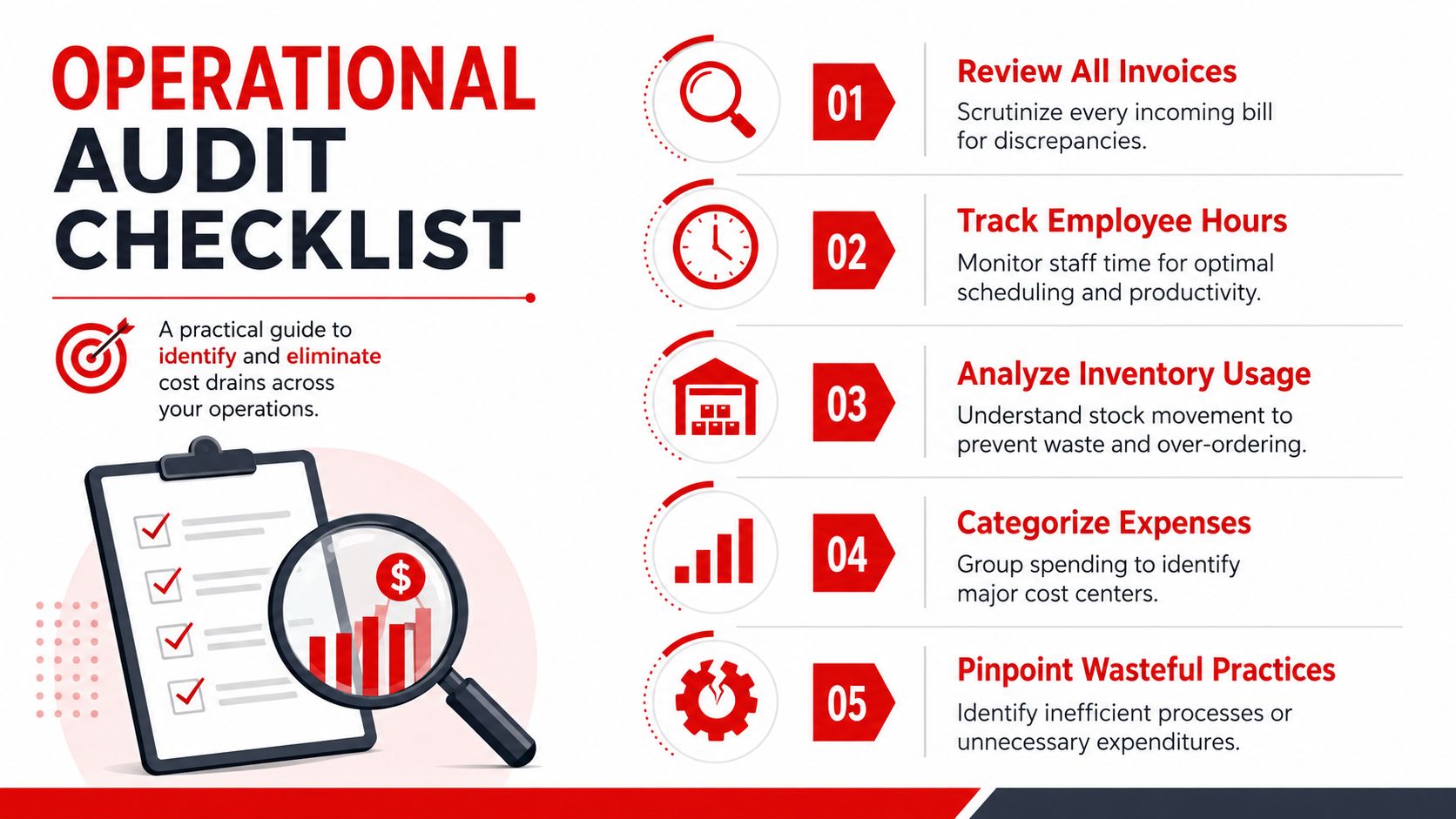
A practical audit should cover:
Food and beverage purchasing
Check for quiet price creep, duplicate suppliers, inconsistent pack sizes, and products bought for one dish that barely sells.Labour deployment
Compare rota hours against actual covers, room occupancy, average spend and daypart demand. Sites often discover they're carrying labour patterns built for last season, not this week.Utilities
Look for spikes in gas, electric and water use. Then ask operational questions. Are extraction systems running too long? Is refrigeration overdue for service? Are lights and kit left on after close?Repairs and maintenance
Separate planned maintenance from emergency fixes. Emergency spend usually signals poor asset discipline, not bad luck.Marketing and subscriptions
Review software, booking tools, listing fees, ad spend and any retained services. Hospitality businesses often keep paying for tools they no longer use properly.
Audit by line, not by feeling
Managers often know something feels expensive. That's not enough. Go line by line.
Use a simple review table like this:
| Cost area | What to check | Common leak |
|---|---|---|
| Labour | Hours vs demand by shift | Overstaffed quiet periods, overtime, cover panic |
| Food | Item sales vs ingredient purchases | Waste, over-ordering, low-margin dishes |
| Beverage | Pour control and stock counts | Shrinkage, weak controls |
| Utilities | Bill trends and equipment usage | Wasteful operating habits |
| Maintenance | Call-out history | Paying for breakdowns instead of prevention |
If an expense repeats every week, staff have normalised it. That doesn't mean it should stay.
What managers usually miss
The hidden drains are rarely dramatic. They're repetitive.
A pub in Berkshire might keep three quiet midweek lunch shifts staffed like a Saturday because “that's how we've always done it”. A hotel in Dorset may carry an overcomplicated breakfast offer that creates waste and extra prep without adding perceived value. A restaurant in Bristol may buy from too many suppliers, which weakens pricing and increases admin.
Look closely at these patterns:
- Menu complexity that drives low-value prep
- Rota templates copied forward without challenge
- Slow stock that ties up cash
- Equipment faults that increase labour time
- Last-minute staffing decisions made at premium cost
Turn the audit into decisions
At the end of the audit, identify your top three cost drains only. Not ten. Three.
Then assign one owner to each issue, one deadline, and one measurable outcome. If nobody owns the action, the audit becomes a filing exercise.
That discipline matters more than the template you use.
Master Your Labour Costs Without Sacrificing Service
If you want serious operational cost reduction in hospitality, labour is where the work starts.
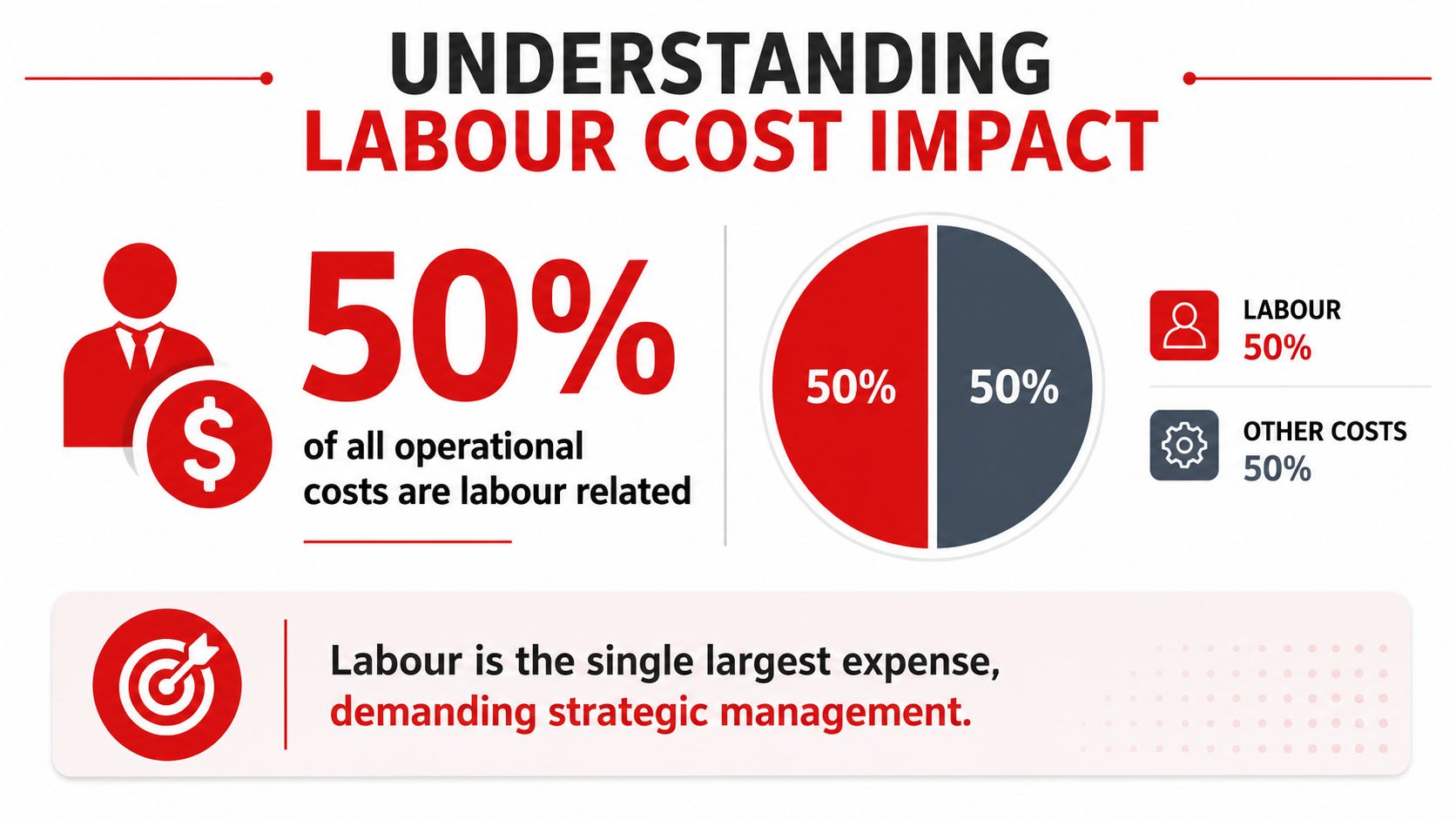
In the UK hospitality sector, labour expenses account for approximately 50% of total operational costs, and 95% of businesses faced rising wage costs in a UKHospitality study. That's why labour planning can't be left to instinct, habit or whatever rota was used last month.
Here's the scale of the issue visually.
Stop treating labour as a fixed block
A lot of businesses still build staffing around what they wish demand will be, not what booking patterns, covers, occupancy and event activity suggest it will be.
That approach causes problems in both directions. You either overstaff quieter periods and bleed margin, or you understaff busy services and pay for it through overtime, comped dishes, poor reviews and team fatigue.
A more disciplined model uses:
- Demand-led rotas based on bookings, historic trade patterns, local events and weather-sensitive trade where relevant
- Cross-trained core staff who can move across service pressure points
- Role flexibility so chefs and kitchen support aren't boxed into inefficient silos
- Planned cover options for holiday, sickness and spikes in demand
The point isn't to run dangerously lean. The point is to stop carrying fixed payroll that doesn't match real trade.
Recruitment churn is a cost centre in its own right
Operators often focus on wages and ignore the wider cost of being short-staffed.
The labour market is still tight. Hospitality vacancies remain at 132,000, which is 48% above pre-pandemic levels, and over 60% of hospitality businesses report staff shortages. Separate reporting also shows the sector lost 59,000 workers in the past 12 months, according to the latest ONS figures cited here.
When a chef leaves, you don't just lose a person. You lose consistency, prep knowledge, shift reliability and usually a chunk of kitchen confidence.
The financial burden is real too. The average cost to fill a single hospitality role in the UK is £6,125, according to the CIPD figure cited here.
That's why permanent recruitment should be deliberate, not rushed. If you hire badly under pressure, you often pay twice.
A fuller breakdown of wages, overhead and employment-related spend helps when you're reviewing your true cost of employing hospitality staff.
What works better than overtime dependency
When the sous chef is off sick at short notice, many businesses fall into the same trap. They ask the remaining team to absorb it. Then they add overtime. Then standards slip by the third double shift.
That might rescue one service. It doesn't build a stable operation.
In practice, the stronger model is a leaner permanent brigade supported by flexible cover when needed. That matters in seasonal locations such as Devon and Dorset, city markets like Bristol and Reading, and tourist-led trade in Windsor and Wales where demand can move quickly.
Later in the week, it helps to show your team what good labour planning looks like in practice.
Flexible staffing is a cost-control tool, not a panic button
Temporary chefs, relief chefs and planned short-term cover often get treated as emergency purchases. That's too narrow.
Used properly, flexible staffing helps you:
| Pressure point | Poor response | Better response |
|---|---|---|
| Short notice sickness | Overtime and menu compromise | Bring in qualified short-term kitchen cover |
| Seasonal demand | Carry excess payroll all year | Scale up only when trade justifies it |
| Chef vacancy | Rush a permanent hire | Use temporary support while recruiting properly |
| Kitchen burnout | Push core team harder | Protect rest days and service standards |
A staffing partner can therefore integrate into the cost strategy, rather than remaining outside it. Relief Chefs UK, established in 2013, provides relief chefs, temporary chefs, permanent chef recruitment, yacht chefs, villa chefs and wider hospitality staffing support across the UK. For operators dealing with kitchen instability, unreliable agency cover, chef shortages or urgent gaps, a flexible staffing model can reduce disruption while avoiding unnecessary fixed payroll.
Operator view: The cheapest shift on paper is often the one that creates the most expensive week.
That's particularly true when an exhausted permanent team starts making avoidable errors, waste rises, prep falls behind, and management spends every day firefighting. Labour control only works when it protects service as well as wages.
Drive Profitability from Your Menu and Suppliers
Labour usually gets the headlines, but poor menu design and weak buying discipline can undo a good rota fast.
A kitchen can be busy and still underperform if it's selling the wrong mix of dishes, carrying too many low-contribution items, or buying in a way that creates waste and inconsistency. Given these challenges, head chefs and GMs need to work from the same numbers.

Trim complexity before you touch quality
A strong menu isn't the longest one. It's the one your team can execute consistently, at speed, with controlled purchasing and minimal waste.
Start with a practical sort of your menu:
Best sellers with healthy margin
Keep them prominent. Train the team to sell them properly.Popular dishes with weaker return
Rework portioning, garnish, sides or ingredient sourcing before removing them.Low-volume, high-complexity dishes
These are often the first candidates to change. They create prep burden, stockholding and waste.Items that don't fit your operation
If one dish requires a separate ingredient chain or specialist prep for very little demand, it's usually costing more than it earns.
A pub menu in Slough, a boutique hotel in Berkshire and a coastal restaurant in Devon won't need the same dishes, but they do need the same discipline. Every line should justify its place operationally.
Build dishes around shared ingredients
This is one of the simplest fixes and one of the most effective.
If your starters, mains and specials use overlapping core ingredients, you make ordering easier, reduce spoilage, simplify prep and steady consistency across the week. If every section of the menu pulls from different products, your fridges become a margin graveyard.
A practical example looks like this:
| Menu issue | Operational effect | Better approach |
|---|---|---|
| One-off ingredients for slow dishes | Waste and over-ordering | Use shared bases across multiple dishes |
| Too many garnishes | Slower service and higher prep | Standardise finishing elements |
| Specials disconnected from stock | More purchasing complexity | Build specials around surplus or existing stock |
Teams that want tighter stock handling should also review disciplined stock rotation methods in hospitality kitchens, especially when multiple chefs and deliveries are involved.
Menus fail financially long before they fail creatively. The warning signs show up in prep hours, waste bins and overfull walk-ins.
Buy better, not just cheaper
Supplier management matters as much as recipe costing.
Start by asking hard questions. Are you splitting orders across too many suppliers? Are you accepting increases without challenge? Are delivery minimums pushing you into overbuying? Are there products you can standardise across sites if you run more than one venue?
A sensible supplier review usually includes:
Consolidating where it makes sense
Fewer suppliers can improve pricing, simplify ordering and reduce admin.Renegotiating terms with evidence
Take actual order history into the conversation. Suppliers respond better when operators know their volumes.Reviewing delivery patterns
More frequent, smaller deliveries may cut waste in some operations. Others benefit from tighter ordering windows and fewer drops.Checking specification drift
Teams sometimes buy premium lines by habit even when guests wouldn't notice a change in non-core products.
An independent pub redesigning its menu often sees the biggest gains not from raising prices, but from removing dishes that create hidden cost, tightening portion control, and buying with more consistency. That's how gross profit improves without making the menu feel mean.
Find Savings in Your Building and Equipment
A lot of managers treat building and equipment costs as fixed. They aren't. They're often just unmanaged.
If your extraction runs longer than needed, fridge seals are poor, taps waste water, or kitchen kit is overdue for service, the building erodes margin daily. None of that feels urgent until a bill lands or a combi fails in the middle of service.
The cheapest decision can be the expensive one
Many operators delay spending because they're trying to save cash. That instinct is understandable, but it often creates a larger cost later.
UK hospitality faces 12% operational cost increases, yet only 15% of venues use capital allowances for energy-efficient tech investments, despite the available savings highlighted here. The same source argues that strategic investment in efficiency tech cuts costs more sustainably than wage cuts.
That matters because energy-efficient equipment, improved controls and better-maintained plant don't just lower waste. They also reduce service disruption.
Quick checks that pay back operationally
Walk the site with your maintenance lead or trusted contractor and check the basics first.
Lighting and controls
Replace outdated lighting with LED where appropriate, and make sure lights aren't running in back-of-house spaces without reason.Water use
Check taps, spray heads, toilets and dishwashing areas for avoidable waste.Refrigeration and seals
Poor seals and neglected condenser maintenance push up energy use and increase failure risk.Extraction and ventilation
Overrun times are often excessive. So is unnecessary usage outside active service periods.
Preventative maintenance protects more than repair spend
The ultimate value of preventative maintenance isn't just avoiding a repair invoice. It's avoiding chaos.
If a key fridge, dishwasher or oven fails during a packed weekend in Bristol or a busy summer stretch in Dorset, the cost isn't only technical. It hits labour, menu availability, service speed and guest satisfaction at the same time.
Spend planned money to avoid unplanned disruption.
Operators should keep a simple equipment schedule covering service dates, recurring faults, expected replacement windows and who signs off action. That's not glamorous, but it's one of the clearest forms of operational cost reduction because it cuts emergency decisions out of the week.
Implement Your Cost Reduction Plan
Most cost plans fail because they ask the team to change everything at once. Keep it simple. Sequence the work.
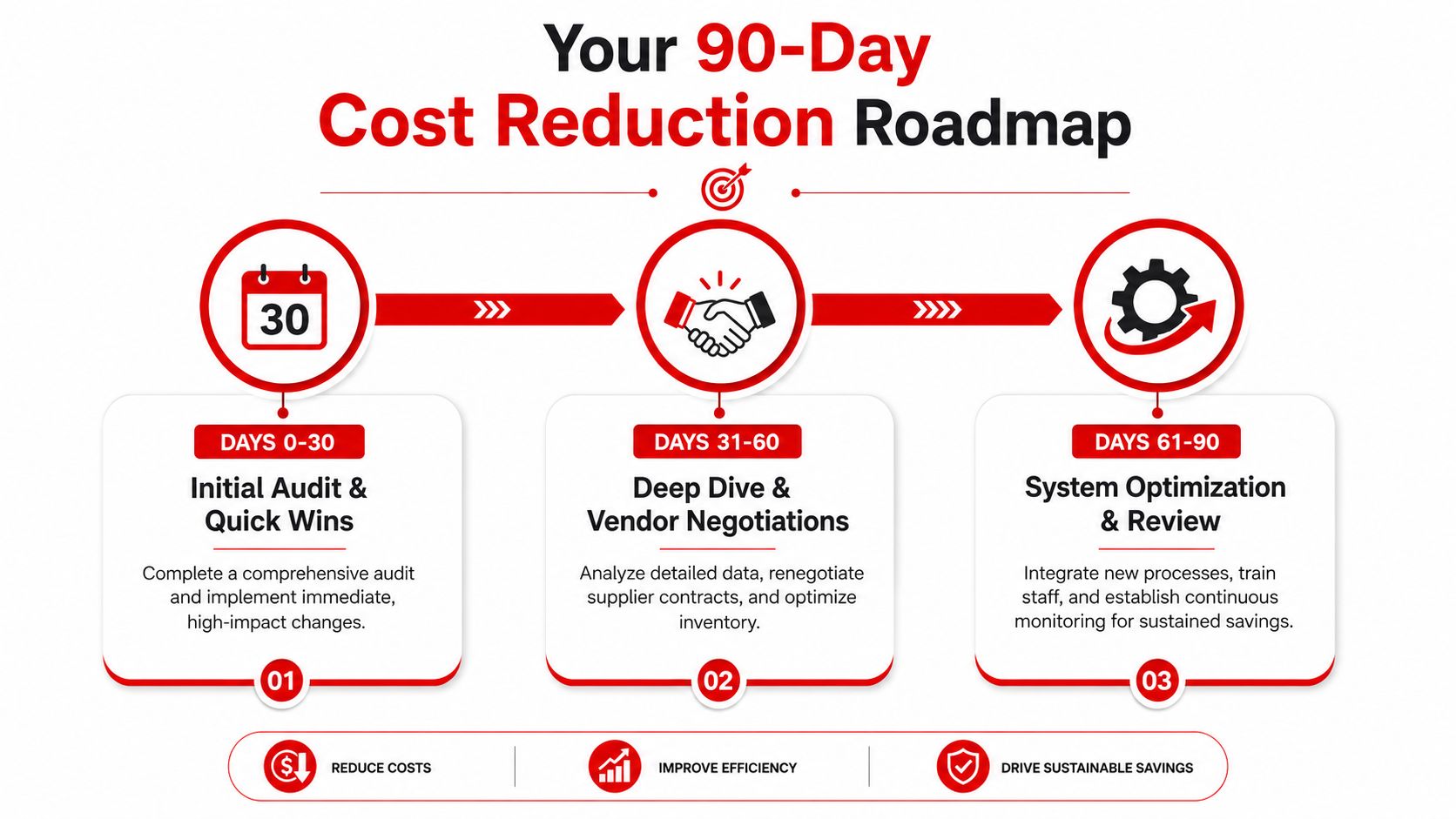
Days 0 to 30
Finish the audit. Identify the three biggest drains. Fix the obvious issues immediately.
That usually means removing dead menu lines, tightening ordering, checking utility waste, and rebuilding rotas around actual trade rather than inherited patterns. Keep a short weekly review with clear ownership.
Days 31 to 60
Focus on labour structure and supplier decisions.
Review where overtime is recurring, where short notice sickness creates operational risk, and where a flexible staffing arrangement would stop service disruption. At the same time, renegotiate with key suppliers, simplify buying, and set stricter controls around ordering and stock movement.
Days 61 to 90
Standardise what worked. Train managers and chefs to hold the line.
Use a small scorecard each week. Track labour cost percentage, waste trends, stock variances, overtime pressure, and whether service standards are holding. If a saving damages service, revise it. If a change improves both control and consistency, lock it in.
A cost plan only works when it becomes part of daily management, not a one-off project. The operators who get ahead are the ones who stop firefighting and put repeatable controls in place.
Common Questions on Hospitality Cost Control
Is a relief chef cheaper than paying overtime
Often, yes in practical terms, especially when overtime starts masking a wider staffing problem.
Overtime can look simpler because it sits inside the existing team. But fatigue reduces pace, accuracy and consistency. You also increase the risk of burnout, absence and eventual turnover. In a busy kitchen, one exhausted senior chef can cost more through mistakes and instability than planned short-term cover.
What should I cut first when margins are under pressure
Cut waste, not quality.
Start with low-selling menu items, duplicated suppliers, poor rota habits, unused subscriptions, unnecessary utility usage and unplanned overtime. Don't start by stripping the guest experience or pushing a thin brigade harder. That move usually comes back as lower spend per head, worse reviews and more recruitment pain.
How do I cope with chef shortages in places like Dorset or rural Wales
Accept that local hiring alone may not solve it.
Some areas face persistent shortages, seasonal surges and smaller talent pools. In those markets, you need a wider staffing strategy that combines better retention, advance planning for peak periods, and access to vetted temporary cover when local availability dries up. That matters for pubs, boutique hotels, private households, yachts and villas that can't afford cancelled service because one key chef drops out.
Should I reduce menu size if I'm short on chefs
Usually yes, if the current menu is stretching the kitchen.
A smaller, sharper offer often improves speed, consistency, stock control and labour efficiency. Guests rarely object to a tighter menu if the execution is strong. They do notice long waits, missing dishes and uneven quality.
If rising costs, chef shortages, short notice sickness or unreliable cover are putting pressure on your kitchen, speak to Relief Chefs UK. They support pubs, restaurants, hotels, private households, yachts and villas across the UK with relief chefs, temporary chefs, permanent chef recruitment and wider hospitality staffing support, helping operators protect service and regain control of operational costs.