
Saturday night is already sliding sideways. A chef's off sick, the new starter on garnish doesn't know the pass rhythm, and the ticket printer has started spitting out orders faster than the section can clear them. By the time someone notices the same mistake has happened three times, the kitchen is no longer fighting the problem, it's fighting the fallout.
That's why so many hospitality teams get stuck. They don't lack effort. They lack a continuous improvement culture, so every service gets treated like a fresh emergency instead of a chance to make the next one cleaner, calmer, and more profitable.
Why Most Kitchens Stay Stuck on Service Night
The classic pattern is simple. A garnish goes missing, a dish is held back, front of house blames the kitchen, the kitchen blames the rota, and everyone resets for the next service without changing the system. That feels normal in a busy pub, restaurant, or hotel kitchen, but normal isn't the same as healthy.
A kitchen that runs on habit can survive a rough shift. It can't keep improving if nobody is responsible for capturing what went wrong and fixing the cause. That's why the same problems keep reappearing, short notice sickness keeps knocking the brigade off balance, and seasonal demand turns into a weekly scramble.
The issue isn't effort, it's structure
Continuous improvement became a formal management priority in the NHS when the NHS Lean Programme launched in 2008. The lesson for hospitality is straightforward, small process gains matter more when a busy operation repeats them every day, week after week, and season after season. KPMG's UK healthcare operational excellence guidance also pushes leaders to build an end-to-end management system, secure senior commitment, use improvement huddles, and measure and report impact early, rather than treating improvement as a one-off project. That mindset fits kitchens perfectly, because a single tweak to prep flow or handover discipline can scale across every service.
The opposite approach is easy to spot. One person remembers the fix, another ignores it, and the venue keeps “solving” the same issue from scratch. That's not improvement, it's memory loss.
Practical rule: if a problem shows up more than once, it needs a process change, not another apology.
Hospitality teams don't need a wall of posters. They need a way to turn recurring pain points into routine learning. In a kitchen, that could mean a tighter line check, a cleaner prep list, or a clearer rule for who calls out a 86 before service starts. Those are small changes, but they reduce noise fast.
What a Continuous Improvement Culture Actually Means in Hospitality
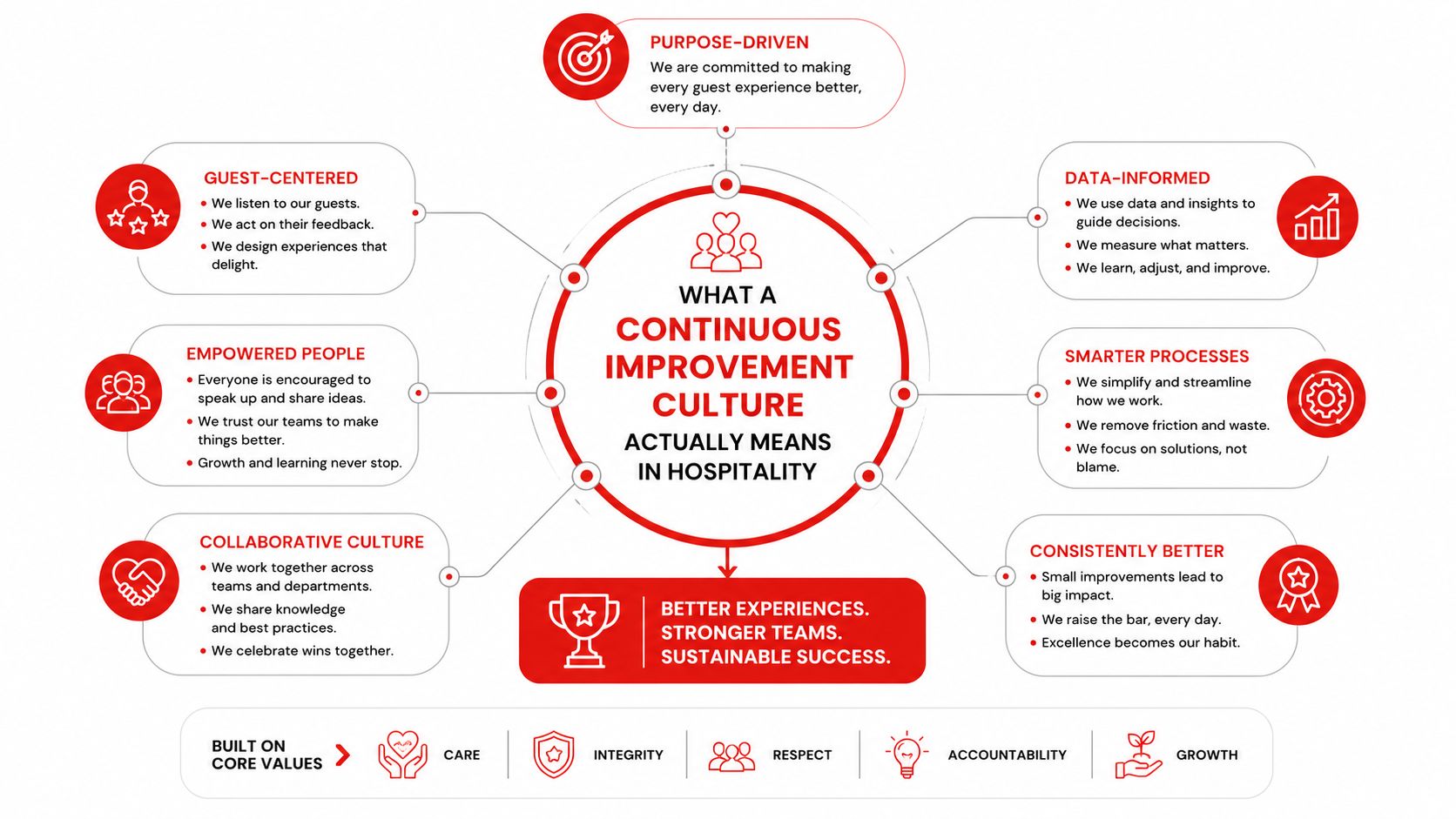
A continuous improvement culture isn't a slogan, and it isn't a certificate on the wall. It's a habit system that helps the kitchen spot friction, test a better way, check whether it worked, then lock it in if it did. In operational terms, it's just repeated small change over time, which is exactly what Kaizen means, “change for the better” (Kissflow's overview of continuous improvement culture).
The useful part for hospitality is that this works on the line, at the pass, and in the office. On the line, it might be cleaner mise en place. At the pass, it might be a different ticket sequence. In the office, it might be a better way to review rota gaps, guest feedback, and recurring kitchen waste without letting the issue drift for a month.
How the loop works in real kitchens
UK organisations that make continuous improvement visible often use a PDCA loop, plan, do, check, act. In practice, that means clear objectives, a pilot on a small area, checking the results against defined indicators, then standardising or correcting the change. The strongest versions keep the pilot narrow, assign management ownership, and define long-, medium-, and short-term goals before scaling (UPCommons research on operational improvement structure).
That matters because kitchens are full of good ideas that die in the gap between “we should” and “we did”. A venue with a mature improvement culture doesn't wait for a perfect relaunch. It tests one section, learns fast, and moves on.
A weak culture behaves differently. It fires off lots of ideas, but nobody checks whether the team can sustain them on a Friday night when the rota shifts. A strong culture keeps the change small enough to survive real service pressure.
A good improvement system makes the work easier to repeat, not harder to remember.
The Business Case Independent Operators Cannot Ignore
Owners and GMs usually don't ask for a theory of improvement. They ask why the kitchen keeps leaking money and goodwill. The answer is usually in the same places, prep overruns, slow ticket flow, avoidable waste, repeat complaints, and the cost of staffing instability when someone phones in sick and the section can't be covered cleanly.
The wider staffing picture matters here. The ONS reported 55,000 vacancies in accommodation and food services in the three months to April 2024, and UKHospitality has consistently described labour shortages and high turnover as structural pressure on the sector. That's not a background issue, it's the operating environment. Standing still gets more expensive when every gap is harder to fill and every bad shift is harder to absorb.

Where the money leaks in a typical venue
A poor improvement culture usually shows up in predictable ways.
- Food waste: prep is built on guesswork, so the fridge fills with overproduction.
- Labour pressure: one weak section makes the whole rota feel tight, which is brutal in a pub, boutique hotel, or restaurant with short notice sickness.
- Guest experience: a messy handover becomes a bad review, and that lingers longer than the service error that caused it.
- Stability: the best chefs burn out when they're constantly rescuing the same broken process.
- Agency dependence: if the kitchen never improves how it onboards people, every temporary chef has to relearn the same basics.
A continuous improvement culture doesn't fix all of that overnight. What it does is expose the biggest leaks early and give the team a method for closing them before they become standard practice.
Commercial truth: if a venue can't keep a section stable, it'll keep paying for instability in labour, waste, and guest complaints.
How to Build a Continuous Improvement Culture Step by Step
The cleanest rollout starts with restraint. Pick two or three priorities that affect service most, then keep the rest parked. In a hospitality setting, that might be prep flow, ticket timing, and handover quality. KPMG's guidance for UK healthcare makes the same point in different words, choose a few priorities and stick to them, because continuous improvement is a multi-year journey, not a burst of enthusiasm (KPMG UK operational excellence guidance).
Visible leadership commitment has to come first. The owner, head chef, sous chef, and FOH lead need to model the behaviour themselves, not delegate improvement to the most organised junior. A practical version is a short daily or shift-end huddle, one place to collect ideas, and one owner for each change. That keeps improvement from becoming a side project nobody has time to chase.
A strong selection rule helps too. Good ideas should be judged against lead time, capacity impact, cost, and implementation ease, then reviewed through a DMAIC-style pipeline with coaching and status tracking (McKinsey on continuous improvement in organisations). That stops teams from chasing the loudest ideas instead of the most useful ones.
Make the pilot small enough to survive service
The fastest way to lose momentum is to launch too much at once. Run the change on one station, one shift, or one menu section first. Assign the right person to own the result, usually the head chef or sous on the kitchen side, with FOH feeding back on what guests are noticing.
A relief chef should be able to walk in, see the current standard, and understand how to contribute. That means the improvement routine can't live only in someone's head. It needs a simple capture process, a visible board or shared note, and a rule that every idea gets reviewed, even if the answer is “not now”.
The last piece is follow-up. Standardise what works, correct what doesn't, and make sure the team knows which change is now the new normal. Without that, the venue becomes the same kitchen with a different story.
If your team is still improvising training, this needs to sit alongside it: chef training and development support.
Keeping Improvement Alive When Half the Team Is Temporary
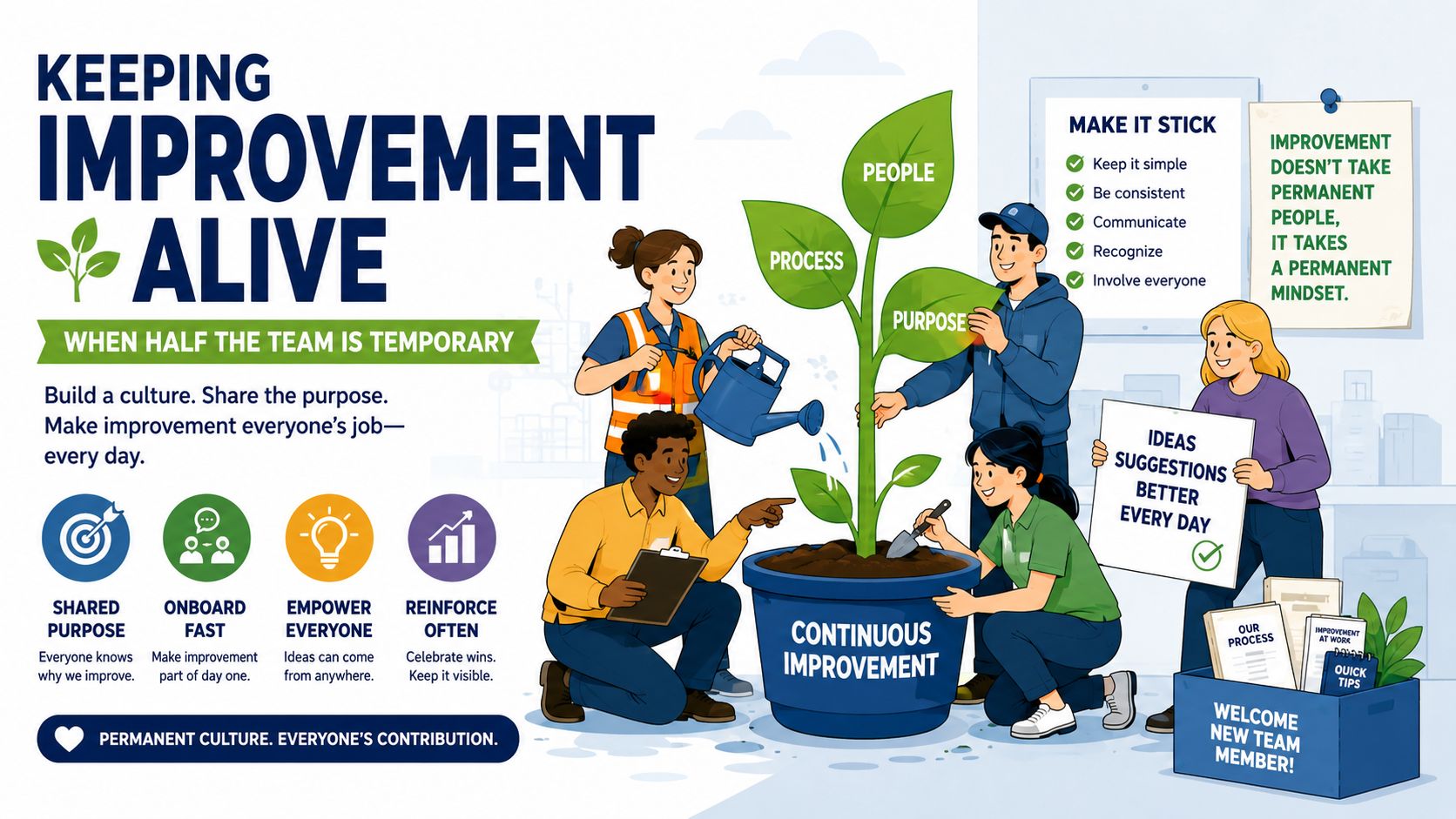
Hospitality is different from a neat office case study. A kitchen can run with relief chefs, seasonal staff, yacht chefs, villa chefs, and new starters landing midweek. If the improvement system only works with a full permanent brigade, it isn't really a system.
The answer is to bake improvement into the handover. Every temporary chef should know three things on arrival, the current standard, the one thing the kitchen is trying to improve, and how to flag a problem without causing friction. That way a chef covering Tuesday service can contribute an idea on Wednesday and still see it reviewed by Friday.
Continuity comes from the cover, not just the culture
Dependable staffing support becomes part of the improvement loop. Relief Chefs UK positions itself as a trusted nationwide chef recruitment agency established in 2013, with fully vetted, right-to-work-checked chefs, a response within two hours, and the ability to start within 48 hours. In practice, that kind of reliability gives a venue a stable base to keep standards moving instead of repeatedly rebuilding the same shift from scratch.
That matters for independent hotels, multi-site groups, and operators across Devon, Bristol, Wales, Berkshire, Windsor, Reading, Slough, and Dorset. It also matters for higher-pressure placements like yacht and villa work, where the team has to absorb new people quickly and still protect standards.
If you're documenting standards properly, this should be attached to handover documentation that actually gets used.
A stable temporary cover pattern does more than fill gaps. It protects the rhythm of improvement, because the team isn't constantly firefighting staffing drift. And when the rota is steadier, leaders can spend less time rescuing service and more time coaching better habits.
Measuring a Continuous Improvement Culture That Actually Works
A kitchen doesn't need a giant dashboard. It needs a short list of indicators that show whether the changes are helping or just creating more admin. The trick is to keep the review brisk, factual, and tied to the shift reality people live through.
The best weekly review I've seen is 30 minutes, standing up, with no theatre. The head chef or GM opens with what changed, the team checks what worked, and then the group decides what to standardise, adjust, or drop. That's enough to keep improvement visible without turning it into another meeting everyone dreads.
| Weekly Continuous Improvement Review Template | How to measure | Target |
|---|---|---|
| Lead time on ticket | Track from order to pass during service | Improve steadily through the week |
| Prep completion by section | Compare planned prep with what's actually ready before service | Full readiness before service starts |
| Waste as a percentage of food cost | Review kitchen waste logs and leftover prep | Lower over time |
| Staff retention at 90 days | Count how many new hires are still in place after onboarding | Stable retention |
| Ideas submitted per week | Record suggestions from kitchen and FOH | Regular participation |
| Percentage closed out | Track ideas completed, standardised, or formally rejected | Close the loop quickly |
| Guest-side metric | Use one review signal, such as online feedback themes | Fewer repeat complaints |
If guest feedback is part of the loop, make it easy to capture and review properly. A simple customer feedback system works better than chasing comments after the fact.
The important point is not the exact template. It's whether the team can see the link between the changes they made and the result they got. If nobody can explain that link, the culture is still a wish, not a working method.
Common Pitfalls and How to Fix Them
The usual failure modes are easy to name. Too many priorities, no visible leadership commitment, ideas that disappear, people hiding mistakes, and no one including temporary staff in the loop. Fix each one by narrowing the focus, assigning one named owner, and making every shift handover carry the current improvement target.
In a Bristol restaurant, the team might blame the Saturday rush for slow tickets, then discover the issue is a prep handover that changes every week. In a multi-site group, managers might collect ideas centrally but never feed the outcome back to the line, so staff stop contributing. One venue learns, the other performs admin.
Key takeaway: a continuous improvement culture only survives when the kitchen can learn faster than it changes hands.
If you're ready to put proper structure around relief chefs, temporary chefs, permanent chef recruitment, or wider hospitality staffing support, contact Relief Chefs UK and build cover that helps your kitchen improve, not just cope.