
Friday night, the bookings are full, the pass is already hot, and then your head chef rings in sick. If you've run a hotel kitchen, a pub group, or a busy restaurant, you know the choice that follows. You either spend the next hour phoning round agencies, repeating the same brief to three different people, or you call one person who already knows your operation, your menu, and the kind of cover you need.
That difference is where a dedicated account manager earns their place. In hospitality, the job is never just answering emails. It's protecting service, keeping the kitchen stable, and making sure the wrong chef doesn't turn a bad day into a lost weekend. Relief Chefs UK, a nationwide chef recruitment agency established in 2013, works in that reality every day, supporting venues with relief chefs, temporary chefs, permanent chef recruitment, yacht chefs, villa chefs, and wider hospitality staffing support.
When Your Head Chef Calls in Sick on a Friday Night
The pressure is never abstract. It's 6 p.m., covers are already arriving, the prep list is only half done, and the person who knows the sauce section best has just gone down with a fever. In one venue, the general manager dials a generic agency line, explains the rota, the menu, the allergens, the pace of service, and the fact that the sous chef is already stretched. By the time someone calls back, the service window is closing.
In another venue, the call goes to a dedicated account manager who already knows the kitchen layout, the style of service, and which chefs have worked there before. The conversation is shorter because the context is already there. Cover can be offered faster, and there's less chance of sending in someone who can cook, but can't fit the room.
Practical rule: crisis cover is rarely won by the biggest database, it's won by the fastest informed decision.
That matters even more when sickness lands on top of seasonal demand, a wedding weekend, or a coastal surge in bookings. A transactional agency may still find you someone, but if every request starts from scratch, you're paying in time, duplication, and stress. For managers dealing with emergency cover, this practical guide on kitchen disaster booking scenarios is worth keeping close.
The test is simple. Can your staffing partner absorb pressure without forcing you to re-explain the basics every single time? If not, you're carrying too much of the process yourself.
What a Dedicated Account Manager Actually Does for Your Kitchen
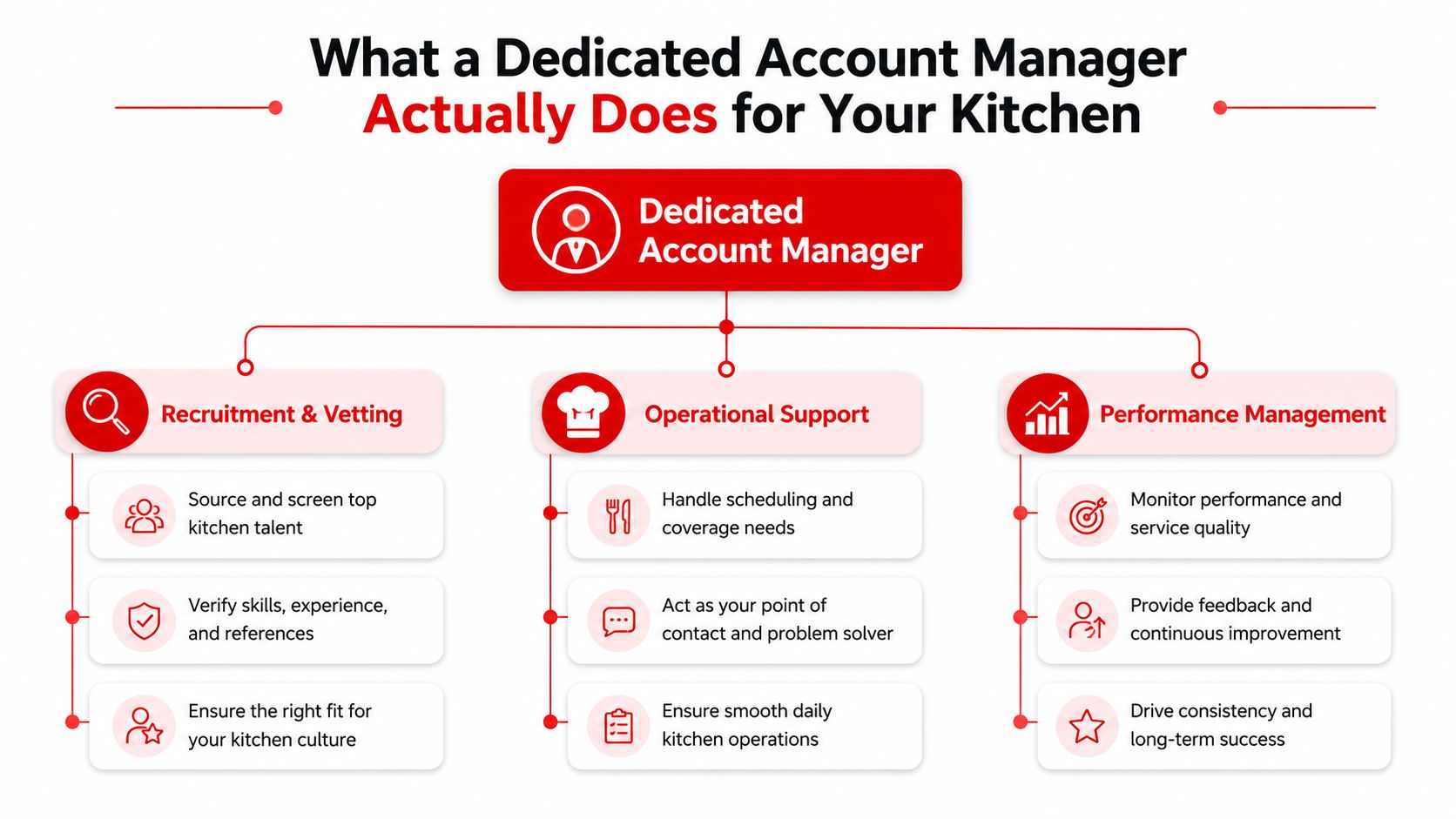
A good dedicated account manager sits between your operation and the chef pool, and that's exactly why the role works when kitchens are under strain. It isn't clerical support dressed up as service. It's a control point for briefings, matching, escalation, and follow-through.
Recruitment and vetting
The first job is knowing who can step into your kitchen and cope. That means understanding whether a chef can handle banqueting, pastry, breakfast service, multi-site travel, or a high-volume grill. It also means knowing who shouldn't be placed there, because the wrong fit costs more than an empty rota slot.
Operational support
The second job is keeping the handover smooth. A dedicated account manager gathers the practical details, comms preferences, team dynamics, and venue-specific quirks, then keeps the information moving without loss. That's where a structured communication cadence matters, because the role is a single point of contact, not a shared inbox. The account manager should also work to clear goals and track progress with SMART criteria, which is a sensible way to keep service measurable rather than vague, as outlined in this guide to dedicated account manager practice.
Performance management
The third job is learning from every booking. If a chef was strong but arrived with the wrong kit knowledge, that feedback should shape the next placement. If a site in Dorset needs seasonal reinforcement, or a hotel group in Berkshire needs continuity across multiple venues, the account manager should build memory around those patterns instead of starting over each time.
A strong provider treats account management as an operating system, not a courtesy. That's why the role also shows up in yacht chef placements, villa work, and multi-site hotel groups, where details change quickly and mistakes travel fast. The account manager's value is not that they “know your name”. It's that they know what has to happen before service starts.
The Real Business Benefits for UK Hospitality Venues
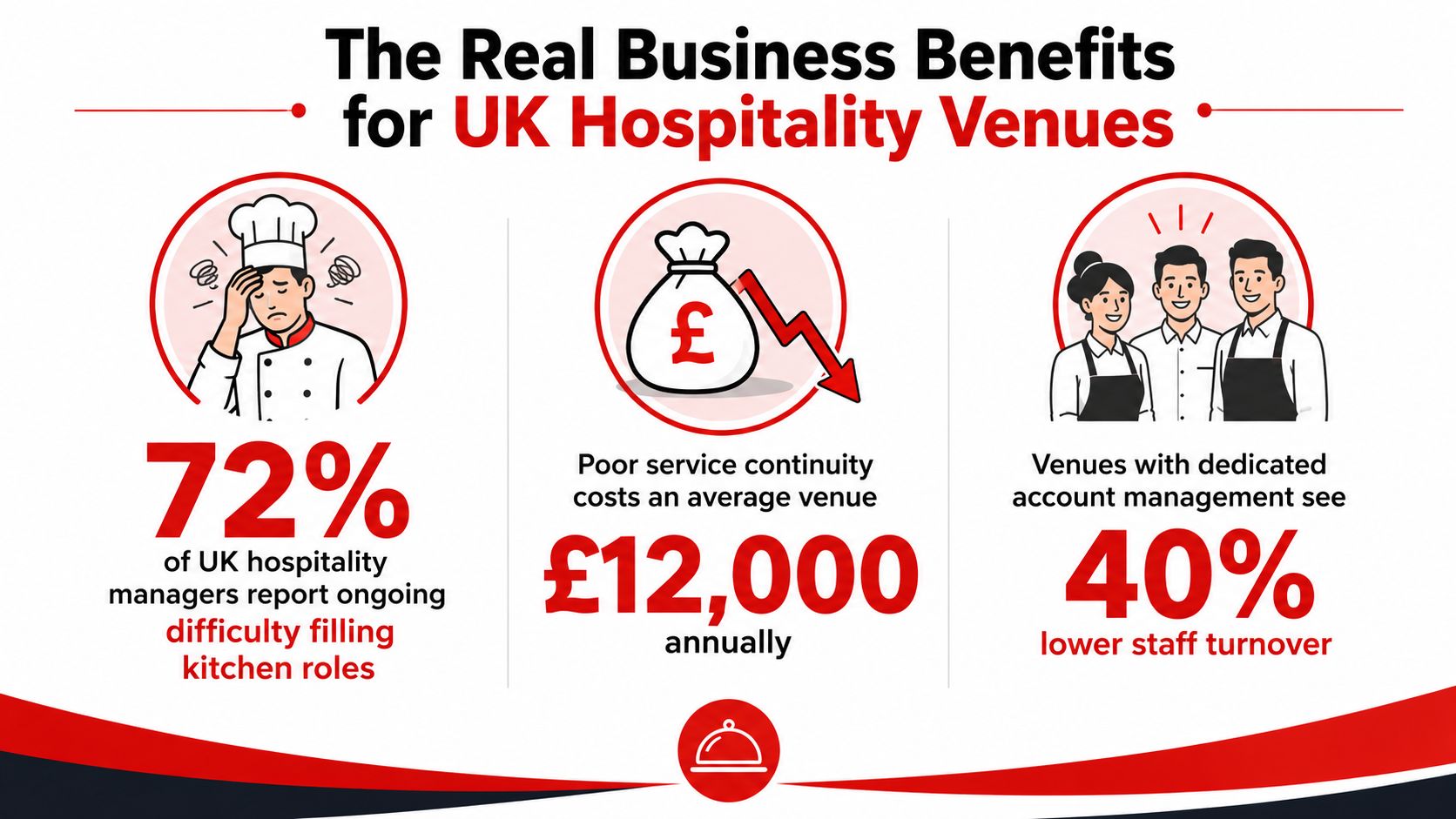
For UK hospitality, the argument for a dedicated account manager starts with pressure, not theory. The Institute of Customer Service reported that poor customer service cost UK businesses £7.3 billion in 2024, and its 2024 UKCSI showed overall satisfaction at 76.1 out of 100, down 0.4 points from January 2024. Those figures explain why consistency matters so much in service businesses, because when the guest experience slips, the financial hit lands quickly, as set out in the industry data on service economics and customer satisfaction.
Hospitality adds its own staffing strain. The ONS reported 32.8 million people in employment in the UK in the three months to May 2024, and the Professional Services sector employed about 4.9 million people in 2023, which gives a sense of the wider labour market pressure around client-facing roles. In parallel, UK service research has found that around 40% of customers are likely to switch providers after a poor service experience, which is why continuity matters in chef staffing too. That same continuity point is reinforced by the operational realities of dedicated account management in hospitality.
A dedicated account manager helps compress decision cycles when kitchen cover is needed within hours, not days. They reduce the repeat brief, cut miscommunication between the venue and the agency, and create one thread of ownership across replacements, escalations, and repeat bookings. For independent pubs, coastal venues in Devon and Dorset, or hotel groups in Bristol and Windsor, that can mean fewer last-minute scrambles and less damage to the relationship with the guest.
A dedicated account manager also helps protect the commercial side of the business. If the same venue keeps seeing cover failures, the hidden cost shows up in management time, lost confidence, and avoidable churn. The strongest agencies don't just send bodies. They reduce friction.
How to Choose a Provider with Genuine Account Management
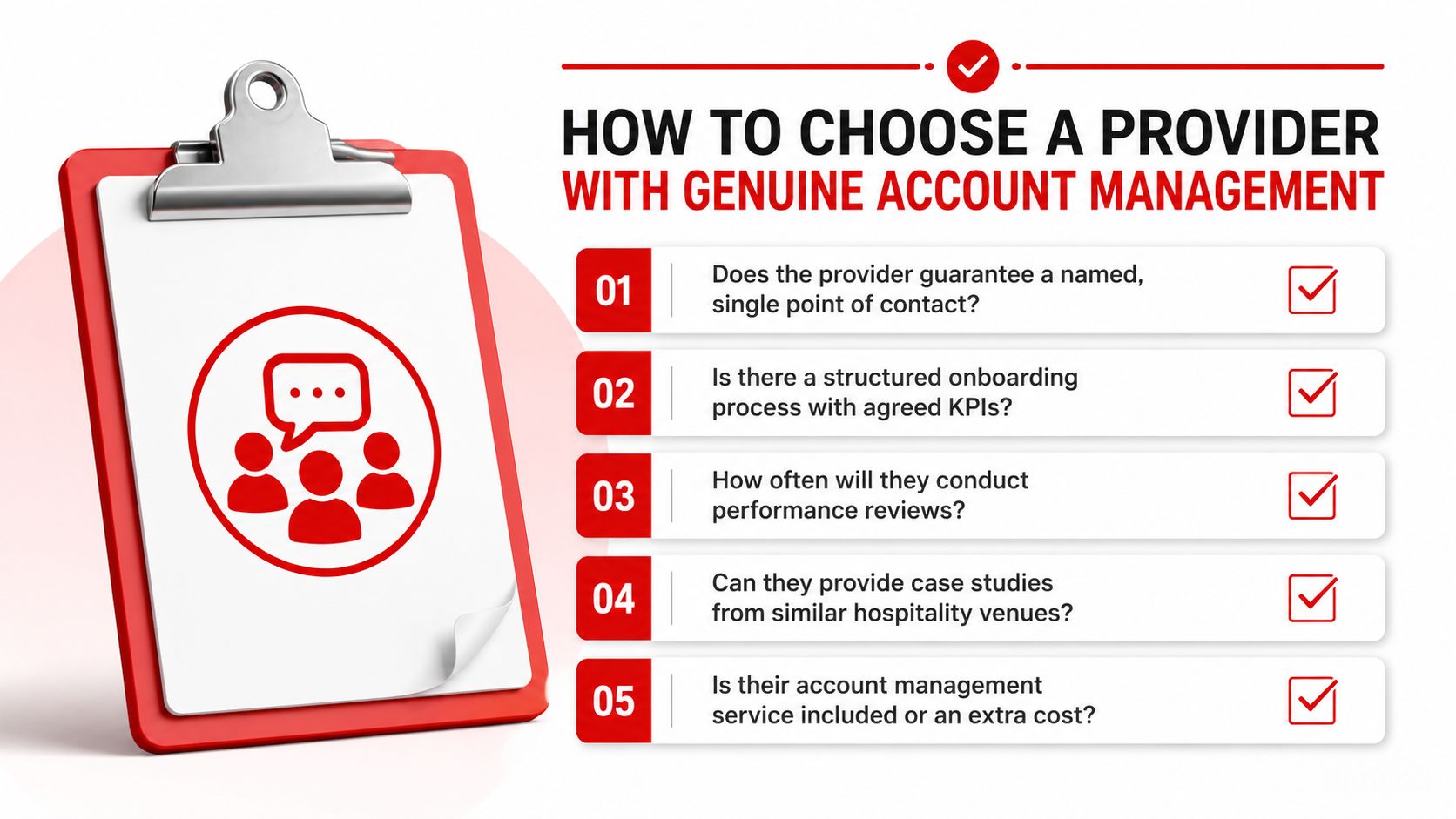
A provider can say it offers account management and still behave like a ticket desk. The difference shows up in the questions you ask before you sign anything.
- Does the provider guarantee a named, single point of contact? If the answer is vague, expect handoffs and repetition.
- Is there a structured onboarding process with agreed KPIs? A real account manager should know what success looks like at your venue.
- How often will they conduct performance reviews? If there's no review rhythm, the relationship will drift into reaction mode.
- Can they provide case studies from similar hospitality venues? A Windsor hotel, a Bristol pub group, and a Dorset coastal venue don't need the same staffing rhythm.
- Is their account management service included or an extra cost? Hidden fees tend to appear where the service is weakest.
The best providers also show local market understanding. That matters in places like Reading, Slough, Berkshire, Wales, and other hospitality-heavy regions, where travel times, seasonal peaks, and venue mix affect what good cover looks like. You want someone who knows that a breakfast chef for a boutique hotel is not the same brief as a pastry replacement for a wedding venue.
A named contact is useful only if that person has authority, memory, and a process behind them.
Red flags are easy to spot once you know what to watch for. Generic email replies, frequent account manager turnover, and a habit of asking the same venue questions every week usually mean the agency is still acting transactionally. If a provider can't explain how it reduces miscommunication, it probably isn't doing the work behind the scenes.
KPIs and Service Level Agreements That Actually Matter
The strongest staffing relationships are measured, not just described. If your provider can't talk in service levels, you'll end up judging them on gut feel, and that's usually how underperformance gets tolerated for too long. The right account-managed service should make expectations visible from the start.
| Service Metric | Standard Agency | Dedicated Account Manager |
|---|---|---|
| Response to cover request | Reactive, often dependent on who answers | Named owner with a clear communication rhythm |
| Venue knowledge | Often limited to the latest booking | Builds memory around menu, team, and site quirks |
| Replacement handling | Ad hoc and request based | Proactive coordination with continuity in mind |
| Review process | Infrequent or absent | Structured reviews with feedback and action points |
| Escalation route | Unclear, especially out of hours | Clear ownership and faster internal escalation |
For hospitality operators, the useful question is not whether a provider sounds responsive. It's whether it can prove a repeatable process. In practice, that means asking for the response window on cover requests, how they handle replacements, and what happens when a chef can't travel or arrives unsuitable for the brief. Relief Chefs UK's Dorset chef agency service sits in this kind of model, where local demand, seasonal pressure, and kitchen fit all matter.
A sensible SLA should also cover monthly reviews, not just bookings. That review should look at the kinds of shifts you needed, where cover landed well, and where the venue had to chase. If the provider is offering flexible monthly plans, the point is not the label, it's whether the service level matches the size and complexity of your operation.
Real Scenarios from Relief Chefs UK Across the Country
A boutique hotel in Dorset heading into a busy season doesn't need a generic promise. It needs someone who understands that bookings, breakfast service, and banqueting can all move at once. With a dedicated account manager, the site brief stays consistent, the right type of chef is prioritised, and seasonal reinforcement is planned without restarting the process for every gap.
A multi-site pub group in Bristol has a different problem. One venue may need short-notice sickness cover, while another wants a steady pipeline for weekend pressure and holiday absences. In that case, the account manager becomes the person who keeps the group's preferences, menu style, and staffing risks organised across sites, rather than forcing each manager to negotiate separately.
An independent restaurant in Devon dealing with repeated call-offs needs speed and reliability. If the same kitchen keeps losing hours to last-minute absence, a transactional agency model usually adds friction instead of removing it. With stronger account management, the relationship becomes more stable because the next booking reflects the history of the last one.
A private household in Windsor looking for vetted villa chefs has a different kind of sensitivity. The fit isn't just culinary, it's about discretion, consistency, and understanding a household rhythm that's much less forgiving than a standard temporary booking. That's where a trusted contact matters as much as the chef itself.
Relief Chefs UK brings 60+ years of combined hospitality experience, 24/7 support, and a two-hour response commitment into that kind of work, with a service model used by 400+ venues across the UK. Those figures matter because they describe responsiveness and scale in real terms, not marketing gloss.
Onboarding Your Account Manager and Measuring ROI
A good start makes the whole relationship easier. The first step is a proper briefing, where the venue shares its menu structure, service style, allergens, team dynamics, and the kind of urgency it normally faces. If you skip that, the account manager is forced to guess, and guesswork is expensive in kitchens.
The next step is access and documentation. Handover notes, rota preferences, and any site-specific expectations should be recorded in one place, which is why clear handover documentation matters so much. Once that's done, the first 30 days should be treated as a calibration period, where the provider learns the rhythm of your business rather than assuming all venues operate the same way.
By the first review, ask two questions. Did communication get faster, and did the chefs match the brief more closely? If the answer is no, the issue is usually not volume, it's lack of clarity. A strong partnership should improve the time you spend coordinating cover, because that time is part of the overall cost.
A simple monthly review should cover:
- What types of cover were needed?
- Where did the process save time?
- Where did the venue still have to chase?
- Which bookings led to repeat requests or repeat problems?
Practical rule: measure the relationship on reduced disruption and better fit, not on friendly emails.
That is the ROI question. If the account manager helps protect bookings, reduces management stress, and gives you a steadier kitchen, the value is operational first and financial second.
Your Next Step Toward Reliable Chef Staffing
A dedicated account manager is worth serious attention when your kitchen can't afford repeated mistakes. It gives you one accountable contact, faster cover decisions, better chef matching, and a more stable service when sickness, seasonality, or agency unreliability hits hard. That's the difference between reacting to disruption and managing it properly.
If you want that kind of support from a nationwide chef recruitment agency established in 2013, Relief Chefs UK works with relief chefs, temporary chefs, permanent chef recruitment, yacht chefs, villa chefs, and hospitality staffing support across the UK. The team is run by chefs, not recruiters, with transparent pricing and no hidden agency fees.
If you're ready to move away from transactional staffing, speak to Relief Chefs UK and ask for a staffing partner that understands real kitchen pressure. You can request cover through the short form or by phone, and get a response that's built around keeping service moving, not adding another layer of admin.