
Boost Hospitality: Staff Training and Development 2026
19 July 2026
You're probably dealing with it now. A chef has called in sick for the weekend. Another left after a fortnight. Service standards are slipping, ticket times are creeping up, and the team you spent time training still doesn't feel settled.
That's the reality of staff training and development in hospitality. It matters. It always will. But training on its own won't rescue a kitchen that's already stretched, short on cover, and firefighting every rota gap from Devon to Bristol, or from Windsor to Wales.
The hard truth is that training only pays off when the business is stable enough to apply it. If the pass is melting down every Friday night and agency cover is hit and miss, the problem isn't just skills. It's operational resilience.
Why Most Hospitality Training Programmes Fail
Plenty of operators still believe the answer is more training. More inductions, more manuals, more shadow shifts, more online modules. That sounds sensible until you look at what happens on the ground.
In hospitality, people often leave before the investment comes back. Staff churn in UK hospitality has reached 75%, meaning only one in four employees remain after 90 days, while training costs have surged 70% in the last decade according to the UK Government's Hospitality and Tourism Workforce Landscape report. If you run a pub in Reading, a boutique hotel in Dorset, or a busy restaurant in Slough, you don't need a report to tell you that. You see it in the rota every week.
Training fails when it's asked to solve the wrong problem
Training is a long game. It builds standards, confidence, and depth in the team. What it doesn't do is fix Saturday night when your sous chef walks out, your commis is still learning the menu, and half the prep list is behind.
That's where many businesses go wrong. They use training as an emergency response when it should be part of a broader staffing plan.
Practical rule: Train for capability, but staff for continuity.
A head chef can teach grill consistency. A good GM can reinforce service standards. Neither can create extra hands out of thin air when two people are off and bookings are full.
The common faults are operational, not academic
Most failed programmes break down in familiar ways:
- No clear target: Staff are told to “improve” without a defined standard for speed, consistency, hygiene, or guest handling.
- Bad timing: Training gets squeezed into the middle of a punishing week, so nobody retains much and everyone resents it.
- No follow-through: Managers deliver a briefing once, then assume the habit has landed.
- No cover plan: Senior team members get pulled off training duties the moment service gets busy.
This is why kitchen stability matters as much as development. A venue with dependable cover can train properly. A venue stuck in constant shortage mode usually can't.
That doesn't mean you stop training. It means you stop pretending training alone will solve chef shortages, short notice sickness, unreliable agency cover, or seasonal pressure.
Conducting a Realistic Needs Analysis
Most training starts too high up. Someone decides the team needs “development”, books a session, and hopes for the best. That's how money gets spent without fixing the underlying weakness.
A better approach is simple. Observe, ask, measure. That works in a city-centre Bristol brasserie, a Windsor pub kitchen, or a coastal hotel in Devon.
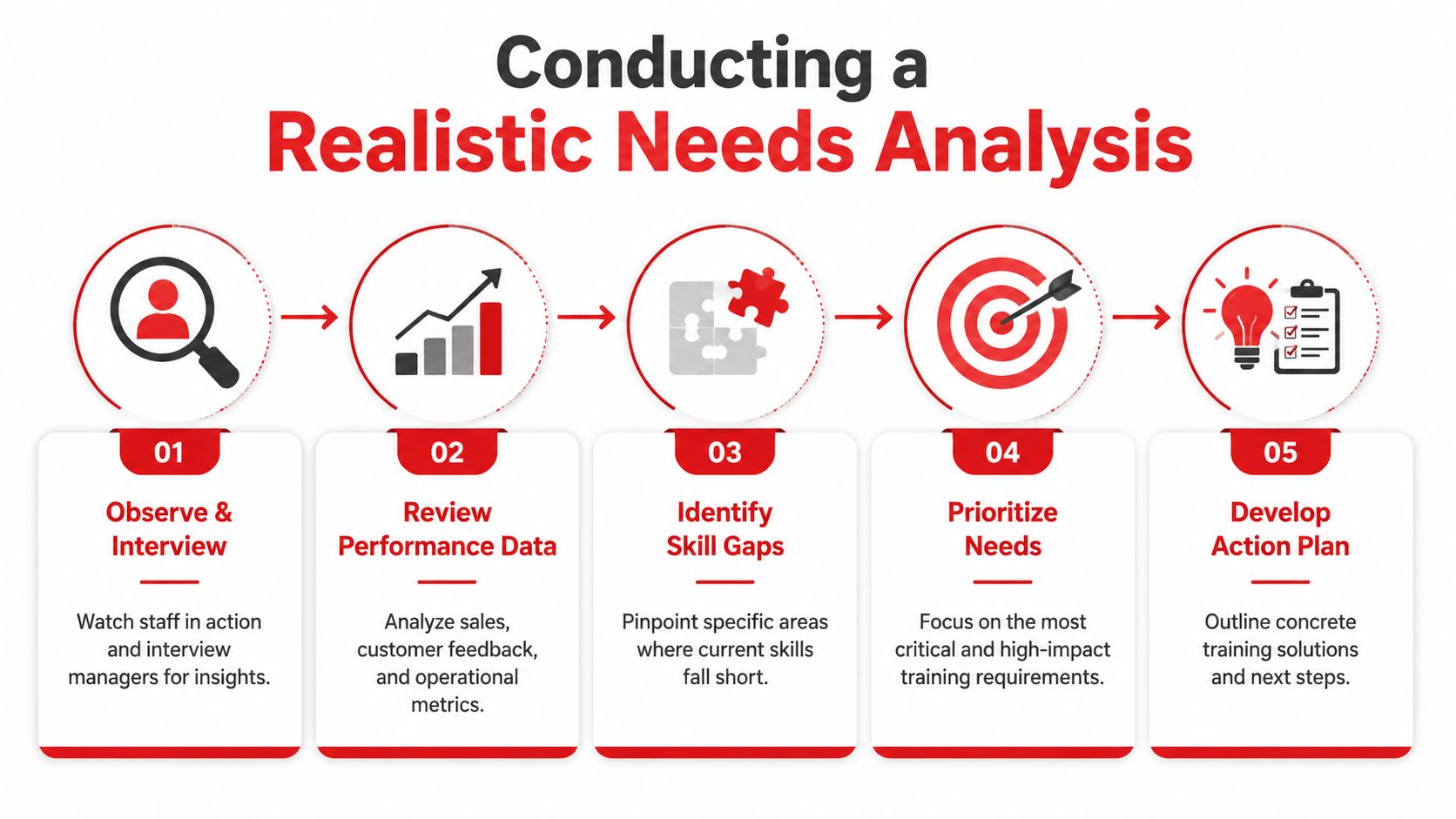
Observe the shift, not the theory
Stand in the kitchen during service and watch what slows the team down.
Is the grill section losing time on setup? Are garnishes inconsistent because prep lists aren't clear? Is FOH struggling to answer allergen questions confidently? Don't start with a training wish list. Start with what's going wrong in live service.
A busy pub in Berkshire may need sharper handover discipline and faster station resets. A boutique hotel in Dorset may need more refined plating, stronger breakfast organisation, or better communication between kitchen and floor.
Ask the people doing the work
You'll get more truth in a ten-minute conversation after service than in a long form no one wants to fill in.
Ask direct questions:
- What part of service feels hardest right now?
- Where do new starters fall behind?
- Which station causes the most stress when one person is missing?
- What do guests complain about that we could prevent?
Good staff usually know where the weak points are. They also know when management is ignoring them.
The best needs analysis is rarely complicated. It's honest, specific, and tied to what keeps going wrong.
Measure what matters in your venue
Many hospitality businesses make a critical mistake in their approach. They measure attendance at training, not whether the operation improved.
According to the Craft Guild of Chefs, 39% of hospitality training initiatives fail, and a key reason is the disconnect between training and the actual needs of the business in the organisation's report on hospitality training failure.
Use operational evidence such as:
- Ticket pressure: Which service periods create the most bottlenecks?
- Waste patterns: Are portions inconsistent or prep levels wrong?
- Guest feedback: Are complaints about speed, temperature, presentation, or staff knowledge?
- Team dependence: Which service falls apart when one senior chef is off?
If you want a practical framework for reviewing weak spots before building a plan, this guide on how to identify skill gaps is worth using with your head chef or operations lead.
A realistic needs analysis doesn't produce a glossy training calendar. It tells you exactly what the team needs to do better next week.
Designing a High-Impact Training Curriculum
Once you know the actual gaps, the curriculum needs to be tight. Not bloated. Not theoretical. Not full of content that looks good in a folder but never changes service.
A useful hospitality training curriculum is built around role, risk, and repeatability. If the skill affects food safety, service consistency, guest confidence, or margin, it goes in. If it doesn't, it can wait.
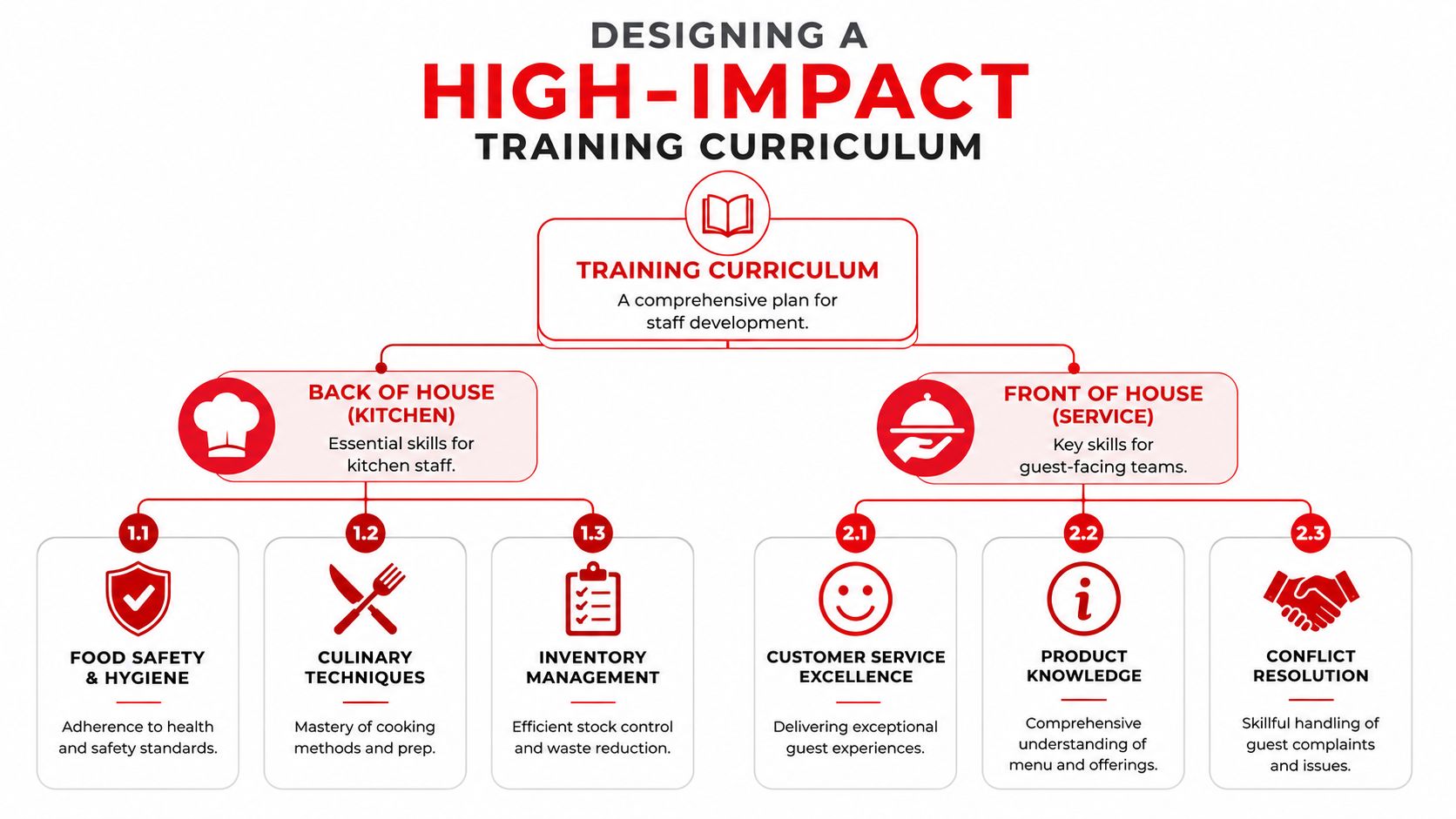
Back of house needs hard standards
Kitchen training should start with the essential elements, then move into performance.
| Area | What good training covers | Why it matters |
|---|---|---|
| Food safety and hygiene | Cleaning routines, storage, temperature discipline, cross-contamination control | Protects guests and the business |
| Section readiness | Mise en place, labelling, prep standards, handover notes | Reduces chaos before service |
| Menu execution | Dish specs, plating order, hold times, finish consistency | Protects quality under pressure |
| Portion control | Specs by dish, equipment use, waste checks | Safeguards margin |
| Speed under pressure | Prioritising tickets, communication on the pass, batch timing | Keeps service moving |
A strong BOH curriculum also includes station-based training. Don't train every chef in the same generic way. A breakfast chef needs pace, organisation, and batch control. A grill chef needs timing, consistency, and communication. A junior chef on larder may need knife work, prep discipline, and presentation.
Front of house training must support service, not script it
FOH training often becomes too polished and not practical enough. Staff don't need corporate lines. They need confidence.
Key areas usually include:
- Service standards: Greeting, pacing, table awareness, and handover between team members.
- Menu knowledge: Ingredients, cooking methods, allergens, and sensible pairings.
- Complaint handling: Calm language, ownership, and when to escalate.
- Upselling with judgement: Recommending well, not pushing badly.
- Communication with kitchen: Calling issues early and accurately.
For venues that want stronger service consistency, it helps to benchmark expectations against clear customer service standards rather than relying on “common sense”.
Cross-training buys you resilience
Astute operators set themselves apart. If one chef calls in sick, the business shouldn't collapse because only one person can close the section or plate the specials.
Cross-training doesn't mean everyone does everything. It means key tasks are shared across enough people that the venue stays functional when the rota gets hit.
Try this approach:
- Primary role first: Make sure each team member is fully competent in their main station.
- Secondary cover skill next: Add one extra skill that helps in a pinch, such as desserts, breakfast, or basic pass support.
- Critical task backup: Train at least one extra person on allergen process, stock handover, and opening or closing routines.
That's how staff training and development becomes useful. It stops being a paper exercise and starts protecting service.
Smart Delivery Methods for Busy Venues
Even a solid curriculum fails if the delivery method doesn't fit the venue. Most hospitality businesses don't have spare afternoons, empty kitchens, or managers with loads of free time. Training has to work in a live trading environment.
Some methods hold up well under pressure. Others look tidy on paper and collapse by week two.
What works in a stretched operation
Structured onboarding still matters. A new starter should know the menu, the section setup, the cleaning standards, the allergen process, and who they report to before they're left to fend for themselves.
Shadowing also works when it's organised properly. Pairing a weaker chef with a strong section lead for a defined task is far better than vague “watch and learn” shifts that teach nothing.
Then there's microlearning. Short, focused bursts on one skill. That might be a five-minute briefing on garnish standards before service, a quick allergen refresher at lineup, or a short pass drill before the weekend.
The strongest internal methods tend to be:
- Tight inductions: One clear checklist, signed off by a manager.
- Buddy systems: A named senior for the first block of shifts.
- Pre-service refreshers: Small, repeated corrections on one live issue.
- Post-service debriefs: What went wrong, what gets fixed tomorrow.
What doesn't work when the rota is already broken
Long classroom sessions usually fail in busy venues. People are tired, distracted, or called back onto the floor. Generic online modules can also become a tick-box exercise if nobody reinforces the learning in service.
Formal apprenticeships can be valuable, but they're not always realistic for smaller operators. For small and medium-sized venues, the administrative burden of apprenticeships is a major barrier to formal training, and a pre-trained talent pipeline is often the most effective solution because vetted chefs can fill skill gaps immediately according to the UKHospitality workforce report.
That matters in independent pubs, cafés, and smaller hotels. If you don't have a training officer, a deep bench, or enough management hours, you need methods that fit the pace of the business.
A temporary chef who can walk in, read the kitchen fast, and hold standards from the first shift isn't just cover. They reduce the training burden on everyone else.
Use outside skill when the gap is immediate
This is the trade-off many operators avoid admitting. Internal development is slower but valuable. Pre-vetted temporary support is faster and often safer when the need is urgent.
If the issue is long-term succession, build your own people. If the issue is next weekend, the answer is usually experienced cover.
That logic applies across hospitality staffing support, whether you need relief chefs for a country house hotel in Wales, temporary chefs for a seaside operation in Devon, or specialist support such as yacht chefs, villa chefs, or permanent chef recruitment for a growing group.
Measuring Training Success and True ROI
If you can't show what changed after training, you haven't managed training. You've just delivered it.
That's one of the biggest weaknesses in hospitality. Managers know money and time were spent, but they can't prove whether standards improved, waste dropped, complaints reduced, or service ran smoother.
A simple visual can help keep the right measures in view.
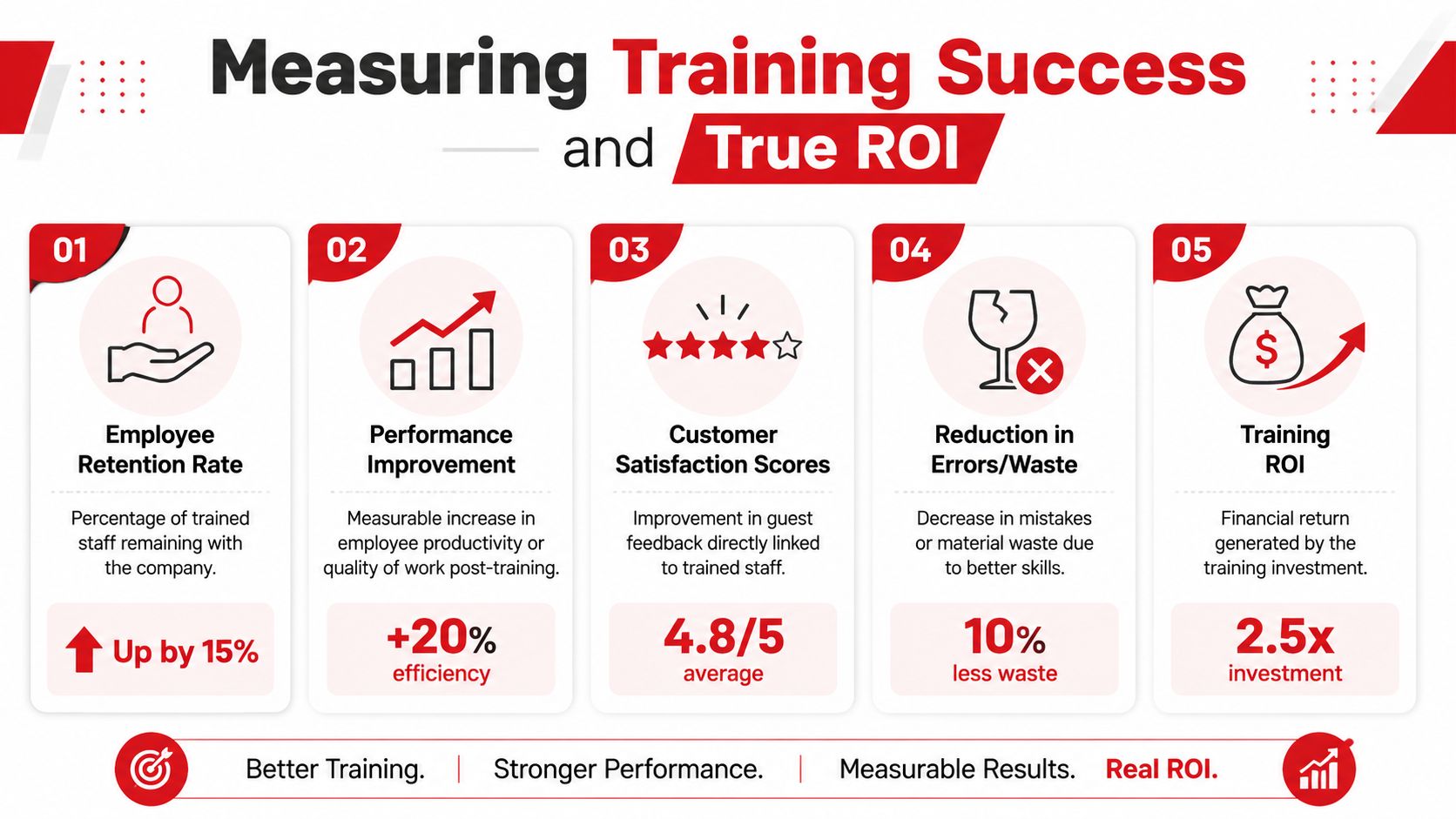
Start with before and after evidence
A common failure in hospitality training is the absence of pre- and post-training assessments, which makes it impossible to measure progress. Tying assessments to operational metrics such as a reduction in compliance breaches or incidents gives you a concrete benchmark according to guidance on employee training and development in hospitality.
That doesn't need to be fancy. In a kitchen, pre and post checks can be short and practical:
- Before training: Watch a chef set up a section, plate a dish, or explain allergen controls.
- After training: Repeat the same task and compare consistency, speed, and accuracy.
- During service: Check whether the behaviour sticks when the pressure is real.
A completion certificate won't tell you if someone can run garnish during a slammed Saturday service. Observation will.
To reinforce the point, this short video is worth a watch for managers reviewing how they assess development in practice.
Track operational outcomes, not training theatre
Use business signals that matter to the venue. You don't need complicated dashboards. You need a few measures that reflect daily reality.
| Metric | What to look for |
|---|---|
| Food waste | Fewer avoidable errors, better portion discipline, stronger prep control |
| Complaints | Fewer issues around speed, wrong orders, poor communication, or dish consistency |
| Section performance | Better setup, calmer handovers, fewer service bottlenecks |
| Compliance | Cleaner records, fewer missed checks, stronger allergen process |
| Team stability | Less dependence on one person to keep service together |
Manager check: If training happened but the same service problems keep showing up, the issue is either the content, the coaching, or the staffing level.
Review quickly and adjust faster
Don't wait months to decide whether training worked. Review after the next few services while the details are fresh.
If a new plating standard still isn't being followed, the training may have been too vague. If an induction was clear but mistakes continue, the person may need supervised repetition. If the whole team knows the standard but can't keep it under pressure, the underlying issue may be lack of experienced cover.
That's how you get true ROI from staff training and development. You tie it to service, not sentiment.
Managing Budgets Compliance and Scheduling
Training budgets are usually built in the margins, not in ideal conditions. Most operators aren't sitting on spare labour hours, and nobody wants to pay for training that drags service down. But cutting development altogether is expensive in a different way. Standards drift, mistakes multiply, and managers spend more time correcting avoidable problems.
Spend where the risk is highest
Start with the essentials. Food safety, allergen awareness, opening and closing discipline, menu execution, and manager capability all deserve budget before softer topics. If the choice is between a polished workshop and getting the team consistent on core procedures, choose the procedures.
Low-cost methods often work best:
- Use senior staff as trainers: A strong sous chef can teach section setup better than a generic provider.
- Train in quiet windows: Mid-afternoon or after a lighter service works better than forcing it into peak trade.
- Keep modules short: Short practical sessions are easier to schedule and retain.
- Document standards clearly: Checklists, prep sheets, and line guides reduce repeat mistakes.
Compliance training isn't optional
In UK hospitality, some training sits squarely in the legal and operational risk category. Food safety, health and safety at work, and allergen procedures must be understood and followed. If staff don't know the process, the business carries the risk.
That applies whether you run a pub in Bristol, a hotel in Berkshire, or a private household kitchen using villa chefs or yacht chefs. The setting changes. The duty doesn't.
Scheduling has to respect live service
Good scheduling is often the difference between a training plan that sticks and one that gets abandoned.
A practical rota-based approach looks like this:
- Before busy periods: Use brief refreshers on one issue, such as prep standards or service communication.
- During quieter days: Run hands-on coaching, not long theory sessions.
- For new starters: Protect the first shifts from full pressure where possible.
- For managers: Give them time to train properly, not while they're covering three gaps.
The mistake is trying to train as if the venue is fully staffed and calm. Most aren't. Build around the reality you've got.
The Ultimate Safety Net for Your Kitchen
Even the best training plan can't stop a chef from leaving without warning, going off sick on a bank holiday weekend, or not being a good fit for the pace of your kitchen. Training builds future strength. It doesn't guarantee tonight's service.
That matters more now because the labour pool is tighter. The UK accommodation and food service sector saw the largest employee decline of any industry, dropping 2.7% by late 2025, according to this analysis of the UK restaurant labour shortage. If you operate in hospitality hotspots such as Devon, Dorset, Reading, Slough, Windsor, Bristol, or across Wales, you already know how exposed that leaves a venue when one key person disappears from the rota.
Stability comes from having a backup before you need it
Too many operators wait until the crisis lands. Then they scramble through old contacts, unreliable agencies, or last-minute favours. That usually means wasted hours, uncertain quality, and more pressure on the team that did turn up.
A proper safety net looks different:
- Relief cover for short notice sickness
- Temporary chefs for seasonal demand and peak periods
- Permanent chef recruitment when a venue needs long-term stability
- Specialist support for yachts, villas, private households, and boutique hotels
- Hospitality staffing support that understands kitchen reality, not just CV matching
There's also a practical link between emergency cover and training. When an experienced chef steps into the kitchen and holds the line, your own senior team gets breathing space. They can supervise properly, coach juniors, and keep standards from slipping.
Run your induction properly, even with temporary cover
Temporary doesn't mean unmanaged. Any chef walking into your venue still needs a fast, clear site induction covering kitchen flow, key risks, allergen procedure, cleaning points, and reporting lines. A concise health and safety induction checklist helps venues standardise that handover and reduce confusion from the first shift.
The safest kitchens don't rely on luck. They rely on clear standards and a backup plan that's already in place.
Relief Chefs UK has been operating nationwide since 2013, providing chef recruitment and temporary chef staffing across the UK. Because the business is run by chefs, not generic recruiters, it understands the difference between someone who can genuinely hold a section and someone who just looks fine on paper. That matters when you need relief chefs in a country inn in Devon, permanent chef recruitment for a hotel group in Berkshire, or yacht chefs and villa chefs who can adapt to specialist environments.
When kitchen stability is the priority, the value isn't theoretical. It's practical. The kitchen stays open. Standards hold. Service goes out properly.
If you need reliable Relief Chefs UK support for short notice sickness, seasonal demand, temporary chefs, relief chefs, permanent chef recruitment, yacht chefs, villa chefs, or wider hospitality staffing support, get in touch now. Relief Chefs UK is a trusted nationwide chef recruitment agency established in 2013, and the team understands exactly what's at stake when a kitchen is under pressure. Contact them before the next gap hits your rota, not after.
Call the team.
Office 01392 715474 · info@reliefchefs.co.uk