
Cross Contamination Prevention: Prevent Cross
18 July 2026
Friday evening is building. Deliveries are half put away, the lunch shift has left a mess in the veg fridge, a sous chef has called in sick, and someone on pastry has borrowed a blue board to slice cooked chicken because the clean stack ran out. Service hasn't even started and the risk is already in the room.
That's how most cross contamination failures begin. Not with a dramatic single mistake, but with shortcuts, weak handovers, and a kitchen that's running faster than its systems can support.
In busy pubs, hotels and restaurants across Devon, Bristol, Berkshire, Wales and Dorset, cross contamination prevention isn't just a food safety issue. It's a management discipline. If your kitchen can prevent contamination under pressure, it can usually handle staff gaps, menu complexity and high-volume service far better too. If it can't, every shift is fragile.
The True Cost of a Contamination Incident
A contamination incident rarely arrives as a neat technical problem. It lands as a business crisis.
One guest complains of illness. Another mentions an allergen concern. Then the phone starts. A manager is pulled off the floor, the head chef is reconstructing prep lists from memory, and someone is trying to work out who used which board, cloth, fryer or spoon. In a hotel in Bristol or a busy coastal pub in Dorset, that disruption can hit in the middle of peak trade, when you can least afford confusion.
It goes far beyond compliance
Most operators think first about inspections, and fair enough. Nobody wants a difficult conversation with the EHO. But the bigger damage often comes after the immediate issue.
You can deep-clean a kitchen. You can replace stock. You can rewrite a rota. What's harder to repair is trust. Guests talk. Staff talk. Reviews stay visible. A venue that looked polished on the surface can suddenly look careless.
Practical rule: If you can't prove how food moved safely through your kitchen, you'll end up relying on guesswork when something goes wrong.
The commercial cost shows up in places owners feel quickly:
- Lost covers: Guests who lose confidence don't always complain directly. They just don't come back.
- Manager time: Senior people stop running the business and start firefighting.
- Team instability: Good staff hate chaotic kitchens. One incident often exposes deeper discipline problems.
- Recruitment pressure: If standards slip, replacing leavers becomes harder and expensive.
- Service disruption: Menus get reduced, prep gets scrapped, and consistency disappears for days or longer.
A lot of operators underestimate how closely safety and staffing are linked. Weak kitchens depend on memory, heroics and luck. Strong kitchens depend on systems. That matters even more when you're dealing with short notice sickness, seasonal demand, chef shortages and patchy agency reliability.
The same patterns that create contamination risk also create unstable service. Poor labelling, unclear storage, no defined prep zones, no briefing routine, no written handover. Those aren't separate problems. They're the same management failure wearing different clothes.
One mistake can expose a wider operating problem
When a contamination incident happens, it often reveals that the kitchen was already under strain. Perhaps the fridge order only made sense to one chef. Perhaps the allergen folder was out of date. Perhaps the team had stopped challenging bad habits because service was busy and nobody wanted the argument.
That's why prevention should be treated as risk control, not paperwork. A reliable kitchen is easier to supervise, easier to train into, and easier to stabilise when key staff are off. If you've ever had to scramble for cover on a bad week, you'll recognise the pattern discussed in this piece on the hidden cost of bad chef cover and emergency booking decisions.
Good kitchens don't just avoid failure. They stay usable under pressure.
Building Your Kitchen Prevention Foundation
Cross contamination prevention starts before anyone picks up a knife. It begins with a clear operating framework that tells the team what good looks like on an ordinary Tuesday, not just when an inspection is due.
A practical system doesn't need to be bureaucratic. It needs to be visible, repeatable and easy to follow at speed.
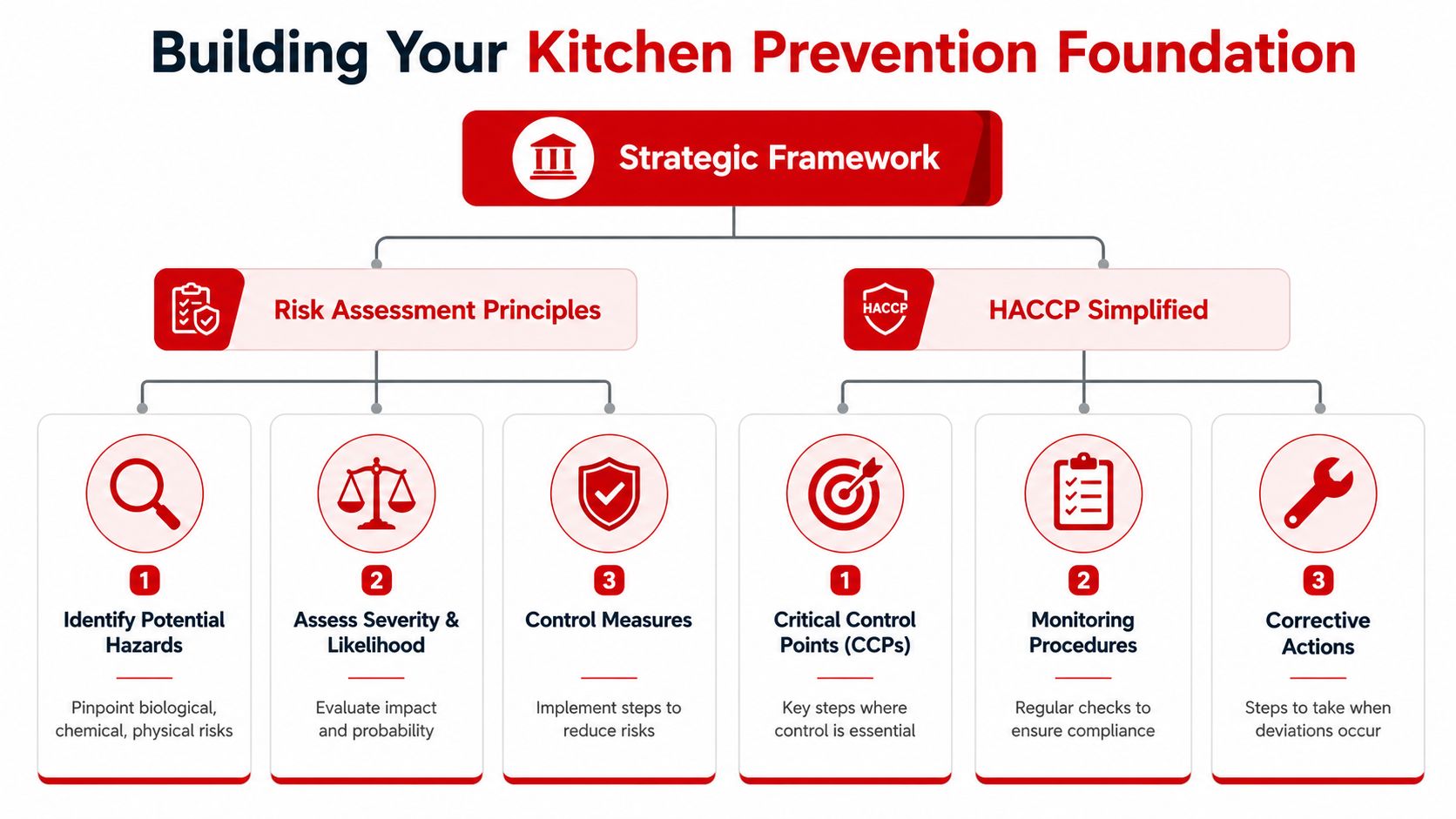
Strip risk assessment back to what matters
Most kitchens don't fail because nobody has heard of HACCP. They fail because the hazard thinking never gets translated into daily behaviour.
Start by walking your kitchen in service order. Don't sit in the office and build a fantasy version of the operation. Follow food as it moves through the business:
Delivery intake
Who checks packaging, use-by dates, leaks, damaged boxes and temperature condition on arrival? If raw chicken is dropped on the same table used for dessert garnishes later, you've already identified a risk point.Storage
Look at fridges, freezers, dry stores and decanting areas. Ask simple questions. Can raw items drip? Are ready-to-eat ingredients covered and labelled? Can a new starter understand the layout without needing a translator?Preparation
List tasks that create the biggest transfer risk. Raw poultry prep, washing salad near raw meat, using one trolley for everything, wiping hands on aprons, shared probes, shared fryer baskets.Service and plating
Many kitchens often go soft at this stage. The pass gets busy, spoons move around, garnish pots get dipped into with contaminated gloves, and people stop thinking.
Turn common tasks into short SOPs
A proper SOP should fit the kitchen that uses it. If it takes two pages to explain how to receive a delivery, nobody will read it during a Saturday push.
Use short, task-based documents with clear actions. Laminated sheets near the work area often work better than folders hidden in an office.
A simple format works well:
| Task | What staff must do | What staff must never do |
|---|---|---|
| Delivery check | Inspect packaging, separate raw from ready-to-eat items immediately, store promptly | Leave mixed crates in prep areas |
| Raw meat prep | Use the correct board, knife, tray and sanitised area, clean down fully after use | Switch straight to salad, desserts or plating without reset |
| Plating | Use clean utensils, protect allergen orders, keep garnish containers clean | Reuse contaminated spoons or cloths on the pass |
Keep the documents operational
The best SOPs answer the questions staff ask in a rush.
For example, a small pub kitchen might write its raw meat SOP like this:
- Set up first: Collect the red board, dedicated knife, sanitiser spray, clean cloths and waste container before opening the pack.
- Limit movement: Prep raw meat in one run instead of stopping and starting across the shift.
- Reset the station: Wash, clean and sanitise the area, then change cloths and wash hands before any other task.
That's useful. “Maintain food safety standards at all times” isn't.
A safe kitchen should work even when the strongest chef is off. If the system only functions when one person is present, it isn't a system.
Build around real pressure points
Different sites have different weak spots. A hotel breakfast kitchen has different risks from a gastropub near Reading or a seasonal restaurant in Devon. A high-volume site may need stricter separation by time and area. A smaller site may need tighter sequencing, so raw prep is completed, cleared and verified before pastry or cold section starts.
The key is consistency. Once the rulebook exists, staff stop improvising the basics. That's where cross contamination prevention becomes practical instead of theoretical.
Practical Controls and Kitchen Workflow
The physical kitchen either helps your standards or fights them every shift. Layout, storage, tools and movement patterns decide whether the team can work cleanly under pressure.
If the workflow is muddled, people will contaminate food without realising they've done it.
To make the contrast clear, use this as a visual reference for common control methods.
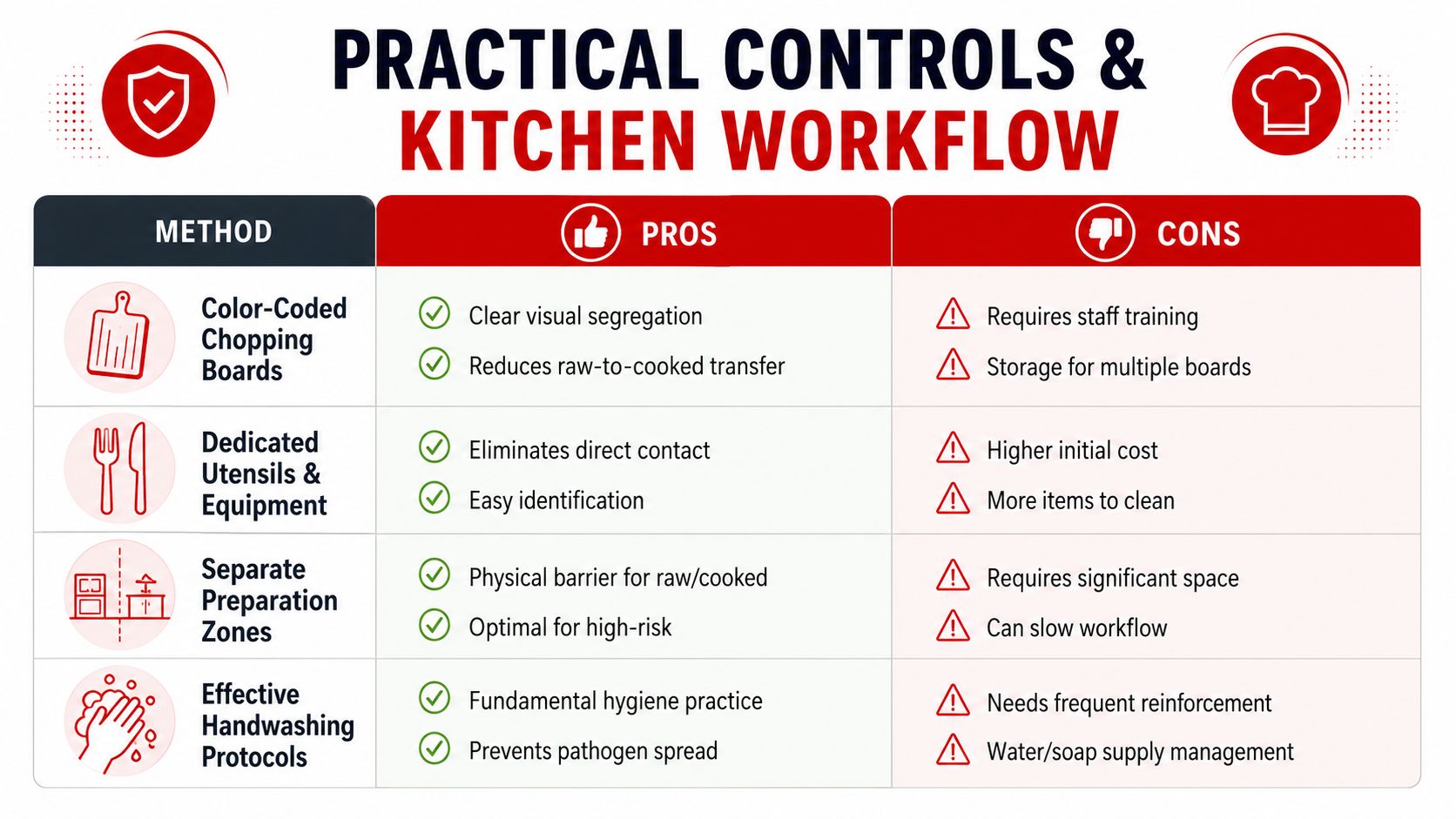
Colour coding only works when the whole system agrees
Most kitchens have some form of board colours. Fewer have a complete colour-coded discipline.
If boards are colour-coded but knives, cloths, containers and tongs aren't, the system breaks down fast. Staff start with the right intention, then finish the task with mixed equipment because the backup kit was stored elsewhere or never replaced after wash-up.
A usable colour-coding system includes:
- Boards and knives together: Store them as matched sets, not in separate corners.
- Cloths by task: Don't let one sanitiser cloth become the kitchen's universal rag.
- Containers and labels: Raw marinades and cooked garnishes shouldn't share lookalike tubs.
- Visible storage points: Put equipment where the task happens, not where there was spare shelf space.
The mistake I see often is overcomplication. If your team needs a poster the size of a menu to decode the colours, you've gone too far. Keep it simple, train it properly, and replace missing kit immediately.
Fridge order is a control, not a preference
Fridge organisation tells you a lot about a kitchen's discipline. A clean-looking fridge can still be dangerous if storage order is wrong.
The basic principle is straightforward. Ready-to-eat and cooked items stay above. Raw products stay below. Liquids, drips and open packs are controlled. Everything is covered, labelled and positioned so one chef can find it without moving three other hazards first.
Here's a practical layout:
| Shelf area | Best use |
|---|---|
| Top shelves | Cooked meats, desserts, dairy, ready-to-eat items, plated mise en place |
| Middle shelves | Washed produce, prepped ingredients in sealed containers |
| Lower shelves | Raw fish and raw meat in secure trays |
| Bottom shelf or lowest zone | Raw poultry and highest-risk leaking products |
| Door and odd spaces | Low-risk sealed items only, never raw open packs |
That sounds obvious. Under pressure, it often isn't. Someone puts a tray of raw chicken on a middle shelf because they're unloading a delivery quickly. Then another chef reaches over it for spinach, knocks condensation onto a container, and the chain starts.
Keep raw products low and contained. Gravity doesn't care how experienced your team is.
Separate prep zones, even in tight kitchens
Not every site has the luxury of a dedicated raw room. That doesn't excuse mixed prep.
In smaller kitchens, separation often has to be created by time, kit and reset, not walls. Raw prep happens first or in a defined slot. The bench is then cleaned and sanitised. Boards, knives, trays and cloths are changed. Handwashing happens. Only then does cooked or ready-to-eat prep begin.
This short training video is useful for reinforcing the discipline with teams during briefing or induction.
A practical workflow for a compact kitchen might look like this:
- Early prep block: Butchery and raw poultry are completed first.
- Full station reset: Surfaces, sink edges, taps, scales and handles are sanitised.
- Cold section opens after sign-off: Salad, desserts and sandwich prep start only after the reset is done.
- Service utensils stay at the pass: They don't travel back to raw prep stations.
Small kitchens can still be safe. The trick is removing overlap.
Managing Allergens and Training Your Team
Allergen control is where good intentions often collapse. A kitchen can be spotless and still serve a dangerous dish if the team treats allergens as a paperwork exercise instead of a live operational risk.
An allergen matrix matters, but it's only the starting point. The primary work happens in the prep area, at the fryer, on the pass, and in the handover between front and back of house.
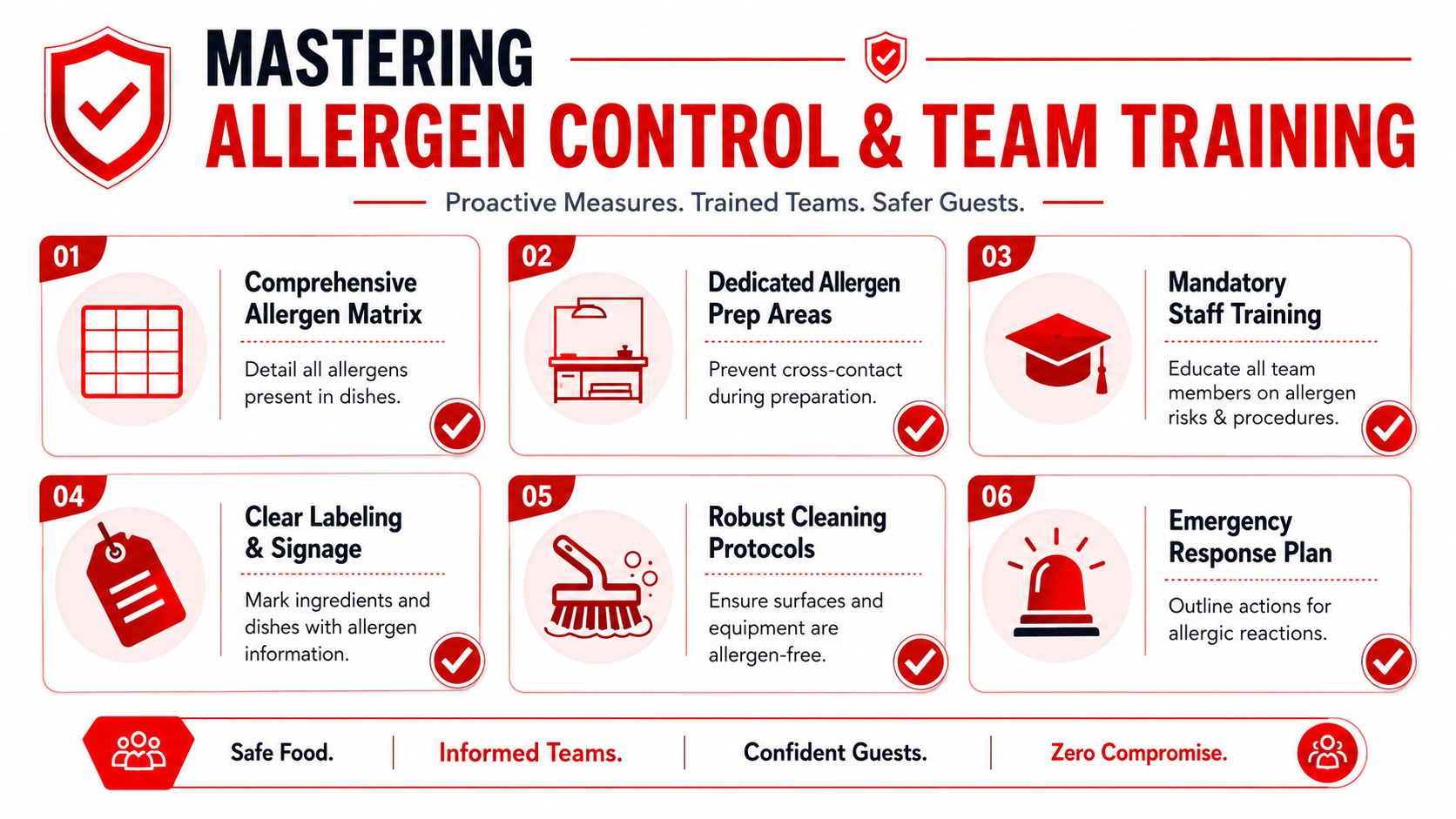
Treat cross-contact risks as active hazards
Shared fryers are a classic example. So is flour in the air during busy prep. So are dessert garnish spoons moving between stations. The dish itself may not contain the allergen by recipe, but the process can still make it unsafe.
That's why allergen controls must include physical behaviours, not just menu notes:
- Dedicated prep kit: Use separate utensils, trays and containers for allergen-sensitive orders where needed.
- Clear communication: The person receiving the order must trigger a kitchen response, not merely hope the note is seen.
- Protected plating: Allergy meals should be plated in a cleared area, not wedged into the middle of a cluttered pass.
- Verified ingredients: Never assume a substitute product has the same allergen profile as the usual one.
A lot of incidents happen after a supplier swap, a rushed menu change or a casual “it should be fine” decision. That language has no place in an allergen process.
For teams that need stronger foundations, proper allergen awareness training for hospitality staff helps turn theory into repeatable kitchen behaviour.
Training has to live in the shift
One induction talk at the start of employment won't hold standards together in August, at Christmas, or during a rough patch of staff turnover.
Training works when it's built into the working day. Short reminders before service often do more than a long annual session nobody remembers. Keep it direct. Which station is handling raw poultry today? Which fryer is off-limits for a specific menu item? Which chef signs off allergy orders? Who updates the board after a delivery substitute arrives?
If a chef can't explain your allergen process in simple words at the start of service, they don't know it well enough to protect a guest.
A practical induction checklist
When new staff join, including casual and agency cover, they need a short but strict induction before touching food. Not a friendly wander round. A proper operational brief.
Cover these points:
Handwashing points and rules
Show the sinks, soap, paper towel and when handwashing is mandatory.Raw and ready-to-eat separation
Explain your site's actual prep rules, not generic posters.Allergen controls
Identify where the matrix is kept, who owns updates, and how allergy orders are flagged.Fridge and dry store layout
Don't assume they'll “work it out”.Cleaning chemicals and sanitisers
Which product is used where, and what the contact method is in your kitchen.Escalation point
Make clear who they ask before guessing.
Permanent staff set the tone
This is where kitchen culture matters. If permanent staff cut corners, temporary staff will either copy them or struggle against them. If permanent staff model the correct system, incoming chefs can slot in quickly and safely.
In hotels, pubs and restaurants dealing with chef shortages, that matters a lot. Staff turnover exposes weak habits. Strong teams absorb change because the rules are visible and consistently enforced.
Keep Standards High with Temporary Staff
The test of cross contamination prevention isn't a calm prep day with your full brigade in place. It's the morning your chef de partie rings in sick, brunch is fully booked in Windsor, and a temporary chef walks through the door with service only a few hours away.
That's where many businesses get exposed. Not because temporary staff are the problem, but because the kitchen has no usable handover structure.
Good systems make temporary cover safer
A capable relief chef can adapt quickly. But they still need a kitchen that communicates clearly.
When an operation relies on unwritten habits, shortcuts and “we all just know”, any outsider is forced to guess. That's dangerous in relation to raw prep, allergen handling, fridge order, cleaning routines and service flow. It also slows the whole team down because permanent staff spend the shift correcting avoidable mistakes.
In Reading, Slough, Bristol or a rural hotel in Devon, the staffing pressure may be different, but the pattern is the same. Short notice sickness, agency unreliability and seasonal demand expose every weakness in your systems.
Build a quick-response welcome pack
Every site that uses temporary chefs should keep a short, current handover pack ready. This shouldn't sit in a dusty folder from last year. It should be updated and usable today.
A strong pack includes:
- Kitchen layout map: Prep zones, handwash sinks, refrigeration, dry store, allergen file, waste area.
- Critical SOPs: Raw prep rules, cleaning reset process, plating controls, delivery storage order.
- Allergen contacts: Who has final authority on allergen queries during the shift.
- Menu notes: Any dish with unusual risk, substitute ingredients, shared equipment concerns.
- Service expectations: Section assignment, prep list, ordering flow and pass communication.
Keep it concise. One or two pages beat a manual no one reads before lunch service.
A proper handover documentation process for temporary kitchen cover makes the difference between a relief chef strengthening the shift and a manager spending all day hovering.
What works and what fails
The most effective sites do three things well. They brief early, they show the physical layout, and they name the essential requirements. That gives a temporary chef enough clarity to work safely and confidently.
What fails is equally predictable:
| What works | What fails |
|---|---|
| Short verbal briefing before prep starts | “You'll pick it up as you go” |
| Written allergen and storage rules | Verbal instructions passed between three people |
| Clear section ownership | Two chefs assuming the other checked it |
| Visible labels and organised fridges | Mystery containers and mixed decants |
Temporary cover performs best in kitchens that are already disciplined. Relief staff shouldn't be expected to solve a broken system mid-service.
This matters for more than one shift. If you regularly need relief chefs, temporary chefs, or support during peak periods, your safety system has to be portable. It must work for the person who's never seen your kitchen before. That applies whether you run a pub company in Wales, a boutique hotel in Berkshire, a private household needing villa chefs, a seasonal coastal venue, or a premium operation using yacht chefs and specialist hospitality staffing support.
Monitoring Your System and Getting Support
Standards slip unnoticed. A label goes missing. A cloth bucket isn't changed. A fridge gets overloaded after a large delivery. Nobody notices on the day because service still goes out.
That's why monitoring matters. Not for show. Not to satisfy a folder on a shelf. For management control.
Keep records that help you run the kitchen
The right documents make weak spots visible before they become incidents. Every site should keep simple, current records that managers can check quickly and chefs can complete without a debate.
Useful examples include:
- Fridge checks: Confirm storage order, container condition and any corrective action.
- Cleaning schedules: Tie tasks to people, areas and sign-off times.
- Training records: Track who has been briefed on raw handling, allergens and service controls.
- Delivery logs: Record rejected items, damaged packaging and substitution issues.
- Temporary staff handovers: Confirm key safety points were covered at the start of the shift.
These documents are management tools. If they're overcomplicated, they won't be used. If they're vague, they won't protect you.
Audit the kitchen when it's under pressure
A quiet mid-morning check has its place. But the best audits happen when the kitchen is busy enough to reveal real habits.
Walk the fridge during the prep rush. Watch the pass during allergy orders. Look at how cloths are used after raw prep. Check if the sink is stocked during the peak, not just at opening. In my experience, kitchens rarely fail on policy. They fail on drift.
You should also review any near miss. A tray stored on the wrong shelf. A missing label. A chef reaching for the wrong tongs. Those moments are warnings.
The best-run kitchens treat near misses as coaching opportunities, not as minor messes to ignore.
For operators juggling recruitment pressure, chef shortages and ongoing service demands, keeping that discipline in place can be hard. It gets harder when you need emergency relief chefs, temporary chefs for seasonal spikes, permanent chef recruitment for long-term stability, or wider hospitality staffing support across multiple sites.
Relief Chefs UK has been established since 2013 and supports hospitality businesses nationwide with practical chef staffing solutions for pubs, restaurants, hotels, private households, villas and yachts. The value isn't just filling a rota gap. It's protecting kitchen continuity when your own team is stretched.
If your kitchen needs dependable cover without sacrificing standards, contact Relief Chefs UK. Whether you need relief chefs for short notice sickness, temporary chefs for seasonal demand, permanent chef recruitment for long-term stability, or specialist support for yacht chefs, villa chefs and wider hospitality staffing support, the team works nationwide to keep kitchens stable across the UK. For venues in Devon, Bristol, Wales, Berkshire, Windsor, Reading, Slough, Dorset and beyond, now's the time to secure reliable chef cover before the next gap puts service and safety at risk.
Call the team.
Office 01392 715474 · info@reliefchefs.co.uk