
You're usually not searching for hospitality jobs near you because you want a long process. You need shifts, a rota, a kitchen, and a manager who'll reply. That's how local hospitality hiring works in practice. A pub in Devon doesn't care that your application is beautifully formatted if they've just had a chef call in sick for the weekend. A boutique hotel in Berkshire wants to know whether you can prep, keep standards up, and get there on time.
That speed catches people out. They search broadly, apply slowly, and miss the roles that were live for only a few hours. The candidates who get hired locally tend to do three things well. They search tightly by area, they stay ready to respond, and they make it easy for a venue to trust them fast.
For owners, GMs, head chefs, and ops teams, the same reality works the other way round. Local hiring is rarely a clean, linear recruitment exercise. It's often a response to short notice sickness, seasonal pressure, unreliable agency cover, chef shortages, and the constant need to protect kitchen stability without dropping service.
Why Hospitality Jobs Near You Move Faster Than You Expect
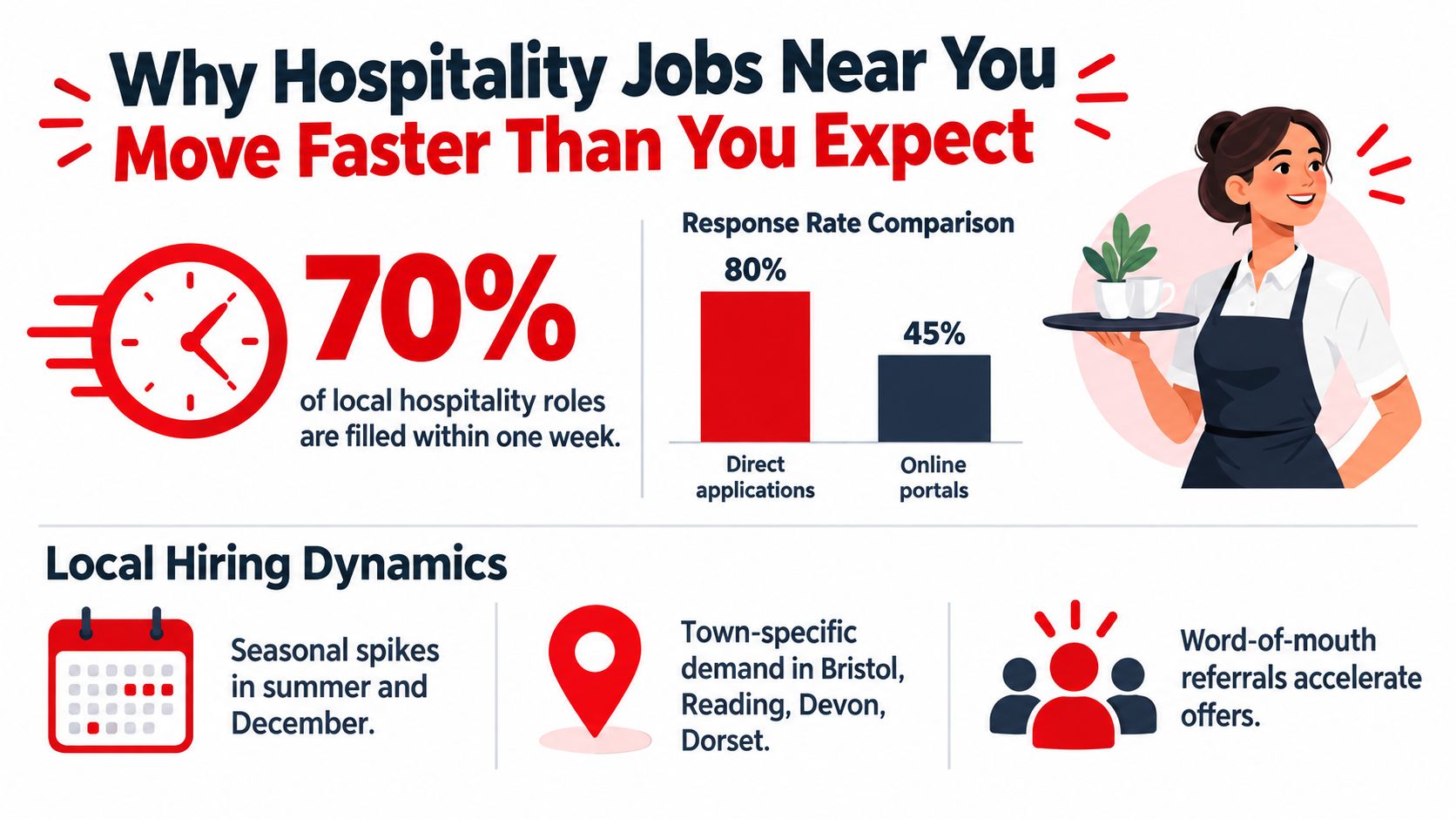
At venue level, local hospitality hiring is driven by operational pressure, not perfect timing. A head chef in Bristol loses a sous on Friday morning. A hotel in Reading suddenly needs breakfast cover after two team absences. A coastal site in Dorset gets a burst of trade the weather didn't warn them about. The role goes live, calls get made, and the person who can start soonest often gets the first serious look.
That isn't guesswork. The UK hospitality labour market has stayed tight for years. Parliament's research briefing reported 2.8 million jobs in hospitality in the three months to June 2024, equal to 7.5% of all UK jobs, and said the sector was the sixth-largest employer among main industry sectors. The same briefing said there were 95,000 hospitality vacancies in the three months to September 2024, or 3.6 vacancies per 100 workers, compared with 2.6 per 100 workers across all industries (UK Parliament hospitality employment briefing).
What nearby venues actually prioritise
When managers hire for nearby roles, they usually scan for a short list:
- Commute realism: Can you get to the site for early starts, late finishes, or split shifts?
- Availability: Are you free this week, this weekend, or tonight if needed?
- Readiness: Can you send your CV, references, and right-to-work documents without delay?
- Relevant section experience: Grill, pastry, breakfast, banqueting, volume service, hotel breakfast, events, or pub trade.
- Low-risk attitude: Will you arrive, communicate properly, and work cleanly under pressure?
A local postcode often matters more than a long personal statement. If a venue in Windsor needs cover for a Sunday lunch push, they won't wait days for someone who lives too far out and still hasn't confirmed transport.
Practical rule: In local hospitality hiring, proximity plus availability often beats a stronger CV with slower response.
Why this matters for both candidates and operators
Applicants often assume hospitality jobs near me means scrolling listing sites until something sticks. In reality, it's a speed market. Venues aren't always building perfect shortlists. They're solving a service risk.
That's one reason seasonal and short-notice planning matters so much in places with tourism swings and event-led demand. Operators dealing with peak periods can see the same patterns in local trade cycles and staffing gaps through seasonal demand forecasting for hospitality teams.
For employers, that means writing roles with clear start expectations and realistic shift patterns. For candidates, it means treating local search like dispatch, not admin.
How to Set Up a Local Search That Finds Real Nearby Roles
Searching hospitality jobs near me, you may cast the net too wide. Then you waste time opening listings that say “local” but are an hour away, multi-site, or based on a different postcode entirely. A better search setup narrows the field before you apply.
Build your search around the commute, not the county
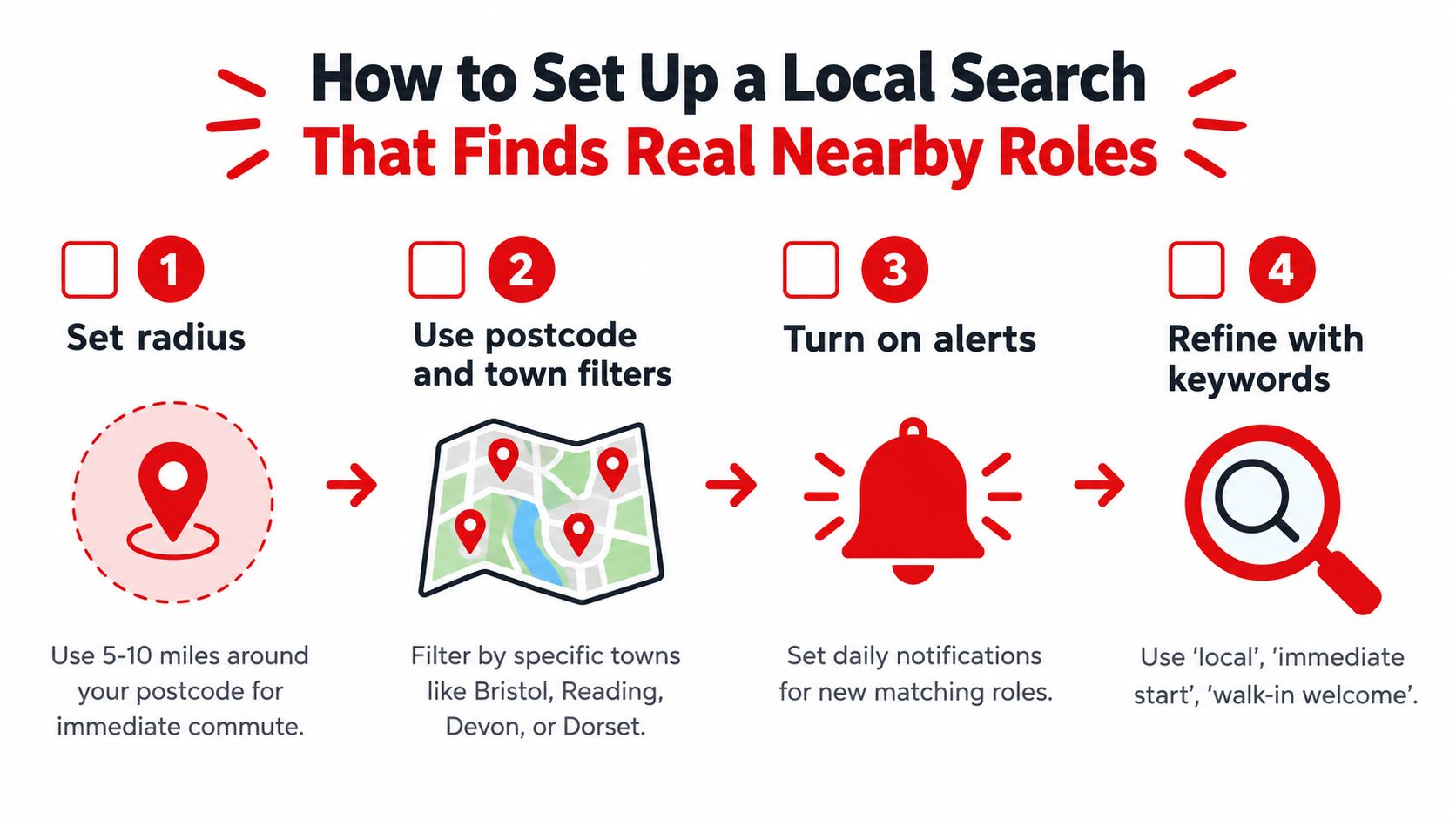
If you're available for immediate work, use the smallest radius that still gives you enough options. Start with your postcode and a practical commute. That's more useful than selecting an entire region and hoping the listings sort themselves out.
Use several search versions rather than one broad term:
- Chef-focused searches: “chef de partie near me”, “relief chef Bristol”, “temporary chef Reading”, “sous chef Windsor”
- Hotel and catering searches: “hotel chef Slough”, “breakfast chef Berkshire”, “banqueting chef Wales”
- General hospitality searches: “hospitality jobs near me”, “kitchen porter near me”, “front of house near me”
Town filters matter. If you're based between locations, run separate alerts for Bristol, Reading, Slough, Windsor, Devon, and Dorset rather than relying on one national search feed.
Set alerts for speed, not convenience
Daily alerts work for some sectors. Hospitality often moves faster than that. If the platform allows it, turn on instant or frequent mobile alerts for your highest-priority searches. Then keep a second layer of daily alerts for broader roles you'd still consider.
This works best when you separate your alerts by purpose:
- Immediate-start alert for short-notice and temporary cover
- Core role alert for your main job title
- Stretch alert for nearby towns you'd travel to for the right site
- Weekend-only alert if you want flexible extra shifts
Apply from your phone if you have to, but keep your documents in a format you can send in minutes, not hours.
One practical route for candidates and employers who want local, flexible staffing options is to monitor specialist support pages such as hospitality staffing agency options near you, especially when direct job board stock is thin.
Filter out false-local listings
Some listings look local until you read the detail. Common warning signs include vague multi-site wording, no postcode, “various locations”, or travel expectations hidden low in the advert. Don't assume the map pin is accurate.
Check these before you apply:
- Site address: Is the venue named, or is it a central office posting?
- Shift timing: A role may be nearby by distance but impossible by public transport after late finishes.
- Employment type: Permanent, relief, seasonal, live-in, or event-based all mean different things for pay stability and scheduling.
- Actual operator: Direct employer, management company, or agency.
Use the right wording in your own saved profiles
Short search profiles often perform better than long summaries. State your role, area, and availability in plain English.
Examples:
- Chef de Partie based in Bristol. Available immediately for temporary or permanent work.
- Sous Chef in Reading with hotel and banqueting background. Full right to work, own transport.
- Relief chef covering Berkshire and Windsor. Weekend and short-notice shifts considered.
That kind of wording helps you appear in recruiter and employer searches, and it reduces pointless calls for jobs that aren't local.
Where to Look for Hospitality Jobs Near You and When to Use Each Option
Different channels solve different problems. If you need a permanent role with time to compare venues, one route works. If you need shifts this week, another route is better. Operators face the same split when they're trying to cover a rota gap versus making a longer-term hire.
A useful way to choose is to match the channel to the urgency, the role level, and the amount of vetting you need.
Choosing the Right Channel for Local Hospitality Roles
| Channel | Best For | Speed to Start | Vetting and Reliability |
|---|---|---|---|
| Major job boards | Permanent roles, broad local search, entry to mid-level vacancies | Moderate | Varies by employer |
| Specialist hospitality boards | Chef roles, hotel jobs, focused sector search | Moderate to fast | Usually more role-relevant |
| Direct venue websites | Targeting specific pubs, hotels, restaurants, groups | Moderate | Strong if venue hires directly |
| Walk-ins and local drop-ins | Independent venues, cafés, pubs, quick local introductions | Fast for the right site | Depends on who you meet and how they hire |
| Staffing and relief agencies | Temporary cover, short-notice work, flexible chef placements | Fast | Strong when checks are done properly |
What each route does well
Major job boards are still useful, especially in bigger hiring markets like Bristol or South Wales. They give volume. The downside is noise. Good candidates get buried, old adverts stay live, and local roles can be mixed with jobs outside your realistic commute.
Specialist hospitality boards are better when you want relevance. They tend to carry more chef, kitchen, hotel, and front-of-house roles than generic job sites. They're useful for candidates with clear experience and for operators who want sector-specific applicants.
Direct venue websites work well if you already know the kind of property you want. Boutique hotels in Berkshire, independent pubs in Devon, and restaurant groups in Slough often post first on their own careers pages or social channels before wider advertising.
Walk-ins still work, particularly with independents. A sensible in-person approach can beat an online queue of half-read applications. It's less effective with branded chains that route everything through HR portals.
When agency and relief routes make more sense
Hospitality vacancy pressure hasn't disappeared. A UK industry analysis citing ONS data reported a peak of 177,000 vacancies in 2022, with annual averages of about 162,000 in 2022, 126,000 in 2023, 98,000 in 2024, and around 79,000 across 2025, before falling to 71,000 in the three months to May 2026. The same source said vacancies in accommodation and food services were still around 71,000 in mid-2026 (UK hospitality staffing cost and vacancy analysis).
That's why flexible channels remain important. If a venue needs same-day or short-notice chef cover, traditional hiring routes are often too slow. For candidates, relief and temporary work can also create a steadier path into local kitchens than waiting on one permanent opening.
Relief Chefs UK, established in 2013, is one route in that category. It works across the UK on relief chefs, temporary chefs, permanent chef recruitment, yacht chefs, villa chefs, and wider hospitality staffing support, and it lists flexible chef opportunities through its temporary chef jobs across the UK.
The best channel isn't the most popular one. It's the one that matches how quickly the site needs someone in uniform and ready to work.
How to Make Your CV and Profiles Stand Out for Local Hiring Managers

A local hiring manager doesn't read your CV the way a corporate recruiter does. They scan it for operational risk. Can this person do the job, turn up reliably, and slot into the brigade or service team without drama?
If you're applying for hospitality jobs near you, your CV should answer those questions fast. Put the practical points high up the page. Don't hide your location, availability, or work status underneath a long profile.
What to move to the top
Start with a short header that includes your town or coverage area, your main role, and how soon you can start. For chef roles, that instantly tells a manager whether the application is usable.
A strong top section might include:
- Current base: Bristol, covering Bath and surrounding areas
- Role level: Sous Chef or Chef de Partie
- Availability: Immediate, weekends, temporary, or permanent
- Transport: Own car or public transport only
- Work status: Right to work in the UK available on request
That beats a generic paragraph about passion for food. Passion doesn't solve a Saturday night gap.
Write for scanning, not storytelling
Busy managers look for evidence in seconds. Use short job entries. Lead with service type and scale. Then note the stations, volume, and responsibilities that matter.
For example:
Chef de Partie, boutique hotel, Berkshire
Ran garnish and starters. Supported breakfast service and functions. Worked with fresh produce, tight GP targets, and changing event numbers.Sous Chef, high-volume pub, Devon
Covered pass, ordering, rota support, and training juniors. Managed service during peak holiday trade and short-staffed weekends.
What gets attention: exact environments, section ownership, and availability. What gets skipped: long personal statements and vague soft skills.
Keep your documents ready to send
For fast local hiring, readiness is part of presentation. Keep one clean CV in PDF, one editable version, and a short message template you can tailor quickly.
Useful add-ons include:
- A two-line intro message: role, area, availability
- Reference list: even if references are supplied later, know who you'll name
- Compliance documents: right-to-work proof and any relevant certificates ready to provide
- Profile headline: local role plus flexibility, not a generic “experienced hospitality professional”
If you run online profiles, keep the wording consistent. A candidate who says “immediate start” on one platform and “available next month” on another creates doubt.
For operators, the reverse also applies. If your advert doesn't state shift pattern, location, and start expectations clearly, stronger local applicants often move on before applying.
Networking Walk Ins and Interview Tips That Win Local Offers
Online applications help, but local hospitality still runs on timing, recognition, and trust. A well-judged walk-in can work because it puts a face to the CV and shows you understand service reality. Done badly, it has the opposite effect.
How to approach a venue properly
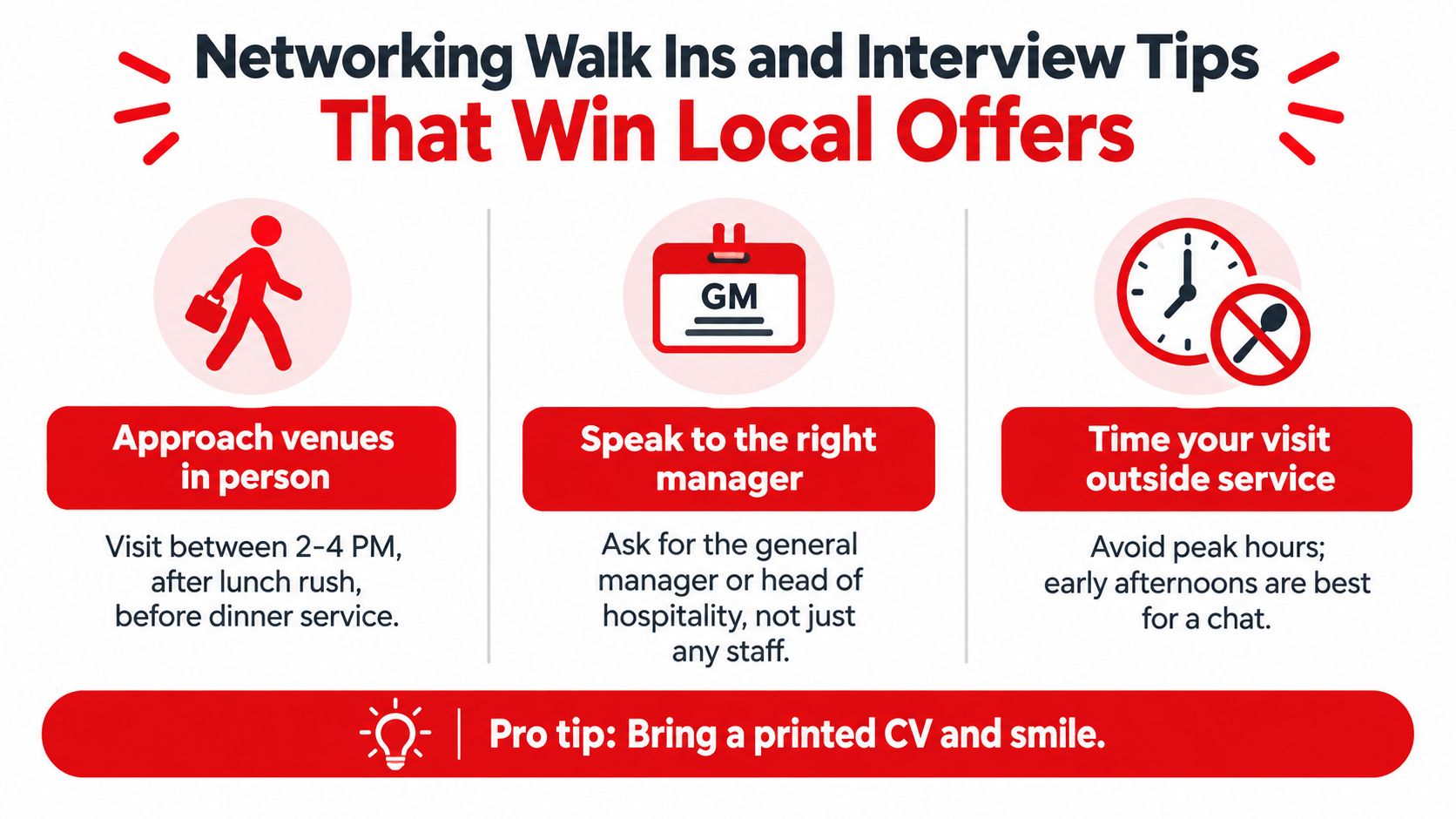
Don't walk into a busy restaurant at lunch or just before evening service and ask for a long chat. That tells the team you don't understand pressure. Go outside peak service and ask politely whether the GM, head chef, or duty manager has a moment.
A simple approach works best. Say who you are, what role you're looking for, and that you're local. Hand over a printed CV. If they can't speak, ask when to come back or who to email directly.
Good walk-in habits include:
- Choose the right time: Mid-afternoon is usually safer than peak service.
- Dress like someone who understands the trade: Clean, practical, presentable.
- Ask for the decision-maker: Head chef, kitchen manager, GM, or F&B lead.
- Keep it brief: You're opening a door, not forcing an interview.
What managers notice in interviews and trial shifts
Hospitality interviews are often shorter and more practical than candidates expect. For chef roles, trial shifts matter more than polished answers. Managers watch how you move, communicate, and keep your station.
They'll notice whether you:
- Arrive early and prepared
- Listen once and act on it
- Keep your section organised
- Speak clearly on the pass
- Stay steady when tickets build
Here's a useful watch before any in-person approach or interview stage:
Chef demand can move sharply, especially for kitchens hiring at pace. Quarterly job-board data for Q2 2026 showed chef vacancies up 83.4% year on year and 74.8% quarter on quarter, rising from 23,103 to 40,395 postings (UK hospitality recruitment trends for 2026). In practical terms, that means slower replies and incomplete paperwork can push a candidate down the list quickly.
If a venue offers a trial, treat the admin as part of the trial. Delays with documents make managers assume service will be the same.
Referrals still matter locally
One reliable introduction from a trusted chef, GM, or supplier can do more than a dozen cold applications. In tight local markets like Windsor, Reading, or parts of Wales, word travels fast. So does news about people who no-show, arrive late, or oversell their level.
For operators, this is why agency reliability and known relievers matter so much. For candidates, it's why every short assignment is also a reputation test.
Get Flexible Vetted Work Faster With Relief Chefs UK
The local market moves quickly, but speed on its own isn't enough. Operators still need chefs who are vetted, reliable, and capable of protecting standards. Candidates need access to real shifts, real kitchens, and people who understand the difference between filling a hole on the rota and sending the right chef for the site.
That's where a structured staffing partner can help both sides. Relief chef work is often the most practical route when venues are managing sickness, annual leave, peak weekends, event trade, or recruitment gaps that haven't closed. Permanent hiring still matters, but plenty of kitchens need stability before they need another long interview process.
What venues are up against
UKHospitality reported that hospitality still had 132,000 vacancies, which it said was 48% above pre-pandemic levels, and described chef shortages as ranging from 10% for head chefs to 21% for production chefs (UKHospitality workforce campaign figures).
A parliamentary written submission from UKHospitality estimated the sector's vacancy rate at between 10% and 16%, equivalent to roughly 210,000 to 336,000 unfilled roles, with chefs, serving staff and housekeeping among the most acute gaps (UKHospitality written evidence to Parliament).
People 1st's chef shortage report also projected that the UK needs an additional 11,000 chefs over the next five years to meet growing demand and replace existing staff (People 1st chef shortage report).
Those numbers explain why so many operators in places like Bristol, Dorset, Berkshire, Devon, and Wales still struggle with kitchen continuity. The issue isn't only getting applicants. It's getting the right people, at the right level, ready to start when the business needs them.
What practical support should look like
For venues, the basics matter:
- Fast response: If a service is at risk, waiting until tomorrow isn't much help.
- Proper vetting: Right-to-work checks and real screening reduce operational risk.
- Flexible cover options: Relief chefs, temporary chefs, and permanent chef recruitment all solve different problems.
- Wider role coverage: Some sites also need yacht chefs, villa chefs, or broader hospitality staffing support.
For candidates, a good system should make flexible work easier to access, not more confusing. Registration should be straightforward. Communication should be clear. Start dates, rates, location, and expectations should be confirmed properly.
Relief Chefs UK has been operating since 2013. According to the publisher information, it's run by chefs rather than recruiters, draws on 60+ years of combined hospitality experience, supports 400+ venues, responds within two hours, provides vetted, right-to-work-checked chefs who can start within 48 hours, and offers 24/7 support with transparent pricing and no hidden agency fees.
That combination matters because kitchen stability usually comes from process. Not promises.
If you need local chef work or your venue needs dependable cover fast, Relief Chefs UK connects kitchens with vetted relief chefs, temporary chefs, permanent placements, and specialist support for private households, yachts, and villas across the UK. When hospitality jobs near you need to move quickly, or when your rota has a gap you can't leave open, it's a practical route to speak to people who understand service pressure and can act on it.