
A Saturday service in Bristol is already booked, the orders are coming in, and the head chef calls in sick. In Windsor, a boutique hotel may have a wedding party arriving while two kitchen staff are away. The problem isn't just finding another pair of hands. You need someone who can read a prep list, understand service standards, work safely, and step onto the pass without slowing the brigade.
That's why temp jobs in the UK have become part of normal hospitality planning rather than an emergency-only solution. The same arrangement can give a chef flexibility between permanent roles, help a pub cover sickness, or allow a hotel to test a candidate before making a longer commitment. It only works, however, when both sides understand the practical, legal and operational details.
This guide looks at temporary work from both sides of the pass. Jobseekers will find a faster way to present their experience and win repeat bookings. Owners, general managers and head chefs will find a clearer method for briefing, checking and retaining temporary cover.
Relief Chefs UK is a nationwide chef recruitment agency established in 2013. Its work covers relief chefs, temporary chefs, permanent chef recruitment, yacht chefs, villa chefs and wider hospitality staffing support. The focus is simple: keep the kitchen open without lowering standards.
The sections below cover how temp assignments work, what the Agency Workers Regulations 2010 mean in a kitchen, where demand is strongest, how workers can move from temporary work into permanent employment, and how venues can build a dependable relief pipeline. If you're facing a gap this week, or trying to stop the same staffing crisis repeating next month, the practical checklists will help you decide what to do next.
Introduction Why Temp Work Keeps UK Hospitality Moving
The head chef's absence rarely arrives at a convenient time. A sickness call may come before breakfast, after the rota has been published and before the supplier delivery is due. A hotel in Berkshire may have a wedding weekend locked into the diary, while a restaurant in Devon faces a sudden rise in bookings because the weather turns. The venue still has to prep, serve and protect the guest experience.
Permanent recruitment remains important, but it can't solve every immediate problem. Interviews take time, notice periods delay starts, and strong chefs are already working elsewhere. Temporary staffing gives operators a way to protect service while they recruit properly, recover from turnover or handle demand that won't last all year.
The UK labour market treats temporary employment as a recognised, regularly monitored category. The Office for National Statistics temporary employees dataset tracks temporary employees by sex and working pattern through the quarterly EMP07 series, alongside monthly labour-market tables. That matters to operators because temporary work isn't an obscure exception. It sits inside the country's core employment reporting.
The pressure behind the rota
Recent ONS-linked reporting recorded about 1.60 million temporary workers in the UK between February and April 2025, representing roughly 5.4% of all workers, with the temporary workforce up 9.8% year on year during that period. The figures come from the current ONS temporary employees data. The movement also differed between women and men, showing how quickly the composition of temporary work can change as demand shifts.
Hospitality feels that movement at ground level. A chef shortage, a late sickness call, a seasonal menu launch or a full hotel can expose a weak rota within hours. In Wales, Dorset and the South West, rural distance can make local recruitment harder. In Reading, Slough, Bristol, Windsor and other busy hospitality centres, competition for reliable chefs can be just as intense.
What this guide gives you
Workers need to know how agencies, venues and payroll fit together, what documents they should prepare, and how to turn a strong assignment into a permanent opportunity. Venues need more than a phone number. They need a brief that produces the right chef, an onboarding process that protects standards, and records that keep pay and compliance straight.
Relief Chefs UK works with independent pubs, restaurants, private households, yachts and boutique hotels across the UK. Whether you're looking for your next kitchen role or trying to keep Saturday service covered, the important question is not whether temp work exists. It's whether the arrangement is organised well enough to protect the food, the team and the guest.
What Temp Jobs in the UK Really Mean and How They Work
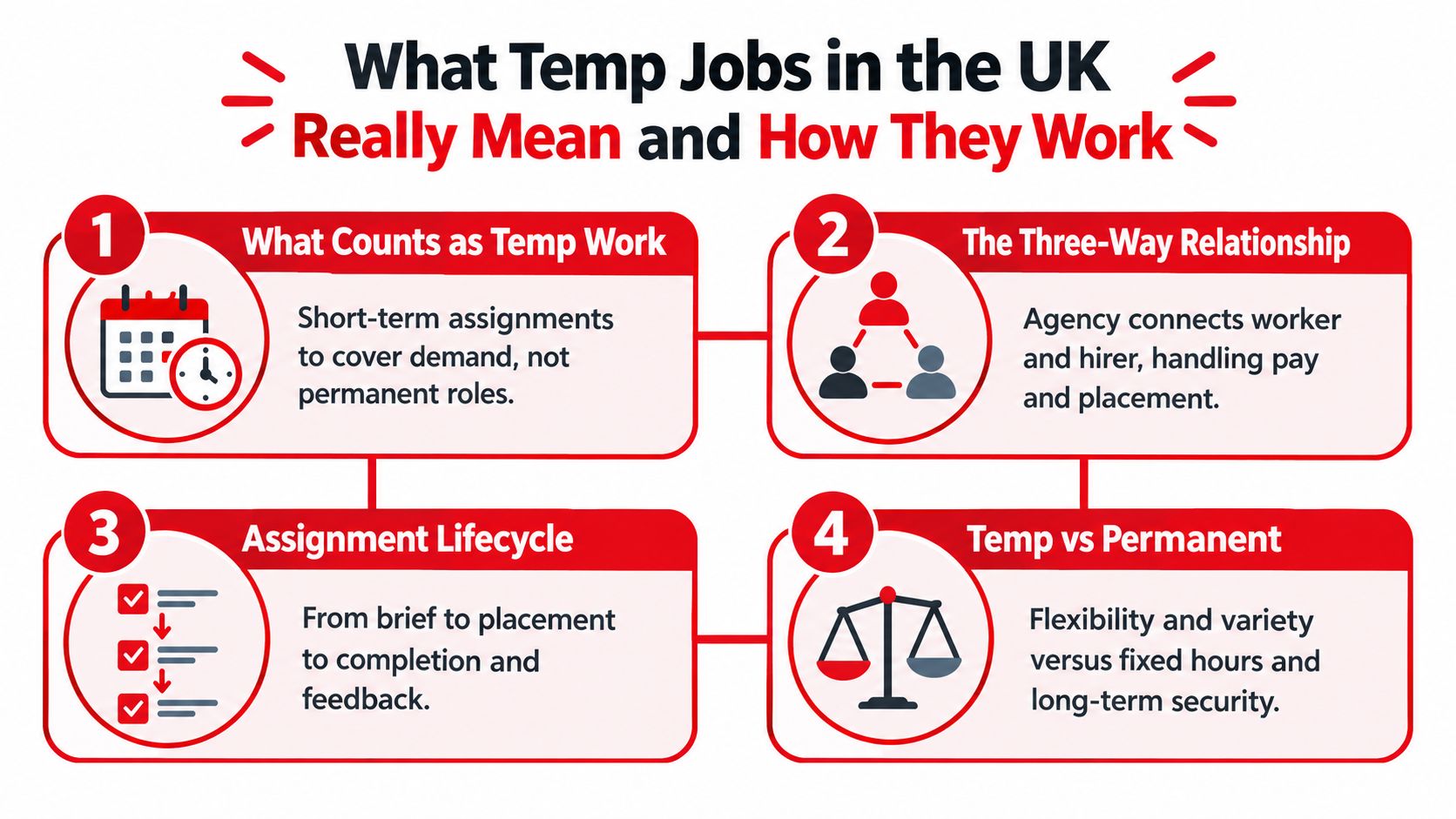
A temporary job is a defined period of work arranged to meet a short-term need. In hospitality, that might mean a chef covering sickness, joining a hotel for a busy season, supporting a new opening, or helping a kitchen while the operator recruits permanently.
The agency model works like a kitchen pass. The worker brings the skills and availability. The hirer provides the workplace, menu, equipment and service brief. The agency matches both sides and usually manages the assignment paperwork and pay process. If one part of that triangle is unclear, service suffers.
How an assignment usually runs
The process starts with a brief. A venue should state the role, start time, expected duration, menu style, team structure, pay arrangement, location and any essential qualifications. A chef should state availability, travel limits, cuisine experience, seniority and whether they want occasional cover or a route towards permanent employment.
The agency then proposes a match. The worker may complete registration, references, right-to-work checks and an interview before accepting. Once the assignment starts, the hirer manages day-to-day kitchen work, while the agency remains involved with timesheets, payroll, changes to the booking and any concerns.
Assignments can last a single shift, several weeks, a season or longer. The exact notice arrangements depend on the agreement, so both parties should confirm them before the first service. Never rely on a verbal assumption that a booking will run for a particular period.
Temp, permanent, fixed-term and zero-hours work
A permanent role normally gives the worker an ongoing relationship with one employer and a clearer long-term rota. A fixed-term role is also usually direct employment, but it has an agreed end date. Temporary agency work keeps the agency relationship in place while the worker performs duties for the hirer.
Zero-hours work is different again. It can offer flexibility, but the worker may not receive a promise of regular hours. Government analysis of ONS Labour Force Survey data recorded around 1.2 million people on zero-hours contracts between October and December 2025, equal to about 3.6% of people in work, and identified accommodation and food as one of the sectors most reliant on that model. The UK Government analysis of zero-hours contracts also highlights the need for careful right-to-work checks, fast onboarding and stable rota communication.
For workers, temp work suits people who value variety, rapid starts or a route into a venue. For operators, it suits urgent cover and variable demand. It won't replace permanent hiring, but it can stop a short-term gap becoming a failed service.
Chefs considering agency work can review how working for a temp agency operates before registering. The useful test is practical: can the agency explain who pays you, how bookings are confirmed, how cancellations are handled and who you contact when the kitchen changes the brief?
Pay Rights and Legal Essentials for Temp Workers and Hirers
Hospitality managers often focus on filling the shift and leave the paperwork until later. That's where avoidable problems start. A temporary chef is still entitled to proper treatment, safe working conditions and accurate pay, while the hirer must give the agency enough information to keep the assignment compliant.
The main framework is the Agency Workers Regulations 2010. They apply to agency workers supplied to temporary hirers in England, Wales and Scotland. The regulations came into force on 1 October 2011, and the legislation establishing the Agency Workers Regulations sets out the relevant rights.
The 12-week rule: after 12 weeks in the same role with the same hirer, an agency worker has the right to the same basic pay and working conditions as a comparable direct hire.
What changes after 12 weeks
The 12-week qualifying period can affect a chef's basic pay, working time, rest arrangements and annual leave treatment. It isn't a signal to end an assignment or move someone between roles just to avoid responsibility. The hirer and agency should track the placement accurately, including the role, start date, breaks and any changes to duties.
For a kitchen, that means the rota and rate must match the assignment. If a commis chef arrives for prep but is then used as the senior chef on a section, the venue should not leave the agency working from an outdated brief. Rate discussions, holiday pay and working-time records need to reflect what the person is doing.
Rights from day one
Some rights apply immediately. The UK Government guidance for recruiters on agency workers says agency workers must have access to workplace facilities, such as a canteen, and information about vacancies from the first day of the assignment.
That has a direct kitchen application. A temporary chef should know where staff facilities are, how to report an accident, where the fire procedures are displayed, and how to find internal job opportunities. Calling someone “agency” doesn't justify leaving them outside the communication loop.
Workers should also check how holiday pay is handled, whether payroll runs through PAYE or an umbrella arrangement, and who deals with National Insurance and tax deductions. The answer should be clear before accepting the booking.
A compliance check before service
For hirers, the minimum practical file should include:
- Right to work: Confirm that the worker has completed the required check before starting.
- Assignment details: Record the role, location, start date, expected hours and reporting manager.
- Rate and holiday treatment: Confirm the agreed rate and how holiday pay appears.
- Safety information: Cover allergens, fire procedures, equipment risks, food safety and accident reporting.
- 12-week monitoring: Ask the agency to track the qualifying period and notify the venue before rights change.
A clean process protects both sides. It also prevents a common operational mistake, treating temporary staff as disposable cover rather than as people working inside the same food, safety and service system.
Where Temp Jobs Are Booming and Why Hospitality Leads Demand
Hospitality has a particular reason for relying on temporary chefs. Demand changes by day, season, weather, bookings and events, while the skills required on the pass cannot always be replaced with a quick general recruitment advert.
Parliamentary briefing data for the three months to September 2024 recorded 95,000 hospitality vacancies, equivalent to 3.6 vacancies per 100 workers, compared with 2.6 per 100 workers across all industries. The parliamentary briefing on hospitality vacancies also indicates that accommodation and food service vacancies remained close to pre-pandemic levels, pointing to persistent undersupply rather than a brief spike.
The chef shortage makes the pressure sharper. A People 1st report cited by the Craft Guild of Chefs said the UK needed at least 11,000 additional chefs over the next five years and estimated chef labour turnover at about 40%, with nearly 94,000 chefs changing jobs each year. That churn affects every part of the operation, from ordering and prep to training and consistency.
Temp Demand by Sector at a Glance
| Sector | Temp Demand Driver | Typical Temp Roles |
|---|---|---|
| Hospitality | Sickness, seasonal bookings, events, chef shortages and fluctuating covers | Relief chefs, sous chefs, pastry chefs, kitchen porters and catering staff |
| Retail | Christmas trading, stock movements and store-level demand | Sales assistants, stockroom staff and supervisors |
| Logistics | Delivery peaks, warehouse volume and short-term contracts | Pickers, drivers, warehouse operatives and coordinators |
| Healthcare | Rota gaps and specialist cover | Care staff, support workers and catering teams |
| Events | Venue schedules, festivals, weddings and conferences | Event chefs, front-of-house teams and catering supervisors |
Hospitality also has a deep flexible labour pool. Zero-hours and agency workers are disproportionately younger, female or in full-time education, according to the government analysis cited above. That can help venues find availability, but managers must allow time for induction, communication and consistent supervision.
Why location changes the problem
A coastal hotel in Devon or Dorset may need a stronger seasonal pipeline than a city-centre restaurant. A venue in Wales may face travel and accommodation issues when local supply is thin. In Berkshire, Windsor, Reading and Slough, hotels, events and corporate demand can create overlapping pressure for chefs who already have several options.
Industry research cited by Westminster reports a 9% hospitality vacancy rate and a shortage of 188,000 workers. The Westminster hospitality and leisure sector research supports the case for maintaining relief cover even when the immediate rota looks complete. A stable pipeline is cheaper operationally than repeatedly discovering the shortage on the day of service.
Operators can use seasonal and temporary chef jobs to target the periods and locations where demand is most exposed. Candidates should search by cuisine, seniority, travel distance and season rather than applying for every vacancy indiscriminately.
How to Find and Win Temp Jobs in the UK Fast
A fast start depends on preparation before the agency calls. Chefs who can prove availability, skills and legal readiness are easier to place than candidates who reply slowly or submit an unclear CV.
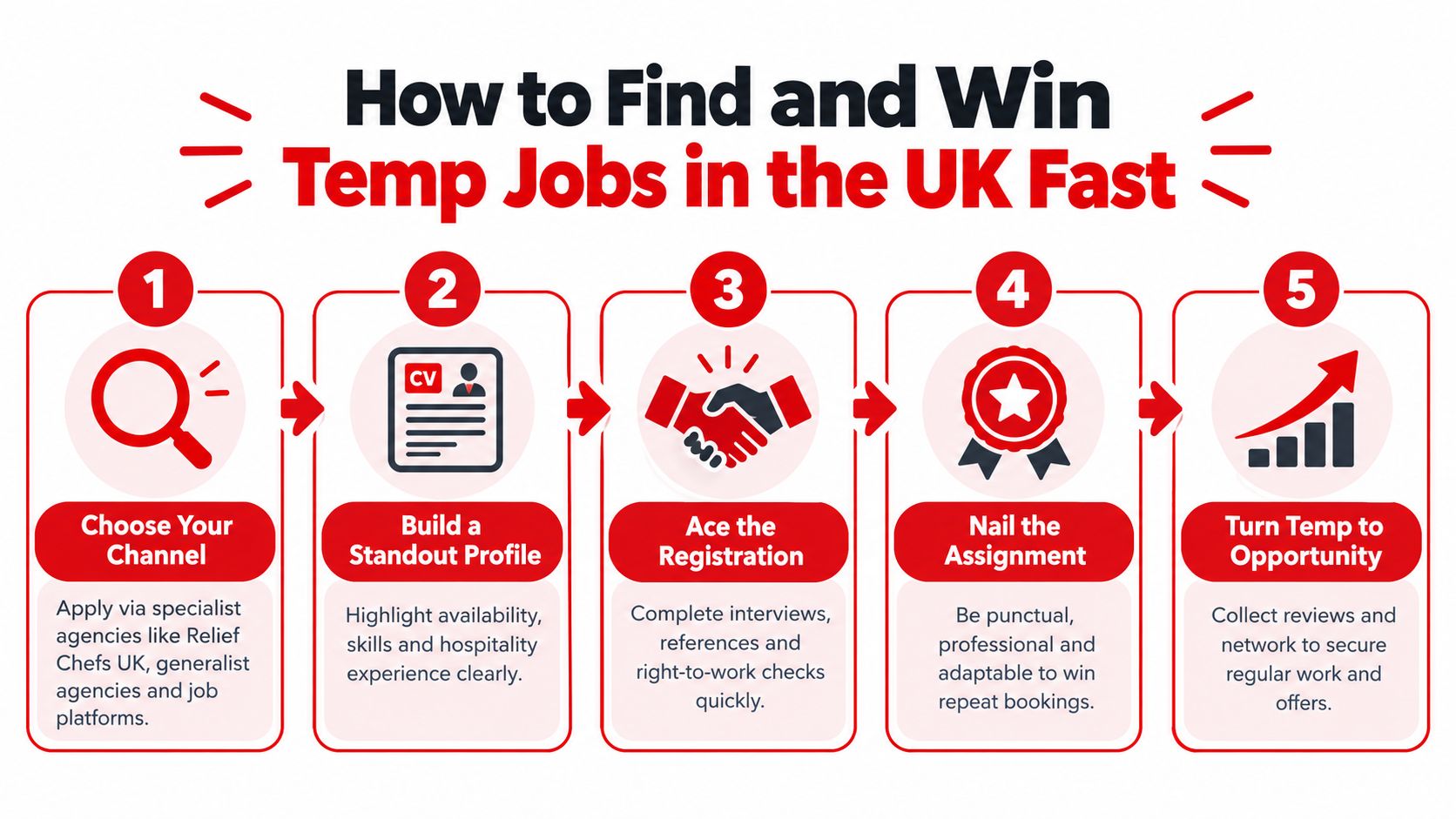
Start with the right channel. Specialist hospitality agencies understand kitchen hierarchy, service pressure and the difference between a chef who can prep and one who can run a section. Generalist agencies may offer broader work, while job platforms and direct approaches to pubs, restaurants and hotels can uncover local shifts. The trade-off is simple. A specialist may understand the brief better, while a direct approach can work well when you already know the venue.
Build a profile that answers the kitchen manager's questions
Your CV should make the match obvious. Put your current level, cuisine experience, section strengths, availability and travel area near the top. A chef applying for work in Bristol should state whether they can cover early prep, late service, banqueting, pastry, fine dining or high-volume pub food.
Keep the evidence practical:
- Show service range: Name the environments you've worked in, such as boutique hotels, contract catering, busy pubs, private households or yachts.
- List readiness documents: Keep food hygiene evidence, references and right-to-work documents available.
- State limitations clearly: If you can't drive, travel overnight or work split shifts, say so before placement.
- Answer quickly: Short-notice work rewards candidates who confirm availability clearly and arrive prepared.
Treat registration as part of the job
Registration isn't just administration. The agency is deciding whether it can trust you with a client's kitchen, so answer questions about allergens, HACCP practice, knife skills, ordering, stock control and team leadership with specific examples.
For a short-notice trial, ask about the menu, uniform, start time, parking, equipment and who will meet you. A chef who arrives with the right shoes, knives and attitude has already reduced pressure for the sous chef.
A Bristol chef who confirms availability, completes checks promptly and accepts a clear brief can be placed quickly when the agency already has the venue relationship and the paperwork ready. The point isn't to promise a particular outcome. It's to remove the delays that stop suitable candidates reaching the pass.
Turning a booking into a longer opportunity
A temporary assignment is a live assessment. Reliability matters more than theatrical confidence. Arrive early enough to change safely, ask focused questions, keep your section clean and tell the senior chef when a problem is developing.
The conversion opportunity is real. A UK hospitality recruitment summary reported that 38% of hospitality temp placements in 2025 converted to permanent roles within four months, as stated in the hospitality recruitment outlook for 2026. That four-month window gives both sides time to assess the fit, but conversion is never automatic.
At the end of a strong assignment, ask for feedback and tell the manager or agency if you'd consider a permanent role. Keep a record of positive comments, new responsibilities and problems you solved. A venue can only argue for your appointment if it can describe the value you brought.
How Venues Can Secure Reliable Temp Cover Without the Stress
A venue shouldn't begin its temp staffing process with “send anyone who can cook”. That brief produces mismatched chefs, poor handovers and an agency relationship built on urgency rather than accuracy.
Start with the failure point. Is the gap caused by short-notice sickness, a seasonal spike, annual leave, chef turnover, a wedding, a hotel contract or a permanent vacancy? The answer determines whether you need a one-day relief chef, a temporary chef for several weeks, or a permanent recruitment process running alongside immediate cover.

Brief the role like a service plan
Give the agency the information a chef needs to succeed:
- Kitchen level: State whether you need a chef de partie, sous chef, head chef, pastry chef or general relief chef.
- Food and volume: Describe the menu, covers, service style, allergens and production requirements.
- Working pattern: Include start times, finish expectations, split shifts, days required and likely extensions.
- Venue conditions: Explain parking, accommodation, uniform, equipment and who owns the pass.
- Success standard: Say what must be protected, whether that's breakfast, banqueting, prep, a tasting menu or an all-day service.
Relief Chefs UK provides relief chefs, temporary chefs, permanent chef recruitment, yacht chefs, villa chefs and wider hospitality staffing support. Its stated service model includes a response within two hours, chefs who can start within 48 hours, vetting and right-to-work checks, flexible Starter, Growth and Premium plans, replacement guarantees, 24/7 support, transparent pricing and full insurance. Those details should be confirmed against the service agreement before booking.
Build the first shift properly
A temporary chef needs a short induction, even when the booking is urgent. Show the allergen file, handwashing points, fire exits, cleaning schedule, temperature records, storage system and staff facilities. Introduce the chef to the pass and explain who makes final calls during service.
Use the same standard you'd use for a new permanent starter. Agency workers have day-one rights to workplace facilities and vacancy information, as covered earlier, and they need the information required to work safely. Treating them as part of the kitchen from the first shift improves handover and protects the brigade.
For operators comparing temporary staffing agencies for hospitality, ask how the agency handles substitutions, sickness, payroll queries, late changes, references, right-to-work checks and feedback. A reliable partner should be able to explain the process before the crisis arrives.
Retain the chefs who stabilise service
After the shift, record what worked. Was the chef strong on breakfast, pastry, banqueting or high-volume service? Did they communicate well with junior staff? Would you book them again for a hotel in Windsor, a pub in Dorset or a multi-site operation across Berkshire?
That feedback creates a useful internal bench. It also gives the agency better information for the next brief. The venue still needs permanent recruitment, but a tested relief network gives managers room to recruit carefully instead of accepting the first available CV.
Next Steps to Get Started With Temp Work or Temp Cover
Workers should choose an agency that understands hospitality, explains pay clearly and can match their real skills rather than just filling a shift. Prepare your CV, right-to-work documents, references, availability and travel limits before you apply. Then treat every booking as both paid work and a chance to build a reputation.
Venues should decide which problem they're solving. Short-notice sickness calls for relief cover. A busy season may need a temporary chef pipeline. Repeated vacancies, high turnover or a missing senior chef may require temporary cover alongside permanent chef recruitment. For an immediate kitchen gap, relief chef cover should be briefed with the same precision as a permanent appointment.
Relief Chefs UK is run by chefs rather than recruiters and draws on more than 60 years of combined hospitality experience. It has earned the trust of 400+ venues, including independent pubs, restaurants, boutique hotels, private households, yacht operators and multi-site hospitality groups. The value is operational: a chef who understands service risk can assess whether the brief needs emergency cover, seasonal reinforcement or a longer recruitment solution.
For workers, the next move is to register with clear availability and a useful skills profile. For managers, it's to request cover before the gap reaches the pass. The FAQ below addresses the questions that usually decide whether a temp arrangement is practical.
Frequently asked questions
Are temp jobs only for emergency cover?
No. Venues use temporary chefs for sickness, annual leave, seasonal demand, events, recruitment gaps and planned operational support. Workers may also use assignments to gain experience, maintain flexibility or test a venue before considering a permanent role.
Can a temporary chef become permanent?
Yes. A successful placement can give both sides evidence about skill, reliability and cultural fit. Hospitality recruitment reporting recorded 38% of temp placements converting within four months in 2025, but conversion depends on the venue's vacancy, the worker's performance and the agreed agency terms.
What should a venue check before a temp chef starts?
Confirm the chef's role, availability, right-to-work status, relevant experience, rate, working hours and references. Give a practical induction covering allergens, food safety, equipment, emergency procedures and the reporting structure.
What happens after 12 weeks?
Agency workers who remain in the same role with the same hirer for 12 weeks gain rights to the same basic pay and working conditions as comparable direct hires under the Agency Workers Regulations 2010. The agency and hirer should track the assignment rather than waiting until the issue appears on a payslip.
Can temporary workers find roles outside restaurants?
Yes. Temp hospitality work includes hotels, pubs, cafés, contract catering, events, private households, yachts and villas. The strongest match depends on the chef's skills, availability, travel range and the venue's service style.
Relief Chefs UK provides vetted relief chefs, temporary chefs, permanent recruitment, yacht chefs, villa chefs and wider hospitality staffing support across the UK, with cover designed around real kitchen pressures. Visit Relief Chefs UK to request temporary cover, discuss your next chef role or start building a dependable staffing pipeline before the next service gap hits.