
If you're standing on a Saturday pass in Bristol, covering a sick sous at short notice, private-chef work can look appealing from a distance. Fewer covers. Better kitchens. Higher spend. More control. Then you step into a client's house, realise there's no KP, no stores system, no second pair of hands, and the guest has changed dinner from four to eight with one gluten-free and one dairy-free at two hours' notice.
That's the job.
For chefs in restaurants, hotels, pubs and contract settings, the move into private work isn't a soft exit from service pressure. It's a shift from brigade support to solo accountability. You're cooking, planning, sourcing, managing expectations, protecting privacy and leaving the kitchen spotless. On yachts and in villas, that pressure sharpens again because space, timing and client standards tighten fast.
At the same time, hospitality businesses across the UK are still dealing with the same operational problems every week. Short-notice sickness. Seasonal demand in places like Devon and Dorset. Agency chefs who overpromise and underdeliver. Ongoing chef shortages that leave head chefs firefighting rotas instead of running kitchens. The wider labour picture explains part of this. The UK hospitality sector reported 132,000 vacancies, described as 48% above pre-pandemic levels, with member evidence showing chef shortages from 10% for head chefs to 21% for production chefs according to UK chef shortage reporting.
That pressure cuts both ways. Venues need kitchen stability, and experienced chefs start looking for a different path.
Introduction What Private Chef Work Really Involves
A private chef rarely gets judged on one plate. Clients judge the full day.
They notice whether breakfast lands on time, whether the children's supper is handled without fuss, whether allergens are understood without drama, and whether you can work around household staff, dogs, builders, guests and last-minute travel plans. In a hotel, you can usually lean on systems. In a private home, villa or yacht, you are the system.

What changes when you leave the brigade
In a restaurant, a strong chef can specialise. Good on garnish. Fast on fish. Dependable on pastry prep. In private work, that separation disappears.
You might write menus in the morning, shop before lunch, prep for a family meal in the afternoon, then serve a more formal dinner at night. If the kitchen equipment is poor, you adapt. If the principal wants a lighter menu after seeing the original, you adjust. If the pantry is badly organised, you fix it because tomorrow still has to run cleanly.
Three parts of the role catch chefs out most often:
- Client contact matters more: Technical ability gets you considered. Calm communication gets you rebooked.
- Discretion is part of service: High-end households don't want drama, oversharing or kitchen ego.
- Self-management is essential: No head chef is checking your prep list, ordering errors or time plan.
Private-chef work suits chefs who can cook well without supervision, stay steady under domestic pressure, and treat service standards and privacy as part of the craft.
Who private-chef work suits
The strongest private-chef candidates usually come from solid restaurant, hotel or event backgrounds, but not always from the flashiest names. A chef who can organise a full day, manage dietary detail and keep standards up in unfamiliar kitchens often beats a chef with a better CV and weaker discipline.
That matters for employers as well. A household hiring a private chef is still making a staffing decision. They want the same things a serious operator in Berkshire, Windsor or Reading wants from agency or permanent support. Reliability. Right fit. No chaos on day one.
For venues dealing with staffing gaps, that same standard is why many operators use specialist support rather than gambling on unknowns. Relief Chefs UK has worked nationwide since 2013 across relief chefs, temporary chefs, permanent chef recruitment, yacht chefs, villa chefs and wider hospitality staffing support. That kind of operational view matters because private-chef placements and kitchen placements often fail for the same reason. People apply too early, or they look polished on paper and fall short in live service.
Skills Qualifications and Experience You Need First
The first answer to how to become private chef in the UK is simple. Build proper kitchen experience before you chase private households.
In the UK, chefs sit under SOC code 5434 and are generally treated as a skilled occupation at RQF levels 3 to 5. Industry guidance also points to private chefs typically needing around 2 to 5 years of prior kitchen experience, with some employers and career guides looking for at least 1 year and ideally 3 to 5 years before moving into private households, as set out in the UK shortage review and chef occupation guidance.
Start with brigade miles, not branding
A lot of chefs focus too hard on where they worked and not enough on what they did there.
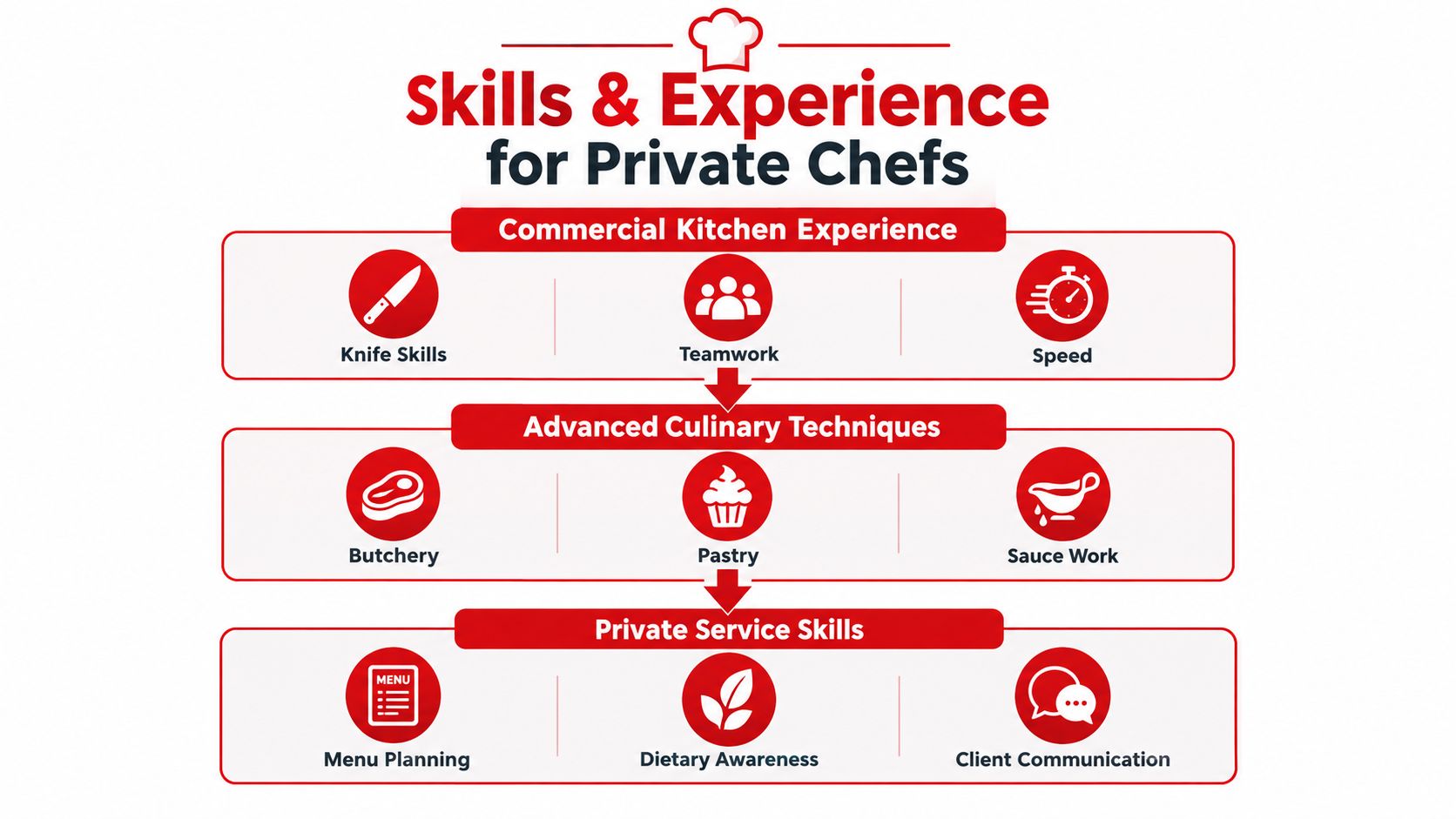
Private clients want evidence that you can handle pressure, organise mise en place, plan menus, maintain standards and deliver without supervision. That's why commercial kitchen experience matters. It exposes you to pace, repetition, consistency and accountability. A commis who has progressed through chef de partie responsibilities in a serious operation is often on a better track than someone who trained well but hasn't carried a section properly.
London culinary guidance says a credible personal chef typically needs at least one year of relevant experience and ideally three to five years, while UK adverts often ask for a Level 3 NVQ in catering or equivalent plus high-end kitchen exposure, according to Le Cordon Bleu London's guide to becoming a personal chef.
What qualifications actually signal
Formal training helps because it tells clients and agencies you've had structured development. It doesn't replace service history.
Useful signals include:
- Cookery training: This shows a technical foundation and discipline.
- Level 3 NVQ or equivalent: Often requested in UK job adverts for chef roles with responsibility.
- Food hygiene certification: Essential, but it's a baseline, not a selling point on its own.
- Documented progression: Promotions and better sections matter more than a stack of unrelated certificates.
If you're still building your route, Relief Chefs UK's guide to chef qualifications in the UK gives a practical overview of what employers usually recognise.
Takeaway: Qualifications can open the conversation. They do not secure private-chef placements without proven hands-on experience.
The private-service skills clients actually notice
Private work adds another layer on top of kitchen ability. These are the gaps I see most often when chefs try to move too soon:
Menu planning for real households
Not a tasting-menu fantasy. Menus that suit routines, preferences, children, events and dietary restrictions.Sourcing and cost judgement
You need to know when to buy premium and when to buy smart. Clients notice waste quickly.Presentation without overcomplication
Restaurant polish matters. So does serving food that fits the setting and timing.Client-facing service
Some households want warmth. Others want near invisibility. Reading that properly is part of the job.Dietary confidence
Gluten-free, dairy-free, low-allium, child-friendly, training-focused. You don't need every niche, but you do need control.
What doesn't work
Chefs struggle when they assume private work is easier than restaurant work. It isn't. It's narrower in covers and broader in responsibility.
A common mistake is leaving commercial kitchens too early. Another is trying to jump straight into elite London household or travelling roles without proving you can run breakfast through dinner cleanly, repeatedly, and without being managed. Build the foundation first. Then private-chef work becomes a credible move, not a gamble.
Food Safety Compliance Insurance and Legal Setup in the UK
Once your cooking background is ready, the next stage is business readiness. A lot of strong chefs lose momentum. They can cook, but they haven't set themselves up to trade properly.
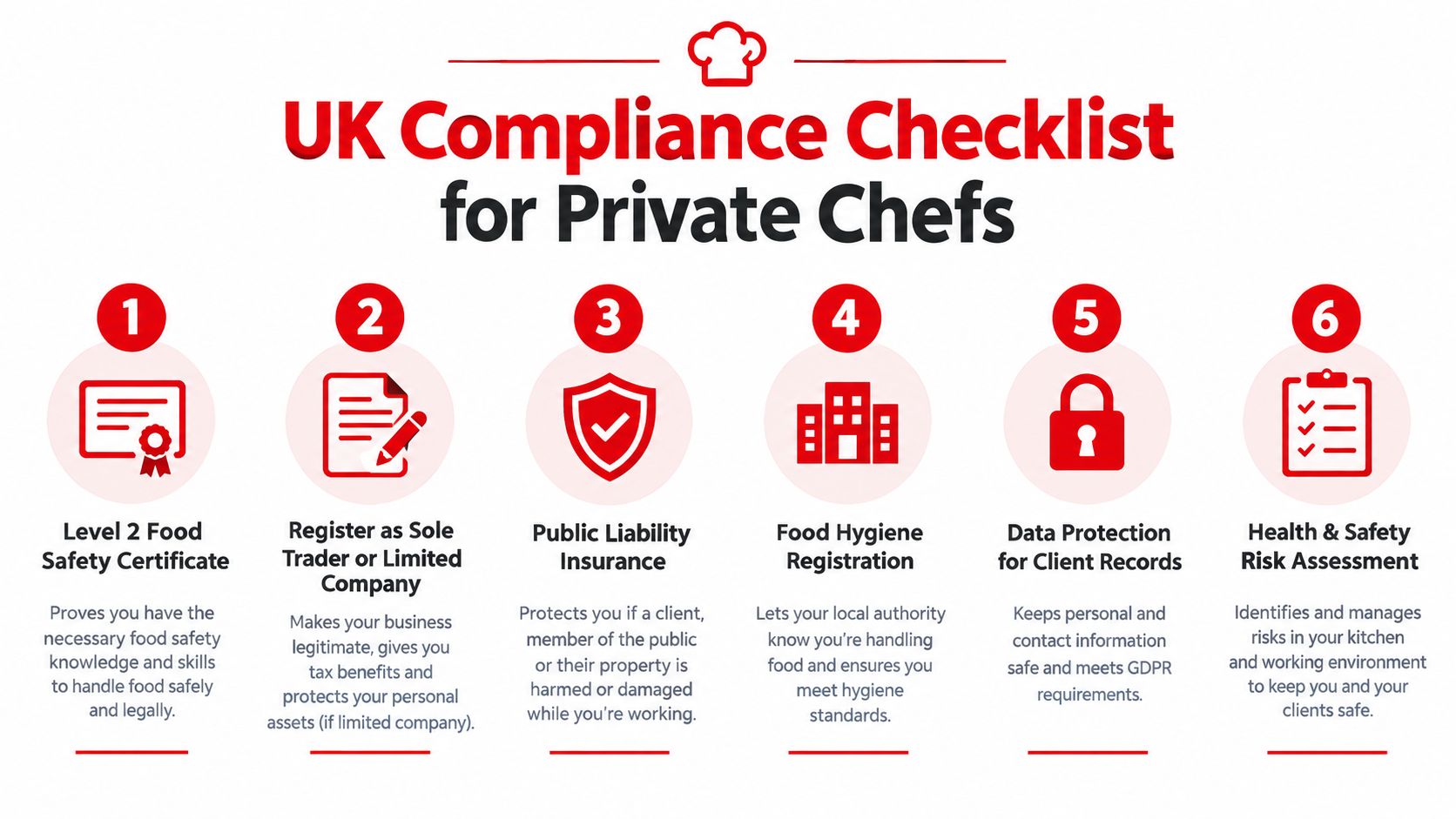
A recent UK private-chef guide says aspiring chefs should obtain a Level 2 Food Safety Certificate, register as a sole trader with HMRC, secure public liability insurance, and arrange any required local-council food-safety compliance before trading privately, as outlined in this UK private-chef setup guide.
Your core compliance checklist
Private chefs often work alone in homes, holiday lets and on yachts. That means you can't rely on restaurant systems to cover weak habits.
Use this checklist before you take paid work:
- Food safety certificate in place: A Level 2 certificate is the basic line. If it's expired or missing, sort it first.
- Tax structure chosen: Decide whether you're operating as a sole trader or limited company.
- HMRC registration done: Don't leave this until after invoices go out.
- Insurance live: Public liability matters because you're working in private property around people, equipment and food risk.
- Local authority requirements checked: If your setup counts as a food business, deal with registration properly.
- Records and admin organised: Client notes, allergies, invoices and terms all need a system.
For chefs who need to tighten the basics first, Relief Chefs UK has a straightforward Level 2 food hygiene training guide.
Why private work needs tighter discipline
A restaurant chef can be excellent and still rely on the building around them. The probe is there. The cleaning schedule exists. The EHO file is kept by someone else. In private work, the client assumes you've already got that discipline sorted.
That's especially true on yachts and in luxury villas. Provisioning may be remote. Storage space may be tight. Guest preferences may change daily. If your paperwork, hygiene habits and insurance position are shaky, the problem shows quickly.
This short video gives a useful overview before you start putting your paperwork together.
Common mistakes that delay good chefs
I see the same setup errors repeatedly:
- Trading before registration: Chefs take casual bookings and only think about HMRC later.
- No insurance because it's “just a dinner”: That's the wrong mindset. Risk doesn't ask how formal the booking was.
- Weak allergen documentation: Verbal notes aren't enough when clients are rotating diets or hosting guests.
- No written terms: If timings move, guest numbers change, or shopping costs escalate, you need something clear to rely on.
A private chef is a cook, service professional and operator in one person. If one part is missing, clients notice.
What legal setup means in practice
The most practical route is simple. Get your hygiene certification current. Choose your trading structure. Register correctly. Put insurance in place. Keep written records. Then start selling your service.
That might sound administrative, but it's part of the standard. Serious clients in Slough, Reading or central London don't just buy food. They buy confidence that nothing around the food becomes a problem.
Building Your Portfolio Demo Menus Pricing and Contracts
The chefs who move into private work fastest aren't always the most talented. They're often the clearest.
A client or household manager should be able to look at your material and understand what you cook, who you suit, how you charge, and how you work. If your portfolio is vague, your enquiries will be vague too.
Build a portfolio that answers real client questions
A useful private-chef portfolio doesn't need to be flashy. It needs to reduce uncertainty.
Include:
- Clear food photos: Show food you cooked, not borrowed content or old college shots.
- Menus that feel bookable: Family meal prep, dinner party, health-focused weekly support, villa dining. Give people formats they can picture.
- Dietary examples: Show where you've handled gluten-free, dairy-free, child-friendly or higher-protein menus sensibly.
- Short testimonials: Specific comments about reliability, flavour, cleanliness or flexibility help more than generic praise.
If you're based in Devon, Dorset or Wales, local context helps. A coastal property owner may want a seafood-led family menu with simple lunches and a polished dinner. A client in Berkshire or Windsor may want weekday structure plus occasional entertaining. Build examples around real buying behaviour, not chef vanity.
Demo menus should prove judgement
A demo menu is not there to impress other chefs. It's there to help a client say yes.
Strong demo menus usually do three things well:
They fit a service type
A six-person anniversary dinner needs a different structure from weekly prep for a busy household.They show restraint
Too many components suggest risk in unfamiliar kitchens.They show range without confusion
A small set of well-judged menus beats a random list of cuisines.
A lot of chefs underperform here because they write menus like competition entries. Clients want confidence, not theatre.
UK salary context also matters when you shape your offer. Advertised private-chef roles average about £47,499, with typical listings around £42,499 to £52,499, while higher-end travelling roles can reach about £80,000 in London-based searches according to current UK private-chef job listings. That's why it makes sense to win mid-market work first, then move upward once your proof matches the level.
Private Chef Pricing Models Compared
| Pricing Model | Best For | What to Include |
|---|---|---|
| Day rate | Single-day household cover, holiday lets, yacht handovers | Labour window, service scope, shopping terms, travel terms, cleanup expectation |
| Per service | Dinner parties, small events, anniversary meals | Guest count, menu format, arrival time, serving style, washing down and waste handling |
| Weekly retainer | Regular family cooking, recurring meal prep | Number of visits, meal count, revision limits, shopping process, pause or cancellation terms |
| Salary or fixed contract | Full-time private household roles | Hours, accommodation if relevant, travel expectations, confidentiality, holiday cover |
Chefs often ask what to charge before they've defined the service. Do it the other way round. Nail the scope first.
For broader UK context, a practical overview of how much a private chef costs is useful when benchmarking your offer against client expectations.
The easiest way to lose money in private work is to sound flexible while pricing vaguely.
Contracts protect both sides
At minimum, your written terms should cover dates, timings, guest count assumptions, cancellation, payment timing, ingredient handling, allergies, kitchen access and confidentiality. On villas and yachts, add travel days, provisioning process and staff meal expectations if those sit with you.
Underpricing is another common mistake. Recent UK guidance notes freelance day rates commonly sit around £150 to £400 depending on client type and reputation, alongside the need to choose a sole trader or limited company structure, register with HMRC, notify local authorities as a food business, and secure business insurance, as explained in this UK personal-chef business guide.
Finding Clients Agencies Networking and Yacht and Villa Work
Once your offer is clear, the next job is getting in front of the right buyers. Chefs waste a lot of time. They use one route, get poor results, then assume there's no demand. Usually the issue is channel fit.
Direct enquiries versus placed work
Direct household enquiries can be excellent if you're local, visible and already trusted in your area. In places like Bristol, Devon or Dorset, referrals from food suppliers, local event planners, boutique accommodation operators and returning guests can produce steady work.
The problem is inconsistency. Direct enquiries often come in waves. Good month, dead month, panic month.
Agencies and staffing partners add structure. They also filter some of the nonsense. Better briefs, clearer expectations, vetted clients, and a more realistic match between chef level and job level. That matters if you're aiming for households, yachts or villas where one bad placement can damage future access.
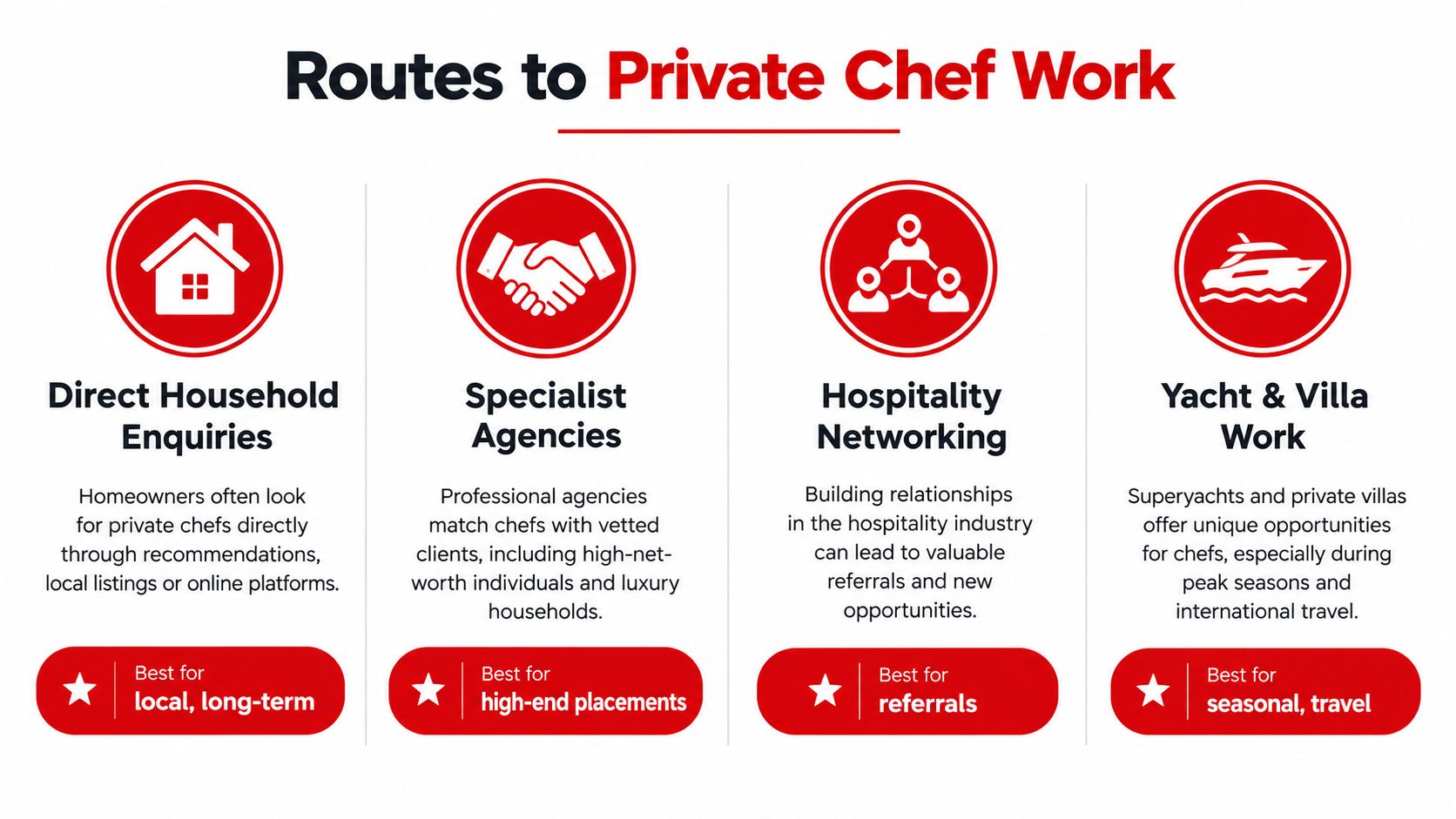
Compare the main routes properly
Here's the honest version.
Direct household enquiries
Best when you already have local reputation and want control over your diary. More admin. More chasing. Quality varies.Specialist agencies
Best when you want access to better-screened roles and higher-trust placements. Less control over every brief, but usually a cleaner route into private households.Hospitality networking
Strong for chefs coming from hotels, country houses, event catering and premium pubs. A GM in Berkshire, a head chef in Windsor or an operator in Reading often knows households that need cover.Yacht and villa placements
Good for chefs who travel well, work cleanly in tight spaces and can manage provisioning without drama. Not ideal for chefs who still need heavy supervision.
Where most chefs get it wrong
They apply too widely and too early.
A chef with decent hotel breakfast and banqueting experience may suit family villa support in Wales before they suit a travelling UHNW principal. A chef who's excellent on a line but weak with clients may be stronger in private prep and support than formal household service. Matching matters.
The wider earnings split is one reason so many chefs want clarity here. One UK guide notes private-chef wages in England averaging £23.18 per hour versus a broader UK chef average of £14.75 per hour, highlighting why career-switchers want clearer entry steps and realistic expectations in the UK private-chef salary and career guide.
Better-paid private work exists, but clients don't pay premium rates for potential. They pay for proof, discretion and consistency.
A practical route for chefs and operators
For chefs looking to move across, and for businesses needing reliable cover at the same time, one route is to stay connected to quality staffing networks while you build relevant experience. Relief Chefs UK places chefs into hospitality and private-client environments including relief chefs, temporary chefs, permanent chef recruitment, yacht chefs, villa chefs and broader staffing support across the UK. For operators dealing with seasonal pressure, sickness or kitchen instability, that kind of crossover matters because the same chef may suit a boutique hotel in Dorset one month and a private household cover brief the next.
If you're a chef, use agencies selectively, keep your network warm, and target jobs that match your actual level. If you're a venue, don't leave staffing until the rota has already failed. Short-notice sickness and unreliable agency cover cost more when service drops with it.
Your Actionable Timeline and Checklist to Launch
Most chefs don't need more inspiration. They need a sequence.
If you want to move into private work properly, treat it as a transition from one operating model to another. That means earning the right experience, sorting compliance, packaging your offer, then taking the right level of booking first.
A workable launch timeline
Phase one builds the base. Stay in brigade roles long enough to handle service, ordering pressure, menu changes and section ownership without hand-holding. If you still need constant supervision in a restaurant, private work will expose that quickly.
Phase two formalises the business side. Get hygiene certification current, set up your trading structure, organise insurance, and put your admin in order. This is also the stage to decide whether you want occasional private bookings, a freelance personal-chef model, or a full private-household route.
Phase three packages your service. Build a lean portfolio, create a few sensible demo menus, and write terms that stop scope drift. Then start with placements and bookings that suit your current level, not the level you hope to be at in a year.
Use this readiness checklist before you apply
- Experience check: Can you run a day's food output alone without compromising standards?
- Dietary check: Can you confidently manage common restrictions and household preferences?
- Service check: Are you calm and polished around clients, family members and guests?
- Compliance check: Is your paperwork complete and current?
- Commercial check: Do you know what you're selling, what's included, and how it's priced?
- Practical check: Can you work cleanly in unfamiliar kitchens with limited support?
Don't rush premium placements
It's tempting to go straight after travelling roles, yacht jobs and formal private household positions because the money is better. But the fastest route is often the slower-looking one. Mid-market work gives you references, repeat clients and operating confidence.
That's also where staffing partners can help on both sides. Businesses need stable cover. Chefs need credible routes into the right work. Whether that's temporary kitchen support, private household cover, or specialist placements such as yacht chefs and villa chefs, the point is the same. Match level to role and protect standards from the start.
If you're a hotel manager, operator or head chef, this matters for retention as well. Chefs don't leave just for money. They leave when progression is unclear, rotas stay broken, and every staffing issue becomes an emergency. If you're a chef, the private route can be strong, but only when it's built on real service ability and proper setup.
A rushed move usually creates two problems. The chef struggles, and the client stops trusting the next candidate.
If you need dependable kitchen cover or want help moving into private household, yacht or villa work through a team that understands service from the inside, Relief Chefs UK can support both sides of that transition. We work nationwide across relief chefs, temporary chefs, permanent recruitment and specialist hospitality staffing, so whether you're filling a rota gap or building a private-chef career path, get in touch before the pressure lands on service.