
Hospitality Staffing Agency London
19 October 2026
A head chef calls in sick late on a Friday. The bookings are full, the kitchen is already moving, and the shift has no spare person who can take over the pass. In that moment, a staffing agency's polished pitch matters less than whether it answers, understands the kitchen's needs and can send someone competent.
For London pubs, restaurants and hotels, that decision isn't about filling a rota gap. It's about protecting service, supporting the team still on shift and choosing cover that costs less than the disruption it prevents. The right approach starts before the phone rings: know what kind of support you need, what checks you expect and how you'll judge the cost of cover.
When a Friday Night Cover Call Changes Everything
It's late afternoon in a Central London kitchen. The head chef phones in sick, service is approaching, and the bookings leave little room to cut the menu or slow the pass. The sous chef can take charge, but only if someone capable steps into the section the head chef was due to run.
The first useful question isn't, “How cheap is the hourly rate?” It's, “Can this agency understand the job, confirm a suitable chef and give us a clear answer quickly?” A candidate who has the right title but can't handle your menu, volume or kitchen routines may fill a line on the rota without solving the problem.

That's why response, vetting and continuity are operational decisions, not just procurement details. If the agency can't tell you who's available, what they've been assessed for or what happens if the booking falls through, your team is carrying the risk. A reliable process should establish the role, shift, service style and essential skills before a chef is confirmed.
Practical rule: Brief for the work, not just the job title. “Chef de partie” doesn't tell an agency whether you need someone to run breakfast, manage a busy grill section or step into a small brigade with minimal handover.
For an independent pub, a no-show could leave the kitchen short at the busiest point of the evening. For a hotel general manager, it might threaten breakfast and dinner service across a shift change. Multi-site operators need the same clarity at scale, so one venue's emergency doesn't become a chain-wide scramble. A prepared emergency relief-chef booking plan helps managers decide who to call and what details to give before time is tight.
Whether your kitchen is in Westminster, the City, the West End, Camden, Southwark or the Docklands, the standard should be the same: a suitable chef, clear communication and a plan for continuity. That's what makes agency cover useful rather than merely available.
Why London Kitchens Still Cannot Find Enough Chefs
London's hospitality workforce is large, but headcount alone doesn't tell an operator whether a competent chef can take a shift at short notice. The Greater London Authority recorded approximately 456,000 hospitality jobs in June 2025, broadly matching the sector's 2019 level but below 472,000 in June 2023. From 2019 to 2025, hospitality employment contracted by 1%, while employment across London industries grew by 8%, according to the GLA's hospitality sector analysis.
The skills gap matters as much as the size of the workforce. In 2024, 46,000 London hospitality vacancies were hard to fill because of skills shortages, representing 24% of relevant vacancies, and an estimated 310,000 employees, or 6% of the sector's workforce, weren't fully proficient in their roles, the same GLA analysis reports. For chef positions in skilled trades, 39% of vacancies were hard to fill because of skills shortages, compared with 17% across the relevant hospitality-sector average, according to the GLA's source report on hospitality.
A vacancy count can fall while a kitchen's ability to cover service remains strained. Across the UK, accommodation and food-services vacancies were estimated at 79,000 in the three months to May 2025, down from 82,000 in the previous three-month period and 19% below May 2024. In the same period, payrolled hospitality employment fell from 2,111,898 in April 2025 to 2,100,827 in May, and was 4.6% lower than in May 2024, according to industry reporting on hospitality employment and vacancies. Fewer advertised jobs don't necessarily mean there are more suitably experienced chefs available for your Friday service. Some businesses may have cut hours, reduced headcount or left positions unfilled.
London's exposure makes contingency planning important
London kitchens also rely heavily on international recruitment. Before the pandemic, 85% of chefs working in London were born outside the UK, compared with 50% of chefs across the UK. More than half of London's hospitality workers were estimated to have come from Europe, compared with more than 30% nationally, according to the Mayor of London's statement on hospitality shortages. For operators, that dependence makes it sensible to plan for changes in staff availability and recruitment conditions rather than relying on one hiring route.
National employment history also shows how sharply demand can move. UK accommodation and food-services employment rose from 1.316 million in 1997 to 1.865 million in 2025, an increase of approximately 549,000 workers, or 41.7%. The sector's vacancies fell to 28,000 in the fourth quarter of 2020, climbed to 177,000 in the second quarter of 2022, then stood at 79,000 in the second quarter of 2025, according to ONS employment data. A venue's rota still has to work through sickness, leave, weddings, conferences and busy seasonal periods, whatever the national trend says.
That's why a relief option isn't a luxury reserved for a crisis. It's a way to secure verified practical capacity when the permanent team can't absorb another shift.
Comparing Temporary Cover, Permanent Recruitment and Hybrid Models
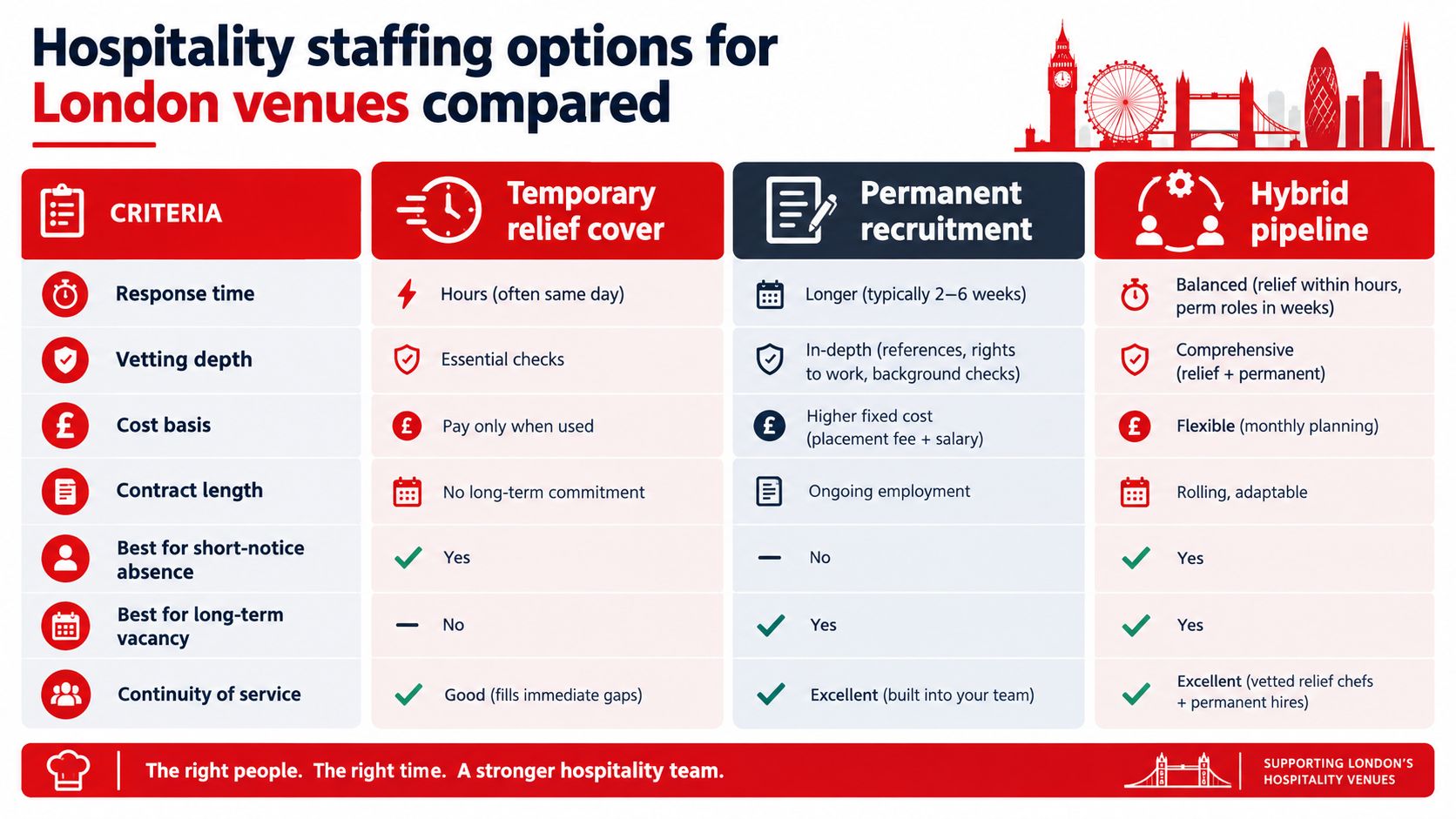
Before choosing an agency, identify the gap you're trying to solve. A short-notice absence, a persistent vacancy and a recurring seasonal spike aren't interchangeable problems. Using temporary cover to avoid making a permanent hire can leave a team unstable; hiring permanently to solve a short-lived peak may commit the venue to a cost it doesn't need.
| Criteria | Temporary relief cover | Permanent recruitment | Hybrid pipeline |
|---|---|---|---|
| Response time | Designed for short-notice gaps, subject to availability and role fit | Longer hiring process, with interviews and onboarding | Immediate cover can support a planned permanent search |
| Vetting depth | Confirm the candidate's practical fit for the shift and kitchen | Assess for longer-term capability and team fit | Apply shift-level checks and a consistent permanent selection process |
| Cost basis | Pay for cover when required; check rates and any extra charges | Ongoing employment cost and recruitment expenses | Variable cover alongside a longer-term hiring budget |
| Contract length | Shift-based or short-term, depending on agreement | Ongoing employment | Flexible cover plus permanent placements |
| Best for short-notice absence | Yes, when a suitably skilled chef is available | No | Yes |
| Best for long-term vacancy | Can bridge the gap, but isn't a permanent solution by itself | Yes | Yes, while protecting service during recruitment |
| Continuity of service | Depends on briefing, repeat bookings and replacement arrangements | Builds through integration into the team | Balances immediate cover with a stable permanent team |
Match the model to the pressure point
Temporary relief cover suits a head chef's sickness, booked events, annual leave or a sudden surge in trading. Give the agency the shift time, expected covers, menu style, section duties, dress or equipment requirements and who will brief the chef on arrival. A clear handover can make the difference between a capable cook finding their feet and the permanent team losing time explaining basics during service.
Permanent recruitment makes more sense when the role is part of the operation's long-term structure. If the venue needs someone to lead a brigade, take ownership of ordering or develop the menu, assess for those responsibilities instead of expecting short-term cover to solve a permanent team-design problem.
A hybrid pipeline combines both: maintain access to temporary chefs for planned and unplanned gaps, while recruiting permanently when the role warrants it. For example, a hotel can protect breakfast and dinner service with relief cover while interviewing for a permanent sous chef. A group with several London sites can plan known busy periods rather than making every temporary booking from scratch.
A temporary chef can keep the section moving. A well-planned hybrid approach also gives the permanent team a route back to stability.
There's a video overview of staffing approaches for operators weighing up their options:
Chef Vetting, Compliance and Insurance You Should See on Paper
A confident phone manner isn't proof that an agency's checks are complete. Ask what it verifies, how it records the evidence and what your venue remains responsible for. Get the process in writing before the first shift, especially if the chef will work unsupervised or handle sensitive duties.

Ask for evidence, not assurances
Start with identity and right-to-work procedures. Ask who checks documents, how the agency records the check and how information is kept current. Your organisation still needs to understand its own obligations when engaging temporary workers. For an overview of the process, review this guide to right-to-work verification for hospitality staff.
Then check role-specific capability. A chef who can cook well in one setting may not be ready to run your section without support. Ask how candidates are assessed for food safety, allergen handling, pace, menu familiarity and the level of supervision your kitchen can provide. References and a work history that fits your operation should support that assessment, not replace it.
Clarify who carries the risk
Ask to see insurance details and confirm exactly what cover applies to the chef's work, including public liability and professional indemnity where relevant. If the position requires a DBS check, establish whether it's appropriate and whether the agency can show the required evidence. Don't assume every check applies to every job; ask for the rationale and the documentation.
The replacement process deserves the same scrutiny. Who do you call if a chef cancels? How quickly will the agency escalate the issue? Is a replacement offered, and under what terms? A vague promise to “sort something out” won't help the manager trying to keep a service staffed.
| Evidence to request | What it should help you establish |
|---|---|
| Identity and right-to-work records | Checks are completed and documented |
| Role history, references and skills assessment | The chef's experience matches your kitchen |
| Food-safety and allergen competence | The chef can follow your venue's standards |
| Insurance details | You understand the applicable cover and responsibilities |
| Cancellation and replacement terms | You know the escalation route if a booking fails |
Write down your agreed standards and compare agencies against the same checklist. That makes a weaker provider easier to spot before a failed shift, not after.
Pricing Structures and the Real Cost of Cover
London operators need to compare total cost of cover, not just the quoted rate. BDO's 2025 Hotel Britain analysis reports an average year-on-year payroll-cost increase of 4.2% across the sector, rising to 6.6% in London, according to BDO's Hotel Britain analysis. With payroll under pressure, a low headline price can look tempting. It still won't be a saving if the shift fails and the venue has to find cover, extend overtime or reduce service.
A practical comparison is:
Total cover cost = agency charge + employer on-cost equivalent + overtime or shift-premium exposure + expected cost of service disruption.
Consider a London restaurant comparing two options for a chef's shift. One agency quotes a lower charge but can't confirm the candidate's section experience or what happens after a cancellation. The other quotes more, provides evidence of checks and sets out its replacement process. There's no need to invent a precise financial forecast to see the trade-off: the cheaper option carries more uncertainty, while the second may better protect the service. The right choice depends on the role, terms and operational consequences.

Compare the invoice with the outcome
Ask agencies to explain their charging basis, any minimum booking terms, cancellation arrangements and potential additional fees. If an agency offers a monthly plan, check precisely what each tier includes, as plan names alone don't tell you whether priority support, a replacement guarantee or a dedicated account manager is included.
For an independent pub, occasional shift-based cover may suit better than an ongoing plan. A boutique hotel with recurring leave gaps may value predictable access to chefs. A multi-site group might need a named contact and a clear process for allocating support between properties. In each case, compare the agreement with the actual pattern of need. For broader employer cost considerations, see this guide to the cost of employing staff.
Track performance against a consistent scorecard:
- Fill rate and response time: Did the agency confirm suitable cover and communicate clearly?
- 48-hour placement rate: For bookings where that timeframe is required, did the placement arrive as agreed?
- Replacement and cancellation rates: How often did the venue need the agency to recover a booking?
- Repeat-booking retention: Did the chef work well enough to be requested again?
- Invoice variance: Did the final charge match the quote and agreed terms?
A cheaper rate that brings a no-show or a chef who can't run the section may cost more in management time and disrupted service. Measure what happened, not just what the sales conversation promised.
Choosing the Right Agency for Your Venue and When to Call
For an independent pub, prioritise a clear response route, a useful brief and a chef who can fit the kitchen's pace. In a West End boutique hotel, ask whether the person can handle the breakfast or dinner operation you need covered, with a handover your team can manage. A multi-site group should look for transparent booking arrangements and one process managers can use across venues. Yacht and villa operators should ask specifically about chefs suited to those settings, rather than assuming every hospitality placement transfers directly.
Continuity matters alongside speed. A 2026 survey reported that 52% of hospitality workers expected to stay with their current employer, down from 62% in 2024; working with good colleagues was the leading retention factor at 72%, according to hospitality workforce survey reporting. That makes fit important: a chef who works well with the existing brigade can be more valuable than a fast placement that creates extra friction.
Relief Chefs UK is a nationwide chef recruitment agency established in 2013. It offers relief chefs, temporary chefs and permanent chef recruitment, alongside yacht chefs, villa chefs and broader hospitality staffing support. Its experienced recruitment team is available 24/7 to help venues find vetted, right-to-work-checked chefs for temporary, emergency and permanent placements, subject to availability, with transparent pricing. Confirm the terms that apply to your venue and booking before you commit.
The same contingency planning can support kitchens beyond London, including Bristol, Devon, Berkshire, Windsor, Reading, Slough, Dorset and Wales. Set a clear trigger for requesting cover, agree who makes the call and keep a concise shift brief ready. That preparation gives the agency a better chance of matching the chef to the job.
Contact Relief Chefs UK to discuss relief chefs, temporary cover or permanent recruitment for your London kitchen. Share the shift, role and service requirements, then agree the checks and cover terms before the next rota gap threatens service.
Call the team.
Office 01392 715474 · info@reliefchefs.co.uk