

A Friday service is already fully booked when the agency chef arrives late, struggles with the pass and admits they haven't worked with a menu like yours before. Your head chef abandons prep to reorganise the section, permanent staff lose confidence, tickets slow down and the front of house team starts explaining delays to guests. The quoted hourly rate looked competitive. The actual cost is measured in wasted preparation, damaged trust and a service your team will spend days trying to recover.
That's why choosing a host staffing agency requires more than comparing hourly rates. UK hospitality has dealt with persistent labour shortages for years. Evidence submitted to Parliament placed vacancies at 10% to 16%, equivalent to roughly 210,000 to 336,000 unfilled roles, with especially acute gaps among serving staff, chefs, housekeeping and security. The same evidence said vacancies were 49% higher than pre-pandemic levels. (Parliamentary written evidence)
A reliable agency can protect kitchen stability when sickness, seasonal demand or failed permanent recruitment leaves a rota exposed. An unreliable one can make the gap worse. The practical test is simple: does the agency understand your operation well enough to send a chef who can contribute safely and productively from the first service?
Why Choosing the Right Host Staffing Agency Matters
The first warning sign usually appears before the guests notice anything. A chef arrives without the right knife skills, can't find the stock, misreads the prep list or needs constant direction from a sous chef who was supposed to be running service. One weak placement can force your permanent team to cover two jobs at once.
The damage spreads quickly:
- Lost preparation time: A senior chef leaves their own section to correct basic work.
- Slower service: The pass carries more unfinished or inconsistent plates.
- Guest dissatisfaction: Delays and uneven food quality affect reviews and repeat bookings.
- Staff frustration: Permanent chefs resent agencies that create extra supervision rather than relieving pressure.
- Unplanned labour cost: You pay for cover, then pay again through overtime, rework and management time.
The hidden cost of bad chef cover is particularly severe during a peak service, because a venue can't recover lost covers once the seating window has passed. A pub in Devon, a hotel near Windsor or a restaurant in Bristol may all face the same operational problem, even though their menus, staffing models and local candidate pools differ.
Labour shortages have made agency cover strategic
Temporary staffing is no longer limited to genuine emergencies. The hospitality sector has had to rely on flexible labour because vacancies have remained high across pubs, restaurants, hotels and other venues. A separate UKHospitality update reported 132,000 vacancies, with shortages 48% above pre-pandemic levels. (UKHospitality workforce evidence)
The pressure has been especially visible in kitchens. Industry reporting found that 76% of operators with recruitment issues were trying to fill chef vacancies in 2022, compared with 81% seeking front-of-house staff. (Standard hospitality labour reporting)
That context changes how you should assess an agency. The question isn't just whether it can send a body. It's whether it can provide a suitable chef, with the right experience, availability and attitude, without transferring the management burden to your existing team.
Practical rule: If an agency can't explain how it matches a chef to your kitchen, it hasn't demonstrated that it understands your risk.
Ask for evidence of role-fit, not just a CV. A chef who is excellent in a large hotel brigade may be wrong for a small Dorset pub where one person handles breakfast, prep, service and close-down. Conversely, a strong all-rounder may not be suitable for a high-volume hotel pass. Good agency selection protects the operation before the first shift begins.
Essential Vetting Criteria for Any Host Staffing Agency
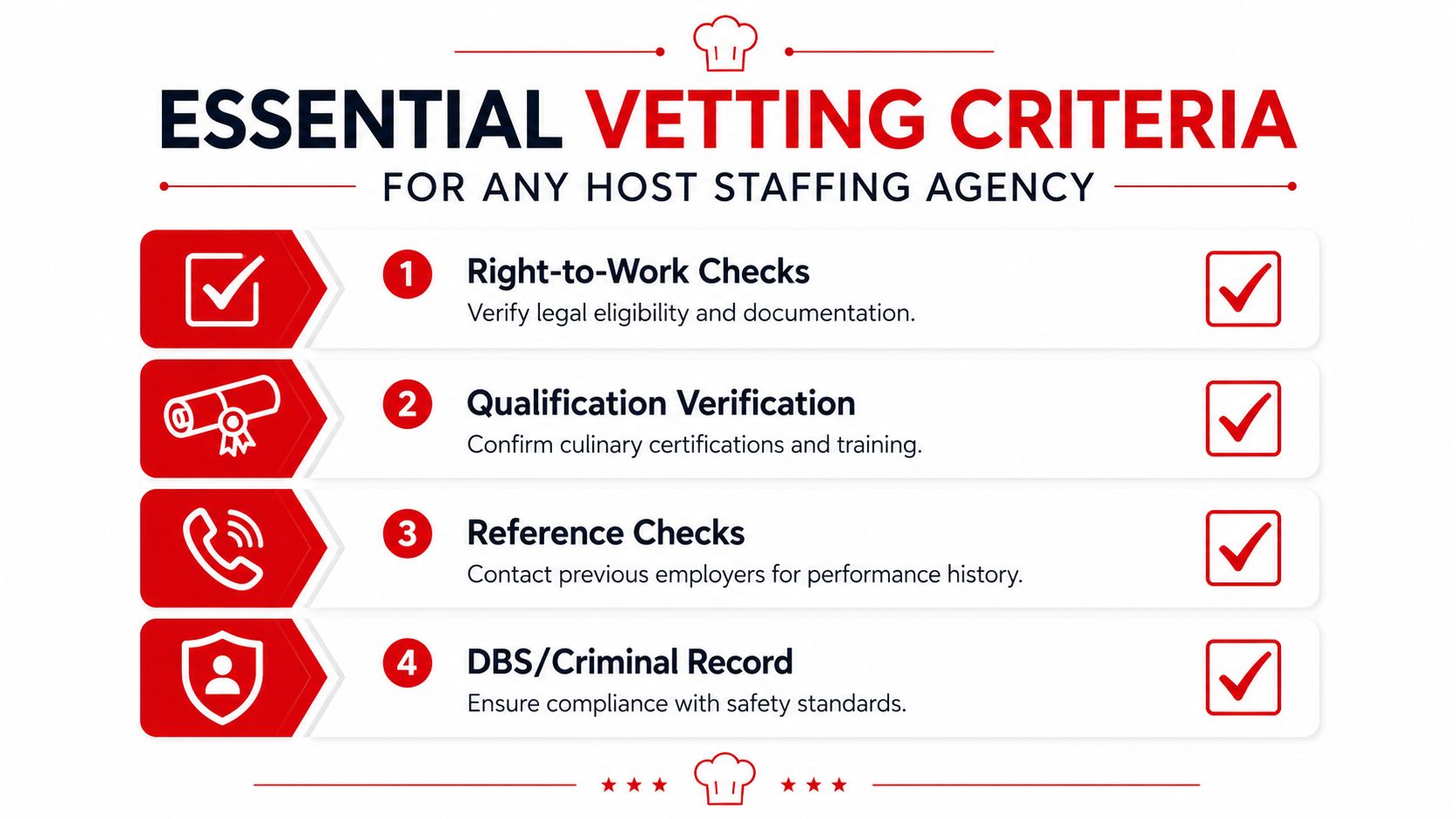
A credible host staffing agency should explain its vetting process in practical terms. Ask what was checked, when it was checked, where the record is kept and who updates it. Vague assurances are a warning, especially when a chef is booked for a busy service.
Start with legal eligibility
Right-to-work verification must be completed before deployment. “The paperwork is being processed” is not an acceptable answer when a chef is due to start. Ask how the agency stores documents, monitors expiring permission and confirms to the venue that checks are complete.
Temporary agency workers have employment rights from day one and qualify for equal treatment after 12 weeks, including equal pay with a permanent colleague doing the same job, automatic pension enrolment and paid annual leave. (GOV.UK agency worker rights) These obligations affect the agency's cost base and the terms attached to your booking, so they belong in the vetting conversation.
Check capability, not just qualifications
Food hygiene certificates and culinary qualifications establish a baseline. They do not show whether someone can control a section during a delayed delivery, staff shortage or full pass. Ask the agency to assess:
- Kitchen level: Commis, chef de partie, sous chef, head chef or a suitable equivalent.
- Service background: Breakfast, banqueting, fine dining, gastro pub, care catering or private household work.
- Menu compatibility: Allergens, dietary requirements, production methods and available equipment.
- Availability: Exact dates, travel limits and willingness to work the required shift pattern.
- Practical independence: Whether the chef can read a prep list, organise a section and raise problems early.
A live register should show verified skill levels and current availability. A CV forwarded without context leaves your sous chef to discover the mismatch during service, when correcting it is most expensive.
Validate references and safety checks
References should come from previous employers or managers who can discuss attendance, reliability, conduct and technical performance. For private households, children, vulnerable people or other relevant responsibilities, ask whether a DBS check is appropriate and how recently it was completed.
The guidance on working with temporary agencies helps clarify which responsibilities sit with the venue and which sit with the supplier. Before booking, request proof of insurance, a named emergency contact and the replacement process if a chef is unsuitable or fails to attend.
A useful red-flag test is simple. If the agency cannot confirm right-to-work status, references, availability and role-fit before sending someone to your kitchen, it is transferring the operational risk to you.
Comparing Service Levels and Pricing Models
The cheapest quote rarely represents the cheapest operating model. A low hourly rate can be outweighed by a late-booking surcharge, travel expenses, cancellation terms, poor replacement support or the management time required to supervise an unsuitable chef.
Ask each agency to price the same scenario. For example, request cover for a chef de partie in a hotel near Reading, a weekend placement in Devon, and a seasonal requirement in Wales. The comparison should show the hourly charge, VAT treatment where applicable, travel arrangements, minimum shift length, cancellation window, replacement policy and out-of-hours contact.
The transparent pricing model used by Relief Chefs UK illustrates the type of detail venues should expect before agreeing to a booking. Pricing should be clear enough for a general manager to forecast the cost and for a head chef to understand what support sits behind it.
Host Staffing Agency Service Tiers Compared
| Feature | Basic On-Demand | Growth Plan | Premium Plan |
|---|---|---|---|
| Best suited to | Occasional sickness or isolated vacancies | Regular cover for a pub, restaurant or small hotel group | Multi-site operations and recurring seasonal demand |
| Booking model | Pay as needed | Flexible monthly arrangement | Structured monthly partnership |
| Account support | Shared booking contact | Priority support | Dedicated account manager |
| Replacement support | Confirm the policy before booking | Usually included if agreed in writing | Should be clearly defined and actively managed |
| Planning | Reactive | Advance rota and demand planning | Workforce pipeline and site-by-site planning |
| Main trade-off | Simple access, but less certainty at peak times | Better continuity, with a commitment to regular use | Strongest control, but requires clearer forecasting |
Look beyond the hourly figure
Regional travel deserves particular attention. A chef travelling to a coastal venue in Dorset, a seasonal property in Devon or a hotel in Wales may need travel expenses or accommodation. Those costs aren't necessarily unreasonable, but they must be stated before the shift is confirmed.
Cancellation fees can also create friction. A venue might release a booking because a permanent chef returns, while the agency has already rejected another assignment for that worker. Agree a fair cancellation period and ask whether the agency offers a replacement rather than just charging a fee.
The market also demands tighter screening than it once did. In Q1 2025, 42% of employers made hires within three weeks, while average applications per vacancy reached 75.3, according to Caterer's hospitality hiring analysis. A high-volume funnel doesn't guarantee a good match. It makes disciplined screening more important.
Understanding Contract Terms and Legal Obligations
A staffing agreement should identify who carries each responsibility before a chef enters your kitchen. It must explain how bookings are confirmed, who manages compliance, and what happens if the placement fails. Avoid contracts that give the agency broad payment rights while leaving attendance, replacement and vetting obligations unclear.
Read these clauses line by line:
- Worker status and payroll: Confirm who employs the chef, processes pay, handles tax and keeps employment records.
- Agency Workers Regulations: Check that the pricing model allows for day-one rights and equal treatment after 12 weeks.
- Notice and cancellation: Record the deadline for cancelling a shift and the charge that follows.
- Replacement guarantee: Establish how quickly an unsuitable or absent chef will be replaced, and whether the replacement has to meet the same requirements.
- Insurance: Request evidence of suitable employers' liability and public liability cover.
- Complaints and escalation: Identify the person authorised to make an immediate decision during service.
- Conversion terms: If you may hire a temporary chef permanently, clarify any transfer fee and time limits.
Rights affect the commercial arrangement
Temporary agency workers have rights from their first day. Equal treatment after 12 weeks includes equal pay, automatic pension enrolment and paid annual leave. Those obligations affect the agency's cost base and should be reflected clearly in the quoted rate. If a supplier avoids discussing them, ask which party carries each obligation and how it is administered.
The contract should also define the venue's practical role. Your chef can explain the menu, enforce food safety and coordinate service, while the agency should handle formal performance issues, disciplinary action and employment decisions where it remains the employer. Clear boundaries protect both sides and stop a failed service becoming a dispute over responsibility.
The operational test is simple: a chef fails to arrive at 5pm. You should know who to call, how quickly a replacement decision will be made, what cover the agency will provide and what you will pay. If the wording cannot answer those questions, the contract is incomplete.
Do not rely on verbal promises about “guaranteed cover” or “fully insured chefs”. Put each promise in the booking confirmation or master agreement, including response times and any limits. A reliable supplier should be able to explain its process and accept wording that matches the service it sells. That detail can prevent the hidden cost of a missed shift, rushed recruitment and an overwhelmed kitchen team.
Interview Questions and Practical Tests for Agency Chefs
A CV can confirm where someone has worked. It can't show whether they can recover a failing section while ten tickets are printing. Your assessment should mirror the pressure, equipment and communication style of the venue.
Ask questions that require a real example rather than a rehearsed statement:
- “A section has crashed during service and the head chef is occupied. What do you do first?” Look for prioritisation, communication and a willingness to ask for targeted help.
- “Your prep is behind and the first sitting is approaching. How do you reorganise the work?” A capable chef should identify critical prep, delegate appropriately and tell the pass what may be affected.
- “How would you adapt this dish for a serious allergen or dietary restriction?” The answer should include safe separation, communication and verification, not just an ingredient substitution.
- “Tell me about a service failure you helped fix.” Listen for ownership. Blaming every previous team is a warning sign.
Test the fundamentals
A short practical assessment can be more useful than another interview. Keep it proportionate and lawful, and don't use unpaid trial work to obtain productive labour. You might ask the chef to:
- Complete a knife-skills exercise: Observe precision, safe handling, pace and workstation discipline.
- Prepare a familiar dish: Use a signature menu item or a representative plate, then assess seasoning, timing, presentation and cleanliness.
- Talk through a prep list: Ask what they'd complete first and what information they'd need from the sous chef.
- Explain hygiene controls: Test understanding of allergen separation, temperature control, cleaning routines and HACCP principles.
The practical environment matters. A chef who performs well in a quiet interview may struggle with your combi oven, cramped pass or service style. If possible, arrange a supervised trial during a quieter service and give a clear start and finish time.
Watch the behaviours that keep kitchens stable
Technical skill only solves part of the problem. Notice whether the chef arrives prepared, listens to instructions, labels food correctly, keeps colleagues informed and responds professionally when corrected. A strong temporary chef doesn't act as though agency status excuses poor standards.
Use the assessment to tell the agency what your operation needs. A small café in Slough may need an adaptable all-rounder, while a hotel in Berkshire may need someone comfortable with banqueting volume. The better agencies record that distinction instead of sending the same candidate profile to every venue.
Partnering with Relief Chefs UK for Reliable Kitchen Cover
Relief Chefs UK is a nationwide chef recruitment agency established in 2013 and run by chefs rather than recruiters. Its team brings more than 60 years of combined hospitality experience, which supports practical matching across independent pubs, restaurants, cafés, hotels, private households, yachts and villas.
The service covers relief chefs, temporary chefs, permanent chef recruitment, yacht chefs, villa chefs and wider hospitality staffing support. Venues can request cover through a short form or phone, receive a response within two hours and meet fully vetted, right-to-work-checked chefs who can start within 48 hours.

Monthly Starter, Growth and Premium plans are designed for different operating models, from a small pub or café to a multi-site hotel group. Depending on the arrangement, support can include replacement guarantees, priority assistance and a dedicated account manager. Relief Chefs UK also states that it provides 24/7 support, transparent pricing with no hidden agency fees and full insurance, and has earned the trust of 400+ venues.
That model suits a venue that needs same-day relief after sickness, seasonal reinforcement in Devon, Dorset, Wales or another tourism-heavy area, or a dependable pipeline for permanent recruitment. The right supplier won't just fill a shift. It will help protect your kitchen standards, your permanent team and the guest experience.
Contact Relief Chefs UK for vetted relief chefs, temporary or permanent chef recruitment, yacht and villa chefs, and practical hospitality staffing support across the UK. Explain your location, service pattern and immediate gap, then ask for a suitable cover plan instead of accepting an unverified placement at the lowest hourly rate.