
Working Time Directives for Hospitality Staff Explained
21 August 2026
Saturday night, the head chef calls in sick two hours before service. The sous chef is already carrying a long week, the commis team is stretched, and the rota shows one more double shift than anyone noticed. You can either push the existing brigade past a safe working pattern, or bring in a relief chef and keep the service open without turning a staffing problem into a compliance problem.
That decision sits at the heart of working time directives for hospitality staff. In the UK, the Working Time Regulations 1998 set the legal floor for weekly hours, rest breaks and night work. The rules apply across restaurants, pubs, hotels, catering operations, yacht kitchens and private hospitality settings. They also apply when demand rises sharply, sickness arrives without warning and agency cover proves difficult to secure.
The practical answer isn't more paperwork. It's a rota built around genuine rest, accurate records and dependable staffing support.
Why Hospitality Kitchens Cannot Ignore Working Time Directives
On that Saturday, the venue had a choice. The sous chef could have stayed through prep, service and clean-down, then returned for breakfast preparation. Instead, the manager booked a relief chef, split the workload properly and protected the team from another excessive run of hours. The booking didn't just save the pass. It stopped a weak rota from becoming a working-time breach.
The Working Time Regulations 1998 were made on 30 July 1998 and came into force on 1 October 1998, extending to Great Britain only. They implemented Council Directive 93/104/EC, which created the wider framework for working-time protection across the EU. The regulations embedded the 48-hour average weekly limit into UK law, normally measured across a reference period of 17 weeks, with a written opt-out available for most adults. The Working Time Regulations 1998 remain the foundation for how UK venues manage working hours.
A kitchen exposes weak planning quickly. A shift starts with deliveries and mise en place, runs through lunch, continues into dinner and ends with cleaning, stock checks and handover. Split shifts create another risk, because a chef may appear to have time off while still losing the uninterrupted rest required between duties.
The pressure points managers see every week
- Short-notice sickness: One absence can turn a compliant rota into a run of doubles for the remaining chefs.
- Seasonal demand: Weddings, Christmas trading, summer tourism and hotel events increase hours precisely when recruitment becomes hardest.
- Late finishes: A banquet may finish after midnight, while the next breakfast shift begins early.
- Agency uncertainty: An unverified chef may arrive without a clear record of previous hours or night work.
- Brigade stability: Repeated overwork leads to fatigue, mistakes, resignations and a kitchen that can't hold standards.
A tribunal claim, an inspection or a serious fatigue-related incident can expose more than one missed break. It can reveal poor scheduling, incomplete records and a management culture that treats overtime as the only solution.
Operational rule: Treat compliance as a staffing design issue. If the rota only works when one person works beyond safe limits, the rota doesn't work.
That applies whether you're running a neighbourhood restaurant in Bristol, a hotel in Windsor, a pub in Devon or a large operation serving guests across Berkshire, Reading, Slough, Dorset and Wales.
The 48-Hour Weekly Limit and How Rotas Are Measured
A chef finishes a six-day run, covers a sickness absence, then stays late for stocktaking. The rota may show manageable shifts, but the working-time calculation must include what happened on the floor. An adult worker's working time, including overtime, must not exceed an average of 48 hours for each seven days, normally calculated across 17 weeks, unless the worker has agreed in writing to opt out. The GOV.UK maximum weekly working hours guidance confirms that one week can exceed 48 hours when the average across the reference period remains within the limit.
Working time covers duties performed and periods when the chef must remain available to the employer. Count prep, service, cleaning, stock counts, required training and paid on-call time. Exclude an unpaid break only when the chef is relieved from duty and can leave the workstation. Travel between separate sites needs separate assessment, particularly when the travel forms part of the job.
Read the rota in four steps
- Record actual hours, not scheduled hours. A chef rostered until 22:00 but kept for an extra stock count has worked through the later finish.
- Include overtime and training. A required product briefing before service is working time, even if it was absent from the published shift.
- Review the reference period. The average normally runs across 17 weeks. An agreement, such as a trade union agreement, can extend it up to 52 weeks.
- Check the pattern continuously. Sunday trading, bank holidays and event work count like any other working time. A busy wedding or seasonal service does not remove those hours from the calculation.
Take two weeks in which Chef A works six 10-hour double shifts, producing 60 hours in each week. That pattern demands intervention. Chef B removes one long shift from the permanent rota and a relief chef covers it, reducing pressure on the existing brigade and giving managers a practical compliance control.
| Week | Chef A (Hours) | Chef B with Relief Cover (Hours) | Rolling 17-Week Average |
|---|---|---|---|
| Week 1 | 60 | 50 | Review actual hours across the reference period |
| Week 2 | 60 | 40 | Review actual hours across the reference period |
| Remaining weeks | Record actual hours | Record actual hours | Calculate the live average |
The table demonstrates the method, not permission to ignore the rest of the reference period. A 48-hour average allows flexibility during a peak week, but repeated dependence on exhausted chefs is poor operations and poor risk control. Use a rota that plans cover before the long shift becomes unavoidable to reduce unnecessary overtime costs. A staffing partner can provide relief for sickness, agency gaps and seasonal demand before extra hours become the default solution.
Rest Breaks That Kitchens Routinely Get Wrong
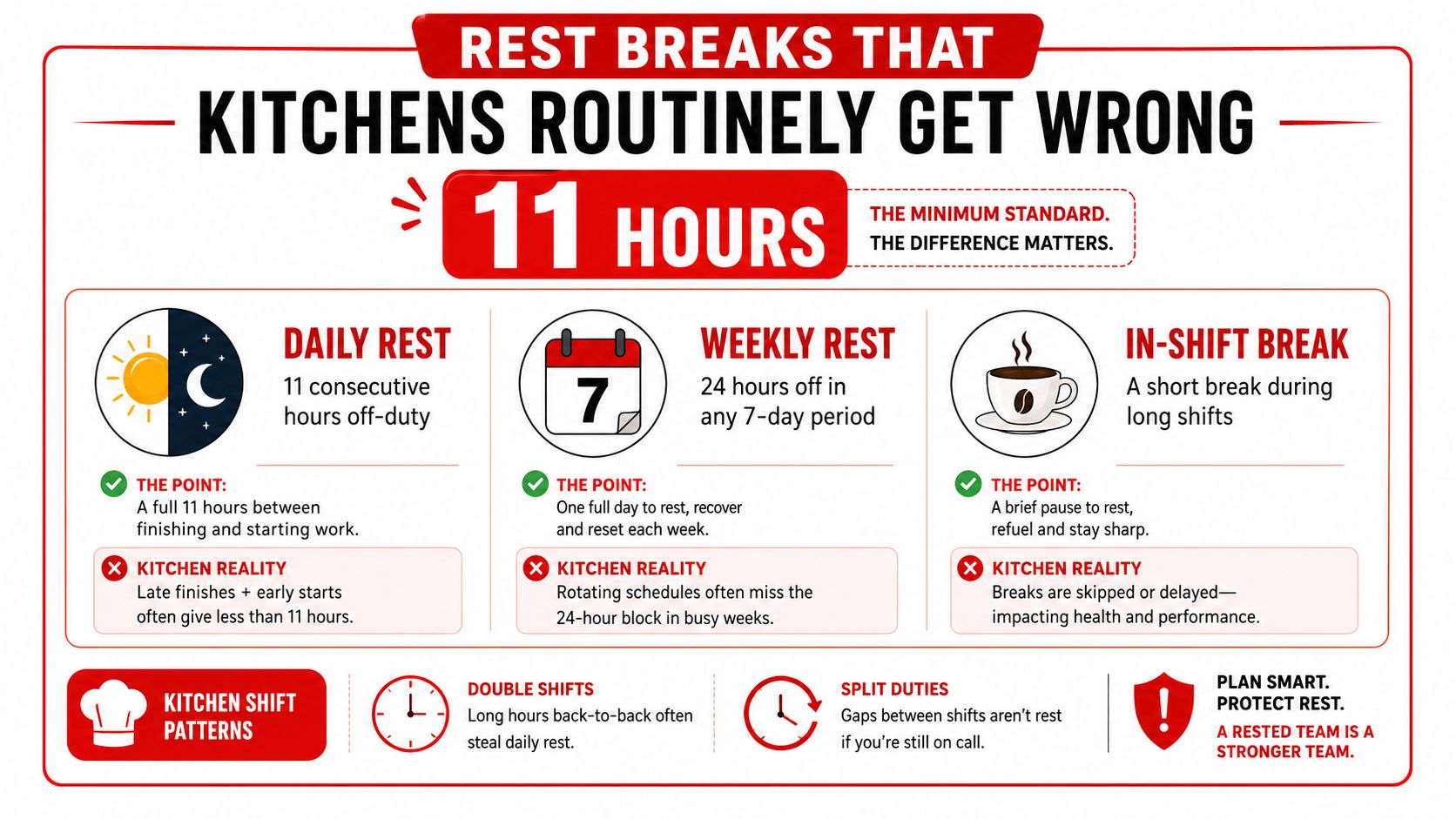
A kitchen can comply with the weekly average and still fail on rest. Managers need to check three separate protections: daily rest, weekly rest and the in-shift break.
Adults usually need 11 uninterrupted hours of rest in each 24-hour period, and they normally receive at least 24 hours without work in each seven-day period, or 48 hours in a fortnight. The regulations allow the fortnightly rest to be taken as one 48-hour block or two 24-hour blocks. Acas also states that a shift lasting more than six hours usually requires a 20-minute uninterrupted break, and GOV.UK says that break must be away from the workstation. See the Acas guidance on rest breaks and the GOV.UK rules on rest breaks at work.
Where the rota usually fails
A breakfast chef finishes at 23:00 after evening prep and returns at 07:00. That gap is only eight hours, so it doesn't provide the usual daily rest. A split-shift chef may have a long gap between duties, but the manager must check whether the break is genuinely free time and whether the full working day still leaves proper recovery.
The same problem appears during a 13-hour double. A head chef may be told to take lunch at the pass, answer questions throughout the meal and return to service immediately. That isn't a genuine uninterrupted break away from the workstation.
Young workers need particular care. A worker under 18 is entitled to a 30-minute rest break where the relevant conditions apply. Trainee chefs and junior staff shouldn't be handed the hardest double shifts just because senior chefs have signed an opt-out.
A coffee at the pass isn't a compliant rest break if the chef is still responsible for service.
Managers should build cover into the rota. A second chef, kitchen porter or duty manager may need to protect the break while the main chef leaves the kitchen. If nobody can cover the station, the venue has a staffing problem, not a break problem.
Night Work, Late Finishes and Overnight Prep
Night work needs its own calculation. A night worker is generally someone who works at least three hours during the night period, usually 23:00 to 06:00. Their normal hours must not exceed an average of eight hours in any 24-hour period over the relevant reference period. The Acas night-worker guidance also explains that where the work involves special hazards or heavy physical or mental strain, the eight-hour limit becomes a hard cap in each 24-hour period.
That matters in a hotel pastry section, a late kitchen, yacht catering or an overnight preparation team. A chef who finishes a charter dinner, stays for cleaning and returns for early preparation may cross the night-work threshold even when the weekly rota looks reasonable.
Employers must keep night-worker hours records for two years. Payroll alone often won't show the full pattern, especially when chefs move between banquet work, breakfast preparation and overnight storage or delivery duties. Keep a separate night-work view in the rota system.
Some tourism and round-the-clock operations have exceptions to usual night-work limits, but compensatory rest still has to be provided. The HSENI explanation of working-time rules confirms that exceptions don't turn fatigue into an acceptable operating model.
Use a practical test before confirming a late booking:
- What time did the chef finish the previous shift?
- How much of the proposed shift falls within the night period?
- Does the work involve heavy physical or mental strain?
- Has the chef worked at another site or assignment?
- Where is the compensatory rest recorded if an exception applies?
Late service, overnight prep and employer-provided transport can all create working-time questions. If the chef remains required to work or remain available, record the time accurately rather than assuming the shift ended when guests left.
Exceptions and Derogations Worth Knowing
Hospitality managers often reach for exceptions when a rota breaks. Most exceptions are narrower than they first appear.
The standard position is that chefs, supervisors and front-of-house employees remain within the ordinary working-time framework. A role isn't exempt because the employee is senior, salaried or trusted to manage a section.
| Worker Category | Weekly Average Limit | Daily Rest | Weekly Rest | Key Caveat |
|---|---|---|---|---|
| Standard adult hospitality worker | 48-hour average | Usual rest rights apply | Usual rest rights apply | Written opt-out may be available for most adults |
| Genuinely autonomous worker | Depends on whether working time can be measured | Health and safety duties remain | Health and safety duties remain | Most chefs don't control their own schedule sufficiently |
| Worker in a formal training category | Special limits may apply | Enhanced protection may apply | Enhanced protection may apply | Don't treat a trainee as an ordinary adult worker |
| Certain transport workers | Sector-specific rules | Compensatory rest may apply | Compensatory rest may apply | The transport connection must be genuine |
| Tourism or round-the-clock staffing | A specific exception may apply | Compensatory rest required | Compensatory rest required | An exception doesn't remove fatigue controls |
The transport point matters for yacht stewards, airline caterers and coach drivers, but it doesn't automatically cover hotel, restaurant or pub kitchens. A yacht chef may have a transport-related question, yet the employer still needs to identify which rules govern that role and assignment.
Unmeasured working time applies only where the worker's working pattern can't be measured and the person has meaningful autonomy. A head chef working to fixed service times, bookings and delivery schedules won't usually fit that description.
Don't rely on a label. Check the actual duties, schedule, control and sector rules, then keep health and safety at the centre of the decision.
Record-Keeping That Stands Up to an Inspection
Good records protect the venue, the chef and the staffing partner. Employers need a retrievable system showing when work started and finished, which breaks were taken and how night-worker hours were managed. Night-worker records must be retained for two years, as stated in the Acas night-worker record guidance.
A closed payroll file isn't enough if it doesn't show the actual shift pattern. Use one rota-plus-timesheet record for every chef, whether permanent, casual or temporary.
A workable log structure
| Worker | Engagement | Date | Start | Finish | Unpaid break | On-call or standby | Night hours | Manager sign-off |
|---|---|---|---|---|---|---|---|---|
| Permanent chef | Direct employee | Shift date | Actual time | Actual time | Taken and duration | Yes or no | Record where relevant | Name and time |
| Relief chef | Agency assignment | Shift date | Actual time | Actual time | Taken and duration | Yes or no | Record where relevant | Venue and agency confirmation |
The venue should confirm what happened on site. The staffing partner should retain the assignment information, vetting record and hours supplied by the chef. Neither side should assume the other has captured every extra hour.
Record changes made after the rota was published. If a chef stays for a late function, note the revised finish. If a break couldn't be taken because of an incident, record that fact and escalate it rather than deleting the break from the timesheet.
Before placing a temporary chef, complete employment verification checks and confirm the information needed to manage the assignment. Accurate logs are the cheapest defence available. A manager who can produce a clean, time-stamped record quickly is in a far stronger position than one searching through messages and handwritten notes.
How Chef Staffing Choices Protect Compliance
Relief cover works as a working-time safety valve. It gives managers another option besides extending an already tired shift, cancelling covers or asking the same sous chef to absorb every absence.
A head chef calls in sick two hours before a 120-cover Friday service. The poor response is to keep the sous chef on from prep through close and hope the team survives. The better response is to bring in a vetted relief chef whose availability and previous assignment hours have been checked before confirmation.
A sous chef is then pulled into a double shift that would push the week towards or beyond the 48-hour average. Swapping one long duty for temporary cover protects the existing rota and gives the sous chef a realistic chance to take proper rest.
A seasonal wedding venue in Dorset, Devon or Berkshire may need extra kitchen hands during a concentrated period. Permanent recruitment may not solve an immediate peak, while repeatedly stretching the core team creates instability. Temporary chefs, yacht chefs or villa chefs can be matched to the setting and the service requirement without making the permanent brigade carry every event.
Practical staffing rule: Book cover before the rota becomes impossible, not after the head chef has already worked the extra hours.
Relief Chefs UK, established in 2013, supplies relief chefs, temporary chefs, permanent chef recruitment, yacht chefs, villa chefs and wider hospitality staffing support across the UK. Its employment law guidance for temporary staff can help venues and staffing partners clarify responsibilities, while the operational decision remains simple: share the actual hours, confirm the rest pattern and don't book a chef into an unsafe sequence.
Agency fees may look more visible than overtime, but the cost of poor kitchen stability is harder to control. Burnout, inconsistent food quality, failed events and emergency recruitment all damage the operation.
Compliance Checklists for Employers and Staffing Partners
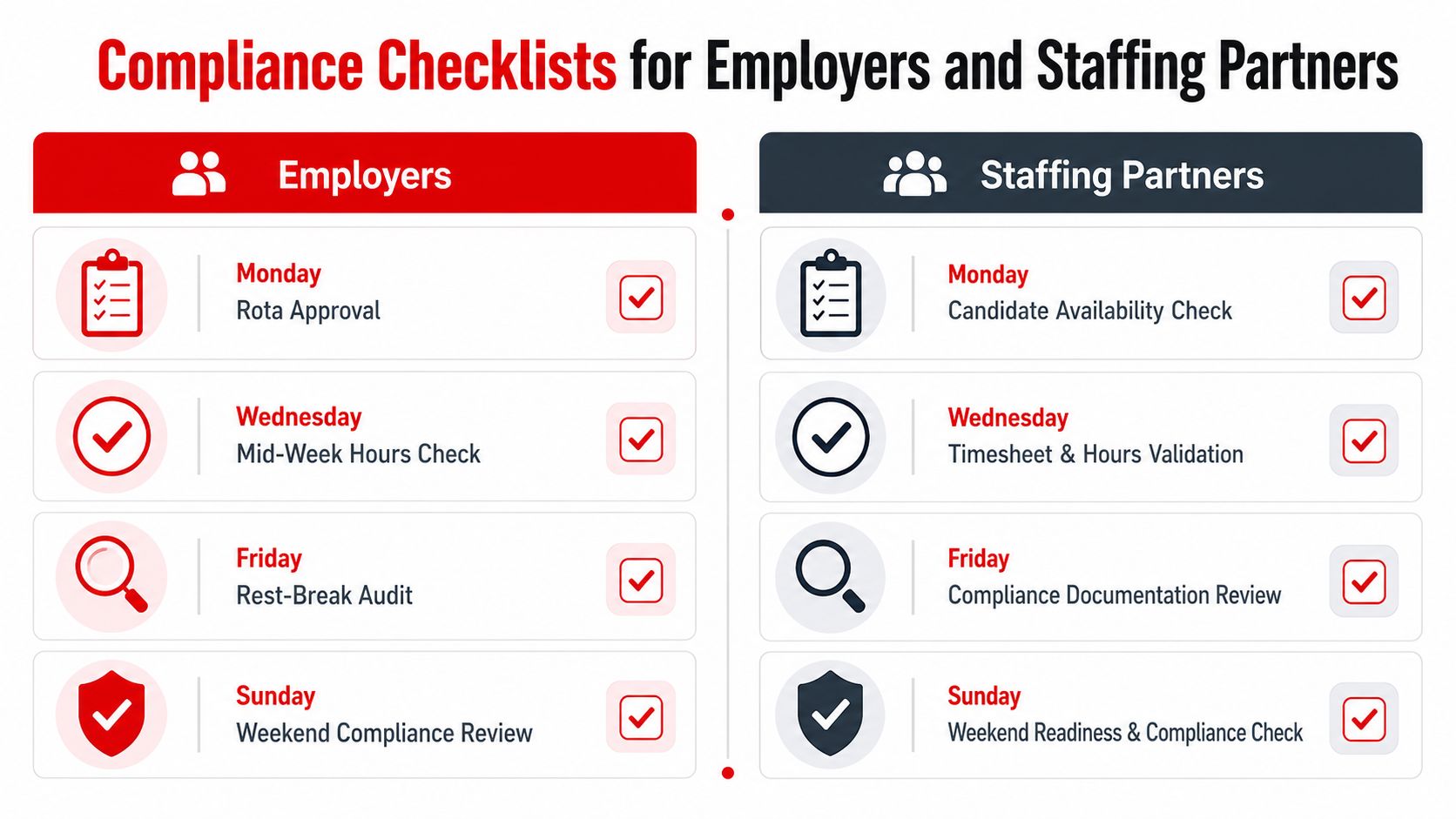
A checklist only works if someone can use it during a busy service week. Keep it next to the rota, review actual hours rather than planned hours and escalate any pattern that depends on a missed break or short rest period.
Employer checklist
- Monday, approve the rota: Check start times, finishes, doubles, split shifts and known night work.
- Wednesday, check hours: Compare actual hours with the live weekly and reference-period position.
- Friday, audit breaks: Confirm who covers breaks during prep, service and clean-down.
- Sunday, reconcile the week: Match rota entries against clock-in records and signed timesheets.
- Monthly, review records: Test whether a manager can retrieve working-time and night-work records quickly.
- Annually, refresh policy: Revisit break procedures, secondary employment, opt-outs and escalation routes.
Staffing partner checklist
- Before registration, verify the chef: Complete identity, right-to-work and professional checks.
- Before booking, confirm availability: Ask about other assignments, recent finishes and proposed night work.
- At confirmation, check limits: Review the chef's hours cap position and any written opt-out status.
- After the shift, collect actual hours: Capture the start, finish, break and any additional duty.
- During an assignment, monitor changes: Escalate a client rota that drifts from the agreed pattern.
- At handover, retain the record: Give the venue the information it needs and keep the assignment trail.
The staffing partner shouldn't fill a vacancy and disappear. The venue remains responsible for managing the workplace, while the agency must provide accurate information and avoid placing chefs into assignments that conflict with known hours or rest.
Opt-Outs Done Right Without Exposing the Business
A signed opt-out isn't a blank cheque. Most adults can agree in writing to opt out of the 48-hour average weekly limit, but the agreement is voluntary, can be revoked and doesn't remove the employer's wider health and safety duties. The legislation for regulation 4 sets out the average limit and the written opt-out mechanism.
A defensible process has several parts:
- Explain the expected pattern and the health risks.
- Sign the written agreement before over-limit hours are worked.
- Record what the employee is consenting to, rather than using vague wording.
- Make revocation straightforward and explain how to give notice.
- Review the arrangement regularly, especially after a role or rota change.
A banquet chef may voluntarily agree to longer weeks during a defined wedding season because the role demands concentrated availability. That still doesn't justify excessive night work, missed rest or a permanent pattern of fatigue.
The dangerous version is handing a junior chef an opt-out form on the first day, presenting it as standard paperwork and never explaining that refusal is allowed. That approach weakens trust and creates a poor record if the employee later challenges the arrangement.
Use opt-outs for exceptional operational needs. Don't use them to disguise understaffing.
Quick-Reference Limits for Every Shift
Print this table and check it against the rota before confirming a difficult booking, particularly after short-notice sickness, a split shift, or an agency booking.
| Rule | Legal Limit | How It Is Measured | Hospitality Exception |
|---|---|---|---|
| Weekly working time | 48-hour average | Normally across 17 weeks | Written opt-out may apply for most adults |
| Daily rest | 11 uninterrupted hours | In each 24-hour period | Limited sector arrangements may require compensatory rest |
| Weekly rest | 24 hours | In each seven-day period, or 48 hours in a fortnight | The 48 hours may be one block or two 24-hour blocks |
| In-shift break | 20 minutes | During a shift longer than six hours, away from the workstation | Young workers have enhanced break protection |
| Night work | 8-hour average | In any 24-hour period over the reference period | Special hazards can make the cap absolute, and exceptions require compensatory rest |
| Reference period | 17 weeks | Average calculated across the applicable period | Can extend up to 52 weeks by agreement |
The weekly limit is an average, while rest and break rules apply to the rota pattern itself. Check the planned start and finish times, not just the total hours in the booking. The GOV.UK rest-break guidance and night-work rules explained by Acas provide the supporting detail.
Yellow flag: The 48-hour figure is an average, not an automatic ceiling for every individual week.
Red flag: A seasonal rush or agency replacement does not remove the need for reliable records, rest planning and health and safety controls. Confirm hours already worked before adding another shift, then record the actual finish afterwards.
Frequently Asked Working Time Questions
Who carries responsibility when an agency chef exceeds the limit?
The venue controls the shift and workplace, while the staffing partner should provide accurate assignment information and monitor the hours it knows about. Confirm previous and planned hours before booking, then record the actual shift afterwards. Don't assume an agency booking transfers every responsibility away from the venue.
Can a chef see their working-time records?
Workers should be able to ask for information about the hours recorded for their work. Keep the records organised, retrievable and clear enough to show start times, finishes, breaks and relevant night work.
What should a manager do after finding a breach?
Document the actual hours, assess immediate fatigue and safety risks, tell the worker what you've found and reset the upcoming rota. Avoid automatic disciplinary action. First establish what happened, whether the worker was aware, whether the pattern continues and what compliant cover is available.
Do bank-holiday shifts count?
Yes. A bank holiday doesn't remove working time from the calculation. Include the actual hours in the relevant average and check the effect on rest.
What about young or trainee chefs?
Don't apply the adult rota automatically. Young workers and trainees may have different protections, so check their age, training status, duties and applicable rules before assigning doubles, late finishes or overnight preparation.
Relief Chefs UK provides nationwide relief chefs, temporary chefs, permanent chef recruitment, yacht chefs, villa chefs and hospitality staffing support for venues managing sickness, seasonal demand and working-time risk. Visit Relief Chefs UK to request dependable cover and discuss a compliant staffing plan before your next difficult service.
Call the team.
Office 01392 715474 · info@reliefchefs.co.uk