

A wedding party is due at a hotel in Berkshire. The sous chef calls in sick, the banquet kitchen is already short on prep, and the first guests will arrive before a permanent replacement could even complete an interview. The operation doesn't need another CV on a database. It needs a capable chef who understands service, arrives prepared and keeps the pass moving.
That is the reality of temp event work across the UK. Weddings in Devon, festivals around Bristol, corporate functions in Reading and Windsor, hotel banqueting in Slough, and seasonal work across Wales and Dorset all create demand that rises sharply around bookings. Temporary staffing is a way to find occasional shifts. For venues, it's a form of operational risk management. For chefs, it can offer flexibility, but only when pay timing, employment status and availability are clear.
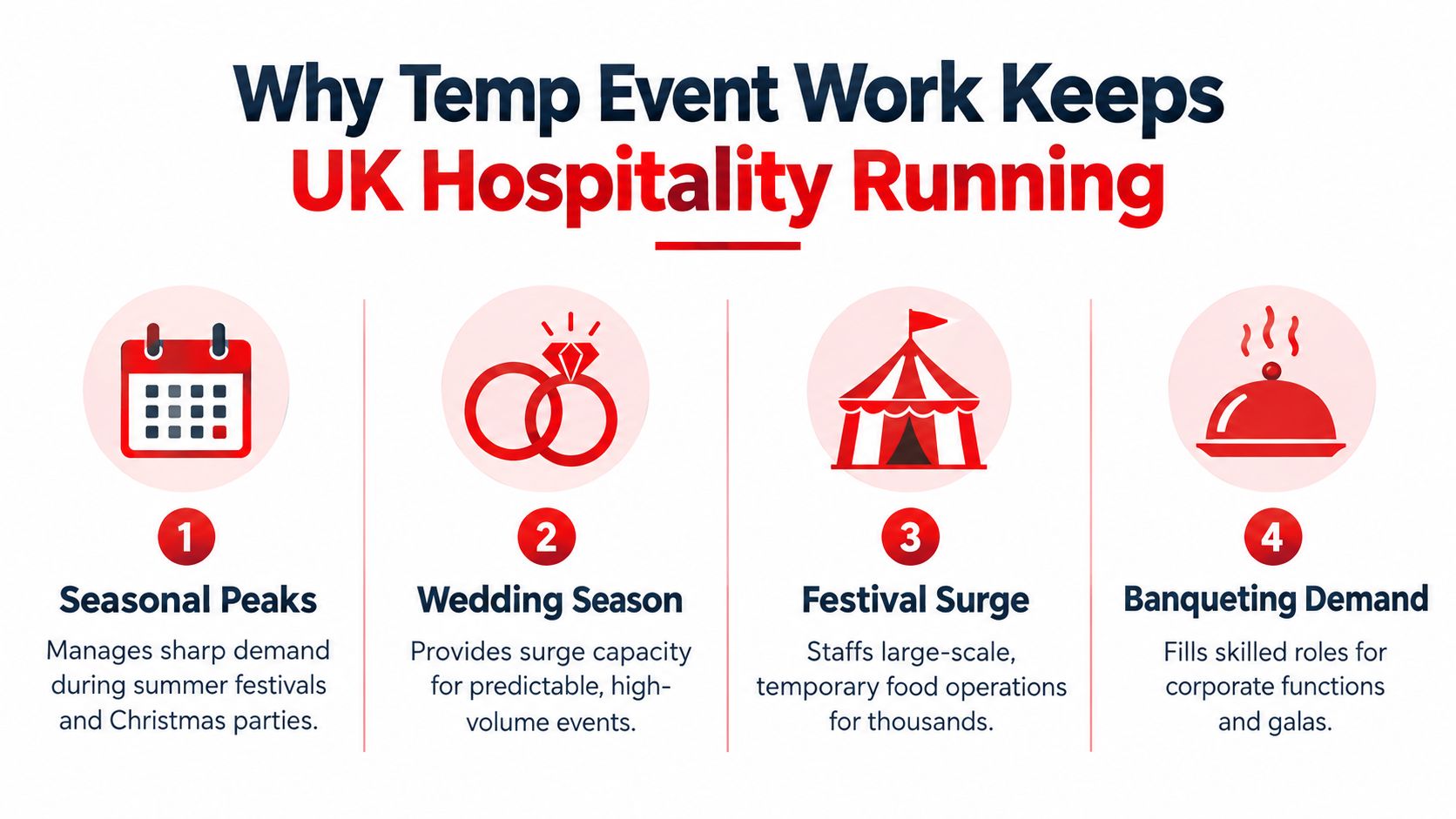
Why Temp Event Work Keeps UK Hospitality Running
A hotel can run breakfast and dinner with its usual brigade, then face two conferences on the same day. A pub may handle a normal weekend but take a wedding that adds canapé preparation, plated service and an evening buffet. A festival kitchen can need a full temporary team for a short operating window, then no extra labour when the site closes.
This is what temp event work looks like across the UK. A DCMS and industry workforce analysis found that 10.43% of tourism jobs were temporary, compared with 6.12% across non-tourism industries. The figures reflect a demand-driven labour model. Businesses increase staffing around bookings, holidays and event calendars instead of carrying permanent headcount for every possible peak.
Permanent headcount can't absorb every spike
Permanent chefs bring continuity, menu knowledge and kitchen culture. They also bring fixed costs, contracted hours and limited capacity. Hiring enough staff for every summer wedding, Christmas party and festival weekend can leave a venue paying for labour it does not need during quieter periods.
Temporary chefs give managers another staffing option. They can cover sickness, take charge of a section during a banquet, or strengthen the existing brigade while recruitment continues. That protects the service plan. One missing chef can force a menu reduction, slow ticket times, increase pressure on the remaining team and weaken the guest experience.
The UK flexible workforce remains substantial. In the July to September 2024 quarter, around 1.50 million people were temporary workers, representing 5.2% of all employees, according to UK labour-market data summarised for hospitality employers. Venues can draw on workers accustomed to flexible arrangements, although availability alone does not confirm the right skill, reliability or start time.
Pay timing also affects whether a temporary shift solves the problem. Chefs managing self-employed cash flow need clear rates, payment dates and expense arrangements before accepting work. Venues need enough notice to arrange layered cover, rather than relying on one person to carry the full risk if illness, travel disruption or a late booking changes the plan.
Practical rule: Treat a temporary chef as part of the service plan, not as an emergency body placed wherever pressure is highest.
Stability matters more than a filled box
A filled shift is not automatically a successful shift. If the chef lacks the required section experience, arrives without the right documents or needs constant supervision, the manager may still lose capacity. Matching matters for banqueting, large-scale preparation, pastry, grill, breakfast and high-volume festival production.
Relief Chefs UK, established in 2013, works nationwide with hospitality businesses seeking relief chefs and temporary chefs, alongside longer-term recruitment support. The operational distinction is straightforward: urgent cover addresses today's exposure, while permanent recruitment deals with a recurring vacancy that keeps creating the same exposure.
Where to Find Reliable Temp Event Work That Fits Your Goals
The fastest source of a shift isn't always the safest source of cover. Chefs and venues should choose a channel based on the consequence of failure, the level of skill required and how much time remains before service.
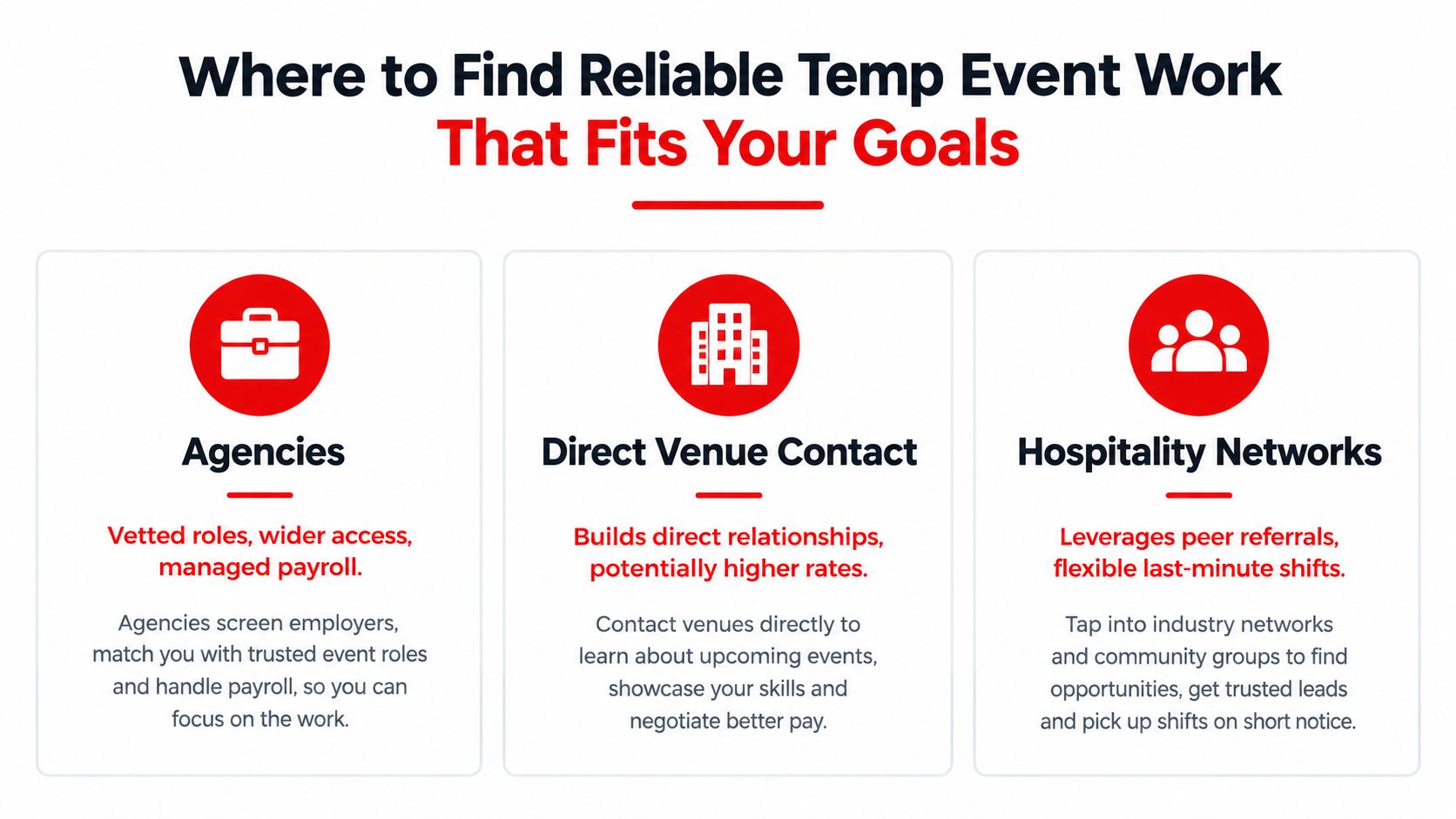
A general job board can expose a chef to many opportunities, but it leaves the worker to assess the venue, duties, travel, pay arrangement and reliability. A venue's own contact list can work well for repeat relationships, but it takes time to build and may fail when several chefs are unavailable at once. A specialist agency adds a matching and vetting layer, which is especially useful when a head chef needs credible cover rather than a general hospitality worker.
Compare the main routes
| Route | Works well for | Main drawback |
|---|---|---|
| Specialist chef agency | Urgent cover, matched skills and repeat staffing | The venue must provide a precise brief |
| Direct venue contact | Building trusted relationships and understanding kitchen culture | Limited reach during widespread shortages |
| Hospitality networks | Local, short-notice opportunities and peer recommendations | Vetting, paperwork and payment terms may be inconsistent |
| Job boards | Finding varied work across regions and event types | The worker or manager carries more checking responsibility |
| Private household, yacht or villa placements | Chefs seeking a different service environment | The role requires specialist expectations and availability |
For a pub in Dorset facing a Saturday sickness, a local contact may solve the immediate problem if the chef is known and insured. For a hotel in Windsor running several functions, a specialist agency can reduce the risk of placing a grill chef into a pastry-heavy booking. In Devon and Wales, travel time and accommodation can also determine whether a booking is commercially sensible, even when the kitchen match looks good.
Managers should separate speed from suitability. A general temporary agency may fill a hospitality shift, but a specialist chef partner is more likely to understand brigade structure, section ownership, menu volume and the difference between a commis, chef de partie, sous chef and head chef. For event work, that distinction affects supervision requirements and service resilience.
Relief Chefs UK's event recruitment service is one option for venues that need temporary event staffing alongside broader hospitality support. Use a direct relationship when the venue already has a reliable bench. Use a specialist partner when the event carries meaningful revenue risk, the brief is technical or the notice period is short.
Match the channel to the assignment
Chefs should ask whether the role is a single event, a run of seasonal shifts or a route into permanent work. An agency may offer wider access and managed administration, while direct contact may give a clearer picture of the kitchen and its standards. Neither route removes the need to confirm duties, rate, payment timing, travel, breaks and employment status before accepting.
Hotels and event venues should also decide whether they need relief chefs for isolated cover, temporary chefs for a defined busy period or permanent recruitment for an ongoing gap. Mixing those requirements creates poor briefs and slow decisions.
How to Prepare a Profile That Gets Booked Quickly
A chef profile needs to answer a manager's first questions before the phone rings. What can this person run? Which sections have they covered? Are they available for evenings and weekends? Can they legally work, travel to the venue and start without avoidable paperwork?
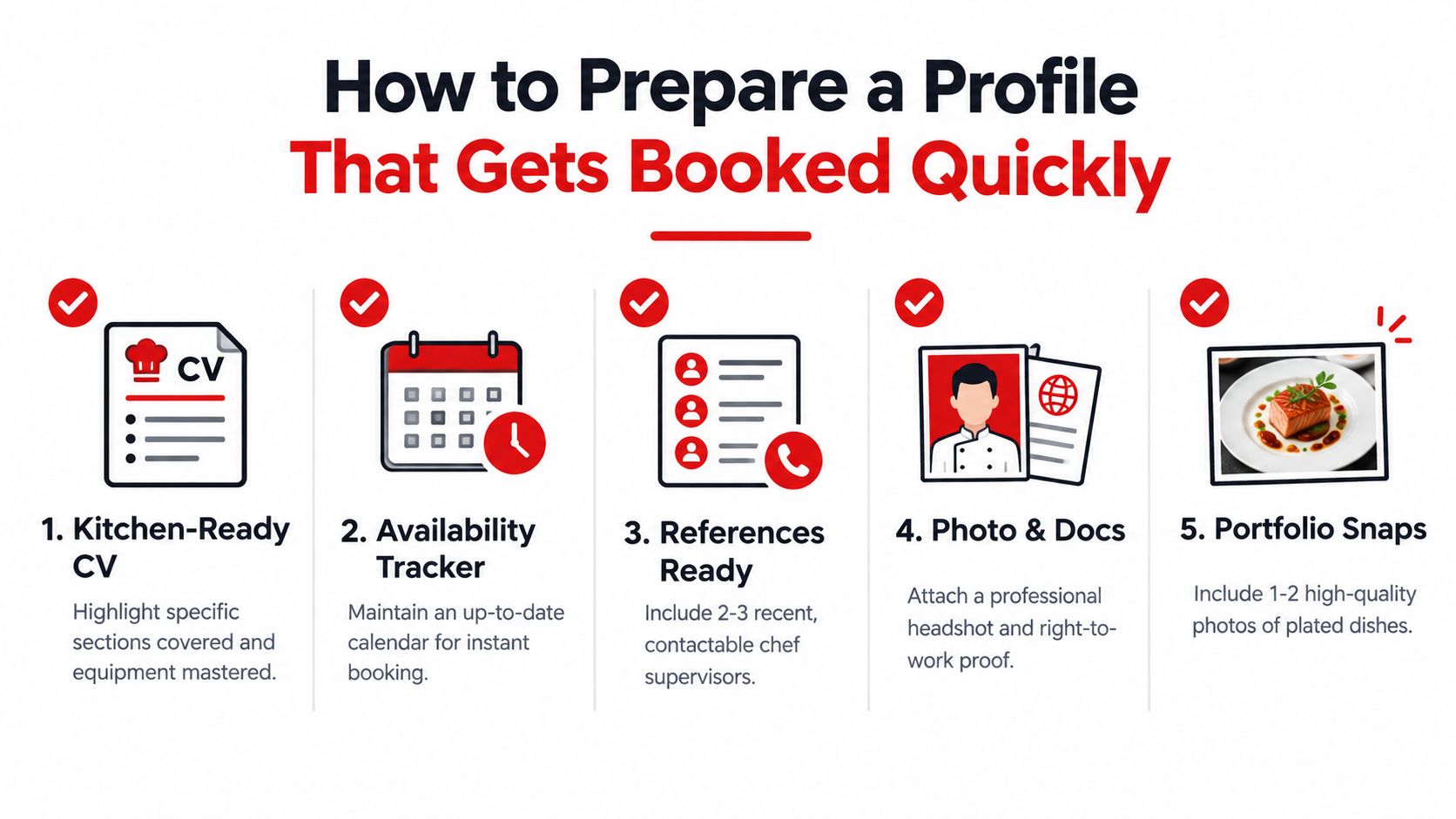
A short, accurate CV usually performs better than a long career history that hides the useful details. Put recent kitchen roles first, then name the sections and service types you can handle confidently. “Worked in hotels” tells a manager very little. “Covered banqueting prep, plated service and breakfast pass” gives the booking coordinator something practical to match.
Build the profile around decisions
Include an availability tracker that reflects reality. Mark evening, weekend and early-morning commitments rather than writing “flexible”. A venue booking a wedding in Bristol needs confidence that you can arrive for prep, not just that you can work the dinner period.
Your profile should cover:
- Kitchen-ready experience: Name sections, equipment and service formats you can manage without close supervision.
- Current availability: Keep a live calendar and state your travel range, including whether Devon, Bristol, Berkshire, Reading, Slough, Dorset or Wales is practical.
- References: Provide 2 to 3 recent, contactable chef supervisors as requested in the profile checklist. Ask permission before sharing their details.
- Documents: Keep right-to-work proof, food hygiene records, relevant certificates and insurance information ready where applicable.
- Professional presentation: Add a clear headshot and 1 to 2 high-quality photos of plated dishes if a portfolio is relevant to the role.
- Kit and logistics: Confirm chef whites, safety footwear, knives and transport arrangements before accepting a booking.
Managers need to make the brief equally specific. State the event type, guest service, menu, section, start and finish times, dress requirements, kitchen equipment and reporting line. “Chef needed for an event” invites a mismatch. “Chef de partie for a hotel banquet, responsible for prep and service on larder, reporting to the sous chef” gives a recruiter or chef a workable picture.
A reliable profile also makes repeat work easier. After each booking, record the venue, section, service style and any feedback. Chefs who can demonstrate calm performance in high-volume banqueting may stand out in London and the South East, while a chef with strong rural hotel and event experience can be particularly useful across Devon, Dorset and Wales.
Guidance on joining a temp agency, including the information workers should prepare, is available through Relief Chefs UK's temporary agency guidance. The principle is simple: remove administrative uncertainty before the booking becomes urgent.
Rates Contracts and Legal Checks You Must Get Right
A headline hourly rate rarely shows whether an assignment works financially. Chefs need to account for travel, equipment, unpaid gaps and delayed payment. Venues need clarity on what the quoted rate includes, who engages the worker, which insurance applies and whether the relationship could change as the booking continues.
One current UK listing requires workers to be self-employed, offers £13 per hour and states that payment arrives 4 weeks after the event. The SimplyHired listing offering £13 per hour paid four weeks after service makes the cash-flow issue clear. A chef who needs income quickly may prefer faster payment to a higher-looking rate. A self-employed chef must also allow for tax, expenses and the gap between finishing the shift and receiving the money. The venue must confirm that the engagement and invoicing arrangement reflect the actual working relationship.
Temp event work pay and contract trade-offs
| Arrangement | Rate and Pay Timing | Compliance and Risk |
|---|---|---|
| Self-employed event assignment | Example listing shows £13 per hour, paid 4 weeks after the event | Worker carries tax and cash-flow responsibilities, and both parties must ensure the status reflects the actual relationship |
| Agency temporary placement | Confirm the agreed rate, payroll route and payment date before acceptance | Agency and hirer must manage right-to-work checks, records, insurance and assignment terms |
| Direct employee cover | Pay follows the employment agreement and payroll process | Venue takes on employer responsibilities, including records, supervision and statutory obligations |
| Longer temporary placement | Review terms if the role continues beyond the original event period | Equal-treatment requirements can become relevant under the Agency Workers Regulations |
Right-to-work checks must be completed before the chef starts. The venue or staffing provider should also confirm insurance, food-safety expectations, working hours, breaks, reporting arrangements and cancellation terms. Ask for agency fees and other charges in writing. Comparing hourly rates without the full cost can produce the wrong decision.
For a practical explanation of the legal duties around temporary workers, see Relief Chefs UK's employment law guidance for temporary staff.
The Agency Workers Regulations create a specific threshold for extended assignments. After 12 continuous calendar weeks in the same role with the same hirer, an agency worker is entitled to equal treatment on pay and basic working conditions compared with a directly recruited employee, as explained in guidance on temporary hospitality worker rights. A relief chef booked for separate events may not face the same issue as someone remaining in one role, so managers should track continuity rather than assume every booking stays short.
Budget for continuity, not only the hourly figure
A low-cost booking can become expensive if the chef cannot run the section and the permanent team absorbs the work. Compare the full operational exposure, including lost covers, delayed service, menu reductions and management time. Parliamentary evidence cited in the Institute of Hospitality market intelligence report linked acute staffing shortages with an average 16% of sales lost where shortages were severe.
Chefs should ask who pays, when payment arrives, which expenses are covered and what status applies. Venues should ask who checked the chef, what happens if they cancel, what support is available during service and how a longer assignment will be reviewed. That turns temp hiring into cover planning and cash-flow control, rather than a last-minute search for a name on the rota.
On Shift Best Practices That Keep Service Smooth
A temporary chef earns trust quickly by becoming useful without creating noise. The first hour matters. Arrive early enough to find the changing area, read the menu, inspect the pass and understand who owns each decision.

Start with the kitchen in front of you
Ask the sous chef or event lead for the service brief. Confirm covers, timings, allergens, menu changes, stock limitations and the escalation route if equipment fails. Then walk your section physically. Check par levels, labels, defrosting, sauces, garnishes, storage and the condition of the equipment.
Don't assume the prep list is complete because it says “ready”. A banquet larder station may have cold components prepared but no service plates, garnishes or backup containers. A festival kitchen may have ingredients on site but no clear replenishment route. Identify the constraint before tickets arrive.
Before service: Know your section, your backup, your next prep task and the person who can make a decision.
Own the section you have been given. Keep the bench clean, label anything you prepare and tell the lead chef before a shortage becomes a service problem. If the grill station is under-prepped, don't disappear into a general scramble. State what is missing, suggest the fastest safe alternative and agree the priority.
Protect ticket flow under pressure
During a walkout, the remaining brigade must simplify communication. Repeat orders clearly, group tasks by service priority and avoid sending incomplete plates to the pass. In a festival rush, batch work where the menu allows it, but keep temperature, portion control and allergen separation under control.
Front of house needs usable information, not kitchen frustration. If a dish is delayed, tell the pass lead what is affected and give a realistic update. If a menu item is unavailable, communicate the agreed alternative consistently so servers don't promise something the kitchen can't deliver.
Managers can help temporary chefs succeed by appointing one kitchen contact, providing a concise brief and avoiding conflicting instructions from several supervisors. A relief chef shouldn't spend the shift guessing whether the head chef, event manager or front-of-house lead has final authority.
At close, leave the station in a condition the permanent team can inherit. Store, label and date food correctly, record shortages and tell the manager about equipment or staffing problems while the details are still clear. That handover is often what turns one successful booking into dependable future cover.
How Relief Chefs UK Makes Urgent Temp Event Cover Simple
A wedding series can look fully staffed until sickness, delayed travel or a late booking removes one chef from the rota. The workable response starts earlier. Build known rotas two to four weeks ahead, separate section skills from general support, check documents in advance and hold reserve cover for likely disruptions. A spare name is not enough if that chef cannot handle the required station.
The wider hiring market makes layered planning sensible. Accommodation and food-service vacancies were reported at 109,000 between November 2023 and January 2024, down from 146,000 in the same period two years earlier, in industry analysis using ONS vacancy data. Pressure also remains strong in chef recruitment. UK hospitality and catering recorded 237,601 vacancy postings in Q2 2026, while chef vacancies reached 40,395, up from 23,103 in Q2 2025, according to Craft Guild of Chefs reporting.
Use the right service for the risk
Relief Chefs UK provides relief chefs and temporary chefs for planned or urgent cover, as well as permanent chef recruitment and wider hospitality staffing support. It also handles specialist requirements such as yacht chefs and villa chefs, where accommodation, travel and working expectations can differ from a hotel or restaurant booking.
The right arrangement depends on the failure you are trying to prevent. A Devon hotel running several weddings may need a temporary chef who can join an established brigade without extensive induction. A multi-site operator in Bristol, Berkshire or the South East may need a permanent recruitment pipeline to reduce repeated emergency calls. An independent hotel in Wales or Dorset may use temporary cover while recruiting for a longer-term vacancy.
Relief Chefs UK's stated operating model includes a response within two hours, chefs who can start within 48 hours, right-to-work checks, 24/7 support, transparent pricing and insurance. Starter, Growth and Premium plans cover different levels of ongoing support, with features such as replacement guarantees, priority support and dedicated account management. The business says it supports 400+ venues nationwide. Confirm these points against the service agreement, especially where the booking includes travel, specialist equipment or an extended placement.
Cash flow also belongs in the plan. Confirm the chef's pay timing, invoice terms and self-employment responsibilities before accepting work. A booking that pays late can create pressure even when the rate looks attractive, particularly when travel and accommodation must be funded first.
The commercial test is direct. If one unfilled shift could close a section, reduce the menu or overload the permanent brigade, arrange cover before demand peaks. If the same role repeatedly becomes urgent, move from isolated bookings to planned temporary or permanent recruitment.
Relief Chefs UK can discuss event cover and wider staffing requirements through Relief Chefs UK, helping managers set up cover before the next sickness or demand spike.