
Level 2 Food Hygiene Training: UK Compliance
13 July 2026
Friday afternoon. Full restaurant. Wedding breakfast in the function room. A chef phones in sick, your agency replacement is still on the M4, and an Environmental Health Officer walks through the door asking for training records.
That's when food hygiene stops being a policy folder and becomes an operational problem.
Most kitchen failures don't start with a dramatic incident. They start with small gaps. A commis chef who's never been properly shown raw and ready-to-eat separation. A temp who says their certificate is “somewhere in my emails”. A manager who assumes a document equals competence. When service is under pressure, those gaps turn into cross-contamination risks, stock losses, failed checks, and a brigade that stops trusting itself.
That's why Level 2 food hygiene training matters. Not because it looks tidy in a file, but because it stabilises kitchens. It gives managers a baseline. It helps supervisors delegate with confidence. It reduces the chance that one weak link will create chaos during service.
If you run a hotel kitchen in Berkshire, a pub in Devon, a restaurant in Bristol, or a seasonal operation on the Dorset coast, this isn't academic. Chef shortages, short notice sickness, unreliable agencies, and peak season demand all put pressure on standards. The right training standard protects the business when the staffing picture isn't perfect.
Introduction
A busy kitchen can hide a lot of risk.
From the outside, everything looks fine. Pans moving, checks called, prep stacked, covers building. But if the wrong person is handling raw poultry, plating ready-to-eat food, or rotating chilled stock without the right grounding, your service is running on luck. Luck doesn't hold up in an inspection. It doesn't hold up when a guest complaint lands. It certainly doesn't hold up when half your regular brigade is off and you're leaning on temporary cover.
I've seen managers focus on labour first and compliance second. That order usually causes trouble. If you don't know who is properly trained, who needs supervision, and who can work unsupervised on high-risk tasks, the rota becomes fragile. One absence creates a chain reaction. The head chef gets dragged off the pass to police basics. The sous chef starts firefighting. Standards slip.
Practical rule: If your staffing plan depends on everyone “just knowing what to do”, you haven't got a staffing plan. You've got exposure.
Level 2 food hygiene training is one of the clearest ways to reduce that exposure. It gives you a working standard for the people who handle food. It also gives you something more important than a certificate. It gives you control.
What Level 2 Food Hygiene Training Actually Means
The biggest misunderstanding is simple. Managers often think Level 2 is a strict legal requirement written into statute. It isn't that straightforward.
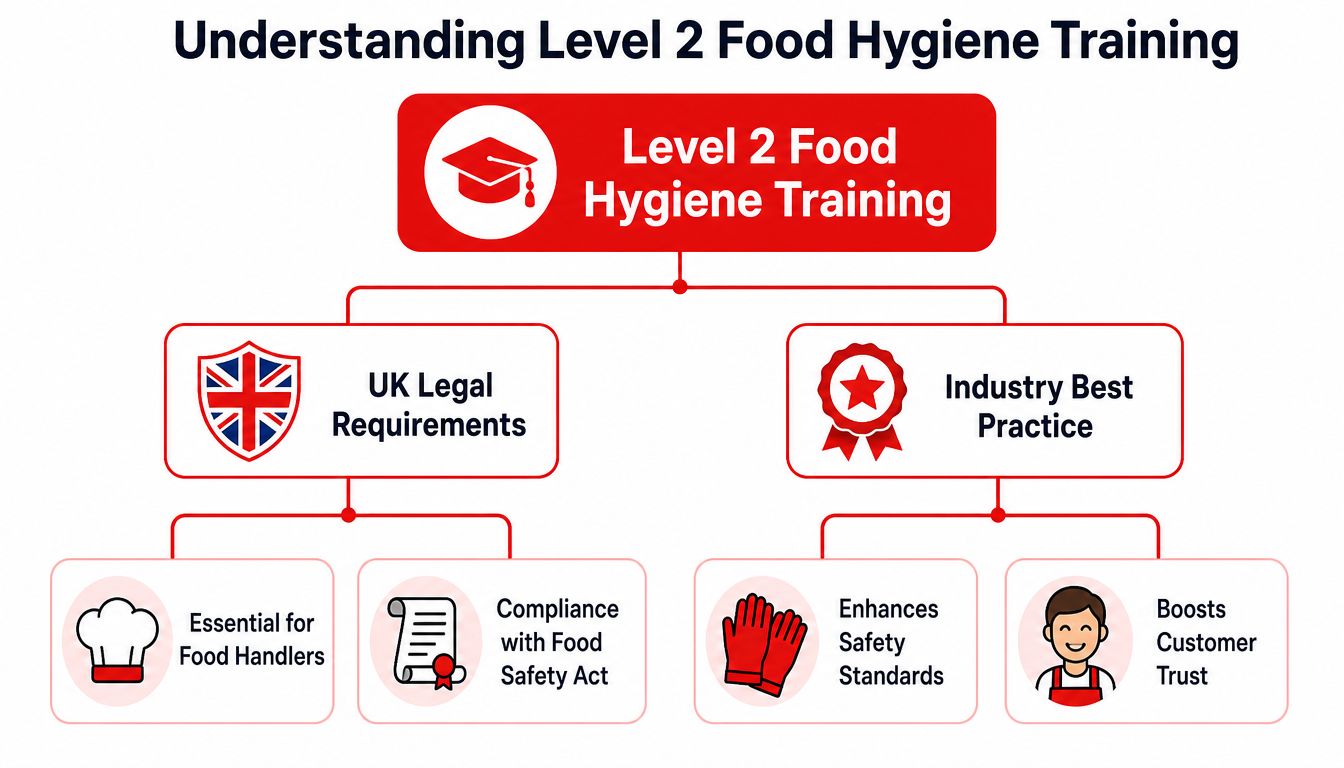
Under UK food hygiene training requirements explained under Regulation (EC) 852/2004, food handlers must be “supervised and instructed and/or trained in food hygiene commensurate with their work activity”. The law doesn't prescribe a single certificate. In practice, though, Level 2 food hygiene training has become the accepted benchmark for staff who prepare, cook, handle, or serve open food.
Legal duty versus operational reality
This distinction matters because legal flexibility doesn't remove management responsibility.
A kitchen porter working pot wash doesn't need the same training depth as a chef breaking down raw chicken or a baker producing high-risk items. The law allows for that difference. But once someone is involved in hands-on food handling, most operators and inspectors expect Level 2 as the safest and most defensible standard.
That's why smart managers stop arguing over whether it's technically named in legislation and start asking a better question. Can I show that this person is appropriately trained for the job I'm asking them to do?
What the training should give you
At a practical level, Level 2 should build sound habits around core food safety controls. That includes:
- Personal hygiene discipline so poor handwashing and bad workstation behaviour don't contaminate food
- Safe storage knowledge so chilled goods are handled correctly and stock isn't left in danger zones
- Cross-contamination control so raw and ready-to-eat processes don't overlap
- Basic food safety judgement so staff recognise when something is unsafe, not just when a manager tells them
A certificate isn't the finish line. It's the minimum proof that someone has been given the baseline knowledge to work safely.
In commercial kitchens, that baseline makes staffing decisions easier. You can move people with more confidence. You can supervise exceptions instead of policing every task. You can also spot where someone needs a tighter induction, not a blind assumption.
Who in Your Team Absolutely Needs This Training
If you apply the same training standard to every role, you'll waste money. If you under-train food handlers, you'll create risk. The job is to match training to actual tasks.
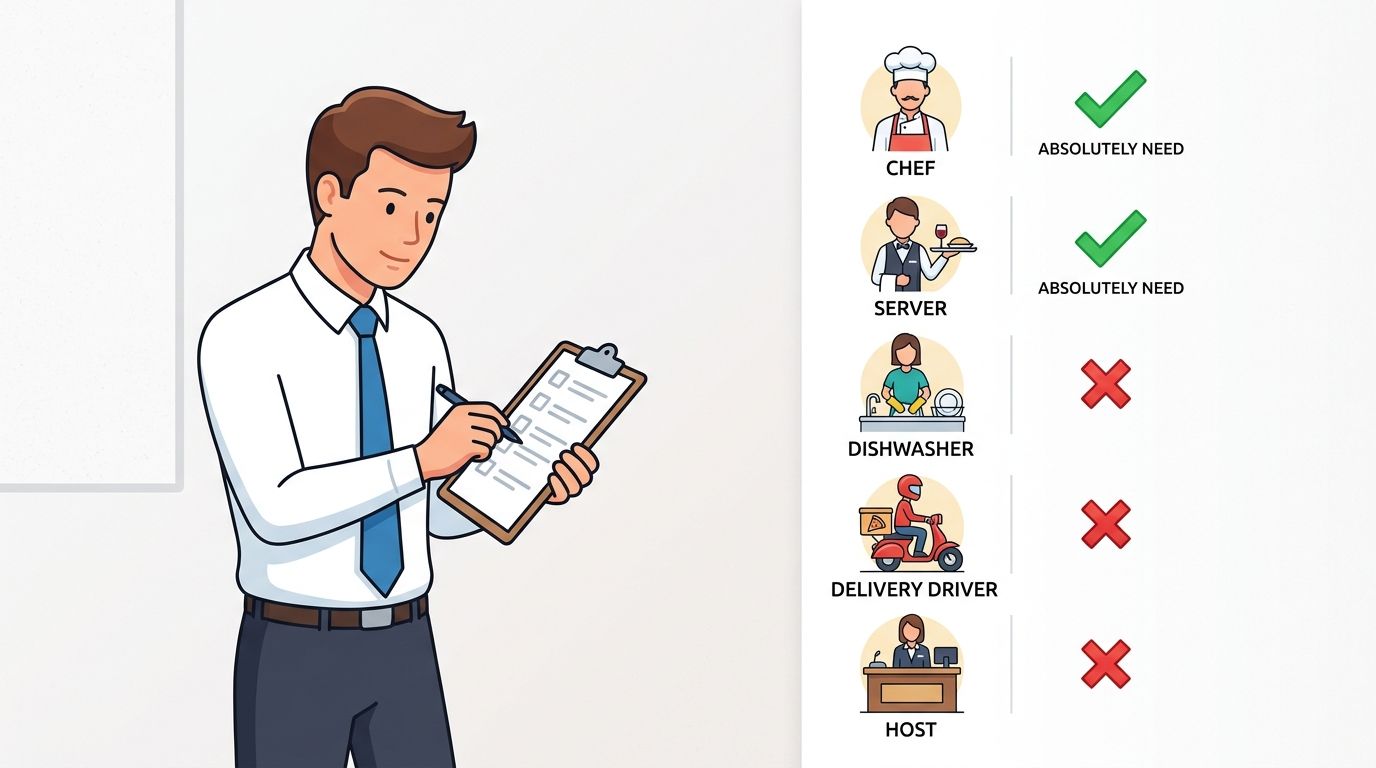
A practical food safety role guide from Commodious states that a Level 2 food hygiene course is specifically designed for professionals who handle or produce high-risk foods, such as cooks, chefs, and bakers. Level 1 is only suitable for staff handling pre-wrapped food or undertaking low-risk duties, like waiters.
Roles that should have Level 2
In most hospitality businesses, these roles should be treated as clear Level 2 territory:
- Chefs and cooks handling raw ingredients, cooking, cooling, reheating, plating, or storing open food
- Commis chefs and chef de parties who prep salads, desserts, garnishes, meat, fish, or sauces
- Kitchen assistants involved in food prep rather than pure cleaning
- Bakers and butchers working with higher-risk products
- Temporary chefs stepping into active production during service
If they touch unpacked food in a meaningful way, Level 2 is usually the sensible line.
Roles that may not need Level 2
Some positions often need instruction and supervision, but not necessarily the same qualification level:
| Role | Typical risk level | Usual training need |
|---|---|---|
| Waiter handling wrapped items only | Lower risk | Level 1 may be suitable |
| Pot wash kitchen porter | Lower risk unless doing prep | Role-specific instruction, sometimes Level 1 |
| Bar staff serving packaged goods | Lower risk | Task-based training |
The detail matters. A kitchen porter who only washes pans is one thing. A kitchen porter who starts prepping veg, portioning desserts, or assembling cold items has moved into a different risk category.
What goes wrong when you get it wrong
The classic mistake is using role title instead of actual duty.
A “junior kitchen assistant” may spend half the shift handling ready-to-eat food. A temp brought in for breakfast service may end up storing chilled deliveries, slicing cooked meats, and plating buffets. If their training doesn't match the work, the risk sits with the business, not the worker.
If someone can contaminate food, damage your due diligence position, or force a supervisor to shadow basic tasks, treat training as a management control, not an admin task.
That approach matters even more in hotels, pubs, and event venues where teams flex constantly across breakfast, banqueting, restaurant, and function work.
Choosing a Legitimate Course and Verifying Certificates
Bad training costs more than good training. You just pay for it later, through wasted spend, weak records, and awkward conversations during an inspection.
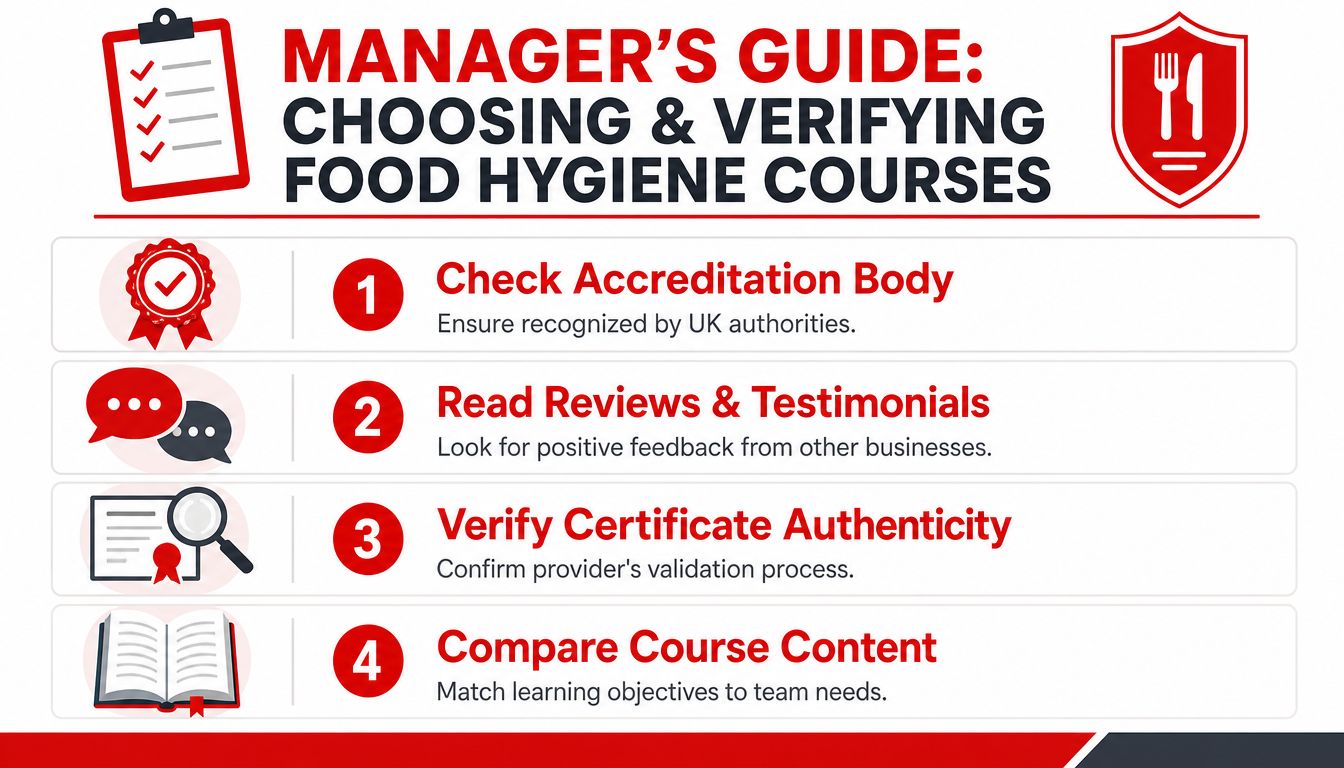
The safest starting point is accreditation. According to guidance on choosing a credible Level 2 course for EHO scrutiny, for a Level 2 course to be credible during an EHO inspection, it must be accredited by a recognised body like Highfield, City & Guilds, CPD, or RoSPA. A legitimate certificate will always display the awarding body's logo for verification.
What a credible course looks like
A proper course should be easy to defend if an inspector asks questions. That means:
- Recognised accreditation from a body people in the industry know
- Visible certificate verification through the awarding body logo
- Relevant content for food handlers, not generic health and safety padding
- Clear learner records that you can file and retrieve quickly
Cheap, vague certificates from unknown providers are a false economy. They look fine until someone asks who issued them and what standard they meet.
For wider health and safety compliance support in hospitality operations, the same rule applies. Documents only help if they stand up under scrutiny.
Online versus in-person training
Managers need judgement rather than slogans.
Online Level 2 training can be perfectly workable if the course is accredited, the learner completes it properly, and the business follows through with a real-site induction. But there's still a practical grey area in higher-risk or more scrutinised environments such as boutique hotels, yachts, villas, and mobile operations. The issue isn't just the certificate. It's whether the method of delivery and the person's actual competence line up with the environment you're putting them into.
That matters in places like Devon marinas, Dorset coastal venues, or private yacht operations where supply chains, storage space, and service conditions can be more complex than a standard pub kitchen.
Before choosing any provider, watch how serious trainers explain the difference between paper compliance and operational competence.
A simple verification process
Use this every time a new starter or temporary chef joins:
- Request the certificate before first shift
- Check the awarding body logo
- Match the training level to the actual duties
- File the record somewhere your managers can access quickly
- Add a site induction because certificates never replace local process training
If any part of that chain is weak, fix it before service pressure makes the decision for you.
A Manager's Playbook for Ensuring Team Compliance
The best compliance systems are boring. That's a compliment. They don't rely on memory, good intentions, or one organised head chef. They run the same way whether it's a quiet Tuesday in Reading or a packed Saturday in Windsor.
According to guidance on proving due diligence during food safety inspections, food businesses must maintain adequate records of hygiene procedures and ensure appropriate training is given to all employees involved in food handling. That is what gives you a due diligence position if your operation is challenged.
Keep records that survive pressure
A training file no one can find isn't a system.
Your managers should be able to access, at short notice, the training status of every team member handling food. Keep it simple. One record per employee. Certificate copy. Start date. Role. Tasks they're cleared for. Notes on local induction and supervision where needed.
A useful system usually includes:
- A live training matrix showing who holds what and where the gaps are
- Role-based task sign-off so a breakfast chef, pastry chef, and KP doing prep aren't all treated the same
- Induction records covering your site layout, allergen process, cleaning schedule, and stock controls
- Renewal prompts so nothing expires unnoticed in the background
For a structured health and safety induction approach for kitchen teams, build your local process around the actual work people will do on shift, not generic welcome paperwork.
Deal with weak points before they become incidents
Most compliance failures come from three situations.
The first is the new hire with a certificate that can't be verified. The second is the temp who arrives with decent skills but no clear paperwork. The third is the long-serving team member who's trusted because they've “always done it that way”, even though no one can evidence their training properly.
Handle those cases directly:
- Questionable certificate. Don't ignore it. Verify it or retrain.
- Role creep. If a lower-risk role starts handling open food, upgrade the training requirement.
- Agency uncertainty. If the agency can't confirm training and checks clearly, you're carrying their risk.
Your busiest week is the worst time to discover your staffing supplier has weak vetting.
Build resilience into the rota
Compliance and staffing converge.
If one chef absence means you must let an underqualified person step into food prep, your kitchen isn't resilient. It's exposed. Managers in Bristol, Wales, Slough, and across seasonal locations know the pattern. Sickness lands at the wrong time. Demand spikes without warning. Another agency sends someone available, but not properly briefed, not clearly vetted, and not ready for the pace.
A stable operation plans for that reality. It keeps a list of verified people who can step in. It separates “available” from “deployable”. It makes training status part of workforce planning, not an afterthought once service is already under strain.
That same principle applies whether you need relief chefs for a weekend, temporary chefs for peak season, permanent chef recruitment for a hard-to-fill post, or specialist support such as yacht chefs, villa chefs, and wider hospitality staffing support. The commercial risk is always the same. If the person can't be trusted on day one, the manager pays for it.
Putting Training into Practice During Service
The true value of Level 2 shows up when the kitchen gets stretched.
A properly trained chef doesn't wait to be told that raw prep and ready-to-eat garnish can't share the same sloppy workflow. They instinctively reset the section, change gloves when appropriate, wash hands properly, clean down, and keep the task moving without contaminating the next one.
Level 2 food safety content for hospitality teams covers key control points including personal hygiene, keeping refrigerated foods below 8°C, cooking foods to 70°C for 2 minutes to kill pathogens, and cross-contamination prevention, which form the basis of a HACCP system.
What good habits look like on a live shift
Take a breakfast service in a hotel. Deliveries arrived late. The junior chef is rushing. A trained team member checks chilled storage immediately rather than assuming everything is fine. If a fridge is above the required threshold, they escalate and protect stock instead of carrying on and hoping.
Take an evening service in a pub kitchen. One section is handling raw chicken, another is finishing salads and cold starters. A trained chef doesn't improvise with shared boards, cluttered benches, or half-clean utensils. They understand that cross-contamination usually comes from speed without control.
Kitchens rarely fail because nobody cared. They fail because pressure exposed habits that were never strong enough.
Training supports service, it doesn't slow it down
Some managers still treat food hygiene training as something that gets in the way of operations. In reality, good training reduces hesitation. It helps people make the right call quickly.
It also supports other risk areas that sit close to food handling. Allergen control is a clear example. If your team needs stronger practice around that side of service, allergen awareness training for hospitality teams should sit alongside food hygiene standards, not separately in another folder.
When training is embedded, service runs cleaner. Less second-guessing. Fewer corrections from the pass. Better stock handling. Better confidence from supervisors. That's what stability looks like in a working kitchen.
Frequently Asked Questions on Food Hygiene Certificates
How long does a Level 2 food hygiene certificate last
Providers and employers often apply their own refresh expectations, so don't rely on assumptions. The practical answer is to check the awarding body, review your internal policy, and retrain sooner if the role changes or standards have slipped. Good managers don't wait for paperwork to become a problem.
Is a certificate transferable between jobs
Usually, yes in practical terms, but that doesn't remove the need for site induction. A certificate may show baseline knowledge. It doesn't teach your kitchen layout, your cleaning schedule, your storage system, your allergen controls, or your service style. Every new employer still needs to verify the document and assess competence in context.
Does someone need Level 1 before Level 2
Not necessarily. If the role involves preparing, cooking, or handling open food, managers often move straight to the level that matches the job. The right choice depends on duties, not on completing levels in order like school exams.
Is an online certificate enough
Sometimes, but don't confuse “valid” with “sufficient”. If the course is accredited and verifiable, that's a sound start. For higher-pressure sites such as boutique hotels, private households, yachts, and seasonal operations, pair it with a proper local induction and active supervision until you're confident in the person.
What should I do if a temporary chef arrives without proof
Don't guess. Don't let service pressure bully you into poor decisions. Verify the qualification, restrict duties if needed, and document the action you took. If your staffing model depends on taking people at their word, it's too loose.
If your kitchen is dealing with short notice sickness, seasonal pressure, chef shortages, or unreliable agency cover, Relief Chefs UK can help you protect both service and standards. Established in 2013, Relief Chefs UK supports independent pubs, restaurants, boutique hotels, private households, yachts, and villas across the UK with relief chefs, temporary chefs, permanent chef recruitment, yacht chefs, villa chefs, and wider hospitality staffing support. If you need a dependable nationwide chef recruitment agency that understands compliance, kitchen stability, and the commercial cost of getting staffing wrong, contact Relief Chefs UK today.
Call the team.
Office 01392 715474 · info@reliefchefs.co.uk