
Identifying skill gaps in your kitchen team means auditing what your people can do against what your business actually needs, looking at performance data, and then zeroing in on the weaknesses that put your service at the greatest risk. It’s about seeing the gap between the skills you have on the books and the skills you need to run smoothly, day in, day out, especially when facing staff sickness or seasonal rushes.
The True Cost of Hidden Kitchen Skill Gaps
Let's be blunt: ignoring skill gaps is costing your business more than you think. This isn't some abstract HR problem; it's the real reason for inconsistent food quality on a packed Friday night, the chaos that erupts when your head chef calls in sick, and the constant financial drain of high staff turnover and unreliable agency fees. Those hidden weak spots hit your bottom line directly.
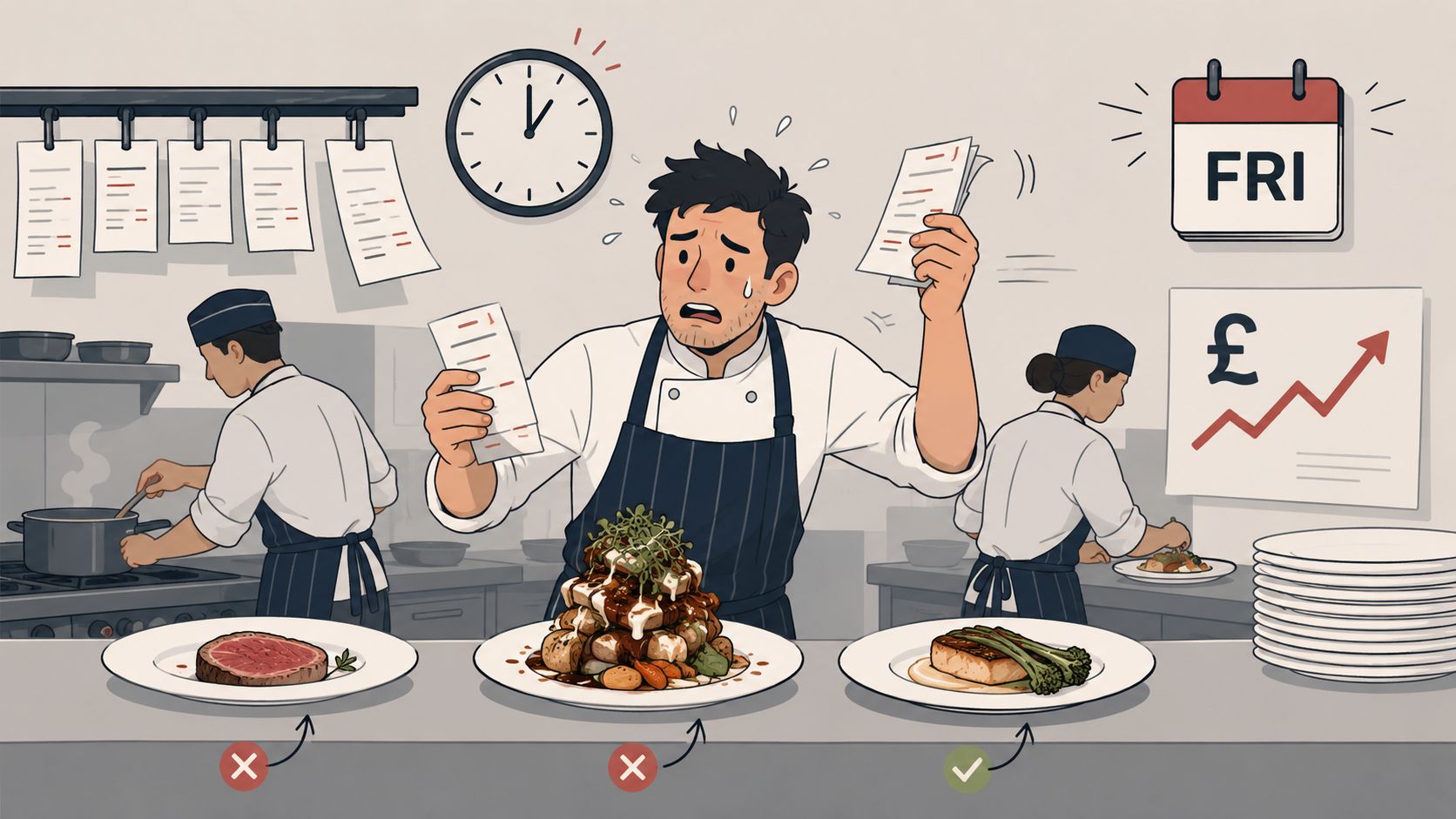
Think about the real-world scenarios we see all the time. A gastropub in Bristol struggles to deliver its new vegan menu because only one chef has the right experience. A boutique hotel in Dorset gets swamped by the summer tourist rush, and the bad reviews start rolling in because the brigade lacks the speed and stamina for high-volume service. These aren't just one-off bad days; they're symptoms of a deeper skills problem that threatens kitchen stability.
A skills gap isn't just an inconvenience; it's a direct threat to your kitchen's stability, profitability, and reputation. Proactively identifying these gaps is the first step toward building a more resilient and successful operation.
This problem is rife across the UK hospitality sector. According to the Institute of Hospitality’s April 2024 report, our industry has a far worse skills deficit than the national average. A worrying 7% of staff are not fully proficient in their roles, compared to just 4% across all industries. The issue gets even more stark in elementary and customer-facing roles, where that figure climbs to 8%. You can explore more data on skills in the hospitality industry to see the full picture.
Ultimately, identifying these gaps isn't a box-ticking exercise. It's an essential business strategy for protecting your standards and making sure your kitchen can handle anything, from last-minute sickness to a sudden surge in seasonal demand. Whether you need a temporary chef to plug an immediate hole or you're looking for a permanent hire with a specific skillset, knowing your weaknesses is the first step. That’s where Relief Chefs UK can help.
Defining Your Kitchen's Standard of Excellence
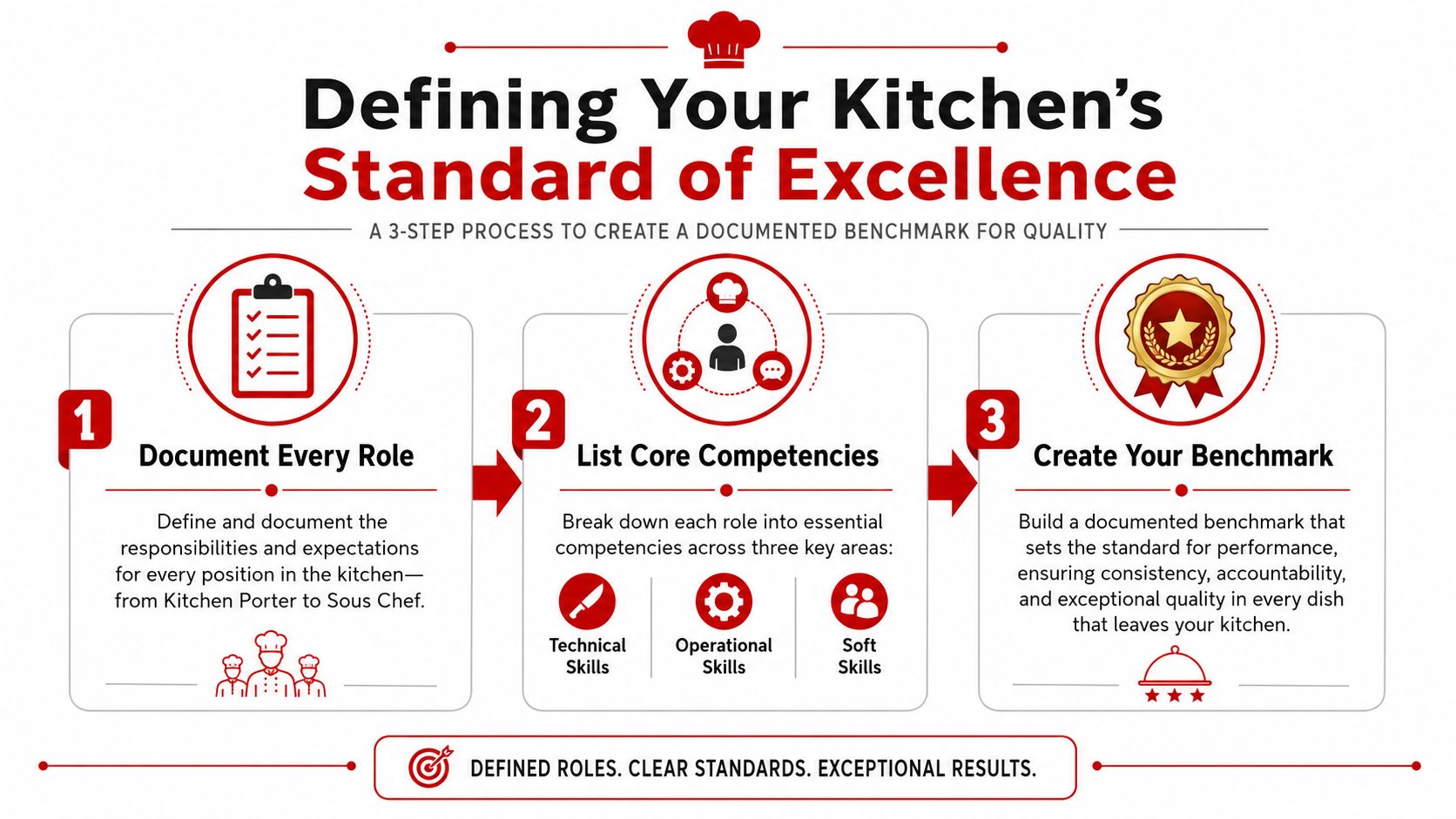
You can't spot skill gaps if you haven't first defined what ‘good’ actually looks like in your kitchen. And no, just ‘knowing’ it in your head doesn’t count. Without a clear, documented map of excellence, you’re just guessing. This benchmark is your kitchen’s constitution, and it's impossible to measure performance objectively without it.
The process starts by breaking down every single role, from the Kitchen Porter right up to your Sous Chef. For each position, you need to list the core competencies needed to excel in that job. This goes way beyond just cooking ability. A proper framework covers three distinct areas.
Technical Skills: This is the hands-on craft. Think specific, measurable abilities like filleting fish with minimal waste, classic sauce work, butchery, pastry knowledge, or mastering key equipment like a combi oven.
Operational Skills: These are the processes that keep the kitchen running safely and efficiently. It covers the non-negotiables: immaculate HACCP compliance, accurate stock rotation, precise ordering, and most critically, robust allergen management.
Soft Skills: These are the often-overlooked behaviours that separate a good chef from a great one. We’re talking about clear communication under pressure, the ability to train junior staff, problem-solving during a chaotic service, and maintaining a positive, professional attitude when the dockets are flying.
Setting Your Gold Standard
Creating this framework isn't about setting an impossible standard that no one can meet. It's about establishing a gold standard for quality and consistency that applies everywhere. A chef in Windsor and a chef in Wales should be held to the same core standards of food safety and professionalism, even if their menus are completely different.
This documented benchmark gives everyone clarity. Your team knows exactly what’s expected of them, and you have a solid foundation for every conversation about performance, training, and development. When you’re clear on your standards for critical areas, you’ll also be better prepared to manage them; our guide to allergen awareness training is a great starting point for one of the most crucial operational skills.
This standard becomes the yardstick you measure every team member against, both current and future. It makes identifying skill gaps systematic and far less personal, transforming a vague feeling like "the team seems a bit weak" into hard, actionable data.
How to Build and Use a Kitchen Skills Matrix
Once you know what ‘good’ looks like for your kitchen, you need a way to measure your team against it. This is where a kitchen skills matrix comes in.
Forget fancy software. This is a simple but powerful spreadsheet that maps every member of your brigade against the essential skills you’ve already defined. Think of it as your kitchen’s live dashboard, giving you an honest, at-a-glance view of your strengths and, more importantly, your critical weaknesses.
The idea is simple. List your core competencies down one column and your team members’ names across the top. You then fill in the grid based on your daily observations and informal chats. This isn’t about formal exams; it’s about a real-world assessment of current abilities.
A Simple Scoring System That Actually Works
To make this work, you need a scoring system that everyone understands instantly. A simple 0-3 scale is brutally effective.
- 0 = No Skill/Awareness: The person needs complete training from scratch.
- 1 = Needs Supervision/Training: They have the basic idea but can’t perform the task alone or to the required standard.
- 2 = Competent: They can reliably nail the task to your standard without any hand-holding.
- 3 = Can Train Others: They’ve mastered the skill and can confidently teach it to junior staff.
This entire process—defining roles, listing core skills, and benchmarking your team—is the foundation for consistency. It’s how you build a gold standard for your kitchen.
Putting It All Together: A Skills Matrix in Action
Here’s a simplified example of what your matrix could look like. It’s a basic grid, but the data it reveals is incredibly powerful.
Simple Kitchen Skills Matrix Example
| Skill/Competency | Chef de Partie – Alex | Commis Chef – Sam | Sous Chef – Maria |
|---|---|---|---|
| Fish Butchery | 2 | 1 | 3 |
| Pastry & Desserts | 1 | 0 | 2 |
| Sauce Section | 2 | 1 | 3 |
| Grill Section | 3 | 2 | 2 |
| Stock Management | 1 | 1 | 3 |
Even with just a few data points, the gaps are obvious. Pastry is a weak point across the board, and only Maria, the Sous Chef, is truly competent with stock management. If she’s off, you could have a serious problem.
Once populated, the matrix instantly shows you where the risks are. You might discover only one chef scores a ‘2’ or ‘3’ on the pastry section, creating a huge vulnerability if they call in sick or go on holiday. Or perhaps you realise no one on the team is rated above a ‘1’ for advanced butchery, which directly limits your menu’s potential.
This matrix transforms vague worries into concrete data. It’s the difference between thinking, "We might have a problem with pastry," and knowing, "We have a single point of failure in our pastry section that could cripple service on any given day."
This is precisely where having a trusted partner becomes invaluable. The moment your matrix reveals a high-risk gap, you have a direct line to a solution. Instead of just asking an agency for "a chef," you can request an experienced temporary chef who is a proven ‘3’ in pastry. Since 2013, we at Relief Chefs UK have provided this kind of targeted, nationwide hospitality staffing support to kitchens from Berkshire to Wales, filling the exact gaps you identify to ensure your service remains stable.
Turning Your Matrix Data into an Actionable Strategy
That skills matrix you just built isn’t just a spreadsheet. It’s a map of every single operational risk in your kitchen. Your job now is to read that map and turn the data into a focused, commercially-minded action plan. Don't try to fix everything at once. The key is to spot the different types of risk so you can prioritise what will actually sink your service.
With the data laid out, you can finally see your specific vulnerabilities. Think it’s just you? It’s not. According to CloudAssess, a staggering 32% of UK hospitality businesses have struggled to fill vacancies simply because of a shortage of skilled applicants. The problem is particularly bad for senior roles, with a reported 10% skills shortage for head chefs alone. You can read more on these findings here, but knowing this gives you crucial context when a gap appears in your own brigade.
This analysis is your guide. It tells you exactly where to focus your time and money.
Identifying Your Priority Gaps
Start by sorting the gaps your matrix has flagged. This isn't just an academic exercise; it’s about understanding the nature of the threat to your business.
Single-Point-of-Failure Gaps: This is where a critical skill is held by only one or two people. It's the most common and dangerous risk. For example, if your Sous Chef Maria is the only one rated a '3' for stock management and ordering, you have a serious financial and operational weak point every time she’s on holiday or unwell.
Team-Wide Gaps: These are the weaknesses that affect the entire brigade. If your matrix shows everyone scores a '1' on new allergen legislation or advanced food safety, this is a major compliance and safety threat. It’s a ticking time bomb that needs immediate, group-wide attention.
Future-Focused Gaps: These are the skills your team will need soon but doesn't have yet. Maybe you're launching a new brunch menu at your hotel in Windsor or Slough, but nobody has strong experience with modern breakfast pastry. That’s a future gap you need to close now, not a week before launch.
Prioritise ruthlessly. A team-wide gap in Level 3 Food Safety knowledge is always more urgent than a single chef’s weakness in advanced sugar work. Focus on the gaps that pose the greatest immediate threat to service, safety, and revenue.
Once you’ve prioritised, your options become much clearer. A team-wide gap probably calls for a formal training course for everyone. A single-point-of-failure, however, often needs an immediate, temporary fix. This is a perfect scenario for bringing in targeted external expertise from a service like Relief Chefs UK. It gives you an instant, skilled solution to plug the hole while you work on upskilling your permanent team for the long term. Our nationwide network includes not just relief and permanent chefs, but also specialist yacht chefs and villa chefs.
Whatever you decide, make sure your analysis becomes a core part of a new hire's induction. Document it properly in your chef handover documentation so they can hit the ground running and add value from day one.
Practical Solutions for Closing Critical Skill Gaps
Your skills matrix has given you the hard data. Now it’s time to turn those numbers into a concrete plan. This is where you move from analysis to action, making smart, commercially-minded decisions that protect your service, support your team, and ultimately make your kitchen stronger.
With a clear picture of your weaknesses, you can start closing the gaps you’ve found. The solutions tend to fall into three main areas, each designed for different problems and levels of urgency.
Internal Training and Mentorship
For minor gaps or skills you want to develop over time, internal training is your most cost-effective tool. It’s the classic approach for a reason. Pairing a senior chef who’s a master of sauce work with a junior who’s still learning is a powerful way to pass on real-world knowledge directly within your brigade.
This builds skills, sure, but it also fosters a positive learning culture and helps with your succession planning. The catch? It only works if you have the expertise in-house and your senior chefs have the time and patience to teach. If everyone’s already stretched to breaking point, adding mentoring duties on top can lead to burnout and sloppy training.

Formal Courses and Apprenticeships
What about a bigger, team-wide problem? Maybe nobody has a solid grasp of modern patisserie, or you realise your team’s knowledge of advanced food safety is patchy at best. This is when you need to look outside.
Sending key staff on specialised courses or investing in apprenticeships are fantastic ways to build a pipeline of talent with certified, structured skills. With the UK hospitality industry facing 83% more vacancies than before the pandemic, apprenticeships are a vital weapon against the ongoing chef shortage. They provide role-relevant training and lead to valuable qualifications like the Hospitality Skills Passport. It’s a long game, but one that pays off.
Strategic Staffing for Immediate Gaps
Training is a great long-term strategy, but it doesn't fix the problem you have right now. What happens when your skills matrix reveals a single point of failure and that exact person has just handed in their notice? What do you do when the summer season in Dorset is weeks away and your team simply isn't ready?
This is where strategic staffing becomes your most powerful tool. It’s about using specialist external support to plug a critical gap instantly, ensuring your operation remains stable and your standards don't slip.
This is precisely what we do. Since 2013, Relief Chefs UK has built a nationwide network of vetted, experienced chefs to solve these exact problems.
- Need to cover a sudden departure? Our relief chefs can walk in and fill that specific skill gap immediately.
- Facing a seasonal rush? Our temporary chefs bring proven expertise for your busiest periods without the long-term overheads.
- Missing a permanent skill set? Our permanent chef recruitment service finds candidates with the exact skills your matrix shows you're lacking.
Once you know your gaps, don’t wait for them to become a full-blown crisis. Contact us and let us provide the immediate, targeted solution your kitchen needs. You can learn more about our approach in our guide to skills shortage solutions.
Common Questions on Kitchen Skill Management
We hear the same questions from managers and head chefs all over the UK, from buzzing city centres like Bristol to seasonal hotspots in Devon and Berkshire. Here are some straight-talking answers to the concerns that come up time and again when you’re trying to manage kitchen skills.
How Often Should I Update My Skills Matrix?
A full, deep-dive skills analysis should be on your calendar once a year, minimum. But a skills matrix that just gathers dust is useless. It needs to be a living document.
You absolutely have to revisit and adjust it quarterly, or whenever there’s a major shift in the kitchen. That means:
- Before you roll out a new menu.
- The moment a key team member hands in their notice.
- Ahead of a predictably manic season, like summer in Dorset or Christmas in Windsor.
Regular tweaks mean your matrix actually reflects what’s happening on the ground, helping you make smart decisions in real time, not based on old data.
How Can I Do This Without Stressing My Team?
This is a huge one. The key is to frame this as what it is: professional development, not a test to catch people out. No one responds well to feeling like they're being graded.
Keep it informal. Use quick chats during a quiet afternoon prep session and your own observations during service. Formal exams and clipboards just create anxiety. The real goal here is to support your team's growth, which is one of the best ways to boost morale and keep good people from leaving.
For those immediate, critical gaps that are already causing stress, bringing in a temporary relief chef is the smartest move. It gives you the breathing room to train your permanent team properly without burning them out.
What Is the Fastest Way to Fill a Critical Skill Gap?
When you’re facing a service-threatening gap, the quickest and most reliable solution is to use a specialist chef recruitment agency. Simple as that.
While you figure out your long-term training plan, a properly vetted relief chef from a trusted nationwide agency like Relief Chefs UK can be in your kitchen, often within 48 hours, with the exact skills you’re missing. This stabilises the entire operation instantly, protects your service standards, and buys you the time you desperately need.
Is a Skills Matrix Even Useful for a Small Kitchen Team?
Absolutely. In fact, for a small team, it's arguably even more critical.
In a big brigade, you might have cover. In a team of three or four, one person leaving or calling in sick can create a massive hole that threatens to sink the entire service. A skills matrix is your best tool for spotting these single points of failure. It shows you exactly where you need to cross-train to build a more resilient and flexible team.
Don't let a skills gap escalate into a full-blown service crisis. If you've identified a weakness that needs immediate, professional cover, Relief Chefs UK is ready to step in. As a trusted nationwide chef recruitment agency established in 2013, we provide relief chefs, temporary chefs, and permanent recruitment solutions to keep your kitchen running smoothly.