

A private household chef in the UK typically commands between £70,000 and £100,000 gross per year for full-time roles, and specialist agencies can charge around 15% of first-year salary. Relief and flexible cover starts with short-notice bookings, which is why households with live diaries, multiple residences, or travel-heavy principals need a model that's built for speed as well as trust.
That's the reality when the weekend lunch guest list changes, the family returns from holiday early, or a chef phones in sick the night before service. In private homes, the problem isn't just cooking. It's continuity, discretion, compliance, and getting the right person in place without creating a mess for the house manager or family office.
Why Private Households Need Specialist Chef Agencies
A family can have the dining room set, the menu agreed, and the shopping delivered, then lose the chef at the worst possible moment. Informal hiring falls apart fast in that situation. A private home is not a restaurant pass, and a chef who works brilliantly in service can still be the wrong fit for a house with children, security protocols, or rotating principals.
The UK has a measurable domestic staffing base, and the Office for National Statistics labour market data shows a real pool of workers already tied to home-based roles. That matters because private household food service is drawn from the same wider domestic staffing market, not from restaurant kitchens alone. The point is simple, private household staffing is no longer a side market run on favours and word of mouth.
Why the household environment changes the job
A private household chef is hired into a role that is personal, on demand, and often invisible until something goes wrong. Dietary changes happen fast. Guests arrive late. One residence becomes two. A chef who is not screened properly can create problems that go well beyond the kitchen, from confidentiality breaches to poor coordination with other staff.
Practical rule: if the role touches family routines, security, or multiple properties, it needs a structured placement process, not a quick informal introduction.
Specialist agencies exist because that pressure is hard to manage through general hiring channels. Relief Chefs UK was built for exactly this kind of work, where the brief changes quickly and the house still needs the kitchen to run. For households in Devon, Bristol, Berkshire, Windsor, Reading, Slough, Dorset, Wales, and other UK hospitality hotspots, the value is having a vetted chef available without sacrificing standards.
Private household staffing has also moved toward formal placement, documentation, and screening over the past few decades. Families now expect the same reliability from household staff that hotels expect from their operations teams, but with a much higher need for discretion. When a household gets that wrong, the cost is not just a bad meal. It can mean disruption across the house, pressure on the house manager, and a hiring mistake that has to be fixed quickly.
What a Private Household Chef Agency Actually Does
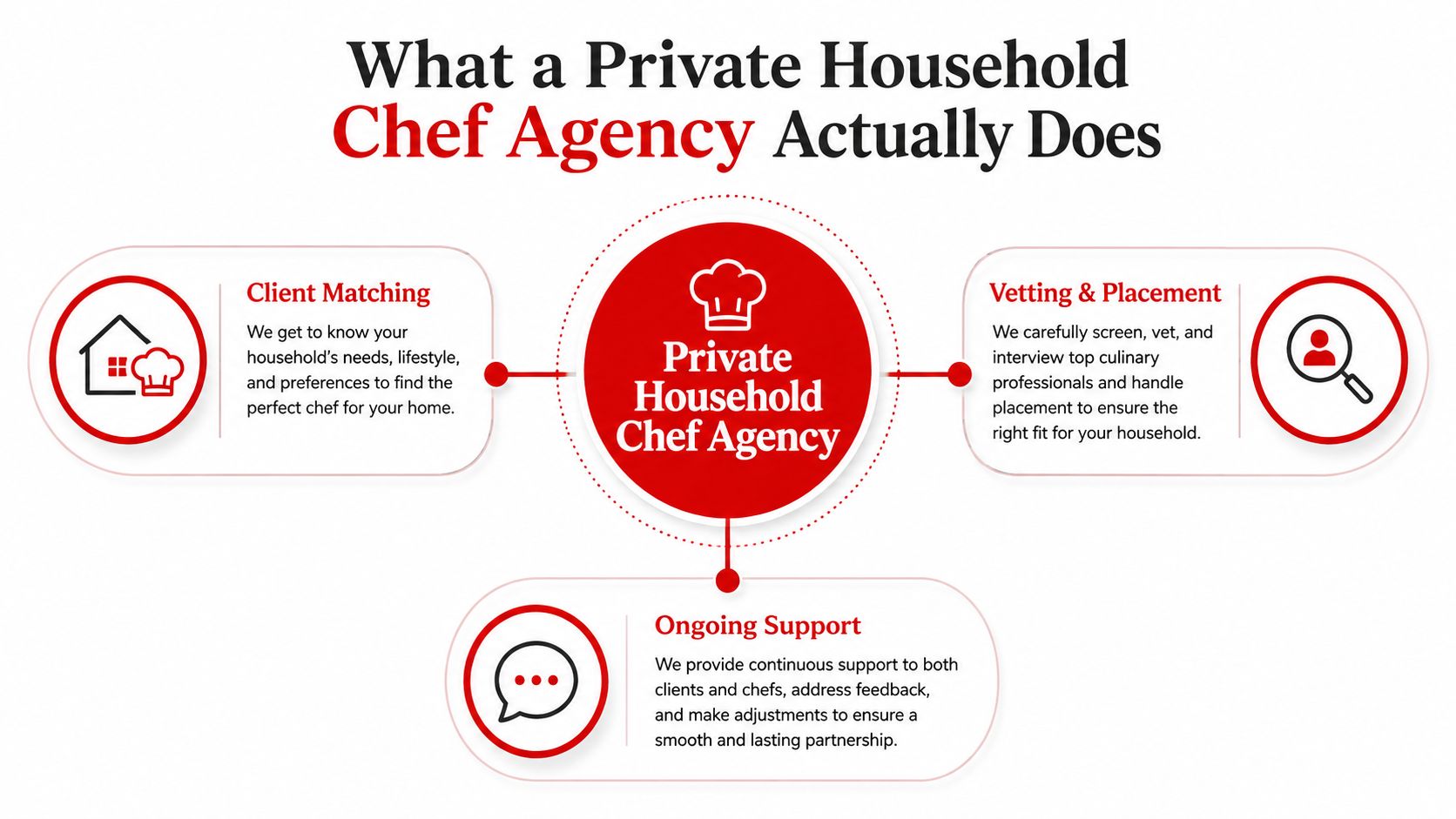
A true private household chef agency does more than match a CV to a kitchen. It interprets the household, the living pattern, the travel pattern, and the confidentiality risk before a candidate ever reaches the shortlist. That's a very different job from standard hospitality temp work, where the brief is usually shift cover, station competence, and speed.
Some specialist London and UHNW agencies advertise UK compensation of £100,000 to £230,000+ PAYE (Montclair Chef), and that tells you something important. The market prices in estate complexity, confidentiality, and multi-residence coordination, not just cooking ability. If an agency treats a private chef role like a generic restaurant placement, it's missing the point.
The core services that matter
A credible agency should be doing three things well.
- Client matching: It filters for household style, schedule, dietary needs, and whether the chef needs to travel or rotate between properties.
- Vetting and placement: It sources candidates who aren't sitting on public job boards, then checks the evidence behind the CV.
- Ongoing support: It stays involved if the placement needs a replacement, a second option, or relief cover for an absence.
Specialist agencies also work across different formats. That can include permanent placements, part-time private chef work, live-in or live-out roles, event chefs, yacht chefs, villa chefs, and short-notice relief. In practice, that mix matters because many households don't need one model forever. They need one model this month, another during the summer, and temporary cover when the principal travels.
A useful benchmark for how serious the shortlist process should be comes from specialist providers that create a curated shortlist of 3 to 5 candidates after consultation, structured interviews, reference verification, right-to-work checks, enhanced background screening, and practical culinary evaluation (Oplu private chefs). That's the level of process households should expect before anyone is invited into the home.
Vetting, Right-to-Work Checks and Compliance Standards
The biggest mistake households make is assuming that good cooking means safe hiring. It doesn't. In a private home, the chef may be working alone, entering bedrooms-adjacent spaces, handling family dietary needs, or travelling with the principal. That raises safeguarding, lone-working, and continuity questions that don't exist in the same way in a commercial kitchen.
UK employers also continue to face scrutiny around illegal working compliance, so right-to-work verification isn't optional. It has to happen before day one, and it has to be documented properly. If an agency can't show how it checks identity, eligibility, and references, it's not running a serious private household process.
What the vetting pipeline should include
A sound pipeline looks like this.
- Define the role properly. Is the chef live-in, live-out, full-time, part-time, or only needed for events and cover?
- Check identity and right to work. This should happen before any commitment is made.
- Verify references. The references need to speak to private household behaviour, not just restaurant output.
- Assess suitability for the environment. DBS checks may be appropriate where the role and household context justify them.
- Test the cooking. Practical evaluation matters because a strong interview doesn't tell you how someone performs under real household service pressure.
Households should also ask about allergy protocols, food-safety handling, lone-working expectations, and what happens if the chef resigns or falls ill. That last point is where many placements fail. If there's no continuity plan, the family ends up back at square one with the same urgency and a higher risk of a bad hire.
A chef can be technically excellent and still be unsuitable for a family home if they can't handle confidentiality, pace changes, or household etiquette.
If you need a practical starting point for checking eligibility and documentation, use Relief Chefs UK's right-to-work verification guidance as a model for the kind of process a household should expect from any agency.
Insurance, Liability and What Households Should Verify
Private chef work in a family home brings a different insurance profile from a commercial kitchen. A house doesn't have the same operational controls as a hotel or restaurant, so the agency and the household both need to be clear on who carries what cover and when that cover applies.
The first thing to check is whether the agency has valid employer liability insurance. After that, ask how the chef is covered for professional indemnity, especially if the role includes menu planning, allergy handling, or food advice. If the chef will live in, travel, or work across several properties, you also need to know how that movement affects coverage.
Certificates, records and boundary lines
Before the chef starts, ask for the paperwork, not a verbal promise. That includes insurance certificates, confidentiality terms, and the agency's process for recording staff data in line with privacy expectations. A private home isn't just another workplace, so records need to be handled carefully.
Households should also verify:
- Food-safety documentation: If the chef handles vulnerable diners, allergens, or strict dietary regimes, the paperwork should reflect that.
- Safeguarding expectations: The chef will have access to a private setting, so house rules and boundaries need to be clear.
- Continuity planning: If the placement ends suddenly, how quickly can the agency replace the chef or provide cover?
If you want a simple reference point for professional cover, Relief Chefs UK's professional indemnity information is a useful reminder of how seriously these issues should be treated. The key point is that insurance gaps don't show themselves on day one, they show themselves when something goes wrong.
Pricing Models, Contract Types and Hidden Costs to Avoid
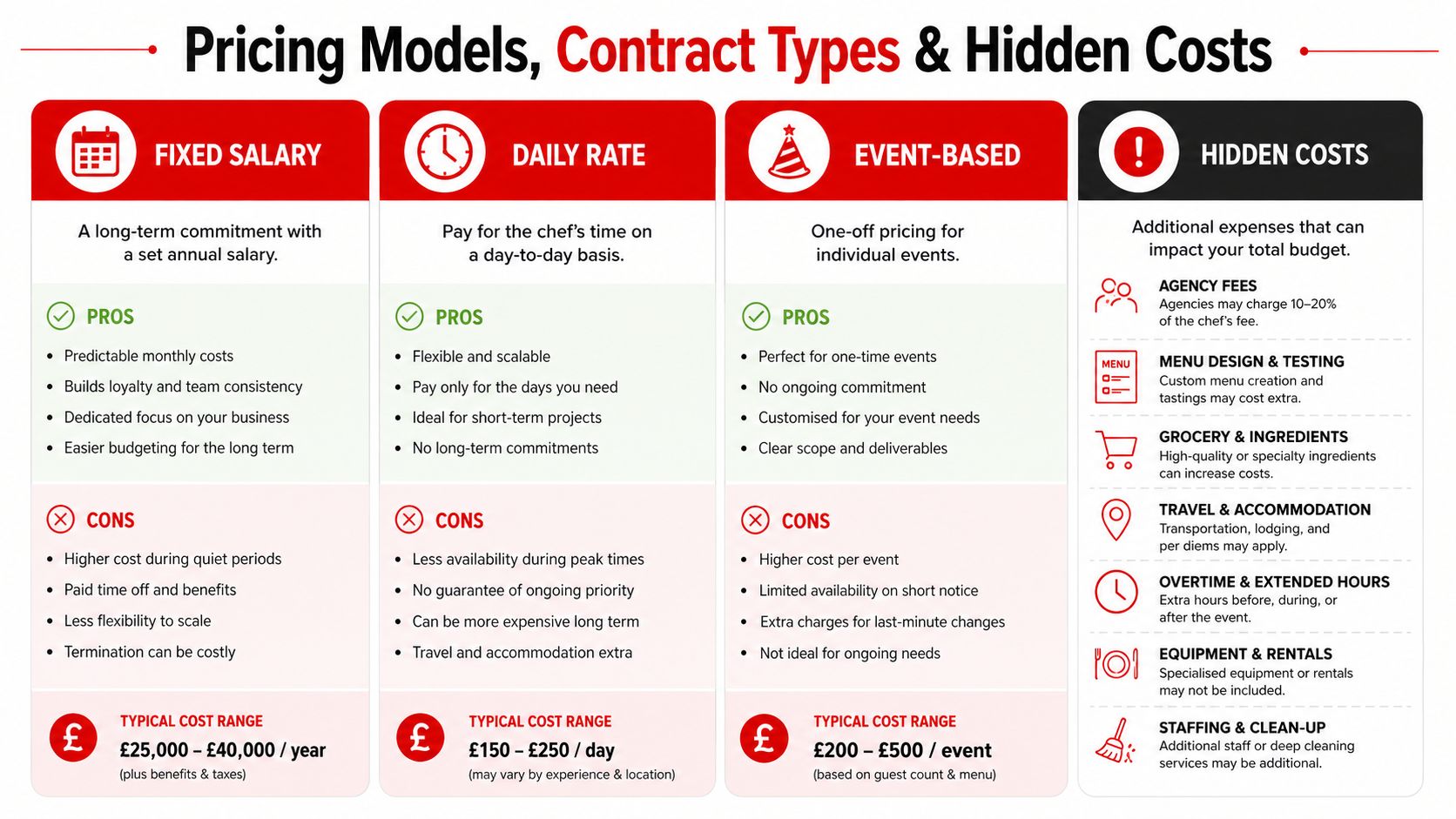
Cost is usually the first thing families ask about, but the cheapest route is rarely the safest one. Permanent placement, relief cover, and standby support all solve different problems, and they carry different hidden costs if you choose the wrong model.
Full-time placement clients typically pay a fee of 15% of the first year's annual salary or upwards of $10,000 to get started (BBC Worklife). That same article notes that full-time chefs who do not live in the client's home can earn $65,000 to $180,000 per year, which gives household managers a useful benchmark when comparing search fees with likely compensation.
Comparing the main cost models
Permanent placement makes sense when the household needs a stable, long-term chef and can wait for the right person. Relief cover makes more sense when the need is irregular, seasonal, or driven by sickness, travel, or event pressure. Standby or retainer models are useful when the household wants rapid access without restarting the search process each time.
Some UK specialist agencies say typical private-chef pay is £70,000 gross per year and up, and overseas roles are usually £80,000 per year and up, with overseas placements often requiring the client to cover work visa, relocation, travel, and board in addition to salary (Bespoke Bureau). That's a reminder that the fully loaded cost is rarely just the salary number you first hear.
| Model | Best fit | Typical risk if chosen badly |
|---|---|---|
| Permanent placement | Stable households, repeat service, one principal | Slow hiring if the search brief is wrong |
| Relief cover | Short notice sickness, seasonal peaks, travel gaps | Inconsistent quality if vetting is weak |
| Retainer or standby | Multi-residence households, unpredictable diaries | Paying for access you don't use unless the model is structured well |
A few hidden costs come up again and again. Travel, accommodation, menu development, trial days, visa support, and replacement terms can all affect the actual figure. If those items aren't disclosed early, the household usually pays for them later in delays, friction, or a second hire.
Use this private chef cost guide from Relief Chefs UK when you want to compare placement economics against flexible cover, especially if the household needs short-notice support rather than a single permanent hire.
Real-World Use Cases for Private Household Chef Agencies
A private estate with two residences needs a different staffing plan from a single household in the city. A yacht follows a different rhythm from a villa. A family that hosts formal dinners twice a month has different pressure points from a principal who wants a chef available for travel weeks and last-minute guests.
Private household chef agencies earn their keep by matching the model to the job. Permanent estate chef placements suit homes where confidentiality, routine, and consistent standards matter most. Yacht and villa chefs need mobility, quick adaptation, and the ability to work across different settings without losing pace. Short-notice relief makes sense when a regular chef is ill, resigns without warning, or is pulled away by travel.
Matching the staffing model to the pressure point
Hybrid households are common. The main residence may run one schedule, a secondary property another, and private entertaining spaces create extra pressure at peak times. In those situations, Relief Chefs UK's hospitality staffing support can sit alongside longer-term recruitment, so the kitchen stays covered without forcing every property into the same arrangement.
Operational reality matters here. Yacht kitchens often need chefs who can move quickly, adjust to changing crews, and keep standards high in tight service windows. Villas usually need flexible cover that can absorb seasonal swings and guest turnover. Estates tend to place more weight on continuity, discretion, and long-term fit, especially where multiple staff members already depend on a settled routine.
Hospitality labour pressure has not gone away. The Office for National Statistics has reported high vacancy levels in hospitality, and UKHospitality has repeatedly described labour shortages as structural rather than temporary. Private households feel that pressure too, but they have fewer fallback options because they cannot afford casual screening shortcuts.
The quickest hire is often the most expensive one if it creates a service failure, a compliance issue, or a confidentiality breach.
That is why the same agency approach should not be used for every household type. Yacht management companies need chefs who can travel and settle in fast. Villa operators need people who can step in for a season or a single booking without disrupting service. Estate principals need a placement process that protects continuity and keeps the kitchen stable when the diary changes.
Hiring Checklist and Questions to Ask Before You Book
A poor placement usually starts before the interview. The household brief is too vague, the agency fills in the gaps, and the wrong chef ends up in a role that was never properly defined.
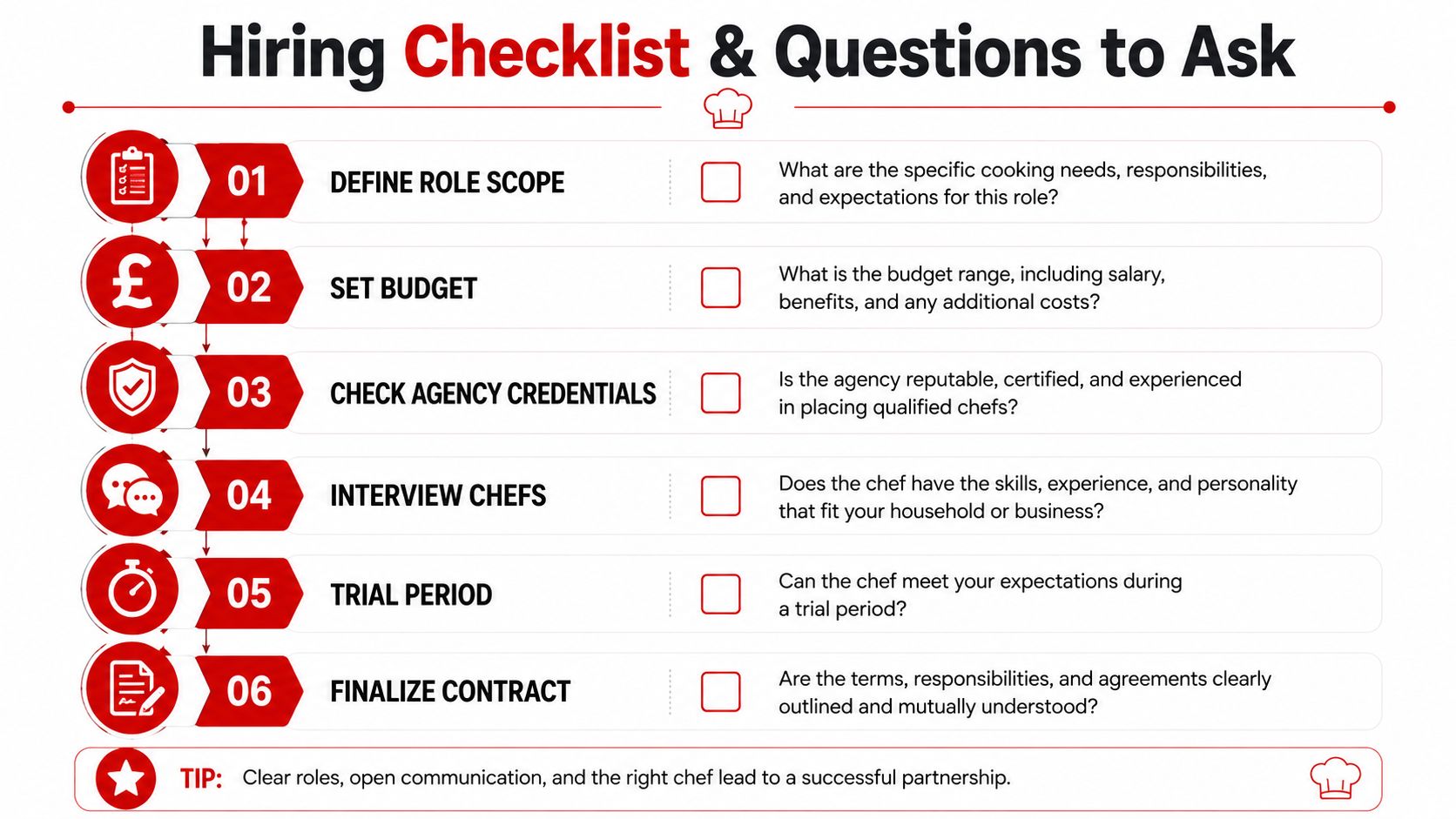
The six checks that protect the household
- Define the role scope. Decide whether the household needs live-in, live-out, permanent, relief, short-notice cover, or event support, and state the service style clearly.
- Set the budget clearly. Allow for salary, agency fee, travel, accommodation, and any visa or relocation cost that may apply.
- Check agency credentials. Ask how right-to-work checks are handled, what references are taken, whether insurance is in place, and what replacement terms apply if the match fails.
- Interview chefs properly. Ask about household standards, menu flexibility, discretion, reporting lines, and whether the chef has worked in private homes, yachts, villas, or estates before.
- Use a trial period where possible. A short test day or trial service gives a clearer read on pace, attitude, and fit than a long guess based on a CV.
- Finalise the contract. Confirm notice periods, cancellation terms, confidentiality, handover arrangements, and continuity if the chef becomes unavailable.
The questions need to be direct. How fast can vetted chefs start? What checks are completed before a candidate is put forward? What happens if the first placement does not work? What documents are issued before day one? Who handles cover if the chef is ill, delayed, or leaves without warning?
For households comparing agencies, A structured checklist for hiring a private chef, outlining six essential steps from defining scope to finalizing contracts. is a useful reference point for the order of checks, while Relief Chefs UK's hiring support approach is a practical benchmark for speed and process discipline. The test is simple, whether the agency can explain its screening, replacement, and compliance steps without vague answers.
Key Takeaways and Next Steps with Relief Chefs UK
A private household chef agency exists to handle the parts of hiring that informal arrangements often miss. Compliance, safeguarding, continuity, confidentiality, and short-notice cover all matter in a household that cannot afford kitchen disruption. The job is built on trust, so the agency process needs more than a quick interview and a menu tasting.
Households that avoid costly mistakes treat vetting as the first decision, not the last. They ask how right-to-work checks are handled, what insurance is in place, how replacements are arranged, and whether the chef will fit the rhythm of the household before they talk about start dates. Price transparency matters too, because unclear fees usually become delayed fees later.
Relief Chefs UK has been operating since 2013, supports 400+ venues across the UK, and offers relief chefs, temporary chefs, permanent chef recruitment, yacht chefs, villa chefs and hospitality staffing support through flexible monthly plans. For private households, estate managers, yacht and villa operators, and hospitality teams that need dependable cover, that range matters because it gives one staffing partner for urgent gaps and longer-term hiring.
If fast, vetted support is the priority, Relief Chefs UK says it responds within two hours to booking requests and can place fully vetted, right-to-work-checked chefs who can start within 48 hours. That kind of speed protects service without cutting corners, which is what households need when the kitchen cannot wait.
If you need private household chef cover, permanent recruitment, or flexible relief support, speak to Relief Chefs UK today. Visit Relief Chefs UK to request a consultation or send a short booking form, then receive vetted chef options for your household, yacht, villa, or hospitality operation without the usual delay.