
Why Use Recruitment Agencies: Key Benefits
4 August 2026
The phone goes off just as the first pans hit the heat. Your sous chef is sick, the prep board is already behind, and the dining room is fully booked by nine. Every operator I've worked with knows that feeling, because in hospitality the problem usually doesn't arrive on a quiet Tuesday, it lands on a Saturday morning when there's no room for delay.
That's why people ask why use recruitment agencies in the first place. Not for theory, not for a glossy pitch, but because service still has to happen when a key chef falls out, a seasonal spike hits, or a venue can't afford to gamble on another no-show.

The Saturday Morning Call That Changes Service
The call is always the same. A chef is on the line, they're ill, and you've got a full book, a function, or a stacked brunch service staring back at you. In a small brigade, that single absence can change the whole day, because someone else ends up on prep, someone else picks up the section, and standards start to wobble.
In hospitality, this isn't a rare emergency. It's part of the operating model, which is exactly why short-notice cover matters so much in pubs, hotels, and yachts. If you try to patch it internally, you usually pay for it in overtime, fatigue, slower tickets, or a menu that gets trimmed to survive the shift.
Practical rule: if a vacancy or absence will affect service within hours, it's not a hiring problem any more, it's a continuity problem.
That's where a specialist chef staffing partner earns its place. The point isn't just to find a body, it's to keep the pass moving with someone who can work safely, fit the brief, and land without creating another mess for the duty manager to clean up.
A good operator doesn't ask, “Can we somehow manage?” They ask, “What keeps the kitchen stable by lunch?” That mindset is the reason agencies get called, because the cost of muddling through is often hidden until the covers are already lost.
Why Hospitality Venues Are Turning to Specialist Agencies
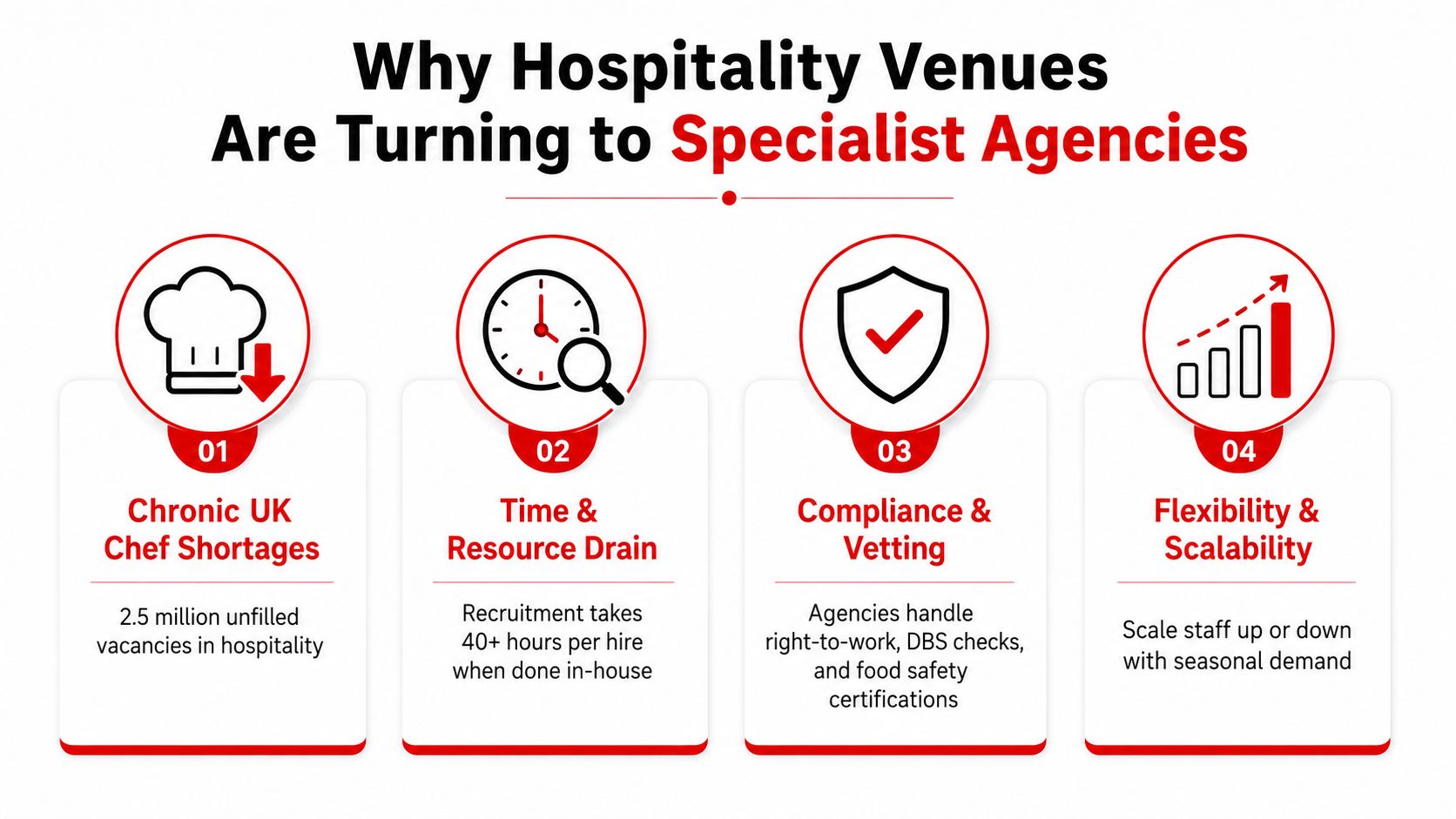
The first reason is speed, and the numbers back that up. A UK recruitment statistics roundup says the average time to fill a vacancy in the UK is 42 days, while 59% of businesses use recruitment agencies to help secure good staff and 67% of UK employers planned to recruit in 2024, according to UK recruitment statistics. In hospitality, a six-week gap can burn service quality long before a hire ever walks through the door.
The second reason is talent scarcity. The same source says the UK faces a shortfall of 2.5 million highly skilled workers, costing businesses £6.6 billion per year, which helps explain why venues in places like Bristol, Devon, Reading, Dorset, Berkshire, Windsor, Slough, and across Wales lean on external support when a specialist role won't land fast enough through direct hiring. The issue isn't just headcount, it's access to the right kind of chef at the right time.
What agencies actually remove from the operator's plate
They don't just source people, they remove admin and uncertainty. UK guidance says hard-to-fill vacancies are often met by using agencies, increasing pay, or widening the search rather than relying on direct advertising alone, because agencies can shorten the cycle by reusing pre-vetted talent pools and coordinating interviews and offers faster than an in-house team stretched across service Robert Half UK.
That matters more in practical settings than most buyers admit. A boutique hotel in Windsor covering a wedding weekend needs resilience, not a pile of CVs. A Welsh coastal pub with bank-holiday bookings needs someone who can walk in and cook, not someone who still needs three days of settling in.
The third reason is compliance. Temporary hospitality hiring in the UK brings right-to-work checks, ID verification, insurance questions, and onboarding records into the same urgent conversation as the rota. A specialist agency can standardise that process, which is especially useful when the kitchen is already under pressure and the manager doesn't have time to become the compliance department as well.
The fourth reason is flexibility. Hospitality demand moves around the calendar. Permanent headcount can't always flex for seasonal peaks, events, absenteeism, or last-minute group bookings, which is why agency cover is increasingly treated as a core staffing layer rather than an emergency backup.
Agency Versus Direct Hiring in Real Kitchen Numbers
A Saturday morning sick call does not care about your hiring plan. The grill still needs covering, the pass still needs control, and the guests will not wait while you shortlist candidates.
Direct hiring makes sense when the role is stable, planned, and tied to the long-term structure of the business. Permanent chef recruitment suits a brigade build, a head chef replacement, or a position that shapes menu direction and team culture. That is a different task from getting tomorrow's service covered.
Agency cover works when the clock is the problem. Temporary chef staffing is built for sickness, seasonal surges, trial shifts, and short-term gaps, where the question is not who you want to employ forever, but who can step in and protect the service now.
A simple decision grid
| Hiring need | Better route | Why it fits |
|---|---|---|
| Short-notice sickness cover | Agency | Speed, availability, less disruption |
| Summer or bank holiday demand | Agency | Flexible cover without permanent overhead |
| Long-term replacement | Permanent recruitment | Better for fit, progression, and retention |
| Trial before commitment | Agency first | Lower risk before making a permanent offer |
The cost question is usually where people get stuck. Direct hiring carries more of the search burden in-house, and that burden shows up in time, admin, and the cost of getting the wrong person in front of the stove. For a closer look at the hidden overheads, see our breakdown of the true cost of employing a chef. Agency cover shifts more of that process outward, so the fee is paying for speed, filtering, and someone else chasing availability.
There is also replacement risk. If a permanent hire does not work out, you still absorb the time spent searching and the disruption caused by the mismatch. With short-notice kitchen cover, the risk sits elsewhere, because the failure point is usually service continuity rather than long-term retention.
I have seen venues try to make one route do both jobs. It usually costs more in the end. The cleaner approach is to use direct hiring for the roles that shape the kitchen over time, and use agency cover for the shifts that cannot be left to chance.
A good agency also carries process risk that direct hiring does not remove from your plate. Right-to-work checks, insurance cover, and replacement terms matter when you need someone in fast and cannot afford a weak link in the handover. That is where a chef-led staffing partner earns its keep, because Relief Chefs UK is not just supplying names, it is helping operators reduce the admin and compliance load that comes with urgent cover.
A Practical Checklist for Vetting a Chef Staffing Partner
A serious staffing partner should be able to prove the basics without fuss. If they can't show right-to-work checks, insurance details, or a clear booking process, they're asking you to take too much on trust. In hospitality, trust is earned with paperwork, response time, and consistency, not a polished sales call.
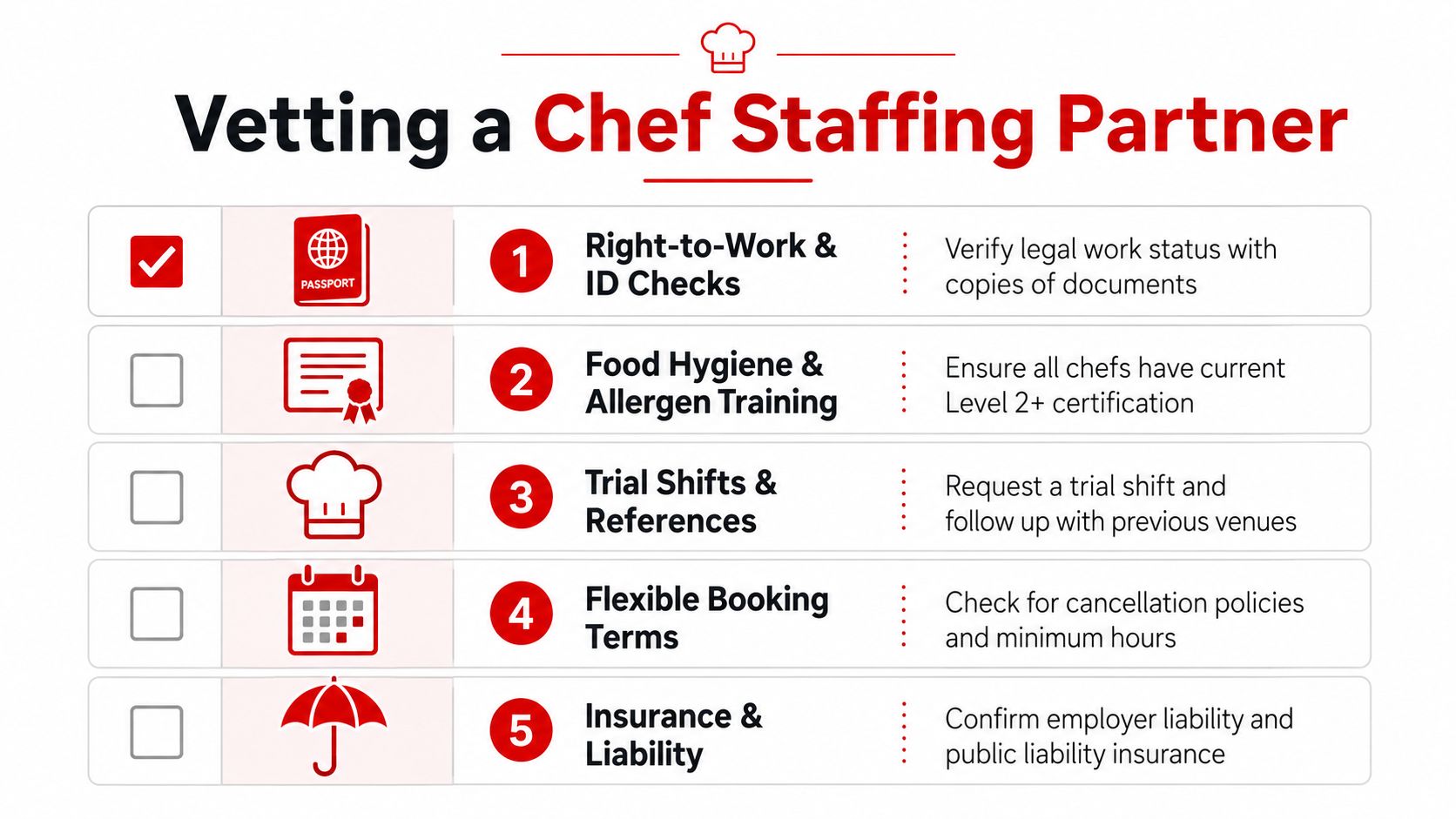
Start with the documents. You want confirmation of right-to-work and identity checks, evidence of current food hygiene and allergen awareness, and insurance that covers the work being supplied. If the agency sends candidates into a kitchen without those essentials visible and ready, it's not a partner, it's a risk.
Here's the checklist I'd use before signing anything:
- Right-to-work and ID checks: ask how documents are verified and how quickly they can be produced on request.
- Food hygiene and allergen training: confirm the level of training they expect and whether it's current.
- Public liability and employer liability insurance: ask for proof, not reassurance.
- Replacement terms: find out what happens if the chef doesn't turn up or doesn't fit the brief.
- Response time: agree how fast they'll come back when you send a cover request.
- Sector specialism: check whether they place in kitchens, hotels, pubs, yachts, or private households.
- References from similar venues: ask for examples from operations like yours, not vague testimonials.
- Pricing clarity: ask what's included and what isn't before you approve the booking.
- Trial shift options: useful if you're considering a longer-term move later.
If an agency won't share documents or fee terms upfront, assume the process will stay opaque after you've signed.
One of the advantages of chef-led firms is that they already understand kitchen standards before they talk about staffing. Relief Chefs UK is one example of that kind of operation, with a focus on hospitality cover rather than general labour. Their model fits the sort of buying decision operators make when they need reliability, not noise.
For a closer look at how temporary bookings are structured, see working with temp agencies.
The Objections Operators Raise, Answered Honestly
The first objection is usually cost. On paper, agencies feel expensive. In a real kitchen, the comparison is usually against lost covers, overtime, and the chaos of dragging tired staff through an extra shift. If a booking is full and a section is missing, the cheap option can end up being the most expensive one.
The second objection is quality. That one is fair, because not every agency understands a pass, a service spec, or the difference between someone who can talk about kitchens and someone who can hold one together. Good specialist agencies deal with that by vetting for sector fit, checking references, and using trial shifts where needed.
The third objection is, “I've got my own network.” That's useful, but it can also become a bottleneck. When the same two or three names are asked to cover every gap, they're not always available, and your rota starts depending on goodwill rather than process. A wider agency network gives you another route when your personal contacts are already working or already booked.
The fourth objection is, “They won't understand our kitchen.” That's where onboarding and briefing matter. If the partner asks the right questions about menu style, volume, section structure, and service times, they're not just filling a shift, they're matching the job to the kitchen reality.
The fifth objection is that cover is only needed occasionally. That still doesn't make it trivial. Rare problems are often the ones that hit hardest, because they arrive when the team is least prepared for them.
Operator's truth: occasional problems still need a repeatable system, especially when the next one turns up during a busy weekend.
How Relief Chefs UK Delivers These Benefits in Practice
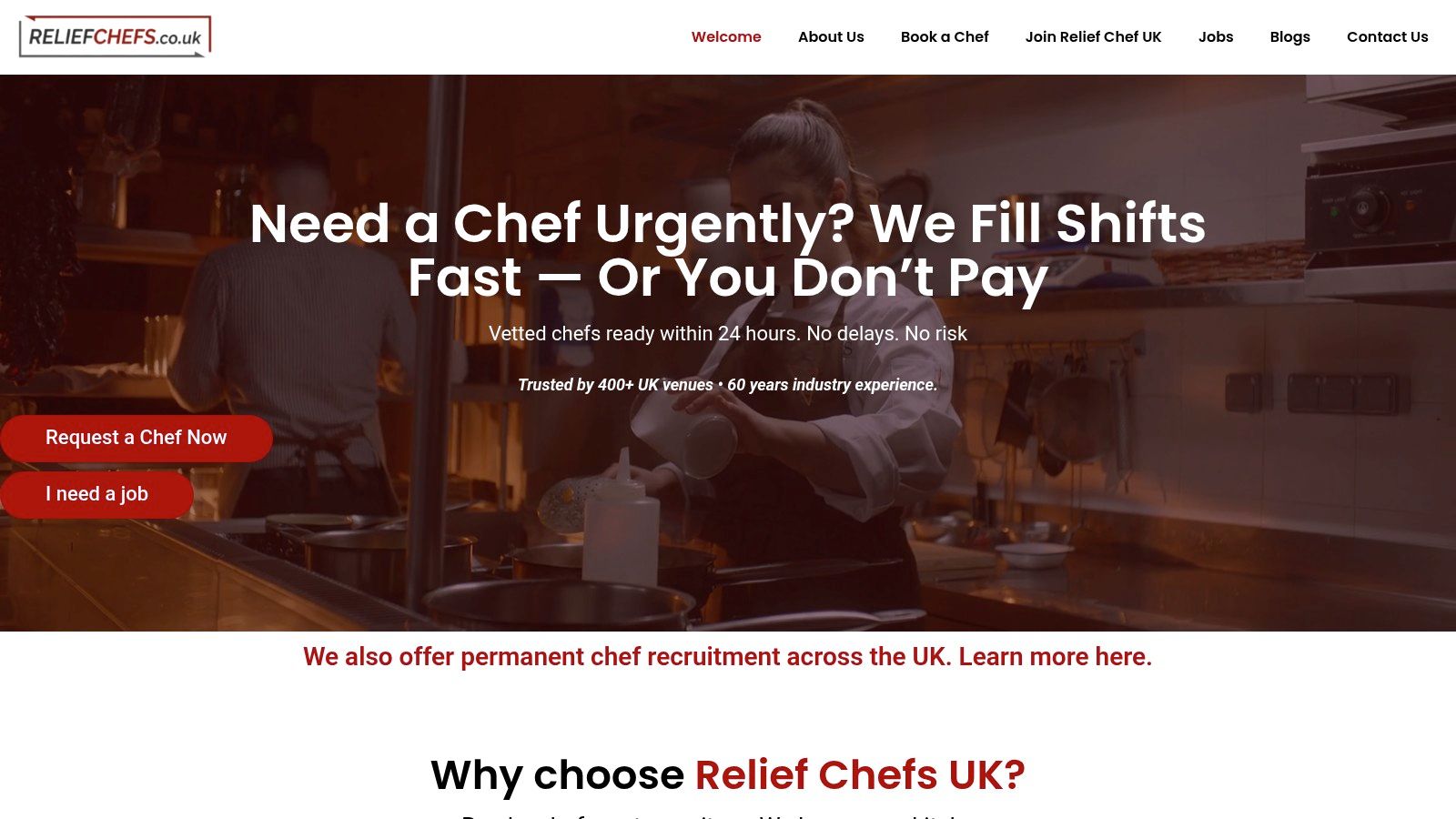
A chef staffing partner only earns its place if it can respond like a kitchen operator, not a call-centre script. Relief Chefs UK is a nationwide chef recruitment agency established in 2013, run by chefs rather than recruiters, with 60+ years of combined hospitality experience behind the team. Their setup is built around relief chefs, temporary chefs, permanent chef recruitment, yacht chefs, villa chefs, and wider hospitality staffing support for pubs, hotels, private households, and marine clients.
Their operating model is straightforward. Venues can send a brief at any time, with the team available 24/7, and work with fully vetted chefs, subject to availability. That matters when a kitchen needs cover quickly, because the value is not a big promise, it's what happens between the first call and the first service.
For operators comparing options, it helps to think in terms of different levels of operational cover. Occasional use, busier venues that need more support, and teams that want a stronger ongoing relationship all need something slightly different. The point is the same in each case, a structured way to buy reliability rather than improvising every time a shift blows up.
A good example is the kind of feedback operators share after a peak-season rescue, where a venue gets through a packed weekend because the right chef lands fast and keeps standards intact. That same working pattern also helps on the permanent side, where a business needs more than emergency cover and wants to build a stable kitchen team for the long term.
For agencies and venue teams that want the practical version of this, see 24/7 recruitment solutions, then compare the relief chefs, temporary chefs, and permanent chef recruitment pages against your actual rota pressure.
What to Do Next and Quick Answers for Busy Operators
If you've got a gap to fill today, send a clear brief, ask for a trial shift, or ask for a quote for regular cover and compare it against the cost of carrying the risk yourself. If the cover is urgent, use a partner that can respond quickly and keep the kitchen stable while you deal with service.
Quick answers
- Are there hidden agency fees? A proper provider should spell out pricing clearly before you book.
- How fast can a relief chef start? That depends on the brief, but urgent cover should be handled as a short-notice conversation.
- What documents should be provided? Right-to-work, ID, and relevant insurance cover should be part of the process.
- Can a trial cover become a permanent hire? Yes, if both sides want to continue after the shift.
The reason this matters is simple. Short-notice sickness, seasonal demand, and chef shortages aren't going away, so staffing support now sits alongside the other suppliers that keep hospitality working day to day.
If your kitchen needs reliable cover, a sharper hiring process, or a permanent chef search that won't drag on for weeks, speak to Relief Chefs UK. They match hospitality businesses with vetted chefs, temporary cover, and long-term placements, so you can keep service moving when the rota doesn't.
Call the team.
Office 01392 715474 · info@reliefchefs.co.uk